DiscoverOrg vs RampedUp: Full B2B Data Comparison 2026
DiscoverOrg is now ZoomInfo, RampedUp is the CRM-native challenger, and the two are priced an order of magnitude apart. Here is the honest breakdown of coverage, accuracy, contracts, and who each one actually fits.
TL;DR
- DiscoverOrg no longer exists as a standalone product. It merged with ZoomInfo in 2019 and the brand was folded in — if a rep is pitching you "DiscoverOrg" in 2026, you are buying ZoomInfo.
- RampedUp is a much smaller, CRM-native player. Its pitch is enrichment, job-change alerts, and list-building that lives inside Salesforce and HubSpot rather than a separate portal.
- Price gap is the real story: DiscoverOrg/ZoomInfo contracts routinely land in five figures annually with multi-year terms. RampedUp publishes per-user pricing that starts in the tens of dollars per month.
- Accuracy is not a single number. DiscoverOrg's historical edge was human-verified org charts and direct dials in IT/enterprise. RampedUp trades some depth for cost and workflow convenience.
- If all you actually need is verified work emails at scale, neither platform is the cheapest path — a dedicated email finder does that one job for a fraction of the seat cost.
What happened to DiscoverOrg?#
Short version: it became ZoomInfo. DiscoverOrg was founded in 2007 and built its reputation on something unusual for a data vendor — human researchers calling into companies to map org charts, verify titles, and confirm direct dial numbers, particularly inside IT departments. That manual layer is why enterprise buyers tolerated the price.
In February 2019, DiscoverOrg acquired ZoomInfo and later adopted the ZoomInfo name for the combined company, which went public in 2020. Today the product you evaluate is ZoomInfo, and the DiscoverOrg brand survives mostly in old comparison posts, legacy contracts, and search queries like this one.
That matters for your evaluation in three ways:
- Pricing changed. ZoomInfo's packaging (Copilot, Sales, Marketing, Talent, Operations) is bundled and seat-based. You are rarely quoted "just the data."
- The research team's output is now blended. Human verification still exists, but it sits inside a much larger machine-collected corpus.
- Contracts got firmer. Annual minimums, auto-renewal clauses, and overage terms are common complaints in public reviews on G2.
So when you search "DiscoverOrg vs RampedUp," you are really asking: do I need enterprise-grade sales intelligence, or do I need good-enough contact data plumbed into my CRM?
What is RampedUp?#
RampedUp is a B2B data and enrichment platform built around the CRM rather than around a standalone search portal. Its core value propositions:
- Native enrichment — fill in missing fields on existing Salesforce or HubSpot records rather than exporting CSVs.
- Job-change and people-movement alerts — flag when a known contact leaves for a new company, which is one of the highest-intent signals in B2B.
- List building and TAM sizing — build target account lists from firmographic filters.
- Intent and technographic layers — available depending on plan.
The positioning is deliberate: RampedUp does not try to out-spend ZoomInfo on research headcount. It competes on cost per enriched record and on not making reps leave the CRM. For a 5–30 person sales team, that trade is often correct.

DiscoverOrg vs RampedUp: how do they actually compare?#
Here is the head-to-head on the attributes that change buying decisions. Treat all pricing as directional — DiscoverOrg/ZoomInfo does not publish rate cards, and vendor packaging shifts.
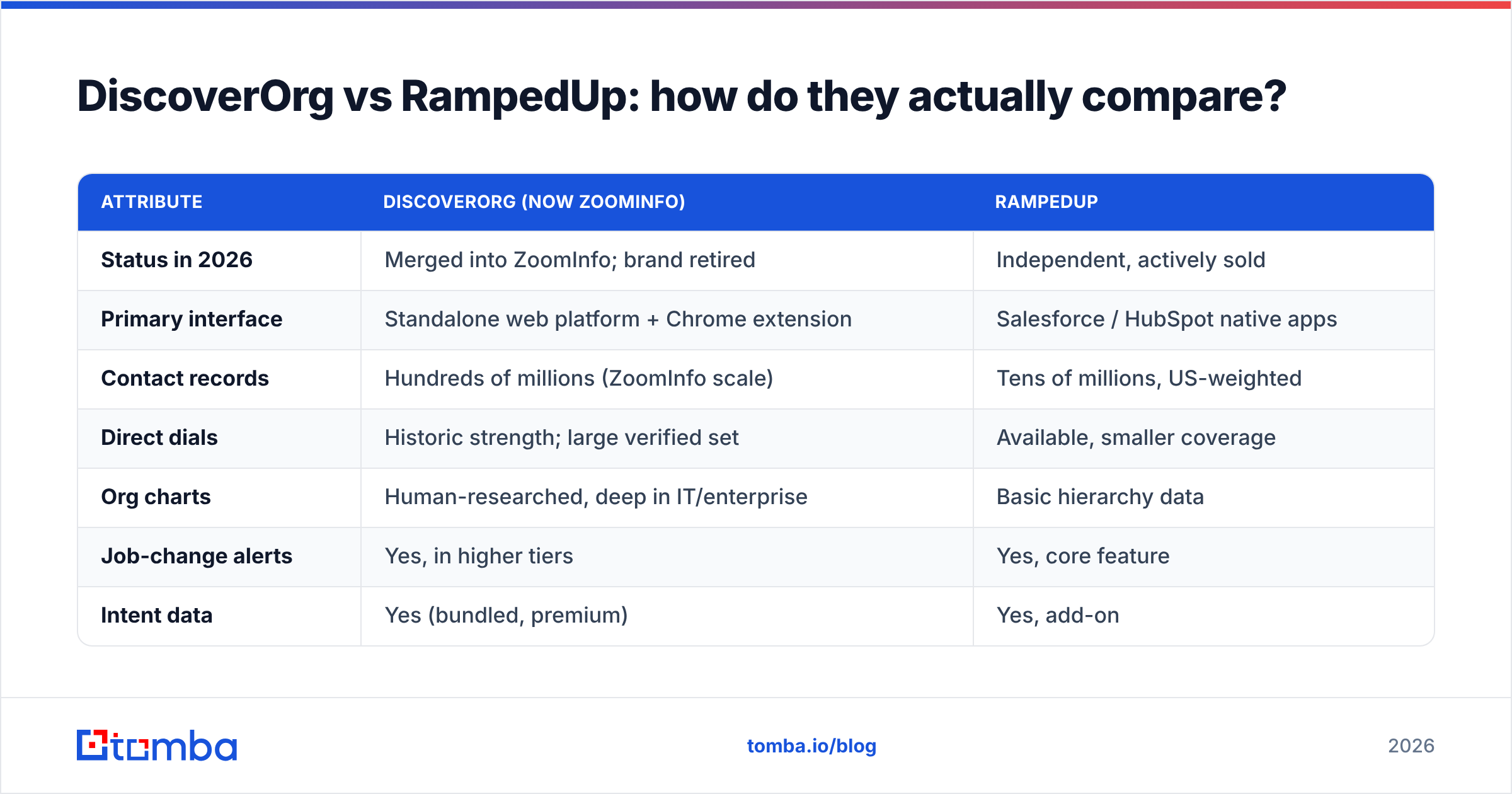
| Attribute | DiscoverOrg (now ZoomInfo) | RampedUp |
|---|---|---|
| Status in 2026 | Merged into ZoomInfo; brand retired | Independent, actively sold |
| Primary interface | Standalone web platform + Chrome extension | Salesforce / HubSpot native apps |
| Contact records | Hundreds of millions (ZoomInfo scale) | Tens of millions, US-weighted |
| Direct dials | Historic strength; large verified set | Available, smaller coverage |
| Org charts | Human-researched, deep in IT/enterprise | Basic hierarchy data |
| Job-change alerts | Yes, in higher tiers | Yes, core feature |
| Intent data | Yes (bundled, premium) | Yes, add-on |
| Typical entry cost | Five figures per year, annual contract | Per-user monthly, low three figures |
| Free tier | No (trial only, gated) | Limited trial |
| Contract flexibility | Annual+, auto-renew common | Month-to-month options |
| Best fit | Enterprise ABM, 20+ seats, IT/tech ICP | SMB and mid-market CRM teams |
The pattern in that table is consistent: DiscoverOrg/ZoomInfo wins on depth and breadth, RampedUp wins on cost and time-to-value. Neither of those is a moral victory — they are different products sold to different buyers who wrote different budgets.
Which one has better data accuracy?#
DiscoverOrg's lineage gives it the edge on verified depth, especially for direct dials and reporting structure inside large enterprises. If your ICP is "VP of Infrastructure at a 5,000-person manufacturer," that human-research legacy still shows up.
But accuracy claims deserve scrutiny in both directions:
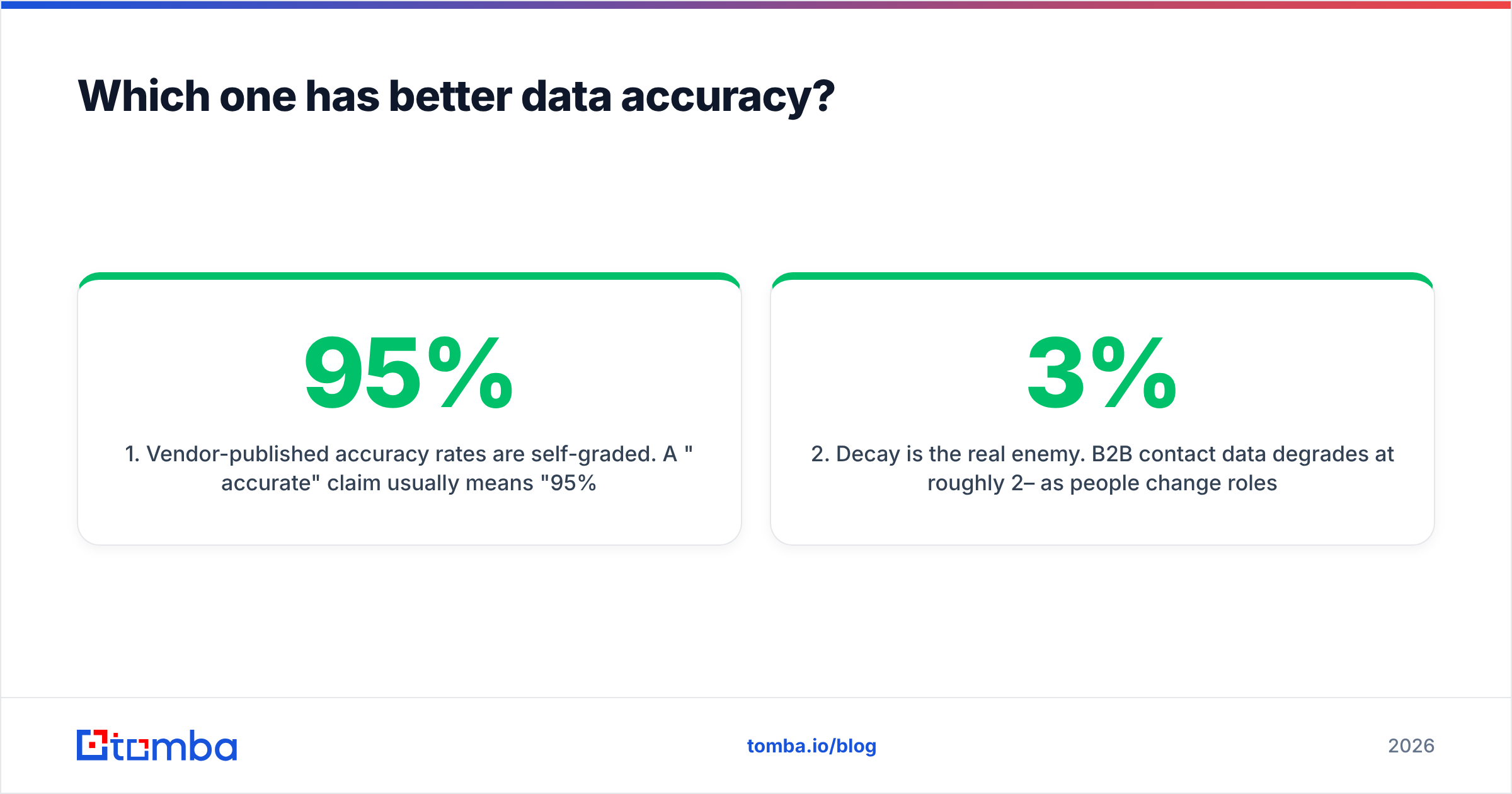
- Vendor-published accuracy rates are self-graded. A "95% accurate" claim usually means "95% of records passed our own internal check at collection time," not "95% of the emails you export today will deliver."
- Decay is the real enemy. B2B contact data degrades at roughly 2–3% per month as people change roles. A record verified 14 months ago is a coin flip regardless of who sold it to you.
- Coverage and accuracy trade against each other. A provider can hit a high accuracy number by simply refusing to return anything uncertain — which looks great on a scorecard and terrible when your list comes back half empty.
- Catch-all domains break naive checks. Any provider that reports a catch-all address as "valid" is guessing. This is why a separate catch-all verifier exists as its own category.

The practical move, whichever platform you buy: run a sample of 500 records against your actual ICP before signing, and verify the emails independently. A standalone email verifier run over a vendor's export tells you more in an afternoon than three demo calls will.
How does the pricing really compare?#
This is where the two products stop being comparable at all.
DiscoverOrg / ZoomInfo. No public pricing. Deals are quoted per seat with credit allocations, and packaging bundles intent, workflows, and Copilot features you may not want. Public reviews and procurement chatter consistently put entry-level annual contracts in the $15,000–$40,000 range for small teams, climbing sharply with seats and add-ons. Common friction points reported by customers:
- Annual minimums — you cannot buy three months to test.
- Credit overages — exports beyond your allotment are billed or blocked.
- Auto-renewal windows — cancellation notice periods that are easy to miss.
- Seat sprawl — every rep who touches the platform is a licensed seat.
RampedUp. Publishes per-user monthly pricing with credit packs, and offers shorter commitments. For a team of ten, total annual spend typically lands one order of magnitude below a comparable ZoomInfo contract.
The third option people forget. If your actual bottleneck is "I have a list of companies and names, I need verified work emails," you are paying enterprise platform prices for a lookup. Point-solution pricing looks like this:
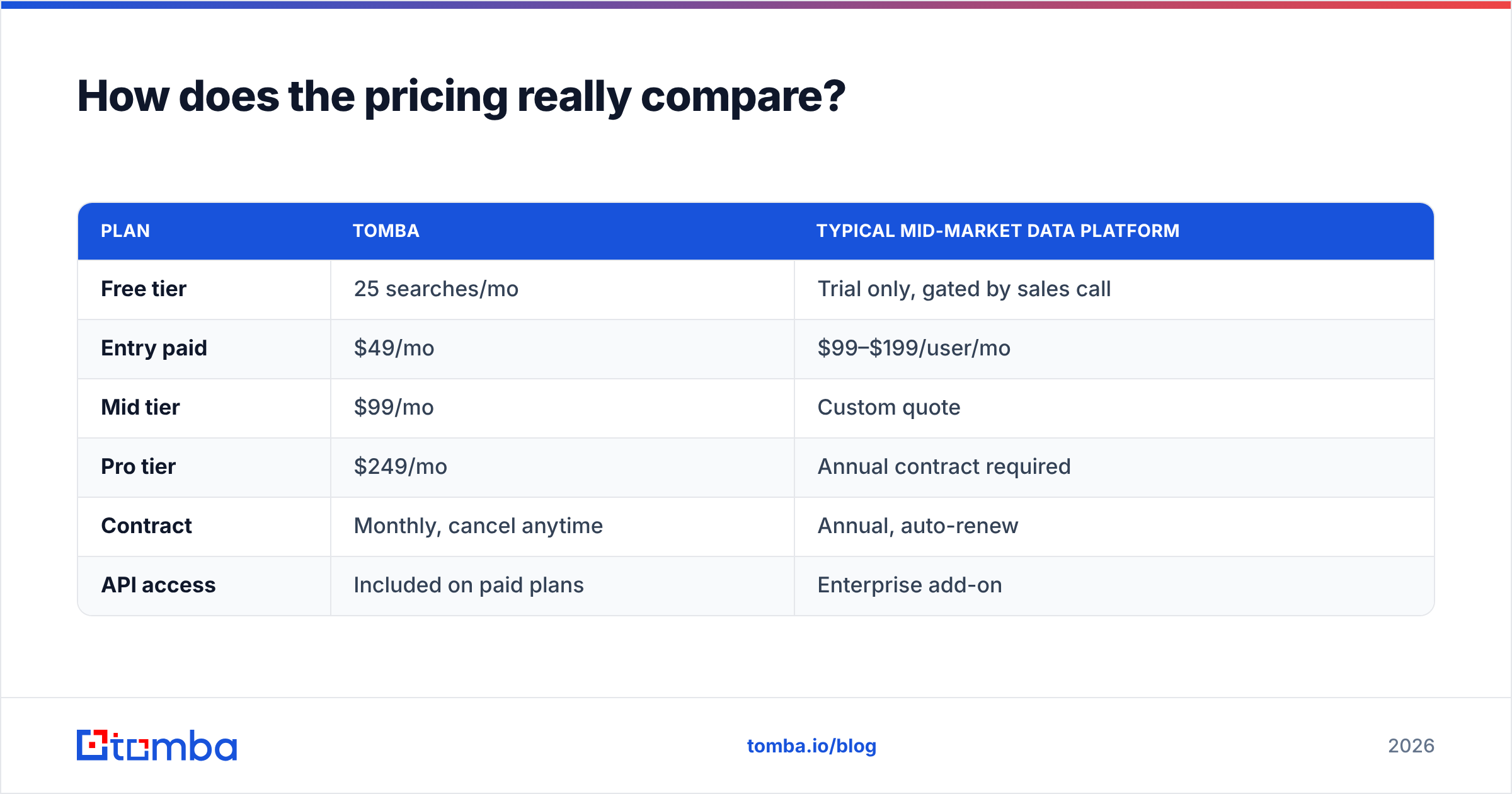
| Plan | Tomba | Typical mid-market data platform |
|---|---|---|
| Free tier | 25 searches/mo | Trial only, gated by sales call |
| Entry paid | $49/mo | $99–$199/user/mo |
| Mid tier | $99/mo | Custom quote |
| Pro tier | $249/mo | Annual contract required |
| Contract | Monthly, cancel anytime | Annual, auto-renew |
| API access | Included on paid plans | Enterprise add-on |
Full Tomba pricing is public, which is itself a differentiator in this category. The point is not that a finder replaces a sales intelligence suite — it does not do intent, org charts, or ABM scoring. The point is that a lot of teams buy the suite and only ever use the lookup.

Who should choose which?#
Choose DiscoverOrg/ZoomInfo if:
- Your ICP skews enterprise and you need to map buying committees, not just find one contact.
- Direct dials matter as much as email — you run a real phone motion.
- You have 20+ seats and a budget line that survives a $30k renewal conversation.
- You want intent signals, technographics, and workflow automation in one contract.
- Procurement and security review already cleared the vendor.
Choose RampedUp if:
- Your team lives in Salesforce or HubSpot and hates portal-hopping.
- Job-change alerts on your existing CRM database would drive real pipeline.
- You are SMB or mid-market and need predictable per-user cost.
- You want to start without a twelve-month commitment.
- Your ICP is primarily US-based.
Choose neither, and buy a focused stack, if:
- Your outbound is email-first and you do not run ABM.
- You already source target accounts from another system (a list, a partner feed, your CRM, a scraper).
- Your monthly volume is a few thousand contacts, not a few hundred thousand.
- You need data enrichment and verification via API inside your own tooling rather than a UI a rep logs into.
That last profile is far more common than vendor marketing implies. A three-person outbound team that needs 2,000 verified emails a month does not need a sales intelligence platform. It needs a finder, a verifier, and a sending tool.
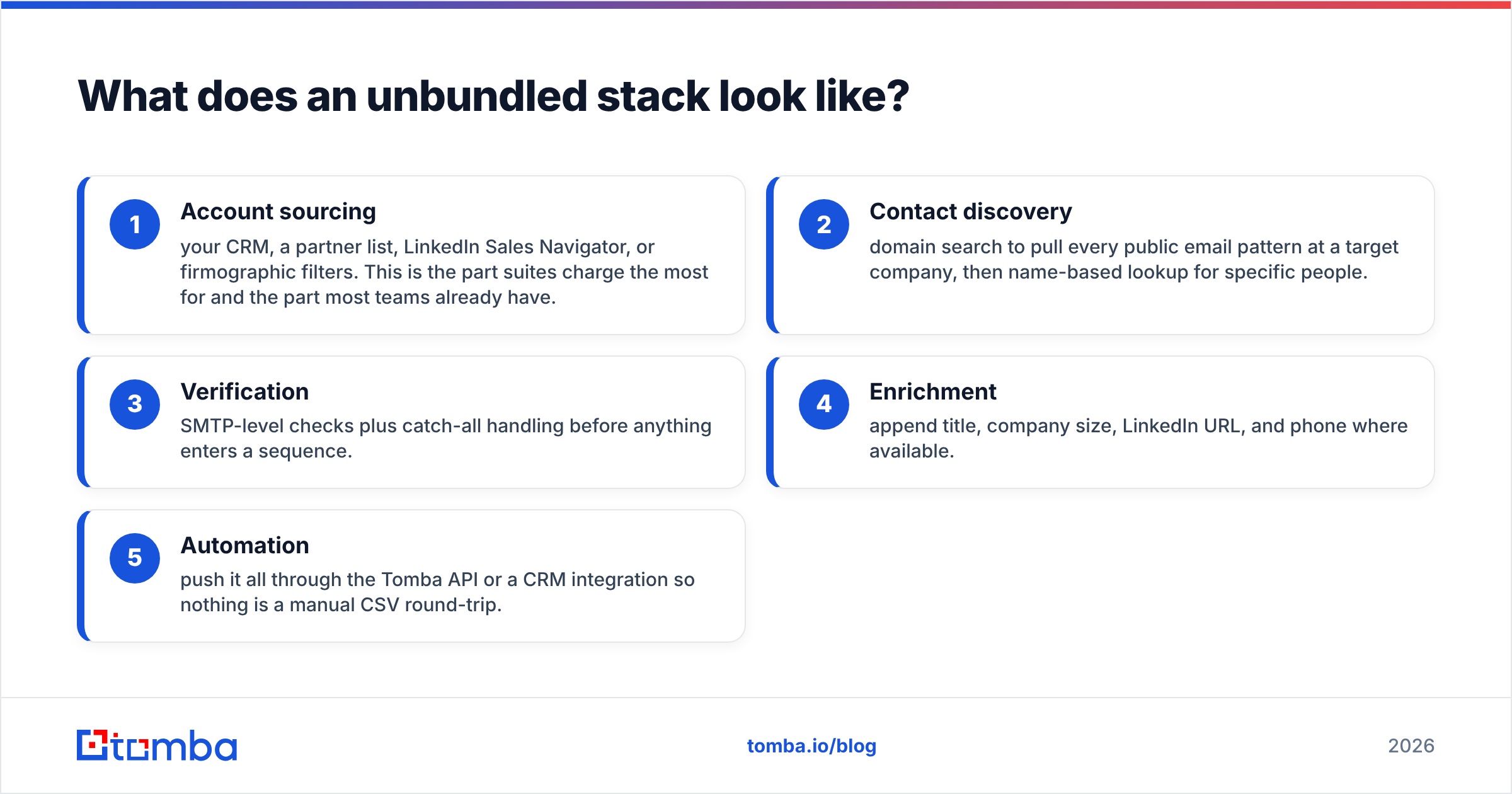
What does an unbundled stack look like?#
If you go the point-solution route, the pieces map cleanly to what the suites bundle:
- Account sourcing — your CRM, a partner list, LinkedIn Sales Navigator, or firmographic filters. This is the part suites charge the most for and the part most teams already have.
- Contact discovery — domain search to pull every public email pattern at a target company, then name-based lookup for specific people.
- Verification — SMTP-level checks plus catch-all handling before anything enters a sequence.
- Enrichment — append title, company size, LinkedIn URL, and phone where available.
- Automation — push it all through the Tomba API or a CRM integration so nothing is a manual CSV round-trip.
The trade-off is honest: you lose the single pane of glass, the intent scoring, and the org-chart depth. You gain roughly 80–95% cost reduction and no auto-renewal clause. For a lot of teams that is the right call. For an enterprise ABM program with a named-account list of 400 logos and a committee of seven per deal, it is not.
What about the wider alternatives set?#
DiscoverOrg vs RampedUp is a narrow frame. In practice most buyers evaluating this pair also look at:
- Apollo.io — huge database plus sequencing, aggressive pricing, variable accuracy on smaller companies. See the Apollo alternative breakdown for the detail.
- Lusha / Cognism — strong European coverage and GDPR posture, useful if your ICP is not US-centric.
- BookYourData — pay-as-you-go B2B lists with no subscription lock-in, a genuinely different commercial model that suits teams doing occasional bulk pulls rather than continuous enrichment.
- Clearbit (now part of HubSpot) — enrichment-first rather than prospecting-first; see the Clearbit alternative comparison.
- RocketReach — contact lookup with consumer-friendly pricing and shallower firmographics.

Run all of them through the same test: same 200 target contacts, same day, measure match rate, bounce rate after verification, and cost per usable record. Vendor demos are designed around accounts where the vendor is strong. Your own sample is not.
What questions should you ask on the demo call?#
Bring these to either vendor and you will learn more than any comparison post can tell you:
- "What is my all-in cost in year two, including expected overages?" Year-one discounts are common; year-two renewals are where budgets break.
- "What is the notice period to cancel, and is renewal automatic?" Get it in writing.
- "How recently was a record like this one verified?" Ask for the timestamp field, not the marketing number.
- "What happens to exported data if I churn?" Some contracts restrict continued use.
- "Can I test on my own list of 200 accounts before signing?" A refusal is itself an answer.
The verdict#
If you need enterprise depth — org charts, direct dials, intent, and a committee-mapping workflow — DiscoverOrg's successor at ZoomInfo is still the reference product in the category, and you should budget accordingly. If you need solid contact data plumbed into Salesforce or HubSpot without a five-figure commitment, RampedUp is a reasonable, well-scoped choice that does not pretend to be an enterprise suite.
But before you sign either, be honest about what you actually use. If the answer is "we look up email addresses and push them into a sequencer," you are buying a platform to run a lookup. Start with Tomba Email Finder — 25 free searches a month to test your real ICP, $49/mo when you are ready to scale, verification and API access included, and no annual contract to escape from. Run your 200-account sample against it alongside whatever the enterprise rep quotes you, compare cost per verified email, and let the numbers pick the winner.
Related guides#
Ready to find emails that actually work?
Join 150,000+ professionals who stopped guessing and started sending. Free credits on signup — no credit card required.
Get the Tomba newsletter
Practical outbound tactics and product updates — once every two weeks.
About the author