11 Best DiscoverOrg Alternatives in 2026 (Tested & Ranked)
DiscoverOrg is now ZoomInfo, and the price tag came with it. Here are 11 alternatives that deliver comparable B2B contact data for a fraction of the annual contract.
TL;DR
- DiscoverOrg no longer exists as a standalone product. It merged with ZoomInfo in 2019 and the brand was fully absorbed — if you're shopping for "DiscoverOrg," you're shopping for ZoomInfo.
- The main reasons teams leave: annual contracts starting around $15,000, credit rollover restrictions, seat-based pricing that punishes growing teams, and aggressive auto-renewal clauses.
- For pure contact discovery, an email finder like Tomba covers 80% of the DiscoverOrg use case at roughly 2-5% of the cost.
- For org charts, intent data, and technographics, you need a genuine platform replacement — Cognism, Lusha, or Apollo — not a point tool.
- Match the tool to the job: contact discovery, account intelligence, and buyer intent are three different purchases that DiscoverOrg bundled into one invoice.
What happened to DiscoverOrg?#
DiscoverOrg acquired ZoomInfo in 2019, then took the ZoomInfo name for the combined company. The DiscoverOrg product — known for hand-verified org charts and deep IT department mapping — was folded into the ZoomInfo platform. By 2021 the discoverorg.com domain redirected to zoominfo.com, and today there is no separate DiscoverOrg SKU to buy.
That matters for your evaluation. If a vendor comparison page still pitches itself against "DiscoverOrg," it's either outdated or deliberately targeting stale search traffic. What you're actually comparing against is ZoomInfo's current pricing and contract structure, which inherited DiscoverOrg's enterprise sales motion: annual commitments, credit caps, seat licences, and a renewal conversation you schedule three months out.
The legacy DiscoverOrg strengths worth replacing:
- Org charts and reporting lines — who reports to whom inside a target account, refreshed by human researchers.
- IT technographics — installed software, hardware refresh cycles, contract renewal dates.
- Direct dials — mobile numbers for decision-makers, historically DiscoverOrg's strongest differentiator.
- Department-level headcount — how many engineers, how many in finance, growth trend over time.
- Trigger events — funding rounds, exec changes, office openings.
Most teams that leave discover they were paying platform prices for one or two of those five. That's the core arbitrage in this whole category.

Why do teams look for DiscoverOrg alternatives?#
Four complaints show up repeatedly in G2 reviews and procurement conversations.
Cost floor. Entry contracts land in the $15,000-$25,000/year range for a small team, and scale from there. That's fine if you're closing $150K ACV deals. It's indefensible if your average contract value is $8,000 and you need three seats.
Credit mechanics. Credits expire. Bulk exports are metered separately from in-app views. Enriching an existing CRM list burns credits at a different rate than net-new discovery. Teams routinely hit their cap in month eight and either buy an overage pack or go dark for four months.
Seat-based pricing. Adding an SDR costs more than the marginal value that SDR generates in their first quarter. This creates a hiring drag that nobody budgets for.
Data decay on the long tail. Coverage on Fortune 5000 accounts is genuinely excellent. Coverage on 20-200 employee companies in non-US markets is patchier than the sales demo suggests — and that's where most SMB-focused GTM teams actually prospect.
None of that means the platform is bad. It means it's priced and built for a specific buyer, and a lot of teams buying it aren't that buyer.
What are the best DiscoverOrg alternatives in 2026?#
Here's the honest breakdown. Prices are entry-level published rates as of mid-2026; enterprise tiers are quote-only across the board.
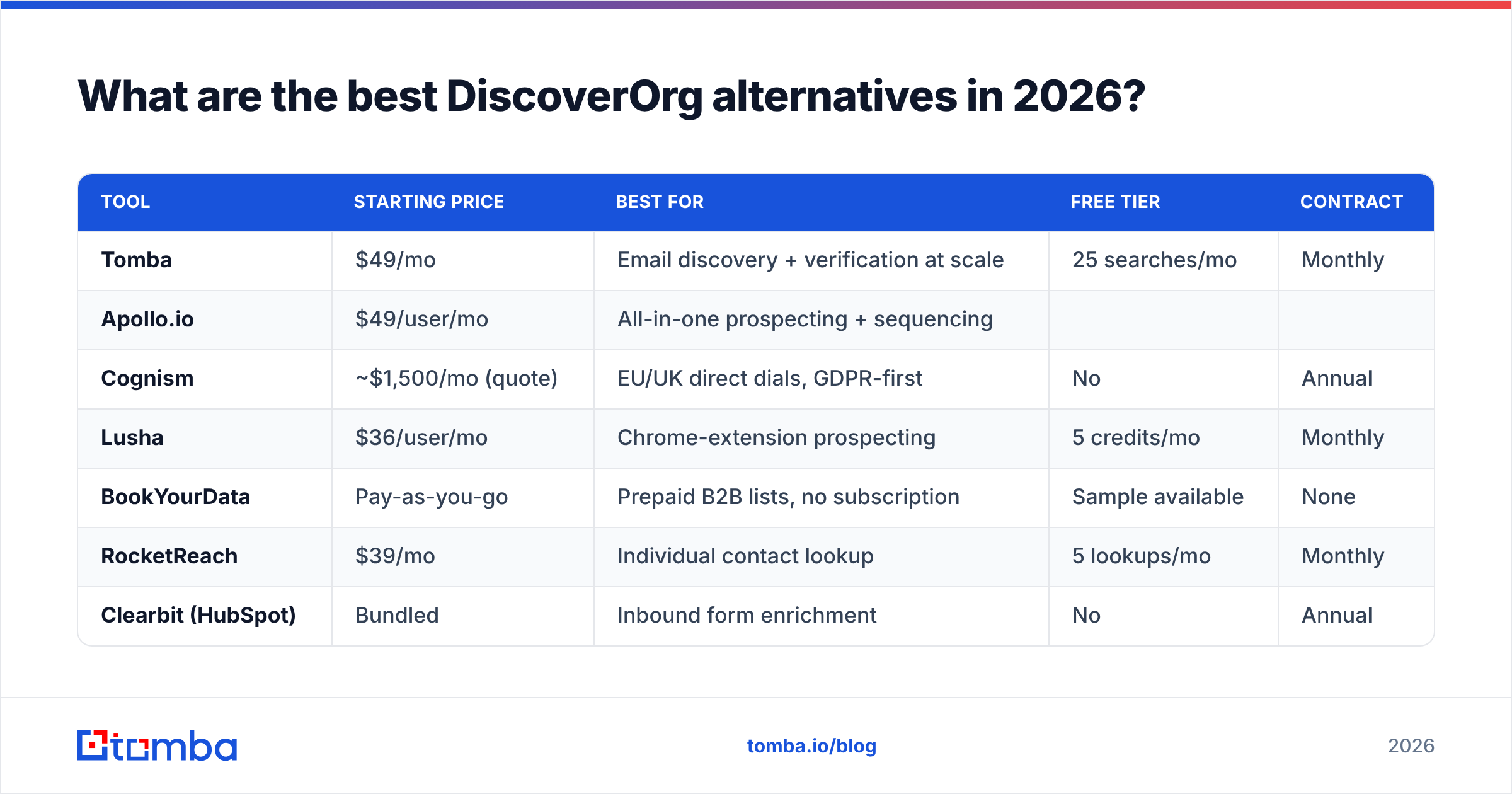
| Tool | Starting price | Best for | Free tier | Contract |
|---|---|---|---|---|
| Tomba | $49/mo | Email discovery + verification at scale | 25 searches/mo | Monthly |
| Apollo.io | $49/user/mo | All-in-one prospecting + sequencing | ||
| Limited | Monthly or annual | |||
| Cognism | ~$1,500/mo (quote) | EU/UK direct dials, GDPR-first | No | Annual |
| --- | --- | --- | --- | --- |
| Lusha | $36/user/mo | Chrome-extension prospecting | 5 credits/mo | Monthly |
| BookYourData | Pay-as-you-go | Prepaid B2B lists, no subscription | Sample available | None |
| RocketReach | $39/mo | Individual contact lookup | 5 lookups/mo | Monthly |
| Clearbit (HubSpot) | Bundled | Inbound form enrichment | No | Annual |
| Seamless.AI | Quote-only | Real-time search + basic intent | Trial credits | Annual |
| LeadIQ | $45/user/mo | CRM-native capture workflows | 20 credits/mo | Monthly or annual |
| ZoomInfo (DiscoverOrg) | ~$15K/yr | Enterprise org charts + intent | No | Annual |
| Clay | $149/mo | Waterfall enrichment across providers | 100 credits | Monthly |
Note what the table shows: the price spread between the cheapest credible option and the incumbent is roughly 25x. That gap is only justified if you genuinely need org charts, technographics, and intent signals bundled together — and if you'll use all three every month.
Tomba — best for email discovery and verification#
If your DiscoverOrg use case is "get me verified work emails for a list of people at a list of companies," this is the direct replacement. The email finder resolves addresses by name + domain, and domain search returns every discoverable address at a company with its role and confidence score.
The part that matters operationally: verification is built in rather than sold as a separate SKU. Every result passes through SMTP and syntax checks before it hits your export, and the catch-all verifier handles the domains that normally return an ambiguous "unknown" and quietly wreck your bounce rate.
Pricing is Free (25 searches/mo), Starter $49/mo, Growth $99/mo, Pro $249/mo, Enterprise custom — see Tomba pricing for credit allocations per tier. Monthly billing, no annual lock.
Where it doesn't replace DiscoverOrg: no org charts, no intent data, no technographics. It's a contact data tool, not an account intelligence platform. If you need to know that a prospect's Okta contract renews in Q3, look elsewhere.
Cognism — best for European coverage and compliance#
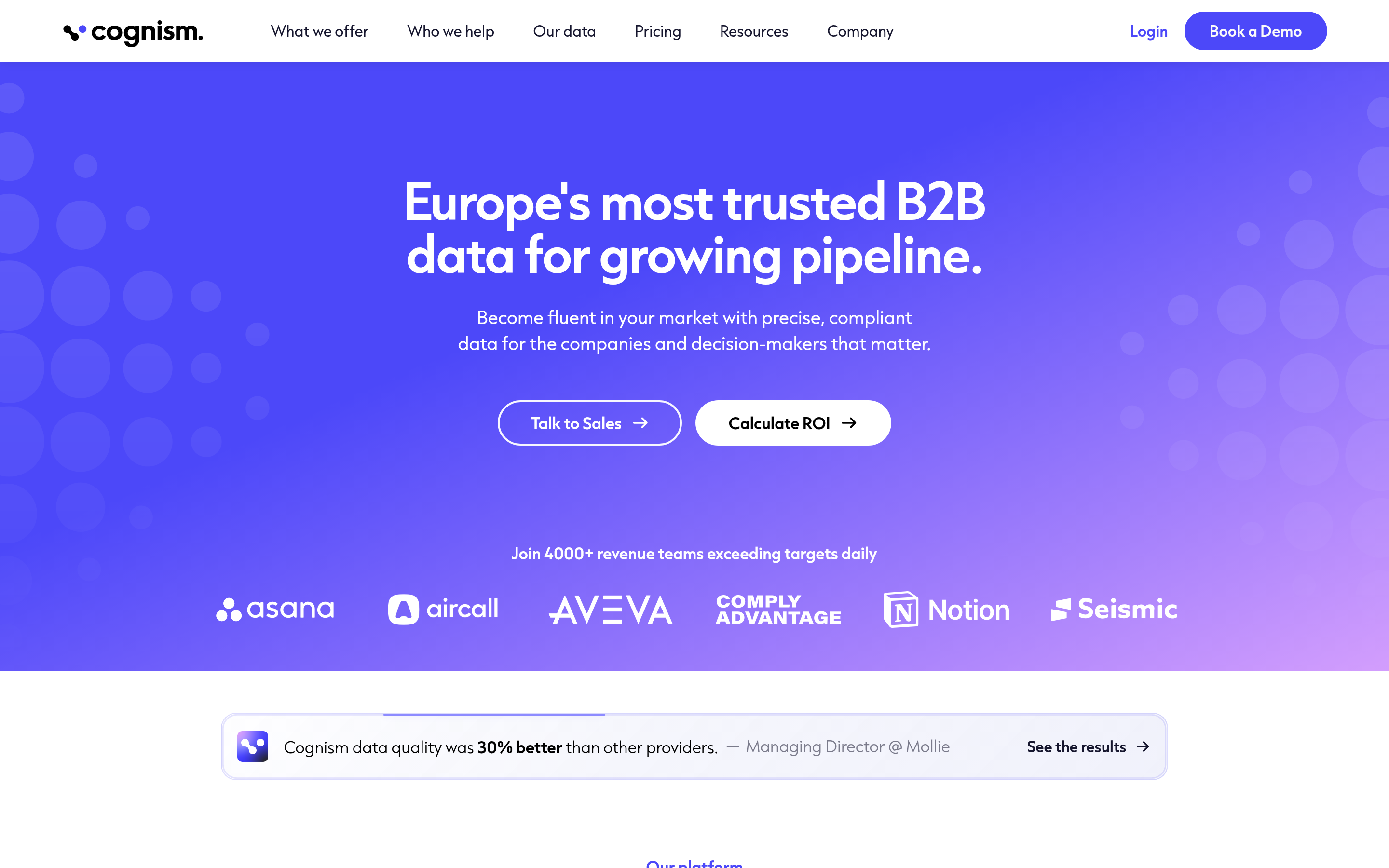
Cognism's Diamond Data (phone-verified mobile numbers) is the closest thing to DiscoverOrg's direct-dial strength, and its EU coverage is materially better. It notifies against DNC lists across major European markets, which matters if your legal team has opinions about GDPR.
Expect annual contracts and a real sales cycle. Pricing is quote-only and typically lands somewhere between Lusha and ZoomInfo.
Apollo.io — best all-in-one at mid-market price#
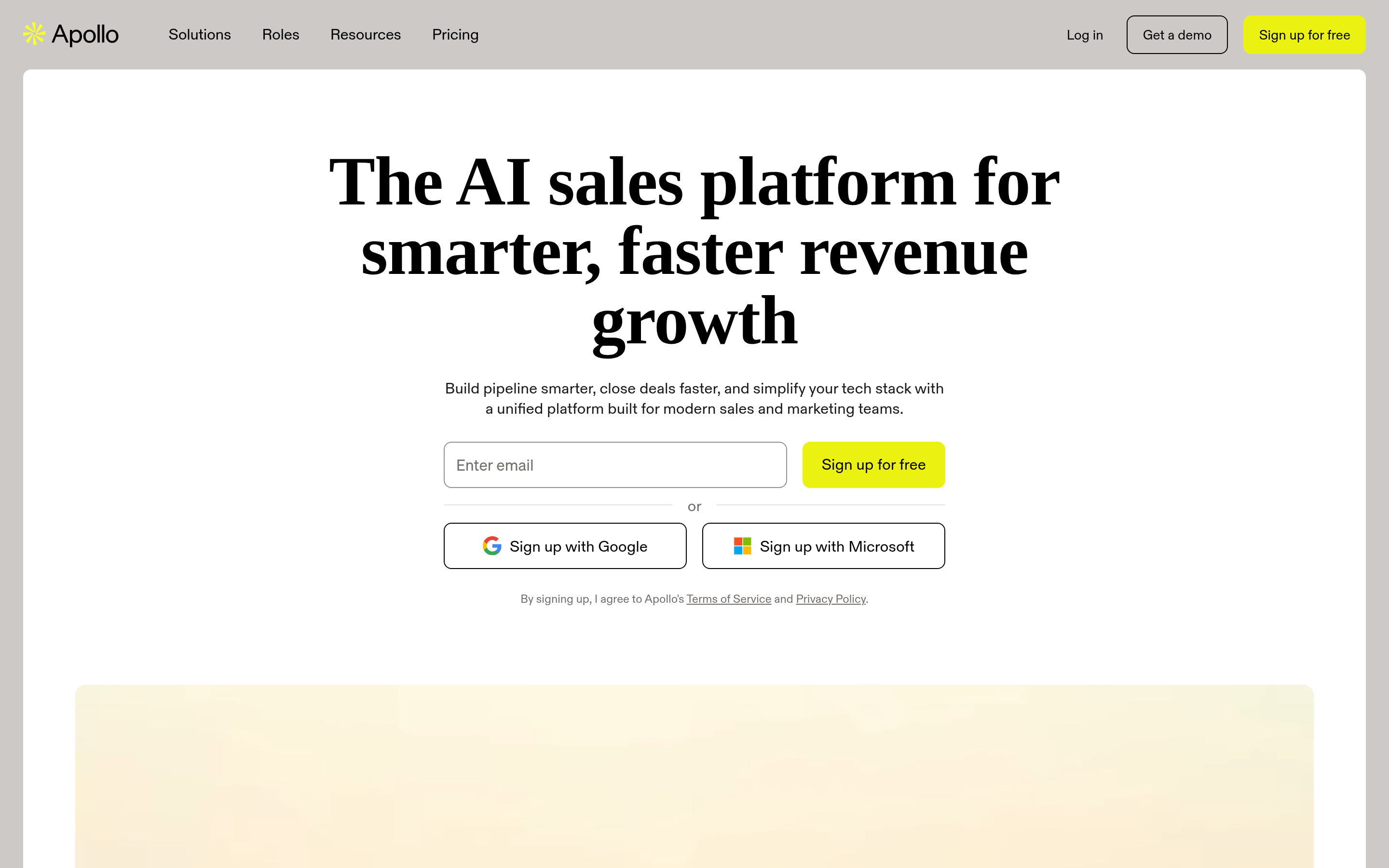
Apollo bundles a contact database, sequencer, dialer, and basic intent into one seat price. Data quality on US mid-market is solid; international coverage is thinner than Cognism. The trade-off is that you're using a single vendor's data with no waterfall fallback — when Apollo doesn't have a contact, you're stuck. Many teams pair it with an Apollo alternative for gap-filling rather than replacing it outright.
BookYourData — best for prepaid, no-subscription list buying#
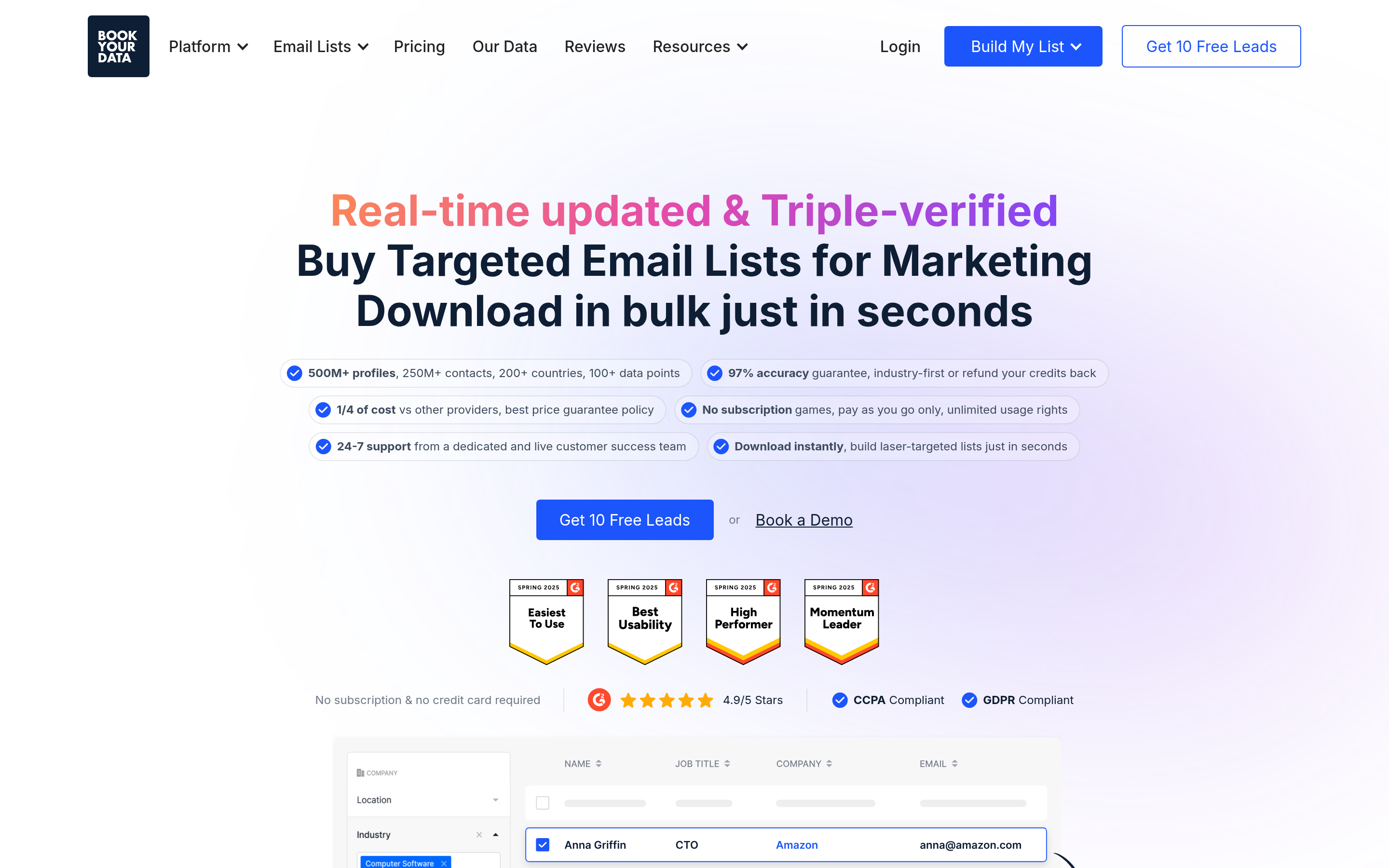
If your buying pattern is "I need 5,000 verified contacts in healthcare IT this quarter, and then nothing for six months," a subscription is the wrong instrument. BookYourData sells prepaid credits against a filterable B2B database with an accuracy guarantee, no recurring commitment, and no seat licences. That's a genuinely different purchasing model from everything else on this list, and for lumpy or campaign-driven demand it's often the cheaper path.
Clay — best for waterfall enrichment#
Clay isn't a data provider; it's an orchestration layer that queries multiple providers in sequence until one returns a hit. Plug in Tomba, Apollo, and a phone provider, and Clay tries each in your chosen order. Coverage goes up, cost-per-enriched-record goes down. The catch is that you're now managing a data pipeline, which needs someone who enjoys that. Budget real onboarding time.
How do you replace DiscoverOrg without losing data quality?#
Unbundle first, then rebuild. Most teams overbuy because they replace a platform with a platform instead of asking what they actually consumed.
Step 1: Audit last quarter's actual usage. Pull your export logs. Count how many records you enriched, how many org charts you opened, how many intent alerts you acted on. In most audits, intent data goes untouched for months while contact exports run hot.
Step 2: Split the spend by job. Contact discovery, phone numbers, and account intelligence are three separate markets with three separate price curves. Buying them bundled costs more than buying them separately unless you're at enterprise volume.
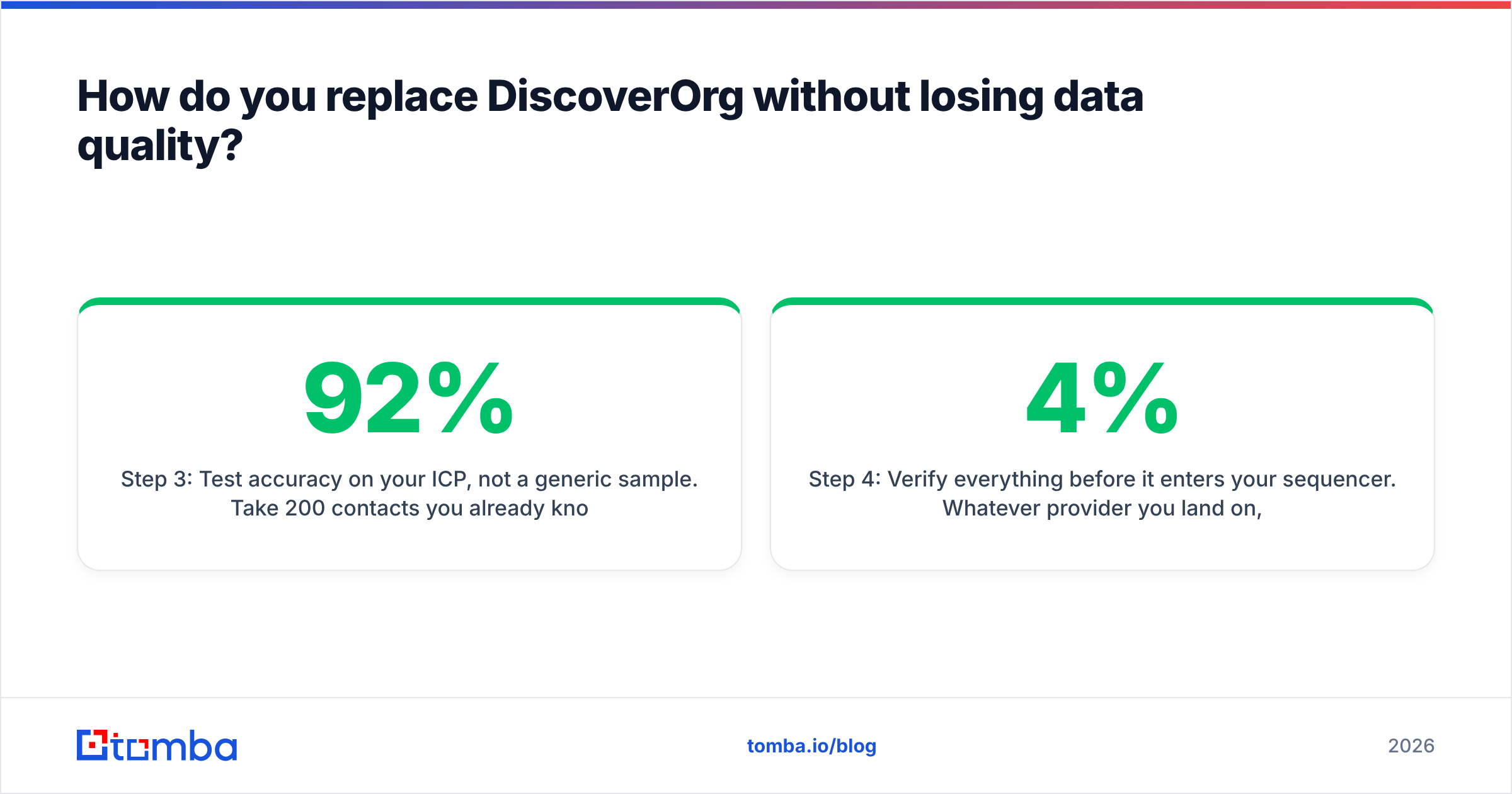
Step 3: Test accuracy on your ICP, not a generic sample. Take 200 contacts you already know are correct, strip the emails, and run them through each candidate tool. Score on match rate and bounce rate — not on the vendor's published accuracy claim. A tool with 92% coverage of your exact segment beats one with 97% coverage of the general market.
Step 4: Verify everything before it enters your sequencer. Whatever provider you land on, run a final email verification pass. Provider databases age, and a 4% bounce rate on a fresh list is enough to damage sender reputation across your whole domain.
Step 5: Negotiate against a real quote. Vendors discount hardest when you have a competing quote in hand and a contract end date on the calendar. Start the conversation 90 days before renewal, not 30.

What does a replacement stack actually cost?#
Three common configurations, with real numbers.
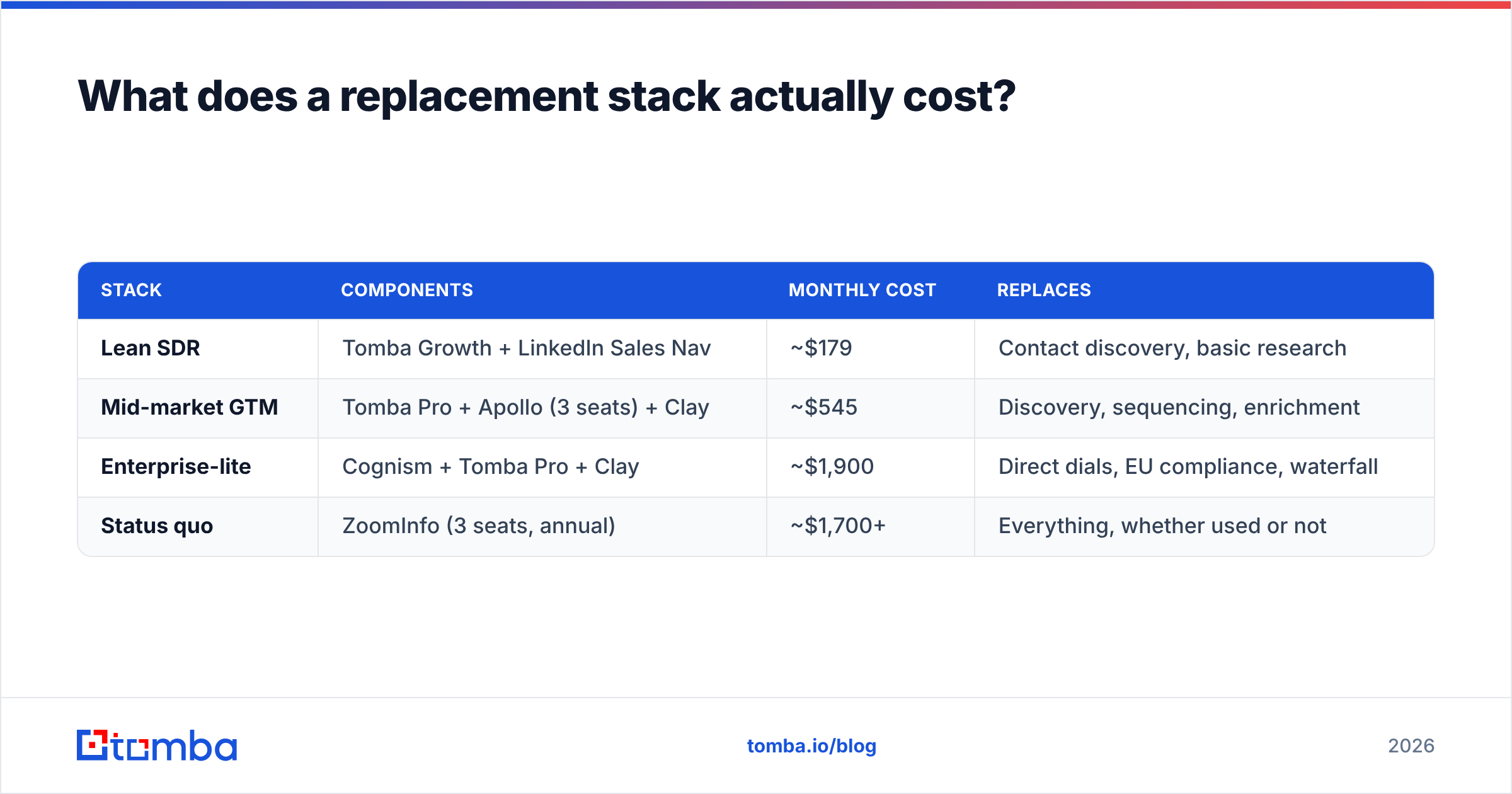
| Stack | Components | Monthly cost | Replaces |
|---|---|---|---|
| Lean SDR | Tomba Growth + LinkedIn Sales Nav | ~$179 | Contact discovery, basic research |
| Mid-market GTM | Tomba Pro + Apollo (3 seats) + Clay | ~$545 | Discovery, sequencing, enrichment |
| Enterprise-lite | Cognism + Tomba Pro + Clay | ~$1,900 | Direct dials, EU compliance, waterfall |
| Status quo | ZoomInfo (3 seats, annual) | ~$1,700+ | Everything, whether used or not |
The lean stack costs about 10% of a ZoomInfo contract and covers the workflow most SDR teams run daily: find the company, find the people, verify the emails, sequence. The enterprise-lite stack costs roughly the same as ZoomInfo but gives you better European phone data and a fallback when the primary provider misses.
What you lose in every case is the single-pane-of-glass experience and one invoice. That's a real cost — more logins, more integrations to maintain, more vendors to manage. Whether it's worth saving $12,000/year depends on how much your ops person's time is worth.
Which alternative fits your team?#
You're a 1-5 person outbound team. Start with a contact finder and a sequencer. Tomba's Starter or Growth plan plus a lightweight sequencer covers you for under $150/month. Skip intent data entirely — you don't have the volume to act on it.
You sell into Europe. Cognism, full stop. The DNC compliance and mobile coverage justify the price, and neither ZoomInfo nor most US-first tools match it there.
You're replacing DiscoverOrg mid-contract. You probably can't exit early, so run the replacement in parallel for one quarter. Measure match rate and bounce rate side by side, then let the contract lapse with data in hand rather than a hunch.
You need org charts specifically. No cheap tool does this well. Either stay on ZoomInfo, or accept that you'll rebuild org charts manually from LinkedIn — which is slower but free, and often more current than any database.
You're technical and want to automate. Use the Tomba API or a bulk email finder run and skip the UI entirely. Enrichment on 10,000 records via API costs a fraction of what platform export credits run, and you can wire it directly into your warehouse or CRM without a middleware layer.
What should you check before you sign anything?#
Run this list against every finalist before the contract goes to legal:
- Credit rollover. Do unused credits carry over, expire monthly, or expire annually? This single term can double your effective cost.
- Export rights. Can you keep the data after you churn? Many contracts say no. Read the clause.
- Seat vs. usage pricing. If you plan to double headcount, model the cost at 2x seats before you sign.
- Auto-renewal window. How many days' notice to cancel? 60 and 90 days are both common, and missing it costs a full year.
- Accuracy SLA. Is there a bounce credit or refund if data quality misses a stated threshold? Get it in writing, not in the demo.
The specifics beat the brand every time. Two tools with identical published prices can differ by 3x in effective annual cost once credit expiry and seat minimums are applied.
Start with contact data, add the rest later#
The fastest way to cut a DiscoverOrg or ZoomInfo bill is to stop paying platform prices for the one job you do every single day: finding and verifying work email addresses. Run the Tomba Email Finder against your current target list, compare the match rate and bounce rate to what you're getting now, and price it against your renewal quote. The free tier gives you 25 searches to test the accuracy on your own ICP before you commit to anything — and Starter is $49/month with no annual contract, which is roughly what an enterprise platform charges per seat per week.
Prove the contact layer works first. Then decide whether org charts and intent data are worth the rest of the invoice.
Related guides#
Ready to find emails that actually work?
Join 150,000+ professionals who stopped guessing and started sending. Free credits on signup — no credit card required.
Get the Tomba newsletter
Practical outbound tactics and product updates — once every two weeks.
About the author