DiscoverOrg Pricing in 2026: Real Costs, Tiers & Alternatives
DiscoverOrg is now ZoomInfo, and the pricing has changed with it. Here's what the plans actually cost, where the hidden fees hide, and when a $49/mo tool does the same job.
TL;DR
- DiscoverOrg no longer exists as a standalone product. It merged with ZoomInfo in 2019, and what you buy today is a ZoomInfo Copilot or Sales seat with the old DiscoverOrg org-chart data folded in.
- Expect $15,000–$40,000/year for a small team. Public reseller listings and G2 reviews cluster around $1,250/month for a three-seat entry package, before add-ons.
- The real cost drivers are not the base license: they're seat minimums, credit caps, intent-data add-ons, CRM enrichment modules, and annual renewal uplifts of 10–20%.
- There is no free tier and no month-to-month plan. Annual contracts are standard, and mid-term downgrades are usually not permitted.
- If you only need verified work emails and firmographics, a per-credit tool like Tomba at $49–$249/month replaces 80% of the use case at roughly 2% of the cost.
What is DiscoverOrg and does it still exist?#
DiscoverOrg was a B2B contact and org-chart database founded in 2007, best known for human-verified data on IT, marketing, finance, and HR departments. Its differentiator was depth: not just "here's a director of engineering," but reporting lines, budget ownership, installed tech stack, and project triggers.
In February 2019 DiscoverOrg acquired ZoomInfo and then adopted the ZoomInfo name for the combined company. If you search for DiscoverOrg pricing today, you are effectively researching ZoomInfo pricing with a legacy label. Some enterprise accounts still have DiscoverOrg-era contract language, and a handful of resellers still list "DiscoverOrg" SKUs, but new buyers get ZoomInfo paper.
That matters for budgeting. The old DiscoverOrg model was closer to a flat database subscription. The current model is seat-based plus credit-based plus module-based — three meters running at once.
How much does DiscoverOrg pricing actually cost in 2026?#
ZoomInfo does not publish a price list. That's deliberate: pricing is quoted per account after a discovery call, and it flexes based on company size, seat count, data scope, and how badly the rep wants to close the quarter.
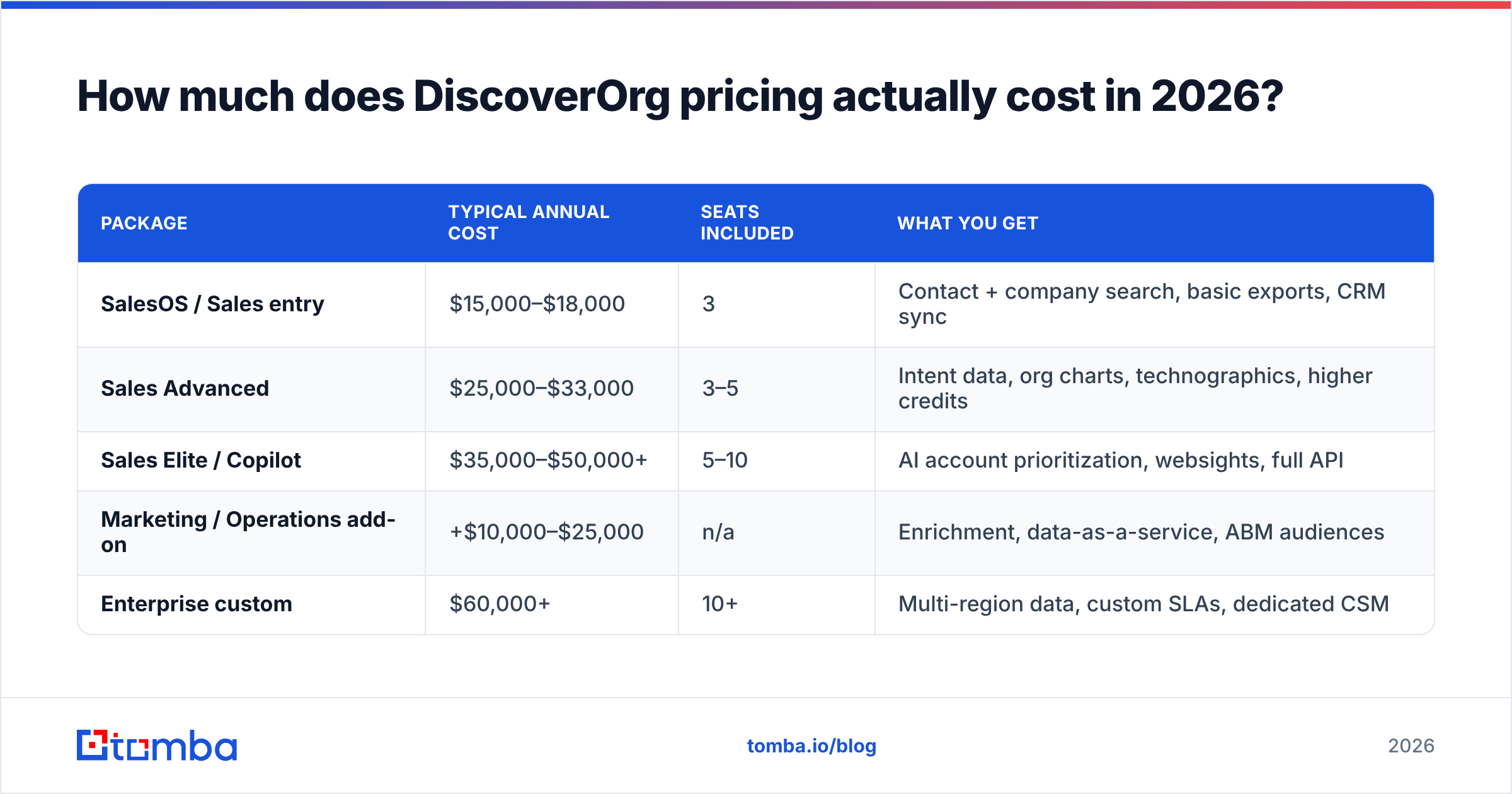
Based on reseller listings, G2 reviews, and buyer reports, here is the realistic range:
| Package | Typical annual cost | Seats included | What you get |
|---|---|---|---|
| SalesOS / Sales entry | $15,000–$18,000 | 3 | Contact + company search, basic exports, CRM sync |
| Sales Advanced | $25,000–$33,000 | 3–5 | Intent data, org charts, technographics, higher credits |
| Sales Elite / Copilot | $35,000–$50,000+ | 5–10 | AI account prioritization, websights, full API |
| Marketing / Operations add-on | +$10,000–$25,000 | n/a | Enrichment, data-as-a-service, ABM audiences |
| Enterprise custom | $60,000+ | 10+ | Multi-region data, custom SLAs, dedicated CSM |
A few patterns hold across nearly every quote:
- Three seats is the practical floor. Single-seat deals exist but are quoted at nearly the same total as three, so the per-seat math pushes you upward.
- Credits are metered separately from seats. Entry packages often include 5,000–10,000 annual export credits pooled across the team. Blow through them in month seven and you buy more at list price.
- Intent data is the biggest upsell. Bombora-powered intent typically adds $10,000–$15,000/year and is the line item most often cut at renewal.
- Renewals go up, not down. Multiple buyers report 10–20% uplift at year two unless you negotiate a multi-year cap upfront.
- Downgrades mid-term are rare. The contract locks seat count for the term; you can add, not subtract.

What is included at each DiscoverOrg / ZoomInfo tier?#
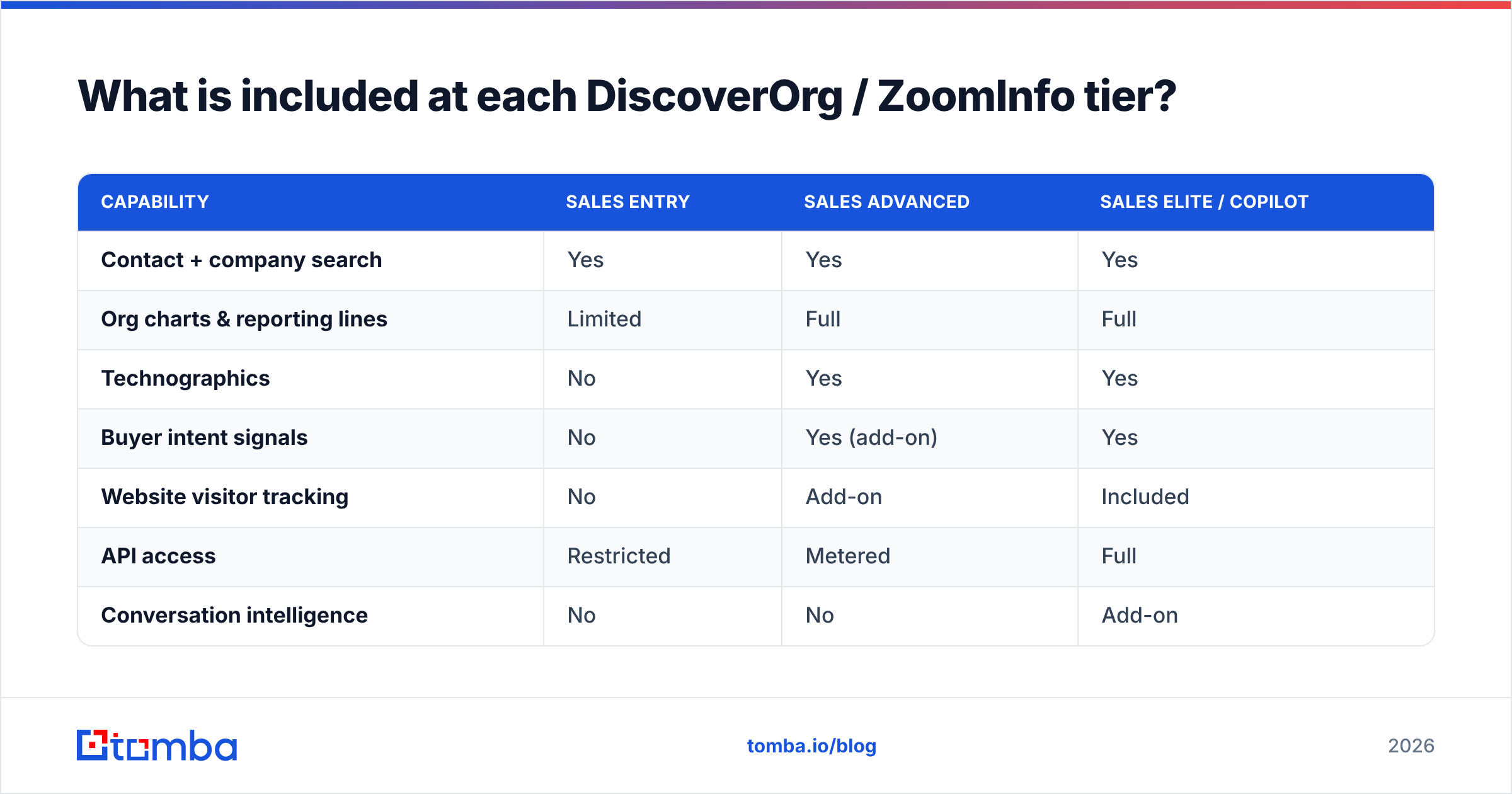
The tiers are less about data quality and more about which surfaces you unlock. The underlying contact record is the same; access, volume, and automation differ.
| Capability | Sales entry | Sales Advanced | Sales Elite / Copilot |
|---|---|---|---|
| Contact + company search | Yes | Yes | Yes |
| Org charts & reporting lines | Limited | Full | Full |
| Technographics | No | Yes | Yes |
| Buyer intent signals | No | Yes (add-on) | Yes |
| Website visitor tracking | No | Add-on | Included |
| API access | Restricted | Metered | Full |
| Conversation intelligence | No | No | Add-on |
| Annual export credits | ~5,000 | ~10,000–20,000 | Negotiated |
| Contract length | 12 months | 12 months | 12–36 months |
If your team's actual workflow is "find the VP of Engineering at 400 target accounts, get a valid email, push to the sequencer," you are paying for the top three rows and ignoring the rest. That's the central budgeting question with DiscoverOrg pricing — you buy a platform, but most teams use a lookup tool.
Where do the hidden costs come from?#
Four line items catch buyers off guard.
Credit overages. Export credits are consumed on reveal, not on use. Pull 500 contacts into a list, decide 400 aren't a fit, and you've still spent 500 credits. Teams that prospect broadly burn their annual allotment by Q3.
Seat inflation. SDR teams grow. Each added seat is charged at the then-current rate, not your original per-seat price, and it resets nothing on the contract end date.
Integration modules. CRM enrichment for Salesforce or HubSpot is frequently a separate SKU. If your plan was "let it clean our CRM automatically," budget for it explicitly — that's often a five-figure add.
Data scope limits by region. European contact coverage is narrower and, under GDPR, ZoomInfo applies notification and suppression handling that can shrink usable records. If your ICP is EMEA-heavy, validate coverage during the trial rather than after signature. The GDPR overview is worth reading before you scope a European rollout.
Procurement time. Not a dollar line, but real: enterprise data contracts routinely take 3–6 weeks from demo to signature, including security review. If you need contacts this month, that's a cost.
Is DiscoverOrg pricing worth it for your team?#
It comes down to whether you need a data platform or a data lookup.
DiscoverOrg-era data is genuinely strong where it always was: org charts, department budgets, and technology installs at mid-market and enterprise accounts. If your motion is multi-threaded enterprise ABM with 8-person buying committees and six-figure ACVs, the hierarchy data earns its keep. One extra closed deal covers the year.
It's poor value when:
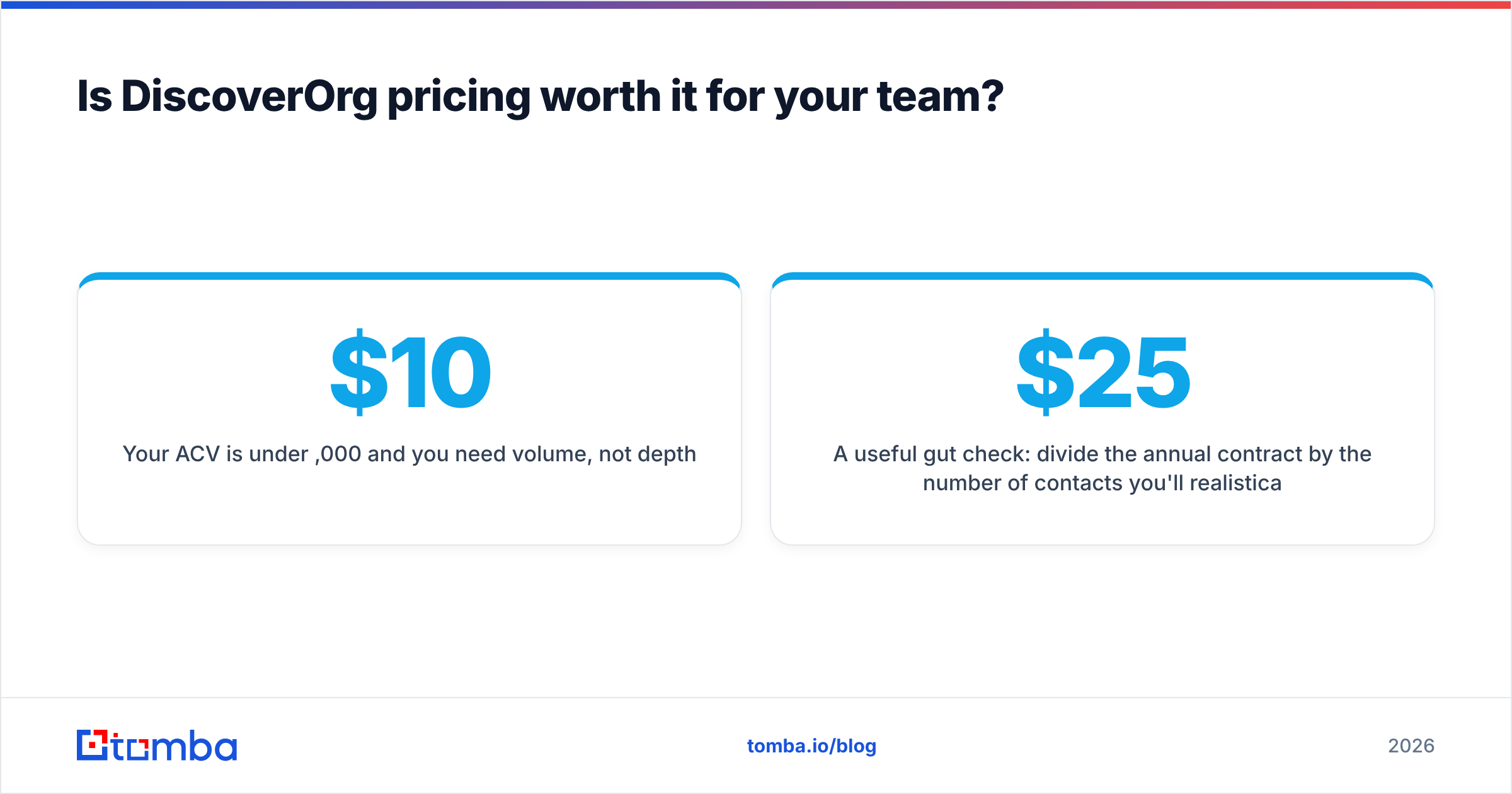
- Your ACV is under $10,000 and you need volume, not depth.
- You're a two-person founding team validating an ICP.
- You already have a target list and only need verified emails and phones.
- Your ICP is SMB, where coverage thins noticeably.
- You need month-to-month flexibility or seasonal usage.
A useful gut check: divide the annual contract by the number of contacts you'll realistically action in a year. If DiscoverOrg costs $25,000 and your team sequences 20,000 contacts, that's $1.25 per contact. A per-credit email finder lands between $0.01 and $0.05 per verified contact. The gap has to be justified by the org-chart and intent layers, not by the emails themselves.

How does DiscoverOrg pricing compare to alternatives?#
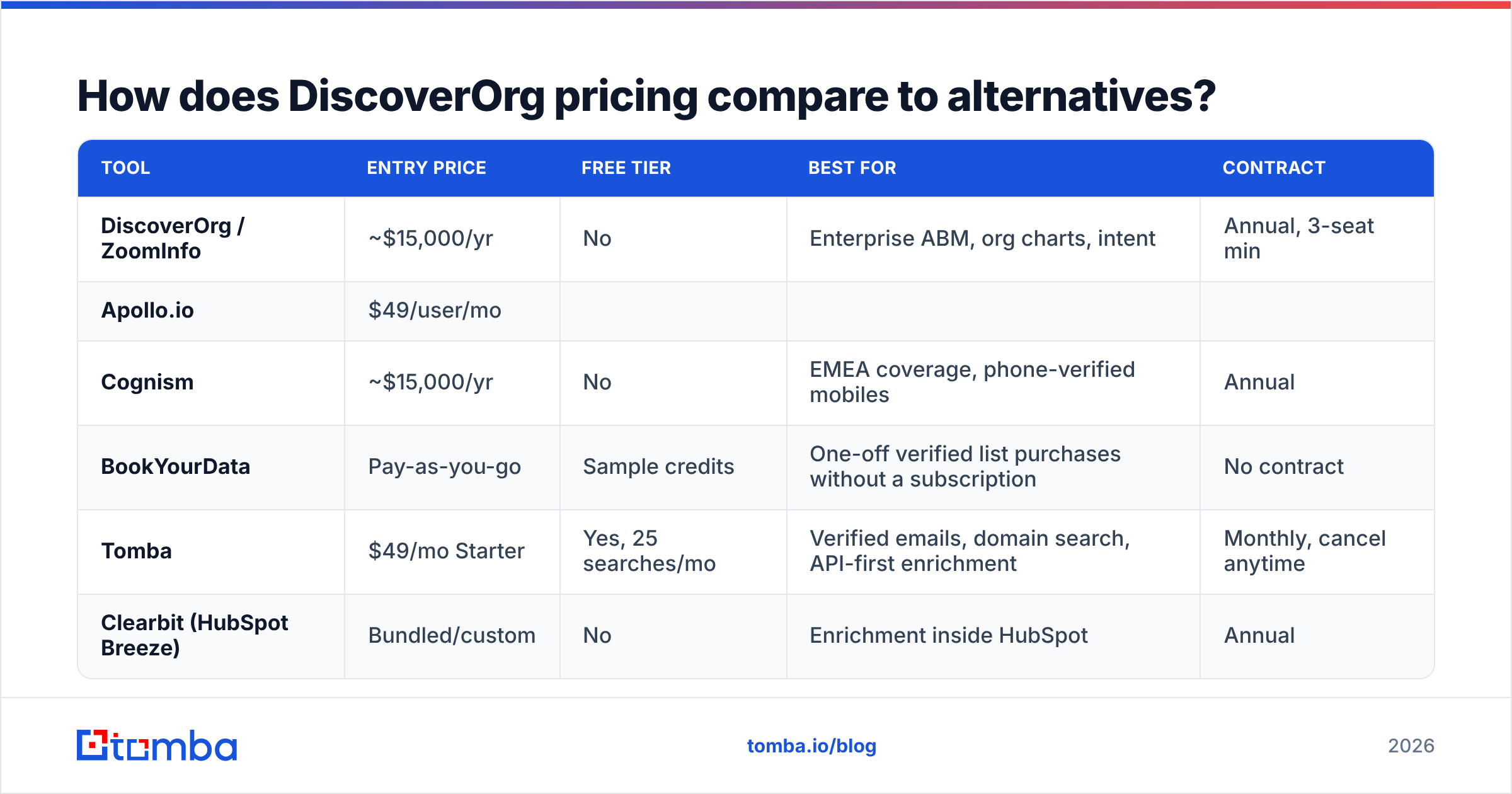
Here's the honest landscape at three price points. All figures are entry-level list prices for a small team.
| Tool | Entry price | Free tier | Best for | Contract |
|---|---|---|---|---|
| DiscoverOrg / ZoomInfo | ~$15,000/yr | No | Enterprise ABM, org charts, intent | Annual, 3-seat min |
| Apollo.io | $49/user/mo | |||
| Yes, limited | All-in-one prospecting + sequencing | Monthly or annual | ||
| Cognism | ~$15,000/yr | No | EMEA coverage, phone-verified mobiles | Annual |
| --- | --- | --- | --- | --- |
| BookYourData | Pay-as-you-go | Sample credits | One-off verified list purchases without a subscription | No contract |
| Tomba | $49/mo Starter | Yes, 25 searches/mo | Verified emails, domain search, API-first enrichment | Monthly, cancel anytime |
| Clearbit (HubSpot Breeze) | Bundled/custom | No | Enrichment inside HubSpot | Annual |
Two of these deserve a note. BookYourData is a genuinely different purchase model — you buy the list you need, verified, without committing to an annual platform seat. For teams with a bounded, one-time campaign, that avoids the entire seat-minimum problem, and their accuracy guarantee makes the unit economics predictable. Apollo bundles sequencing, so comparing its per-seat price to DiscoverOrg's is apples-to-oranges unless you also price your outbound tool.
For a fuller breakdown of the platform-replacement options, see the Apollo alternative and Clearbit alternative comparisons.
How do you cut the cost without losing coverage?#
You have three practical levers.
- Unbundle the stack. Buy hierarchy/intent data only if you use it. Most teams can replace the contact-lookup portion with a dedicated finder and verifier, keeping spend proportional to volume. Pair a domain search for account mapping with an email verifier before send, and you've covered the core workflow.
- Negotiate the meters, not the sticker. Reps have more room on credit allotments and add-on modules than on per-seat list price. Ask for a credit rollover clause and a renewal cap in writing — both are commonly granted and rarely offered.
- Time the purchase. Data vendors close hard at quarter and fiscal year end. A January quote and a late-December quote for identical scope can differ by 20–30%.
If you do buy, run a genuine trial against your actual ICP list — not the vendor's demo accounts. Export 200 records, verify them independently, and measure the bounce rate. A platform that costs 40x more should not have a materially worse hit rate on your specific segment, and sometimes it does.
What should you do next?#
If you need enterprise org charts, installed-tech signals, and intent scoring across a committee-heavy buying process, DiscoverOrg/ZoomInfo pricing is defensible — go in with a credit-rollover clause and a renewal cap, and buy at quarter end.
If what you actually need is a verified work email for a named person at a known company, at volume, without a five-figure annual commitment, start smaller. Tomba's Email Finder returns verified professional emails by name and domain, with a free tier of 25 searches per month and paid plans starting at $49/month — see full Tomba pricing for Growth ($99/mo) and Pro ($249/mo). It won't draw you an org chart. It will get the right address in front of your sequencer for roughly the cost of one DiscoverOrg seat-hour, and you can cancel any month you don't need it.
Prove the ICP first with a cheap, accurate finder. Buy the platform when the org-chart data is the thing actually blocking your pipeline — not before.
Related guides#
Ready to find emails that actually work?
Join 150,000+ professionals who stopped guessing and started sending. Free credits on signup — no credit card required.
Get the Tomba newsletter
Practical outbound tactics and product updates — once every two weeks.
About the author