DiscoverOrg Reviews 2026: Pricing, Data Quality, Verdict
DiscoverOrg no longer exists as a standalone product — it became ZoomInfo. Here's what that means for the reviews you're reading, what the data is actually worth in 2026, and which cheaper tools cover the same job.
Looking for honest DiscoverOrg reviews? Start with one fact: DiscoverOrg is not a product you can buy in 2026. Most DiscoverOrg reviews still online describe a tool that no longer ships. Here is what changed, and what to buy instead.
TL;DR
- DiscoverOrg merged with ZoomInfo in 2019, and the combined company kept the ZoomInfo name. So DiscoverOrg reviews you find today are either old history or ZoomInfo reviews wearing an old badge.
- The heritage is real. Human-verified org charts, IT install data, and department hierarchy all survived the merger. That research layer is still the strongest part of the platform.
- Expect five-figure annual contracts. Public ZoomInfo deals cluster in the $15,000–$40,000 per year range, with seat minimums and credit caps.
- Need org charts, intent, and ABM tooling? The price can pencil out. Need work emails for a target list? You are paying enterprise money for a $49/month job.
- Best move for most teams under 50 seats: buy contact data à la carte (Tomba, Findymail, BookYourData). Skip the platform tax until you need intent and org charts.
What happened to DiscoverOrg, and why most DiscoverOrg reviews are stale#
Short version: DiscoverOrg bought ZoomInfo in February 2019. The merged company then took the ZoomInfo name. The DiscoverOrg brand was retired and the URL now redirects. The product you would evaluate today is ZoomInfo. The company went public in 2020 and has repackaged the platform since, so even the tier names in a 2022 review are stale (background on the merger).
This matters more than a trivia footnote. Search "discoverorg reviews" and much of what ranks was written between 2016 and 2019. Those pages describe pricing tiers, refresh cadence, and support SLAs that no longer exist. DiscoverOrg reviews on G2 are, in most cases, legacy entries carried over during the merge.
So here is the honest framing for this post. What did DiscoverOrg do well? What survived into the current platform? And is that worth the money in 2026?

What DiscoverOrg reviews praised: depth, not volume#
DiscoverOrg's edge was never volume. It was depth on a narrow slice. Human research teams called into companies. They verified who reported to whom, what tech ran there, and which projects had budget.
Two things it did better than the scraping crowd:
- Org charts with real reporting lines. Not "a VP of Engineering exists at Acme." More like "the VP of Engineering reports to the CTO and owns a team of 40." That is hard to scrape, and it is useful when you multi-thread a deal.
- IT install and tech-stack data. Which CRM, which cloud, which security vendor, and when the contract renews. This was the wedge that made DiscoverOrg the default for IT and infosec sellers.
Two more strengths show up in almost all DiscoverOrg reviews:
- Human verification cadence. Researchers re-touched records on a schedule. Nothing sat until a user complained. Slower than automated refresh, but far more reliable at director level and above.
- Depth over breadth by design. DiscoverOrg covered fewer companies with more attributes. If your ICP sat inside that coverage, the data was excellent. If it did not, you got nothing.
All four capabilities carried into ZoomInfo. They now sit inside a much larger database that also holds automated collection, contributory network data, and intent signals. The research quality is still there. It is just no longer the whole product.
Is ZoomInfo (formerly DiscoverOrg) worth the price in 2026?#
Here is the core tension. ZoomInfo sells a platform: data, intent, engagement, workflow, enrichment, and website visitor identification. You buy the whole thing on an annual contract, with per-seat licensing and credit allocations.
Most people reading DiscoverOrg reviews want one narrow output: reliable contact data for a defined list of accounts. Buying a GTM platform to get that is like leasing a commercial kitchen because you want a good knife.
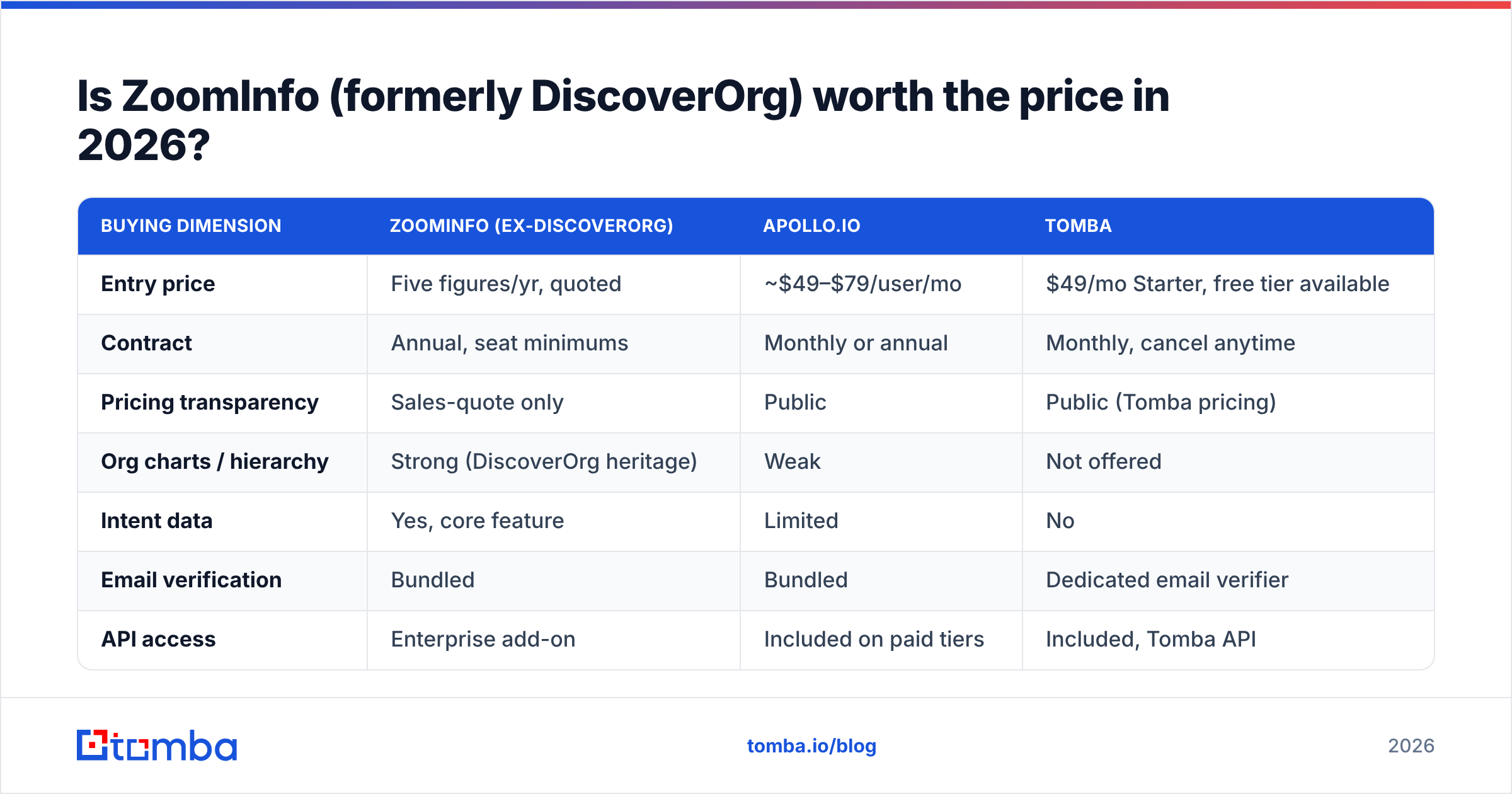
| Buying dimension | ZoomInfo (ex-DiscoverOrg) | Apollo.io | Tomba |
|---|---|---|---|
| Entry price | Five figures/yr, quoted | ~$49–$79/user/mo | $49/mo Starter, free tier available |
| Contract | Annual, seat minimums | Monthly or annual | Monthly, cancel anytime |
| Pricing transparency | Sales-quote only | Public | Public (Tomba pricing) |
| Org charts / hierarchy | Strong (DiscoverOrg heritage) | Weak | Not offered |
| Intent data | Yes, core feature | Limited | No |
| Email verification | Bundled | Bundled | Dedicated email verifier |
| API access | Enterprise add-on | Included on paid tiers | Included, Tomba API |
| Best for | Enterprise ABM, IT sales | All-in-one SMB outbound | Precise email finding + enrichment |
The pattern is consistent across public review sites. Buyers who use intent, org charts, and workflow automation together report strong ROI. Buyers who log in twice a week to export a contact list say the same thing every time: good data, wrong price.
What buyers consistently complain about#
Four complaints repeat across DiscoverOrg reviews on G2, Capterra, and Reddit sales communities:
- Contract rigidity. Annual commitments, auto-renew clauses, and few mid-term downgrade options. Several reviewers describe hard negotiations to avoid renewing at a higher tier.
- Credit mechanics. Exports burn credits. On some plans credits reset yearly, not monthly. Heavy list-builders run dry by Q3.
- Coverage skew. Strong on North American mid-market and enterprise tech. Thinner on EMEA SMB, APAC, and non-tech verticals. That is a direct inheritance of the depth-first strategy.
- Mobile number accuracy. Direct dials are a headline feature and a frequent letdown. Reported connect rates vary a lot by segment.
None of this is disqualifying. These are the normal tradeoffs of enterprise data buying. But price them in before the demo, not in month seven.
How accurate is the data compared to dedicated email finders?#
This is where the DiscoverOrg legacy and modern email finders split.
Human-researched databases optimize for a complete record: title, hierarchy, tech stack, direct dial, email. Dedicated email finders optimize for one fresh field. A record verified by a researcher in March is a snapshot. An email finder runs a live SMTP check at query time, so it tells you whether the mailbox accepts mail right now.
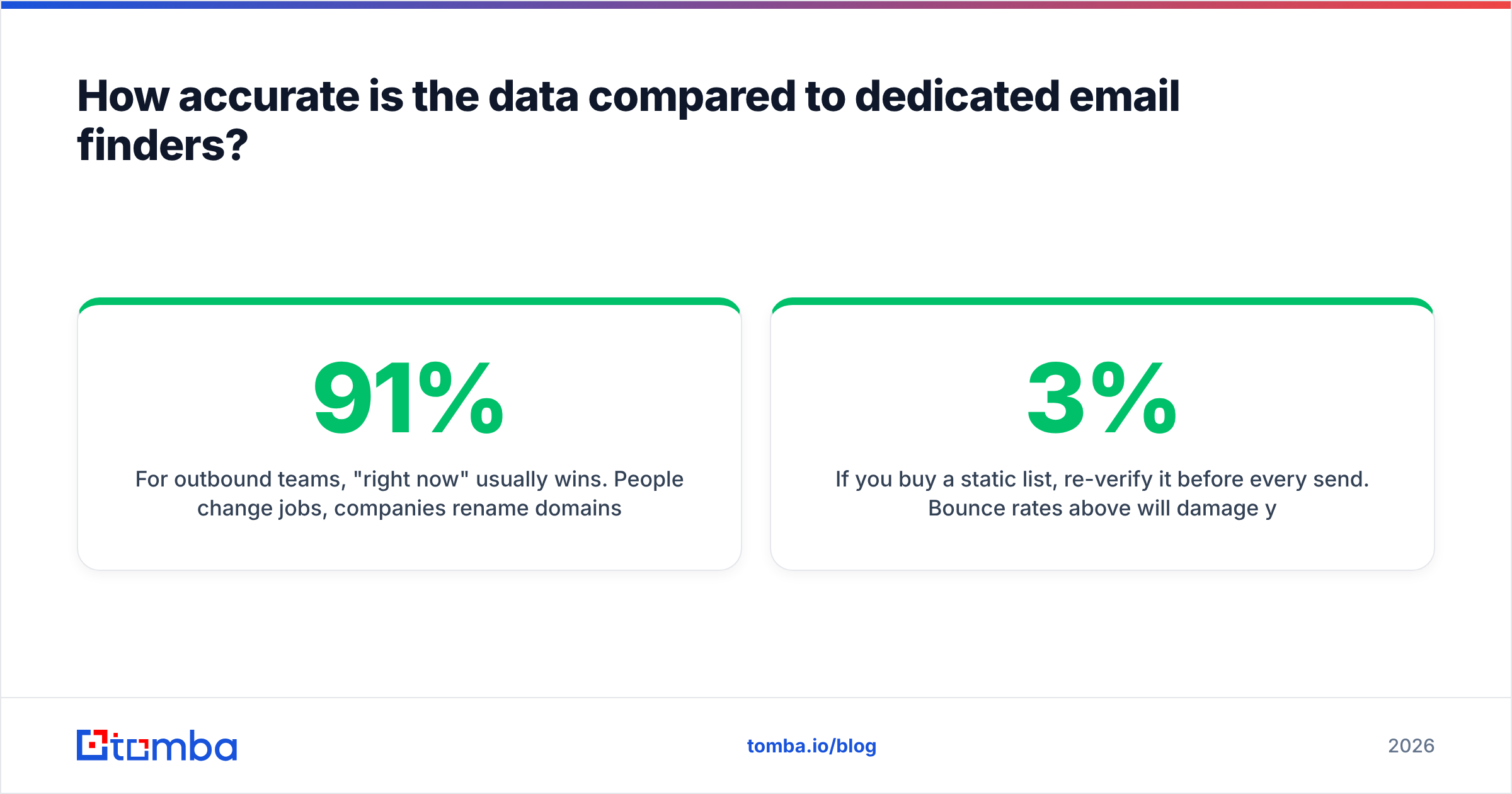
For outbound teams, "right now" usually wins. People change jobs. Companies rename domains. Mail servers change acceptance rules. A database that was 91% accurate six months ago behaves like a 70% one by the time you send.

Practical implications:
- If you buy a static list, re-verify it before every send. Bounce rates above 3% damage your sender reputation no matter where the data came from.
- Catch-all domains are the silent killer. Big databases often mark catch-all addresses valid, because the server accepts everything. A dedicated catch-all verifier scores pattern confidence instead of trusting the SMTP handshake.
- Pattern-based finding beats record lookup. If you know a company uses
first.last@, you can reach anyone there. That includes the hire who started last week and sits in no database yet.
Which DiscoverOrg alternatives make sense in 2026?#
It depends on the job you hire the tool to do. Four buyer profiles, four different answers.
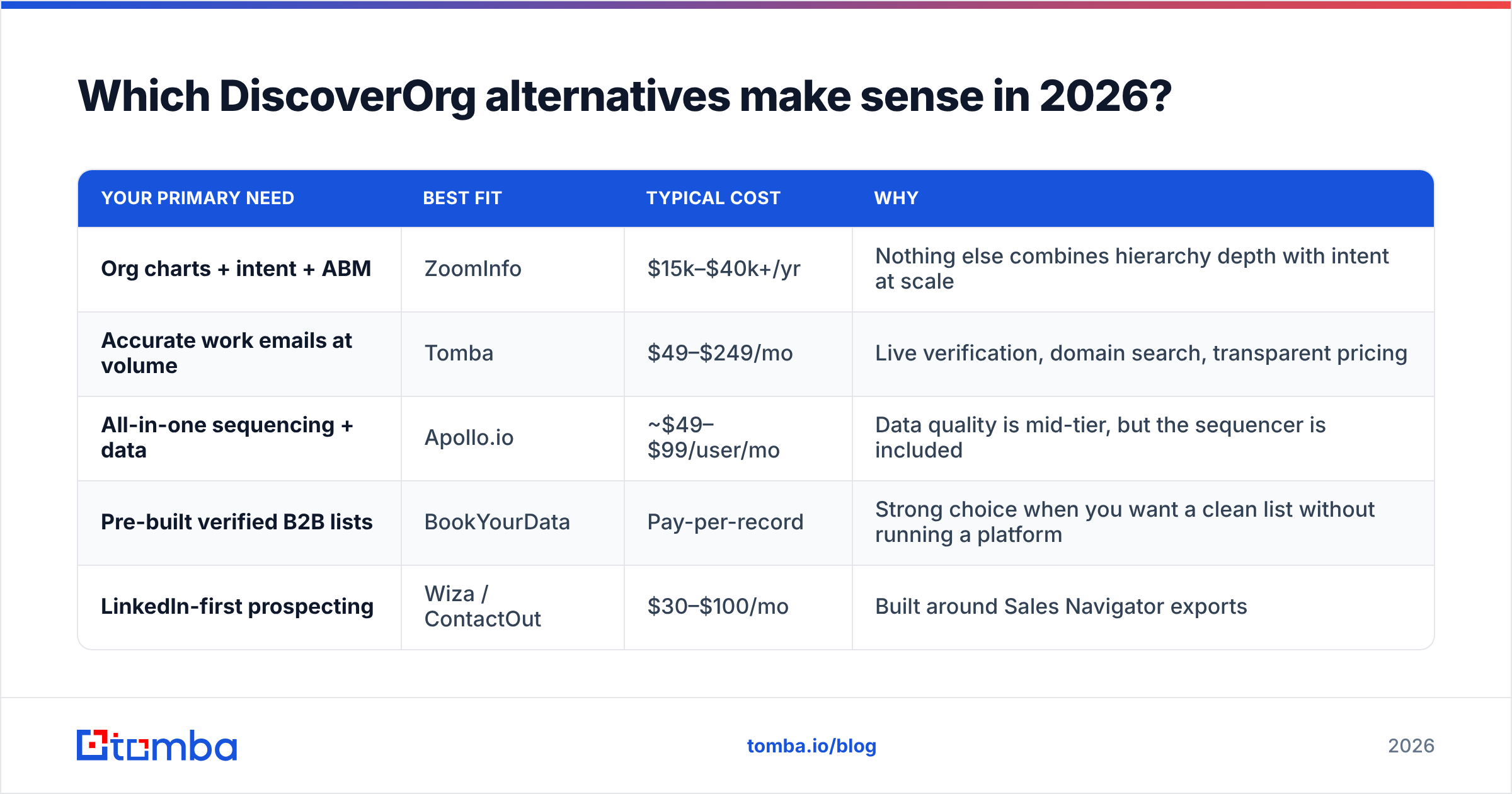
| Your primary need | Best fit | Typical cost | Why |
|---|---|---|---|
| Org charts + intent + ABM | ZoomInfo | $15k–$40k+/yr | Nothing else combines hierarchy depth with intent at scale |
| Accurate work emails at volume | Tomba | $49–$249/mo | Live verification, domain search, transparent pricing |
| All-in-one sequencing + data | Apollo.io | ~$49–$99/user/mo | Data quality is mid-tier, but the sequencer is included |
| Pre-built verified B2B lists | BookYourData | Pay-per-record | Strong choice when you want a clean list without running a platform |
| LinkedIn-first prospecting | Wiza / ContactOut | $30–$100/mo | Built around Sales Navigator exports |
A few notes on that table.
BookYourData works if your workflow is "buy a targeted list, hand it to SDRs, move on." It sidesteps the platform tax. Records come pre-verified, which suits teams with no data ops function.
Apollo competes on bundling, not data quality. If you already have a sequencer you like, you pay twice. If you do not, the bundle is efficient. Teams weighing that tradeoff usually compare an Apollo alternative per credit, not per seat.
Tomba is the narrow-and-deep pick on the contact side. Find email addresses by name and domain. Sweep a whole company with domain search. Verify in bulk. Enrich records through the API. No intent data, no org charts, no annual contract.


How should you actually run the evaluation?#
Ignore the star ratings in DiscoverOrg reviews. They average across buyers whose needs look nothing like yours. Run this instead.
Before the demo:
- Define the ICP in writing. Industry, employee band, geography, seniority, tech stack. Vendors demo their strongest segment. You want yours.
- Demand a coverage test on your accounts. Hand over 100 real target companies and ask for a match-rate report. Coverage on your list is the only number that matters. A vendor who refuses that test is telling you something.
- Test the contact data yourself. Export 200 records and check them with a third-party tool. A free email checker makes this a 20-minute exercise.
Before you sign:
- Price the total cost, not the license. Seats × contract length, plus overage credits, implementation, and the CRM integration work. That last item gets underestimated a lot.
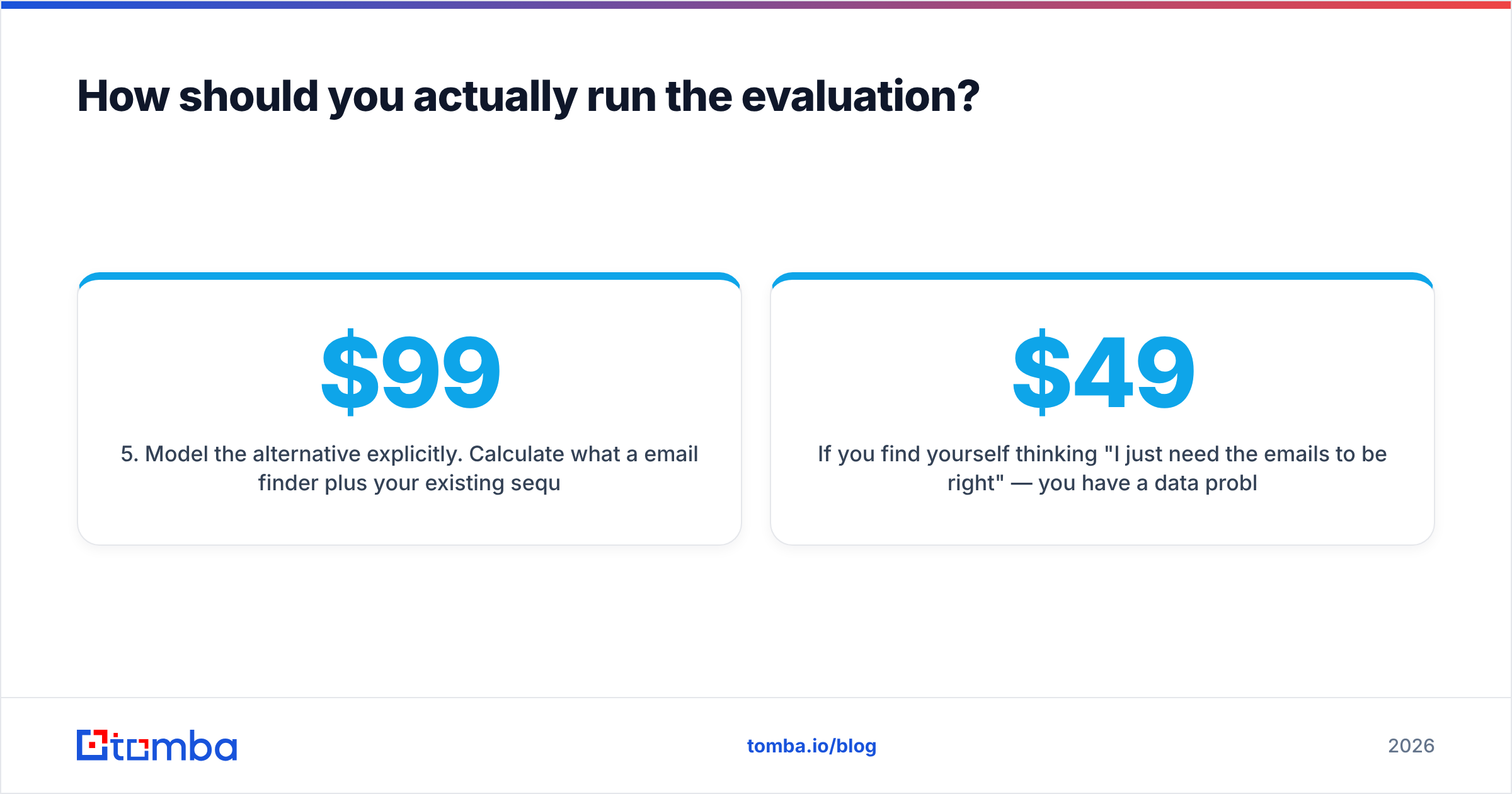
- Model the cheap alternative. Add up a $99/month email finder plus your current sequencer over 12 months. If the gap is $30,000, the platform must return $30,000 in pipeline from features the cheap stack lacks. Sometimes it does. Often it does not.
- Negotiate the exit before the entry. Auto-renewal notice periods, mid-term downgrade rights, and data portability on cancellation. Get all three in writing.
The 80/20 signal#
If org charts, intent spikes, and visitor identification excite you during the evaluation, buy the platform. Those features are hard to replicate and they drive enterprise deals.
If you keep thinking "I just need the emails to be right," you have a data problem, not a platform problem. Solve it for $49 a month. Put the rest into headcount or a better sequencer.
Frequently asked questions#
Can I still buy DiscoverOrg? No. The product line was absorbed into ZoomInfo after the 2019 merger. Any vendor claiming to sell "DiscoverOrg" today is reselling ZoomInfo or misrepresenting the product.
Are old DiscoverOrg reviews useless? Not useless, just historical. They describe the research method and coverage philosophy that still shape the platform. They do not describe current pricing, packaging, UI, or support.
Where can I find current DiscoverOrg reviews? Read ZoomInfo reviews dated 2024 or later. DiscoverOrg reviews written before 2020 cover a product that no longer ships on its own.
Does ZoomInfo publish pricing? No. All pricing is quote-based. Public figures come from buyer disclosures on review sites and forums, so treat any number as a range, not a rate card.
What is the cheapest way to test data quality before committing? Take 50 contacts you know are correct, such as current customers or past colleagues. Run them through each vendor's lookup. A tool that misses people you know exist will miss the people you do not.
Do I need both a database and an email finder? Many teams run both. The database covers account intelligence and hierarchy. The finder supplies fresh, verified contact points at send time. That works if you have the budget. If you do not, the finder is the higher-leverage half.
The bottom line#
DiscoverOrg was an excellent research-first data company. The parts that survived the ZoomInfo merger, such as org charts, tech install data, and human verification, are still best-in-class for enterprise ABM. That is the honest case for buying.
Here is the honest case against. Most teams reading DiscoverOrg reviews need accurate contact data, not a GTM platform. An enterprise contract is a very expensive way to solve a narrow problem.
If your bottleneck is finding and verifying work emails for a defined target list, start with the Tomba Email Finder. The free tier covers 25 searches a month, so you can benchmark it against whatever quote you are holding. Starter runs $49 a month, with no annual lock-in to escape. Test both on the same 100 accounts, compare match rates and bounce rates, then spend the difference on something that closes deals.
Related guides#
Ready to find emails that actually work?
Join 150,000+ professionals who stopped guessing and started sending. Free credits on signup — no credit card required.
Get the Tomba newsletter
Practical outbound tactics and product updates — once every two weeks.
About the author