DiscoverOrg Sales Intelligence in 2026: What It Became
DiscoverOrg was the gold standard for researched B2B org charts and direct dials — then it bought ZoomInfo and took its name. Here is what happened to the data, what it costs in 2026, and which stacks replace it.
TL;DR
- DiscoverOrg no longer exists as a product you can buy. It acquired ZoomInfo in February 2019, kept the ZoomInfo brand, and the research-driven DiscoverOrg dataset was folded into what is now ZoomInfo Sales.
- What made DiscoverOrg different was human-verified org charts, direct dials, and IT install data on a re-verification cycle — not scale. That methodology survives inside ZoomInfo, but at platform pricing.
- Expect $15,000–$40,000+ per year for ZoomInfo Sales with credits, seat minimums, and annual commitments. Public G2 reviews and buyer reports consistently land in that band.
- If you bought DiscoverOrg for account intelligence, ZoomInfo or Cognism are the honest replacements. If you bought it mainly for contact data, a $49–$99/month finder plus enrichment covers 80% of the job.
- The 2026 buying question is not "who has the most records" — it's "who re-verifies the records I actually email, and can I pay per record instead of per seat?"
What was DiscoverOrg sales intelligence?#
DiscoverOrg was a B2B sales intelligence provider founded in 2007 that sold researched account and contact intelligence to sales, marketing, and recruiting teams. Its pitch was the opposite of the scraped-database pitch: instead of the largest pile of records, it sold a smaller pile that human researchers had called, checked, and re-checked on a schedule.
Three things made it the default for enterprise outbound teams in the 2010s:
- Human-verified org charts. Not just "VP of Engineering at Acme" — reporting lines, team structure, and who owned budget. That let SDRs write multithreaded sequences instead of spraying one title.
- Direct dials, not switchboards. DiscoverOrg's direct-dial coverage in North America was its most-cited advantage, and it is the reason so many cold-calling teams tolerated the price.
- Technographic and install data. Which CRM, which security stack, which ERP, and renewal timing where researchers could establish it. For anyone selling software into IT, that was the buying trigger.
The tradeoff was equally clear: coverage was deep in North American mid-market and enterprise tech, thin outside it, and the contract was an enterprise contract — annual, seat-based, negotiated.

Why can't you buy DiscoverOrg anymore?#
Because DiscoverOrg bought ZoomInfo in February 2019 and adopted the acquired company's name. The combined entity went public in June 2020 as ZoomInfo Technologies. If you search for "DiscoverOrg login" or "DiscoverOrg pricing" today, you land on ZoomInfo properties, and the product you are shown is ZoomInfo Sales.
That is unusual enough to confuse buyers seven years later, so it is worth stating plainly: DiscoverOrg was the acquirer, not the acquired. The reasoning was straightforward — ZoomInfo had scale and brand recognition in contact data, DiscoverOrg had depth and verification methodology. The merged product kept the bigger name and absorbed the better research process. The corporate history is documented on the ZoomInfo Wikipedia entry if you want the timeline.
What this means practically:
- Legacy DiscoverOrg contracts were migrated years ago. There is no standalone renewal path.
- The dataset persists. Org charts, direct dials, and intent signals are ZoomInfo features now, not DiscoverOrg features.
- The pricing model changed. DiscoverOrg's researched-data premium became ZoomInfo's platform premium — more modules, more seats, more credits, higher floor.
How does DiscoverOrg compare to ZoomInfo today?#
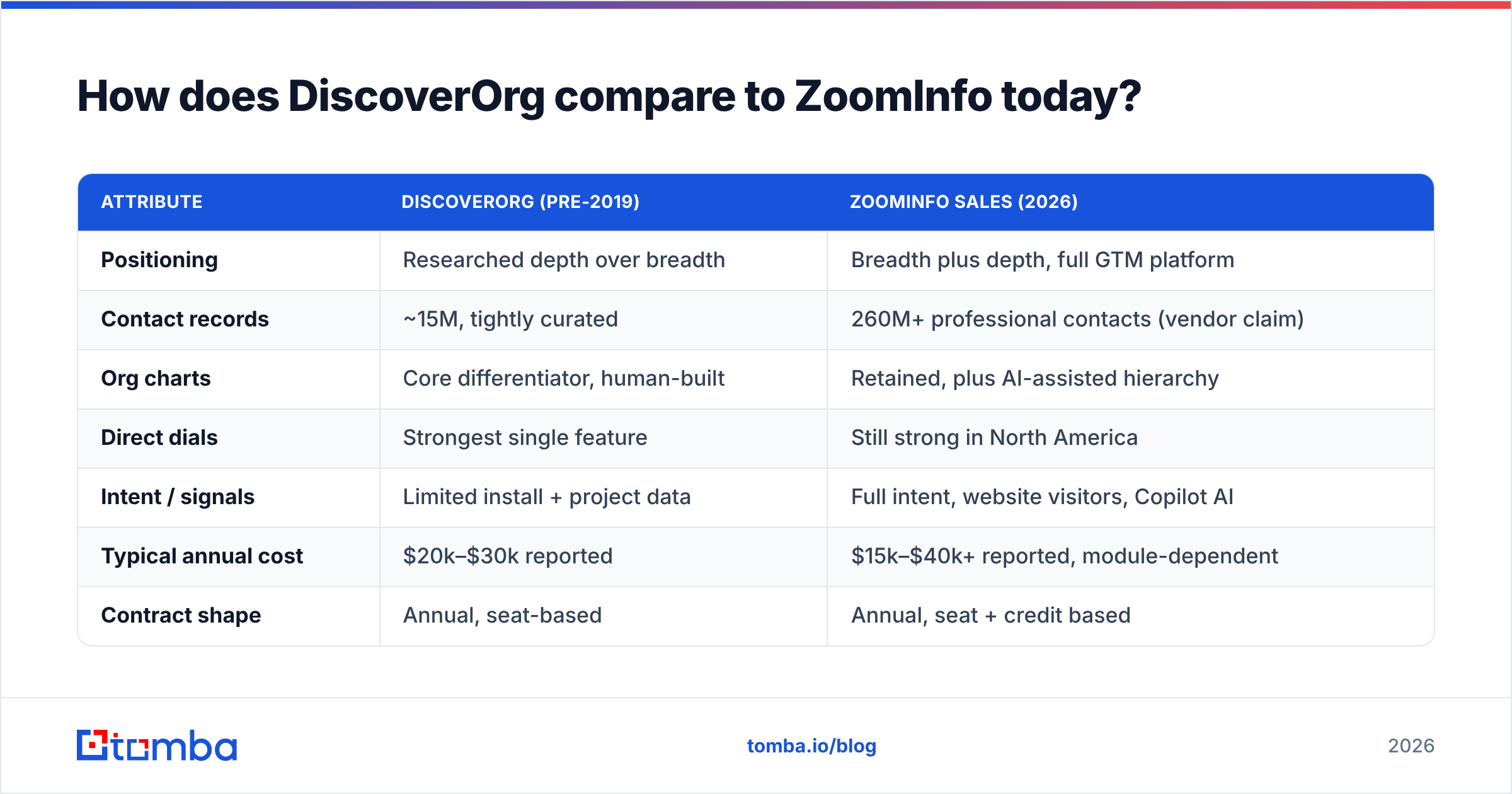
Here is the honest before/after for anyone evaluating based on old DiscoverOrg experience:
| Attribute | DiscoverOrg (pre-2019) | ZoomInfo Sales (2026) |
|---|---|---|
| Positioning | Researched depth over breadth | Breadth plus depth, full GTM platform |
| Contact records | ~15M, tightly curated | 260M+ professional contacts (vendor claim) |
| Org charts | Core differentiator, human-built | Retained, plus AI-assisted hierarchy |
| Direct dials | Strongest single feature | Still strong in North America |
| Intent / signals | Limited install + project data | Full intent, website visitors, Copilot AI |
| Typical annual cost | $20k–$30k reported | $15k–$40k+ reported, module-dependent |
| Contract shape | Annual, seat-based | Annual, seat + credit based |
| Best fit | Enterprise IT sellers, NA focus | Enterprise GTM teams needing one platform |
The upgrade is real — you get intent data, website visitor identification, and workflow automation that DiscoverOrg never had. The downgrade is also real: you can no longer buy the narrow, researched slice on its own. You buy the platform.
What does ZoomInfo actually cost in 2026?#
ZoomInfo does not publish list pricing, which is itself a signal about the sales motion. Based on buyer reports and public reviews on G2, the pattern looks like this:
- Entry point around $15,000/year for a small team on a limited module set.
- Common mid-market landing zone of $25,000–$40,000/year once you add seats, Copilot, or intent.
- Credit caps on exports, which is the line item that surprises people. Running out of credits in month eight is a normal experience.
- Annual commitment with auto-renewal clauses. Read the renewal terms before you sign; the most common complaint in public reviews is not data quality, it is renewal friction.
- Seat minimums that make small-team pilots awkward.
None of that makes it a bad product. It makes it a specific kind of purchase: a platform bet with a procurement cycle attached. If your motion needs org charts, intent, and dials in one place and you have budget, that bet is defensible. If you need 3,000 verified email addresses this quarter, it is not.
Which sales intelligence alternatives replace DiscoverOrg?#
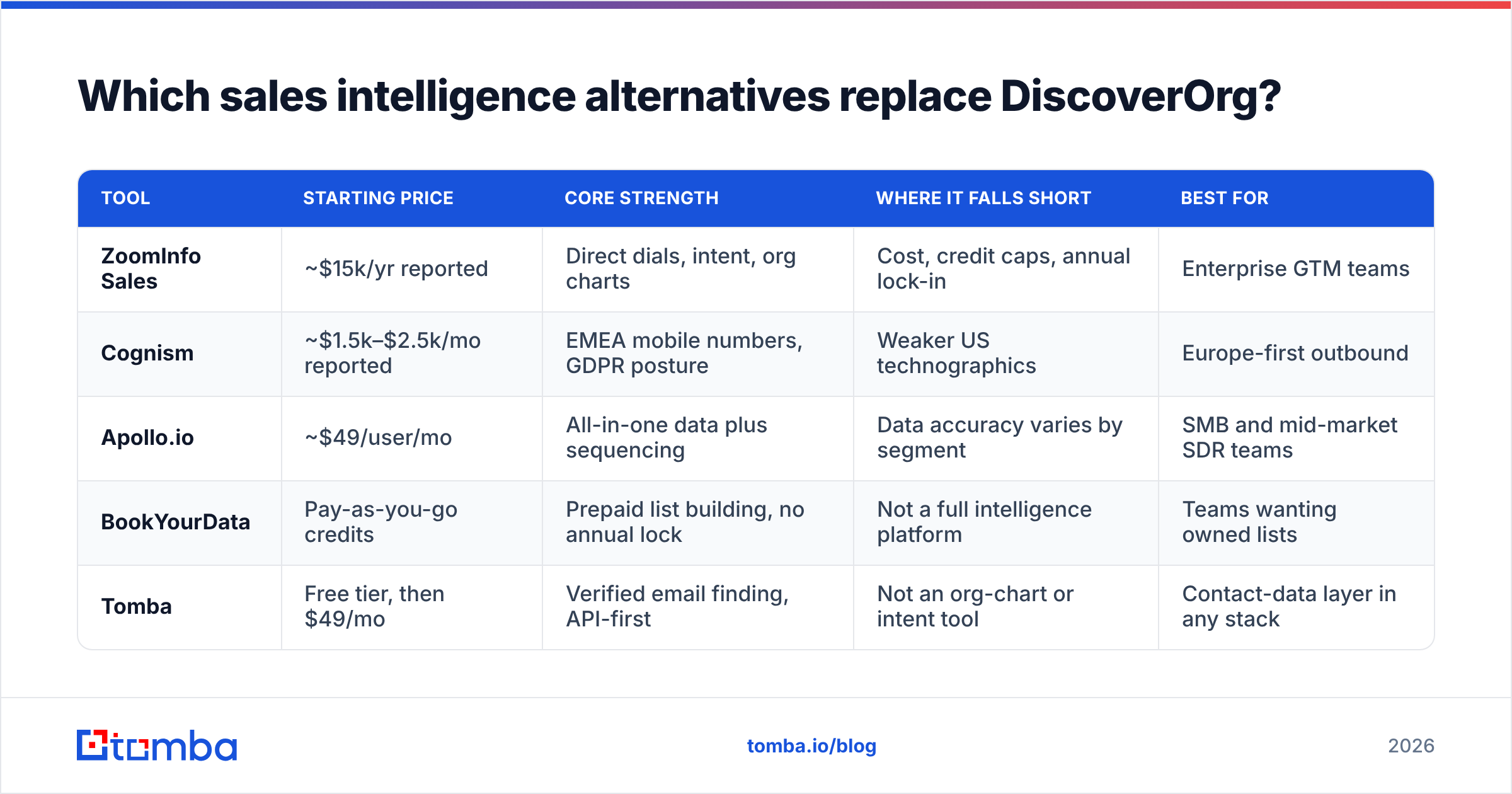
Split the decision by what you were actually buying. Most former DiscoverOrg users were buying one of two things: account intelligence (org charts, triggers, technographics) or contact data (emails and dials). Different replacements.
| Tool | Starting price | Core strength | Where it falls short | Best for |
|---|---|---|---|---|
| ZoomInfo Sales | ~$15k/yr reported | Direct dials, intent, org charts | Cost, credit caps, annual lock-in | Enterprise GTM teams |
| Cognism | ~$1.5k–$2.5k/mo reported | EMEA mobile numbers, GDPR posture | Weaker US technographics | Europe-first outbound |
| Apollo.io | ~$49/user/mo | All-in-one data plus sequencing | Data accuracy varies by segment | SMB and mid-market SDR teams |
| BookYourData | Pay-as-you-go credits | Prepaid list building, no annual lock | Not a full intelligence platform | Teams wanting owned lists |
| Tomba | Free tier, then $49/mo | Verified email finding, API-first | Not an org-chart or intent tool | Contact-data layer in any stack |
| Lusha | ~$36/user/mo | Fast browser-based lookups | Credit burn on bulk work | Individual reps, light volume |
Reading that table honestly: if the org chart was the reason you renewed DiscoverOrg every year, only ZoomInfo and Cognism are real substitutes, and you should expect platform pricing. If you were exporting contacts into a sequencer and everything else went unused — which is the most common pattern — you are overpaying by an order of magnitude.
How do you rebuild a DiscoverOrg-grade stack for under $500 a month?#
You can get surprisingly close on the parts that drive pipeline. The trick is unbundling. DiscoverOrg sold one contract; you assemble four cheap layers.
- Account list layer. Define your ICP in a spreadsheet or CRM view rather than a vendor's filter UI. Firmographic data is close to commoditized in 2026 — the differentiation was never here.
- Contact discovery layer. Use an email finder against target domains and named people. For a whole company at once, domain search returns the pattern plus known mailboxes in one call, which is how you rebuild a lightweight org view without paying for a researched one.
- Verification layer. Run everything through an email verifier before it touches a sequencer. This is the step teams skip and then blame their sending platform for bounce rates.
- Enrichment layer. Add titles, company size, and social profiles with data enrichment so your personalization tokens actually populate.
- Automation layer. Wire it together with the Tomba API or a no-code connector so list building happens on a schedule, not in a Friday-afternoon CSV panic.
- Phone layer, if you cold call. This is where the DIY stack is genuinely weaker than DiscoverOrg was. Budget separately for dials — a phone finder covers B2B numbers, but nobody has replicated DiscoverOrg's 2018-era direct-dial research at self-serve pricing.
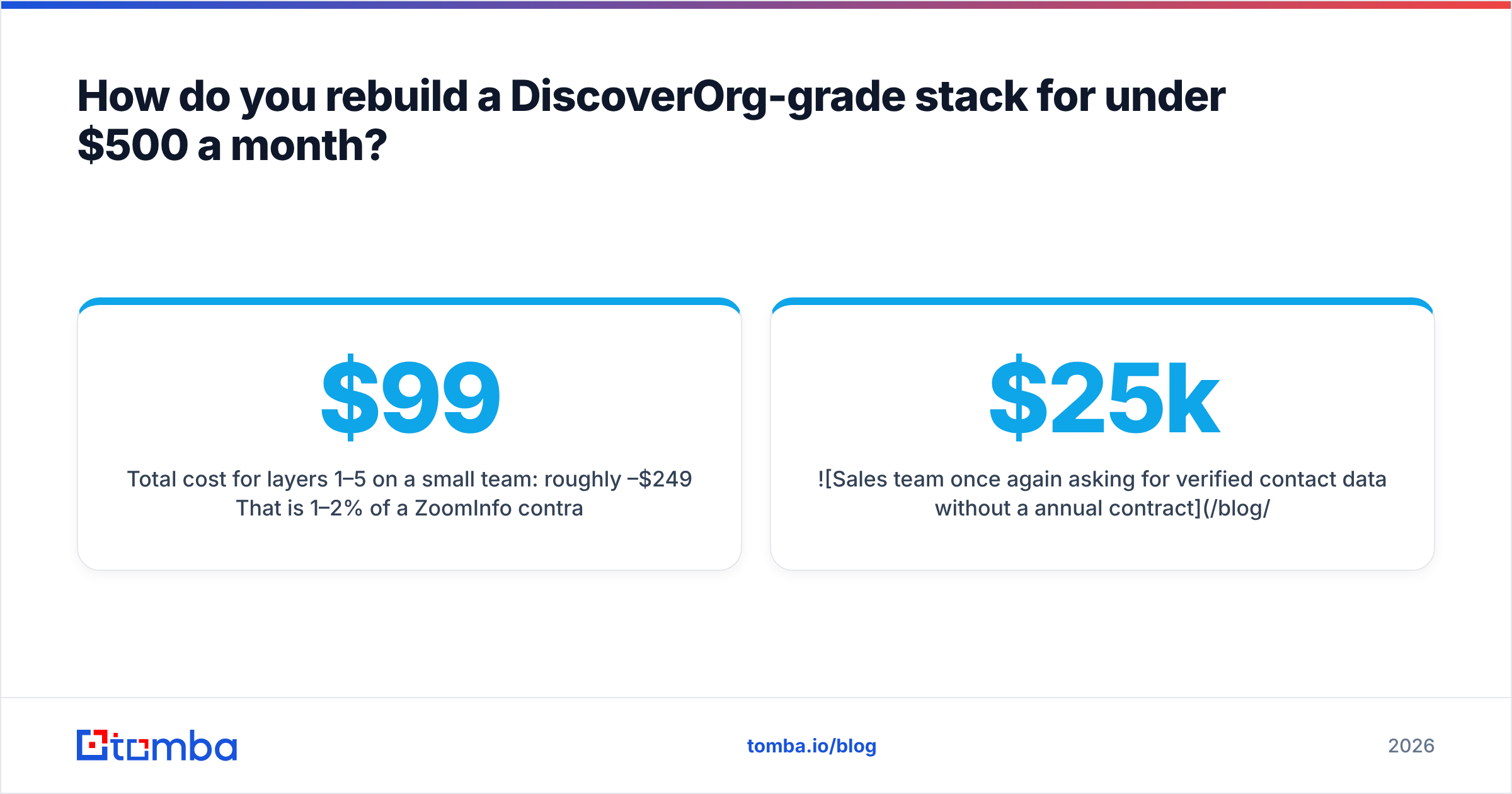
Total cost for layers 1–5 on a small team: roughly $99–$249/month. That is 1–2% of a ZoomInfo contract for maybe 70% of the outcome, assuming email is your primary channel.
Is researched data still worth paying a premium for?#
Yes, but the premium is smaller than it was in 2019, and the reason is decay math.
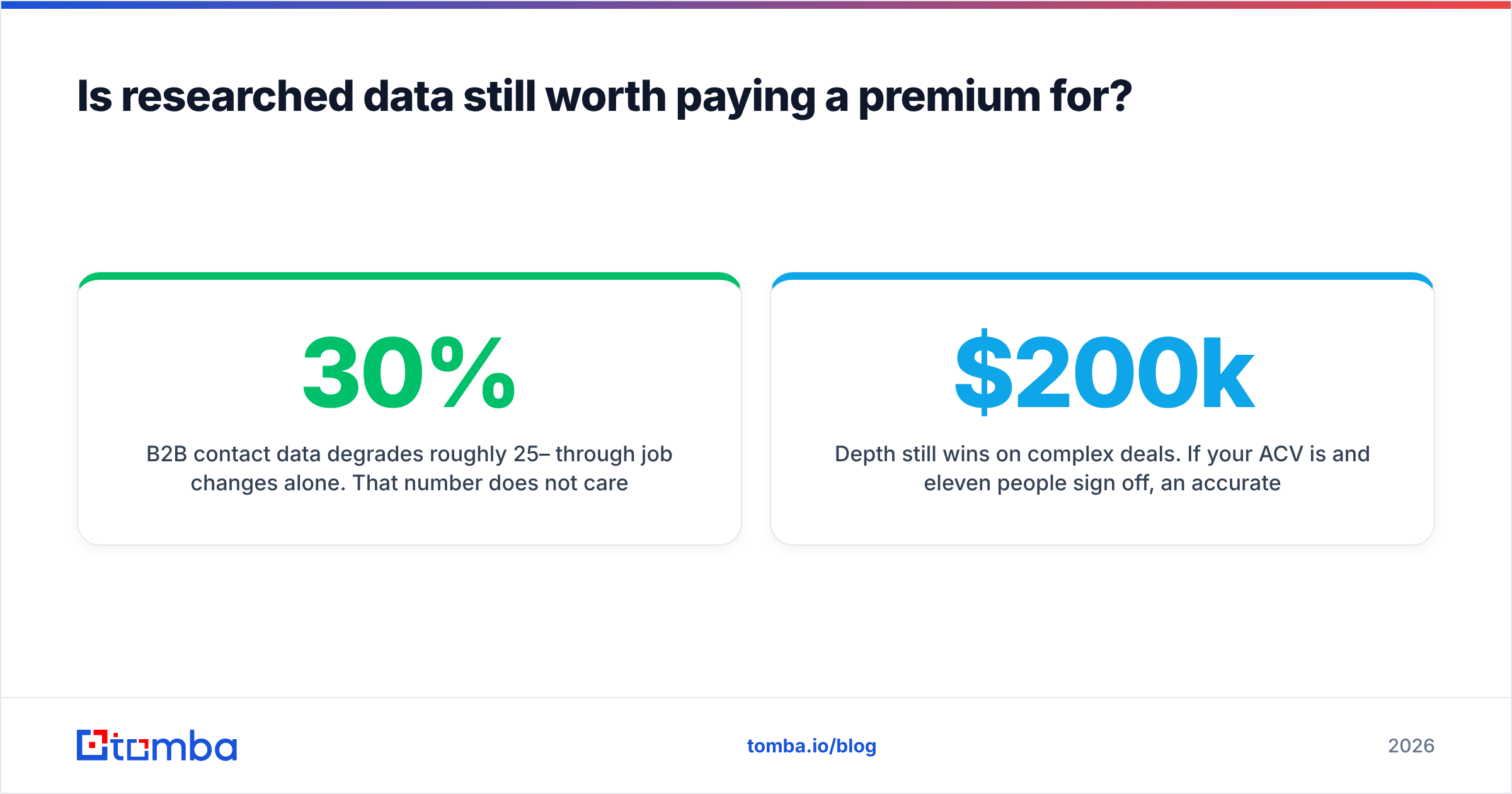
B2B contact data degrades roughly 25–30% per year through job changes alone. That number does not care whether a human researcher or a crawler created the record. A human-verified direct dial captured 14 months ago and a scraped one captured last week can be equally wrong.
So the question shifted from how was this collected to when was it last confirmed, and can I confirm it myself before I send. That reframing is what killed the researched-data premium as a standalone business:
- Freshness beats provenance. A record re-verified this week outperforms a beautifully researched record from last year.
- Verification is now cheap. Real-time SMTP and catch-all handling used to be a differentiator. Today it is table stakes, available at Tomba pricing starting on a free tier with 25 searches per month.
- Depth still wins on complex deals. If your ACV is $200k and eleven people sign off, an accurate org chart is worth thousands. If your ACV is $6k and one person signs, it is worth close to nothing.
That last bullet is the actual DiscoverOrg legacy test. Run it before you talk to any vendor: multiply your ACV by your win rate and divide by the number of stakeholders you have to map. If the answer is small, buy contact data. If it is large, buy intelligence.
What should you do if you inherited a legacy DiscoverOrg workflow?#
Some teams are still running processes designed around DiscoverOrg exports — the field mappings, the CSV cadence, the "pull the org chart before you call" ritual. Auditing that is usually worth a week:
- Check what you actually export. Pull the last two quarters of export logs. If 90% of the fields you use are name, title, company, email, and phone, you have a contact-data problem wearing an intelligence-platform contract.
- Test coverage against your real list. Take 200 accounts you care about and measure hit rate and bounce rate across two or three vendors. Do not evaluate on the vendor's demo list. Bulk tooling like a bulk email finder makes this a one-hour exercise.
- Separate the phone budget. Dials and emails have different vendor leaders. Buying one tool for both is how you end up overpaying for the half you use less.
- Look at renewal timing early. Enterprise data contracts renew quietly. Ninety days out is when you have leverage; thirty days out you have none.
- Consider prepaid over subscription for list work. Credit-based providers such as BookYourData suit teams that build lists in bursts rather than continuously — no annual floor to amortize.
If you are specifically evaluating the all-in-one route, our Apollo alternative breakdown covers where bundled platforms save money and where their data quality wobbles by segment.
The bottom line on DiscoverOrg in 2026#
DiscoverOrg was excellent at a job that has since been split in two. The org-chart-and-triggers half lives on inside ZoomInfo at enterprise pricing and is a fair purchase for complex, multi-stakeholder deals. The contact-data half has been commoditized by verification-first tools that charge two orders of magnitude less and let you confirm every address before you send it.
Do not buy a platform to solve a spreadsheet problem. Start with the layer that touches your sequencer, prove your bounce rate and reply rate on real accounts, and only add intelligence modules when your deal complexity justifies them.
Start with the data layer. Try the Tomba Email Finder free — 25 searches a month, no contract, real-time verification on every result. If it covers your ICP, you just replaced the part of DiscoverOrg you were actually using for $49/month.
Related guides#
Ready to find emails that actually work?
Join 150,000+ professionals who stopped guessing and started sending. Free credits on signup — no credit card required.
Get the Tomba newsletter
Practical outbound tactics and product updates — once every two weeks.
About the author