DiscoverOrg vs Apollo.io in 2026: Pricing, Data, Verdict
DiscoverOrg no longer exists as a standalone product — it became ZoomInfo. Here's the honest 2026 breakdown of pricing, data accuracy, contracts, and who each platform actually fits.
DiscoverOrg vs Apollo.io is the wrong matchup in 2026, and the reason matters. DiscoverOrg is no longer sold as a product. It became ZoomInfo. So the real question is ZoomInfo versus Apollo.io, and the gap between them comes down to price, contract terms, and who the data was built for.
TL;DR
- DiscoverOrg is not a product you can buy in 2026. It merged with ZoomInfo in 2019, and the brand was folded into ZoomInfo. So "DiscoverOrg vs Apollo.io" really means ZoomInfo vs Apollo.io.
- ZoomInfo sells annual contracts with custom quotes. Buyers commonly report $15,000–$40,000+ per year once seats, credits, and intent data are added. Apollo.io publishes per-seat pricing: free, then roughly $49–$149 per user per month.
- ZoomInfo wins on org charts, direct dials, and enterprise intent. Apollo wins on price, self-serve setup, and sequences bundled with the data.
- Both bill you per record, even when the email bounces. If you only need verified work emails, an email finder does that job for far less.
- Best move for teams under 20 reps: Apollo for volume, a verification layer on top, no enterprise contract yet.
What happened to DiscoverOrg?#
DiscoverOrg bought ZoomInfo in 2019 and kept the ZoomInfo name. The company went public under it in 2020. The DiscoverOrg product line was famous for human-verified org charts and IT department mapping. All of it was absorbed into the ZoomInfo platform.
If a vendor or blog post still sells you "DiscoverOrg" in 2026, one of two things is true. Either they are using a legacy contract name, or they have not updated the page in years.
That matters for your evaluation. The DiscoverOrg DNA is still visible in ZoomInfo's strongest features: deep org hierarchies, department headcounts, and hand-researched profiles for enterprise IT and finance buyers. But the pricing and contract mechanics are all ZoomInfo's now. Expect annual commitments, credit pools, and quotes that swing widely between two companies of the same size.
Apollo.io came from the opposite direction. It started as a sales engagement tool and bolted a contact database onto it. Growth came from a self-serve, product-led motion. That origin story explains almost every difference below.
DiscoverOrg vs Apollo.io: how do the platforms differ?#
Here is the head-to-head on the attributes that change buying decisions, not the marketing bullet lists.
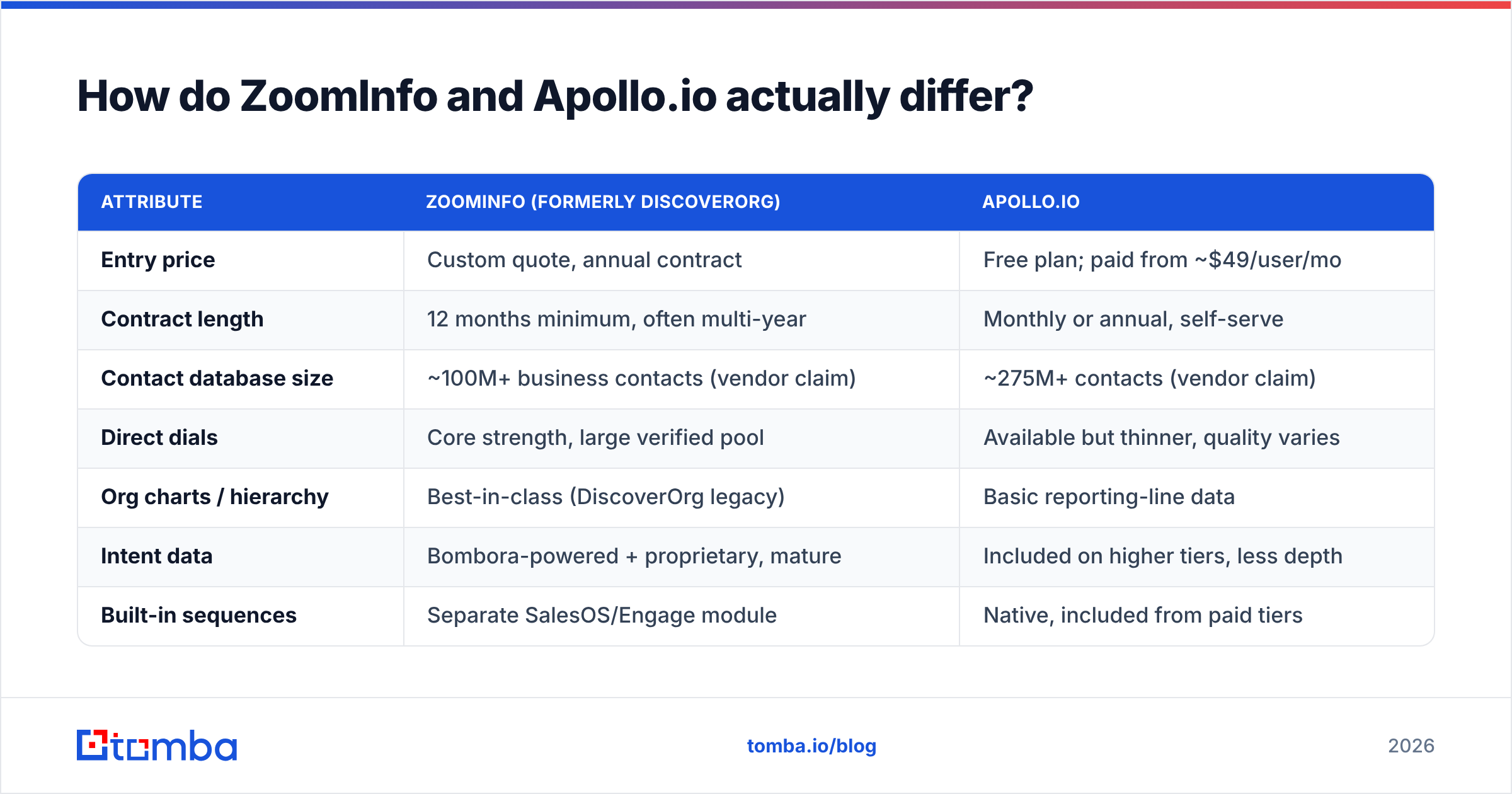
| Attribute | ZoomInfo (formerly DiscoverOrg) | Apollo.io |
|---|---|---|
| Entry price | Custom quote, annual contract | Free plan; paid from ~$49/user/mo |
| Contract length | 12 months minimum, often multi-year | Monthly or annual, self-serve |
| Contact database size | ~100M+ business contacts (vendor claim) | ~275M+ contacts (vendor claim) |
| Direct dials | Core strength, large verified pool | Available but thinner, quality varies |
| Org charts / hierarchy | Best-in-class (DiscoverOrg legacy) | Basic reporting-line data |
| Intent data | Bombora-powered + proprietary, mature | Included on higher tiers, less depth |
| Built-in sequences | Separate SalesOS/Engage module | Native, included from paid tiers |
| Credit model | Bulk credits, negotiated, seat-gated | Monthly export credits per seat |
| Onboarding | Sales call, demo, procurement cycle | Sign up and start in 5 minutes |
| Best for | Enterprise ABM, 50+ seat orgs | SMB and mid-market outbound teams |
The pattern is consistent. ZoomInfo is a data warehouse you rent. Apollo is a prospecting workflow that ships with data attached. Neither is a scam, and neither is a bargain. They are priced for different buyers.

DiscoverOrg vs Apollo.io pricing: what does each cost in 2026?#
Pricing is where most DiscoverOrg vs Apollo.io comparisons go vague. Let's be as specific as public information allows.
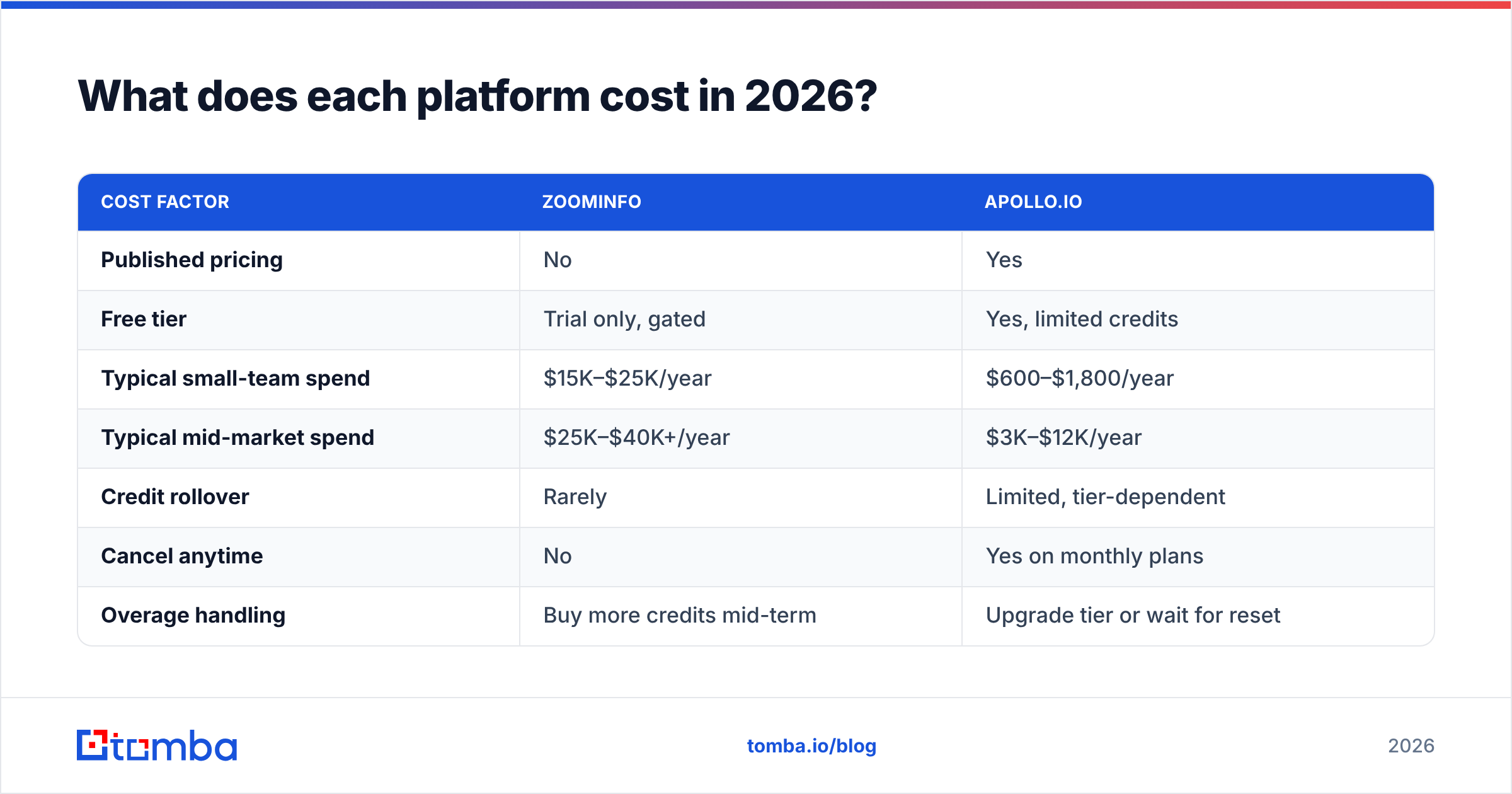
ZoomInfo does not publish list pricing. Based on user-reported figures on G2 and procurement threads, a 2026 budget has three parts: a platform fee, per-seat licenses, and credit blocks. Small teams land in the low five figures per year. Mid-market deals with intent data and CRM enrichment routinely clear $30,000. Renewal increases are a common complaint, and credits rarely roll over.
Apollo publishes its tiers openly, which is a real advantage during evaluation. The free plan gives limited monthly credits. That is enough to sanity-check data quality on your own ICP. Paid tiers scale per user per month, and export credits and sequence limits rise at each step. Annual billing cuts the effective rate meaningfully.
| Cost factor | ZoomInfo | Apollo.io |
|---|---|---|
| Published pricing | No | Yes |
| Free tier | Trial only, gated | Yes, limited credits |
| Typical small-team spend | $15K–$25K/year | $600–$1,800/year |
| Typical mid-market spend | $25K–$40K+/year | $3K–$12K/year |
| Credit rollover | Rarely | Limited, tier-dependent |
| Cancel anytime | No | Yes on monthly plans |
| Overage handling | Buy more credits mid-term | Upgrade tier or wait for reset |
The number that matters is cost per usable contact, not cost per seat. A $30,000 contract that returns 40,000 deliverable emails costs $0.75 each. A $99/month tool that returns 2,000 deliverable emails costs $0.05 each. Run that math with your own bounce data before you sign anything.
Want a baseline to compare against? Tomba pricing starts free at 25 searches per month. Paid plans run $49/mo on Starter, $99/mo on Growth, and $249/mo on Pro.
Whose data is more accurate?#
Accuracy claims from data vendors are close to meaningless. Every vendor measures it differently. ZoomInfo counts a record as accurate if the person still works there. Apollo counts an email as valid if its verification pass returns green. Neither definition tells you how much of your send list will bounce.

What holds up across independent testing:
- ZoomInfo is stronger on senior contacts. The DiscoverOrg research heritage shows up in VP-and-above records at companies over 500 employees. Direct dials for those people are its most defensible asset.
- Apollo is stronger on breadth and startups. More total records, better coverage of companies under 100 employees, and faster job-change updates. More noise is the tradeoff.
- Both decay fast. B2B contact data goes stale roughly 25–30% per year. A record verified in January is a coin flip by December.
- Neither replaces verification. Exporting straight into a sending platform is how teams torch their sender reputation. Run the list through an email verifier first.
- Catch-all domains break both. Large enterprises accept all mail at the SMTP layer, so "valid" is unprovable without a catch-all verifier. Vendors that mark these as valid inflate their stats.
The practical read is simple. Use ZoomInfo when you need certainty that one named executive is reachable by phone. Use Apollo when you need 5,000 plausible contacts fast and you have verification downstream.
DiscoverOrg vs Apollo.io: which one fits your team?#

Match the tool to your motion, not to the feature grid.
Choose ZoomInfo (ex-DiscoverOrg) if:
- You sell into enterprises and need accurate org charts to map buying committees.
- Cold calling is a primary channel and direct dial quality drives your connect rate.
- You have budget for a five-figure annual contract and a RevOps person to administer credits.
- Intent signals feed a real workflow, such as territory prioritization, ad targeting, or SDR routing.
Choose Apollo.io if:
- You're a startup or mid-market team that needs to start prospecting this week.
- You want data and sequences in one tool instead of stitching a database to a separate sender.
- Your ICP skews toward companies under 500 employees, where Apollo's coverage is competitive.
- You want to test before committing. The free tier tells you more in two hours than any demo will.
Choose neither if:
- Your real bottleneck is finding verified work emails for names or domains you already have. That's a narrow job, and platform prices for it are the most common overspend in outbound. A domain search plus verification handles it.
- You need consumer or non-B2B data. Both platforms are built for business contacts.
- You're buying mainly for CRM hygiene. Standalone data enrichment beats a full seat license per person who touches records.

What are the realistic alternatives?#
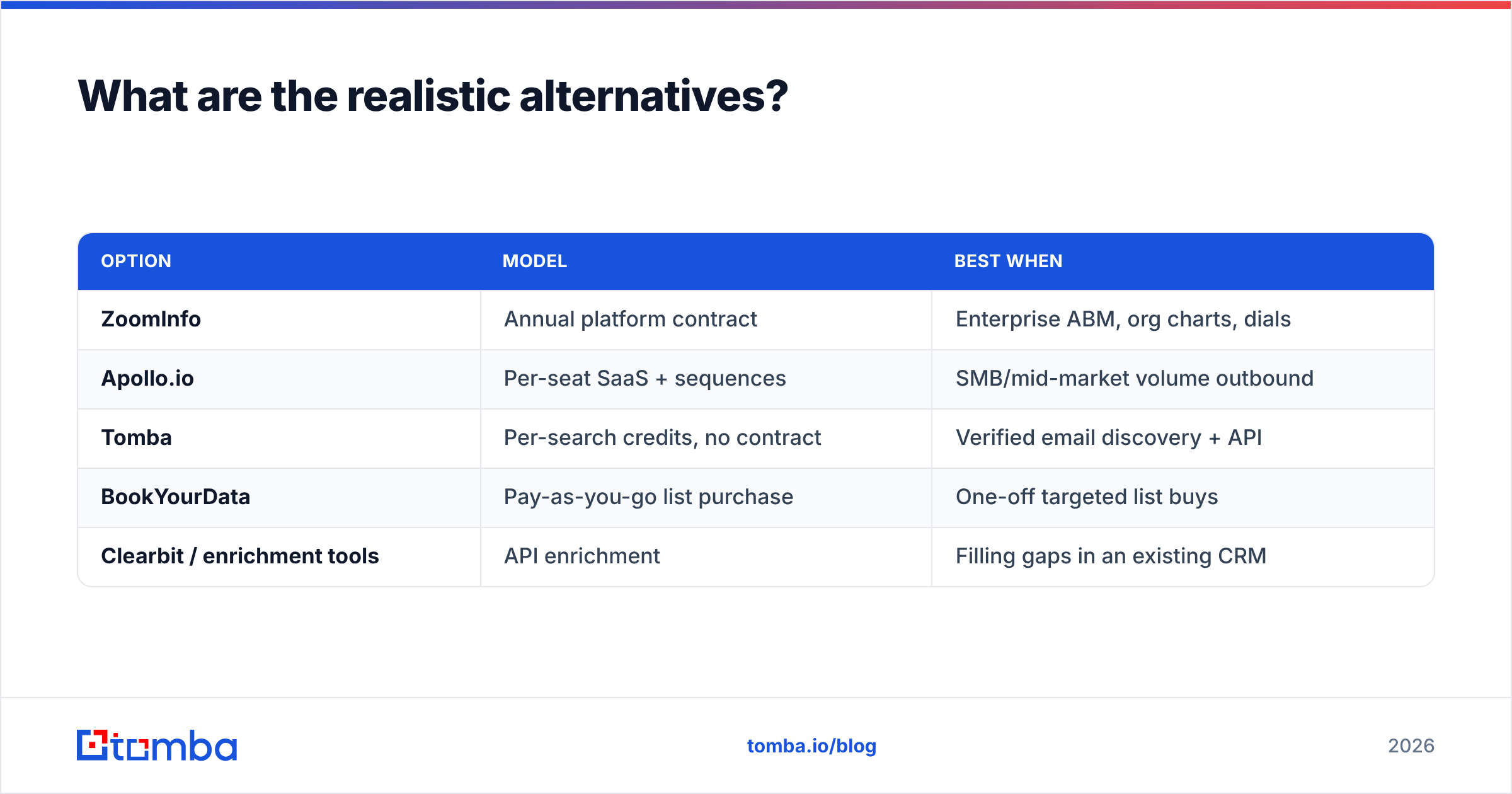
The DiscoverOrg vs Apollo.io framing assumes you need an all-in-one platform. Most teams don't. Here's the honest landscape:
| Option | Model | Best when |
|---|---|---|
| ZoomInfo | Annual platform contract | Enterprise ABM, org charts, dials |
| Apollo.io | Per-seat SaaS + sequences | SMB/mid-market volume outbound |
| Tomba | Per-search credits, no contract | Verified email discovery + API |
| BookYourData | Pay-as-you-go list purchase | One-off targeted list buys |
| Clearbit / enrichment tools | API enrichment | Filling gaps in an existing CRM |
Two of these deserve a note. BookYourData works well when you want a defined list without a subscription. You set the filters, pay once, and own the file. If you're specifically evaluating Apollo, the Apollo alternative breakdown covers the credit model in more detail than fits here.
Tomba sits in a narrower lane than either headline platform. It's an email finder first: domain search, name-to-email lookup, verification, catch-all handling, phone finder, and enrichment. You reach it through the UI, the Tomba API, a Chrome extension, or Google Sheets. It doesn't send sequences and it doesn't sell intent data. That's the point. You pay for contact discovery, not for a bundle you'll use twice.
How should you run the evaluation?#
Don't take a demo first. Demos are built to show you the 200 records where the vendor's data is perfect.
Run this instead:
- Build a control list. Pick 100 real target contacts across your ICP. Mix company sizes, seniority, and geography. Include 20 people you can confirm independently.
- Test on free or trial access. Apollo's free tier and Tomba's free 25 searches cost nothing. Push ZoomInfo for trial credits during the sales cycle.
- Measure three numbers per tool: match rate, deliverability after verification, and correctness against your 20 known contacts.
- Divide annual cost by usable contacts. This is the only number that survives contact with a CFO.
- Test one send. Fifty emails through your real domain. Watch the bounce rate. Above 3% means the list needed more scrubbing, not that the tool is broken.
Teams that run this process usually find their spend was misallocated. They were paying enterprise data prices for a mid-market ICP, or paying per seat for sequences they already had in HubSpot.
If your CRM is the system of record, check the native HubSpot integration or Salesforce integration first. One of them may remove the need for a second platform. HubSpot's own guidance on what belongs in the CRM is worth a read before you duplicate functionality.
The verdict#
If you must choose one: Apollo.io for most teams, ZoomInfo for enterprise ABM with real budget. That is the short answer to DiscoverOrg vs Apollo.io. DiscoverOrg's legacy strengths, org charts and researched executive profiles, are still best-in-class inside ZoomInfo. If buying-committee mapping is your job, nothing else matches it. But you pay enterprise prices on annual paper, with credits that expire.
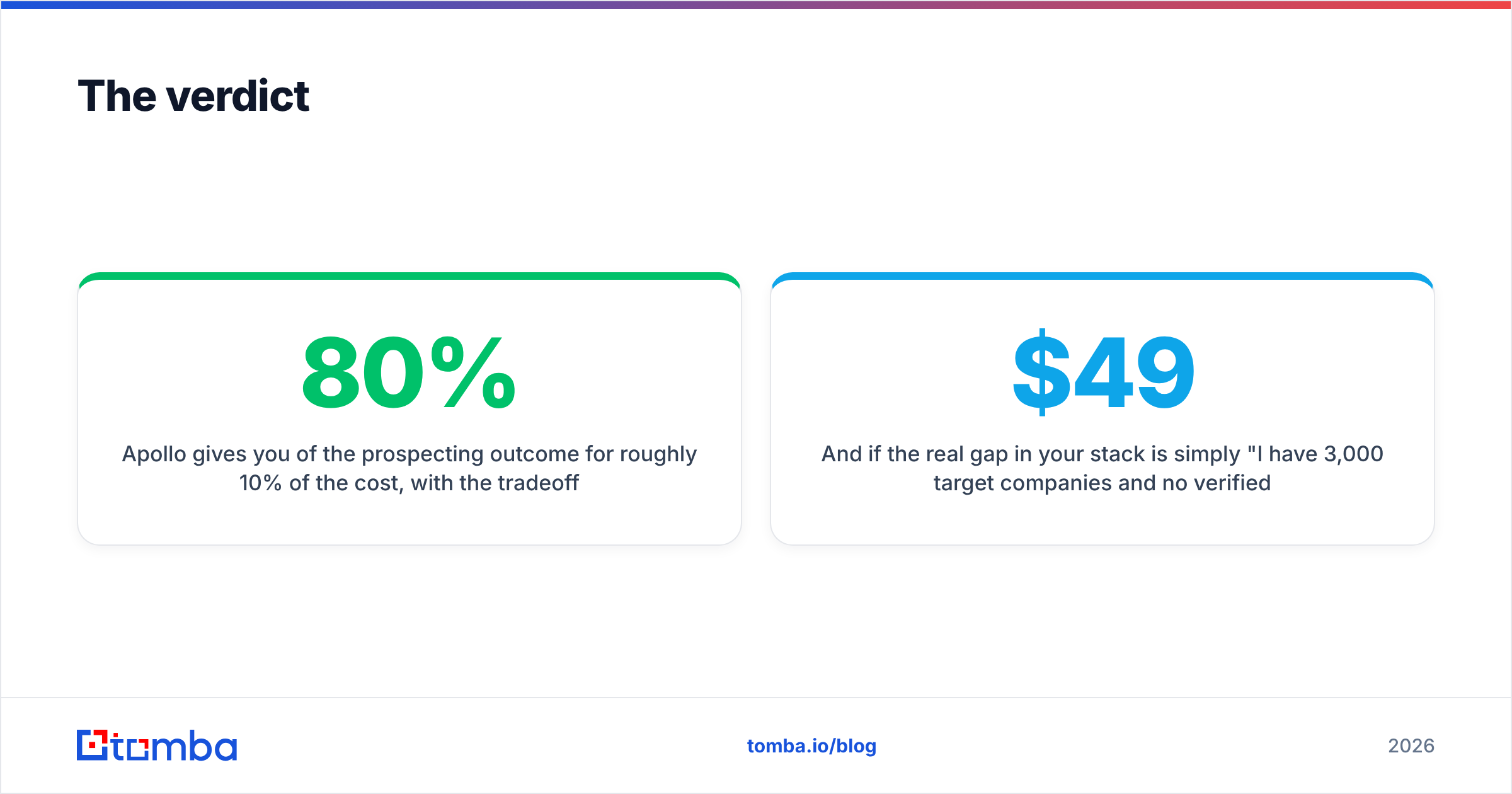
Apollo gives you 80% of the prospecting outcome for roughly 10% of the cost. The tradeoff is that you own more of the quality control. That's a good trade for teams selling into companies under 1,000 employees.
And if the real gap is "I have 3,000 target companies and no verified emails," neither platform is efficient. Start with Tomba Email Finder. It's free for 25 searches a month, $49/mo on Starter, and there's no annual contract. Verification lives in the same workflow, so you're not exporting bounces into your sending domain. Test it against your control list next to the two giants, then let the cost-per-deliverable-contact number decide.
Related guides#
Ready to find emails that actually work?
Join 150,000+ professionals who stopped guessing and started sending. Free credits on signup — no credit card required.
Get the Tomba newsletter
Practical outbound tactics and product updates — once every two weeks.
About the author