DiscoverOrg vs Exact Data: B2B Data Compared for 2026
DiscoverOrg (now ZoomInfo) sells enterprise intelligence at enterprise prices. Exact Data sells list files by the record. They solve different problems — here's which one actually fits your pipeline, and where a cheaper stack beats both.
TL;DR
- DiscoverOrg no longer exists as a standalone product. It merged with ZoomInfo in 2019 and the brand was folded into ZoomInfo SalesOS. When a vendor pitches you "DiscoverOrg," you are buying ZoomInfo — annual contract, seat-based, typically $15,000–$40,000+ per year.
- Exact Data is a list broker, not a platform. You buy a one-time file of records (postal, email, phone) filtered by criteria, priced per record — usually $0.10–$0.35 depending on volume and selects. No API, no refresh, no seat model.
- They are not really competitors. One sells continuously refreshed org charts, intent signals, and workflow integrations. The other sells a CSV. Comparing them is comparing a subscription to a purchase.
- Both fail the same test for most SMB and mid-market teams: you pay for volume you never touch. A verify-on-demand stack (find the email when you need it, verify before send) costs a fraction and produces cleaner sends.
- Our pick: ZoomInfo/DiscoverOrg if you sell six-figure deals into enterprise IT and need org charts plus intent. Exact Data if you need a one-off direct-mail or SMB list and accept decay. Neither if you run modern, targeted outbound — build the list yourself and verify at send time.
What is DiscoverOrg, and does it still exist in 2026?#
DiscoverOrg was a B2B contact and org-chart database founded in 2007, best known for human-researched IT department data — who reports to whom, what tech stack they run, what budget cycle they're on. It was the premium option when everyone else was scraping.
In February 2019, DiscoverOrg acquired ZoomInfo and then took the ZoomInfo name. By 2021 the DiscoverOrg product surface had been absorbed entirely into ZoomInfo SalesOS. Today, "DiscoverOrg" is a legacy search term, not a purchasable SKU. Legacy contracts have been migrated. Any reseller still using the name is selling you ZoomInfo credits.
That matters for this comparison because the thing people liked about DiscoverOrg — deep, human-verified org hierarchy in technology departments — still exists inside ZoomInfo, but it now comes bundled with a much larger, much pricier platform: intent data from Bombora, WebSights visitor ID, Engage sequencing, Chorus conversation intelligence. You cannot buy the org-chart slice alone.
What you actually get when you buy "DiscoverOrg" today:
- ZoomInfo SalesOS contact database — roughly 100M+ business contacts, 100M+ company profiles, with direct dials and mobile numbers as an upcharge tier.
- Org charts and reporting lines — the DiscoverOrg legacy strength, strongest in IT, finance, and HR functions at companies above 200 employees.
- Intent signals — topic-level buying signals sourced from a co-op of B2B publishers.
- Technographics — installed software and hardware per account, useful for displacement plays.
- Workflow integrations — native CRM sync to Salesforce and HubSpot, plus enrichment webhooks.
- Credit-metered exports — every contact you export burns credits, and credits typically do not roll over.
What is Exact Data, and how does its model differ?#
Exact Data is a Chicago-based list brokerage and data compiler. It sells targeted marketing lists — business and consumer — that you filter down using selects (industry, SIC/NAICS, employee count, revenue, job title, geography, and dozens of consumer attributes) and then purchase as a downloadable file.
The mental model is completely different. ZoomInfo is a subscription to a living database. Exact Data is a trip to the store: you specify what you want, you see a count, you pay for that count, you download the file. It's yours forever, and it starts decaying the moment you download it.
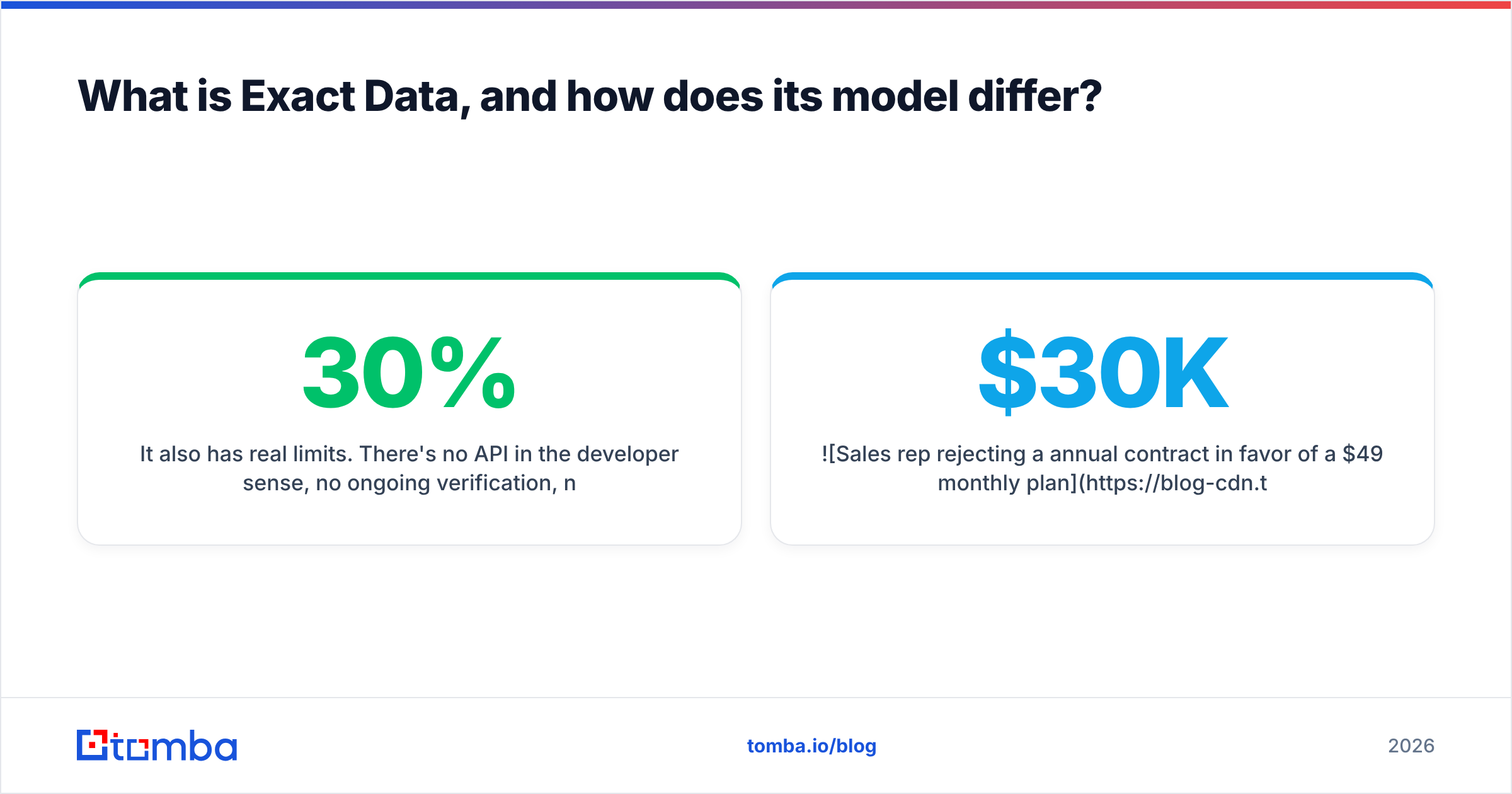
That model has real advantages. There's no annual commitment, no seat minimum, no procurement cycle. If you need 8,000 dentists in Texas for a direct-mail campaign next Tuesday, Exact Data will have that file to you today for a few hundred dollars. ZoomInfo will have you on a discovery call.
It also has real limits. There's no API in the developer sense, no ongoing verification, no org charts, no intent, and email deliverability on compiled B2B files is the persistent complaint across G2 and Capterra reviews of list brokers generally. B2B email data decays at roughly 22–30% per year — people change jobs, companies rebrand domains, roles get eliminated. A file you bought in January is measurably worse in July.

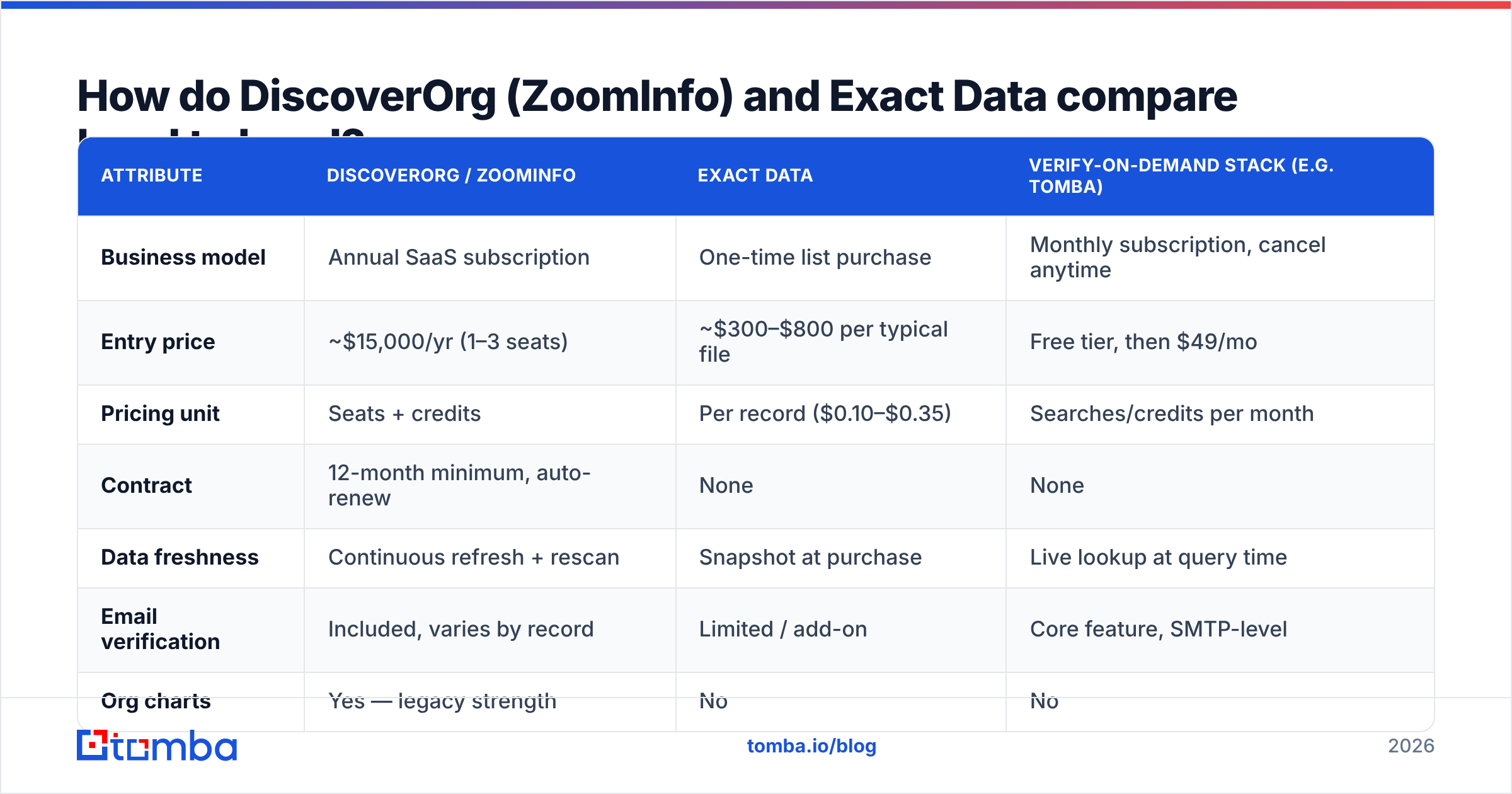
How do DiscoverOrg (ZoomInfo) and Exact Data compare head to head?#
| Attribute | DiscoverOrg / ZoomInfo | Exact Data | Verify-on-demand stack (e.g. Tomba) |
|---|---|---|---|
| Business model | Annual SaaS subscription | One-time list purchase | Monthly subscription, cancel anytime |
| Entry price | ~$15,000/yr (1–3 seats) | ~$300–$800 per typical file | Free tier, then $49/mo |
| Pricing unit | Seats + credits | Per record ($0.10–$0.35) | Searches/credits per month |
| Contract | 12-month minimum, auto-renew | None | None |
| Data freshness | Continuous refresh + rescan | Snapshot at purchase | Live lookup at query time |
| Email verification | Included, varies by record | Limited / add-on | Core feature, SMTP-level |
| Org charts | Yes — legacy strength | No | No |
| Intent data | Yes (Bombora co-op) | No | No |
| Direct dials / mobile | Yes, premium tier | Phone appends available | Phone finder included |
| API access | Enterprise tier only | No true REST API | Full REST API on all paid plans |
| Free trial | Gated demo, no self-serve | Free counts, no free records | 25 free searches/mo |
| Best for | Enterprise IT sales, ABM | Direct mail, SMB list buys | Targeted outbound, enrichment |
| Worst for | Small teams, tight budgets | Cold email at scale | Org-chart mapping, intent plays |
The row that decides most deals is the contract row. ZoomInfo's floor is not really $15,000 — that's the number you see quoted for a minimal seat count before direct dials, intent, or the integrations you'll actually want. Real mid-market deals land between $25,000 and $45,000 annually, and the auto-renewal clause is famously strict. Budget for legal review, not just spend approval.
Exact Data has no contract at all, which is genuinely the strongest argument in its favor. But the per-record price is deceptive on the low end. A file with heavy selects — title plus employee range plus verified email plus SIC code — pushes toward the top of the range, and you pay for every record whether it bounces or not.
Which one has better data accuracy?#
Neither vendor will hand you a bounce-rate SLA you can enforce, so treat published accuracy claims as marketing. What you can compare is method, because method predicts decay.
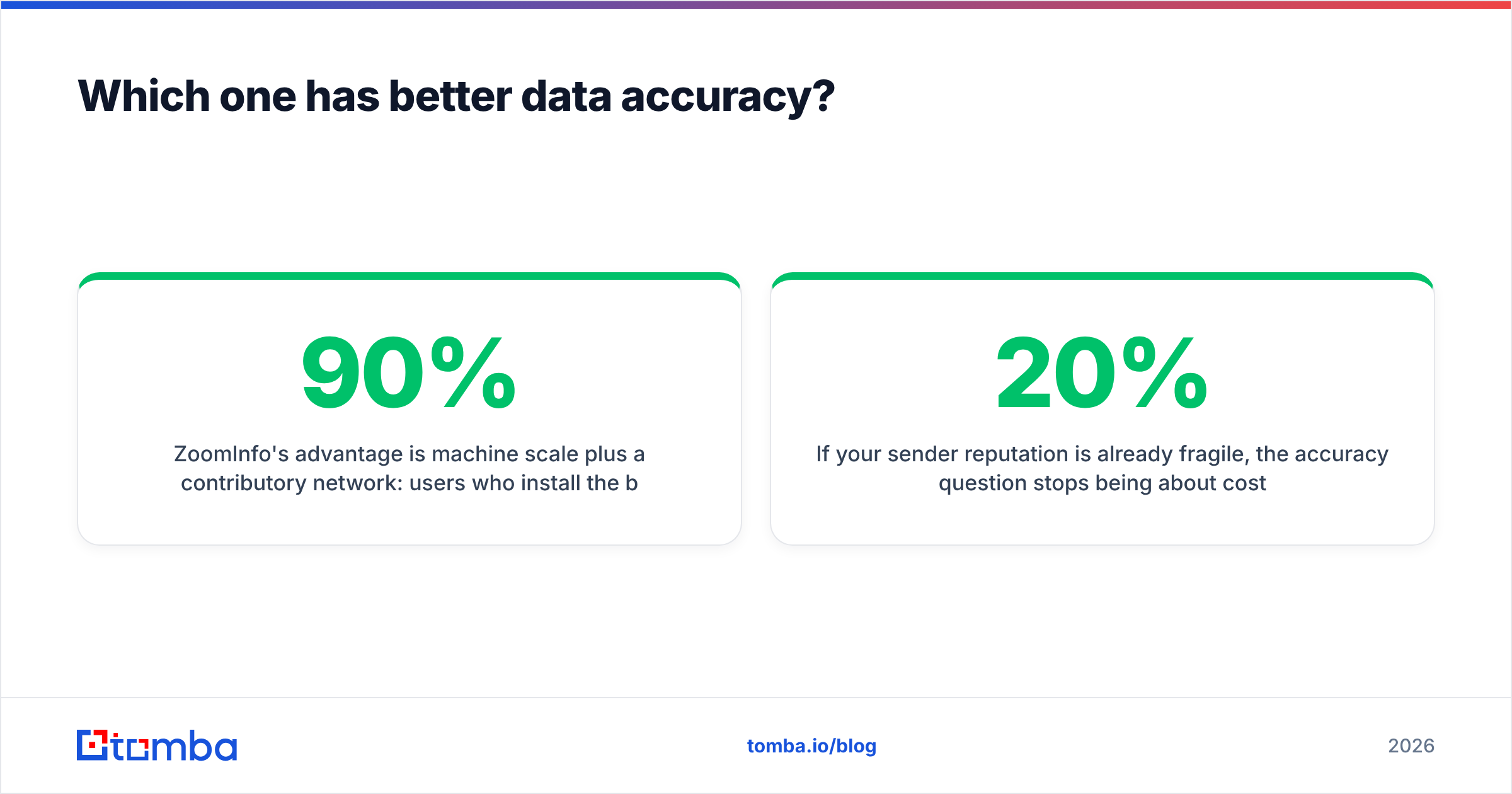
ZoomInfo's advantage is machine scale plus a contributory network: users who install the browser extension and connect their email contribute signal back, which is why ZoomInfo catches job changes faster than most compilers. Its published accuracy claims sit in the 90%+ range for emails on core records. In practice, teams report 8–15% bounce rates on unfiltered ZoomInfo exports, which is respectable for a database that size — and much worse if you export stale segments without re-verifying.
Exact Data compiles from public filings, directories, surveys, and partner sources, then appends. Compiled B2B email data is structurally weaker than contributed data because nothing tells the compiler when a contact leaves. Expect meaningfully higher bounce rates on cold email from a purchased file, and expect that number to climb every month you keep using the same file.
The practical fix for both is the same and it's not glamorous: re-verify before every send. Run any list — bought, exported, or scraped — through an email verifier that does SMTP-level checks and flags catch-all domains separately. Catch-alls are where most "verified" lists quietly hide their bounces; a catch-all verifier will tell you whether a mailbox on an accept-all domain is real rather than just guessing.

If your sender reputation is already fragile, the accuracy question stops being about cost per record and becomes about domain survival. A single 20% bounce campaign can push you into spam folders for months. Check your sender reputation before you upload anything from a purchased file.
Is DiscoverOrg worth the price for a small team?#
Almost never — and that's not a knock on the product.
ZoomInfo is priced and built for organizations where a single closed deal pays for the contract several times over. If your ACV is $80,000 and you're mapping buying committees of nine people across an IT org, the org charts and intent data pay for themselves. That's the use case DiscoverOrg was built for and it's still the best in class at it.
If your ACV is $3,000 and you sell to marketing managers at 20–200 person companies, you are paying enterprise rates for data you could assemble yourself. You'll use maybe 8% of the platform. The intent data will be noise at your deal size. The org charts will be thin for companies under 200 employees, which is exactly your ICP.
The three questions that settle it:
- Is your average deal above $25,000? If no, the contract math rarely works.
- Do you sell into companies above 500 employees? Below that, org-chart coverage thins out fast.
- Will more than three people log in weekly? Seats are the main price lever; underused seats are pure waste.
Two or three yeses means ZoomInfo is a defensible buy. Zero or one means you're buying status, not pipeline. Teams in that second bucket should look at a focused Apollo alternative or build a lookup-based stack instead.
When does buying a list from Exact Data actually make sense?#
There are legitimate cases, and dismissing list brokers wholesale is lazy analysis.
Buy the file when:
- You're running direct mail. Postal data decays far slower than email data, and physical addresses from a compiler are genuinely good. This is Exact Data's strongest play.
- You need SMB or local-business coverage. Database platforms skew toward companies with a web presence and LinkedIn footprint. Compilers reach the HVAC contractor with no marketing site.
- You need consumer-adjacent B2B segments. Franchise owners, independent practitioners, sole traders — a compiler often has them when ZoomInfo doesn't.
- It's a one-off campaign. Paying $600 once beats signing a $30,000 annual agreement for a single quarter's project.
Don't buy the file when:
- You plan to cold email it at volume without re-verification. That's how domains get burned.
- You need the data in your CRM continuously enriched. There's no live sync.
- You need job-change signals, org structure, or technographics. Compilers don't have them.
If you go this route, treat the purchased file as raw material rather than a finished list. De-duplicate it, drop role accounts, verify every address, and segment out catch-all domains into a separate low-volume send. The bulk verify workflow exists precisely for this — you upload the broker's CSV and get back a file you can actually mail.

What's the third option most teams should consider?#
Skip the database-versus-list-file framing entirely and build lists at the moment of need.
The logic is simple. A subscription database charges you for 100 million records so you can use 4,000. A list broker charges you for 8,000 records so you can email 5,200 that don't bounce. Both bill you for coverage you don't consume. A lookup-based stack inverts it: you define the accounts you want, then resolve contacts one account at a time.
The workflow, concretely:
- Build the account list first. Use funding announcements, hiring signals, tech-stack detection, or your own closed-won patterns. Fifty accounts you can name beats fifty thousand you filtered.
- Resolve the people. Run domain search per account to pull every discoverable mailbox with role and department context, then filter to your buying committee.
- Find specific contacts. When you know the name, the email finder resolves the address directly against the company's actual pattern rather than guessing.
- Verify before send. SMTP validation on every address, catch-all domains handled separately, hard bounces removed.
- Enrich what you keep. Push titles, seniority, and company firmographics into the CRM via data enrichment so scoring and routing work.
- Automate it. The Tomba API fits into whatever orchestration layer you already run — n8n, Make, Clay, or your own service.
This won't replace ZoomInfo for enterprise ABM. You won't get org charts or intent. What you will get is a per-usable-contact cost that's typically 5–15× lower, no annual commitment, and a bounce rate you control directly rather than inherit.
For teams weighing this against a compiled-list purchase, it's worth noting that reputable list vendors like BookYourData have moved toward pay-as-you-go pricing with verification built into the purchase — a genuinely better structure than the classic broker model, and a fair option if you specifically want to own a file outright rather than query an API.
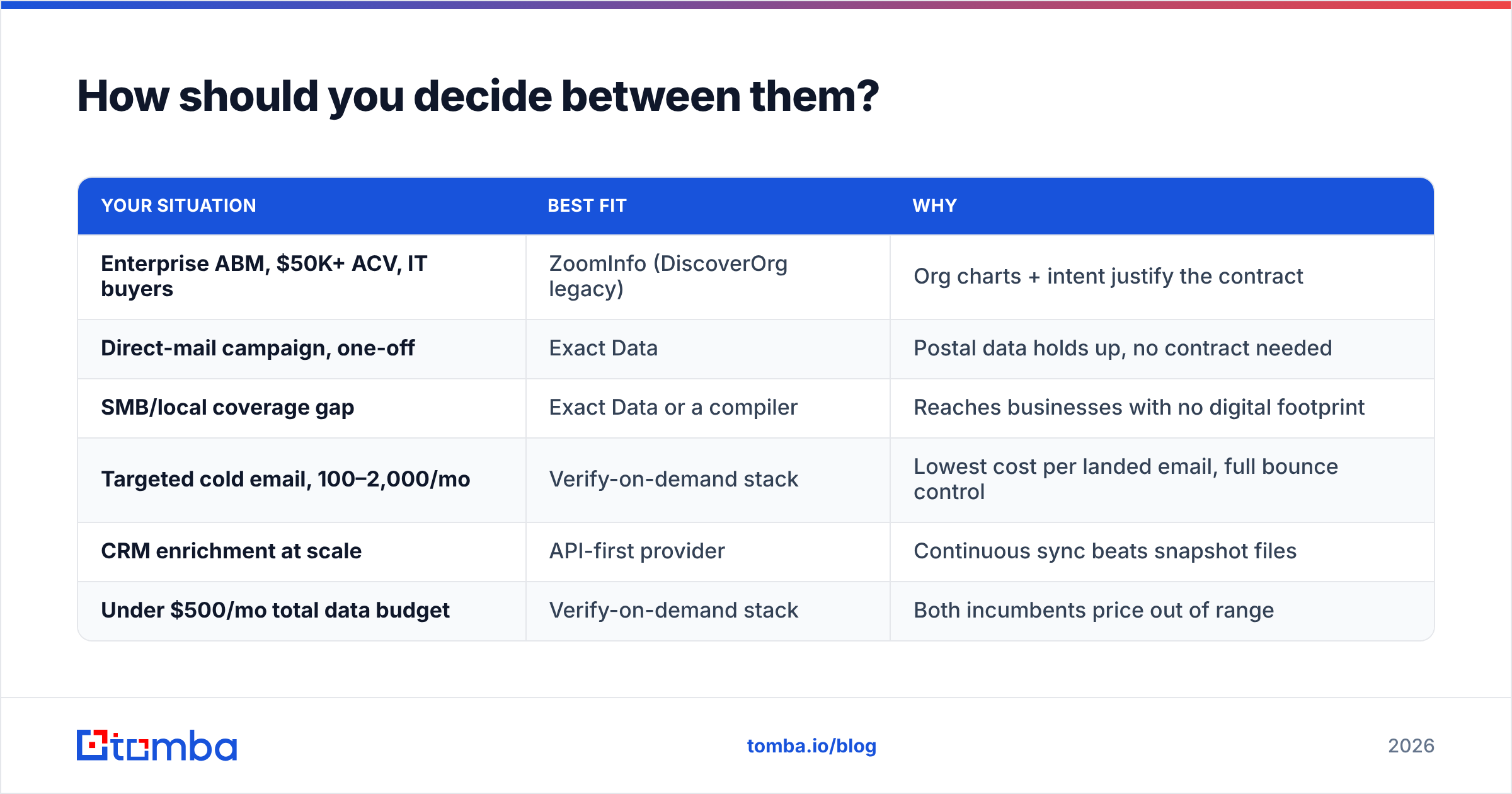
How should you decide between them?#
Match the tool to the motion, not to the feature list.
| Your situation | Best fit | Why |
|---|---|---|
| Enterprise ABM, $50K+ ACV, IT buyers | ZoomInfo (DiscoverOrg legacy) | Org charts + intent justify the contract |
| Direct-mail campaign, one-off | Exact Data | Postal data holds up, no contract needed |
| SMB/local coverage gap | Exact Data or a compiler | Reaches businesses with no digital footprint |
| Targeted cold email, 100–2,000/mo | Verify-on-demand stack | Lowest cost per landed email, full bounce control |
| CRM enrichment at scale | API-first provider | Continuous sync beats snapshot files |
| Under $500/mo total data budget | Verify-on-demand stack | Both incumbents price out of range |
One more consideration that gets ignored until renewal: exit cost. A ZoomInfo contract is hard to leave mid-term and the auto-renew window is short. An Exact Data file is yours but frozen. A monthly subscription you can cancel in-app has an option value that's worth real money when your GTM strategy shifts, which it will.
Also check what happens to data you've already exported. Most enterprise agreements restrict retention after termination. Read that clause before you build workflows that assume permanent access.
What does each option actually cost per usable contact?#
Headline pricing hides the number that matters. Work it backwards.
ZoomInfo scenario: $30,000/yr, 10,000 export credits, 12% bounce rate after verification. You get 8,800 usable contacts. That's $3.41 per usable contact — before you count the seats sitting idle.
Exact Data scenario: 10,000 records at $0.20 = $2,000, with a 25% bounce rate on compiled email. You get 7,500 usable contacts. That's $0.27 per usable contact, plus the verification cost to find out which 2,500 were dead.
Lookup stack scenario: Tomba Growth at $99/mo = $1,188/yr, with monthly credits resolving roughly 5,000 verified contacts/yr at your actual targeting depth, 3–5% bounce. That's under $0.25 per usable contact with the verification already applied and no contract.
The numbers shift with your volume and select depth, but the ranking rarely flips. Enterprise databases are the most expensive per contact by a wide margin. You're paying for the org charts and intent, not the emails — so only buy it if you'll genuinely use the org charts and intent. Full Tomba pricing is public if you want to run your own version of this math.
The verdict#
DiscoverOrg-as-ZoomInfo wins on depth and loses on price and flexibility. Exact Data wins on speed and commitment and loses on freshness and cold-email fitness. Neither is the default answer for a team running targeted outbound in 2026, because neither is priced for the way modern teams actually build lists — small, specific, verified at send time.
If you're mapping nine-person buying committees inside Fortune 500 IT departments, sign the ZoomInfo contract and use the org charts. If you're mailing 8,000 postcards to independent pharmacies, buy the Exact Data file. If you're doing anything in between — which is most people reading this — build the list yourself.
Start with the Tomba Email Finder. Search by domain, name, or company, get SMTP-verified addresses with confidence scores and sources, and run 25 searches a month free before you decide anything. Starter is $49/mo, Growth is $99/mo, and there's no annual contract to negotiate out of when your ICP changes next quarter.
Related guides#
Ready to find emails that actually work?
Join 150,000+ professionals who stopped guessing and started sending. Free credits on signup — no credit card required.
Get the Tomba newsletter
Practical outbound tactics and product updates — once every two weeks.
About the author