DiscoverOrg vs Extruct AI: Which B2B Data Tool Wins in 2026?
DiscoverOrg (now ZoomInfo) sells a curated org-chart database. Extruct AI builds company lists with research agents. Here is where each one actually wins — and where both leave you exposed.
TL;DR
- DiscoverOrg is now ZoomInfo. DiscoverOrg acquired ZoomInfo in 2019 and retired its own brand under the ZoomInfo name. If a rep pitches you "DiscoverOrg," you are buying a ZoomInfo contract — typically annual, five figures, seat-based.
- Extruct AI is a different category. It is an AI research-agent platform that builds and enriches company lists on demand instead of serving them from a pre-built database. You describe the ICP in plain language; agents crawl the web and return structured columns.
- Depth vs freshness is the real trade-off. ZoomInfo/DiscoverOrg gives you verified org charts, direct dials, and intent signals at scale. Extruct gives you custom, current attributes no static database tracks — funding nuance, tech mentions, hiring language.
- Neither is a cheap email source. ZoomInfo's contract floor prices out most small teams; Extruct's company research doesn't ship a verified contact-email layer of the same depth. A dedicated finder/verifier fills that gap for a fraction of either bill.
- Best combo for most teams in 2026: an AI research layer for account discovery, plus a pay-as-you-scale email finder and verifier for contact data — instead of one $30K platform you use at 20% capacity.
What is DiscoverOrg in 2026?#
DiscoverOrg no longer exists as a standalone product. It was a Vancouver, Washington company that built a reputation on one thing: human-verified org charts for IT, marketing, finance, and HR departments, refreshed on a research cadence rather than scraped once and forgotten. In February 2019 DiscoverOrg acquired ZoomInfo and adopted the ZoomInfo name for the combined company, which went public in 2020.
So when you evaluate "DiscoverOrg" today you are evaluating ZoomInfo's platform, and specifically the parts that came from DiscoverOrg's DNA:
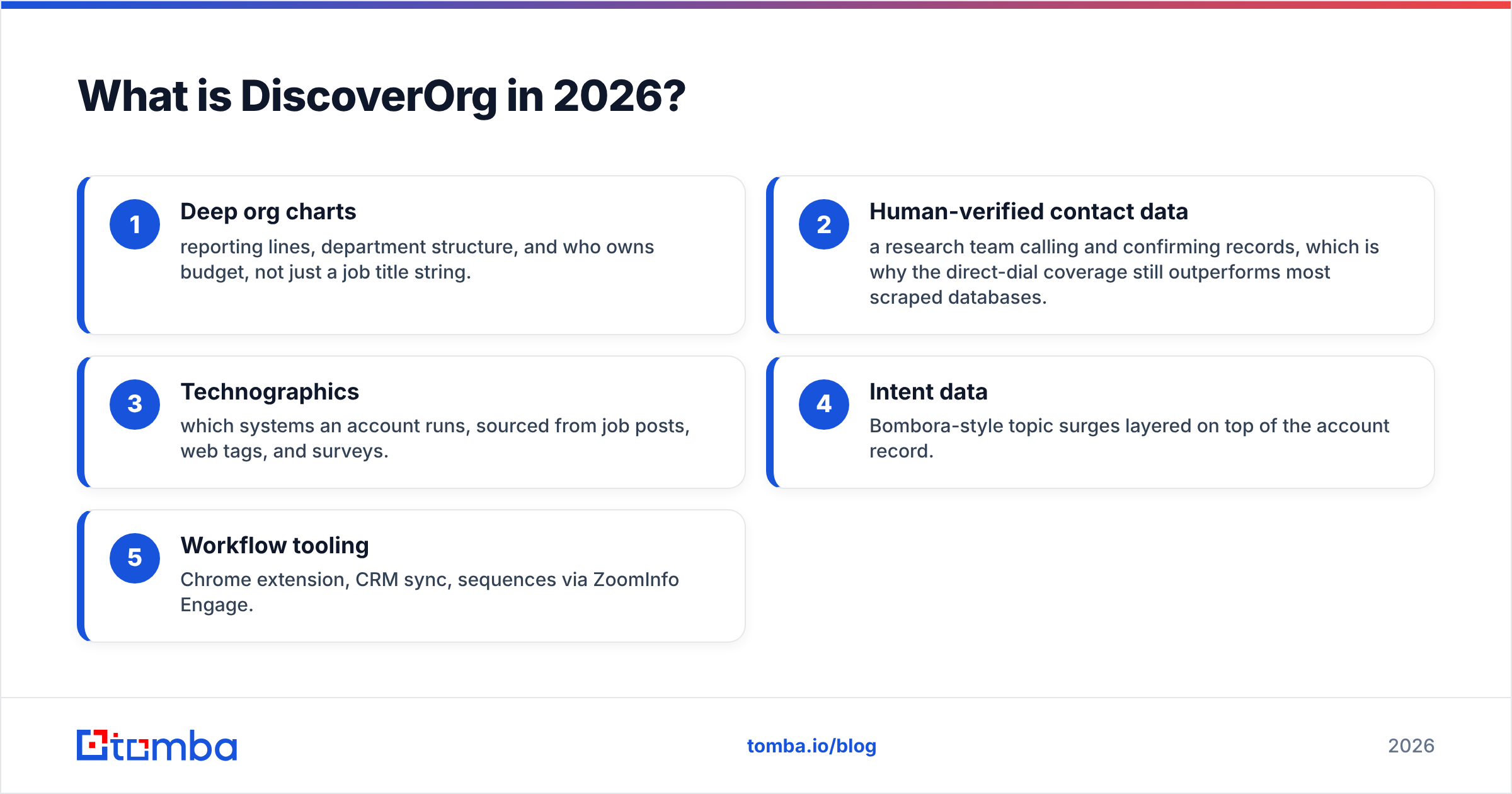
- Deep org charts — reporting lines, department structure, and who owns budget, not just a job title string.
- Human-verified contact data — a research team calling and confirming records, which is why the direct-dial coverage still outperforms most scraped databases.
- Technographics — which systems an account runs, sourced from job posts, web tags, and surveys.
- Intent data — Bombora-style topic surges layered on top of the account record.
- Workflow tooling — Chrome extension, CRM sync, sequences via ZoomInfo Engage.
That combination is genuinely strong for enterprise sales teams selling into large, structured organizations. It is also expensive and rigid, which is the entire reason a category of alternatives exists.

What is Extruct AI and how is it different?#
Extruct AI is an AI company-research platform. Instead of querying a database someone else pre-built, you define the research task — "seed-stage fintechs in the Nordics that mention SOC 2 on their site and have hired a compliance lead in the last six months" — and agents go read the web to assemble that list, column by column.
The mental model: DiscoverOrg is a library, Extruct is a research assistant. A library is fast and reliable for anything already on the shelf. A research assistant is slower per item but can answer questions no book covers.
Practically, that means Extruct excels at:
- Custom attributes. Any column you can describe in a sentence — "does this company sell to hospitals?", "do they mention a partner program?" — becomes a data field.
- Long-tail and non-US companies. Static databases thin out fast outside the Fortune 5000 and outside North America. Web research doesn't.
- Freshness on demand. The agent reads the site today, not whenever the vendor last refreshed the record.
- List building from a fuzzy ICP. You don't need to reverse-engineer someone's taxonomy of SIC codes.
And it falls short at:
- Person-level contact data. This is company intelligence first. Verified work emails and direct dials at scale are not the core promise.
- Determinism. Agent output needs spot-checking. A database row is wrong in predictable ways; an agent can be wrong in creative ones.
- Per-record speed at volume. Researching 50,000 accounts is a different cost curve than pulling 50,000 rows.
DiscoverOrg vs Extruct AI: how do they compare head to head?#
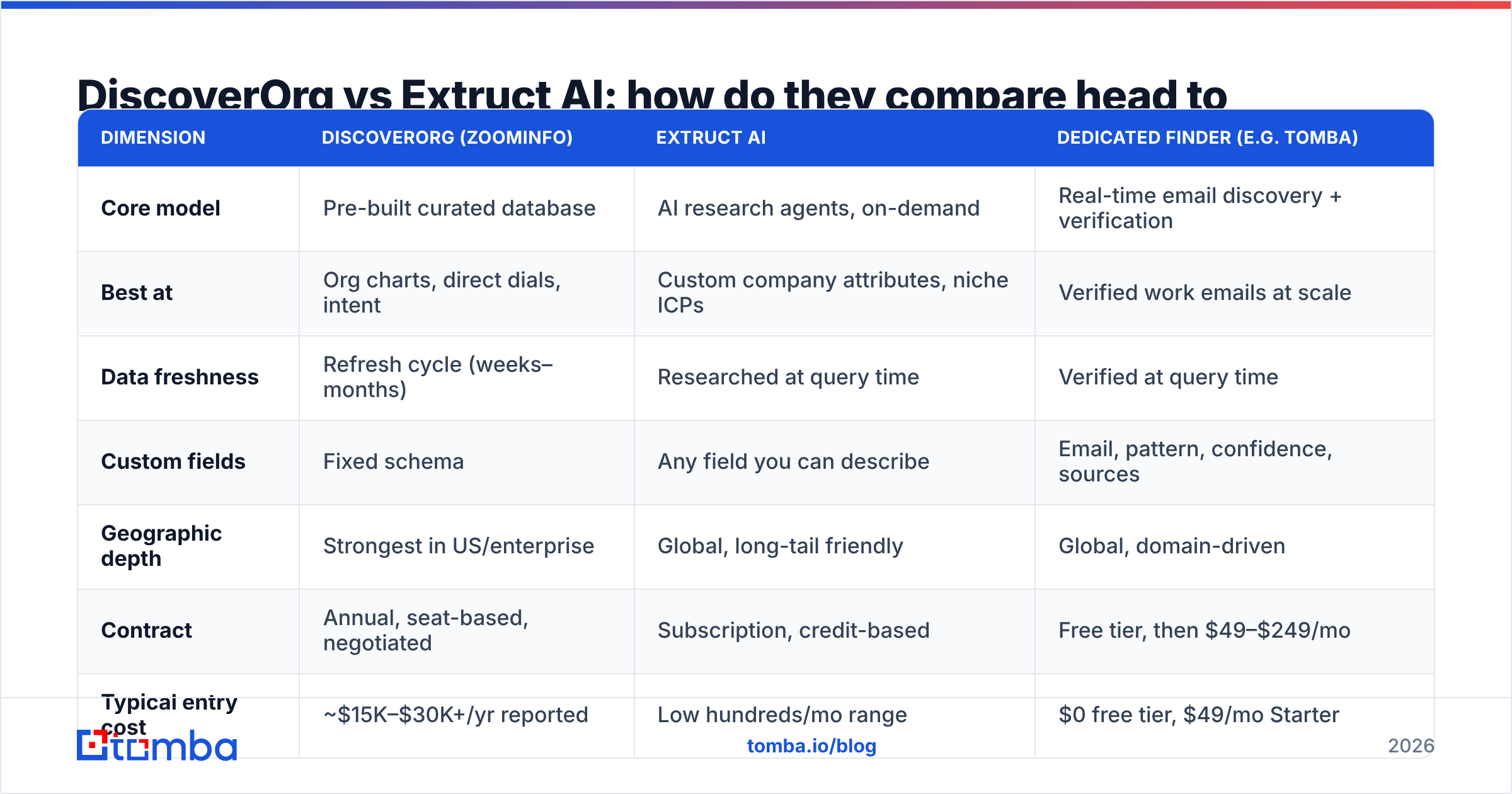
| Dimension | DiscoverOrg (ZoomInfo) | Extruct AI | Dedicated finder (e.g. Tomba) |
|---|---|---|---|
| Core model | Pre-built curated database | AI research agents, on-demand | Real-time email discovery + verification |
| Best at | Org charts, direct dials, intent | Custom company attributes, niche ICPs | Verified work emails at scale |
| Data freshness | Refresh cycle (weeks–months) | Researched at query time | Verified at query time |
| Custom fields | Fixed schema | Any field you can describe | Email, pattern, confidence, sources |
| Geographic depth | Strongest in US/enterprise | Global, long-tail friendly | Global, domain-driven |
| Contract | Annual, seat-based, negotiated | Subscription, credit-based | Free tier, then $49–$249/mo |
| Typical entry cost | ~$15K–$30K+/yr reported | Low hundreds/mo range | $0 free tier, $49/mo Starter |
| Time to first list | Days (onboarding + training) | Minutes | Minutes |
| Best fit | Enterprise AE teams, ABM | Founders, RevOps, research-heavy GTM | Any team needing contactable emails |
The table makes the strategic point better than paragraphs do: these tools do not actually compete for the same job. They compete for the same budget line.
Where DiscoverOrg/ZoomInfo clearly wins#
- You sell six-figure deals into companies with 500+ employees and need to know who reports to whom.
- Direct dials matter because your motion is phone-first.
- You need intent signals wired into your CRM with an ops team to act on them.
- Procurement expects a single vendor with SOC 2, DPAs, and a named CSM.
Where Extruct AI clearly wins#
- Your ICP is defined by behavior or content, not firmographics ("companies running a partner program", "agencies that white-label").
- You sell into markets a US-centric database barely covers.
- You are a small team that needs 500 great accounts, not 500,000 mediocre ones.
- You want to iterate the ICP weekly instead of renegotiating a data contract.
Is ZoomInfo's pricing worth it in 2026?#
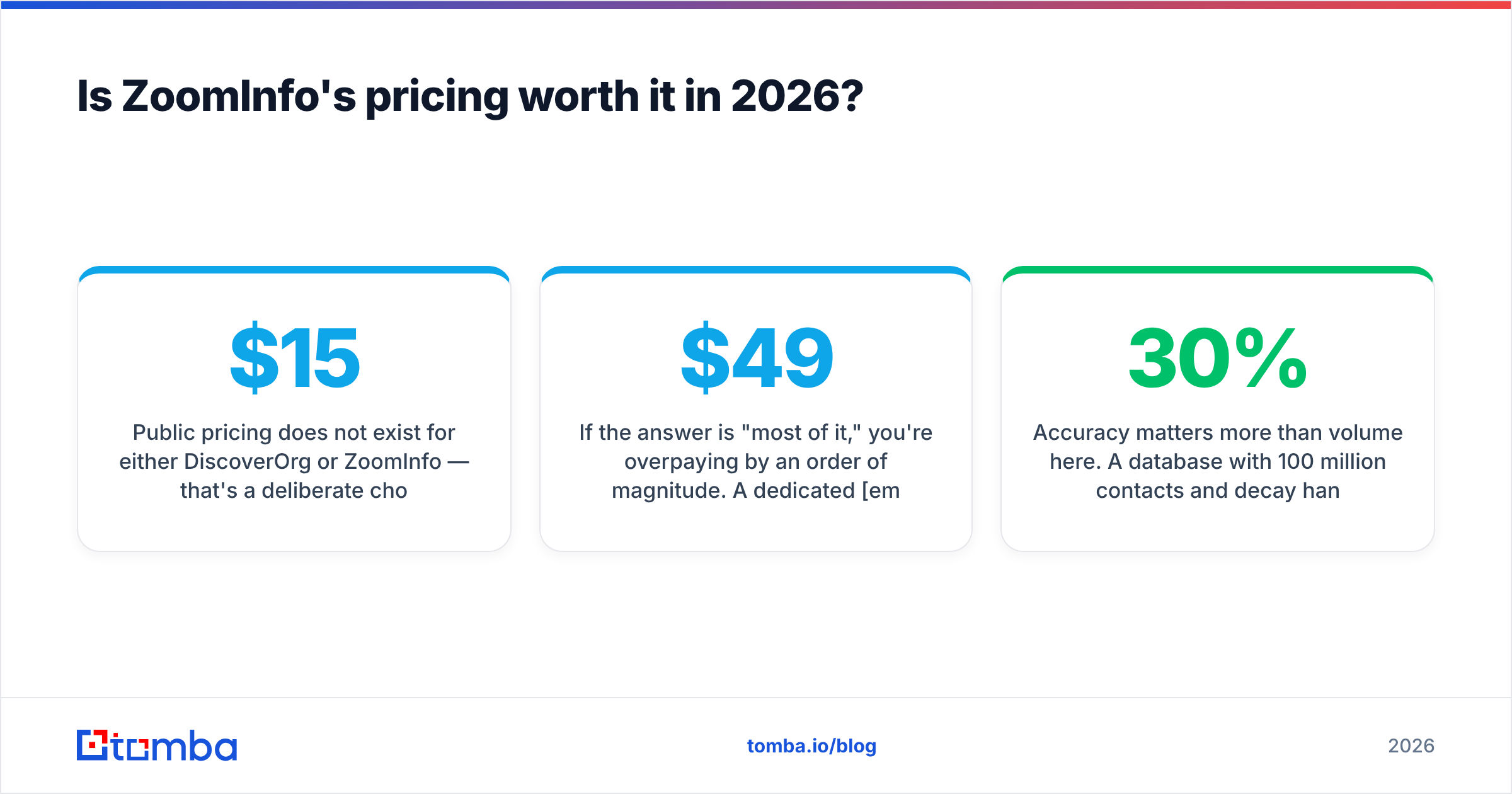
Public pricing does not exist for either DiscoverOrg or ZoomInfo — that's a deliberate choice, and it's the single most common complaint in buyer reviews on G2. Reported contracts cluster in the $15,000–$30,000+ per year range for a small team, with credits, seats, and add-on modules (intent, Engage, Chorus) priced separately. Auto-renewal clauses have been a persistent friction point.
Extruct sits in a completely different bracket — a normal SaaS subscription with credit consumption, typically startable in the low hundreds per month.
Here is the honest budgeting question most teams skip: what percentage of that contract are you buying for emails?
If the answer is "most of it," you're overpaying by an order of magnitude. A dedicated email finder plus an email verifier does that specific job at $49/mo on Tomba's Starter plan, $99/mo on Growth, and $249/mo on Pro, with a free tier at 25 searches to test accuracy before you commit. See full Tomba pricing for credit breakdowns.

Accuracy matters more than volume here. A database with 100 million contacts and 30% decay hands you a bounce problem, not a pipeline. Records rot at roughly 25–30% per year as people change jobs — which is why "verified at query time" beats "verified at some point" for any contact you're about to email.
How do you evaluate data quality between them?#
Run the same test on both, with your own list. Vendors' accuracy claims are marketing; your ICP is the only benchmark that matters.
- Build a 50-account golden set. Pick accounts where you already know the truth — customers, churned logos, companies where you have a friend on the inside.
- Pull the same fields from each tool. Company size, industry, one custom attribute, and (where available) 3 contacts per account.
- Score coverage separately from accuracy. A tool that returns nothing for 40% of your list is failing differently than one that returns wrong data for 40%.
- Verify every email before you count it. Run the output through an independent email verification pass. Vendor-side "verified" flags are graded by the vendor.
- Check catch-all handling. Roughly a fifth of B2B domains are catch-all. If a tool marks every catch-all address as valid, its accuracy number is fiction — a catch-all verifier tells you what's actually deliverable.
- Re-run in 60 days. Freshness is the variable nobody tests, and it's the one that determines whether year two of the contract is worth it.

What are the realistic alternatives to both?#
The market has split into three layers, and the smartest 2026 stacks buy each layer separately instead of paying a platform tax for a bundle.
Layer 1 — Account discovery. Extruct AI, Clay, Ocean.io, and similar research-first tools. You're paying for "which companies should I care about."
Layer 2 — Contact data. Tomba, Hunter, Apollo, Findymail, and BookYourData — a solid pay-as-you-go option if you specifically want to buy a pre-built list with per-record credits rather than run searches yourself. You're paying for "how do I reach the right person."
Layer 3 — Execution. Instantly, Smartlead, Salesloft, Outreach. You're paying for sending, sequencing, and reply handling.
ZoomInfo/DiscoverOrg tries to own all three. That's convenient if you use all three, and expensive if you don't. Many teams that leave the platform find they were really only using layer 2 — which is why Apollo alternatives and Clearbit alternatives are among the highest-traffic searches in this category.
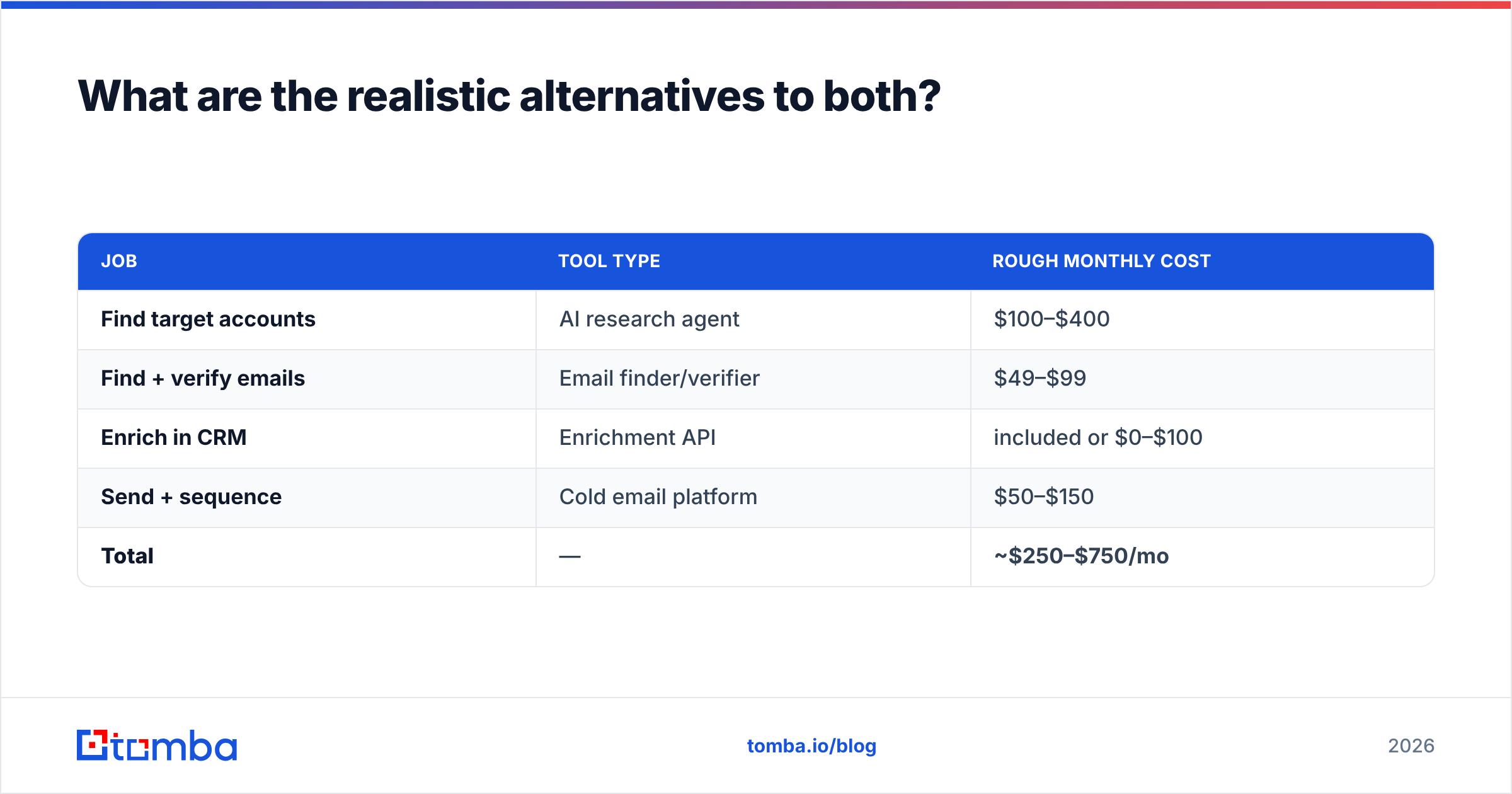
A pragmatic 2026 stack for a 5-person sales team:
| Job | Tool type | Rough monthly cost |
|---|---|---|
| Find target accounts | AI research agent | $100–$400 |
| Find + verify emails | Email finder/verifier | $49–$99 |
| Enrich in CRM | Enrichment API | included or $0–$100 |
| Send + sequence | Cold email platform | $50–$150 |
| Total | — | ~$250–$750/mo |
That's $3K–$9K a year for capability that a single enterprise data contract prices at $25K+. The trade-off is integration work — you own the plumbing instead of buying a suite. For most teams under 20 reps, that trade is clearly worth it. Above that, the ops overhead starts favoring consolidation.
Which should you choose?#
Choose DiscoverOrg/ZoomInfo if: you're an enterprise sales org, org charts and direct dials are load-bearing for your motion, you have RevOps capacity to operationalize intent data, and a five-figure annual contract is a rounding error against deal size. Negotiate hard — list price is a starting position, and ask specifically about auto-renewal terms and credit rollover.
Choose Extruct AI if: your ICP resists firmographic filters, you're building lists that no static database can produce, you're global or long-tail, and you'd rather iterate weekly than commit annually. Budget for a human QA pass on agent output.
Choose neither if: your actual problem is "I have a list of companies and I need to reach a specific role at each one." That's an email discovery problem, and it's solved for two orders of magnitude less money. Use domain search to pull every public address at a target company, or bulk verify an existing list before your next campaign.
What questions should you ask on the sales call?#
Come armed. Both vendors will happily let you self-select into the wrong plan.
- What is the total first-year cost including onboarding, add-on modules, and overage — not just the seat price?
- Do unused credits roll over? What happens at renewal?
- What is the auto-renewal notice window, in writing?
- How is "verified" defined? Date of last verification per record?
- What's your coverage in [specific country/segment]? Show me on my 50-account list, not yours.
- Can I export? Under what license? What happens to exported data if I churn?
- For Extruct specifically: what's the accuracy rate on custom attributes, and how do I audit it?
The vendors who answer these cleanly are the ones worth buying from. Evasion on the auto-renewal question in particular tells you what year two will feel like.
The bottom line#
DiscoverOrg vs Extruct AI isn't really a fair fight because they solve different problems: one hands you a curated enterprise database with org charts and dials, the other hands you a research agent that answers questions no database has indexed. Pick based on whether your bottleneck is depth on known accounts or discovery of unknown ones.
But before you sign either contract, price out the layer you actually use most. If the honest answer is "I mostly need correct, deliverable email addresses for people at companies I've already identified," you don't need a $25K platform or an agent swarm — you need a finder that gets the address right the first time.
Start free with the Tomba Email Finder — 25 searches a month at no cost, no card, no annual commitment. Test it against your golden-set accounts alongside whatever enterprise quote is sitting in your inbox, and let the bounce rate decide. If it holds up, Starter is $49/mo and scales to bulk and API access as your pipeline does.
Related guides#
Ready to find emails that actually work?
Join 150,000+ professionals who stopped guessing and started sending. Free credits on signup — no credit card required.
Get the Tomba newsletter
Practical outbound tactics and product updates — once every two weeks.
About the author