DiscoverOrg vs Forager: Which B2B Data Tool Wins in 2026?
DiscoverOrg (now ZoomInfo) and Forager sit at opposite ends of the B2B data market — one enterprise-priced and org-chart deep, the other lean and email-first. Here's which one actually fits your team.
DiscoverOrg vs Forager is a lopsided matchup, and the price tag is the tell. One is an enterprise intelligence platform. The other is a lean email finder. Here is what each one costs, what it actually buys you, and which side of the line your team sits on.
TL;DR
- DiscoverOrg is now ZoomInfo. The two merged in 2019 and the DiscoverOrg brand was retired. If a vendor still sells you "DiscoverOrg" in 2026, you are buying ZoomInfo SalesOS under an old name.
- Forager is the lean side of the matchup. It is a smaller, email-and-contact-focused tool built for single reps and small teams. No five-figure annual contract.
- Price is the real decision driver. Enterprise org-chart data runs about $15,000–$40,000 a year on an annual commitment. Lean email-first tools start under $100 a month.
Neither tool wins outright. Two more things to weigh:
- Fit beats features. Sell six-figure deals into IT and need reporting-structure depth? You need the enterprise stack. Send 500–3,000 cold emails a month? You are paying for 90% of features you will never open.
- A third path exists. Pair a cheap, accurate email finder (Tomba starts at $49/mo, free tier 25 searches) with a targeted list source. You get 80% of the workflow at roughly 5% of the cost.
What is DiscoverOrg and does it still exist in 2026?#
Short answer: DiscoverOrg exists as technology, not as a brand you can buy.
DiscoverOrg launched in 2007. It built its name on something most data vendors skipped — human-verified org charts. Not just "here is a contact at Acme." More like: here is the VP of Infrastructure, here are her four direct reports, here is the budget owner, and here is the ticketing system they run. That depth made it the default for enterprise IT and security sellers, who had to map a buying committee before the first call.
In February 2019, DiscoverOrg acquired ZoomInfo. The combined company then took the ZoomInfo name. Today the old DiscoverOrg dataset lives inside ZoomInfo SalesOS. The org-chart layer, the technographic signals, and the research-team verification all survived the merger. The standalone product did not.
Why does that matter here? Because a DiscoverOrg vs Forager comparison in 2026 pits an enterprise, annually-contracted platform against a lightweight contact finder. The two were never in the same weight class. The merger only widened the gap.
What is Forager and who is it built for?#
Forager finds and exports business emails without an enterprise procurement cycle. It sits in the same category as Hunter, Findymail, Apollo's data layer, and Tomba. All of them turn a name plus a domain into a deliverable email address. Most add a browser extension and a bulk CSV workflow.
The buyer profile is clear: a founder doing their own outbound, a two-to-five person SDR team, an agency running lead-gen for clients, or a recruiter sourcing candidates. They care about three things — cost per verified contact, bounce rate, and how fast a list gets into their sequencer.
Forager-class tools skip the heavy machinery on purpose. No reporting hierarchies. No intent scoring from third-party bidstream data. No two-way Salesforce sync. No research team re-verifying records on a fixed cycle. Those are enterprise features, and they carry enterprise prices.

DiscoverOrg vs Forager: how do they compare head-to-head?#
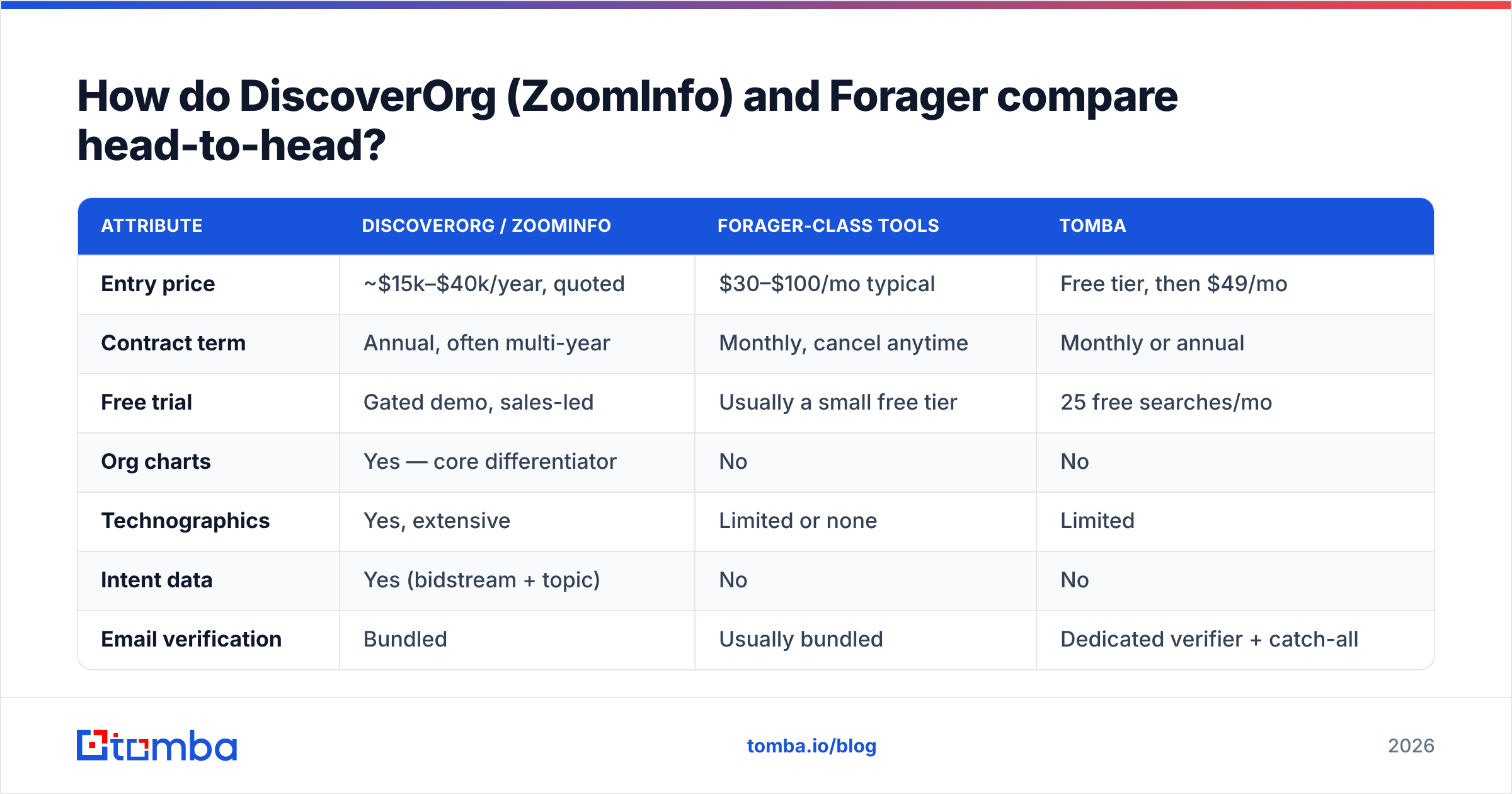
Here is the practical breakdown. Enterprise pricing is quote-based and shifts with seat count, credit volume, and module bundle. Treat the figures below as the commonly reported market range, not a published rate card.
| Attribute | DiscoverOrg / ZoomInfo | Forager-class tools | Tomba |
|---|---|---|---|
| Entry price | ~$15k–$40k/year, quoted | $30–$100/mo typical | Free tier, then $49/mo |
| Contract term | Annual, often multi-year | Monthly, cancel anytime | Monthly or annual |
| Free trial | Gated demo, sales-led | Usually a small free tier | 25 free searches/mo |
| Org charts | Yes — core differentiator | No | No |
| Technographics | Yes, extensive | Limited or none | Limited |
| Intent data | Yes (bidstream + topic) | No | No |
| Email verification | Bundled | Usually bundled | Dedicated verifier + catch-all |
| Direct dials / mobile | Strong coverage | Limited | Phone finder available |
| API access | Yes, enterprise tier | Varies | Yes, all paid plans |
| Best for | Enterprise ABM, IT sales | Solo founders, small SDR teams | Cost-conscious outbound at scale |
The table makes the trade obvious. You are not picking between two versions of the same thing. You are picking between an intelligence platform and a contact resolver.
Which one actually fits your sales motion?#
Use this as a decision filter, not a feature checklist. Start with the three questions that carry the most weight:
- What is your average contract value? Below $10k ACV, an enterprise data contract eats your whole tooling budget and never pays back. Above $75k ACV with six or more stakeholders per deal, org-chart data really does shorten cycles.
- How many net-new contacts do you need each month? Under 2,000, a per-credit email finder is cheaper. Above 20,000 with heavy filtering, platform-level exports start to pay off.
- Do you sell into IT, security, or engineering? This is where the legacy DiscoverOrg dataset is strongest. Technographics tell you who runs Okta and who runs Ping before you write a line.
Two more questions settle the close calls:
- Who owns the tool? Enterprise platforms need an admin. If nobody owns data hygiene, CRM mapping, and credit governance, you will waste 40% of the contract.
- Is your bottleneck data or messaging? Be honest. Most teams under 10 reps have a volume and messaging problem, not a data problem. Better data will not fix a 0.8% reply rate.
If three or more answers point small, you are a Forager-class buyer. Compare the whole lean category, not just one vendor.
What about accuracy and bounce rates?#
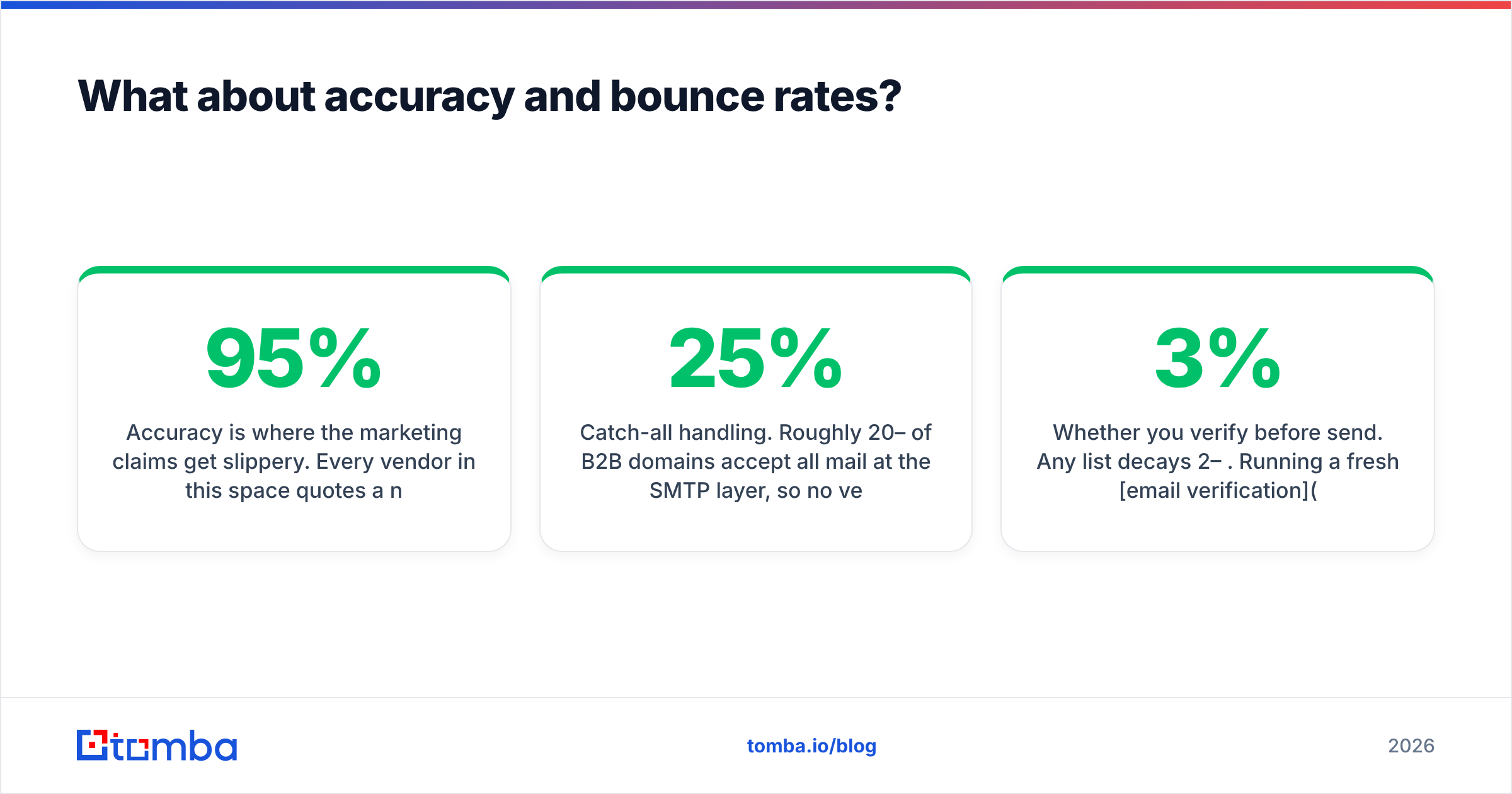
Accuracy is where the marketing gets slippery. Every vendor quotes a number between 95% and 99%. Those numbers are measured differently enough to be useless side by side.
Three things drive your real-world bounce rate:
- Recency of the record. A pattern-matched email for someone who left in March has valid syntax and a live domain. It still bounces. Enterprise platforms with research teams re-verify on a cycle. Cheap tools often do not.
- Catch-all handling. Roughly 20–25% of B2B domains accept all mail at the SMTP layer. No verifier can confirm a single mailbox by handshake alone. How a tool labels those records — "valid," "risky," or "catch-all" — swings measured accuracy by double digits. Tomba splits this out with a dedicated catch-all verifier instead of hiding the doubt behind one green checkmark.
- Whether you verify before send. Any list decays 2–3% a month. A fresh email verification pass right before a campaign matters more than which vendor sourced the record.

So do not buy on quoted accuracy. Pull 100 records from each tool against your real ICP. Run them through a neutral verifier. Then send a small test batch. The vendor whose records hold up on your segment wins, whatever the datasheet says.
What does the DiscoverOrg vs Forager price gap really cost you?#
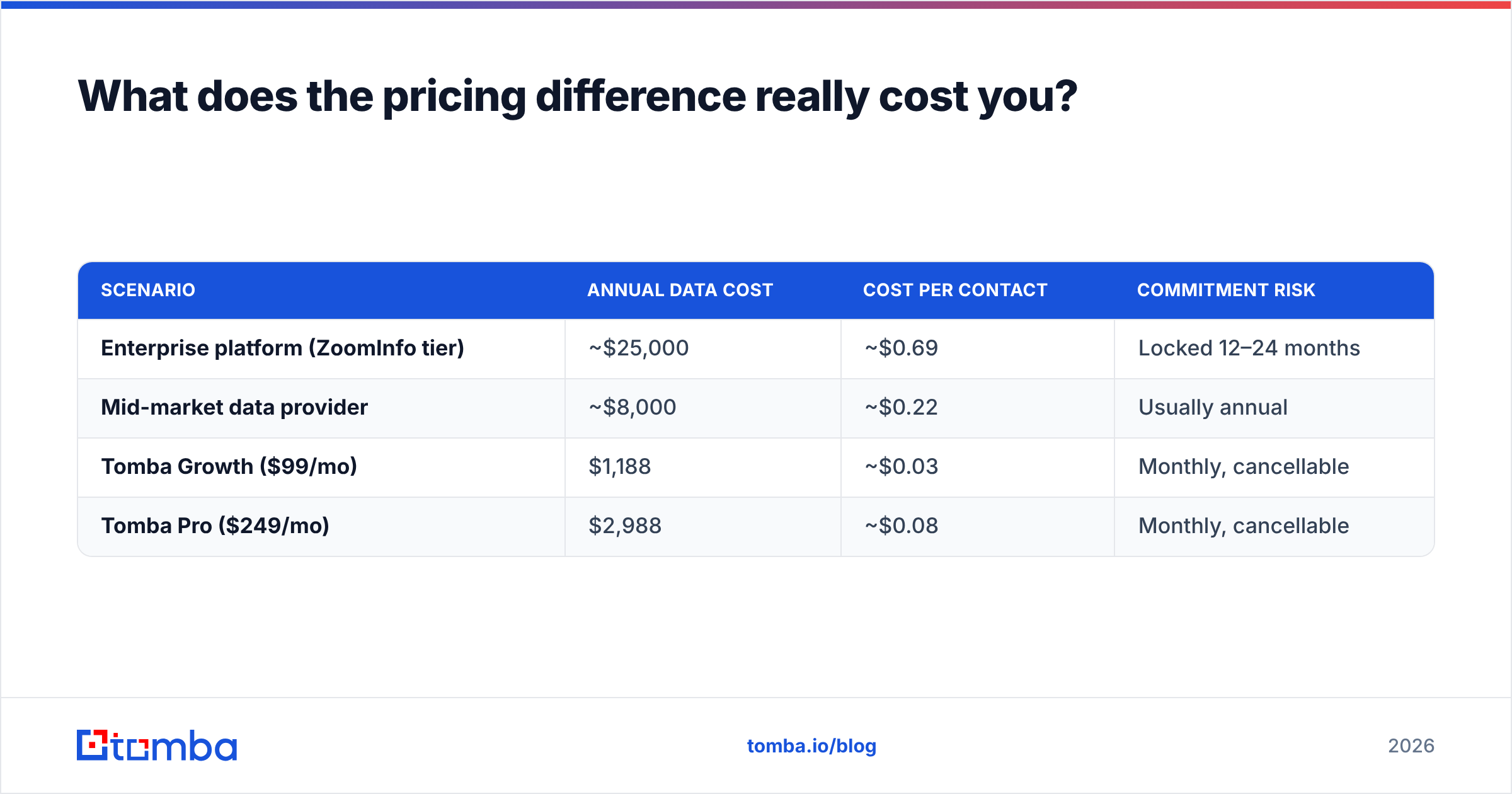
Run the math on a five-person outbound team that needs 3,000 verified contacts a month.
| Scenario | Annual data cost | Cost per contact | Commitment risk |
|---|---|---|---|
| Enterprise platform (ZoomInfo tier) | ~$25,000 | ~$0.69 | Locked 12–24 months |
| Mid-market data provider | ~$8,000 | ~$0.22 | Usually annual |
| Tomba Growth ($99/mo) | $1,188 | ~$0.03 | Monthly, cancellable |
| Tomba Pro ($249/mo) | $2,988 | ~$0.08 | Monthly, cancellable |
That is a 20x spread on the same core job: get a deliverable email into a sequencer. The enterprise premium buys intent signals, org charts, direct dials, and native CRM sync. Use all four and it is defensible. Use one and it is not.
There is also a hidden cost most buyers miss — credit expiry. Enterprise contracts often reset unused credits each year instead of rolling them over. Teams that ramp slowly in Q1 routinely forfeit 30–40% of what they paid for. Monthly tools avoid this, because you never pre-buy twelve months of volume.

What are the strongest alternatives to both?#
If neither end of the barbell fits, the middle is crowded and getting better. Start with these three:
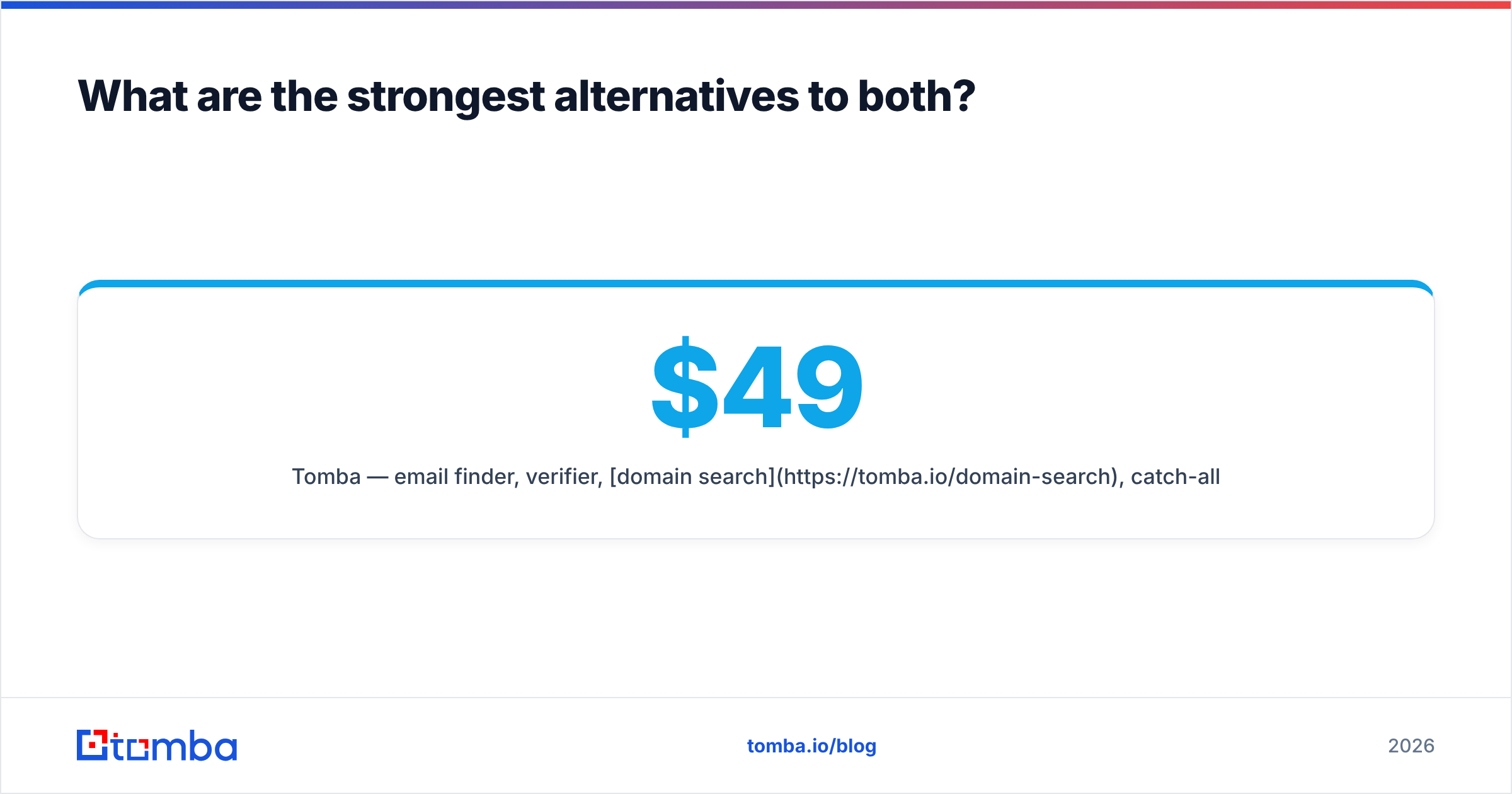
- Tomba — email finder, verifier, domain search, catch-all detection, and enrichment on monthly billing. Free tier at 25 searches, Starter $49/mo, Growth $99/mo, Pro $249/mo. Tomba pricing is public, which is rare in a category built on quote-gating.
- BookYourData — a solid pick when you want pre-built, pay-as-you-go B2B lists with a bounce guarantee. Good for teams that want to buy one targeted list instead of managing credits every month.
- Apollo.io — bundles data with sequencing, which suits teams consolidating tools. Data depth is mid-tier; the sequencer is the real value. See the Apollo alternative breakdown if you are weighing consolidation against best-of-breed.
Two more are worth a look if your needs skew toward enrichment or EMEA:
- Clearbit / HubSpot Breeze Intelligence — enrichment-first, not prospecting-first. Strong if inbound volume is high and you mainly need to fill in fields on records you already have.
- Cognism — the most common enterprise rival to ZoomInfo, especially in EMEA. Phone-verified mobile coverage and GDPR posture are its edge.
Cross-check any shortlist against verified reviews on G2, filtered to your company size. Enterprise reviews of enterprise tools say almost nothing about the SMB experience, and the reverse holds too.
How should you actually run the evaluation?#
Skip the demo-first instinct. Do this instead:
- Build a 100-row ICP sample by hand. Real companies you would target, with named roles. This is your benchmark set.
- Ask every vendor to enrich it during the trial. If a vendor will not run your sample before you sign, that is your answer.
- Verify all outputs through one neutral tool. Do not let each vendor grade its own homework. Run every list through the same email verifier.
- Send a 50-contact test campaign per source. Measure hard bounces, spam complaints, and reply rate. Deliverability beats coverage claims every time.
- Price the winner over 24 months, not 12. Include seat expansion, overage rates, and whether credits roll over. Ask about auto-renewal terms — that is where the surprises live.
Most teams that run this process find the same thing. Their coverage gap was 10–15%, not the 50% the enterprise pitch implied. A cheaper stack plus disciplined verification closes it.
The verdict on DiscoverOrg vs Forager#
Buy the enterprise platform (ZoomInfo, the DiscoverOrg lineage) if you sell high-ACV deals into technical buying committees, someone owns data operations, and org charts plus technographics change how you sequence. That is a real use case, and nothing in the lean category replaces it.
Buy a Forager-class tool if your job is turning names and domains into deliverable emails at fair volume, you want monthly billing, and you would rather spend the difference on sending infrastructure or a better copywriter.
Buy a targeted list from a provider like BookYourData if you need one specific segment and do not want to manage a subscription at all.
The one thing not to do is buy enterprise depth to fix a volume problem. That is the most common and most expensive mistake in this category.
Landed on the lean side of that call? Start with the Tomba Email Finder. The free tier gives you 25 searches a month. That is enough to run the 100-row benchmark above against a real slice of your ICP before you spend anything. Paid plans start at $49/mo and include the verifier, domain search, catch-all detection, and the Tomba API, on monthly billing you can cancel. Test it against whatever quote you are holding, and let the bounce rates decide.
Related guides#
Ready to find emails that actually work?
Join 150,000+ professionals who stopped guessing and started sending. Free credits on signup — no credit card required.
Get the Tomba newsletter
Practical outbound tactics and product updates — once every two weeks.
About the author