DiscoverOrg vs FullCircl: Which B2B Data Tool Wins in 2026?
DiscoverOrg (now ZoomInfo) and FullCircl solve different problems under the same "B2B data" label. Here's the honest breakdown of coverage, pricing, contracts, and who each one actually fits.
TL;DR
- DiscoverOrg no longer exists as a standalone product. It merged into ZoomInfo in 2019, and what you buy today is a ZoomInfo seat with legacy DiscoverOrg org-chart depth baked in. Pricing starts around $15,000/year and climbs fast.
- FullCircl (formerly Artesian Solutions + DueDil) is a UK/EU-first customer lifecycle intelligence platform built for regulated industries — banking, insurance, lending — where KYB, credit risk, and onboarding checks matter more than direct dials.
- They compete on the label "B2B data" and almost nowhere else. DiscoverOrg/ZoomInfo is a North American outbound prospecting machine. FullCircl is a UK company-data and compliance layer.
- Both carry annual contracts, seat minimums, and procurement cycles measured in weeks. Neither offers a genuinely useful free tier.
- If your actual job is "get verified work emails for a list of people at target accounts," a focused email finder at $49/mo does that job for roughly 1/25th of the cost — and you can bolt it onto either platform.
What is DiscoverOrg, and does it still exist?#
Short answer: DiscoverOrg is now ZoomInfo. The brand was retired.
DiscoverOrg launched in 2007 as a human-verified contact database with an unusual selling point — researchers phoned companies to confirm who reported to whom, then published org charts you could actually navigate. That was genuinely differentiated in an era when everyone else was scraping.
In 2019 DiscoverOrg acquired ZoomInfo and took the ZoomInfo name (the parent company later listed as ZoomInfo Technologies). The DiscoverOrg dataset — the deep IT and org-chart intelligence — was folded into the ZoomInfo platform. If a vendor page today offers you "DiscoverOrg," you're being sold ZoomInfo with legacy branding.
What you get in 2026:
- Contact and company records — hundreds of millions of profiles, weighted heavily toward North America.
- Org charts and reporting lines — the surviving DiscoverOrg differentiator, still strongest in IT and enterprise software buying centers.
- Intent data — Bombora-style topic surges plus ZoomInfo's own signal network.
- WebSights and Engage — visitor de-anonymization and a native sequencer, sold as add-ons.
- Technographics — install-base data on what tools a company runs.
The catch is commercial, not technical. ZoomInfo sells annual contracts with seat minimums, credit caps, and auto-renewal clauses that have generated a long tail of complaints on G2. Realistic entry is $15,000–$25,000/year for a small team, and six figures once you add intent, Engage, and CRM sync at scale.
Correction on that image reference — here it is properly:

What is FullCircl, and who is it built for?#
FullCircl is a UK-headquartered customer lifecycle intelligence platform, formed when Artesian Solutions merged with DueDil in 2021. In 2024 it was acquired by nCino. Its centre of gravity is regulated industries: banking, insurance, commercial lending, and B2B financial services.
That heritage shapes everything. FullCircl is less "find me 500 VPs of Engineering" and more "tell me whether this company is real, solvent, who ultimately owns it, and whether onboarding it will fail a compliance review."
Core capabilities:
- Company data from official registries — Companies House and equivalent EU sources, with filings, accounts, and shareholding structures.
- KYB and onboarding checks — beneficial ownership, sanctions screening, AML workflows via its SmartOnboard/W2 lineage.
- Credit and risk signals — financial health scoring drawn from filed accounts.
- News and trigger alerts — the Artesian DNA: monitored events (funding, leadership change, expansion) that create a reason to call.
- CRM embedding — designed to live inside Salesforce and Microsoft Dynamics rather than as a separate prospecting tab.
FullCircl does not publish list pricing. Expect a scoped annual contract, typically negotiated per-seat plus data volume, with implementation involvement. Treat it as an enterprise procurement exercise, not a credit-card signup.
DiscoverOrg vs FullCircl: how do they compare head to head?#
| Dimension | DiscoverOrg (ZoomInfo) | FullCircl |
|---|---|---|
| Current status | Brand retired; sold as ZoomInfo | Active; owned by nCino since 2024 |
| Primary geography | North America (strongest), some EMEA | UK and EU, registry-grade |
| Core job | Outbound prospecting at scale | Customer lifecycle, KYB, risk |
| Contact data | Emails, direct dials, mobiles, org charts | Limited; company-centric, not contact-first |
| Company data depth | Firmographics + technographics + intent | Filings, accounts, ownership, credit risk |
| Compliance tooling | Basic suppression/consent controls | Native AML, KYB, sanctions screening |
| Intent signals | Yes (topic surge, web activity) | Yes (news triggers, financial events) |
| CRM fit | Salesforce, HubSpot, Dynamics | Salesforce, Dynamics (deep embed) |
| Typical entry cost | ~$15k–$25k/year | Custom quote, annual |
| Free tier | No (limited trial only) | No |
| Best-fit buyer | US SaaS SDR teams, enterprise sales | UK/EU banks, insurers, lenders |
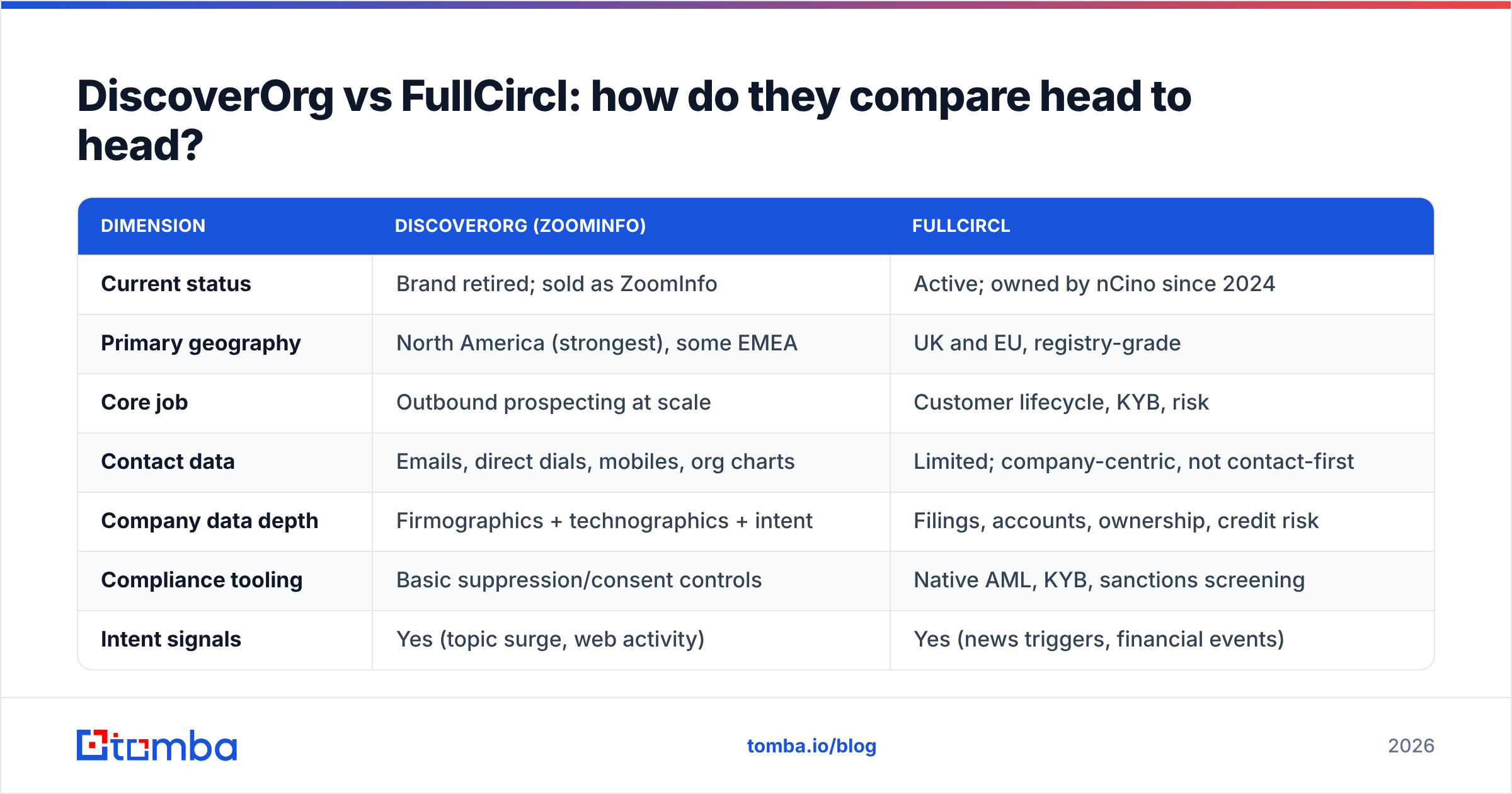
The table makes the real conclusion obvious: this is rarely a genuine either/or. A US software company evaluating both will pick ZoomInfo in about five minutes. A UK commercial bank onboarding SME customers will pick FullCircl just as fast. The overlap buyer — a UK-based B2B SaaS company selling into financial services — is the only one with a real decision to make.
Which one has better data accuracy?#
Neither wins outright, because they're accurate about different things.
ZoomInfo/DiscoverOrg accuracy is strongest on North American company firmographics and job titles, weaker on email deliverability at the individual level. The dataset is large, which means staleness is a structural problem: people change jobs roughly every 2–3 years, and a record captured 18 months ago has meaningful decay. Independent reviewers consistently report usable but imperfect email hit rates, with direct dials being the more defensible line item. Org charts remain the strongest asset — if you need to know who the VP of Infrastructure reports to at a 4,000-person US enterprise, this is still the best commercial answer.
FullCircl accuracy is different in kind. Its company data comes from statutory filings, so it isn't "estimated" — a Companies House filing either says a director is appointed or it doesn't. That makes FullCircl close to authoritative for UK company structure, ownership, and financials. Where it's thin is individual contact detail: it will tell you the company and the officers, not necessarily the marketing director's work email.
The practical consequence: whichever you buy, you will still want an independent email verifier in the workflow. Bounce rates above 3% damage sender reputation regardless of which vendor's logo is on the CSV, and no database vendor's SLA protects your domain from that.
What do they actually cost in 2026?#
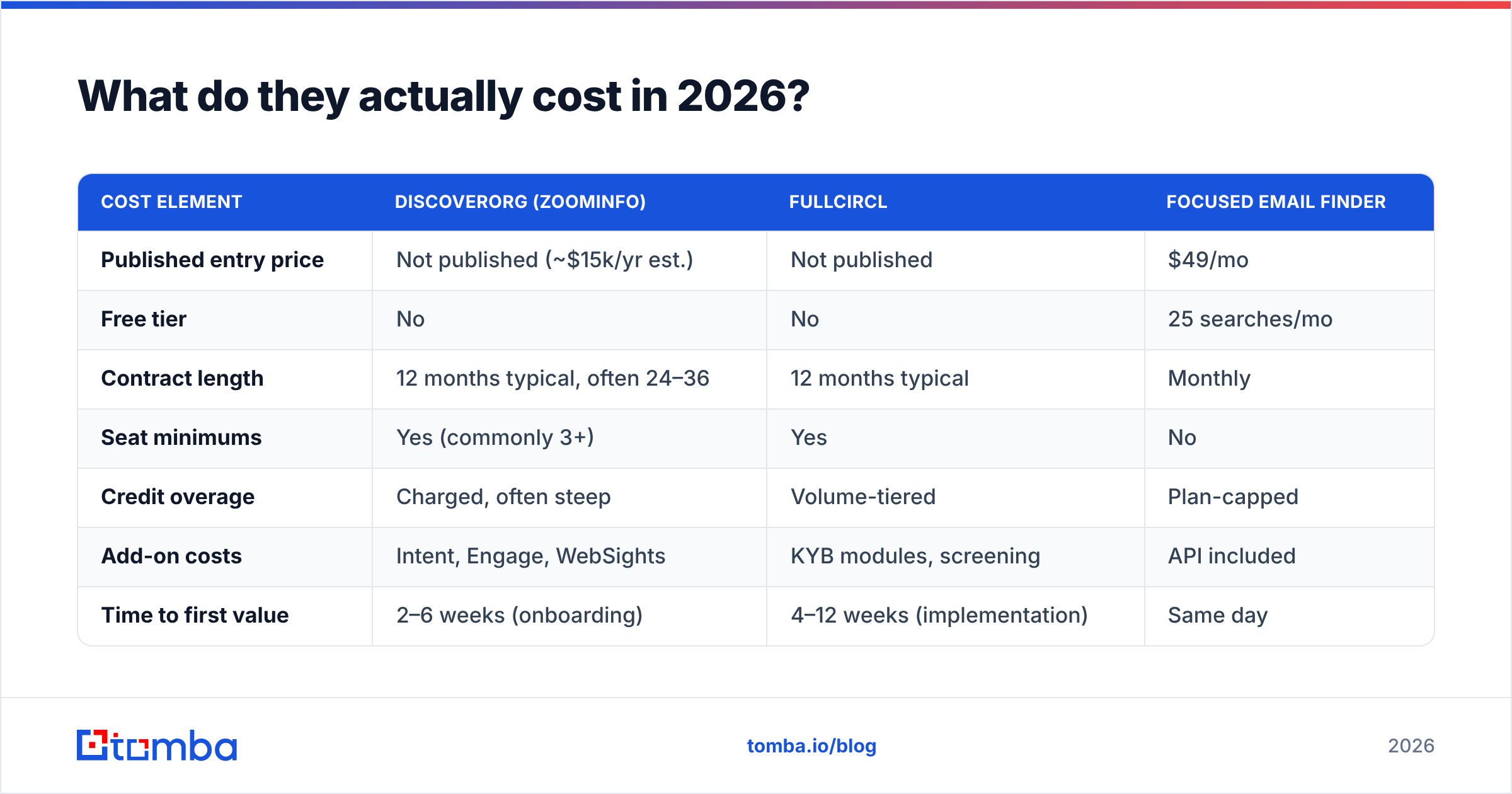
Neither publishes transparent pricing, which itself tells you something about the sales motion.
| Cost element | DiscoverOrg (ZoomInfo) | FullCircl | Focused email finder |
|---|---|---|---|
| Published entry price | Not published (~$15k/yr est.) | Not published | $49/mo |
| Free tier | No | No | 25 searches/mo |
| Contract length | 12 months typical, often 24–36 | 12 months typical | Monthly |
| Seat minimums | Yes (commonly 3+) | Yes | No |
| Credit overage | Charged, often steep | Volume-tiered | Plan-capped |
| Add-on costs | Intent, Engage, WebSights | KYB modules, screening | API included |
| Time to first value | 2–6 weeks (onboarding) | 4–12 weeks (implementation) | Same day |
Two commercial patterns are worth naming explicitly:
- Auto-renewal. ZoomInfo contracts have historically included auto-renew terms with a notice window. Diary the cancellation date the day you sign.
- Credit caps as a pricing lever. Both platforms meter something. Model your realistic monthly volume before signing, then double it — teams almost always underestimate, and overage is where margin lives.
When should you skip both and use a focused tool?#
Skip both when your problem is narrower than the platform you're being sold.
Ask yourself what you're actually buying. If the answer is "verified work email addresses for people I've already identified," you're paying enterprise platform prices for a lookup function. A dedicated email finder resolves a name plus a domain into a verified address, and a domain search returns every discoverable address at a company with role and confidence scoring — the same core output that drives most outbound sequences.
Concrete scenarios where a focused tool wins:
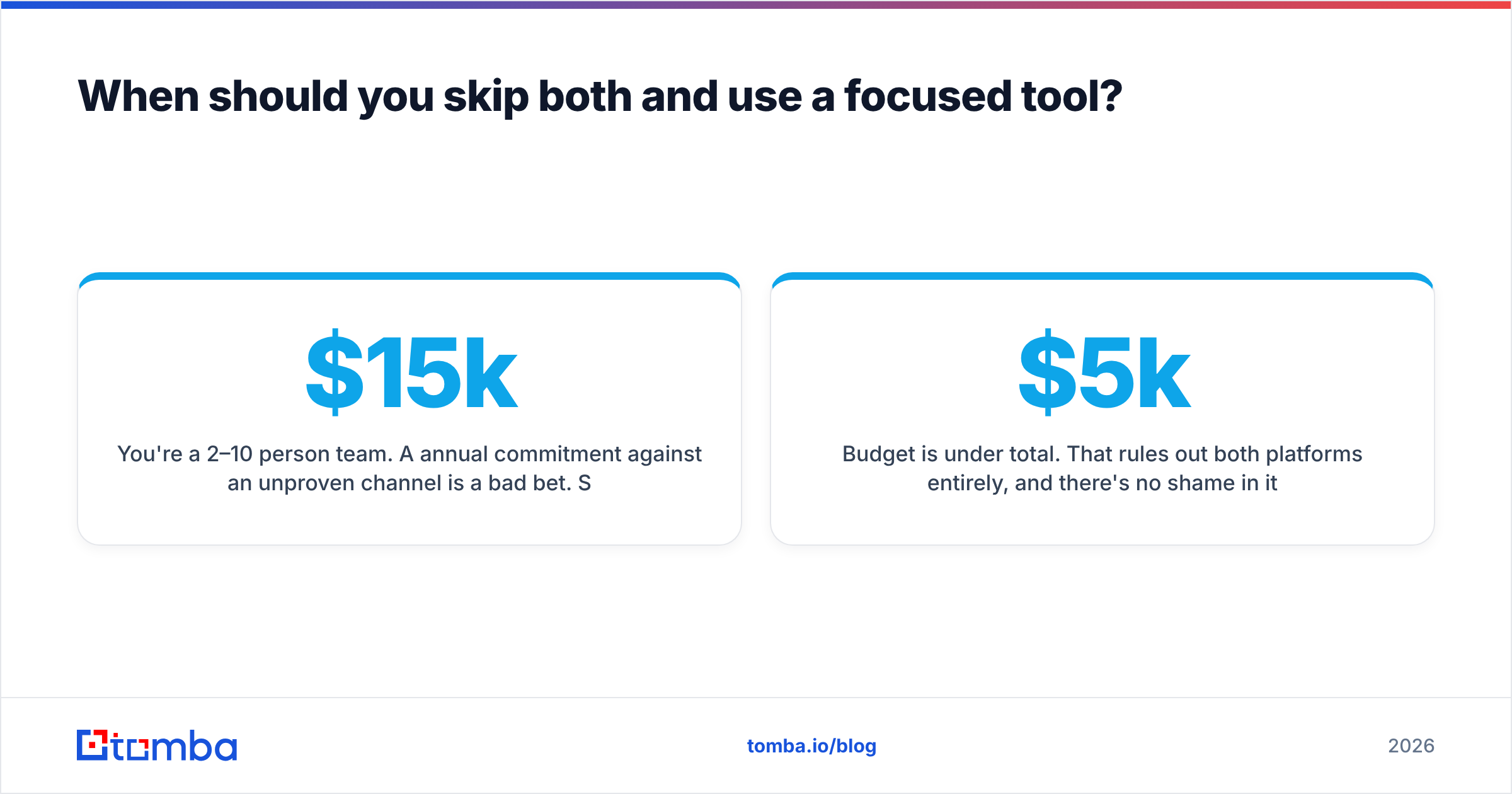
- You're a 2–10 person team. A $15k annual commitment against an unproven channel is a bad bet. Start at $49/mo, prove the motion, then upgrade when the unit economics justify it.
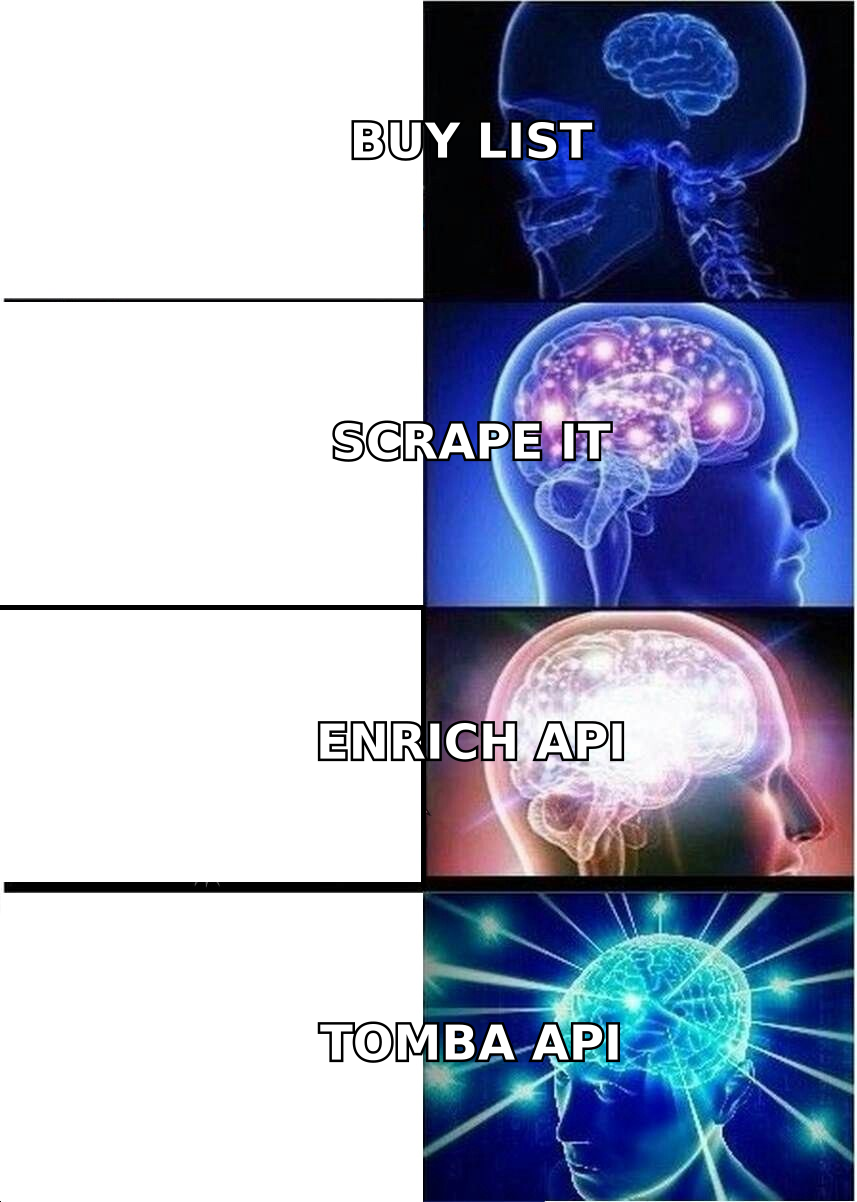
- You already have the target list. If your ICP comes from LinkedIn Sales Navigator, a conference attendee list, or your own product signups, you don't need another database — you need enrichment. Run those rows through bulk email finding or the Tomba API.
- You sell outside North America. ZoomInfo's coverage advantage shrinks sharply outside the US. Pattern-based finding plus SMTP verification often outperforms a stale database record for European and APAC targets.
- You need this in a spreadsheet, today. A Google Sheets add-on beats a six-week implementation for most operational work.
- Budget is under $5k/year total. That rules out both platforms entirely, and there's no shame in it — plenty of eight-figure businesses run outbound on tooling that costs less than one ZoomInfo seat.
Where a focused tool does not win: if you genuinely need statutory ownership data for compliance, buy FullCircl. If you genuinely need org charts for 500-person enterprise buying committees, buy ZoomInfo. Don't cobble together a compliance stack from prospecting tools.
What are the credible alternatives to both?#
The market has fragmented, which is good for buyers. A few honest positions:
- Apollo.io — bundles data with sequencing at a much lower entry price. Coverage is broad but accuracy is variable; strong for SMB outbound. See the Apollo alternative breakdown for the tradeoffs.
- Clearbit (now part of HubSpot) — enrichment-first, excellent for inbound form completion and firmographic append, weaker as a prospecting database. Compare on the Clearbit alternative page.
- BookYourData — pay-as-you-go verified B2B lists with a bounce guarantee. Genuinely useful if you want data ownership without an annual contract, and the credit model avoids the seat-minimum trap entirely.
- Cognism — the closest true FullCircl-adjacent competitor for EMEA coverage, with strong GDPR posture and notified-contact data. More expensive than mid-market tools, cheaper than ZoomInfo at comparable EMEA depth.
- Tomba — email finding, verification, catch-all handling, and enrichment via API, at published prices starting free. Narrower scope than either platform here, deliberately.
The build-your-own stack that most efficient teams land on: one list source (Sales Navigator, a niche directory, or your own research), one enrichment/verification layer, one sequencer. Total cost frequently under $300/month, versus $1,250+/month for a single ZoomInfo seat.
How should you actually run the evaluation?#
Do this in order, and don't let a sales rep reorder it.
- Write down the job. One sentence. "Find compliance-cleared UK SME lending prospects" and "book meetings with US enterprise IT buyers" are different products. If you can't write the sentence, you're not ready to buy.
- Test coverage on your own list, not theirs. Give every vendor the same 200 target accounts from your real ICP. Demand match rate and verified-email rate on that file. Vendor-supplied demo lists are curated and prove nothing.
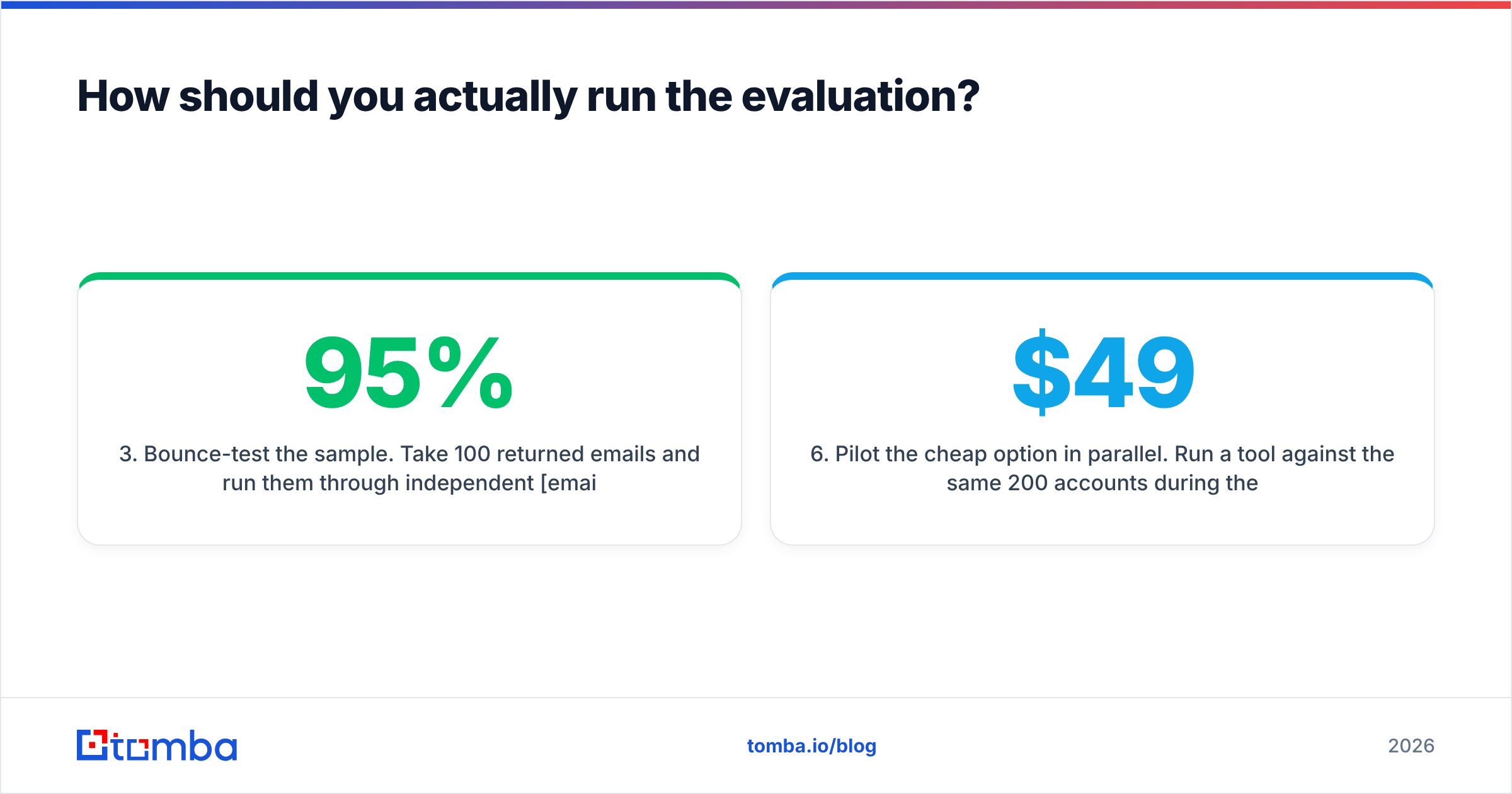
- Bounce-test the sample. Take 100 returned emails and run them through independent email verification before signing. A vendor claiming 95% accuracy that returns 78% deliverable on your list has answered the only question that matters.
- Price the second year, not the first. Discounts on year one are routine. Ask for year-two pricing in writing, plus the overage rate and the renewal notice window.
- Check the exit. Can you export the records you paid for? Under what license? Some contracts prohibit retaining data after termination — that turns your CRM into a rental.
- Pilot the cheap option in parallel. Run a $49/mo tool against the same 200 accounts during the evaluation. If the cheap stack hits 80% of the value at 4% of the cost, that's your answer, and it cost you one month to learn.
Most teams that follow this process discover the same thing: the platform was sold as a data problem, but the bottleneck was list quality and messaging. No database fixes a bad offer.
The verdict#
DiscoverOrg vs FullCircl isn't really a comparison — it's a category confusion. DiscoverOrg is a retired brand inside ZoomInfo, aimed at North American outbound teams who need contacts, direct dials, and org charts, at $15k+/year. FullCircl is a UK/EU customer lifecycle and compliance platform for regulated financial services, priced by scoped enterprise contract. Buying one when you needed the other is an expensive mistake that a single clarifying sentence prevents.
And if neither sentence describes you — if you just need reliable, verified work emails for accounts you've already picked — you're overbuying. Start with the Tomba Email Finder: free for 25 searches a month, $49/mo on Starter, with domain search, catch-all handling, verification, and full API access included rather than sold as modules. Check Tomba pricing, run your real 200-account list through it this afternoon, and see how much of that six-figure platform quote you actually needed.
Related guides#
Ready to find emails that actually work?
Join 150,000+ professionals who stopped guessing and started sending. Free credits on signup — no credit card required.
Get the Tomba newsletter
Practical outbound tactics and product updates — once every two weeks.
About the author