DiscoverOrg vs Getro (2026): Which B2B Data Tool Wins?
DiscoverOrg (now ZoomInfo) and Getro solve different problems that look similar on a demo call. Here's the honest breakdown of pricing, data depth, and who each one actually fits.
DiscoverOrg vs Getro looks like a fair fight. It isn't. One tool sells B2B sales data. The other runs job boards for venture portfolios. Here is the short version, then the details.
TL;DR
- DiscoverOrg is now ZoomInfo. The brand was folded in after the 2019 merger. Buy "DiscoverOrg" today and you get ZoomInfo SalesOS, at ZoomInfo prices. That means $15K–$40K+ a year, on an annual contract.
- Getro is not a sales tool. It runs job boards and talent networks for VC firms, accelerators, and communities.
- The overlap is almost zero. Both touch company data. That is the whole connection. If you are weighing DiscoverOrg vs Getro, you want one of them, not both.
- For finding emails, both are overkill. A dedicated email finder starts at $49/mo and does that one job well.
- Verdict: pick ZoomInfo if you run an enterprise sales team. Pick Getro if you run a portfolio or community. Pick neither if you just need verified emails.
Why are people comparing DiscoverOrg vs Getro at all?#
Because search intent is messy. Both names show up when you type "B2B contact database" into Google.
DiscoverOrg built its name on human-checked org charts. That data told an enterprise rep exactly who reported to whom inside a 3,000-person company.
Getro built its name on job boards for venture portfolios. Ever clicked "Jobs" on a VC firm's site and landed on a board of 400 startups? Getro was probably running it.
The mix-up keeps happening for two reasons. First, both sites use "network" and "talent" language, so the keywords overlap. Second, many buyers inherit a shortlist from someone else. They don't yet know which category each vendor sits in.
So let's fix that first. Then we can compare the things that matter.

What is DiscoverOrg in 2026?#
DiscoverOrg is a legacy brand name. It no longer exists as a standalone product.
DiscoverOrg bought ZoomInfo in 2019. The combined company then took the ZoomInfo name. Buy "DiscoverOrg" today and you are buying ZoomInfo SalesOS.
The DiscoverOrg heritage still shows up in the product. You get deep tech data, hand-checked org charts in some segments, and a research team that keeps mid-market and enterprise accounts current.
What you get in practice:
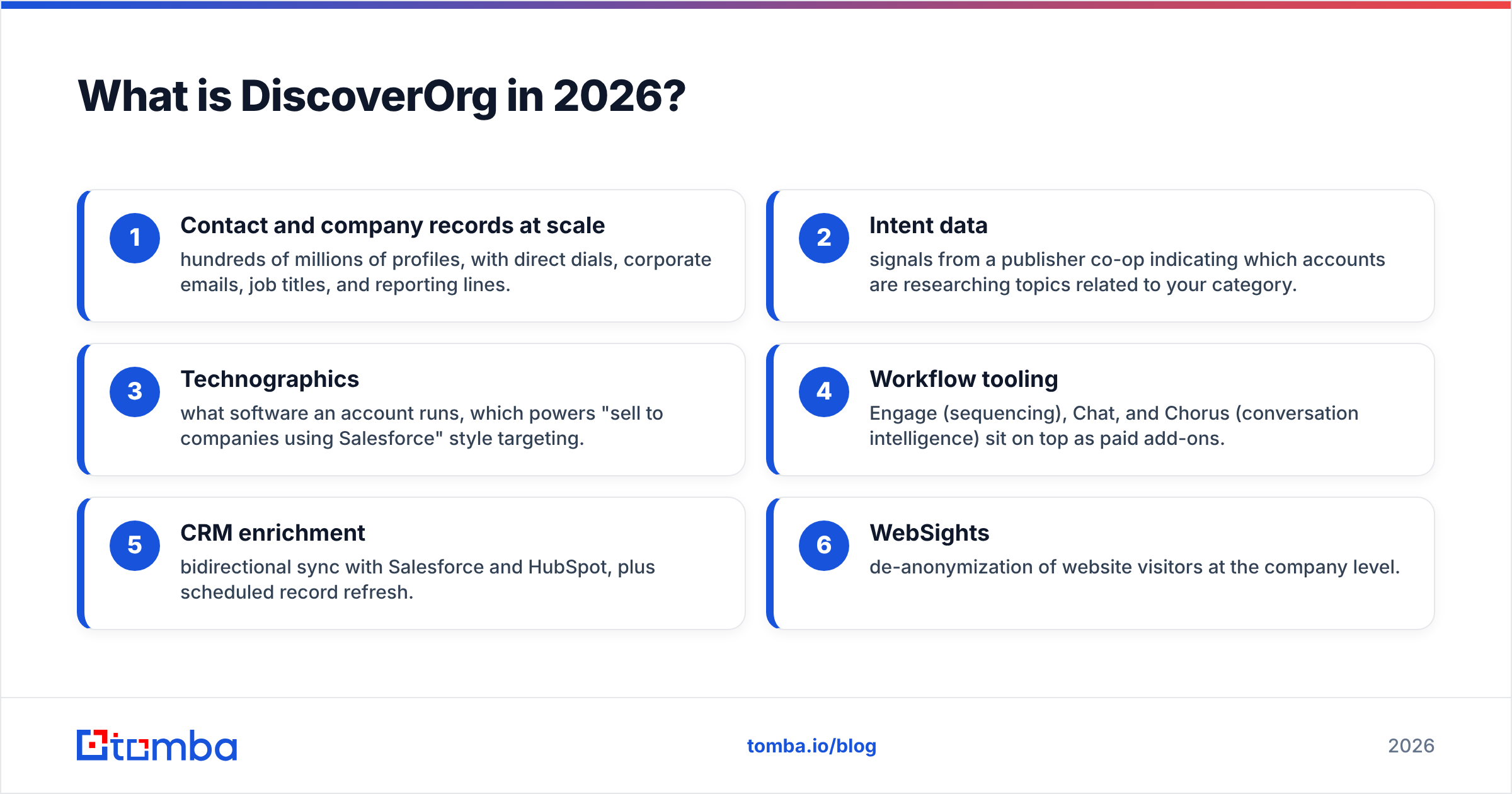
- Contact and company records at scale — hundreds of millions of profiles. Direct dials, work emails, job titles, and reporting lines.
- Intent data — signals that show which accounts are researching your category.
- Technographics — the software an account runs. This powers "sell to companies using Salesforce" targeting.
- Workflow tools — Engage, Chat, and Chorus sit on top as paid add-ons.
- CRM enrichment — two-way sync with Salesforce and HubSpot, plus scheduled record refresh.
- WebSights — tells you which companies visited your site.
The catch is the price model. ZoomInfo sells annual contracts by the seat, with credit caps, and quotes only. Buyer reviews on G2 put real entry points near $15,000–$25,000 a year for small teams.
That number climbs fast once you add seats, add-ons, and export volume. There is no real free tier. Most buyers cannot pay monthly.
What is Getro, and who is it built for?#
Getro is a talent-network platform, not a sales database.
It has two core products. Getro Jobs is a hosted job board that pulls open roles from a group of companies. Getro Network is a talent pool where members opt in and get matched to those roles.
The buyer is a VC firm, accelerator, PE platform team, or professional community. They have 50 to 500 linked companies and want to run talent as a service for them.
What Getro does well:
- Automatic job aggregation — it crawls portfolio career pages, so the board stays current on its own.
- Branded, embeddable boards — the board sits on your domain and looks like your brand.
- Talent network management — candidates join, tag their skills, and become searchable.
- Company data enrichment — logos, headcount, industry, and funding stage on each company card.
- Analytics for stakeholders — roles filled, candidates sourced, and who is hiring.
Getro's own site sells portfolio talent, not prospecting. Pricing is quote-based. It usually lands in the low four to five figures a year, based on portfolio size. That is far cheaper than ZoomInfo, but it does a different job.
How do DiscoverOrg (ZoomInfo) and Getro compare side by side?#
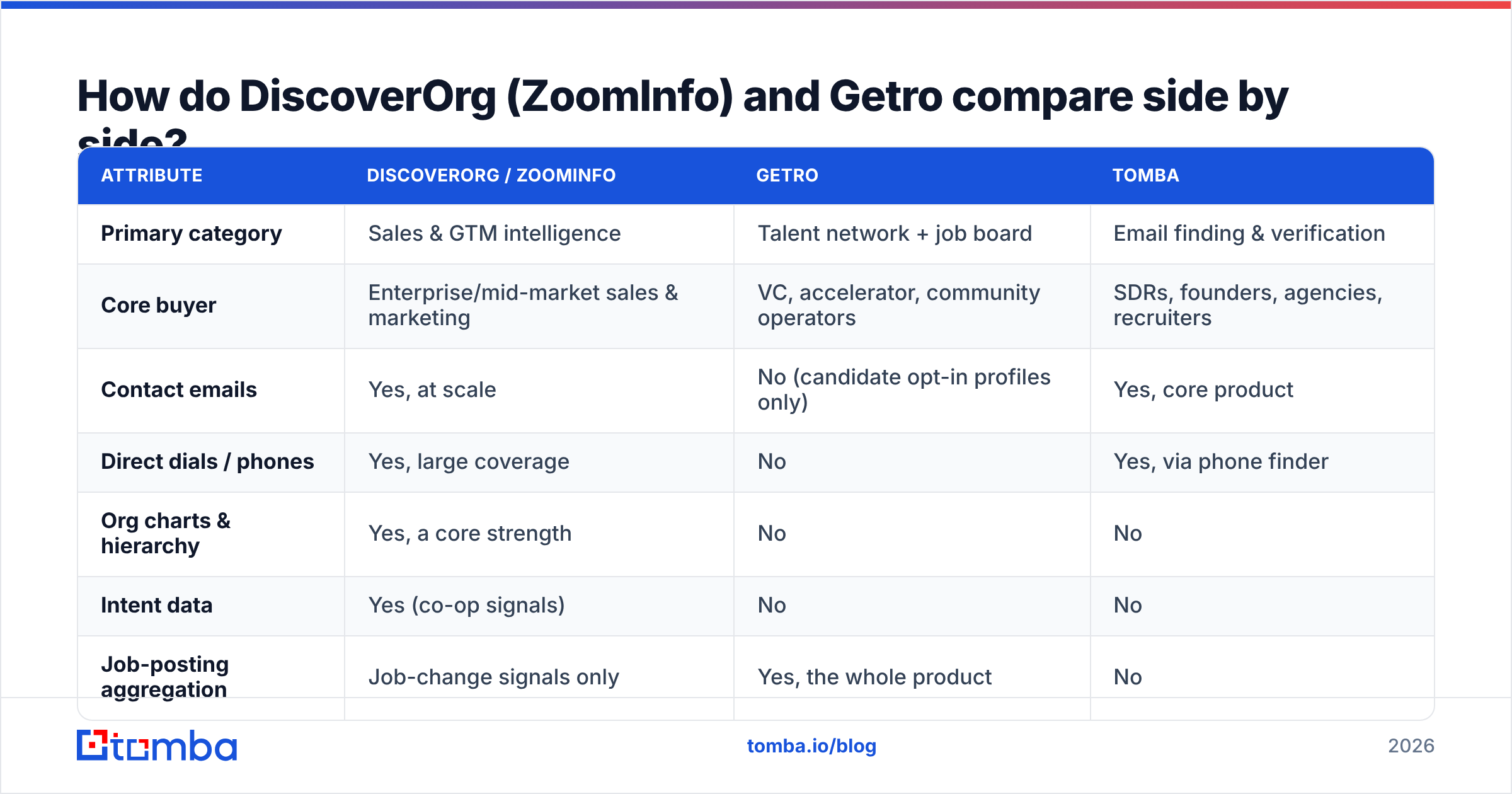
Here is the honest matrix for DiscoverOrg vs Getro. Notice how few rows really overlap.
| Attribute | DiscoverOrg / ZoomInfo | Getro | Tomba |
|---|---|---|---|
| Primary category | Sales & GTM intelligence | Talent network + job board | Email finding & verification |
| Core buyer | Enterprise/mid-market sales & marketing | VC, accelerator, community operators | SDRs, founders, agencies, recruiters |
| Contact emails | Yes, at scale | No (candidate opt-in profiles only) | Yes, core product |
| Direct dials / phones | Yes, large coverage | No | Yes, via phone finder |
| Org charts & hierarchy | Yes, a core strength | No | No |
| Intent data | Yes (co-op signals) | No | No |
| Job-posting aggregation | Job-change signals only | Yes, the whole product | No |
| Entry price | ~$15K+/yr, quote only | Quote, portfolio-size based | Free tier, then $49/mo |
| Billing | Annual contract | Annual contract | Monthly or annual |
| Free tier | No | No | Yes, 25 searches/mo |
| API access | Yes, enterprise tier | Limited | Yes, all paid plans |
| Time to first value | 2–6 weeks (onboarding) | 2–4 weeks (board setup) | Under 10 minutes |
One row matters most: contact emails. Did you shortlist these two because you need to reach decision-makers? Then Getro was never a real option.
Getro does not sell contact data for cold outreach. Using a talent network that way would break the trust it is built on.
Which one should you buy?#
Answer these in order. Stop at your first yes.
Do you run a venture portfolio, accelerator, or member community that needs a job board and a talent pool? Buy Getro. Nothing in ZoomInfo replaces it. Job-change signals are not a job board, and ZoomInfo has no candidate-facing side at all.
Do you have a funded enterprise sales motion, 10+ seats, and a real need for intent data and org charts? Buy ZoomInfo. The DiscoverOrg heritage data is strong in US mid-market and enterprise coverage. The Salesforce integration is mature. Intent signals do change how you rank accounts. At that team size, the math can work.
Is your real problem "I have company names and I need verified emails"? Buy neither. This is the most common case by far. You do not need a $25K contract to append emails to 2,000 prospects.
Are you a 1–10 person team testing outbound for the first time? Start cheap and monthly. Prove the channel works before you sign anything annual.

What does the pricing difference actually look like?#
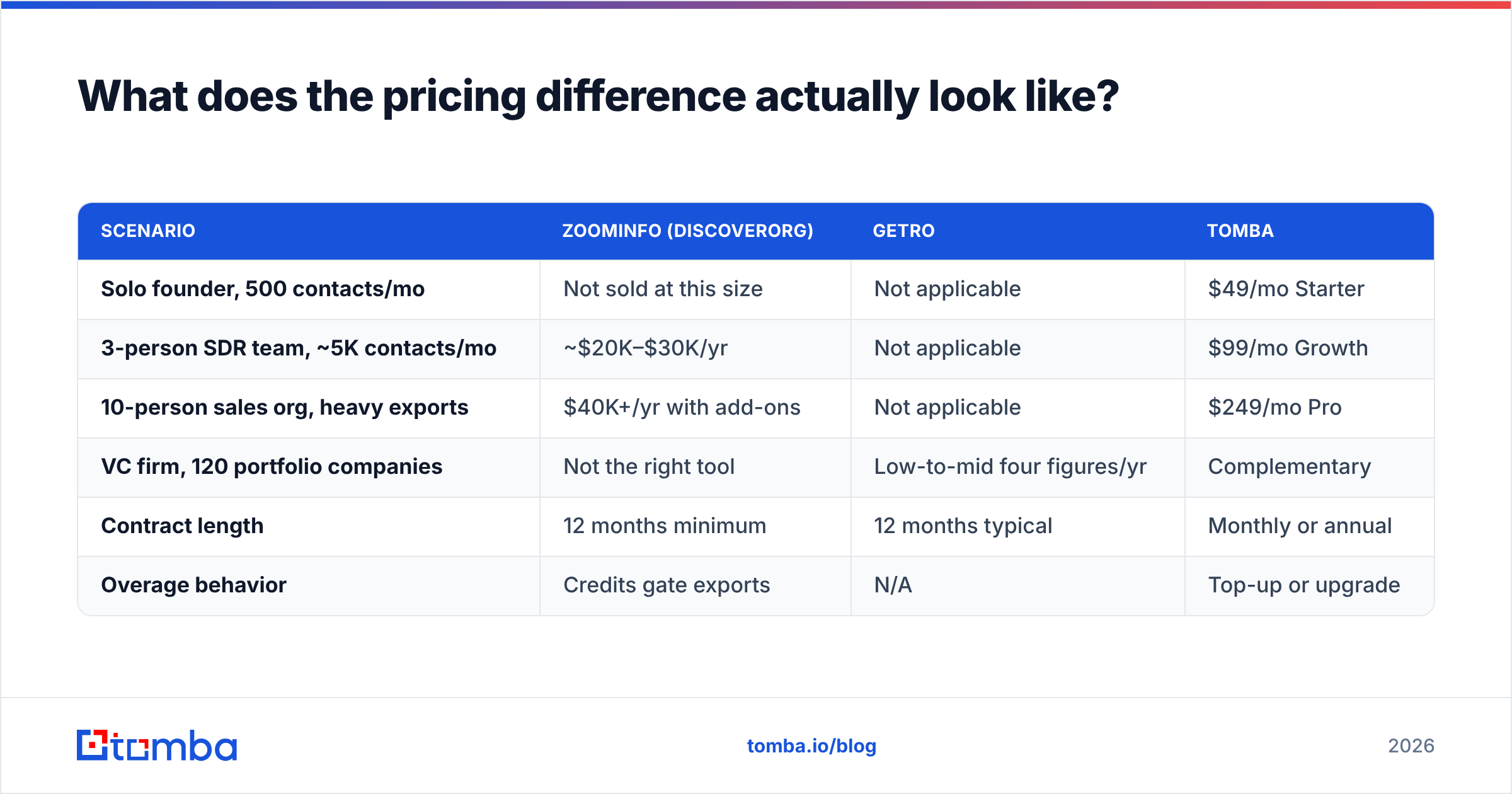
About ten times. And the billing terms hurt more than the sticker price.
| Scenario | ZoomInfo (DiscoverOrg) | Getro | Tomba |
|---|---|---|---|
| Solo founder, 500 contacts/mo | Not sold at this size | Not applicable | $49/mo Starter |
| 3-person SDR team, ~5K contacts/mo | ~$20K–$30K/yr | Not applicable | $99/mo Growth |
| 10-person sales org, heavy exports | $40K+/yr with add-ons | Not applicable | $249/mo Pro |
| VC firm, 120 portfolio companies | Not the right tool | Low-to-mid four figures/yr | Complementary |
| Contract length | 12 months minimum | 12 months typical | Monthly or annual |
| Overage behavior | Credits gate exports | N/A | Top-up or upgrade |
Two honest notes on DiscoverOrg vs Getro pricing.
First, ZoomInfo's price reflects real cost. A research team and an intent co-op are expensive to run. Buyers who use the whole platform do get value. It is not a rip-off. It is a mismatch for small teams.
Second, credit caps are where budgets break. Teams sign at a number they can defend. Three months in, they hit the export ceiling and pay again mid-contract. Ask for the export limit in writing before you sign.
For a simple reference point, Tomba pricing runs Free (25 searches/mo), Starter $49/mo, Growth $99/mo, and Pro $249/mo. Enterprise is custom. Billing is monthly, so a failed test costs you one month, not one year.
What about data accuracy and deliverability?#
Treat every accuracy claim in this space as marketing. Test it on your own target list.
ZoomInfo's coverage leans heavily toward US mid-market and enterprise. Sell to North American firms with 200+ staff and hit rates are good.
Sell into European SMBs, Latin America, or APAC and coverage thins out fast. You end up paying enterprise prices for records you still have to check. GDPR rules have also cut usable EU contact data across the whole category. See the ICO guidance on direct marketing if you work in the UK or EU.
Getro is not part of this debate. Its data is company metadata and opt-in candidate profiles. Accuracy is high because people report it themselves. But it is not prospecting data, and it should not be used that way.
Whatever source you pick, the rule is the same: verify before you send.
A bounce rate above 3–5% starts to hurt your sender reputation. No database ships a list that is clean on arrival, at any price. Records go stale at roughly 20–30% a year as people switch jobs.
Run every list through an email verifier before it hits your sending tool. Handle catch-all domains on purpose instead of guessing.
Are there better alternatives to both?#
Yes. It depends on which half of the problem you have.
If you need contact data without the enterprise contract:
- Tomba — email finder, verifier, domain search, and enrichment. Free tier, monthly billing. Best fit when the job is turning a company and a name into a verified email.
- Apollo — a database plus sequencing in one tool. Good for SMB teams, though data quality varies by region. See our Apollo alternative breakdown.
- BookYourData — pay-as-you-go B2B lists with a strong accuracy guarantee. Handy when you want to buy a list outright.
- Clearbit (now HubSpot Breeze Intelligence) — enrichment first. Strong for inbound forms, weaker for outbound discovery.
If you need a talent or job layer:
- Getro — still the leader for VC portfolio job boards.
- Consider — a competing portfolio job board and talent network.
- Build it yourself — only worth it with spare engineering time and fewer than 30 portfolio companies.
The mistake to avoid is buying a platform to fix a workflow. If reps spend 40% of the week hunting for emails, the fix is a fast bulk email finder wired into your CRM. Not a suite with intent scoring you will never open.
What should your evaluation process look like?#
Run a real test on your own accounts before you sign. Five steps:
- Build a 100-row control list from your real target market. Real companies, real names, and the mix of regions and company sizes you sell to.
- Run it through every tool on your shortlist during a trial. Measure match rate and validity rate.
- Send a small test batch — 50 emails per source — and record the bounce rate. That number matters more than any vendor claim.
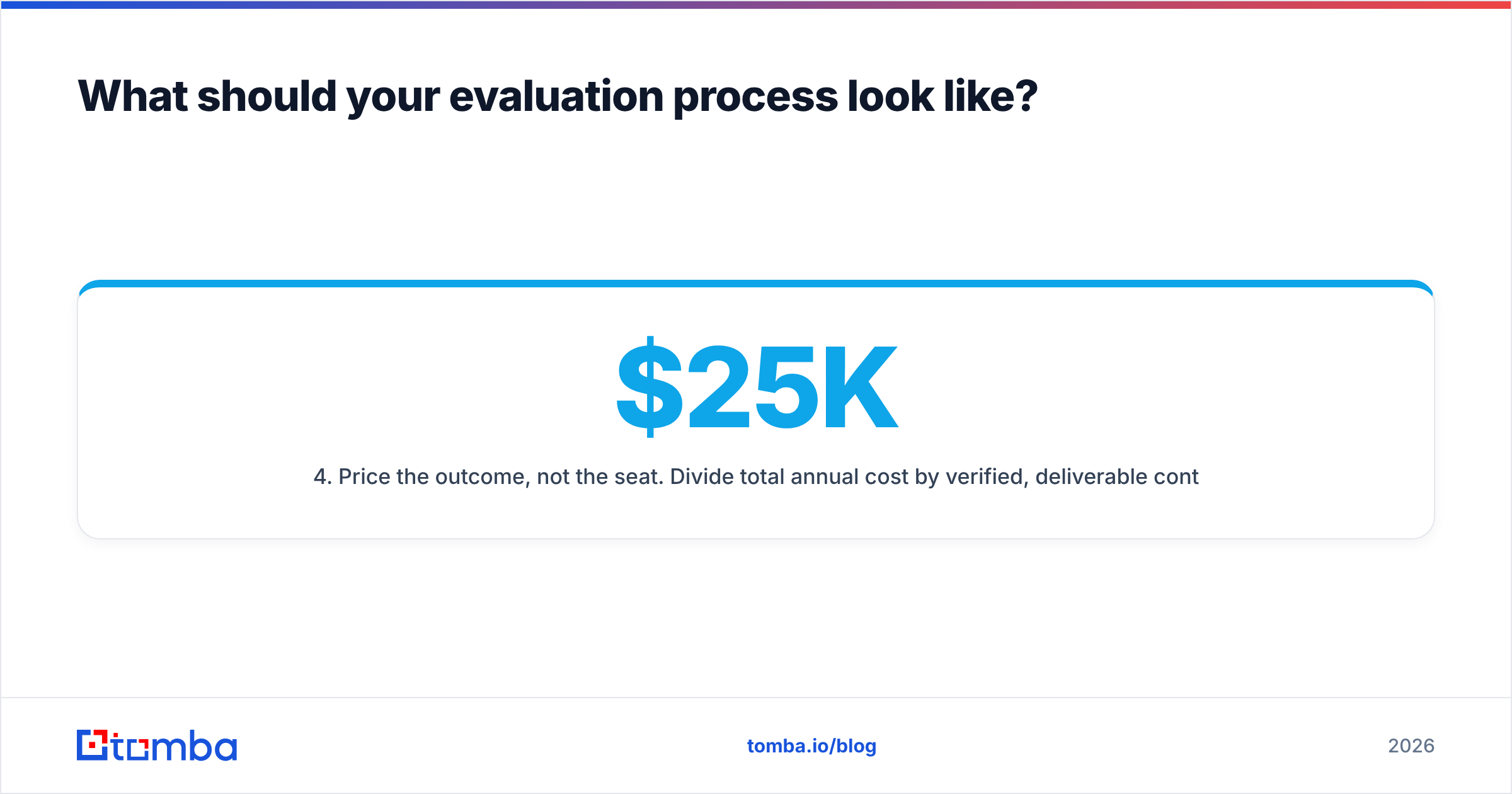
- Price the outcome, not the seat. Divide annual cost by the verified contacts you will actually use. A $25K contract yielding 8,000 usable contacts costs $3.12 each. A $99/mo plan yielding 5,000 costs $0.24.
- Ask three contract questions in writing. What is the export cap? What happens at overage? What is the renewal price cap? A vendor that dodges these is telling you something.
Skip this and you will do what most teams do. You sign after a demo run on the vendor's best-covered accounts. Then you learn your real market is the thin part of the database.
Final verdict: DiscoverOrg vs Getro#
They are not rivals. Treating them as one shortlist will cost you money or months.
Buy ZoomInfo (formerly DiscoverOrg) if you run an enterprise sales org, target the US, have a budget above $20K a year, and truly need org charts and intent data.
Buy Getro if you run a venture portfolio or community and need portfolio jobs plus a talent network. It is the right tool at a fair price for that job.
Buy neither if your bottleneck is finding contacts. That is where most people reading a DiscoverOrg vs Getro comparison actually sit.
If that last line is you, start with the Tomba Email Finder. The free tier gives you 25 searches a month to test hit rates on your own list. Starter is $49/mo. Everything runs through the same Tomba API if you want it in your CRM. Test it against your control list this week. You will know within an hour whether you needed an enterprise contract at all.
Related guides#
Ready to find emails that actually work?
Join 150,000+ professionals who stopped guessing and started sending. Free credits on signup — no credit card required.
Get the Tomba newsletter
Practical outbound tactics and product updates — once every two weeks.
About the author