DiscoverOrg vs Harmonic: Which B2B Data Platform Wins in 2026?
DiscoverOrg (now ZoomInfo) sells org charts and installed-tech depth. Harmonic tracks startups the moment they exist. Here's which one actually fits your motion — and what each really costs.
DiscoverOrg vs Harmonic looks like a head-to-head. It isn't one. One tool maps org charts inside large companies. The other finds startups the week they appear. Here is how to pick.
TL;DR
- DiscoverOrg no longer exists on its own. It merged with ZoomInfo in 2019. Buying "DiscoverOrg" today means buying a ZoomInfo Copilot or SalesOS contract. The org-chart and installed-tech depth survived. The brand did not.
- Harmonic is not a normal rival. It is a startup-and-founder intelligence graph. VCs, corp-dev teams, and people selling to brand-new companies use it.
- Choose by who you sell to. Enterprise IT, security, or finance buyers at 1,000+ employee accounts point to the ZoomInfo/DiscoverOrg lineage. Seed-to-Series-B startups, founder-led buying, and dev tools point to Harmonic.
- Both are platform buys, not data buys. Expect five-figure annual contracts, seat minimums, and export caps. Neither is priced for a two-person team that just needs verified email addresses.
- In DiscoverOrg vs Harmonic, the cheapest right answer is often neither. Use a targeting source for who to contact. Then use a dedicated finder and verifier like Tomba for the contact data itself, at $49/mo instead of $30K/yr.
DiscoverOrg vs Harmonic: why does this comparison exist?#
DiscoverOrg was the go-to B2B database for enterprise IT prospecting through the 2010s. It made its name on human-verified org charts. Not just "who works at Cisco," but who reports to whom on Cisco's infrastructure team, and what they own. That was rare when everyone else scraped LinkedIn titles.
In February 2019, DiscoverOrg bought ZoomInfo and then took the ZoomInfo name. The DiscoverOrg dataset became a layer inside ZoomInfo SalesOS and Copilot. If a rep says they use "DiscoverOrg," they either hold a legacy contract or they mean ZoomInfo.
Harmonic came at the market from the other end. It does not map the Fortune 5000. Harmonic indexes the long tail instead: new startups, founder profiles, headcount curves, funding events, GitHub activity, and product launches. Its first buyer was venture capital, which wants the company before the round is public. Sales teams selling dev tools, fintech rails, and services to young firms came next.
So the real question in DiscoverOrg vs Harmonic is not which database is better. It is which half of the market you hunt in.

DiscoverOrg vs Harmonic: how do the two datasets compare?#
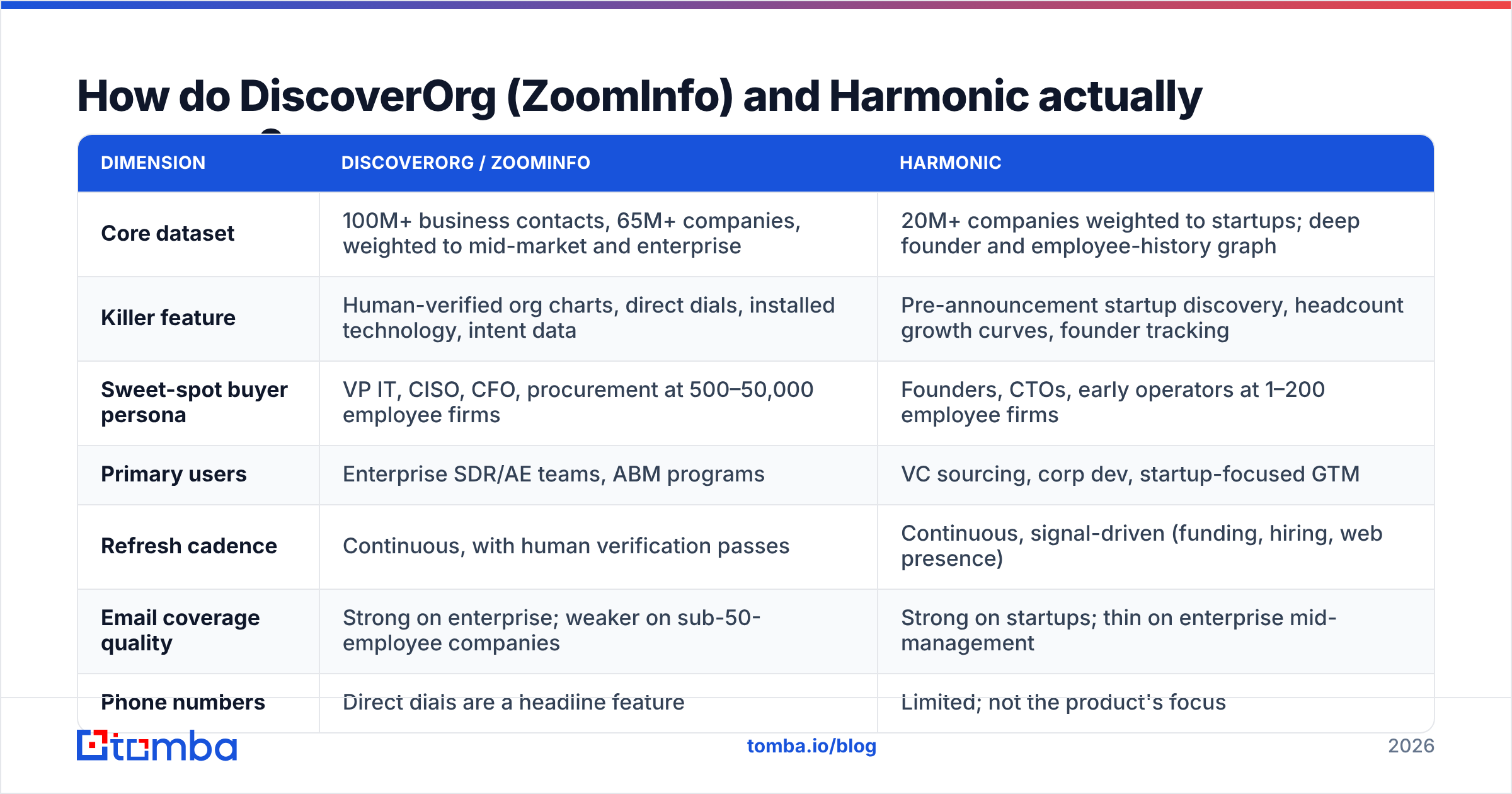
| Dimension | DiscoverOrg / ZoomInfo | Harmonic |
|---|---|---|
| Core dataset | 100M+ business contacts, 65M+ companies, weighted to mid-market and enterprise | 20M+ companies weighted to startups; deep founder and employee-history graph |
| Killer feature | Human-verified org charts, direct dials, installed technology, intent data | Pre-announcement startup discovery, headcount growth curves, founder tracking |
| Sweet-spot buyer persona | VP IT, CISO, CFO, procurement at 500–50,000 employee firms | Founders, CTOs, early operators at 1–200 employee firms |
| Primary users | Enterprise SDR/AE teams, ABM programs | VC sourcing, corp dev, startup-focused GTM |
| Refresh cadence | Continuous, with human verification passes | Continuous, signal-driven (funding, hiring, web presence) |
| Email coverage quality | Strong on enterprise; weaker on sub-50-employee companies | Strong on startups; thin on enterprise mid-management |
| Phone numbers | Direct dials are a headline feature | Limited; not the product's focus |
| Intent / buying signals | Third-party intent topics, website visitor tracking, Copilot AI plays | Growth signals, funding, hiring velocity, tech adoption |
| API access | Available on higher tiers, credit-metered | API-first; developers are a core user group |
| Typical annual spend | $15,000–$40,000+ for a small team | $10,000–$30,000+ depending on seats and API volume |
| Free tier | No — demo and limited trial only | No — demo-gated |
| Contract shape | Annual, seat minimums, auto-renew clauses common | Annual, usage tiers |
Neither vendor publishes list pricing. The ranges above come from what buyers report on G2 and in procurement forums. Your quote will move with seats, credits, and how close you are to the vendor's quarter end.
DiscoverOrg vs Harmonic: which one covers your accounts?#
Coverage is not one number. It depends on company size, geography, and how new the company is.
Where the ZoomInfo/DiscoverOrg lineage wins:
- Companies over 500 employees. Depth of contacts per account is the whole point. You get the security architect three levels below the CISO, not just the CISO.
- Org hierarchy. Reporting lines, department sizing, and budget holders. Nothing in Harmonic touches this.
- Direct dial phone numbers. If you call, this is a real moat. Harmonic does not compete here.
- Installed technology. Knowing an account runs Okta and Snowflake is standard for enterprise ABM plays.
- North American enterprise density. EMEA and APAC coverage is thinner, though it keeps improving.
Where Harmonic wins:
- Companies under 50 employees. Legacy databases can't see these accounts until they hire a marketing person and set up a real domain.
- Recency. Say a company was formed eight weeks ago, has three staff, and a stealth landing page. Harmonic will surface it long before a traditional database does.
- Founder-level identity. Second-time founders, ex-FAANG operators, and who-worked-with-whom graphs.
- Growth as a filter. "Show me firms that went from 12 to 40 engineers in six months" is a query Harmonic answers on its own.
- Developer ergonomics. The API is a first-class surface, not an upsell.
Here is the practical test. Pull 200 target accounts from your closed-won list. Ask each vendor to run coverage against that list during the trial. Do not accept platform-wide stats. A vendor claiming 95% coverage of "the market" tells you nothing about your ICP.
Is Harmonic a real replacement for DiscoverOrg?#
No. Treating it as one is the most common mistake in this evaluation.
Harmonic replaces the discovery half of the job, and only for one segment. It does not replace contact depth for enterprise. Say you sell a $250K compliance platform to banks. Harmonic will hand you almost nothing you can use. Now say you sell developer infrastructure to Series A companies. ZoomInfo's org charts describe a world your buyers don't live in. A 22-person startup has no reporting hierarchy worth mapping.
A third pattern is worth naming. Some teams buy Harmonic for targeting, then find they still need contact data. Harmonic tells you which startup to chase and who founded it. Getting a working inbox for the head of engineering who joined four months ago is a separate job. That is where a dedicated email finder plus email verifier stack fits alongside the intelligence layer, not instead of it.
What do they actually cost, and where are the traps?#
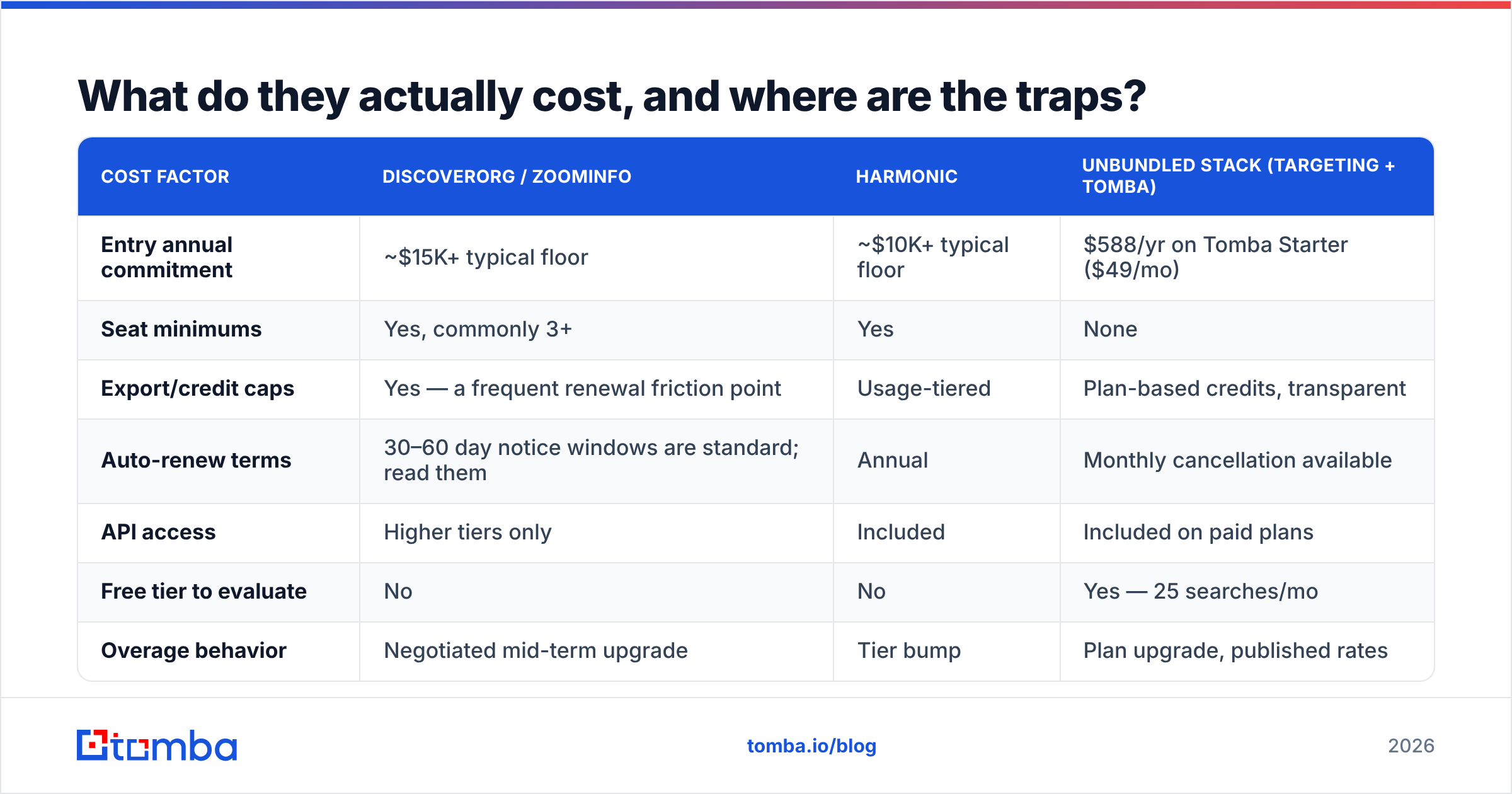
| Cost factor | DiscoverOrg / ZoomInfo | Harmonic | Unbundled stack (targeting + Tomba) |
|---|---|---|---|
| Entry annual commitment | ~$15K+ typical floor | ~$10K+ typical floor | $588/yr on Tomba Starter ($49/mo) |
| Seat minimums | Yes, commonly 3+ | Yes | None |
| Export/credit caps | Yes — a frequent renewal friction point | Usage-tiered | Plan-based credits, transparent |
| Auto-renew terms | 30–60 day notice windows are standard; read them | Annual | Monthly cancellation available |
| API access | Higher tiers only | Included | Included on paid plans |
| Free tier to evaluate | No | No | Yes — 25 searches/mo |
| Overage behavior | Negotiated mid-term upgrade | Tier bump | Plan upgrade, published rates |
Three traps to watch for on either platform:
- The credit cliff. Both platforms meter exports. Teams often burn the annual allotment by month seven. Then they face a mid-term upgrade with zero leverage.
- The auto-renewal window. These contracts usually require written notice 30–60 days before the term ends. Calendar it the day you sign.
- Seats you don't use. Say three of your five seats log in twice a month. You are paying enterprise rates for lookups a per-credit tool would handle for far less.
Some teams mainly need contact data, not a full intelligence platform. For them, Tomba pricing starts with a free tier of 25 searches a month. Paid plans run $49/mo Starter, $99/mo Growth, and $249/mo Pro. That is a different order of magnitude, and a different product category. It does not replace org charts or startup signals. It replaces paying platform rates to do email lookups.
Who should buy which?#
Buy ZoomInfo (the DiscoverOrg lineage) if:
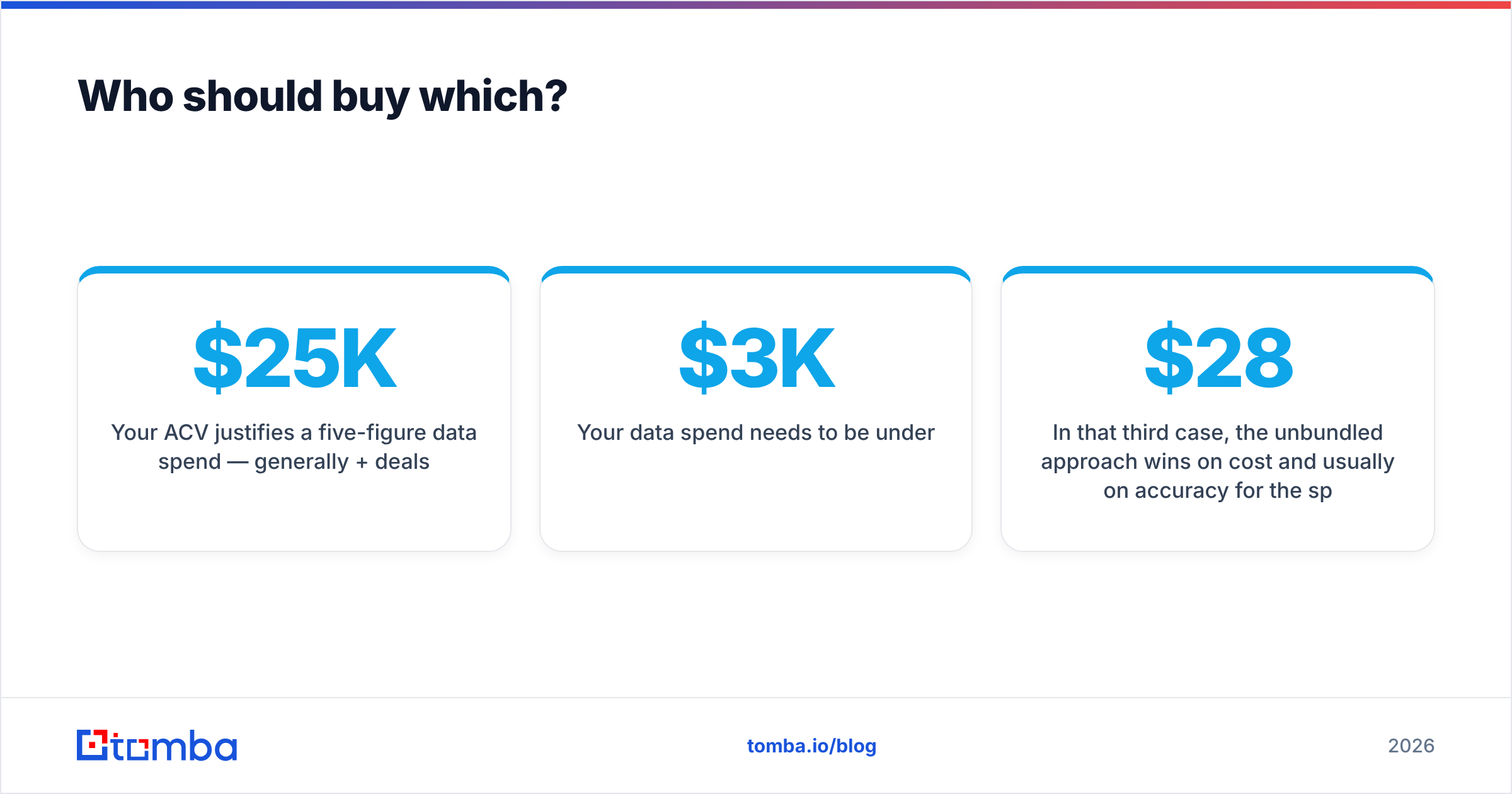
- Your deal size justifies a five-figure data spend, generally $25K+ deals.
- You sell into IT, security, finance, or procurement at established firms.
- Cold calling is a real channel and direct dials move the number.
- You run ABM and need intent signals wired into your CRM.
- You have a RevOps function that can put the data to work. Without one, you are buying a very expensive lookup tool.
Buy Harmonic if:
- Your ICP is companies under two years old or under 100 employees.
- Speed matters. You want to reach a founder within weeks of a launch or a raise.
- You are in venture, corp dev, or selling picks-and-shovels to startups.
- You would rather build workflows on an API than live in a UI.
- Your team is fine enriching contact data separately.
Buy neither if:
- You are under ten people and mainly need to find and verify emails for a list you already have.
- Your targeting comes from a source you already trust: inbound, community, events, a partner list, or a conference roster.
- Your data spend has to stay under $3K a year.
In that third case, the unbundled approach wins on cost. It often wins on accuracy for that narrow job too. Run targeting from wherever your signal comes from. Then use domain search to map a company's contacts, and bulk verify before you send. You lose the intelligence layer. You also lose the $28,000 invoice.
What does a sane evaluation process look like?#
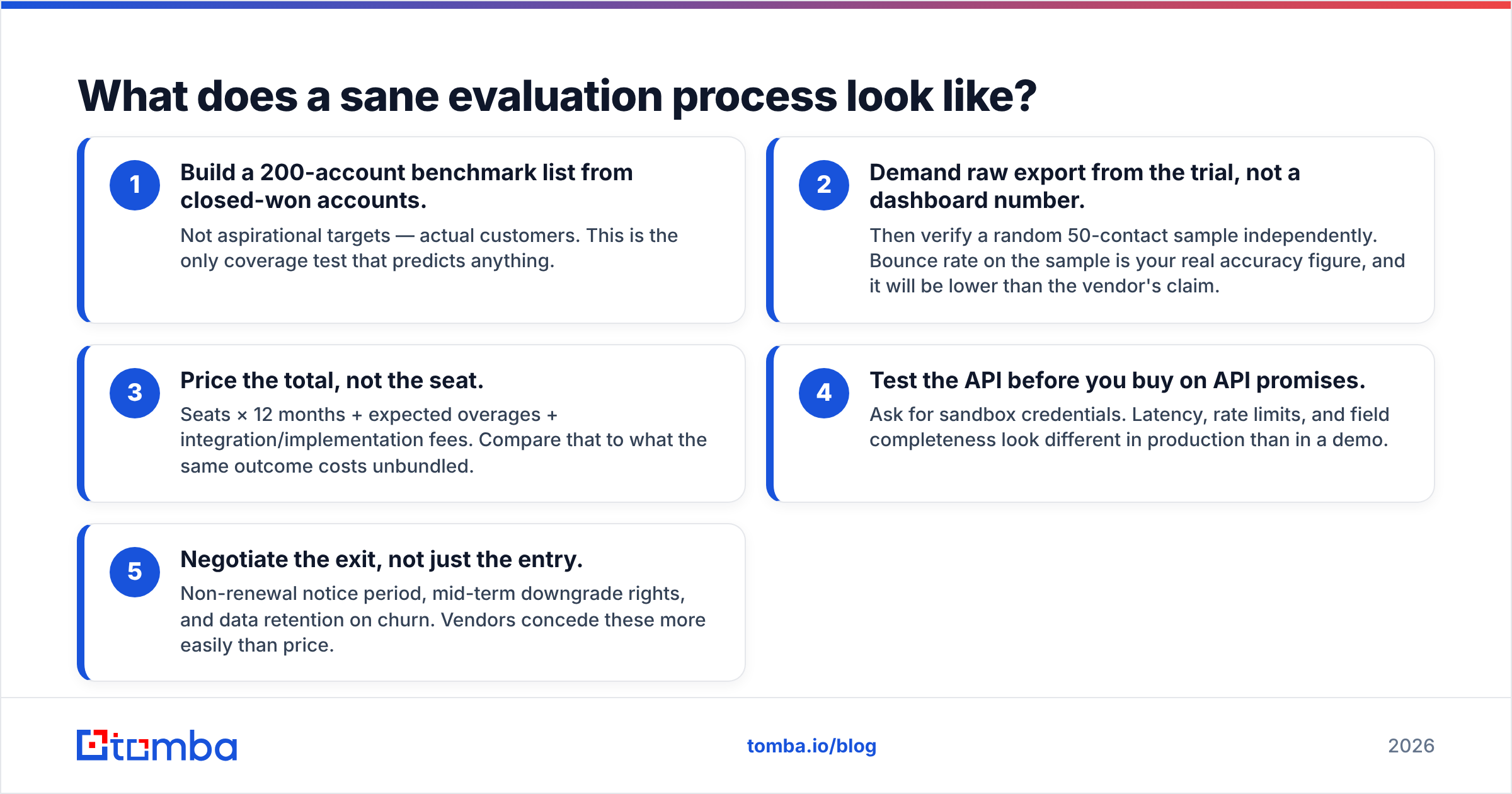
Do these five things before you sign with either vendor.
- Build a 200-account benchmark from closed-won accounts. Use real customers, not wish-list targets. It is the only coverage test that predicts anything.
- Demand a raw export from the trial, not a dashboard number. Then verify a random 50-contact sample yourself. That bounce rate is your real accuracy figure.
- Price the total, not the seat. Add seats × 12 months, expected overages, and setup fees. Compare that to the same outcome unbundled.
- Test the API before you buy on API promises. Ask for sandbox keys. Latency, rate limits, and field completeness all look different outside a demo.
- Negotiate the exit, not just the entry. Cover notice periods, mid-term downgrades, and data retention on churn. Vendors concede these more easily than price.
A few peers are worth a look, depending on your angle. Apollo bundles data plus sequencing at SMB pricing. Clearbit suits enrichment-first workflows. BookYourData handles pay-as-you-go list buying when you would rather skip an annual contract. Each solves a narrower problem than ZoomInfo or Harmonic. That is often the point.
What's the verdict?#
DiscoverOrg vs Harmonic has no head-to-head winner, because the two products barely overlap.
The DiscoverOrg legacy inside ZoomInfo is still the strongest enterprise contact dataset on the market. It is priced that way. Harmonic is the best commercial lens on early-stage companies, and no legacy database matches it on recency there. Picking takes about thirty seconds once you look at the employee-count spread of your closed-won accounts.
One mistake is worth avoiding. Do not buy either one to solve a contact-data problem. Both are intelligence platforms that happen to include emails. If emails and phone numbers are the real deliverable, and your targeting is already solved, you are paying a platform premium for a utility.
Start where the money is smallest. Say your bottleneck is finding verified work emails for people you have already identified. The Tomba Email Finder does exactly that job. Search by domain, name, or company, verify before you send, and pull it through the Tomba API or a Chrome extension. The free tier gives you 25 searches a month, so you can test accuracy on your own list first. Paid plans start at $49/mo, about what one day of an enterprise data contract costs. Prove the data works on your accounts. Then decide whether you need the $30K layer on top.
Related guides#
Ready to find emails that actually work?
Join 150,000+ professionals who stopped guessing and started sending. Free credits on signup — no credit card required.
Get the Tomba newsletter
Practical outbound tactics and product updates — once every two weeks.
About the author