DiscoverOrg vs HitHorizons (2026): Which B2B Data Wins?
DiscoverOrg (now ZoomInfo) sells verified US org charts at enterprise prices. HitHorizons sells 90M+ European company records for a fraction of that. Here's which one actually fits your pipeline — and when neither does.
DiscoverOrg vs HitHorizons is an odd matchup. One sells US contact data at a high price. The other sells European company records for far less. Neither one hands you a verified email. Here is what each tool does, what it costs, and which one fits your team.
TL;DR
- DiscoverOrg is gone as a standalone product. It merged with ZoomInfo in 2019. Buy "DiscoverOrg" today and you get a ZoomInfo Copilot seat. Expect $15,000–$40,000 a year on an annual deal.
- HitHorizons is a European company-data tool, not a contact database. It pulls 90M+ business records from official EU registers. You get firmographics, registry IDs, and financials. You do not get personal contact data.
- They barely compete. ZoomInfo is US people data with direct dials and org charts. HitHorizons is EU company data with registry-grade accuracy and no emails.
- Neither one fixes email deliverability. ZoomInfo contacts go stale fast. HitHorizons ships no contacts at all. You still need a verify step.
- Quick verdict on DiscoverOrg vs HitHorizons: big US outbound budget → ZoomInfo. EU market mapping, KYC, or credit risk → HitHorizons. Cheap, verified, reachable emails → an email finder like Tomba.
What is DiscoverOrg in 2026?#
DiscoverOrg was a B2B data provider based in Vancouver, Washington. It launched in 2007 and made its name on human-checked org charts. Real researchers called companies to confirm who reported to whom. They focused on IT and engineering teams. For a decade, that made DiscoverOrg the accuracy benchmark for enterprise sales.
In February 2019, DiscoverOrg bought ZoomInfo and took its name. By 2021 the DiscoverOrg product line was retired. So when a rep says they "use DiscoverOrg," they mean ZoomInfo SalesOS or Copilot. The old DiscoverOrg data still sits behind it.
What survived the merger:
- Org-chart depth — reporting lines and team structure. Still the best part of the product.
- Direct dials — mobile and desk numbers at a scale few rivals match in North America.
- Technographics — the software a company runs. Handy for rip-and-replace plays.
- Intent data — topic surges, now bundled into higher tiers.
- Enterprise pricing — annual deals, seat minimums, credit caps, and procurement.
Scope is the catch. Coverage is superb in the US. It is decent in the UK and DACH. It thins out fast in Southern and Eastern Europe. GDPR rules also cut what ZoomInfo can legally serve for EU contacts.
What is HitHorizons and who is it for?#
HitHorizons is a European company-data platform. It pulls official business register data from about 50 countries. The database holds 90M+ companies. Each record can include a registry ID, legal form, start date, industry code, revenue estimate, staff band, and parent group.
Most buyers miss the key point. HitHorizons is a company database, not a contact database. You get the entity: the VAT number, the registered address, the NACE code, the parent group. You do not get "Sofia Müller, VP Engineering, sofia.mueller@example.de."
That makes it great for:
- Market sizing — how many factories with 50–200 staff are there in Poland?
- KYC and compliance — proof that a partner exists, and proof of who owns it.
- Credit and risk scoring — filed financials, not scraped guesses.
- Territory planning — map your EU market before you buy contact data.
And poor for:
- Cold outbound. There are no emails to send to.
- Persona targeting. No job titles and no seniority filters.
- Job-change alerts, intent, or engagement signals.

DiscoverOrg vs HitHorizons: how do they compare head-to-head?#
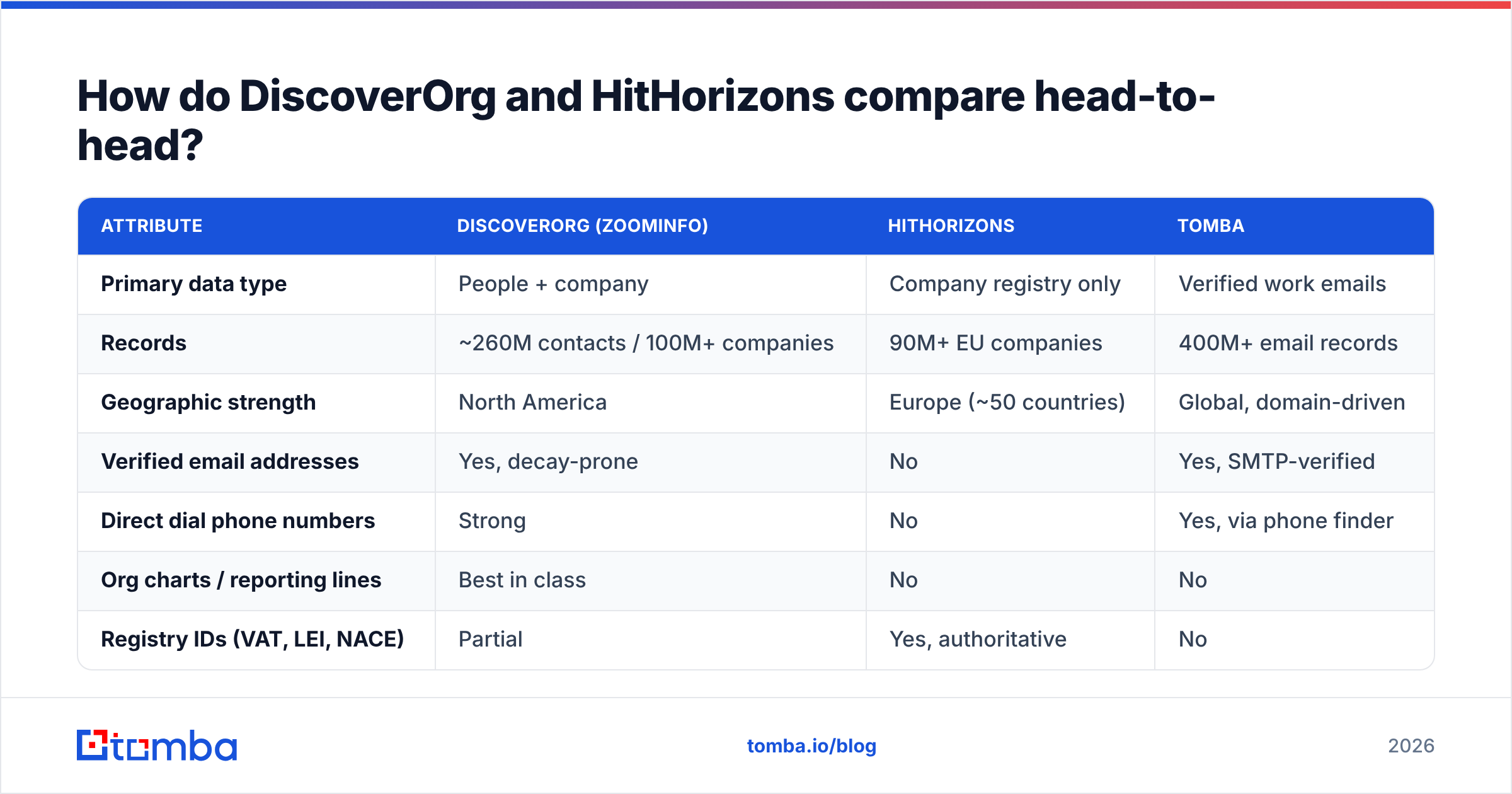
| Attribute | DiscoverOrg (ZoomInfo) | HitHorizons | Tomba |
|---|---|---|---|
| Primary data type | People + company | Company registry only | Verified work emails |
| Records | ~260M contacts / 100M+ companies | 90M+ EU companies | 400M+ email records |
| Geographic strength | North America | Europe (~50 countries) | Global, domain-driven |
| Verified email addresses | Yes, decay-prone | No | Yes, SMTP-verified |
| Direct dial phone numbers | Strong | No | Yes, via phone finder |
| Org charts / reporting lines | Best in class | No | No |
| Registry IDs (VAT, LEI, NACE) | Partial | Yes, authoritative | No |
| Intent data | Yes (add-on tier) | No | No |
| Entry price | ~$15K/yr, annual only | Free lookups; API from ~€99/mo | Free 25 searches/mo; $49/mo Starter |
| Self-serve signup | No — sales-led demo required | Yes | Yes |
| API access | Enterprise tiers | Yes | All paid plans |
| Contract minimum | 12 months, seat minimums | Monthly available | Monthly available |
The table tells the real story. These two tools solve different halves of one problem. ZoomInfo tells you who to call in Boston. HitHorizons tells you which legal entities exist in Bratislava. Neither one alone gets a reply from a European buyer.
DiscoverOrg vs HitHorizons: which one is more accurate?#
"Accurate" is the wrong question on its own. Ask a better one: accurate at what?
HitHorizons wins on entity accuracy. Registry data is filed by the companies themselves, under law. A VAT number from a national register is not a guess. It is a fact with a paper trail. If you need proof of who a company is, nothing scraped comes close.
ZoomInfo wins on contact detail in North America. It blends opt-in email signature data, phone checks, and machine learning. The result is titles and direct dials at a scale HitHorizons never tries to match.
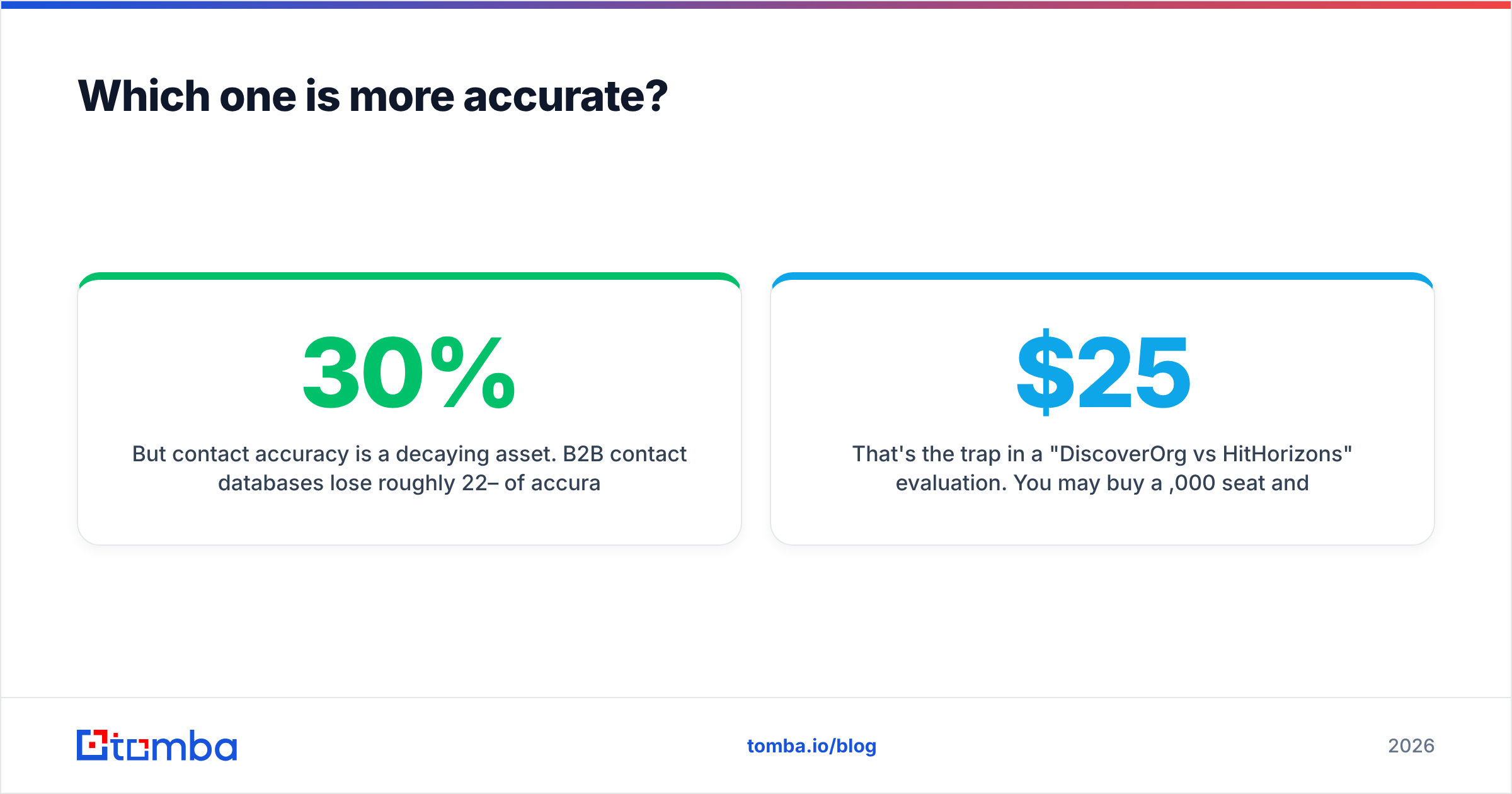
But contact data rots. B2B databases lose roughly 22–30% of their accuracy each year as people switch jobs. Vendor benchmarks and analyst coverage from firms like Gartner show the same pattern. In independent G2 reviews, ZoomInfo bounce rates land around 5–12%. EU records do worse than US ones.
That is the trap in a DiscoverOrg vs HitHorizons review. You can buy a $25,000 seat and still send to a dead address. Or you can buy clean registry data and have no address at all. So smart teams add a verify pass. Run the export through an email verifier before it touches a sequence.
What does each one actually cost?#
The DiscoverOrg vs HitHorizons price gap is wide. So is the gap in pricing openness.
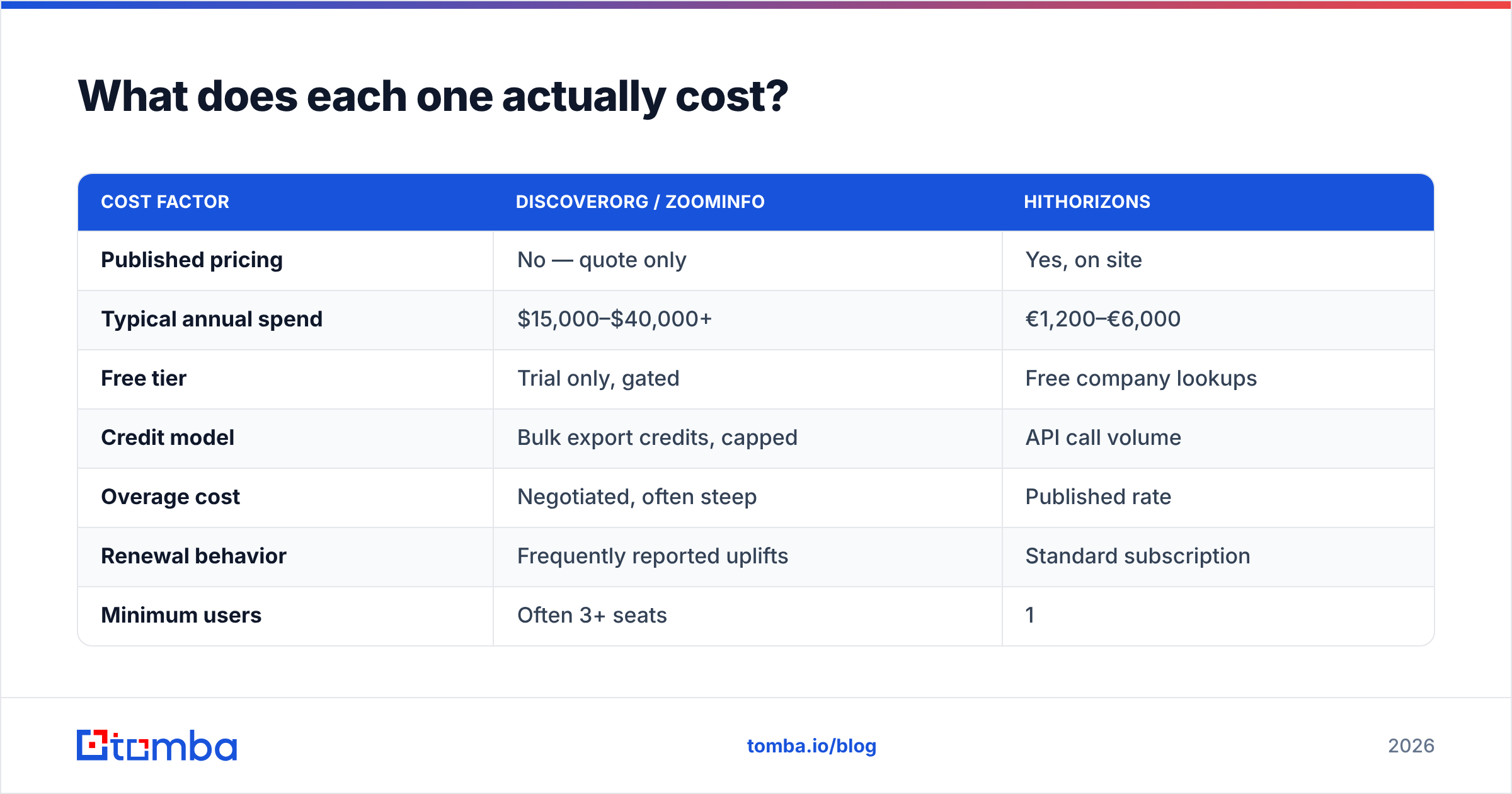
| Cost factor | DiscoverOrg / ZoomInfo | HitHorizons |
|---|---|---|
| Published pricing | No — quote only | Yes, on site |
| Typical annual spend | $15,000–$40,000+ | €1,200–€6,000 |
| Free tier | Trial only, gated | Free company lookups |
| Credit model | Bulk export credits, capped | API call volume |
| Overage cost | Negotiated, often steep | Published rate |
| Renewal behavior | Frequently reported uplifts | Standard subscription |
| Minimum users | Often 3+ seats | 1 |
Say $20,000 is a rounding error in your budget and you sell to US enterprises. Then ZoomInfo maps to real pipeline. Now say you are six people selling into Germany. That same spend burns a whole quarter of your GTM budget. And your sequences still cannot use the data without an email layer.
Compare Tomba pricing: free for 25 searches a month, $49/mo Starter, $99/mo Growth, $249/mo Pro. Monthly billing. No seat minimum. No procurement cycle. It is not a swap for org charts or registry filings. But for turning a company into reachable, verified inboxes, the cost gap is about two orders of magnitude.
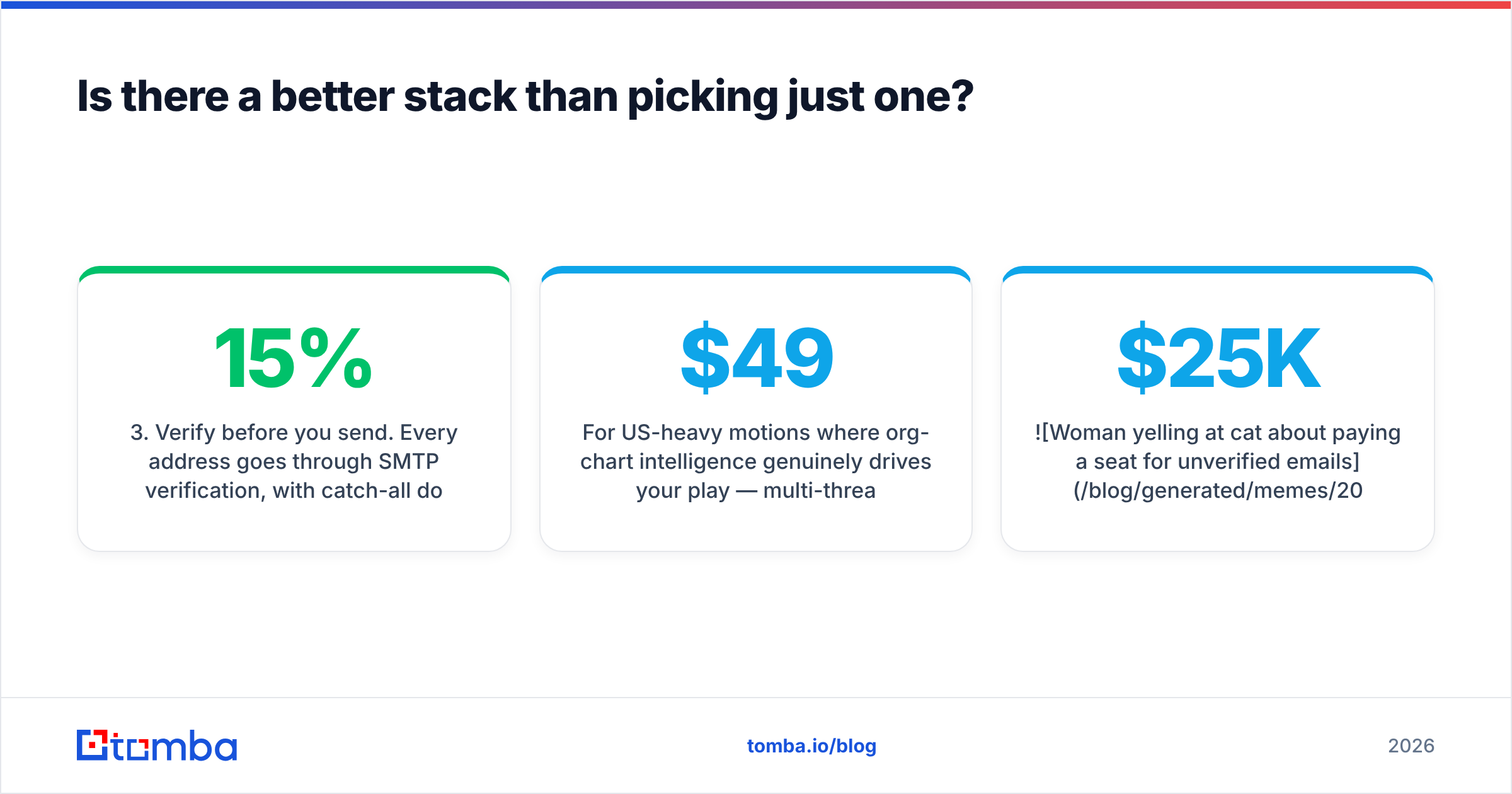
Is there a better stack than picking just one?#
Yes. Most teams that weigh this pair build a layered stack instead of naming a winner.
Here is the pattern that works for EU outbound:
- Set the entity list with registry data. Use HitHorizons, or a national register, to build a clean list of companies that fit your ICP. Filter by industry code, staff band, country, and revenue. Now you have real company names and domains.
- Turn domains into people. Run each domain through a domain search. You get the email patterns and named contacts that exist today, not an 18-month-old export.
- Verify before you send. Check every address by SMTP. Route catch-all domains to a catch-all verifier. Roughly 15% of B2B domains accept everything, so do not guess.
- Enrich the survivors. Add firmographics, profiles, and phone numbers only for contacts that passed. Enriching dead records is wasted money.
- Sequence, then re-verify each quarter. Contact data decays. Treat your list as fresh produce, not an asset.
Some US motions really do run on org-chart intel. If you multi-thread into a 12-person buying committee, ZoomInfo's depth is hard to copy. There are good reasons to pay for it. Just do not pay enterprise rates for the email part. A dedicated finder does that job for $49/mo.

What are the main alternatives worth considering?#
The DiscoverOrg vs HitHorizons frame is narrow. The wider field splits into three lanes.
Enterprise all-in-one platforms. ZoomInfo, Apollo, Cognism, and Lusha bundle contacts, intent, and sequencing. Good if you want one vendor and can absorb the price. If a ZoomInfo quote made you flinch, an Apollo alternative is the usual next stop.
Registry and firmographic providers. HitHorizons, Dun & Bradstreet, Creditsafe, and Vainu. Strong on entities, silent on people. BookYourData sits between the lanes. It sells pay-as-you-go verified B2B lists with a bounce guarantee. That suits teams who want a list handed to them rather than built by API.
Precision email finders. Tomba, Hunter, and Findymail turn a name plus a domain into a live address, with verification built in. Lower cost. Narrower scope. Far less contract friction.
Pick by the constraint that binds hardest:
- Tight budget, EU focus → registry data plus a dedicated finder.
- Flexible budget, US enterprise → ZoomInfo, renewal quirks and all.
- Compliance first (KYC, credit, procurement) → HitHorizons or D&B.
- High-volume outbound at low cost → finder plus verifier, re-run monthly.
How do you run your own DiscoverOrg vs HitHorizons test in a week?#
Trust no vendor's coverage claim. Not even this article's. Run a controlled test.
- Build a 100-company control list from accounts you closed. You know these firms exist. You know the buyer titles.
- Query each vendor on the same 100 domains. Record the match rate. How many returned a usable record at all?
- Sample 25 emails per vendor and check them elsewhere. Use an independent free email checker. Do not grade a vendor with the vendor's own tool.
- Send a small test batch. 50 addresses per source, same copy, same domain. Watch hard bounces. Anything above 3% hurts your sender reputation.
- Work out cost per verified contact, not cost per credit. A $0.10 credit that bounces costs more than a $0.30 credit that lands.
Most teams find the same thing. The pricey platform wins on breadth. The registry source wins on entity truth. Neither one wins on deliverable addresses per dollar. That gap is where a dedicated tool pays for itself.
DiscoverOrg vs HitHorizons: what's the verdict?#
Choose ZoomInfo (formerly DiscoverOrg) if you sell to US enterprises. You get org charts and direct dials. You need a real budget and an annual contract. Nobody maps a buying committee better.
Choose HitHorizons if you need solid European company records. It fits market sizing, compliance, credit checks, and TAM models. Just plan to source your contacts elsewhere.
Choose neither as your main spend if your real problem sounds like this: "I have a list of target companies and I need verified emails for specific roles." That is a smaller problem with a much cheaper fix. Paying an enterprise data tax for it is the most common budget leak in outbound.
Start where the constraint really is. Is your CRM full of company names and short on reachable contacts? Run those domains through the Tomba Email Finder. The first 25 searches are free, and Starter is $49/mo. Every result ships with SMTP verification, and the API is there when you want to automate. Test it against the quote sitting in your inbox, then decide what deserves a signature.
Related guides#
Ready to find emails that actually work?
Join 150,000+ professionals who stopped guessing and started sending. Free credits on signup — no credit card required.
Get the Tomba newsletter
Practical outbound tactics and product updates — once every two weeks.
About the author