DiscoverOrg vs LakeB2B (2026): Which B2B Data Provider Wins?
DiscoverOrg no longer exists as a standalone product, and LakeB2B sells lists, not software. Here is what each one actually gives you in 2026 — accuracy, contracts, real costs, and who should pick which.
DiscoverOrg vs LakeB2B is an odd match-up in 2026. One of them is no longer a product you can buy. The other is not software at all. Here is what each side really sells, what it costs, and who should pick which.
TL;DR
- DiscoverOrg is not a product you can buy in 2026. It merged with ZoomInfo in 2019, and the brand was folded into the ZoomInfo platform. When someone pitches you "DiscoverOrg," they are selling ZoomInfo.
- LakeB2B is a list and data-services vendor, not a self-serve tool. You brief them, they build a file, and you get a CSV or a CRM push. It is a very different way to buy.
- ZoomInfo (ex-DiscoverOrg) wins on org charts, intent data, and daily workflow. LakeB2B wins in niche markets, above all healthcare and education. You also pay only for the records you asked for.
- Both are annual, rep-led purchases. Neither vendor publishes real prices. Expect five figures for ZoomInfo and a custom quote for LakeB2B.
- Do you need accurate contact data without a contract? A per-lookup email finder plus verification covers most outbound work for far less money.
DiscoverOrg vs LakeB2B: is DiscoverOrg still a product in 2026?#
No. DiscoverOrg is gone as a stand-alone brand. It bought ZoomInfo in 2019, then took the ZoomInfo name because more buyers knew it. The DiscoverOrg tech is still there: human-researched org charts, IT department maps, and technographics. All of it now sits inside ZoomInfo Sales, Marketing, Operations, and Talent.
That matters today, not just as history. Maybe you are searching "DiscoverOrg vs LakeB2B" because a legacy contract is up for renewal. Maybe a colleague still calls the tool DiscoverOrg. Either way, you are comparing two very different things:
- A full go-to-market platform, with seats, credits, CRM sync, intent signals, and a conversation-intelligence add-on
- A managed data provider that builds custom contact files to your spec
One is software you log into every day. The other is a data delivery you receive, load, and use.
The DiscoverOrg DNA still shows in the product. ZoomInfo's best asset is org-chart depth in mid-market and enterprise tech accounts. It can tell you that a VP of Infrastructure reports to the CIO, and name the three directors under her. Nobody else built that data the same way. It is why ZoomInfo can still charge what it charges.

What is LakeB2B, and who actually buys it?#
LakeB2B is a data and demand-generation company. It sells targeted contact lists, data appending, data cleaning, and campaign services. There is no search screen with filters you drive yourself. You talk to a rep, describe your ideal customer, and get a quote for a file of N records.
Its best pitch is vertical coverage that broad databases handle badly:
- Healthcare — doctors by specialty, NPI-linked records, hospital and clinic decision makers
- Education — K-12 and higher-ed staff, plus district-level roles
- Technology installs — tech attributes appended to the accounts you already track
- Niche industries — manufacturing subsegments, logistics, and regional trade lists that rarely show up clean in big databases
- Data hygiene — adding missing emails, phones, and firmographics to a CRM you already own
The way you buy is the trade-off. You cannot preview the file before you commit. You cannot tweak filters at 11pm on a Tuesday. Quality also varies by segment, based on the source they pulled from. Reviews on G2 show that split. Buyers who wanted a niche vertical file are mostly happy. Buyers who expected a ZoomInfo-style self-serve tool are not.
DiscoverOrg vs LakeB2B: how do they compare head to head?#
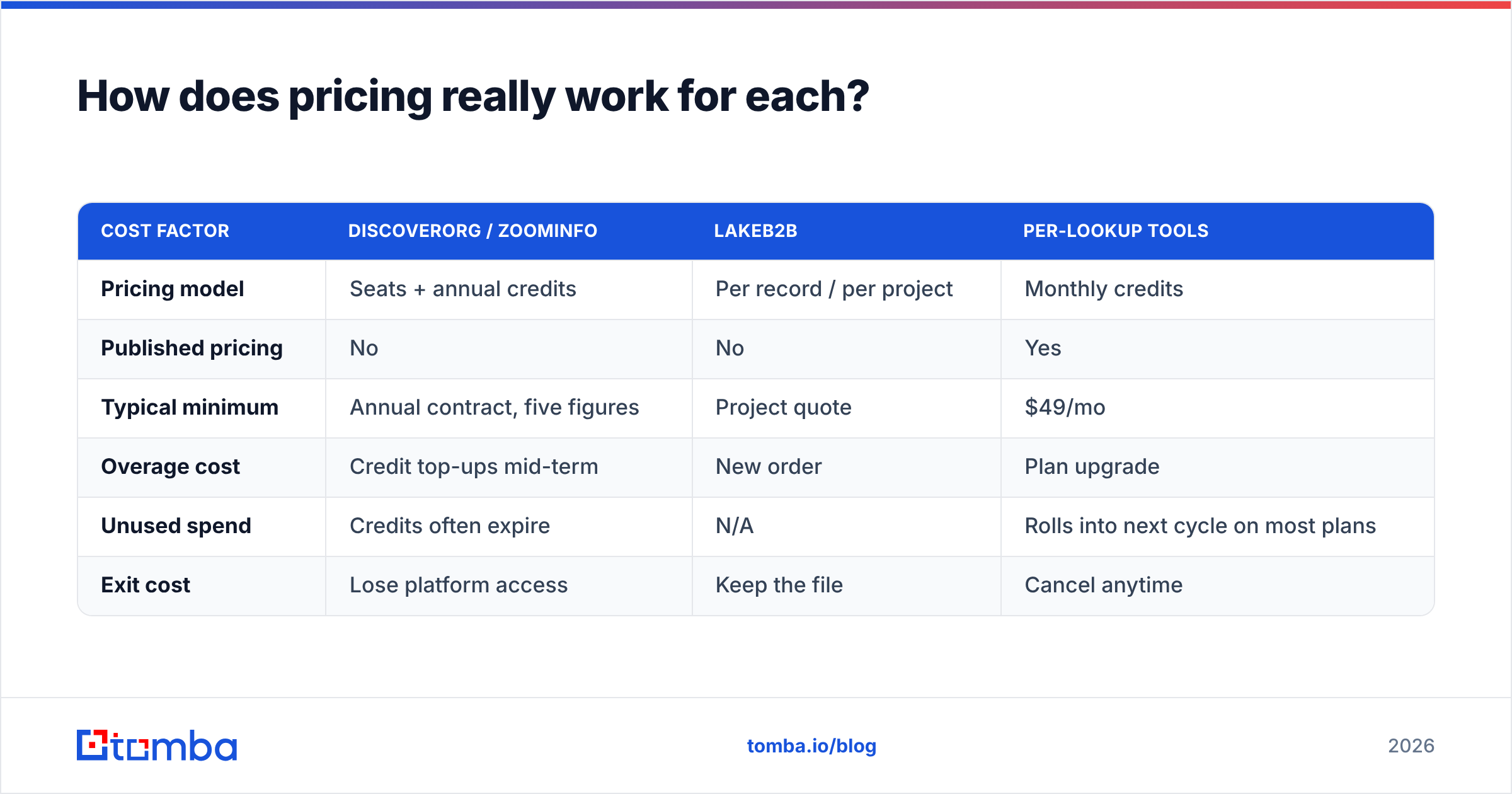
| Attribute | DiscoverOrg / ZoomInfo | LakeB2B |
|---|---|---|
| Product type | Self-serve SaaS platform | Managed list + data services |
| Access model | Seat licenses + credit pool | Per-project file delivery |
| Contract | Annual, typically multi-seat | Per-order or retainer |
| Entry cost (reported) | ~$15,000+/year | Custom quote, often low four figures per list |
| Free trial | Limited, sales-gated | No; sample file on request |
| Org charts | Strongest in market | Not a focus |
| Intent data | Yes, built in | Available as add-on service |
| Vertical depth | Broad, tech-heavy | Deep in healthcare and education |
| CRM integration | Native Salesforce, HubSpot, Dynamics | CSV or assisted import |
| Data refresh | Continuous | At delivery |
| Best for | Enterprise SDR teams with budget | Targeted campaigns in niche verticals |
Read that table as two answers to two different questions. ZoomInfo answers this one: how do 20 reps prospect every day without leaving their workflow? LakeB2B answers a different one: how do I get 8,000 verified nurse practitioners in the Midwest by Friday?
DiscoverOrg vs LakeB2B: which one has better data accuracy?#
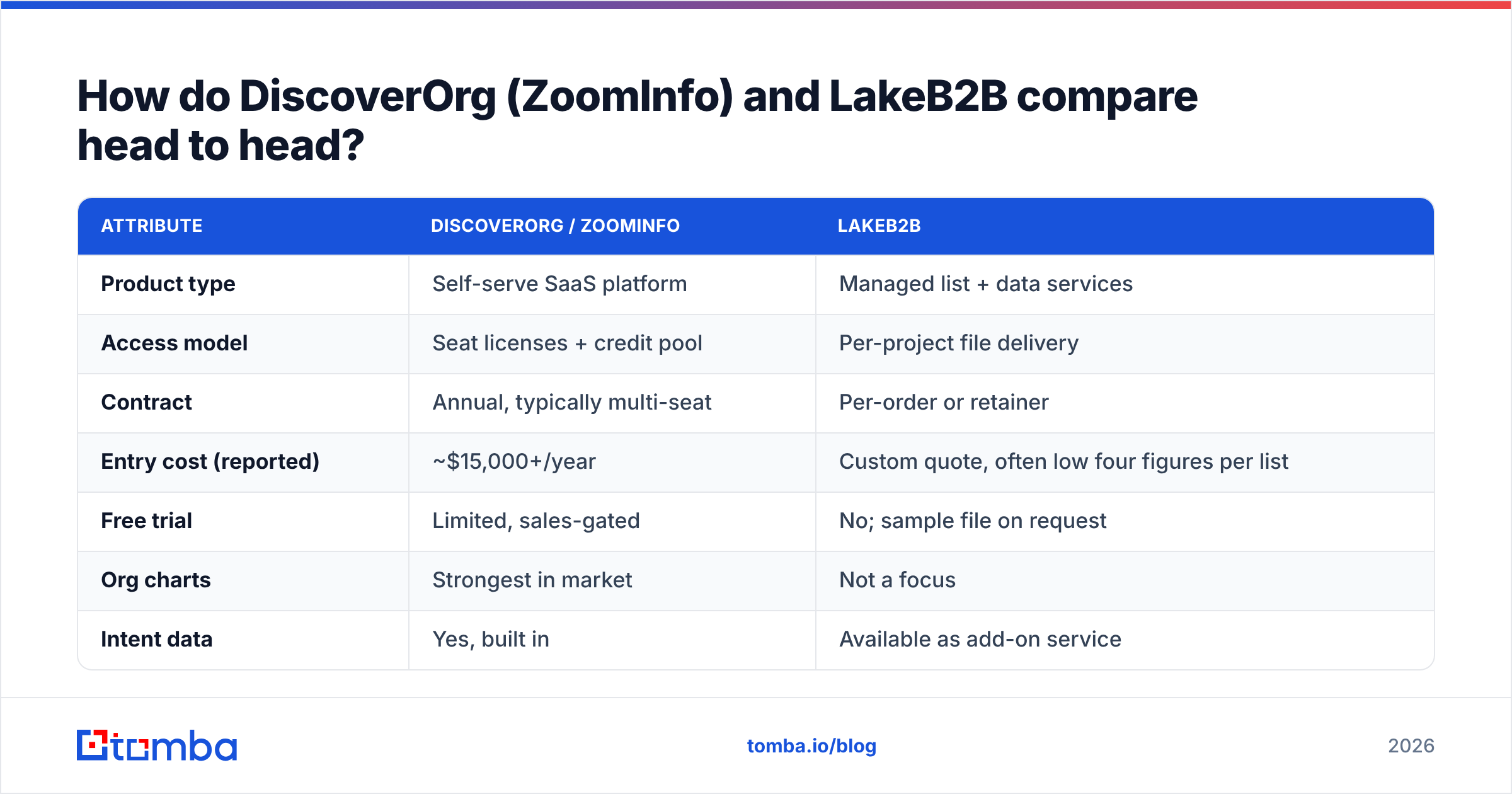
Neither publishes a number you should trust at face value. Both quote 85–95% accuracy, depending on the segment. The real difference is how each one handles decay.
ZoomInfo refreshes all the time. It re-checks records against a large contributor network and its own research team. So the record you pull today is likely fresher than a file built three months ago. You pay a subscription to keep that freshness. Cancel, and you keep only what you exported.
LakeB2B builds a file at one point in time. A good list is accurate the week it lands, then it decays at the normal B2B rate. About 2 to 2.5% of contacts change jobs each month. That adds up to 25–30% decay a year. A list bought in January is well out of date by summer.
That decay math is the most important part of this comparison. It is also why smart teams do the same thing with any vendor: verify before you send. Run every purchased file through an email verifier first. It catches the bounces that would hurt your sending domain. On a 10,000-record file with 20% decay, that is 2,000 bounces you never send. It is the gap between a healthy inbox rate and a blocked domain.
Three checks to run before you sign anything:
- Ask for a 100-record sample in your exact target market, not a generic one. Verify it yourself.
- Check catch-all handling. Many vendors count catch-all domains as "valid." They are unknown, not valid. A catch-all verifier tells the two apart.
- Test recency, not just validity. An email can still work after the person has left. Spot-check 20 records against LinkedIn.
How does pricing really work for each?#
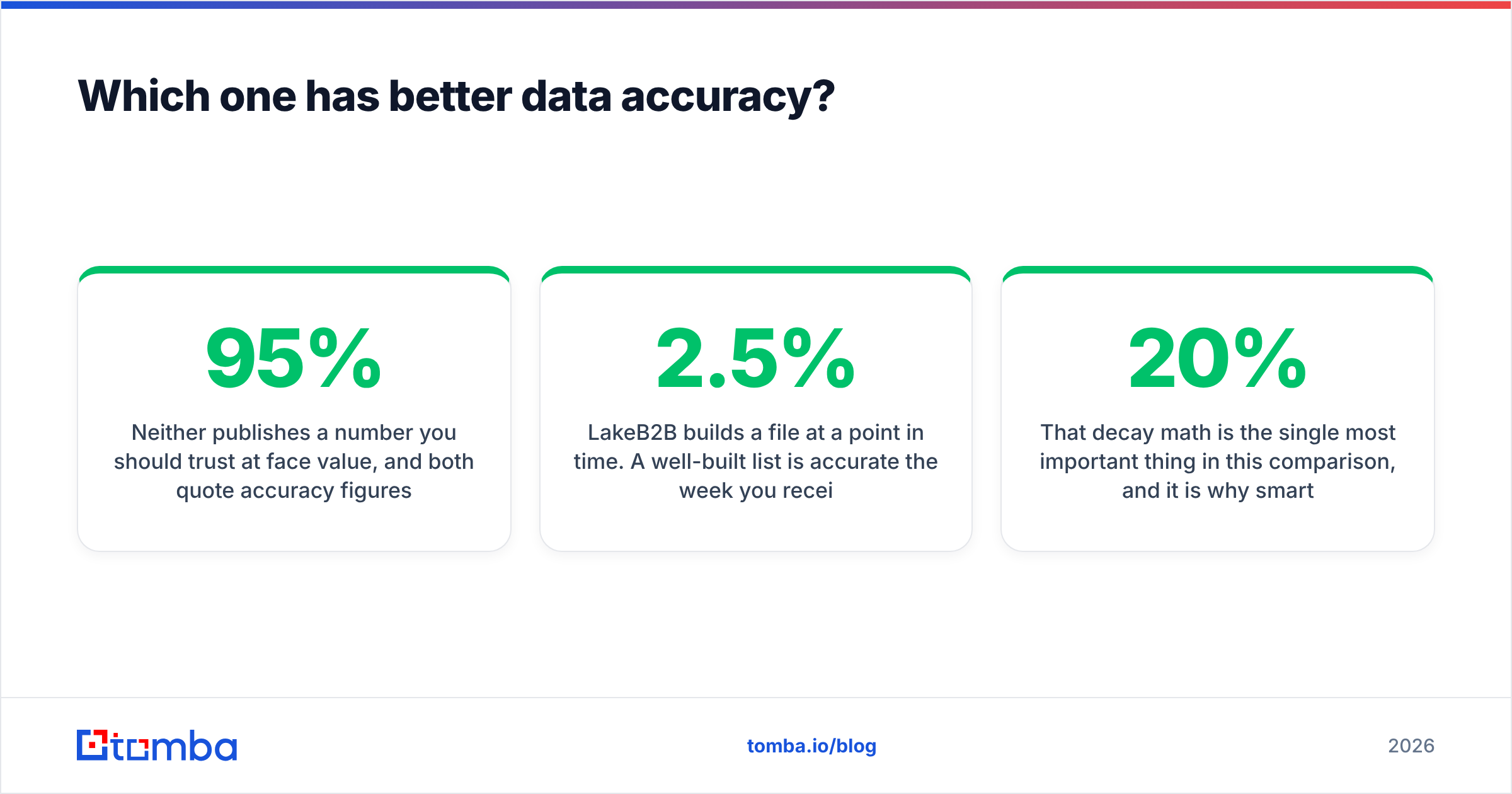
| Cost factor | DiscoverOrg / ZoomInfo | LakeB2B | Per-lookup tools |
|---|---|---|---|
| Pricing model | Seats + annual credits | Per record / per project | Monthly credits |
| Published pricing | No | No | Yes |
| Typical minimum | Annual contract, five figures | Project quote | $49/mo |
| Overage cost | Credit top-ups mid-term | New order | Plan upgrade |
| Unused spend | Credits often expire | N/A | Rolls into next cycle on most plans |
| Exit cost | Lose platform access | Keep the file | Cancel anytime |
The hidden cost with ZoomInfo is not the sticker price. It is the seat math. You buy for a team of 12, two reps leave, and you still pay for 12 seats until renewal. The hidden cost with LakeB2B is repeat buying. Every new segment is a new order, and nothing builds up between orders.
Compare that with clear per-lookup pricing. Tomba's free tier gives 25 searches a month. Starter is $49/mo, Growth $99/mo, and Pro $249/mo, with a custom enterprise plan. The full breakdown sits on the Tomba pricing page. There are no seat minimums and no annual lock-in. It is not a like-for-like swap for a full platform. It replaces the contact data part, which is what most teams really pay for.

Who should choose which?#
Choose ZoomInfo (ex-DiscoverOrg) if you have 10 or more reps, real CRM discipline, and budget for a five-figure annual line item. It fits best when you sell to mid-market or enterprise tech accounts. There, org charts lift your win rate, and the data pays for itself when deal sizes are large.
Choose LakeB2B if your market is one the big databases cover badly. Think health practitioners, school district staff, or regional industrial niches. It also fits campaign-shaped outbound rather than daily prospecting. Buy the file, run the campaign, review, repeat.
Choose neither if you are a founder, a two-person sales team, or an agency doing outbound for clients. Both vendors are built for buyers with a procurement process. The annual commitment is the product, and you will not talk your way out of it.
Run a hybrid if you already own a CRM full of accounts but lack contacts. Use data enrichment to fill the gaps on records you have. Then buy net-new data only for truly new segments. This is the cheapest path for most teams, and almost nobody tries it first.
Look at a peer vendor if you want per-record buying with no services layer. BookYourData sells pay-as-you-go B2B contacts on a simple credit model. It sits between the platform and the managed-list extremes.
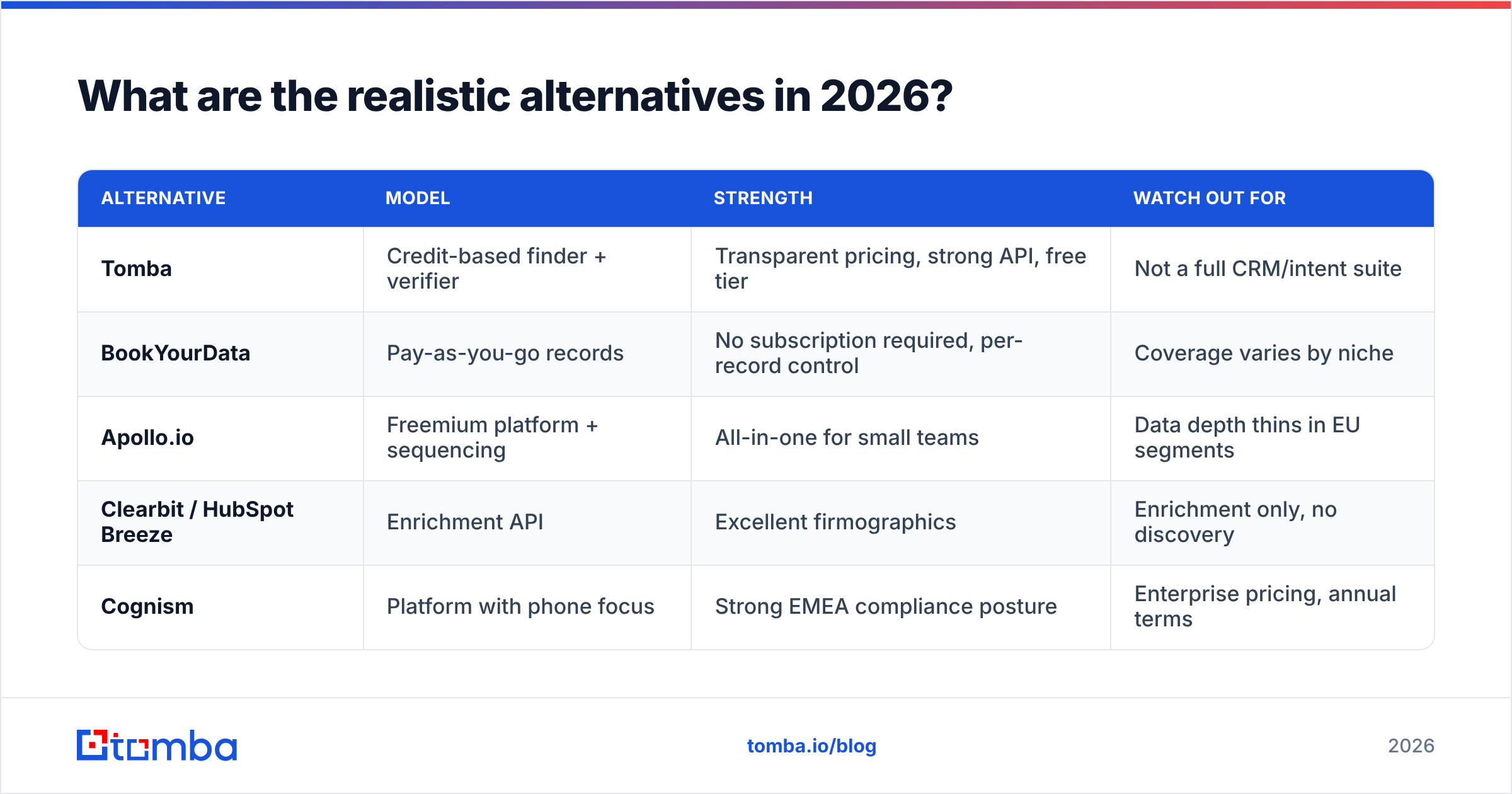
What are the realistic alternatives in 2026?#
| Alternative | Model | Strength | Watch out for |
|---|---|---|---|
| Tomba | Credit-based finder + verifier | Transparent pricing, strong API, free tier | Not a full CRM/intent suite |
| BookYourData | Pay-as-you-go records | No subscription required, per-record control | Coverage varies by niche |
| Apollo.io | Freemium platform + sequencing | All-in-one for small teams | Data depth thins in EU segments |
| Clearbit / HubSpot Breeze | Enrichment API | Excellent firmographics | Enrichment only, no discovery |
| Cognism | Platform with phone focus | Strong EMEA compliance posture | Enterprise pricing, annual terms |
Are you weighing this category seriously? Then read an Apollo alternative comparison too. The vendor set has shrunk a lot since the DiscoverOrg merger. For most teams the real choice is now "platform, list vendor, or API," not "which of these fifteen logos."
How should you run the evaluation?#
Do not start with a demo. Start with a bake-off on your own data.
Take 200 accounts you already want to sell to. Give the same 200 to every vendor on your list. Ask each one for contacts in three named roles. Then measure four things: coverage, validity after your own check, recency against public profiles, and cost per usable record. Coverage means how many of the 200 came back with a contact you can use. Cost per credit does not matter. Cost per record you would really email does.
That last number is where the ranking flips. A $0.10 record with a 60% usable rate costs $0.17 per usable contact. A $0.35 record with a 95% usable rate costs $0.37. The cheap file is still cheaper, but only if your deliverability survives. Google and Yahoo now throttle senders above a 0.3% complaint rate, so it often does not.
Run the bake-off before you talk contracts. Vendors negotiate very differently once you can quote their own coverage numbers back to them.
The verdict on DiscoverOrg vs LakeB2B#
For most teams, neither one is the right first buy in 2026. ZoomInfo is right if your team size and deal size can absorb a five-figure annual contract. Its org-chart lineage is still best in class. LakeB2B is right if the big databases underserve your vertical and you buy in campaign batches. Both are legitimate vendors. Both are also expensive for what a modern outbound team really needs: verified email addresses for named people at named companies.
If that is the job, start with a tool built for it. Tomba's Email Finder returns work email addresses by domain, name, or company. Every result carries a confidence score and its sources. It is free for 25 searches a month and $49/mo on Starter. There is an API and a Chrome extension, so it fits the workflow you already have. Test it against a purchased file on the same 200 accounts, and let the cost per usable record decide.
Related guides#
Ready to find emails that actually work?
Join 150,000+ professionals who stopped guessing and started sending. Free credits on signup — no credit card required.
Get the Tomba newsletter
Practical outbound tactics and product updates — once every two weeks.
About the author