DiscoverOrg vs LeadIQ: Which B2B Data Tool Wins in 2026?
DiscoverOrg (now ZoomInfo) and LeadIQ solve different problems at wildly different prices. Here's the honest breakdown of accuracy, cost, workflow fit — and when a cheaper tool beats both.
DiscoverOrg vs LeadIQ is the wrong fight for most teams. One is a full B2B database. The other is a fast way to pull contacts off LinkedIn. This guide covers what each one costs, where the data holds up, and when a cheaper tool beats both.
TL;DR
- DiscoverOrg is now ZoomInfo. The two merged in 2019 and the DiscoverOrg brand was retired. If a rep pitches you "DiscoverOrg," you are buying ZoomInfo SalesOS.
- They are not the same product. ZoomInfo (DiscoverOrg) is a full B2B database with org charts, intent data, and technographics. LeadIQ is a capture-and-sync layer that lives in your browser next to LinkedIn.
- Price gap is enormous. ZoomInfo lands in the $15K–$40K+/year range with annual contracts and seat minimums. LeadIQ starts free and its paid tiers run roughly $45–$135 per user/month.
- Accuracy differs by data type. ZoomInfo wins on direct dials and firmographic depth. LeadIQ is competitive on work emails and much faster to get value from.
- Most teams overbuy. If you mainly need verified work emails at volume, a dedicated email finder does the job for a fraction of either contract.
What exactly is DiscoverOrg in 2026?#
DiscoverOrg no longer exists as a standalone product. ZoomInfo acquired DiscoverOrg's parent in 2019, and the combined platform sells today as ZoomInfo SalesOS. (Technically DiscoverOrg bought ZoomInfo, then took its name.) The DiscoverOrg DNA still shows in what the platform does best. Think deep org charts, verified direct dials, and IT, finance, and HR mapping.
That heritage matters. DiscoverOrg built its name on human verification. Analysts called into companies to confirm who reports to whom. ZoomInfo layered machine-scale collection on top. The result in 2026 is a database of 100M+ business contacts. It also carries intent signals from a large publisher co-op, tech stack profiles, and website visitor data.
What you are actually buying is a data warehouse with a UI on top. It sells on annual contracts with credit allotments and seat minimums. Here is the part people miss: intent, enrichment, and workflow automation are separate SKUs.
What is LeadIQ and who is it for?#
LeadIQ takes the opposite approach. It does not ask you to search a database and export lists. It lives where reps already work: a Chrome extension on LinkedIn Sales Navigator, plus a light web app.
You browse a Sales Navigator list and click capture. LeadIQ pulls the contact's work email and phone. Then it pushes the record into Salesforce, HubSpot, Outreach, or Salesloft with the right field mapping. Its "Scribe" feature writes personalized email openers from the prospect's recent activity.
LeadIQ's core bet is that the bottleneck for most SDRs is not database size. It is the 40 seconds of copy-paste tax per prospect. That bet is right for a lot of teams and completely wrong for others.
Who LeadIQ fits: SDR teams of 2–30 reps running LinkedIn-first prospecting. They already have a sequencer and a CRM. They just need clean contacts flowing into it.
Who it does not fit: RevOps teams that enrich 200,000 CRM records, ABM programs that need account-level intent, or anyone doing territory planning from firmographics.

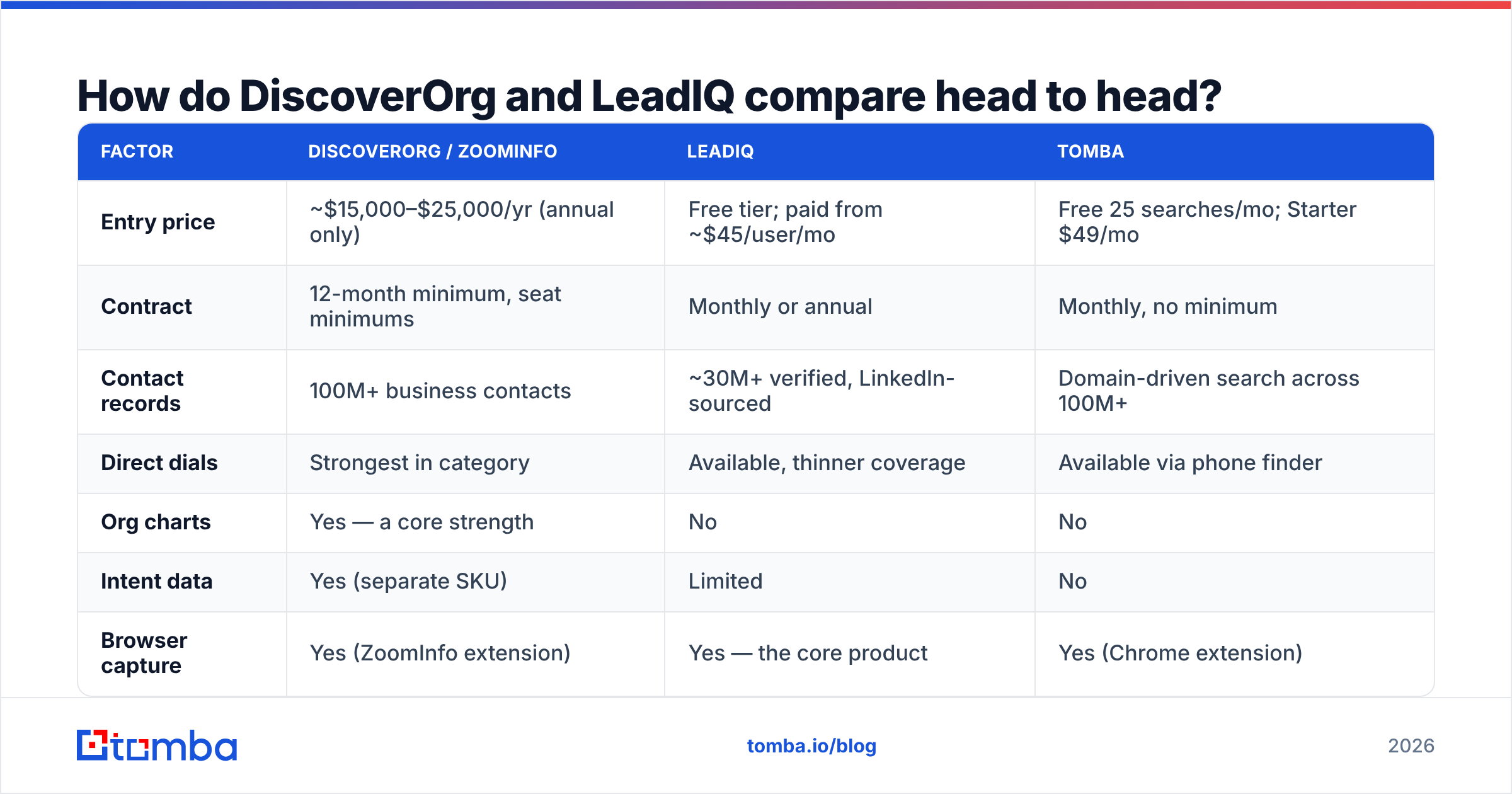
DiscoverOrg vs LeadIQ: how do they compare head to head?#
| Factor | DiscoverOrg / ZoomInfo | LeadIQ | Tomba |
|---|---|---|---|
| Entry price | ~$15,000–$25,000/yr (annual only) | Free tier; paid from ~$45/user/mo | Free 25 searches/mo; Starter $49/mo |
| Contract | 12-month minimum, seat minimums | Monthly or annual | Monthly, no minimum |
| Contact records | 100M+ business contacts | ~30M+ verified, LinkedIn-sourced | Domain-driven search across 100M+ |
| Direct dials | Strongest in category | Available, thinner coverage | Available via phone finder |
| Org charts | Yes — a core strength | No | No |
| Intent data | Yes (separate SKU) | Limited | No |
| Browser capture | Yes (ZoomInfo extension) | Yes — the core product | Yes (Chrome extension) |
| CRM sync | Native, deep | Native, excellent field mapping | Native + Zapier/Make |
| Email verification | Included | Included | Dedicated verifier + catch-all handling |
| API access | Enterprise tier | Available on higher tiers | All paid plans |
| Time to first value | 2–6 weeks (onboarding + training) | Same day | Same day |
| Best for | Enterprise ABM, territory planning | SDR speed on LinkedIn | Volume email discovery + verification |
The table makes the strategic split obvious. These are not competing products. They are adjacent ones that both happen to sell "B2B contact data."
DiscoverOrg vs LeadIQ: which one has better data accuracy?#
Honest answer: it depends on which field you care about.
Direct dial phone numbers — ZoomInfo wins clearly. Its human-verification heritage and phone-focused acquisitions give it the deepest mobile and direct-dial coverage of any commercial database. If you cold call, this is the strongest argument for the contract.
Work email accuracy — Much closer than the price gap suggests. Independent G2 reviews put both platforms in the 85–93% range on verified work emails. LeadIQ often edges ahead on roles that changed recently, because it reads live from LinkedIn instead of a stored index.
Firmographics and org structure — ZoomInfo, no contest. Employee counts, revenue bands, tech stack, reporting lines. LeadIQ does not compete here.
Data freshness on job changes — LeadIQ has the structural edge. It reads the profile at capture time. Big databases always carry index lag. In a market with high job mobility, that lag turns into bounces.
Catch-all and role-based addresses — Both platforms struggle. Neither gives you real control over how catch-all domains are handled. That is why teams sending at volume add a dedicated catch-all verifier on top.
The practical takeaway: every vendor measures accuracy its own way. Run the same 200-contact sample through both trials and count the bounces yourself. That test takes an afternoon. It beats any published benchmark.
What do they actually cost?#
Cost is where the DiscoverOrg vs LeadIQ call usually gets made. It is also where most reviews go sideways.
ZoomInfo (DiscoverOrg) does not publish pricing. Contracts reported on Capterra and vendor-negotiation forums cluster around $15,000/year for a small SalesOS package. They climb past $40,000 once you add intent data, enrichment, and more seats. Credits are metered. Export limits are per seat, and overages get billed. Contracts run 12 months. Auto-renew clauses are common, and mid-term downgrades are rare.
LeadIQ publishes pricing openly. There is a usable free tier and an Essential plan around $45/user/month billed annually. Pro sits near $89–$135/user/month depending on credits. Enterprise pricing is custom. Credits reset monthly and unused ones do not roll over.
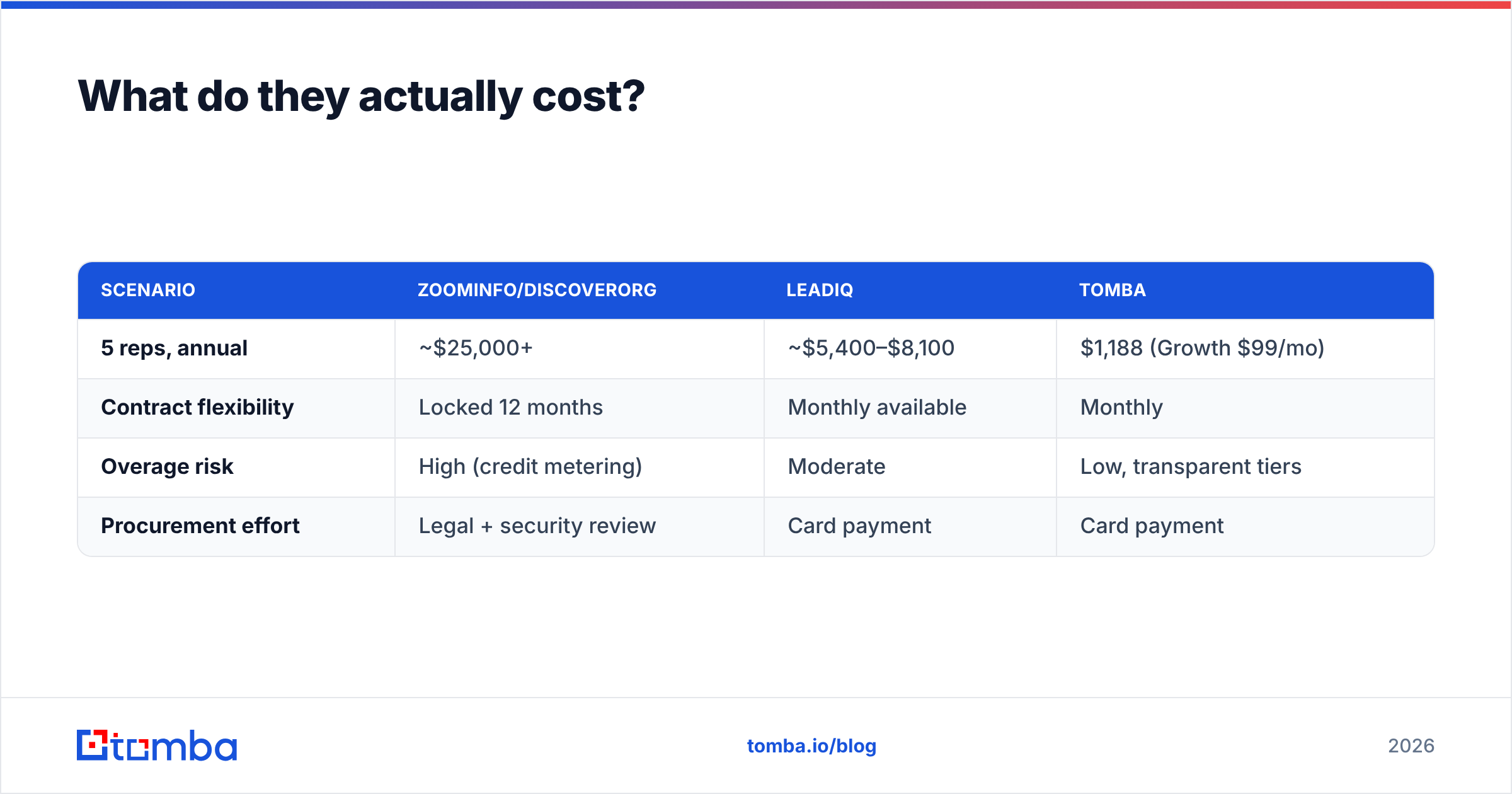
Run the math for a 5-rep team:
| Scenario | ZoomInfo/DiscoverOrg | LeadIQ | Tomba |
|---|---|---|---|
| 5 reps, annual | ~$25,000+ | ~$5,400–$8,100 | $1,188 (Growth $99/mo) |
| Contract flexibility | Locked 12 months | Monthly available | Monthly |
| Overage risk | High (credit metering) | Moderate | Low, transparent tiers |
| Procurement effort | Legal + security review | Card payment | Card payment |
Tomba's pricing sits in that table for one reason. A large share of teams comparing these two only ever use the email-finding feature. Tomba does not replace ZoomInfo's org charts. But paying enterprise rates for one column of data is the most common mistake in this category.
When should you actually pick DiscoverOrg/ZoomInfo?#
Pick it when at least two of these are true:
- You sell to enterprise accounts with complex buying committees. Org charts and reporting-line data are hard to replicate. They are worth real money when a deal has seven stakeholders.
- Cold calling is a primary channel. Direct-dial depth is the moat. No cheaper tool matches it.
- You run account-based marketing with intent triggers. ZoomInfo's intent co-op is large and feeds meaningful surge signals.
- You need to enrich a large CRM continuously. Its enrichment engine handles hundreds of thousands of records with field-level rules.
- You have procurement capacity. A $25K contract needs security review, legal, and a renewal owner. If nobody owns that, the tool turns into shelfware within two quarters.
Skip it if you are a 3-person startup, or if email is your only channel. Skip it too if you cannot name the data field that justifies the spend.

When is LeadIQ the smarter buy?#
Pick LeadIQ when your prospecting already starts on LinkedIn and your pain is workflow friction, not data scarcity.
- Your reps live in Sales Navigator. LeadIQ's capture flow is one of the best in the category — one click from profile to sequence.
- You need CRM hygiene without a RevOps hire. Its field mapping and duplicate detection beat most tools twice its price.
- You want to start this week. No procurement cycle, no onboarding project plan.
- Your team is under 30 reps. Past that, per-seat pricing starts to approach ZoomInfo territory without the database depth.
- Personalization matters more than volume. Scribe's AI openers save real time when reps write one by one instead of blasting.
Be realistic about the limits: no org charts, thinner phone coverage, and credit ceilings that bite on heavy weeks. If your buyers are not well represented on LinkedIn — trades, local services, non-English SMB markets — LeadIQ's LinkedIn-first sourcing becomes a hard constraint.
What are the credible alternatives to both?#
The DiscoverOrg vs LeadIQ frame assumes you need a platform. Often you need a component.
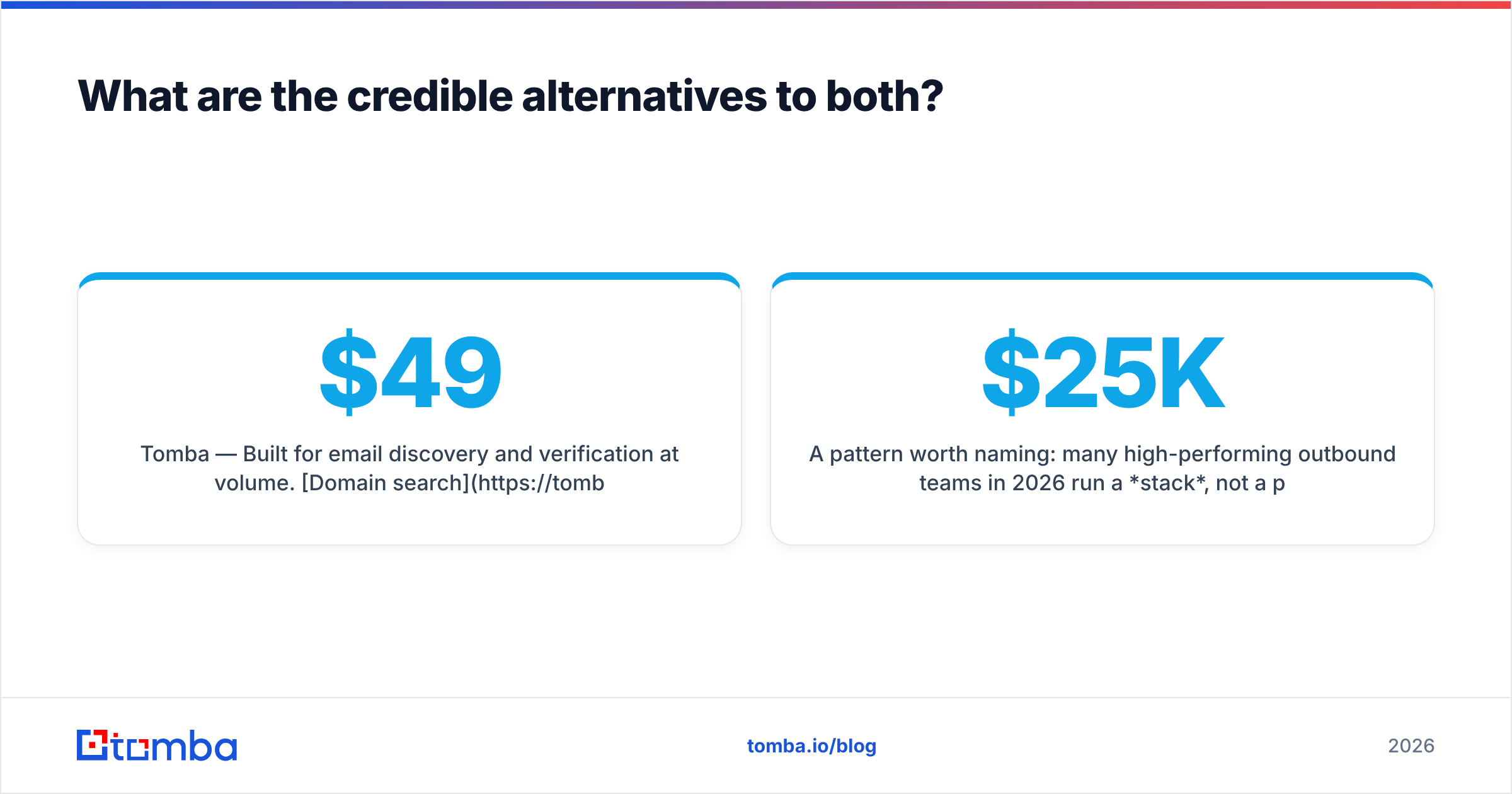
Tomba — Built for email discovery and verification at volume. Domain search pulls every findable address at a company. The email verifier catches bounces before you send, and the Tomba API drops into your own enrichment pipeline. Free tier is 25 searches/month; Starter is $49/mo and Growth $99/mo. No org charts, no intent — by design.
BookYourData — A strong option when you want to buy a targeted, pre-built list instead of running searches yourself. Pay-as-you-go pricing and a bounce guarantee suit teams that need a one-time list for a single campaign.
Apollo.io — The closest thing to an all-in-one at mid-market pricing: database plus sequencer plus dialer. Data quality is uneven by segment, but the bundled value is hard to argue with. See our Apollo alternative breakdown for the trade-offs.
Clay — For teams that want to orchestrate several data providers with waterfall enrichment. Powerful, and it assumes technical ownership.
Direct LeadIQ alternative comparisons — worth reading if the LinkedIn capture workflow is your specific requirement.
A pattern worth naming: many strong outbound teams in 2026 run a stack, not a platform. One tool picks accounts, one finds and verifies email, one sends the sequence. Each part is replaceable, none costs $25K, and the total usually lands under half of a single enterprise contract.
How should you run the evaluation?#
Do not compare feature matrices. Compare outcomes on your own data. Most DiscoverOrg vs LeadIQ calls get made on demo slides, and yours should not.
- Build a 200-contact test list from your actual ICP — real companies you want to sell to, not a random sample.
- Run it through every trial at once. ZoomInfo will require a demo call. LeadIQ and Tomba you can start alone.
- Measure four numbers. Match rate, bounce rate on a real send, phone accuracy (dial 20 and count connects), and time per contact.
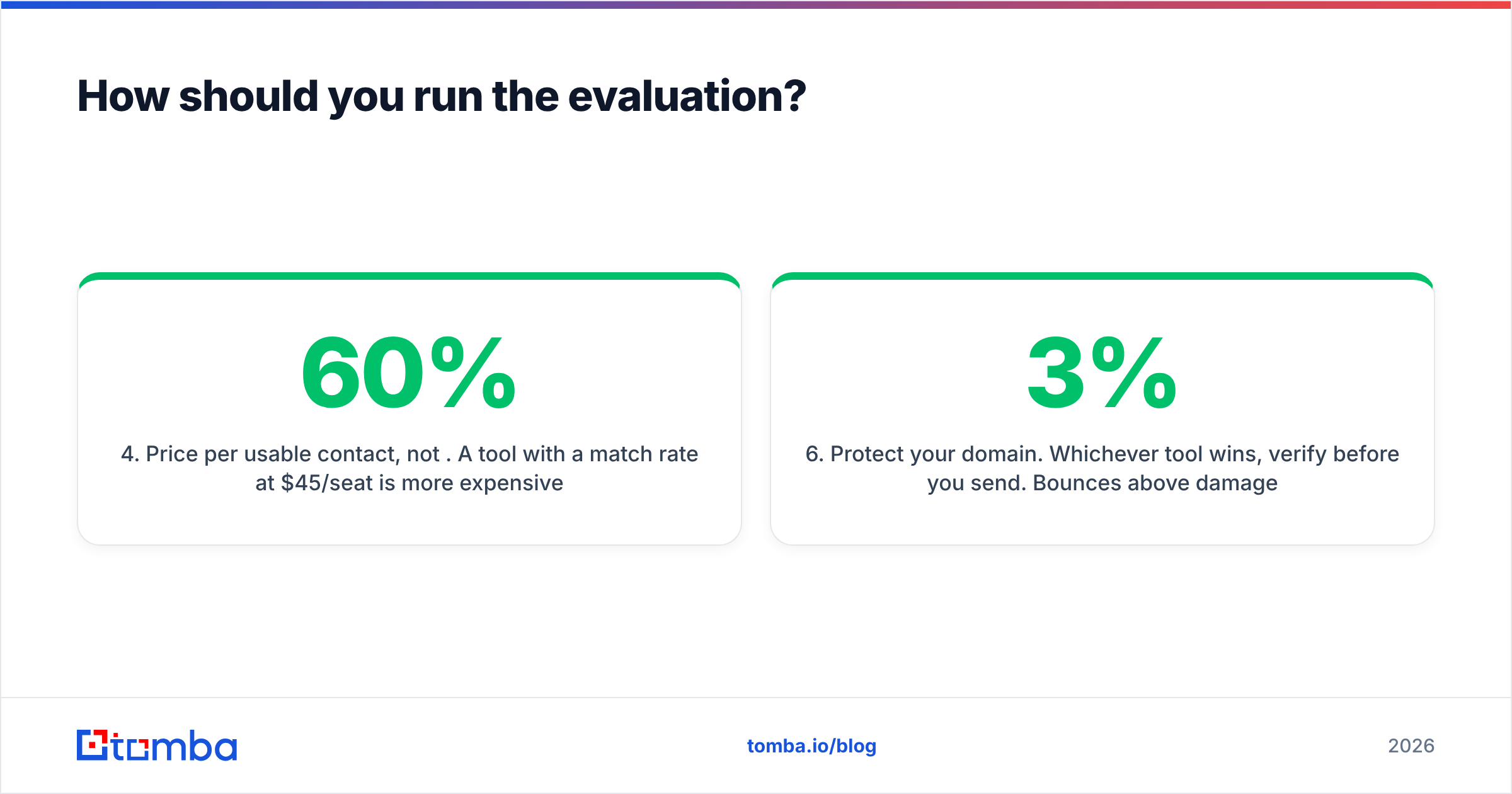
- Price per usable contact, not per seat. A tool with a 60% match rate at $45/seat costs more than one with 90% at $99/mo.
- Check contract terms before the demo ends. Ask directly: auto-renew, credit rollover, mid-term downgrade, overage rate. Get answers in writing.
- Protect your domain. Whichever tool wins, verify before you send. Bounces above 3% damage sender reputation faster than any tool can rebuild it.
That process takes about two weeks and routinely saves teams five figures. The teams that skip it are the ones renewing a contract nobody uses.
The verdict on DiscoverOrg vs LeadIQ#
If you sell enterprise and cold call, ZoomInfo (DiscoverOrg) earns its price. Org charts, direct dials, and intent data are real differentiators that cheaper tools do not replicate. Go in with a negotiated multi-year rate and an internal owner.
If you run LinkedIn-first SDR motions under 30 seats, LeadIQ is the better buy. It is faster to value, the pricing is public, and the capture-to-CRM workflow saves reps hours per week.
If email is your channel and volume is your constraint, neither is the right shape. You are paying for a database when you need a lookup engine.
That last case is where Tomba fits. The Tomba Email Finder finds verified professional emails by domain, name, or company. Verification runs in the same workflow, so bad addresses never reach your sequencer. Start free with 25 searches a month, scale to Starter at $49/mo or Growth at $99/mo, and skip the annual contract. Run your 200-contact test list through it next to your ZoomInfo and LeadIQ trials. The match rate and bounce numbers will tell you what a demo call cannot.
Related guides#
Ready to find emails that actually work?
Join 150,000+ professionals who stopped guessing and started sending. Free credits on signup — no credit card required.
Get the Tomba newsletter
Practical outbound tactics and product updates — once every two weeks.
About the author