DiscoverOrg vs LeadMine (2026): Which B2B Data Tool Wins?
DiscoverOrg no longer exists as a standalone product, and LeadMine is a lightweight email finder with a very different price tag. Here is how the two actually compare in 2026 — and what to buy instead.
TL;DR
- DiscoverOrg does not exist as a standalone product anymore. It acquired ZoomInfo in 2019, took the ZoomInfo name, and everything DiscoverOrg used to sell is now bundled into ZoomInfo's platform with enterprise pricing and annual contracts.
- LeadMine is the opposite trade: a small, self-serve email finder and lead search tool with credit-based pricing, a Chrome extension, and no sales call required.
- If you compare them honestly, this is not a feature fight. It is a budget-and-workflow fight: five-figure annual platform vs a few hundred dollars a year for contact lookups.
- Neither is a great fit if what you actually need is accurate, verified work emails at a predictable per-lookup cost. That is the gap a focused finder like Tomba fills at $49/mo.
- Whatever you buy, verify before you send. Every database — including the expensive one — decays roughly 2-3% per month as people change jobs.
What happened to DiscoverOrg?#
DiscoverOrg was one of the original B2B sales intelligence vendors: human-researched org charts, direct dials, and IT install data sold to enterprise sales and marketing teams on annual seats. In 2019 DiscoverOrg acquired ZoomInfo, kept the ZoomInfo brand as the customer-facing name, and consolidated both datasets into one platform. The combined company went public in 2020.
So when you search "DiscoverOrg vs LeadMine" in 2026, you are really comparing ZoomInfo (the successor to DiscoverOrg) against LeadMine, a much smaller and much cheaper email-finding tool. That matters, because a lot of the "DiscoverOrg pricing" and "DiscoverOrg review" content still floating around describes a product you can no longer buy under that name.
Two practical consequences:
- You cannot buy DiscoverOrg-only anymore. Legacy DiscoverOrg data is folded into ZoomInfo tiers, so you pay for the platform, not the old dataset.
- Pricing moved up, not down. ZoomInfo sells annual contracts through sales reps. Public reports and buyer reviews on G2 consistently put entry commitments in the five figures per year, with per-seat and per-credit add-ons on top.
If you were hoping to find a mid-market DiscoverOrg plan, that ship sailed in 2019.

What is LeadMine and who is it for?#
LeadMine is a lead-generation tool built around two jobs: search a B2B contact database by role, industry, and location, and look up a specific person's work email from their name plus company domain. It ships a Chrome extension, a simple web app, CSV export, and an API. Pricing is credit-based and self-serve — you can start on a free allowance and upgrade with a card.
Who it fits:
- Solo founders and small agencies doing a few hundred lookups a month.
- Recruiters who need one email at a time rather than a full TAM export.
- Anyone allergic to demos. No BDR, no security review, no procurement cycle.
Who it does not fit:
- Teams that need intent data, org charts, technographics, or CRM-native workflows.
- Anyone running high-volume outbound where deliverability depends on tight verification and catch-all handling.
- Ops teams who need SOC 2 paperwork and enterprise support SLAs.
That is the real DiscoverOrg vs LeadMine split: one was built for enterprise revenue teams, the other for individual operators.
How do DiscoverOrg (ZoomInfo) and LeadMine compare feature by feature?#
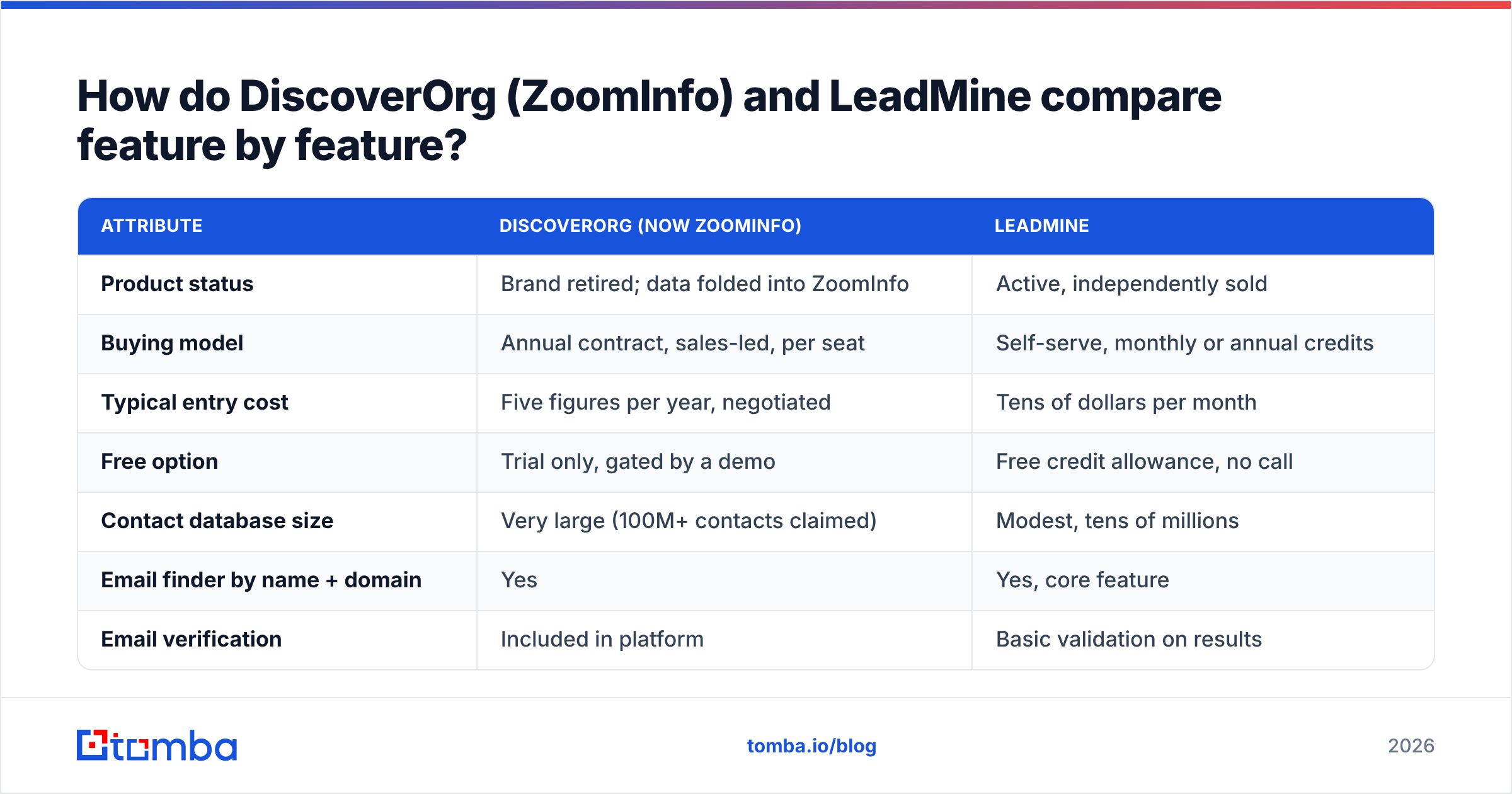
Here is the head-to-head on the attributes that change buying decisions. Treat all pricing as "at time of writing" — ZoomInfo quotes are negotiated, and LeadMine adjusts its self-serve tiers.
| Attribute | DiscoverOrg (now ZoomInfo) | LeadMine |
|---|---|---|
| Product status | Brand retired; data folded into ZoomInfo | Active, independently sold |
| Buying model | Annual contract, sales-led, per seat | Self-serve, monthly or annual credits |
| Typical entry cost | Five figures per year, negotiated | Tens of dollars per month |
| Free option | Trial only, gated by a demo | Free credit allowance, no call |
| Contact database size | Very large (100M+ contacts claimed) | Modest, tens of millions |
| Email finder by name + domain | Yes | Yes, core feature |
| Email verification | Included in platform | Basic validation on results |
| Direct dials / mobile numbers | Strong, a historical DiscoverOrg strength | Limited |
| Org charts + reporting lines | Yes | No |
| Intent + technographic signals | Yes | No |
| Native CRM sync | Salesforce, HubSpot, Outreach, Salesloft | CSV export plus API |
| API access | Yes, enterprise tier | Yes, on paid plans |
| Time to first email | Days to weeks (procurement) | Minutes |
| Best for | Enterprise GTM teams with budget | Solo operators and small teams |
The table makes the verdict obvious in one direction: ZoomInfo wins on breadth, LeadMine wins on speed-to-value and cost. Nobody wins on both.

Which one has better data accuracy?#
ZoomInfo has more coverage. That is not the same as more accuracy on the specific 500 people you care about.
Three things to understand before you trust any vendor's accuracy number:
- Coverage and accuracy are different metrics. A database can return an address for 95% of your list and still be wrong on a third of them. Vendors quote whichever number looks better.
- Decay is constant. Roughly 2-3% of B2B contacts change jobs every month, which means a list is materially stale within a quarter. Enterprise pricing does not pause that clock.
- Catch-all domains break naive verification. A large share of company domains accept mail to any address, so an SMTP check returns "valid" whether or not the mailbox exists. Tools that do not handle catch-alls specifically will inflate their own accuracy stats. This is why a dedicated catch-all verifier matters more than a bigger record count.
In practice, ZoomInfo's legacy DiscoverOrg research pipeline still gives it an edge on direct dials and on org structure at mid-to-large enterprises. LeadMine performs respectably on straightforward name-plus-domain lookups at companies with predictable email patterns, and poorly on smaller companies with unusual formats or heavy privacy tooling.
The honest test is the only one that matters: take 100 real target accounts, run them through each tool, send a verification pass, and measure hard bounces. Vendor marketing numbers are not evidence. Your bounce rate is.
What does each actually cost in 2026?#
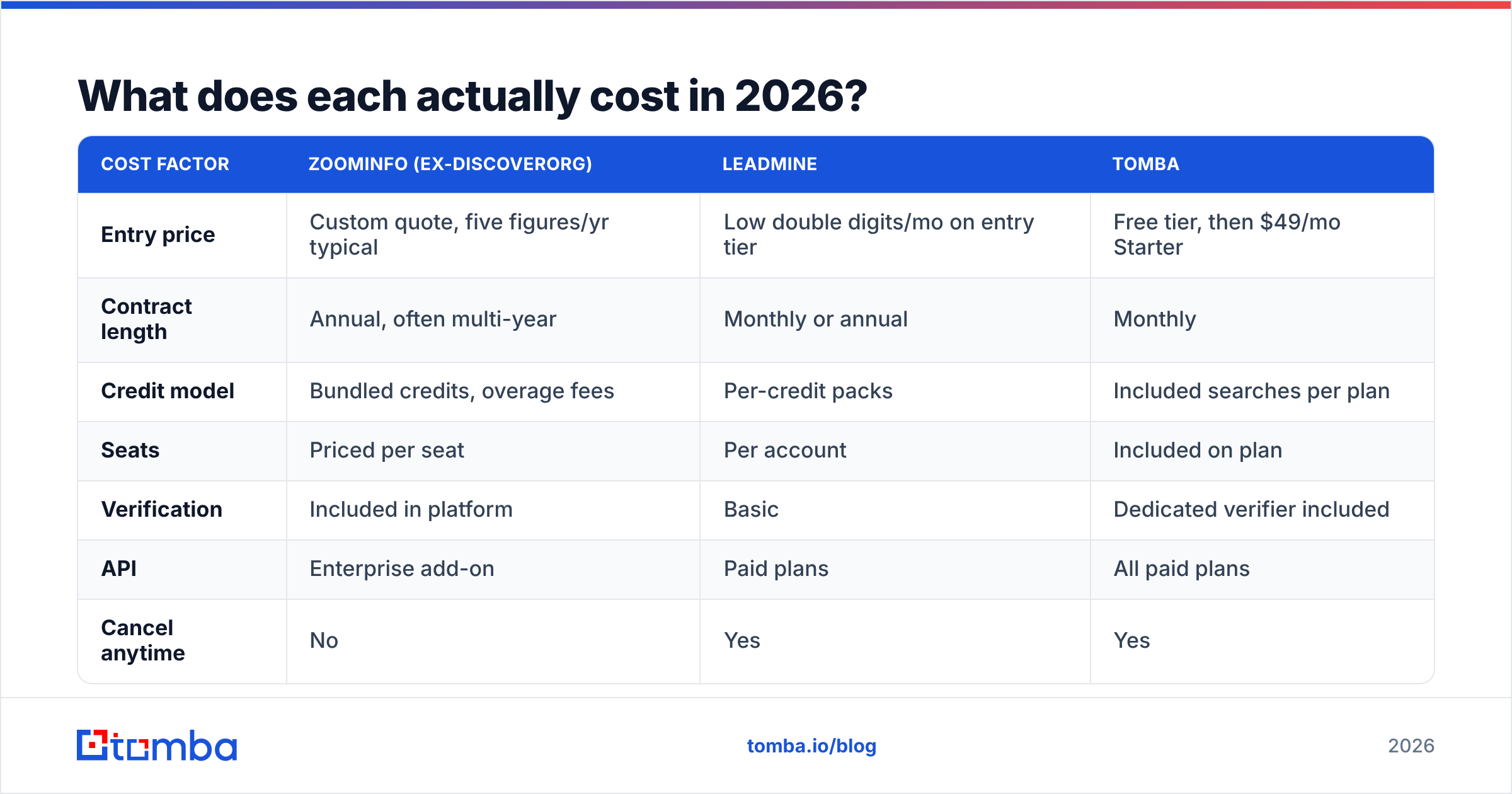
Cost is where DiscoverOrg vs LeadMine stops being close.
| Cost factor | ZoomInfo (ex-DiscoverOrg) | LeadMine | Tomba |
|---|---|---|---|
| Entry price | Custom quote, five figures/yr typical | Low double digits/mo on entry tier | Free tier, then $49/mo Starter |
| Contract length | Annual, often multi-year | Monthly or annual | Monthly |
| Credit model | Bundled credits, overage fees | Per-credit packs | Included searches per plan |
| Seats | Priced per seat | Per account | Included on plan |
| Verification | Included in platform | Basic | Dedicated verifier included |
| API | Enterprise add-on | Paid plans | All paid plans |
| Cancel anytime | No | Yes | Yes |
For reference, Tomba pricing runs Free (25 searches/mo), Starter $49/mo, Growth $99/mo, Pro $249/mo, and custom Enterprise. That is the band most teams comparing these two tools actually live in: more capable than a hobby finder, without an annual commitment that needs CFO sign-off.
One more cost nobody puts on a pricing page: the cost of bad data. A 12% bounce rate on a 5,000-send month does not just waste credits, it damages your sender reputation and drags down every campaign that follows. Cheap data that bounces is more expensive than good data that does not.

Is DiscoverOrg vs LeadMine even the right comparison?#
Usually not — and that is the most useful thing in this post.
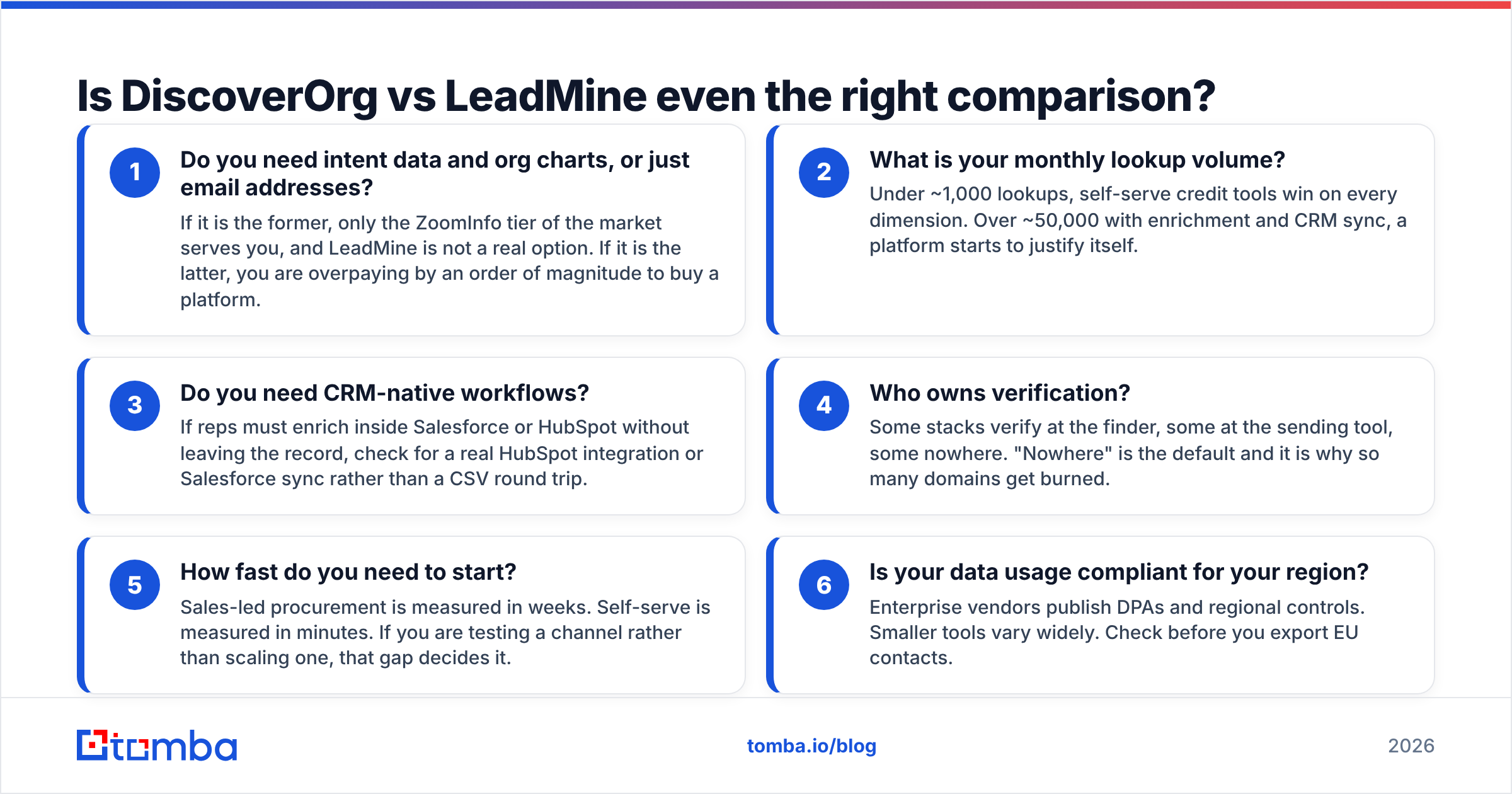
These two tools sit at opposite ends of a spectrum, which means if you are seriously evaluating both, your requirements are probably unclear. Work through this instead:
- Do you need intent data and org charts, or just email addresses? If it is the former, only the ZoomInfo tier of the market serves you, and LeadMine is not a real option. If it is the latter, you are overpaying by an order of magnitude to buy a platform.
- What is your monthly lookup volume? Under ~1,000 lookups, self-serve credit tools win on every dimension. Over ~50,000 with enrichment and CRM sync, a platform starts to justify itself.
- Do you need CRM-native workflows? If reps must enrich inside Salesforce or HubSpot without leaving the record, check for a real HubSpot integration or Salesforce sync rather than a CSV round trip.
- Who owns verification? Some stacks verify at the finder, some at the sending tool, some nowhere. "Nowhere" is the default and it is why so many domains get burned.
- How fast do you need to start? Sales-led procurement is measured in weeks. Self-serve is measured in minutes. If you are testing a channel rather than scaling one, that gap decides it.
- Is your data usage compliant for your region? Enterprise vendors publish DPAs and regional controls. Smaller tools vary widely. Check before you export EU contacts.
Answer those six and the shortlist usually narrows to one tool that was never in your original comparison.
What are the better alternatives to both?#
The middle of this market is crowded and, frankly, that is where most teams should shop.
- Tomba — a focused email finder with domain search, a real email verifier, catch-all handling, phone lookups, data enrichment, and an email finder API. Free tier to test, $49/mo Starter, no annual lock-in. Best fit when your bottleneck is "get accurate work emails at predictable cost," which is the actual job most people hire DiscoverOrg or LeadMine for.
- BookYourData — a solid pay-as-you-go option if you prefer buying pre-built, filtered lists outright rather than running lookups yourself. Strong choice for one-off campaign lists with a guaranteed accuracy commitment, and it plays well alongside a finder for account-by-account work.
- Apollo — the closest thing to a mid-market platform: database, sequencing, and dialer in one. Worth a look if you want ZoomInfo's shape at a fraction of the price, though data quality is more variable. See the tradeoffs on our Apollo alternative page.
- ZoomInfo itself — genuinely the right answer for enterprise teams with a real ABM motion, a data ops function to maintain it, and budget that makes a five-figure contract a rounding error.

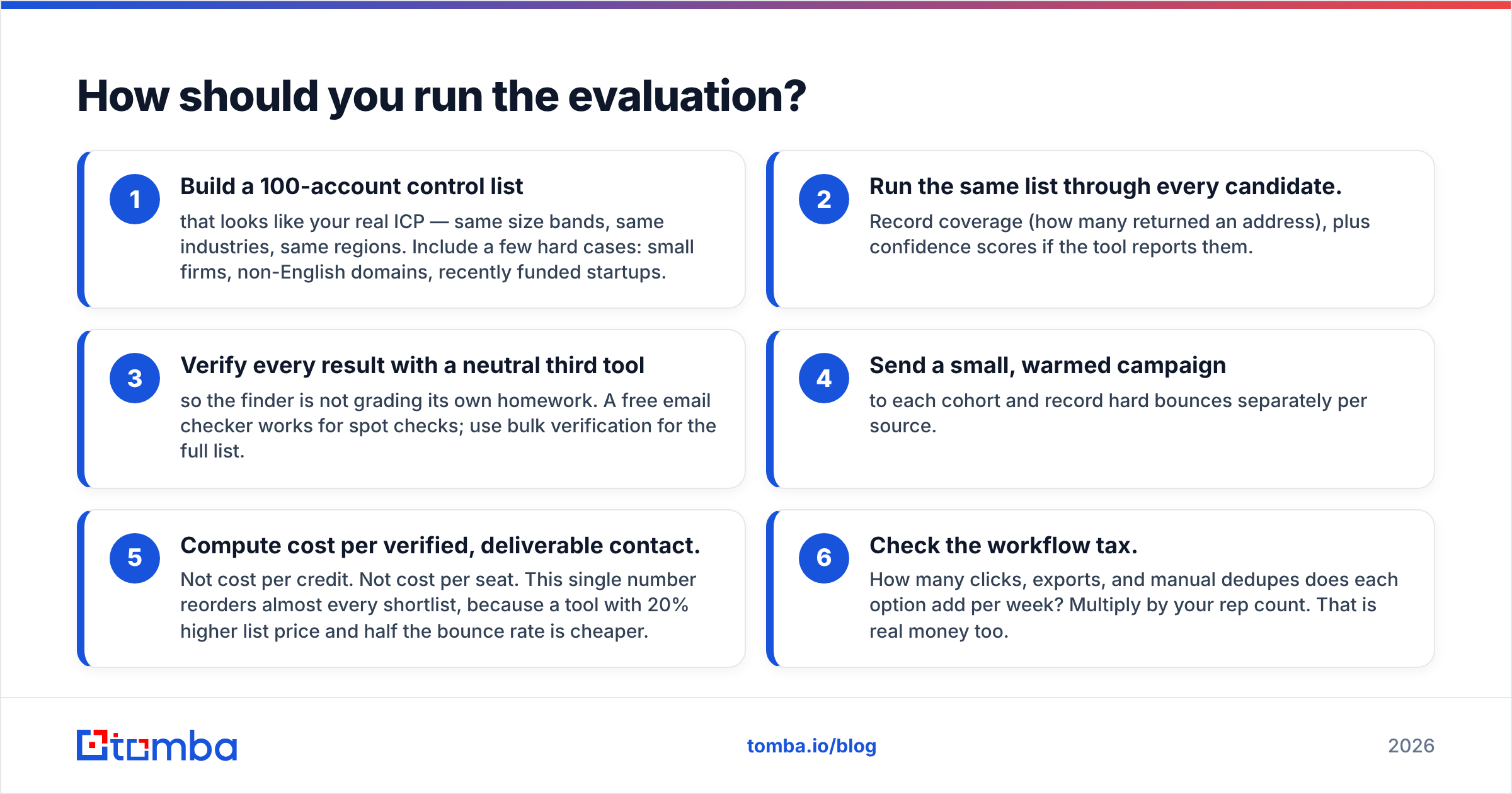
How should you run the evaluation?#
Do not buy on a demo. Run a bake-off. It takes an afternoon.
- Build a 100-account control list that looks like your real ICP — same size bands, same industries, same regions. Include a few hard cases: small firms, non-English domains, recently funded startups.
- Run the same list through every candidate. Record coverage (how many returned an address), plus confidence scores if the tool reports them.
- Verify every result with a neutral third tool so the finder is not grading its own homework. A free email checker works for spot checks; use bulk verification for the full list.
- Send a small, warmed campaign to each cohort and record hard bounces separately per source.
- Compute cost per verified, deliverable contact. Not cost per credit. Not cost per seat. This single number reorders almost every shortlist, because a tool with 20% higher list price and half the bounce rate is cheaper.
- Check the workflow tax. How many clicks, exports, and manual dedupes does each option add per week? Multiply by your rep count. That is real money too.
Teams that run this test usually find the same thing: the enterprise platform wins on coverage of hard-to-find enterprise contacts, the cheap tool wins on price, and a focused mid-tier finder wins on cost per deliverable contact — which is the metric that actually shows up in pipeline.
What is the verdict on DiscoverOrg vs LeadMine?#
Pick ZoomInfo (the DiscoverOrg successor) if you are an enterprise GTM team that needs org charts, intent signals, direct dials, and native CRM enrichment, and you have both the budget and the ops capacity to maintain it. You are buying a platform, not a lookup tool, and you should evaluate it against Apollo and Cognism rather than against LeadMine.
Pick LeadMine if you are a solo operator or tiny team doing low-volume, name-plus-domain lookups, you want to start today, and cost matters more than coverage depth.
Pick neither if your actual problem is "I need accurate, verified work emails and phone numbers at a predictable price, with an API and no annual contract." That is the majority case, and it is the reason the middle of this market exists.
Start with the Tomba Email Finder — the free tier gives you 25 searches a month to run the 100-account bake-off above before you spend anything, and Starter is $49/mo when you are ready to scale. Verify what you find, measure your bounce rate, and let the numbers pick your vendor instead of a demo deck.
Related guides#
Ready to find emails that actually work?
Join 150,000+ professionals who stopped guessing and started sending. Free credits on signup — no credit card required.
Get the Tomba newsletter
Practical outbound tactics and product updates — once every two weeks.
About the author