DiscoverOrg vs LimeLeads in 2026: Full Data Comparison
DiscoverOrg is now ZoomInfo and prices like enterprise software. LimeLeads sells cheap self-serve lead lists. Here is how the two actually compare on data accuracy, contracts, and cost per usable contact in 2026.
DiscoverOrg vs LimeLeads is really a choice between two different products. One is a heavy enterprise data platform. The other is a cheap self-serve list builder. Here is how they compare on price, data quality, and contracts in 2026.
TL;DR — which one should you pick?#
- DiscoverOrg is gone as a standalone product. It merged with ZoomInfo in 2019. Buying "DiscoverOrg" today means buying ZoomInfo on a yearly, seat-based deal. Those deals usually start in the five figures.
- LimeLeads is the opposite trade-off. Self-serve, credit-based, no sales call. It is priced for solo founders and small SDR teams.
- Pick DiscoverOrg/ZoomInfo if you need org charts, intent data, and CRM enrichment across thousands of accounts. You also need budget for a full year.
- Pick LimeLeads if you need a few thousand contacts this month. You see the price before you talk to anyone.
- Pick neither if you already know the exact people you want. That is a lookup job, and a dedicated email finder does it for far less.
What happened to DiscoverOrg?#
DiscoverOrg was a human-researched B2B contact database. It was best known for IT data and org charts. Analysts checked the records by hand, and that was the whole pitch. In 2019 it bought ZoomInfo and kept the ZoomInfo name. The joined company went public in 2020. The DiscoverOrg product line, pricing, and support were all folded in.
Three practical points shape any DiscoverOrg vs LimeLeads comparison today:
- You cannot buy "DiscoverOrg pricing" in 2026. You buy a ZoomInfo plan. It is quoted per seat, with caps on credits.
- The human-checked story is diluted. ZoomInfo now blends user data, web signals, and machine learning with research. Coverage went up a lot. The old promise that an analyst touched every record did not survive that scale.
- Old contracts get repriced upward. Teams renewing off legacy paper are the top source of "why is our data bill 3x?" posts on G2 and Reddit.
So the honest framing is simple. DiscoverOrg vs LimeLeads is enterprise data platform vs self-serve list builder. They do not chase the same buyer. The wrong pick costs you either money or months.
What is LimeLeads, and who is it for?#
LimeLeads is a light B2B lead-list tool. You filter by industry, title, company size, location, and tech. You preview the count. Then you unlock records with credits. There is no setup phase, no CSM, and no order form to negotiate.
Its buyer needs 2,000 contacts for a campaign that starts Monday. Think agency owners, founders doing their own outbound, small SDR pods, and recruiters. LimeLeads competes with other self-serve list vendors: Apollo's cheaper tiers, UpLead, Lead411, and BookYourData. BookYourData is a solid pick too if you want pay-as-you-go lists with a verification guarantee.
What you give up is depth. There are no buying-intent signals and no org charts. There is no website-visitor ID and no live sync into your CRM. If your plays depend on knowing an account started shopping last week, LimeLeads has nothing to offer.

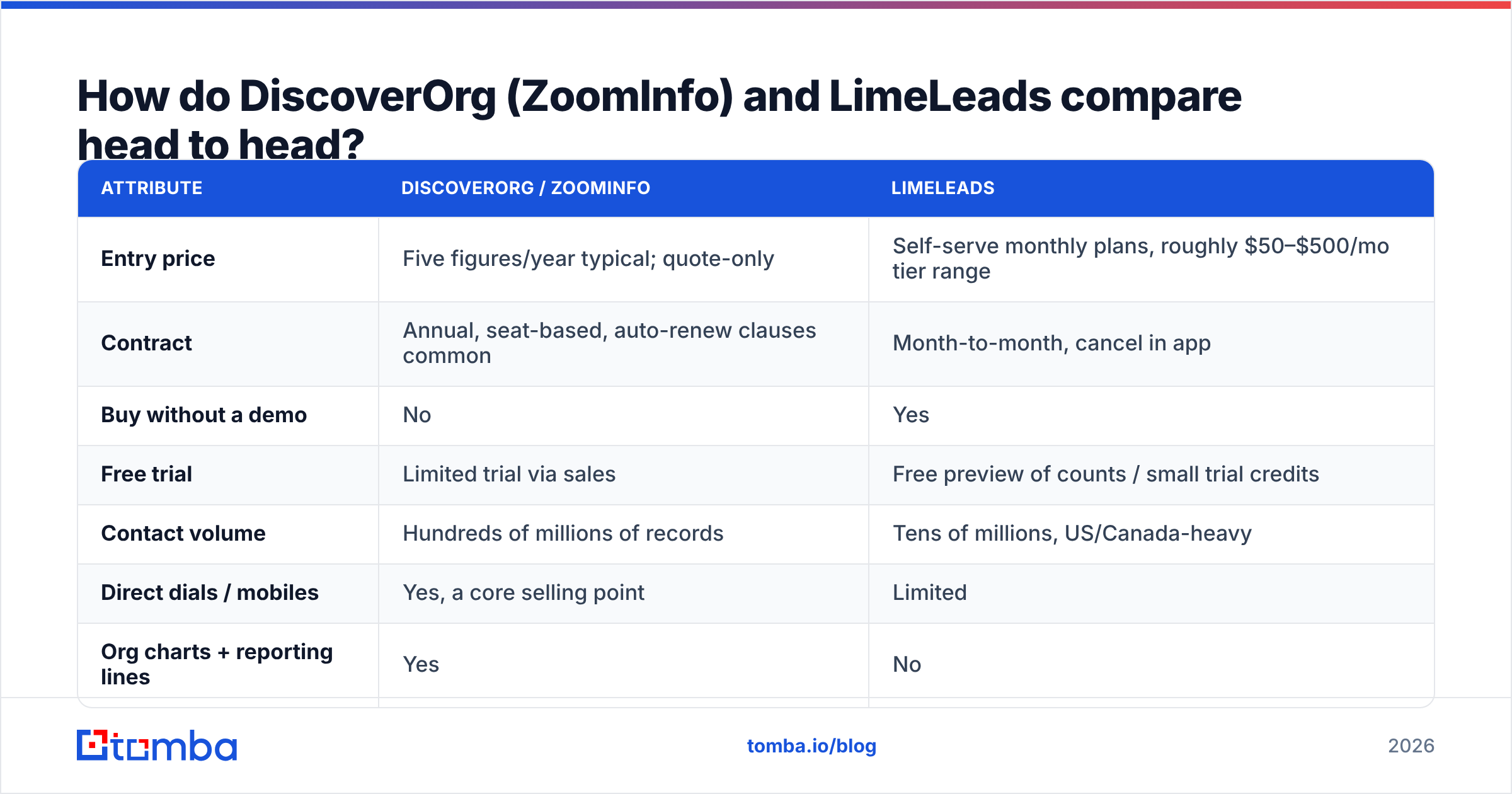
DiscoverOrg vs LimeLeads: how they compare head to head#
| Attribute | DiscoverOrg / ZoomInfo | LimeLeads |
|---|---|---|
| Entry price | Quote-only, five figures/year | Self-serve, about $50–$500/mo |
| Contract | Annual, seat-based, auto-renew | Month-to-month, cancel in app |
| Buy without a demo | No | Yes |
| Free trial | Limited trial via sales | Free count preview, trial credits |
| Contact volume | Hundreds of millions | Tens of millions, US/Canada-heavy |
| Direct dials | Yes, a core selling point | Limited |
| Org charts | Yes | No |
| Intent + technographics | Yes | Basic tech filters only |
| CRM sync + API | Native Salesforce/HubSpot, full API | Exports, light integrations |
| Email verification | Platform-level, varies by segment | Basic; re-verify before sending |
| Best fit | Enterprise RevOps with budget | Founders, agencies, small teams |
| Worst fit | Under 5,000 contacts a year | Account-based plays needing intent |
Read the last two rows first. Most bad buys here are not accuracy failures. They are fit failures.
Which one has better data accuracy?#
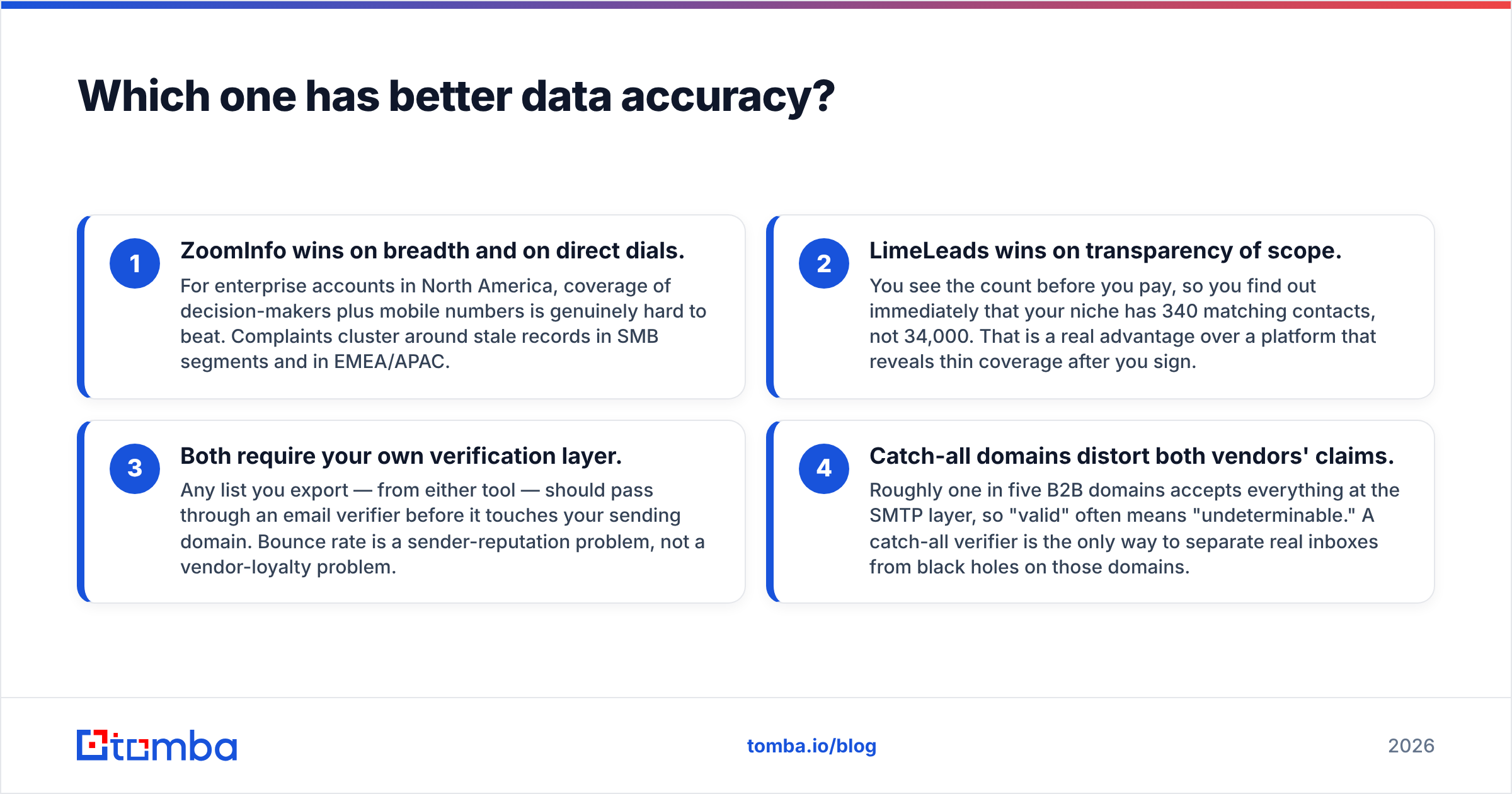
Ignore both headline numbers. Accuracy is measured at one moment, against a sample the vendor picked. About 25–30% of B2B contact data goes stale each year. People change jobs, companies rebrand, and domains move. A "95% accurate" claim describes audit day, not send day.

Here is how the two behave in practice:
- ZoomInfo wins on breadth and direct dials. Its coverage of decision-makers and mobile numbers in North America is hard to beat. Complaints cluster around stale SMB records and thin EMEA/APAC data.
- LimeLeads wins on honest scope. You see the count before you pay. So you learn at once that your niche holds 340 contacts, not 34,000.
- Both still need your own checks. Push every export through an email verifier before it touches your sending domain.
- Catch-all domains skew both claims. About one in five B2B domains accepts every address, so "valid" can mean "unknown." A catch-all verifier sorts real inboxes from black holes.
Take one habit from this DiscoverOrg vs LimeLeads review. Never mail a bought list without re-checking it the same week you send.
What do they actually cost per usable contact?#
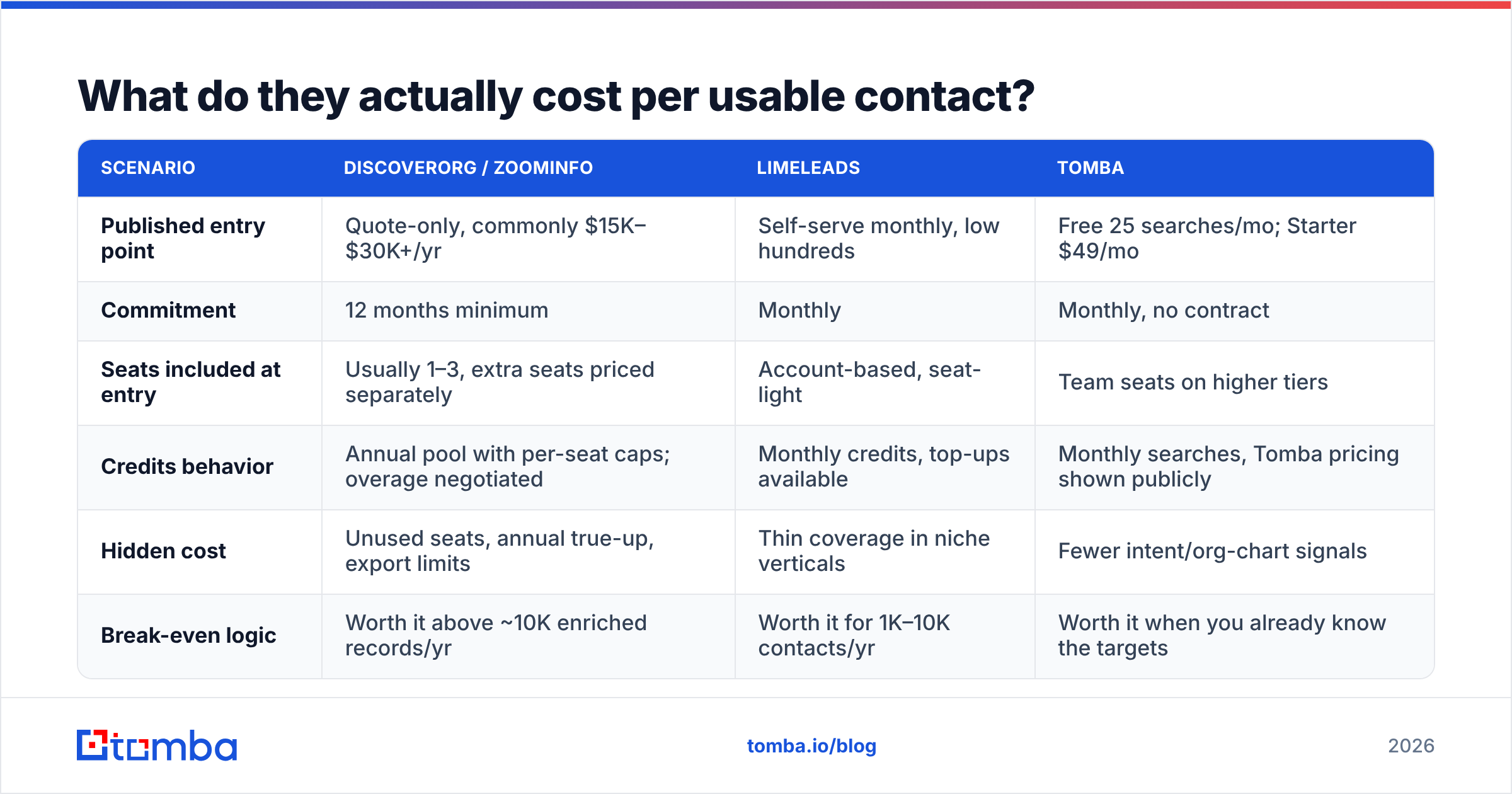
Sticker price hides the real number. Work out the cost per usable contact instead. Usable means in your ICP, deliverable, and not already in your CRM.
| Scenario | DiscoverOrg / ZoomInfo | LimeLeads | Tomba |
|---|---|---|---|
| Published entry point | Quote-only, commonly $15K–$30K+/yr | Self-serve monthly, low hundreds | Free 25 searches/mo; Starter $49/mo |
| Commitment | 12 months minimum | Monthly | Monthly, no contract |
| Seats included at entry | Usually 1–3, extra seats priced separately | Account-based, seat-light | Team seats on higher tiers |
| Credits behavior | Annual pool with per-seat caps; overage negotiated | Monthly credits, top-ups available | Monthly searches, Tomba pricing shown publicly |
| Hidden cost | Unused seats, annual true-up, export limits | Thin coverage in niche verticals | Fewer intent/org-chart signals |
| Break-even logic | Worth it above ~10K enriched records/yr | Worth it for 1K–10K contacts/yr | Worth it when you already know the targets |
Two patterns show up in almost every procurement review:
- Enterprise seats sit idle. A 10-seat ZoomInfo deal where 4 reps log in each month makes your real cost per contact 2.5x your model.
- Cheap lists get bought twice. Teams re-buy the same segment within six months because nobody deduped the first export. One pass through remove duplicates is free and saves credits.
Is there a third option that beats both?#
Yes, for the most common job in outbound. And it changes the math.
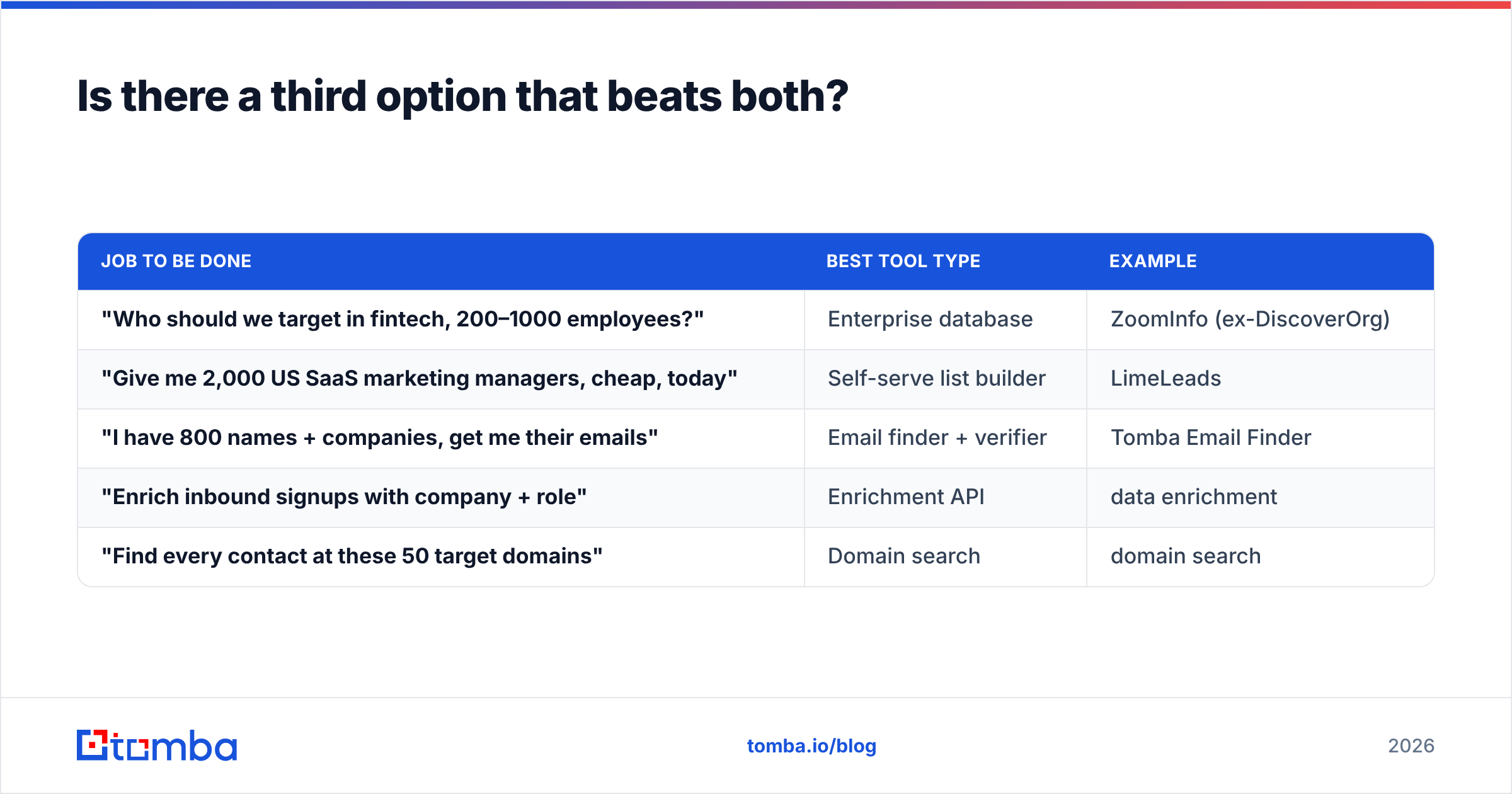
Databases sell you discovery: who might I sell to? By 2026, most teams already know. They have a LinkedIn list, an event sheet, a G2 category page, or a scraped ICP list. What they lack is the verified email address for those exact people.
That is a lookup problem, not a subscription problem. A finder flips the model. You supply a name and a domain. You get back a verified address. You pay per lookup instead of renting a dataset you barely touch.
| Job to be done | Best tool type | Example |
|---|---|---|
| "Who should we target in fintech, 200–1000 employees?" | Enterprise database | ZoomInfo (ex-DiscoverOrg) |
| "Give me 2,000 US SaaS marketing managers, cheap, today" | Self-serve list builder | LimeLeads |
| "I have 800 names + companies, get me their emails" | Email finder + verifier | Tomba Email Finder |
| "Enrich inbound signups with company + role" | Enrichment API | data enrichment |
| "Find every contact at these 50 target domains" | Domain search | domain search |
Tomba is priced for that shape of work. The free tier covers 25 searches a month. Starter is $49/mo, Growth $99/mo, Pro $249/mo, and Enterprise is custom. There is no annual lock. The email finder API lets the same credits work from your CRM, a script, or a spreadsheet.

How should you run the evaluation?#
Do not compare feature grids. Run the same test on every candidate, including the tool you use today.
- Build a 100-row gold-standard sample. Use real names and real companies from across your ICP, not just big logos.
- Run each tool on the same 100 rows. Track match rate and accuracy as two separate numbers.
- Check the output yourself. Send every result through one neutral checker, so you grade data instead of vendor optimism. A free email checker is enough for a spot audit.
- Send a real 200-contact campaign. Watch bounce rate, spam complaints, and replies. A bounce rate above 3% hurts your domain, whatever the dashboard claimed.
- Compute cost per reply, not cost per record. That is the only number your CFO needs.
- Re-test at renewal. Coverage shifts fast, so a 2024 test says nothing about 2026 quality.
Most teams find their spend is misallocated, not too small. Too much goes to a broad database. Nothing goes to verification. Nothing is left for the per-lookup data that feeds the sequence.
What are the main risks with each option?#
The DiscoverOrg vs LimeLeads risk list is short, but every item is real.
DiscoverOrg / ZoomInfo risks:
- Auto-renewal and multi-year price bumps. Read the renewal clause before the feature list.
- Export limits. Many contracts cap how much data you can pull out, which breaks the "we will build our own warehouse" plan.
- Compliance load. Large datasets carry GDPR and CCPA duties, so loop in legal if you sell into the EU.
LimeLeads risks:
- Coverage gaps in narrow verticals and outside North America.
- Lighter checks, so the bounce risk sits with you.
- No intent or hierarchy data, which caps account-based plays.
Shared risk: both give you a snapshot. Neither one notices when your champion changes jobs next quarter. A routine beats a one-time list. Re-verify quarterly, and re-enrich on every CRM write.
Verdict: DiscoverOrg vs LimeLeads in 2026#
Choose ZoomInfo, the product once sold as DiscoverOrg, if you run enterprise account-based motions. You get intent, org charts, and direct dials, and you pay platform prices for them. Choose LimeLeads if you want volume lists at a self-serve price with no procurement cycle. It shows the count before you pay, which is more honest than most.
Test the third path before you sign either one. If your targets are already known, your real gap is verified contact data. Start with the Tomba Email Finder. It is free for 25 searches a month and $49/mo when you scale, month to month. Verification and catch-all handling are built in. Run it on your gold-standard sample this week. Then compare cost per reply against the quote sitting in your inbox. That one test settles most DiscoverOrg vs LimeLeads debates faster than any vendor demo.

Related guides#
Ready to find emails that actually work?
Join 150,000+ professionals who stopped guessing and started sending. Free credits on signup — no credit card required.
Get the Tomba newsletter
Practical outbound tactics and product updates — once every two weeks.
About the author