DiscoverOrg vs ListKit (2026): Which B2B Data Tool Wins?
DiscoverOrg (now ZoomInfo) and ListKit sell very different things at wildly different prices. Here's the honest breakdown of coverage, cost, contracts, and who each one actually fits.
TL;DR
- DiscoverOrg no longer exists as a standalone product. It merged with ZoomInfo in 2019 and the brand was folded in. When someone sells you "DiscoverOrg," you're buying ZoomInfo SalesOS on an annual contract that typically starts around $15,000/year.
- ListKit is a newer, cold-email-first data vendor built by outbound practitioners. Credit-based, self-serve, priced in the hundreds per month rather than five figures per year.
- They solve different problems. DiscoverOrg/ZoomInfo is a full GTM data platform with org charts, intent, and CRM sync. ListKit is a list-building tool that spits out verified contacts for sequencing.
- Verification is the real differentiator. ListKit runs triple-verification on emails; ZoomInfo's database is broader but staler in the long tail. Neither replaces a dedicated verifier before send.
- If you just need accurate emails without a contract, an API-first email finder like Tomba (free tier, $49/mo Starter) covers the same job at a fraction of either price.
What happened to DiscoverOrg?#
DiscoverOrg was acquired by — and then merged with — ZoomInfo in 2019. The combined company kept the ZoomInfo name, retired the DiscoverOrg brand for new sales, and migrated legacy DiscoverOrg accounts onto the ZoomInfo platform. If you're searching "DiscoverOrg vs ListKit" in 2026, you're really comparing ZoomInfo (formerly DiscoverOrg) against ListKit.
That matters for two reasons. First, the pricing you may remember from a 2018 DiscoverOrg quote is gone; ZoomInfo's commercial model is annual, seat-based, and credit-gated. Second, the thing DiscoverOrg was genuinely famous for — hand-researched IT org charts and tech installs — still exists inside ZoomInfo, but it's now bundled with a much larger and much more expensive platform.
ListKit, by contrast, launched in 2023 out of the cold-email agency world. It was built to answer one question: how do I get a clean, sendable list of decision-makers this afternoon without talking to a salesperson? That difference in origin explains almost every difference in the product.

How do DiscoverOrg (ZoomInfo) and ListKit actually compare?#
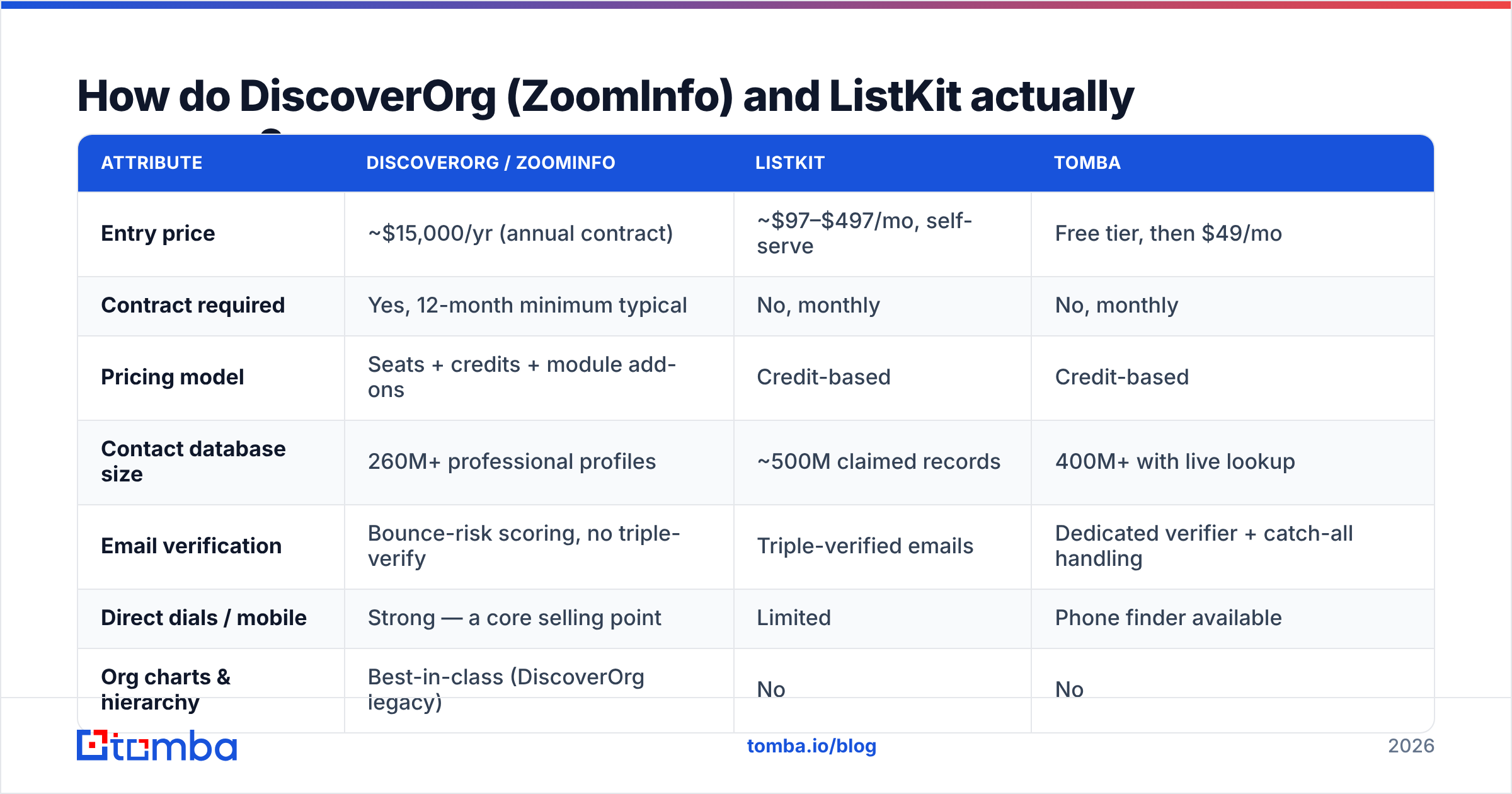
Here's the head-to-head on the attributes that change your decision. Public list prices for enterprise platforms move constantly and are negotiated per deal — treat the ZoomInfo column as the widely reported range, not a quote.
| Attribute | DiscoverOrg / ZoomInfo | ListKit | Tomba |
|---|---|---|---|
| Entry price | ~$15,000/yr (annual contract) | ~$97–$497/mo, self-serve | Free tier, then $49/mo |
| Contract required | Yes, 12-month minimum typical | No, monthly | No, monthly |
| Pricing model | Seats + credits + module add-ons | Credit-based | Credit-based |
| Contact database size | 260M+ professional profiles | ~500M claimed records | 400M+ with live lookup |
| Email verification | Bounce-risk scoring, no triple-verify | Triple-verified emails | Dedicated verifier + catch-all handling |
| Direct dials / mobile | Strong — a core selling point | Limited | Phone finder available |
| Org charts & hierarchy | Best-in-class (DiscoverOrg legacy) | No | No |
| Intent data | Yes (Bombora + proprietary) | No | No |
| API access | Enterprise tier only | Limited | Full API on all paid plans |
| Free trial | Gated demo, sales-led | Free credits on signup | 25 free searches/mo, no card |
| Best for | Enterprise ABM & RevOps teams | Agencies running cold email at volume | Devs and SMB teams needing accurate emails |
The pattern in that table is the whole story. ZoomInfo sells depth per account: who reports to whom, what tech they run, whether they're researching your category this week. ListKit sells speed to a sendable list. You're not choosing the better product — you're choosing which of those two jobs you're actually paying for.
What does DiscoverOrg/ZoomInfo do well?#
Four things, and they're genuinely hard to replicate:
- Org charts and reporting lines. The DiscoverOrg heritage shows here. If you're selling a six-figure deal into a 5,000-person enterprise and need to map the buying committee, this is the dataset that does it. No credit-based list tool comes close.
- Direct dials and mobile numbers. ZoomInfo's phone coverage on mid-market and enterprise contacts is the strongest in the category, which is why cold-calling teams tolerate the price.
- Intent signals. Bombora-powered topic surges plus ZoomInfo's own website-visitor data let you prioritize accounts that are already researching. That's a real revenue-operations advantage, not a vanity feature.
- CRM and workflow depth. Native Salesforce and HubSpot sync, enrichment on record creation, territory routing, and a workflow engine. For a RevOps team standardizing data across a 50-rep org, this replaces three point tools.
What it does poorly: it's expensive, it's a contract, and the long tail of small companies and non-US regions is thinner than the headline record count suggests. Reviews on G2 consistently flag two complaints — auto-renewal terms and data decay on smaller accounts.
What does ListKit do well?#
ListKit was designed by people who send cold email for a living, and it shows in the defaults.
- Triple-verified emails out of the box. Instead of handing you a raw list and a bounce-risk score, ListKit filters aggressively before export. Bounce rates reported by agency users typically land in the low single digits.
- Filters that match how outbound is actually targeted. Job title, headcount, tech stack, hiring signals, and location — the same filters you'd set in a sequencing tool, not a data warehouse query builder.
- Self-serve from minute one. No demo call, no procurement, no annual commit. You sign up, build a list, export a CSV, and you're sequencing the same day.
- Native pushes to sending tools. Direct handoff into Instantly, Smartlead, and similar platforms removes the CSV shuffle that eats an hour a week.
What it does poorly: no org charts, no intent, thin phone coverage, and a database that is younger and therefore less battle-tested on enterprise accounts. If your ACV is $80,000 and your buying committee has seven people, ListKit will not map that committee for you.
Is ListKit cheaper than DiscoverOrg in practice?#
Yes — usually by an order of magnitude — but the comparison only holds if you're honest about scope.
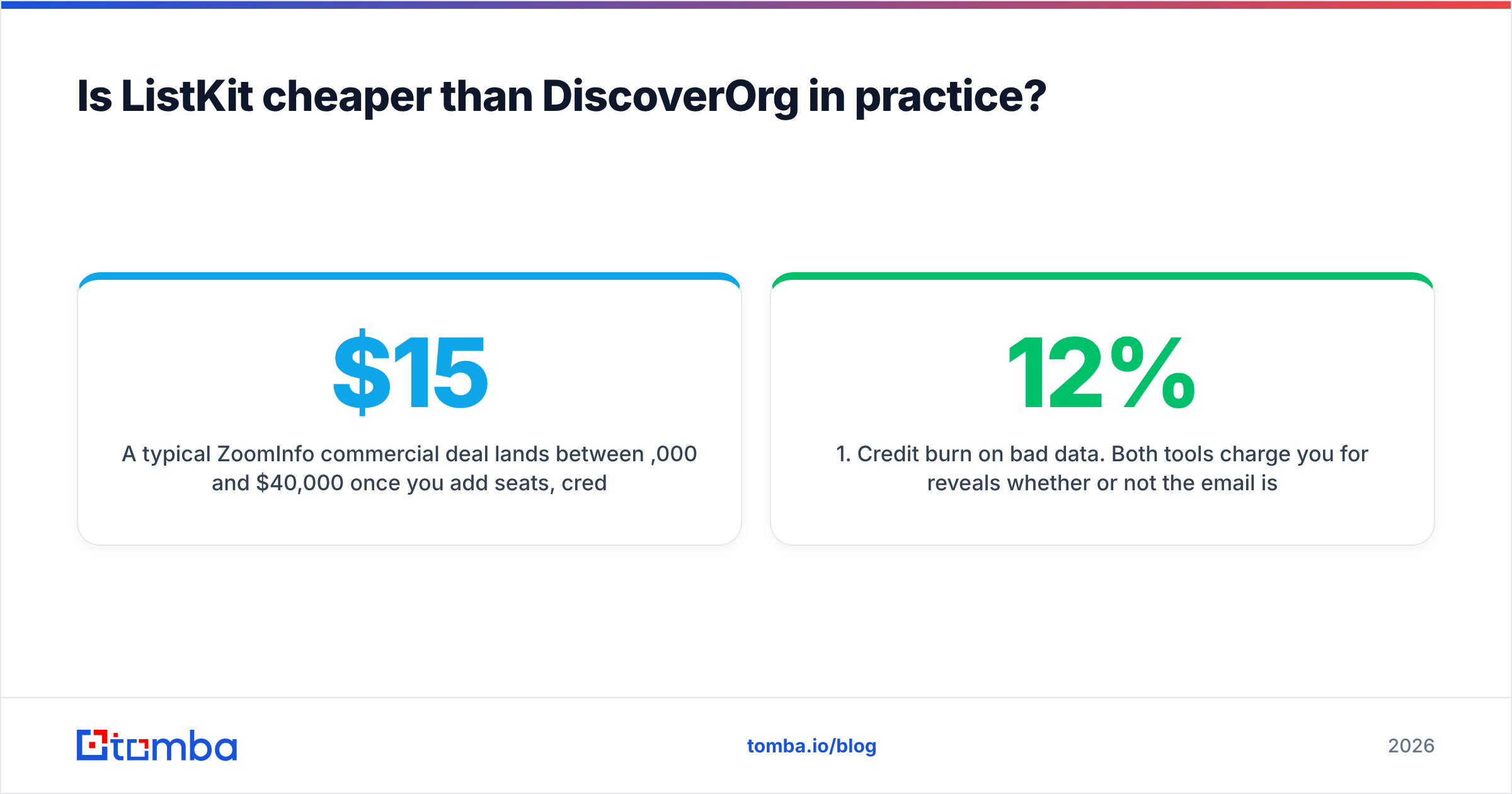
A typical ZoomInfo commercial deal lands between $15,000 and $40,000 per year once you add seats, credit packs, and modules like Intent or Enrich. A typical ListKit spend is $1,200 to $6,000 per year. If your entire use case is "give me 3,000 verified emails a month for cold outbound," ListKit does that job for roughly 5–10% of the cost.
But three cost traps deserve calling out:
- Credit burn on bad data. Both tools charge you for reveals whether or not the email is deliverable. Running exports through an email verifier before you sequence is cheaper than the reputation damage from a 12% bounce rate.
- Seat inflation. ZoomInfo prices per seat. A five-rep team that "just needs a few logins" often doubles its quoted cost at renewal.
- Enrichment double-buying. Many teams pay ZoomInfo for enrichment and then pay a second vendor for emails because the first vendor's coverage in their niche is weak. Audit overlap before you renew.

Which one should you pick for your team?#
Use the buying committee size and the motion, not the feature list.
Pick DiscoverOrg/ZoomInfo if:
- Your ACV is above roughly $25,000 and deals involve 4+ stakeholders
- You run account-based marketing and need intent to prioritize
- You have a RevOps function that will actually operationalize the CRM sync
- Cold calling is a primary channel and direct dials drive your connect rate
Pick ListKit if:
- You or your clients run high-volume cold email as the primary channel
- You need lists today, not after a procurement cycle
- Your ICP is SMB-to-mid-market and reachable by title + firmographic filters
- You want to test a new segment without committing a year of budget
Pick a dedicated email finder if:
- You already have a list of companies or LinkedIn URLs and just need contact data
- You want to build enrichment into your own product or internal tooling via API
- You're paying platform prices for a job that's really a lookup problem
That third case is more common than either vendor's marketing suggests. Plenty of teams buy a $20,000 platform to solve "I have 4,000 domains and I need the head of marketing at each one." That's a domain search problem, and it costs two orders of magnitude less to solve directly.
What are the alternatives to both?#
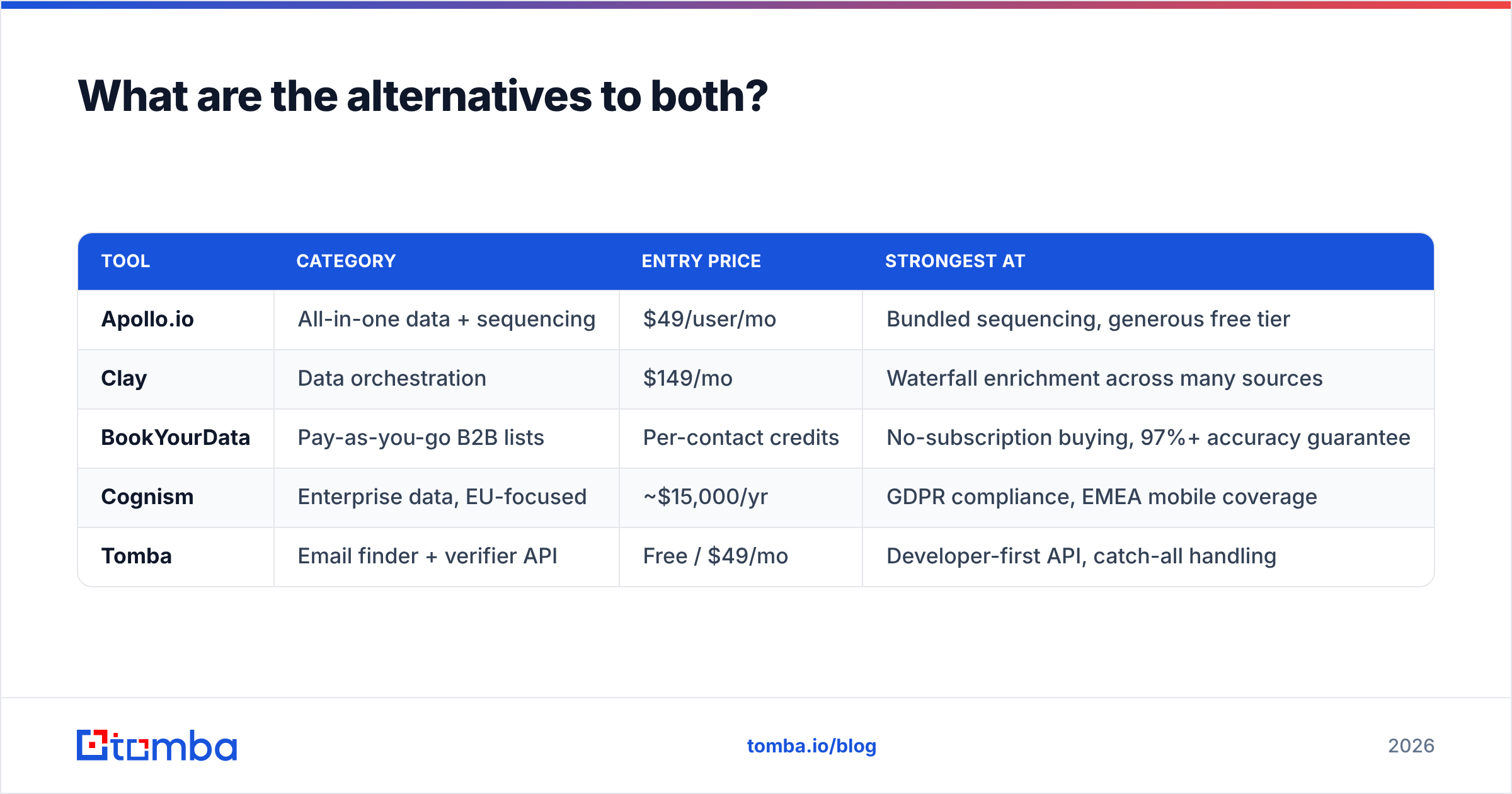
The B2B data market is not a two-horse race. A few categories worth knowing:
| Tool | Category | Entry price | Strongest at |
|---|---|---|---|
| Apollo.io | All-in-one data + sequencing | $49/user/mo | Bundled sequencing, generous free tier |
| Clay | Data orchestration | $149/mo | Waterfall enrichment across many sources |
| BookYourData | Pay-as-you-go B2B lists | Per-contact credits | No-subscription buying, 97%+ accuracy guarantee |
| Cognism | Enterprise data, EU-focused | ~$15,000/yr | GDPR compliance, EMEA mobile coverage |
| Tomba | Email finder + verifier API | Free / $49/mo | Developer-first API, catch-all handling |
Two of these deserve a note. BookYourData is a solid middle path if you dislike subscriptions entirely — you buy contacts outright with an accuracy guarantee, which suits campaign-based teams that don't need a monthly seat. Clay isn't a data vendor at all; it's a router that queries multiple vendors in sequence, which is how sophisticated teams get 90%+ coverage without buying a single expensive platform.
If you're evaluating swaps specifically, our writeups on the Apollo alternative and Clearbit alternative landscape cover the enrichment side in more detail. And if you're comparing on data provenance rather than price, ZoomInfo's own product documentation and ListKit's homepage are worth reading before any demo call — vendors are usually explicit about what they don't cover if you read past the hero section.
How do you evaluate B2B data vendors without getting burned?#
Run the same test on every vendor. It takes an afternoon and it's the only thing that reliably predicts outcomes.
- Build a 100-record control list from your actual ICP — real companies you know, with contacts you can verify manually via LinkedIn or a company site.
- Run it through each vendor's trial and measure match rate, not database size. Database size is marketing; match rate on your ICP is the number that matters.
- Verify every returned email independently. Use a third-party checker so you're not grading the vendor's homework with the vendor's own pen. A free email checker is enough for a 100-record sample.
- Send a 50-contact test campaign and record the actual bounce rate. Vendors quote accuracy on the whole database; you care about accuracy on your slice of it.
- Price the winner at your real volume, including overage. Ask explicitly about auto-renewal, credit rollover, and what happens if you downgrade mid-term.
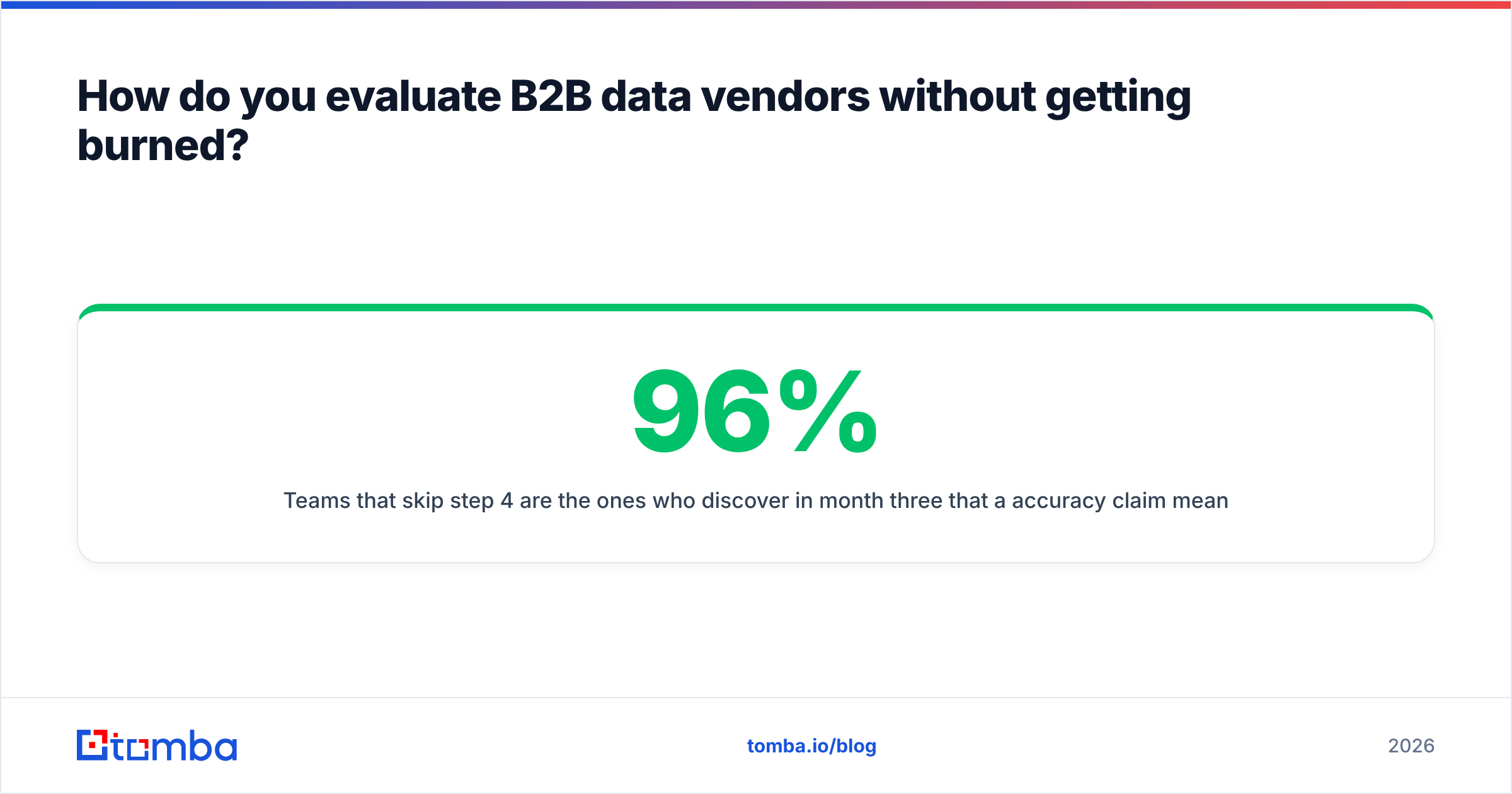
Teams that skip step 4 are the ones who discover in month three that a 96% accuracy claim meant 96% syntactically valid, not 96% deliverable. Those aren't the same thing, and the difference shows up in your sender reputation before it shows up in your pipeline.
The verdict#
DiscoverOrg is a legacy brand; the real comparison is ZoomInfo versus ListKit, and they aren't competing for the same buyer. ZoomInfo wins if you need org charts, intent, direct dials, and CRM depth, and you have the budget and the RevOps headcount to justify a five-figure annual contract. ListKit wins if you run cold email at volume and want a verified list without procurement.
If neither of those descriptions fits — if you have companies and names and you just need accurate work emails — you're overbuying. Start with Tomba's Email Finder: 25 free searches a month with no card, $49/mo when you outgrow it, full API access on every paid plan, and a built-in verifier so you're not stacking a second vendor to check the first one's work. Test it against your control list alongside whatever platform you're being pitched, and let the match rate decide.
Related guides#
Ready to find emails that actually work?
Join 150,000+ professionals who stopped guessing and started sending. Free credits on signup — no credit card required.
Get the Tomba newsletter
Practical outbound tactics and product updates — once every two weeks.
About the author