DiscoverOrg vs PipiLeads: Which B2B Data Tool Wins in 2026?
DiscoverOrg (now ZoomInfo) and PipiLeads sit at opposite ends of the B2B data market — six-figure enterprise contracts vs low-cost self-serve scraping. Here's which one actually fits your team, and when neither does.
TL;DR
- DiscoverOrg no longer exists as a standalone product. It merged with ZoomInfo in 2019 and the brand was fully absorbed. When someone sells you "DiscoverOrg," they're selling you a ZoomInfo contract — typically $15,000–$40,000/year with an annual commitment.
- PipiLeads is the opposite extreme: a low-cost, self-serve lead-scraping tool aimed at solo founders and small agencies. Cheap, fast, and thin on verification.
- Neither is a great default. DiscoverOrg/ZoomInfo overshoots most teams under 50 reps; PipiLeads under-delivers on data hygiene, which quietly wrecks deliverability.
- The real decision is between "buy a database" and "find contacts on demand." Most teams under $10M ARR are better served by on-demand lookup with verification built in.
- If you only need verified work emails for a target list you already defined, a per-lookup tool like the Tomba Email Finder does the same job for a fraction of a ZoomInfo seat.
What is DiscoverOrg, and does it still exist?#
Short answer: DiscoverOrg is now ZoomInfo. In February 2019, DiscoverOrg acquired ZoomInfo, then adopted the ZoomInfo name for the combined company in 2020. The legacy DiscoverOrg dataset — famously human-verified org charts for IT, marketing, finance, and HR departments — was folded into what is now marketed as ZoomInfo Copilot and ZoomInfo Sales.
That history matters for your buying decision. DiscoverOrg's original pitch was depth over breadth: fewer companies, but researched by actual analysts who called switchboards and mapped reporting lines. Post-merger, the combined platform swung toward breadth — hundreds of millions of contacts, machine-enriched, with the human-verified core diluted across a much larger index.
What you get today under the DiscoverOrg lineage:
- Org-chart data — reporting structures and department hierarchies, still the strongest part of the offering.
- Technographics — what software a company runs, inferred from job posts, DNS records, and website tags.
- Intent signals — third-party browsing data suggesting a company is researching your category.
- Direct dials and mobile numbers — a genuine differentiator if you run a phone-heavy motion.
- CRM sync — deep native integrations with Salesforce and HubSpot, including automatic record enrichment.
- Annual contracts with seat minimums — the part nobody puts on the pricing page.
That last item is the one that kills deals. There is no meaningful free tier, no monthly plan, and pricing is quoted per seat with credit caps layered on top. Public reviews on G2 consistently cite contract rigidity and mid-contract upsell pressure as the top complaints, even from customers who rate the data highly.

What is PipiLeads and who is it for?#
PipiLeads sits at the other end of the market: a lightweight, self-serve lead-generation tool built around scraping and list export. The pitch is speed and price. You define a search — industry, location, job title, sometimes a source like Google Maps or a business directory — and it returns a CSV of contacts you can load straight into a sequencer.
The buyer profile is clear:
- Solo founders doing their first 500 cold emails.
- Local agencies selling web design, SEO, or ads to SMBs, where the target list is "dentists in Phoenix" rather than "VPs of Engineering at Series B fintechs."
- Freelancers who need volume and cannot justify a four-figure annual spend.
The trade-offs are equally clear. Scraped directory data skews heavily toward generic inboxes — info@, contact@, office@ — which are fine for a local services pitch and useless for enterprise sales. Coverage of large-company decision-makers is thin. Verification is typically syntax-and-MX level, not full SMTP, which means bounce rates on exported lists tend to land well above the 2% ceiling that Google and Microsoft treat as a red flag.
If your ICP is "any business with a website in a specific city," PipiLeads is a rational tool. If your ICP is "Director of RevOps at a 500-person SaaS company," it is not.
DiscoverOrg vs PipiLeads: how do they actually compare?#
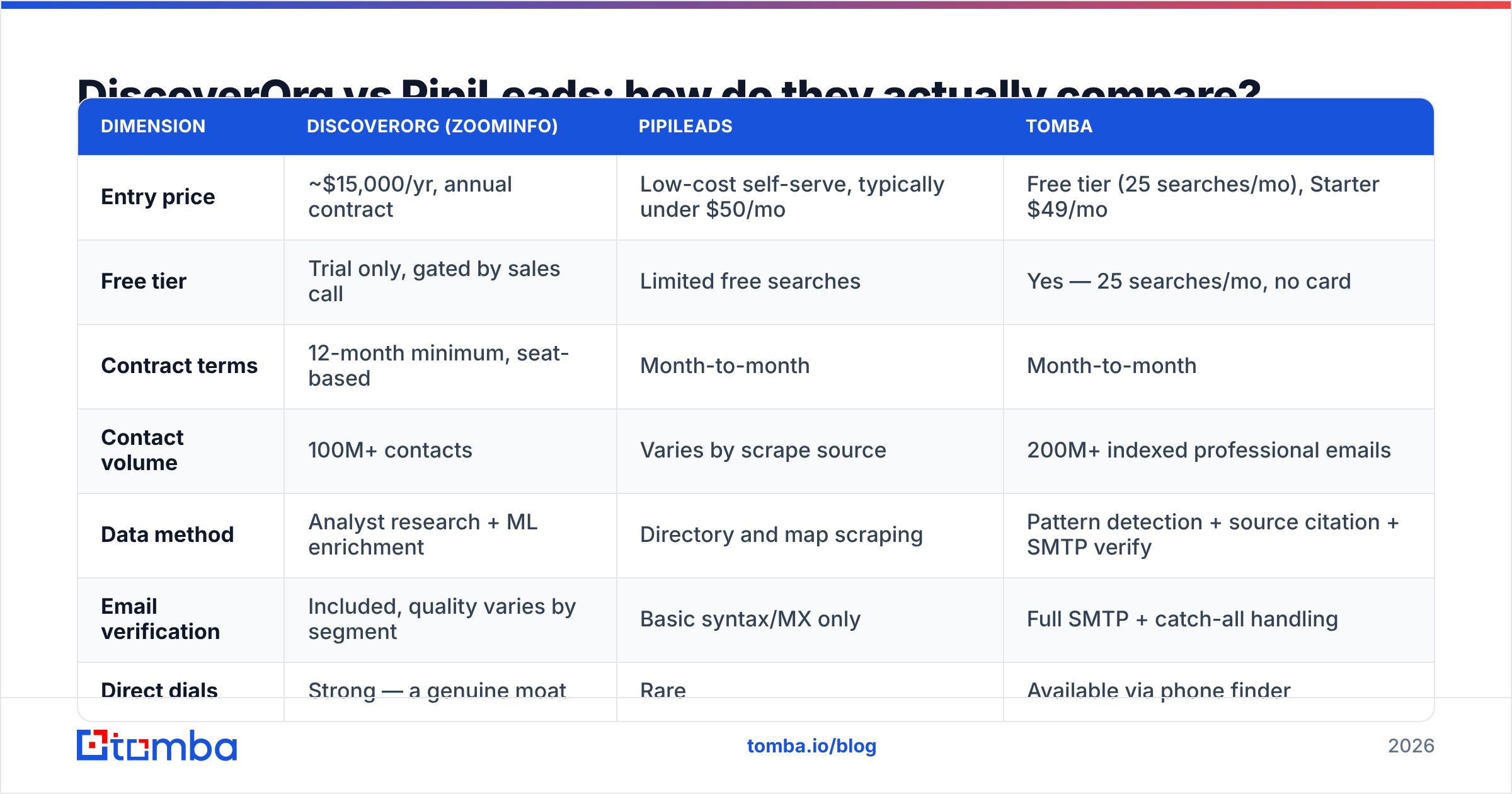
Here is the head-to-head on the dimensions that decide the purchase.
| Dimension | DiscoverOrg (ZoomInfo) | PipiLeads | Tomba |
|---|---|---|---|
| Entry price | ~$15,000/yr, annual contract | Low-cost self-serve, typically under $50/mo | Free tier (25 searches/mo), Starter $49/mo |
| Free tier | Trial only, gated by sales call | Limited free searches | Yes — 25 searches/mo, no card |
| Contract terms | 12-month minimum, seat-based | Month-to-month | Month-to-month |
| Contact volume | 100M+ contacts | Varies by scrape source | 200M+ indexed professional emails |
| Data method | Analyst research + ML enrichment | Directory and map scraping | Pattern detection + source citation + SMTP verify |
| Email verification | Included, quality varies by segment | Basic syntax/MX only | Full SMTP + catch-all handling |
| Direct dials | Strong — a genuine moat | Rare | Available via phone finder |
| Org charts | Best in class | None | None |
| Intent data | Yes (third-party) | No | No |
| Best for | Enterprise ABM teams, 50+ reps | Local SMB outreach, solo founders | Targeted outbound, agencies, developers |
| API access | Enterprise tier only | Limited or none | All paid plans |
Read that table as three different products, not three grades of the same product. DiscoverOrg sells a market map. PipiLeads sells a list. A per-lookup finder sells the specific contact you asked for.
Which one has better data accuracy?#
Accuracy claims in this category are close to meaningless without a methodology, so evaluate the mechanism instead of the marketing number.
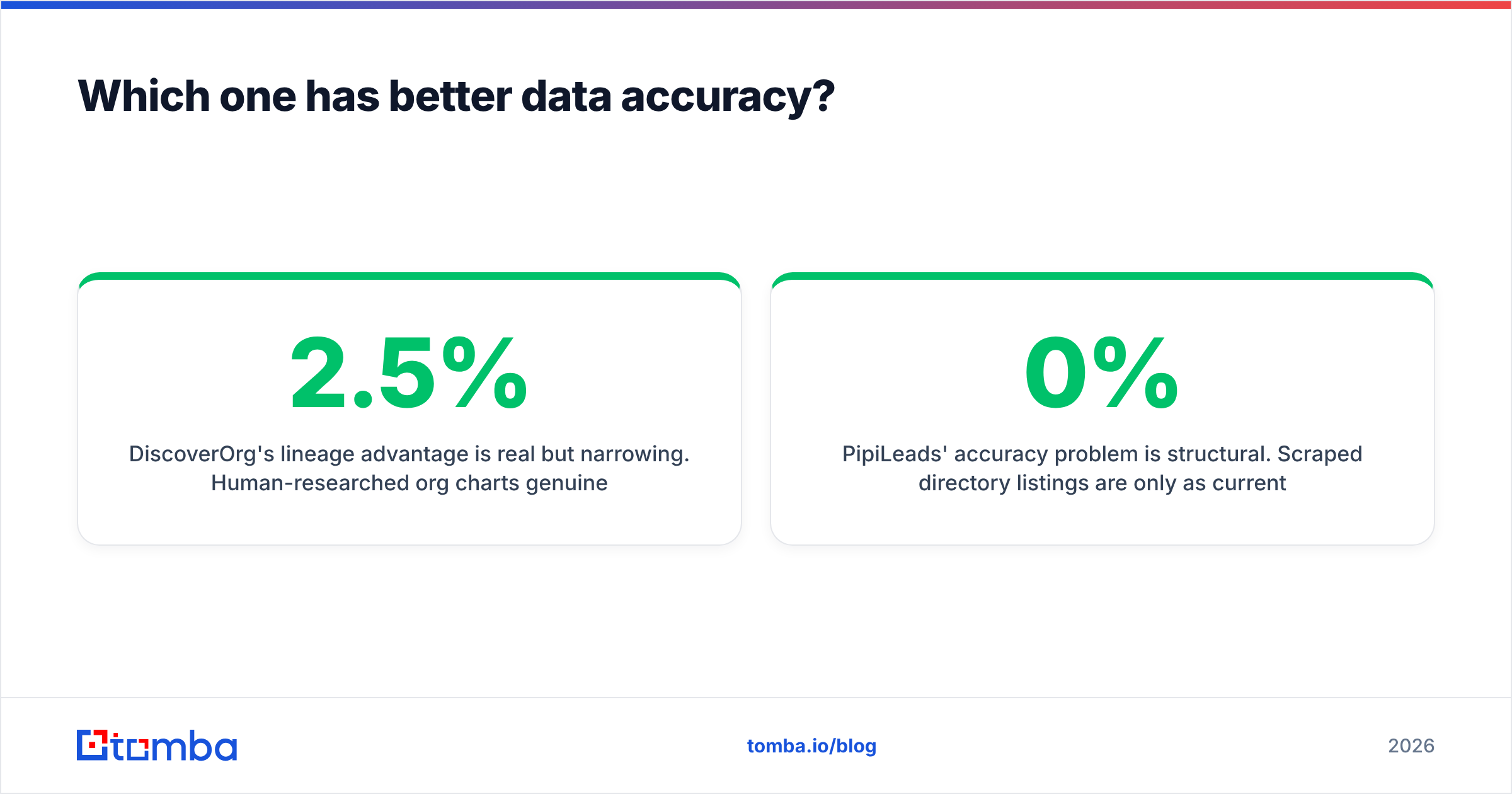
DiscoverOrg's lineage advantage is real but narrowing. Human-researched org charts genuinely beat scraping for structural data — who reports to whom, which team owns the budget. But email accuracy on the combined ZoomInfo index is uneven. Contacts sourced from the legacy DiscoverOrg research process hold up well. Contacts pulled in through community-contributed contact books and machine enrichment decay at the normal B2B rate of roughly 2.5% per month, or about 30% annually as people change jobs. If you buy an annual license and export in month one, a meaningful slice of that export is stale by month twelve.
PipiLeads' accuracy problem is structural. Scraped directory listings are only as current as the directory, and business directories are notoriously stale. Worse, the generic-inbox skew means a "valid" email may deliver technically while never reaching a decision-maker. A 0% bounce rate to info@ addresses that nobody reads is not accuracy — it is a metric that lies to you.
The practical fix in both cases is the same: verify before you send, every time, regardless of source. Run any exported list through an email verifier that does full SMTP checks and handles catch-all domains properly, rather than trusting the vendor's own quality label. Protecting sender reputation is cheaper than rebuilding it.
What does each one actually cost you?#
Sticker price is the smallest part of the total cost.
DiscoverOrg/ZoomInfo total cost includes:
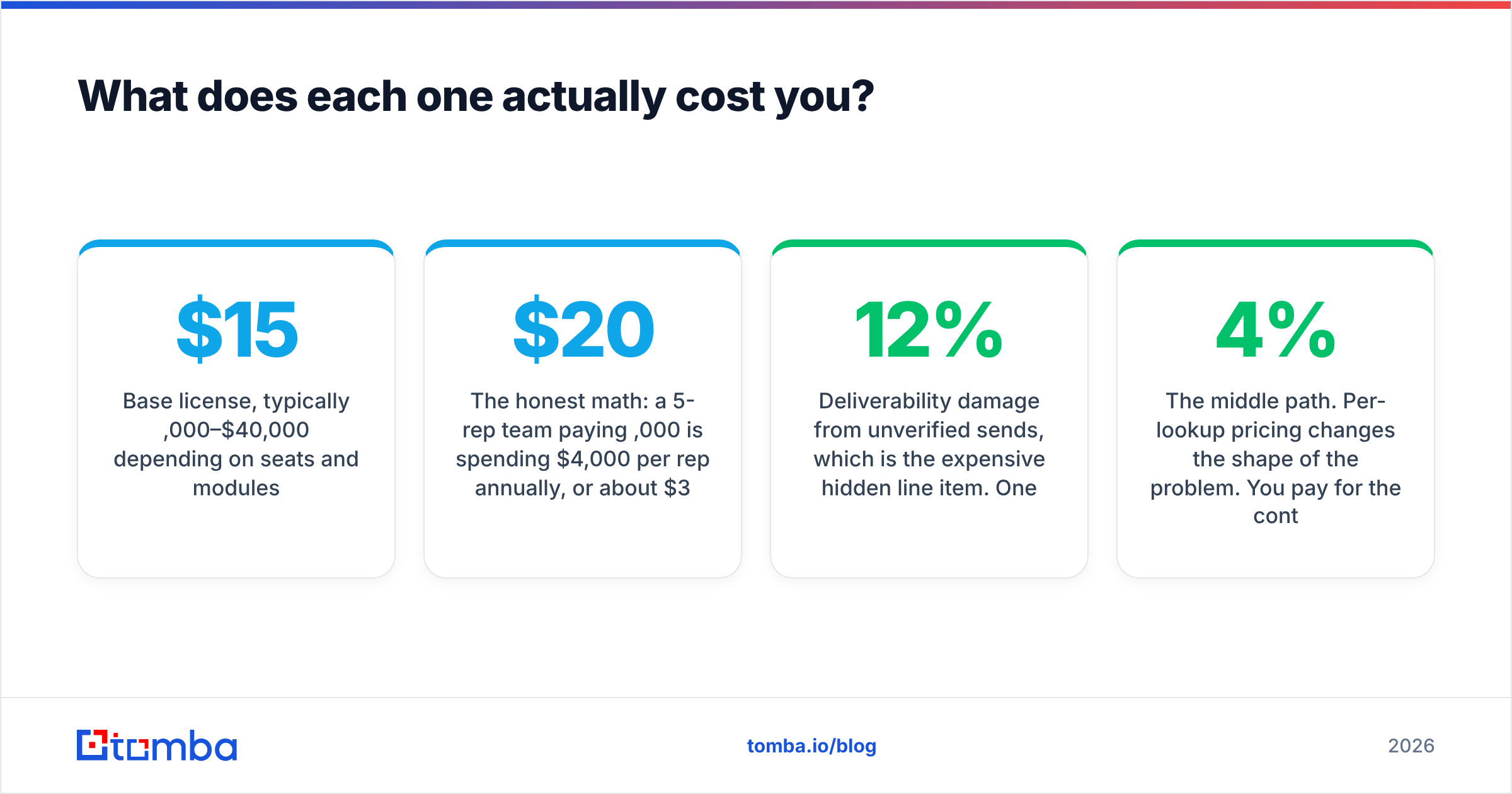
- Base license, typically $15,000–$40,000/year depending on seats and modules.
- Credit overages — exports and enrichments burn credits, and overage pricing is negotiated, not published.
- Add-on modules — intent, Copilot AI, engagement, and websights are usually priced separately.
- Implementation and admin time — the platform rewards a dedicated ops owner and punishes teams without one.
- Renewal risk — the contract auto-renews unless you cancel inside a notice window.
The honest math: a 5-rep team paying $20,000/year is spending $4,000 per rep annually, or about $333/rep/month, on data alone. If those reps each close one extra deal a year because of the org-chart depth, it pays for itself. If they're running volume outbound to a list they already know, it does not.
PipiLeads total cost includes:
- Subscription — genuinely cheap.
- Verification you'll need to buy elsewhere.
- Deliverability damage from unverified sends, which is the expensive hidden line item. One domain burned by a 12% bounce rate costs more in recovery time than a year of any of these subscriptions.
- Manual cleanup labor — deduping, removing role accounts, normalizing company names.
The middle path. Per-lookup pricing changes the shape of the problem. You pay for the contacts you actually pursue instead of pre-buying a database you'll use 4% of. Tomba pricing runs Free (25 searches/mo), Starter $49/mo, Growth $99/mo, Pro $249/mo, and Enterprise custom — all month-to-month, all with API access. For a 5-rep team, Growth at $99/mo is $1,188/year against $20,000 for the enterprise route.

When should you choose DiscoverOrg (ZoomInfo)?#
Buy it when all three of these are true:
- You sell to enterprise accounts with buying committees of 5+ people. Org charts are the reason to pay, and they only matter when you need to map a committee you can't see from the outside.
- You run a phone-first or hybrid motion. Direct dials and mobile numbers are the second real moat. If your reps live on the phone, that data is hard to replicate cheaply.
- You have a RevOps owner. The platform needs someone maintaining filters, enrichment rules, and CRM hygiene. Without that role, you're paying enterprise prices for a search box.
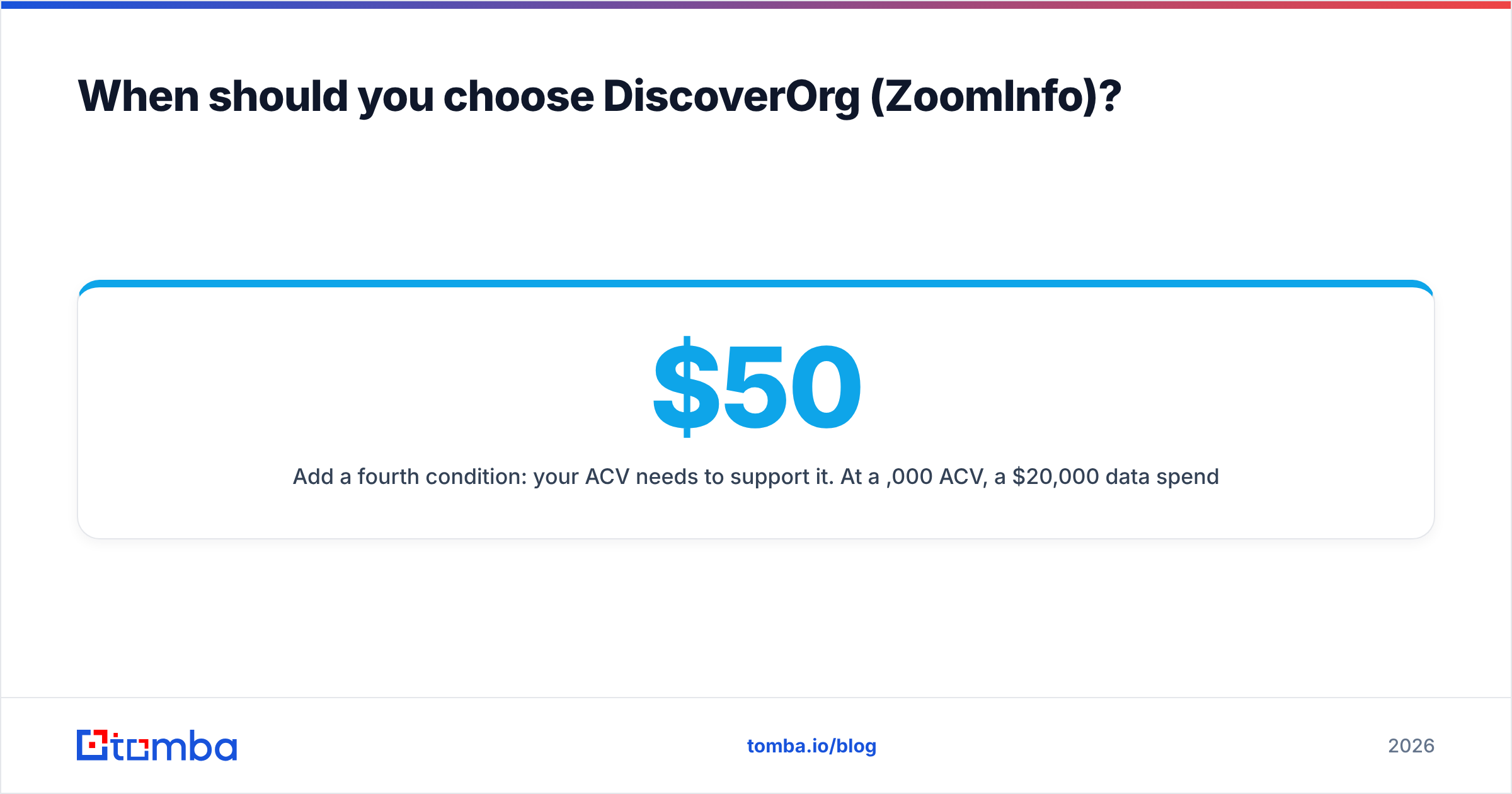
Add a fourth condition: your ACV needs to support it. At a $50,000 ACV, a $20,000 data spend is one extra deal. At a $500/month ACV, it's an obligation you'll resent by month four. If you like the ZoomInfo model but not the price, the market has plenty of options worth benchmarking — start with a structured Apollo alternative comparison and work outward from there.
When should you choose PipiLeads — or something else?#
Choose PipiLeads when your target market is genuinely SMB-local and your offer is transactional. Selling websites to restaurants, HVAC lead-gen, local SEO retainers — these are volume games against businesses that list themselves publicly, and a scraper matches the shape of the problem.
Choose something else when any of these apply:
- Your ICP has job titles in it. Directory scraping doesn't reliably resolve individual decision-makers at mid-market and up.
- You send from a domain you care about. Unverified list quality is the fastest route to a spam-folder problem you'll spend three months undoing.
- You need contacts on demand, not in bulk. If you're researching 40 accounts a week and want the right person at each, per-lookup beats bulk export every time.
- You want the workflow inside your existing tools. A Google Sheets add-on or a Tomba API call fits into a process you already run; a CSV download does not.
What does a better middle option look like?#
The gap between these two products is where most B2B teams actually live: you know who you want to reach, you just need a verified way to reach them, and you don't want to sign an annual contract to get it.
That workflow looks like this:
- Define the account list from your CRM, a funding-round feed, LinkedIn Sales Navigator, or a conference attendee page — sources you already have.
- Resolve the company to a domain, then run a domain search to see every public email pattern and named contact at that company.
- Find the specific person by name and domain when you know who you want, rather than downloading 400 contacts to use 6.
- Verify before sending with SMTP-level checks and explicit catch-all handling, so your bounce rate stays under 2%.
- Enrich what you keep — title, seniority, location, social profiles — with data enrichment so your sequences can actually personalize.
- Automate the repeatable part through the API or a HubSpot integration, so no one is copy-pasting between tabs.
This is not a claim that Tomba replaces ZoomInfo for a 200-rep enterprise ABM program. It doesn't — there are no org charts and no intent data. It's a claim that most teams shopping "DiscoverOrg vs PipiLeads" are actually shopping for verified contact discovery, and both products are the wrong shape for that job: one is over-built and over-priced, the other is under-verified.
Worth noting: this middle tier has real competition. Tools like BookYourData take a pay-as-you-go database approach with a bounce guarantee, which suits teams that prefer buying a defined list up front over per-lookup discovery. Benchmark both against your actual workflow before committing — the right answer depends on whether your list is known or needs to be discovered.
How should you run the evaluation?#
Don't take anyone's accuracy claim, including this article's. Run a controlled test in under an hour:
- Build a 50-contact ground-truth set from people you can independently verify — customers, past colleagues, contacts already in your CRM with confirmed emails.
- Feed the same names and domains to each tool. Same inputs, same day.
- Score three things separately: coverage (did it return anything?), accuracy (was it right?), and confidence calibration (when it said "high confidence," was it actually right?). A tool that returns nothing is often better than one that returns a plausible guess.
- Send a small verified batch and measure real bounce rate, not the vendor's predicted one.
- Price it against your real volume, not the volume the sales rep assumes you'll grow into.
That last point catches most buyers. Enterprise data contracts are sized for the pipeline you hope to build in 18 months. Pay for the pipeline you're building this quarter, and upgrade when the constraint is genuinely data rather than reps or offer.
The verdict#
DiscoverOrg — meaning ZoomInfo today — wins on org charts, direct dials, and intent for enterprise teams that have both the ACV and the ops maturity to use them. PipiLeads wins on price for local SMB list-building where generic inboxes are an acceptable target. Between them sits the majority of B2B sellers, paying for one of two products that don't fit.
If your actual job is "get a verified work email for a specific person at a specific company, repeatedly, without a contract," start with the Tomba Email Finder. The free tier gives you 25 searches a month with no card required — enough to run the ground-truth test above against whatever quote is sitting in your inbox. Starter is $49/mo when you're ready to scale, and every paid plan includes API access so the workflow can live inside whatever stack you already run.
Related guides#
Ready to find emails that actually work?
Join 150,000+ professionals who stopped guessing and started sending. Free credits on signup — no credit card required.
Get the Tomba newsletter
Practical outbound tactics and product updates — once every two weeks.
About the author