DiscoverOrg vs Pubrio: B2B Data Tools Compared 2026
DiscoverOrg (now ZoomInfo) and Pubrio target the same buyer from opposite ends of the price chart. Here's how coverage, accuracy, contracts, and real cost compare in 2026 — and which one fits your team.
DiscoverOrg vs Pubrio is a choice between two very different budgets. One side is an enterprise data contract. The other is a card-swipe subscription. Here is how they stack up in 2026.
TL;DR
- DiscoverOrg is no longer a standalone product. It merged with ZoomInfo in 2019. Buy DiscoverOrg today and you get a ZoomInfo Copilot or SalesOS seat, usually on an annual contract in the $15,000–$40,000+ range.
- Pubrio is much newer. It is a self-serve AI prospecting platform: contact and company search, intent signals, and AI-written outreach. Pricing starts in the low hundreds per month, and monthly billing is available.
- The real question in DiscoverOrg vs Pubrio is not which database is bigger. It is what you need. Org charts, technographics, and intent for a 20-person sales floor? Or verified emails for a two-person outbound push?
- Both tools bundle data with workflow. If you only want the data layer, a finder like Tomba runs $49–$99/mo and plugs into the sequencer you already pay for.
- Budget rule of thumb: under $500/mo, ZoomInfo is out of reach. Over $25k/yr with a RevOps team to run it, Pubrio starts to feel thin.
What happened to DiscoverOrg, and what are you buying?#
DiscoverOrg spent about fifteen years as the premium B2B contact database for tech sales. Buyers paid for human-verified org charts and IT department maps. The data quality justified a five-figure invoice.
In February 2019, DiscoverOrg bought ZoomInfo. The combined company took the ZoomInfo name and went public in 2020.
That history shapes the whole comparison. DiscoverOrg vs Pubrio is really ZoomInfo's enterprise data stack against a modern self-serve tool. If a rep says they use DiscoverOrg, they are on ZoomInfo. If a vendor still sells DiscoverOrg, read the contract before you sign.
Here is what you get on that side in 2026:
- Contact and company records at scale — hundreds of millions of profiles. Direct dials and mobile numbers cost extra.
- Org charts and reporting lines — the original DiscoverOrg edge. Still the strongest part of the product for account-based selling into large firms.
- Technographics — the vendors an account already runs. Useful for displacement plays.
- Intent data — Bombora-style topic surges plus ZoomInfo's own web-visitor signals. Sold as a tier upgrade.
- Workflow tools — Engage for sequencing, Copilot for AI account picks, plus native CRM sync.
- Contracts — annual, seat-based, with credit caps. Overage and add-on prices are negotiated, not published.
What is Pubrio, and who is it for?#
Pubrio is an AI-first lead platform. It targets founders, agencies, and small sales teams priced out of the big data vendors. One self-serve plan covers contact search, company filters, intent signals, a Chrome extension, and AI copy.
The pitch is simple. You get most of what a ZoomInfo seat does, for a small slice of the yearly spend. You pay with a card, not a purchase order.
Where Pubrio is strong:
- Fast start. No demo gate, no sales call, no annual PO.
- Filters that match how founders think — industry, headcount, tech stack, funding, hiring signals.
- AI outreach built in. You skip a second tool on day one.
- Monthly billing. This is the biggest structural gap between the two sides.
Where it is thin:
- Org charts are nowhere near DiscoverOrg's verified mapping.
- Direct dials are fewer, especially outside North America.
- Compliance paperwork (SOC 2 packs, DPAs, custom MSAs) is lighter than an enterprise review expects.
- Support is self-serve first. No named CSM will rebuild your filters with you.

DiscoverOrg vs Pubrio: how do they compare head-to-head?#
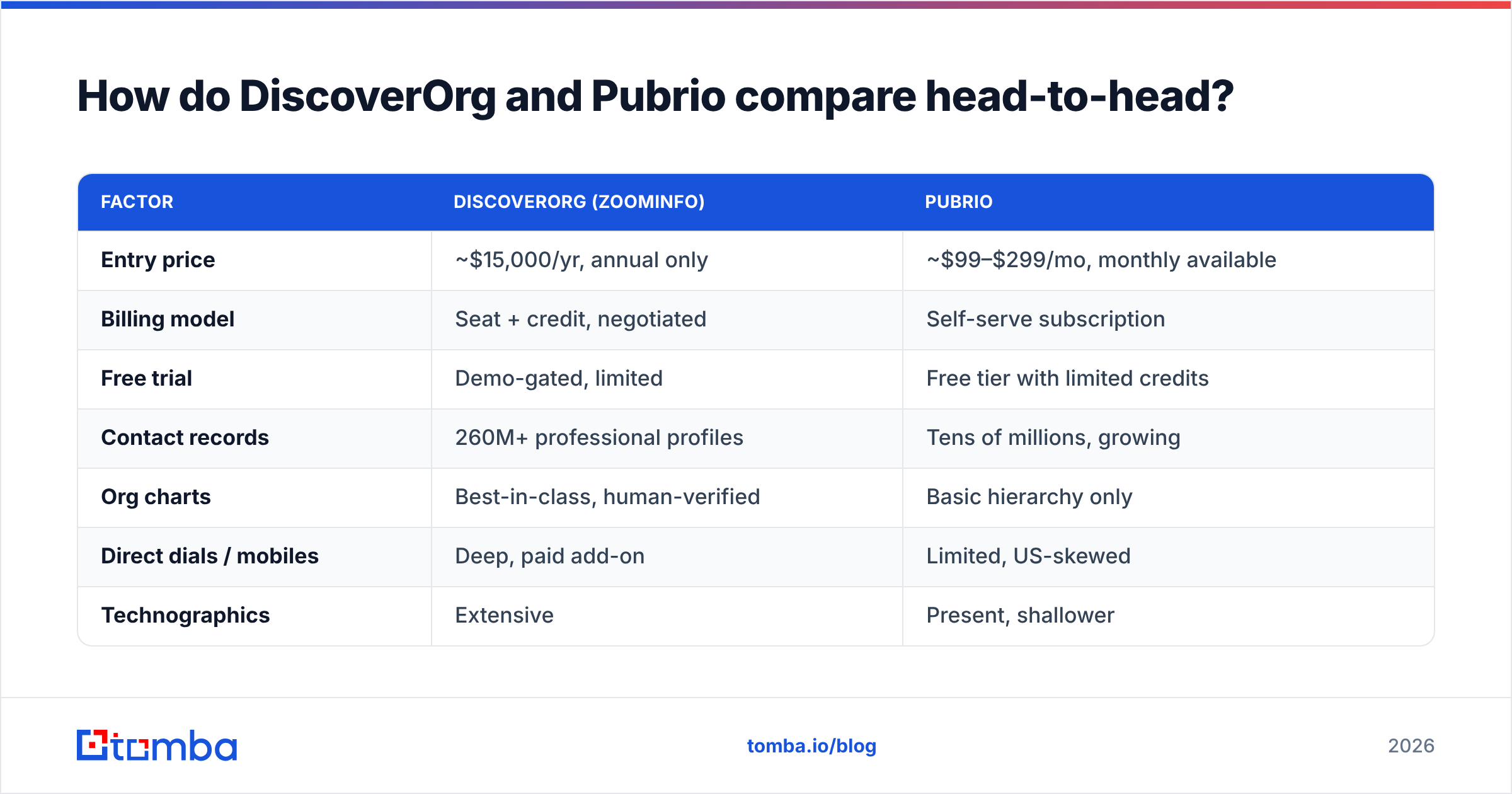
| Factor | DiscoverOrg (ZoomInfo) | Pubrio |
|---|---|---|
| Entry price | ~$15,000/yr, annual only | ~$99–$299/mo, monthly available |
| Billing model | Seat + credit, negotiated | Self-serve subscription |
| Free trial | Demo-gated, limited | Free tier with limited credits |
| Contact records | 260M+ professional profiles | Tens of millions, growing |
| Org charts | Best-in-class, human-verified | Basic hierarchy only |
| Direct dials / mobiles | Deep, paid add-on | Limited, US-skewed |
| Technographics | Extensive | Present, shallower |
| Intent data | Native + Bombora, tiered | Included in mid tiers |
| Email verification | Included, opaque method | Included |
| AI outreach copy | Copilot (upper tiers) | Core feature |
| CRM sync | Native Salesforce/HubSpot | HubSpot + Zapier-style |
| Contract exit | Auto-renew clauses common | Cancel anytime |
| Realistic buyer | 10+ seat sales org | 1–5 person team, agency |
Read the table as two products that merely overlap on contact data. One is infrastructure your RevOps team runs. The other is a tool a founder buys on a Tuesday.
Which one has better data accuracy?#
Neither vendor will hand you a bounce rate you can trust. So use a method, not a marketing claim.
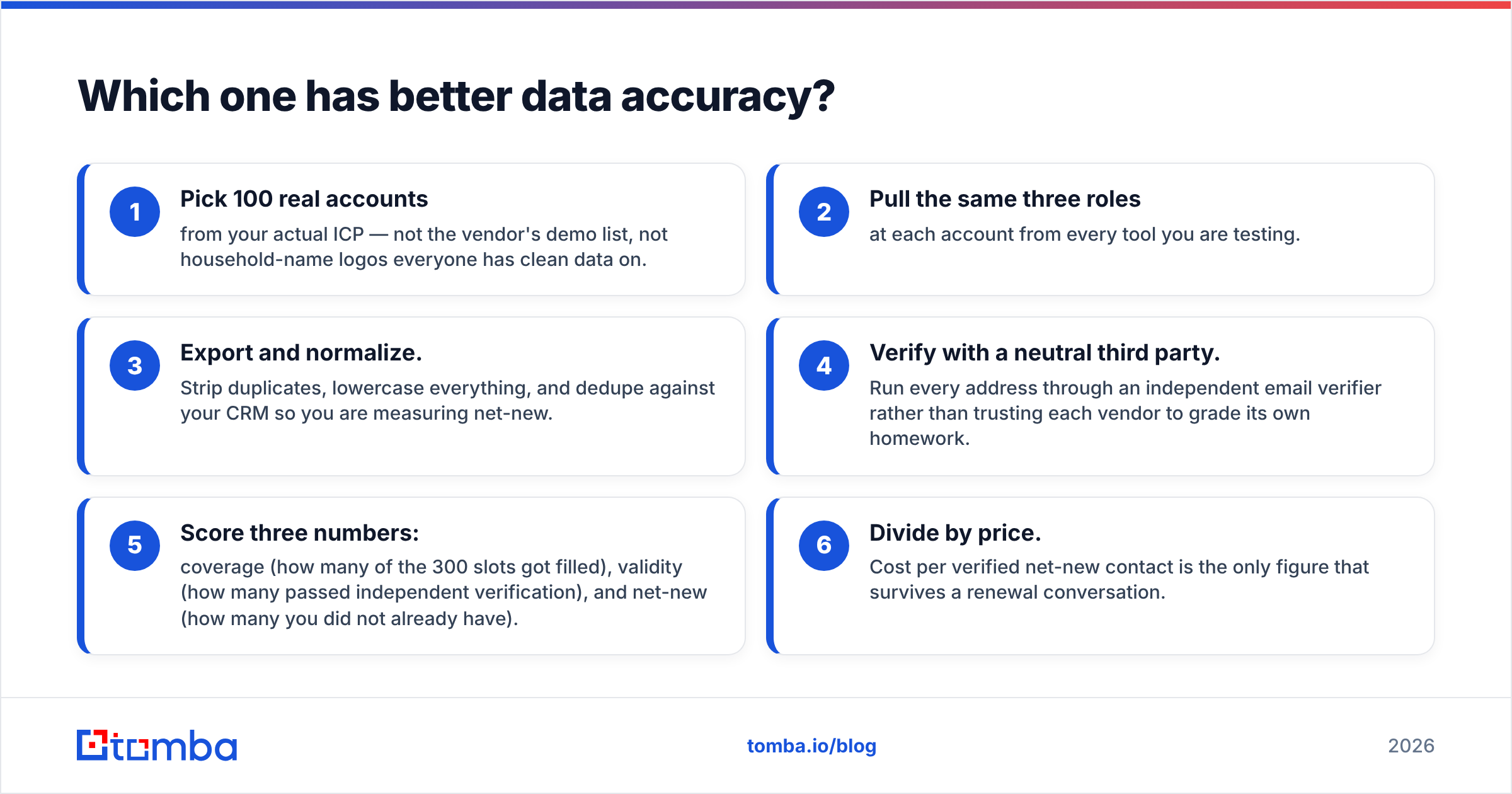
Run a blind sample test before you sign.
- Pick 100 real accounts from your own ICP. Skip the vendor demo list. Skip famous logos that everyone has clean data on.
- Pull the same three roles at each account from every tool you test.
- Export and normalize. Strip duplicates, lowercase everything, and dedupe against your CRM. Now you are measuring net-new.
- Verify with a neutral party. Run each address through an independent email verifier. Do not let a vendor grade its own homework.
- Score three numbers. Coverage, validity, and net-new.
- Divide by price. Cost per verified net-new contact is the figure that survives a renewal talk.
Most DiscoverOrg vs Pubrio tests land the same way. The enterprise side wins on coverage in mid-market and enterprise accounts. It is far better at hard-to-reach titles and odd departments. The lean tool often ties or wins on SMB and startup accounts. There, human verification adds little, and both vendors scrape the same public sources.
Watch for catch-all domains on both sides. A valid result on a catch-all server tells you almost nothing. That is why a catch-all verifier belongs in the test. Bounces from catch-all guesses burn a sending domain fast, and no vendor counts them in its accuracy claim.
What does each one actually cost?#
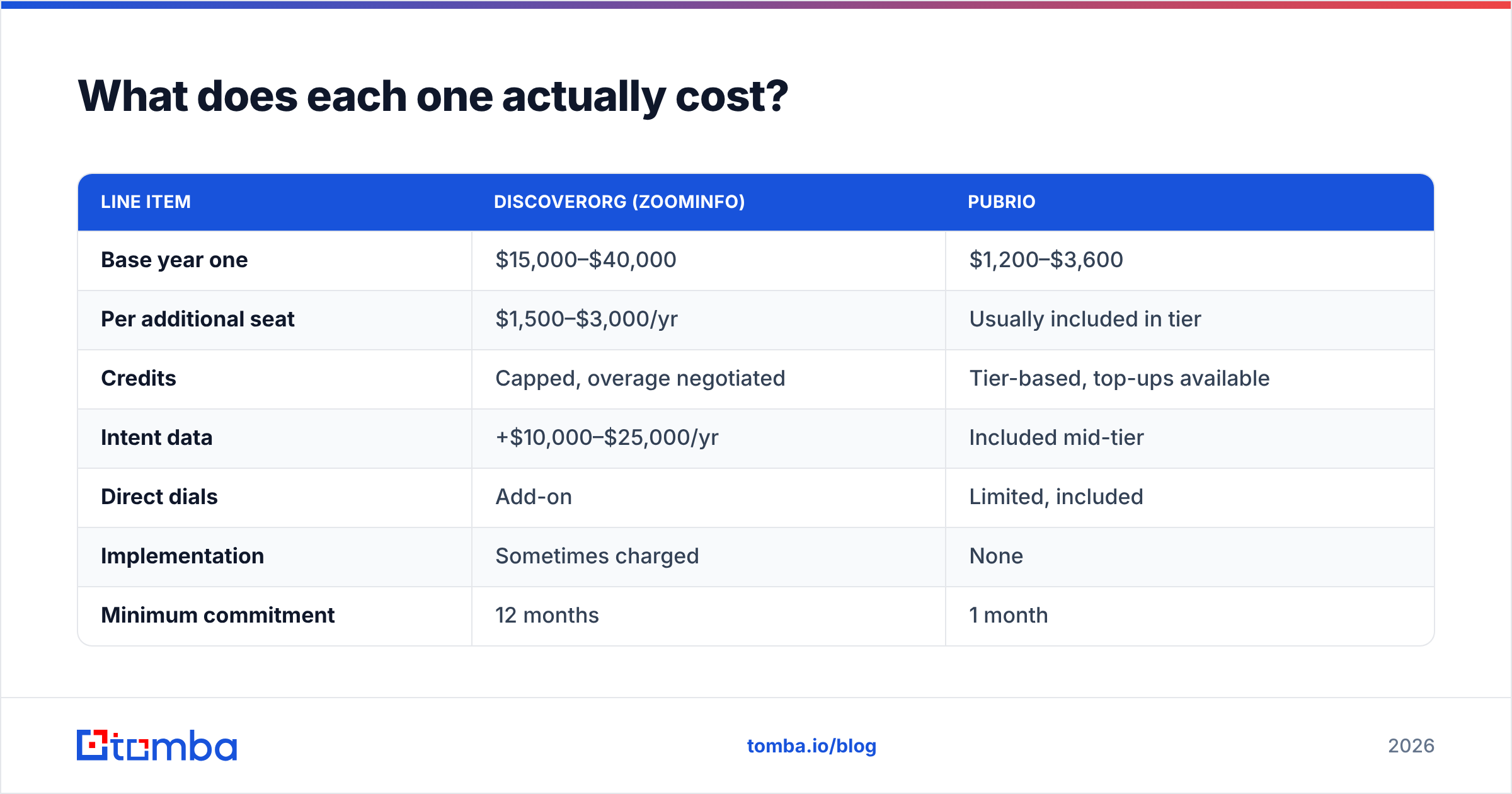
Cost is where DiscoverOrg vs Pubrio splits hardest. ZoomInfo does not publish prices, and that is on purpose. Public deal reports and buyer reviews on G2 point to this 2026 picture:
| Line item | DiscoverOrg (ZoomInfo) | Pubrio |
|---|---|---|
| Base year one | $15,000–$40,000 | $1,200–$3,600 |
| Per additional seat | $1,500–$3,000/yr | Usually included in tier |
| Credits | Capped, overage negotiated | Tier-based, top-ups available |
| Intent data | +$10,000–$25,000/yr | Included mid-tier |
| Direct dials | Add-on | Limited, included |
| Implementation | Sometimes charged | None |
| Minimum commitment | 12 months | 1 month |
The hidden cost on the enterprise side is not the sticker price. It is the credit cap. Teams often burn a year of credits in seven months. Then they negotiate a mid-term expansion with zero leverage, because every sequence already runs on the platform.
The lean side hides a different cost. Coverage gaps push SDRs into manual research. At a loaded SDR rate, four hours a week of hand lookup wipes out the savings.

When should you skip both and buy the data layer?#
Many teams weighing DiscoverOrg vs Pubrio need neither one. They need verified email addresses for a list they can already define. And they like the sequencer they own.
That is the case for unbundling. Buy contact discovery on its own. Keep your outreach stack. Stop paying for org charts nobody opens.
The unbundled stack looks like this:
- Company list — LinkedIn Sales Navigator, Crunchbase, a niche directory, or your own scrape.
- Contact discovery — an email finder turns names and domains into addresses. Domain search pulls every public address at a company at once.
- Verification — a dedicated verifier before anything enters your sequencer.
- Enrichment — data enrichment fills firmographics on records you already hold.
- Sequencing — whatever you already pay for. Instantly, Smartlead, Lemlist, HubSpot, or plain Gmail with a template.
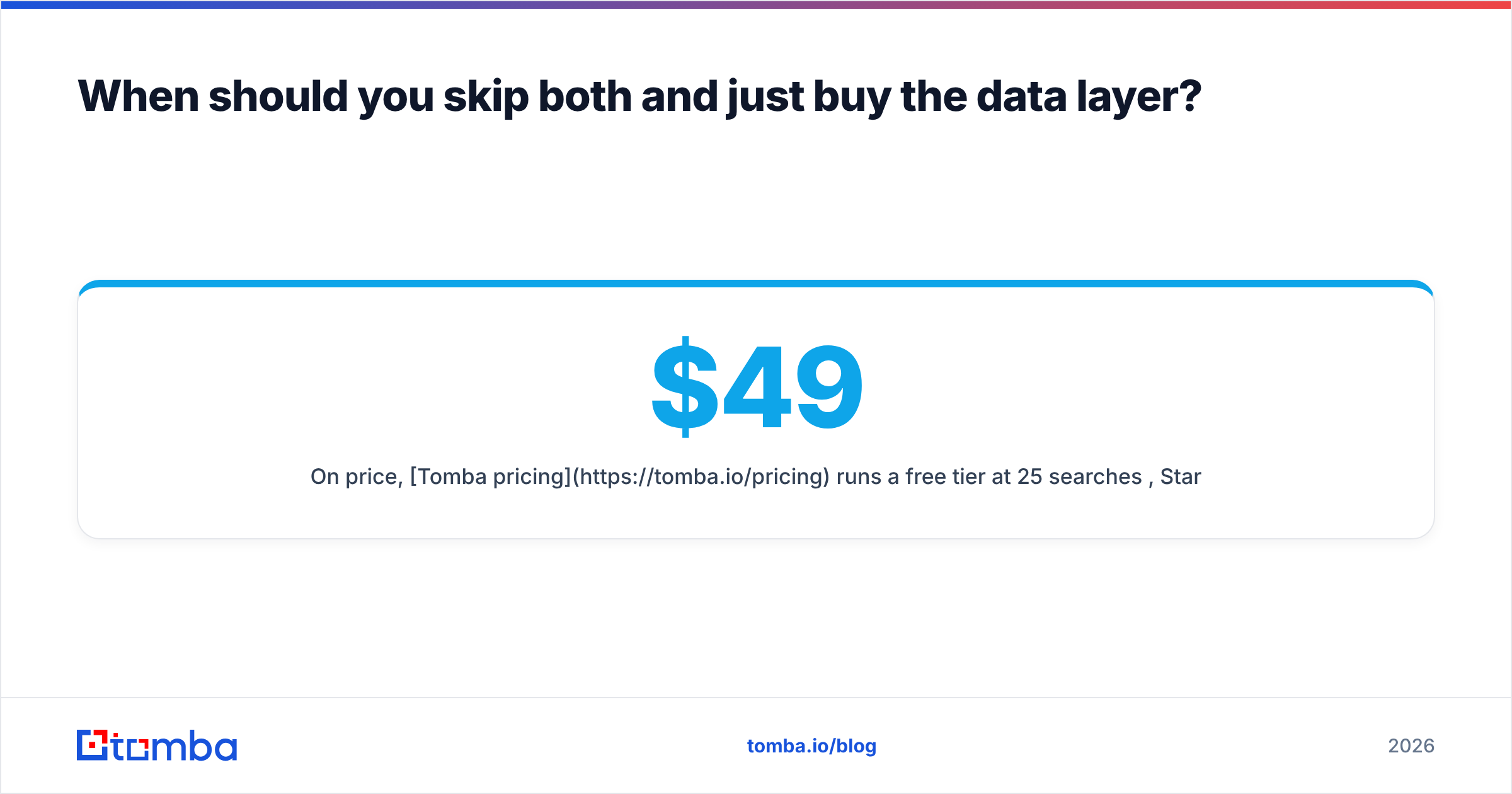
Tomba pricing starts free at 25 searches a month. Starter is $49/mo, Growth is $99/mo, and Pro is $249/mo. Every paid plan includes the API.
That sits near Pubrio on price, and at 1–3% of a ZoomInfo contract. Remember the trade, though. You are buying the data layer only, so compare it against the slice of each suite you would truly use.
One honest caveat. Unbundling means you own the integration work. No single dashboard shows intent, org charts, and sequence stats side by side. If a unified view saves your managers real time, a suite is a fair buy.
Are there better alternatives to both in 2026?#
If DiscoverOrg vs Pubrio both feel wrong, the middle of this market is crowded. A few options deserve a look:
- Apollo alternative territory — Apollo sits between the two. Big database, usable free tier, uneven data by segment.
- BookYourData — good when you want a pay-as-you-go list with a bounce guarantee. Strong for one-off campaigns with no recurring software cost.
- Clearbit alternative options — better if enrichment and website-visitor identification matter more than list building.
- RocketReach alternative options — worth a check if direct dials are your main need and ZoomInfo is out of range.
To be fair, none of these replaces DiscoverOrg's org-chart depth. Say your ABM motion needs the reporting lines inside a 400-person IT team. ZoomInfo is still the best answer, and the price reflects that. Everyone else is buying a different product.
How do you run the evaluation in two weeks?#
Set a two-week clock. Follow a fixed order.
- Write your ICP as filters, not adjectives. Series A–C SaaS, 50–300 staff, US and UK, on HubSpot is testable. Growth-stage tech is not.
- Ask for data before the demo. Request 50 records that match your filters, as a CSV. A refusal tells you plenty.
- Verify on your own. Then work out cost per verified net-new contact.
- Test the workflow you will really use. If reps live in the CRM, test the sync. If they live in a browser extension, test it on ten real profiles.
- Read the renewal clause first. Auto-renewal windows, credit rollover, and expansion pricing decide what year two costs. The feature list does not.
- Price the unbundled option as a control. Even if you buy a suite, that number gives you leverage.
Teams that run this process usually find their needs are narrower than the RFP they started with. That is the point.
The verdict: DiscoverOrg vs Pubrio, which should you pick?#
Pick DiscoverOrg/ZoomInfo if you run 10+ sellers and an ABM motion into mid-market or enterprise accounts. You also need a RevOps owner and a budget that already tolerates five figures. Org charts, technographics, and intent are real edges. No $99/mo tool copies them.
Pick Pubrio if you are a founder, agency, or small team. Your accounts skew SMB and startup. You want monthly billing, no procurement cycle, and AI outreach in the same plan.
Pick neither if your bottleneck is verified email addresses rather than account intelligence. That case is the most common, and the most over-solved.
If that is you, start with the Tomba Email Finder. Feed it a name and a domain, or just a domain. You get verified business addresses back.
Verification, catch-all handling, and enrichment sit on the same account. The free tier gives you 25 searches to test against your own ICP. Starter is $49/mo. The Tomba API wires it into the CRM and sequencer you already run, so nothing has to migrate.
Run the sample test first. Then decide what a suite is really worth to you.
Related guides#
Ready to find emails that actually work?
Join 150,000+ professionals who stopped guessing and started sending. Free credits on signup — no credit card required.
Get the Tomba newsletter
Practical outbound tactics and product updates — once every two weeks.
About the author