DiscoverOrg vs ReachStream: B2B Data Compared for 2026
DiscoverOrg (now ZoomInfo) sells depth at enterprise prices. ReachStream sells volume at startup prices. Here's the honest breakdown of which one actually fits your outbound motion — and when neither does.
DiscoverOrg vs ReachStream is an odd match-up. One is now part of ZoomInfo and sells to enterprise teams. The other sells cheap lists you can download today. This guide compares both on price, data quality, and contract terms.
TL;DR
DiscoverOrg is no longer a standalone product. It merged with ZoomInfo in 2019. Buying "DiscoverOrg" today means buying ZoomInfo.
ReachStream is a different animal. It is a low-cost, self-serve contact database you download. Think hundreds of dollars, not tens of thousands.
The real split is contract shape. ZoomInfo means annual deals, seat minimums, and procurement. ReachStream means a credit card and a CSV.
Both decay. Static databases go stale by 22–30% a year.
Verify either way. A real-time email verifier is the gap between a 2% bounce rate and a 12% one.
Why does DiscoverOrg vs ReachStream still matter?#
DiscoverOrg was based in Vancouver, Washington. It built its name on human-researched org charts, not scraped data. Analysts phoned into companies and confirmed who reported to whom. That research made the product good. It also made it expensive.
In February 2019, DiscoverOrg acquired ZoomInfo and took its name. Today ZoomInfo sells the old DiscoverOrg data as its premium tier. People still search for DiscoverOrg vs ReachStream for two reasons. Many teams inherited legacy DiscoverOrg contracts. And the two products sit at opposite ends of the B2B data market.
ReachStream sits at the cheap end. You buy access, filter by industry, title, or region, and export. There are no org charts, no intent signals, and no research team on the phones. Volume and price are the pitch.
So DiscoverOrg vs ReachStream comes down to one question: do you want researched depth at enterprise cost, or bulk breadth at self-serve cost?
DiscoverOrg vs ReachStream: how do they compare?#
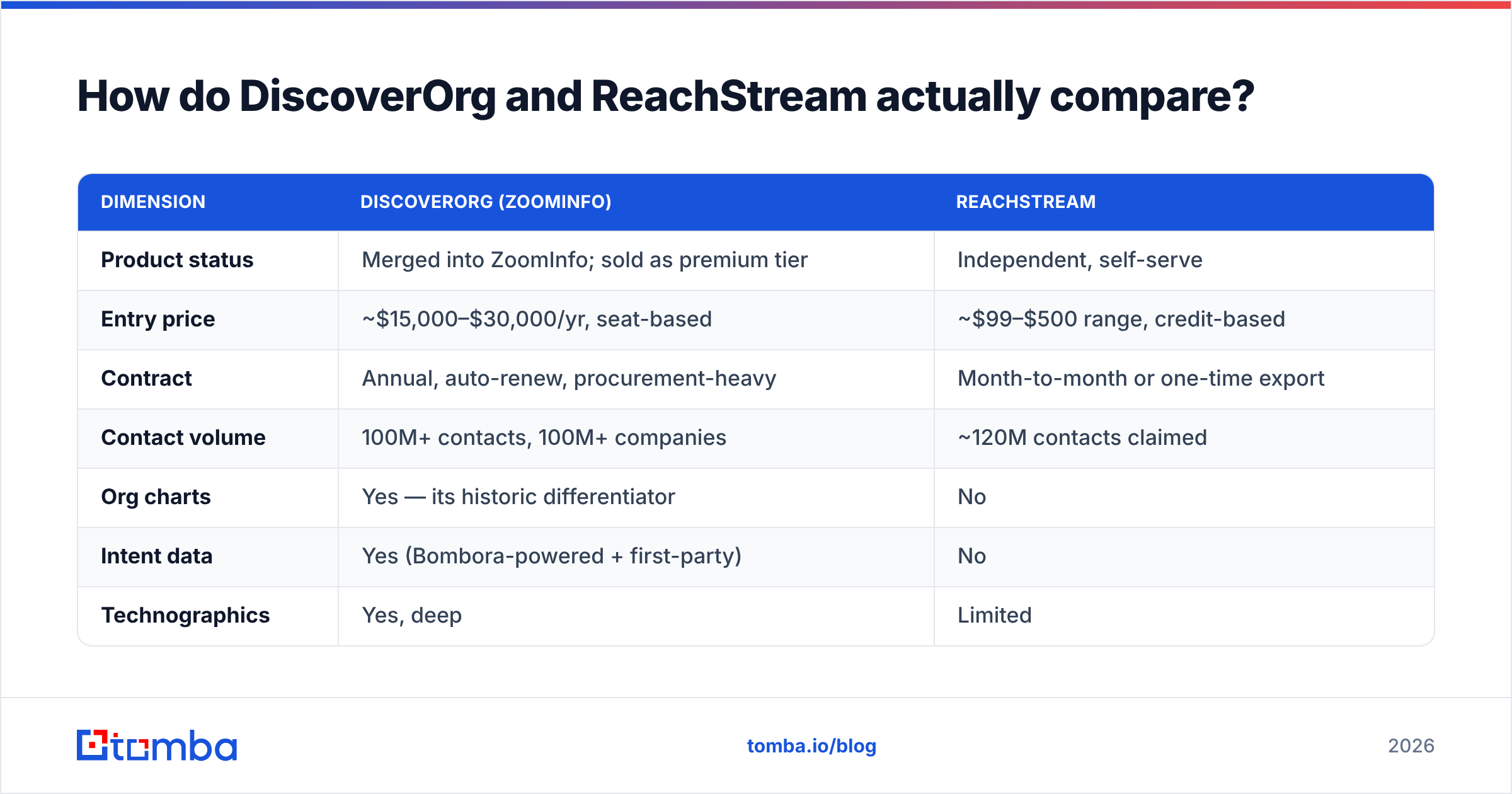
Here is the side-by-side on the points that change your decision. Prices come from public G2 and Capterra reviews and vendor pages. Both vendors quote custom deals, so treat these as ranges, not invoices.
| Dimension | DiscoverOrg (ZoomInfo) | ReachStream |
|---|---|---|
| Product status | Merged into ZoomInfo; sold as premium tier | Independent, self-serve |
| Entry price | ~$15,000–$30,000/yr, seat-based | ~$99–$500 range, credit-based |
| Contract | Annual, auto-renew, procurement-heavy | Month-to-month or one-time export |
| Contact volume | 100M+ contacts, 100M+ companies | ~120M contacts claimed |
| Org charts | Yes — its historic differentiator | No |
| Intent data | Yes (Bombora-powered + first-party) | No |
| Technographics | Yes, deep | Limited |
| Direct dials | Strong, a core selling point | Limited / inconsistent |
| Real-time verification | Partial, refresh-cycle based | Minimal |
| CRM integrations | Salesforce, HubSpot, Outreach, Salesloft, Marketo | CSV export, basic API |
| Free trial | Demo-gated, sales-led | Limited free sample |
| Best fit | Enterprise ABM, 10+ seat sales orgs | Startups, agencies, one-off list builds |
The table hides the line that matters most: time to first email sent. With ReachStream you can be exporting inside an hour. With ZoomInfo you get a demo, a security review, and a legal round. For a mid-market team, that takes three to six weeks.
Is DiscoverOrg's data better than ReachStream's?#
Yes, on depth. No, not by enough to justify a 30x price gap for every team.
Break "better" into four parts:
Coverage — how many of your target accounts are in the database at all. ZoomInfo wins in North American mid-market and enterprise tech. ReachStream's raw count looks similar on paper. But its depth inside one vertical is thinner, and coverage outside the US and UK drops fast.
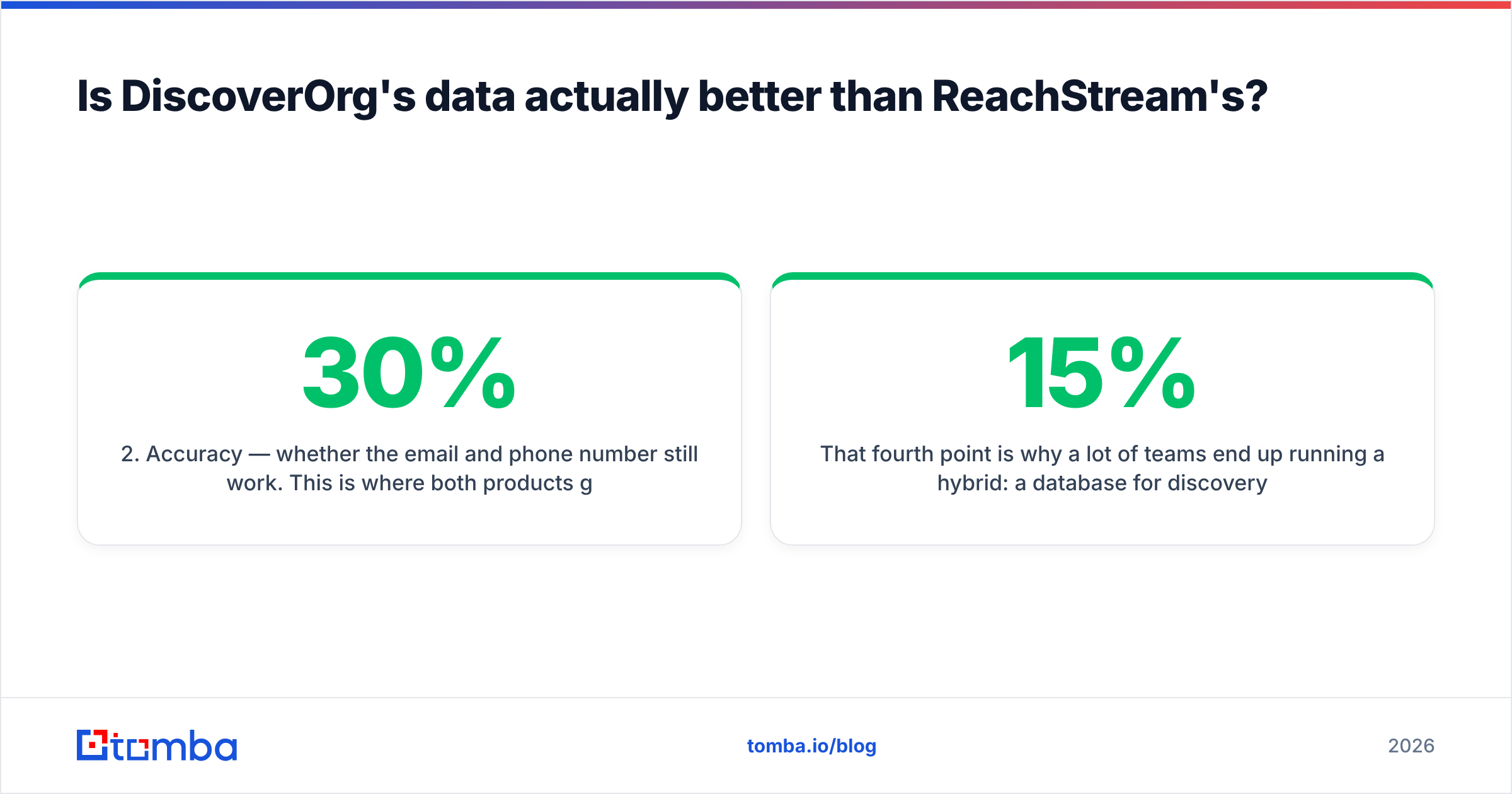
Accuracy — whether the email and phone still work. Both products struggle here. ZoomInfo users share contacts through a browser extension, which keeps data fresher than a plain scrape. Even so, no static database survives job changes. HubSpot's research and most industry estimates put B2B data decay at 22–30% a year. ReachStream decays faster because it refreshes less often.
Depth — org charts, reporting lines, direct dials, technographics, funding events. The old DiscoverOrg research operation is hard to copy. If you sell into a 12-person buying committee, this is the reason to pay.
Freshness at the moment you send — the thing that sets your bounce rate. Neither vendor fixes this. A bigger database is not the answer. Checking the address right before you send is.
That last point pushes many teams into a hybrid setup. They use a database for discovery and firmographics, then a real-time finder and verifier for the send list. Run an export through a bulk verify pass first. It usually strips 8–15% of a six-month-old ZoomInfo list, and far more from a bulk-bought one.

DiscoverOrg vs ReachStream pricing: what does each one cost?#
The sticker price is the smallest part of the total.
ZoomInfo/DiscoverOrg true cost drivers:
- Seat minimums. Pricing is per seat, with a floor. A three-person SDR team often gets quoted for five seats.
- Credit caps. Export credits are metered apart from seat licenses. Run out in month four and you renegotiate with no leverage.
- Annual auto-renew. G2 reviewers flag auto-renewal clauses with short cancellation windows. Check the notice period before you sign.
- Add-on modules. Intent, WebSights, Engage, and Chat all cost extra. The demo shows the full suite. The quote shows the base.
ReachStream true cost drivers:
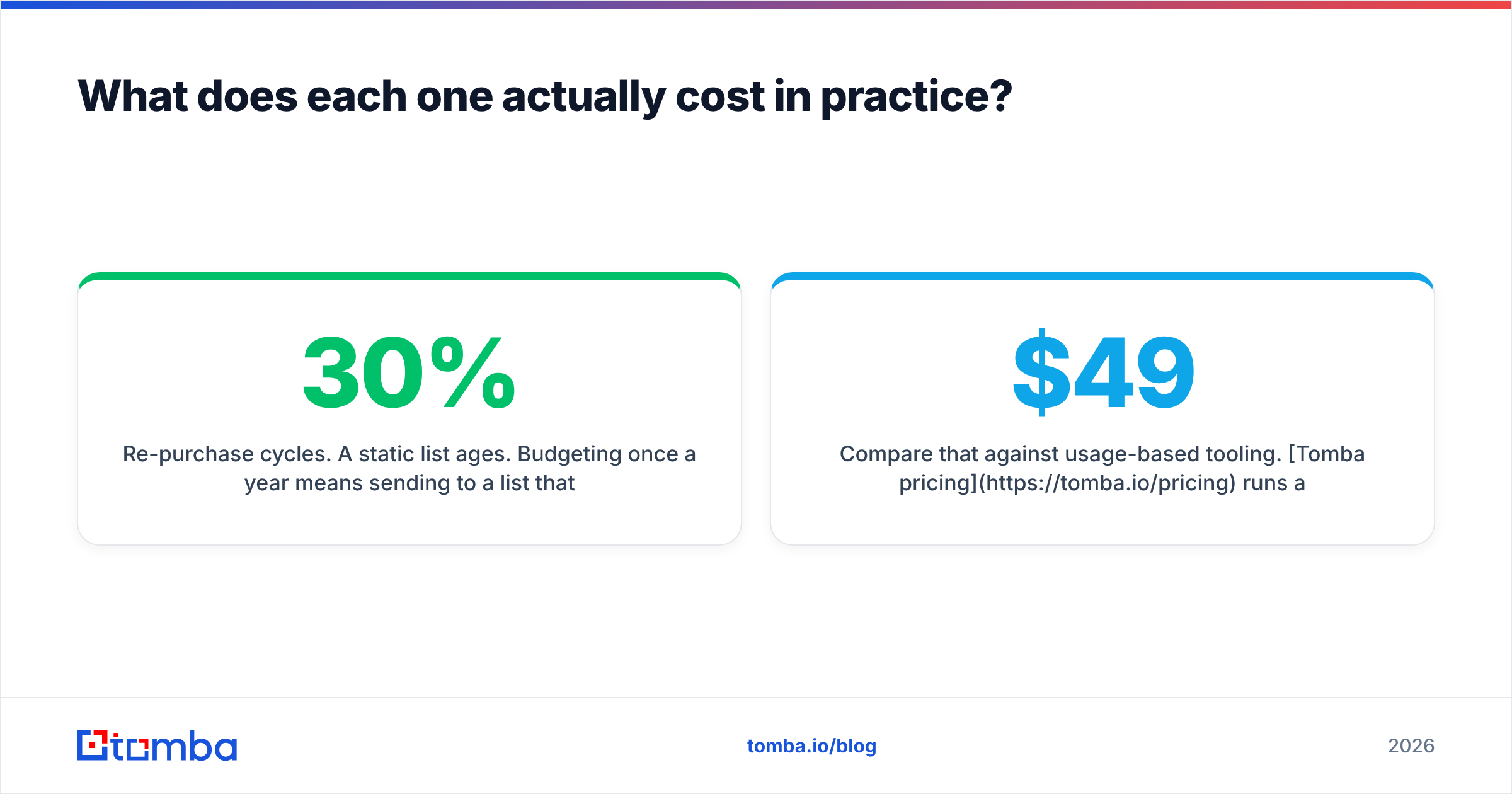
- Re-purchase cycles. A static list ages. Buy once a year and by month twelve a third of it is dead.
- Verification spend. You still need a separate verification tool. That is a real line item.
- Deliverability damage. This is the hidden cost. A bad list burns sender reputation, and repairing a scorched domain costs more than the list did.
Now compare usage-based tooling. Tomba pricing starts free at 25 searches a month. Starter is $49/mo, Growth $99/mo, and Pro $249/mo. There are no seat minimums and no annual lock. That is not a swap for ZoomInfo's intent data. But for one job — find and verify the email of a person you already picked — the cost gap is about two orders of magnitude.
Who should buy DiscoverOrg (ZoomInfo)?#
Buy it if three or more of these are true:
- You run formal ABM with named target accounts and multi-threaded deals.
- You have 10 or more people who need access, so the seat cost spreads out.
- Org charts change your plan. You need to know the VP of Infrastructure reports to the CTO, not the COO.
- You act on intent data. If nobody works the signals, you are paying for a slide.
- Procurement is not a blocker. You have budget authority and a legal team that moves.
The math works for enterprise teams selling six-figure deals. One closed deal pays for the year. It rarely works if you sell $200/month SaaS. That gap is why the Apollo alternative and mid-market category exists.
Who should buy ReachStream?#
ReachStream fits a narrower set of jobs than its marketing suggests:
- One-off campaign lists for an event, a webinar, or a vertical push where you need volume fast and cheap.
- Agency prospect lists that have to stay under a fixed project fee.
- Coverage tests in a new region or vertical, before you commit real budget.
- Early-stage teams with more time than money, who will verify by hand anyway.
ReachStream is not a system of record. Bulk lists are rarely exclusive, so other buyers get the same contacts. If you compete on relevance and timing, a shared list works against you.
What are the better alternatives to both?#
A DiscoverOrg vs ReachStream choice is not your only option. Four other patterns are worth pricing before you sign anything:
1. Trigger-based finding instead of bulk lists. Skip the 50,000-contact buy. Spot accounts from your own signals: hiring posts, funding rounds, tech-stack changes, competitor mentions. Then find the right person's email on demand. A domain search returns every discoverable address at a company, with confidence scores and sources. You build the list you need instead of renting one others already used.
2. Enrichment on top of your CRM. Most teams sit on thousands of half-empty records. Data enrichment fills in missing titles, emails, and company data on records you already own. It costs less than net-new data, and deliverability is better because these contacts are warm.
3. Peer databases at self-serve prices. BookYourData is worth a look. It runs pay-as-you-go with a claimed 97% deliverability guarantee and no subscription. That lands between ReachStream's bulk economics and ZoomInfo's enterprise contracts.
4. API-first pipelines. With engineering help, wiring a data source straight into your workflow beats any UI. The Tomba API finds and verifies emails in code, so records get enriched as they are created.
How do you test either one without wasting a quarter?#
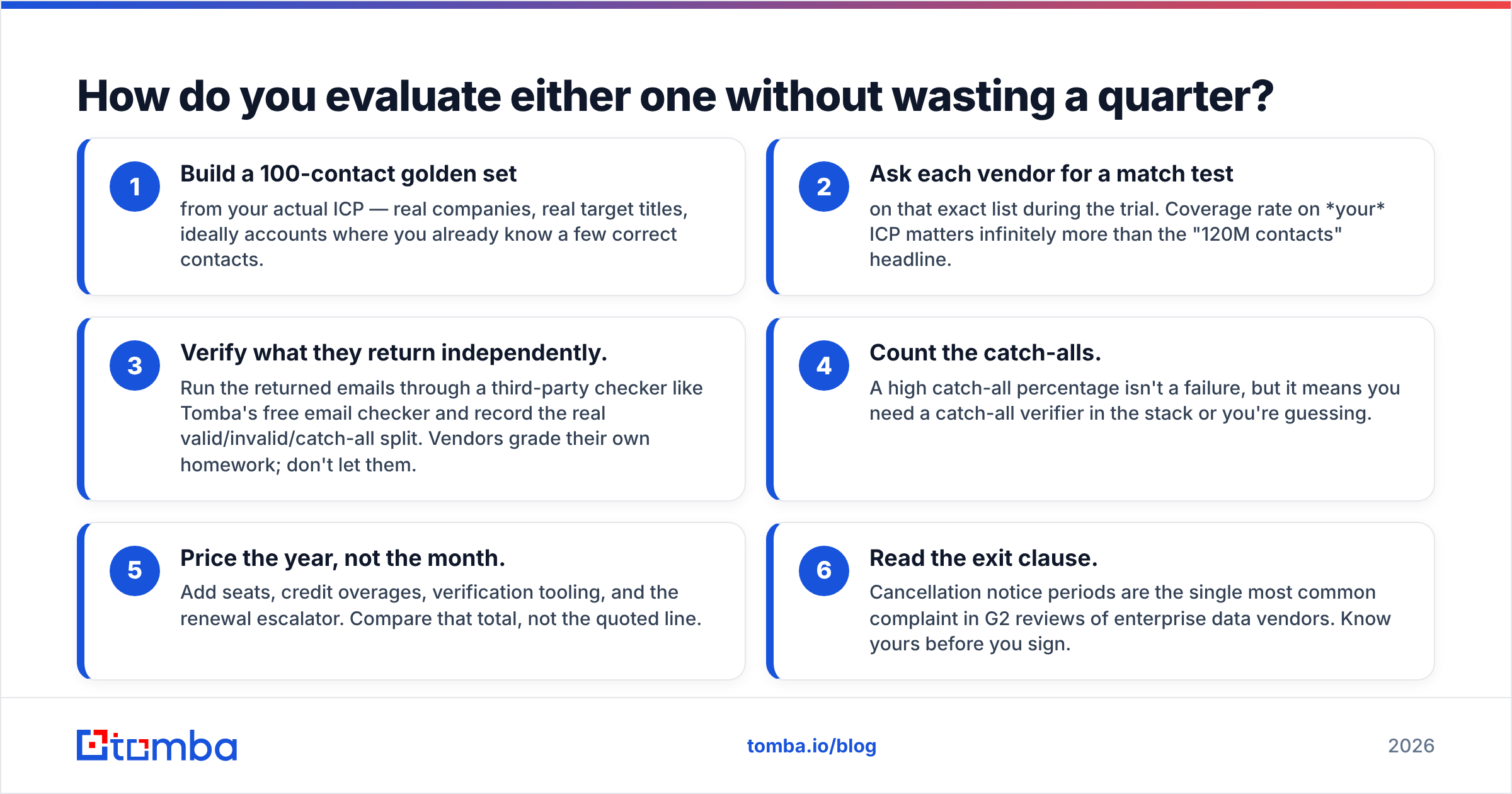
Run the same test on both. Do not let a demo decide for you.
- Build a 100-contact golden set from your real ICP. Use real companies and real target titles.
- Ask each vendor for a match test on that exact list during the trial. Coverage on your ICP beats any "120M contacts" headline.
- Verify the results yourself. Run them through a checker like Tomba's free email checker. Record the valid, invalid, and catch-all split. Vendors grade their own homework.
- Count the catch-alls. A high share is not a failure. It does mean you need a catch-all verifier in the stack.
- Price the year, not the month. Add seats, credit overages, verification tools, and the renewal bump. Compare the totals.
- Read the exit clause. Notice periods are the top complaint in G2 reviews of enterprise data vendors.
Teams that run this test honestly find the same thing. They need about 15% of what the enterprise tier offers. And they need that 15% to be right today, not right last November.
The DiscoverOrg vs ReachStream verdict#
DiscoverOrg (ZoomInfo) wins for enterprise ABM teams with a real budget. You get org charts and intent data, plus enough seats to make per-seat pricing rational. It is the most complete B2B data product on the market, and the price says so.
ReachStream wins when you need a cheap list today for a defined campaign. You have to verify it yourself. You should not build a system of record on it.
Neither wins for a small or mid-size outbound team that mostly needs accurate emails for people it has already found. That is a different job. Paying enterprise prices for it — or living with bulk-list bounce rates — is the most common overspend in this category.
Start with one question. Is your bottleneck discovery or contactability? DiscoverOrg solves discovery at a premium. ReachStream half-solves contactability at a discount. Most teams have a contactability problem and buy a discovery product.
Get the contact data right before you scale the spend. If your real problem is finding and verifying work emails, start with the Tomba Email Finder. Search by domain, name, or company. Every result comes with a confidence score and public sources.
The free tier gives you 25 searches a month with no card. Starter runs $49/mo — about what one seat of enterprise data costs per day. Run your golden-set test on it before you sign anyone's annual contract.
Related guides#
Ready to find emails that actually work?
Join 150,000+ professionals who stopped guessing and started sending. Free credits on signup — no credit card required.
Get the Tomba newsletter
Practical outbound tactics and product updates — once every two weeks.
About the author