DiscoverOrg vs SphereScout: Honest 2026 Data Comparison
DiscoverOrg no longer exists as a standalone product, and SphereScout is a low-profile niche vendor. Here is what that actually means for your 2026 data budget, and what to buy instead.
DiscoverOrg vs SphereScout is a strange matchup. One brand no longer exists. The other publishes almost nothing you can check. Here is what is left to compare, and what to buy instead.
TL;DR
- DiscoverOrg is not a product you can buy in 2026. It merged with ZoomInfo in 2019, and the brand was folded into the ZoomInfo platform.
- SphereScout is the opposite case. It is a small data vendor with thin docs, no public pricing, and few reviews. That is not disqualifying, but the burden of proof sits with you.
- So DiscoverOrg vs SphereScout really means enterprise contract data versus unverified niche data. Under 50 reps, neither is your first buy.
- Enterprise suites usually start near $15,000–$30,000 a year, with seat minimums. A dedicated email finder like Tomba starts at $49/mo with a free tier.
- Test any vendor on 200 contacts you can check yourself. Do that before you sign anything longer than a month.
Is DiscoverOrg still a real product in 2026?#
No. DiscoverOrg merged with ZoomInfo in February 2019. It kept its own name for a while. Then everything moved under the ZoomInfo brand, ahead of the 2020 IPO.
The ZoomInfo company history confirms the deal. The DiscoverOrg domain now points at ZoomInfo pages.
This matters more than it sounds. When you search "DiscoverOrg vs SphereScout," you are usually comparing two things:
- A memory of a product. DiscoverOrg sold human-verified org charts for IT, marketing, finance and HR teams. A research team refreshed them on a schedule, instead of scraping at scale. In 2015, that was a real difference.
- What ZoomInfo sells today. Intent data, technographics, a Chrome extension, conversation intelligence, workflow automation, visitor identification, and a very large contact database. Different product. Different price. Different contract.
So when a rep says they "use DiscoverOrg," they mean a ZoomInfo seat. Price and terms follow the ZoomInfo model: annual commitments, per-seat licences, credit pools that expire, and add-on modules that stack.
What is SphereScout, and why is public information so thin?#
SphereScout shows up in prospecting-tool roundups as a B2B contact and company data provider. That is the same broad category as ZoomInfo, Apollo, Lusha and Cognism. Beyond that, there is not much you can verify.
Here is what "thin public information" means in practice:
- No published pricing. You cannot work out cost per verified contact before a sales call.
- Few third-party reviews. G2 and Capterra are imperfect. Still, a handful of reviews gives you anecdotes, not a spread of outcomes.
- No public accuracy method. Serious vendors publish how they source data, how often they re-check it, and what the bounce guarantee covers. Without that, "95% accurate" is a marketing number.
- No public compliance posture. For EU or UK prospecting, you need the lawful basis, the opt-out path, and the storage location.
- Unclear API. No documented API means no rate limits and no response schemas. You cannot build it into your workflow.
None of that proves SphereScout is bad. Small vendors are often cheaper and more responsive. They can also beat the giants inside one country or one vertical.
It does mean you should treat every claim as unproven until you test it. And it means you should not sign an annual deal on the strength of a demo.
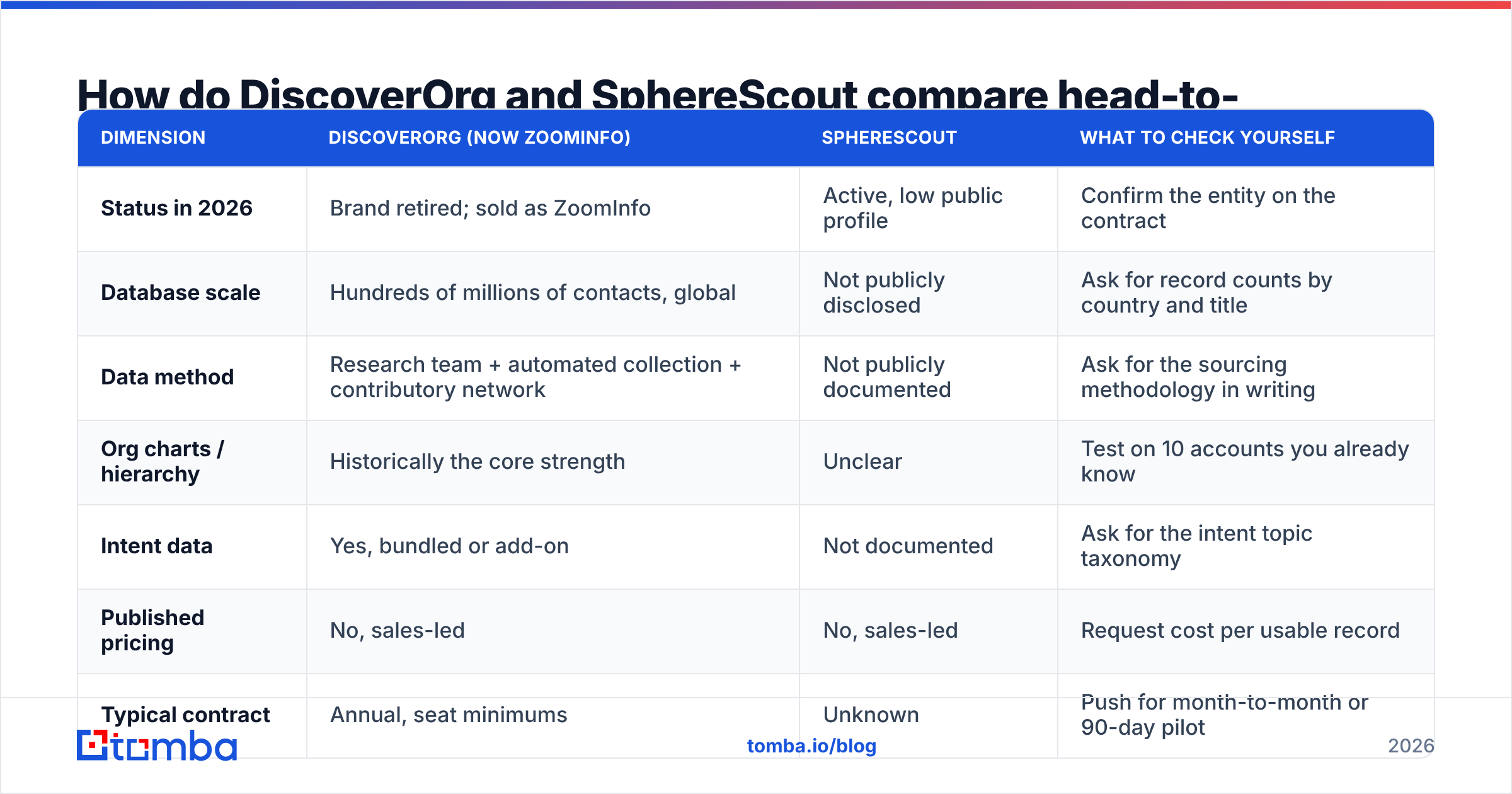
DiscoverOrg vs SphereScout: head-to-head comparison#
| Dimension | DiscoverOrg (now ZoomInfo) | SphereScout | What to check yourself |
|---|---|---|---|
| Status in 2026 | Brand retired; sold as ZoomInfo | Active, low public profile | Confirm the entity on the contract |
| Database scale | Hundreds of millions of contacts, global | Not publicly disclosed | Ask for record counts by country and title |
| Data method | Research team + automated collection + contributory network | Not publicly documented | Ask for the sourcing method in writing |
| Org charts / hierarchy | Historically the core strength | Unclear | Test on 10 accounts you already know |
| Intent data | Yes, bundled or add-on | Not documented | Ask for the intent topic list |
| Published pricing | No, sales-led | No, sales-led | Request cost per usable record |
| Typical contract | Annual, seat minimums | Unknown | Push for month-to-month or a 90-day pilot |
| Free trial | Limited, sales-gated | Unknown | Insist on a sample file before payment |
| API access | Yes, tiered | Not documented | Ask for docs before signing |
| Best fit | Enterprise SDR orgs with budget | Unknown until tested | Run a 200-contact bake-off |
The honest verdict: this is not a fair fight. One side is a mature platform with a known cost structure. The other is a vendor you cannot judge from the outside.
It is also not the fight you should be having. The better question is simple. What job am I hiring a data tool to do, and what is the cheapest reliable way to do it?
Which one has better data accuracy?#
Marketing pages will not settle DiscoverOrg vs SphereScout on accuracy. A test will.
Take 200 target contacts you can verify yourself. Use customers, past prospects, or people whose email format you know from an inbound reply. Run the same list through every vendor. Then measure four numbers:
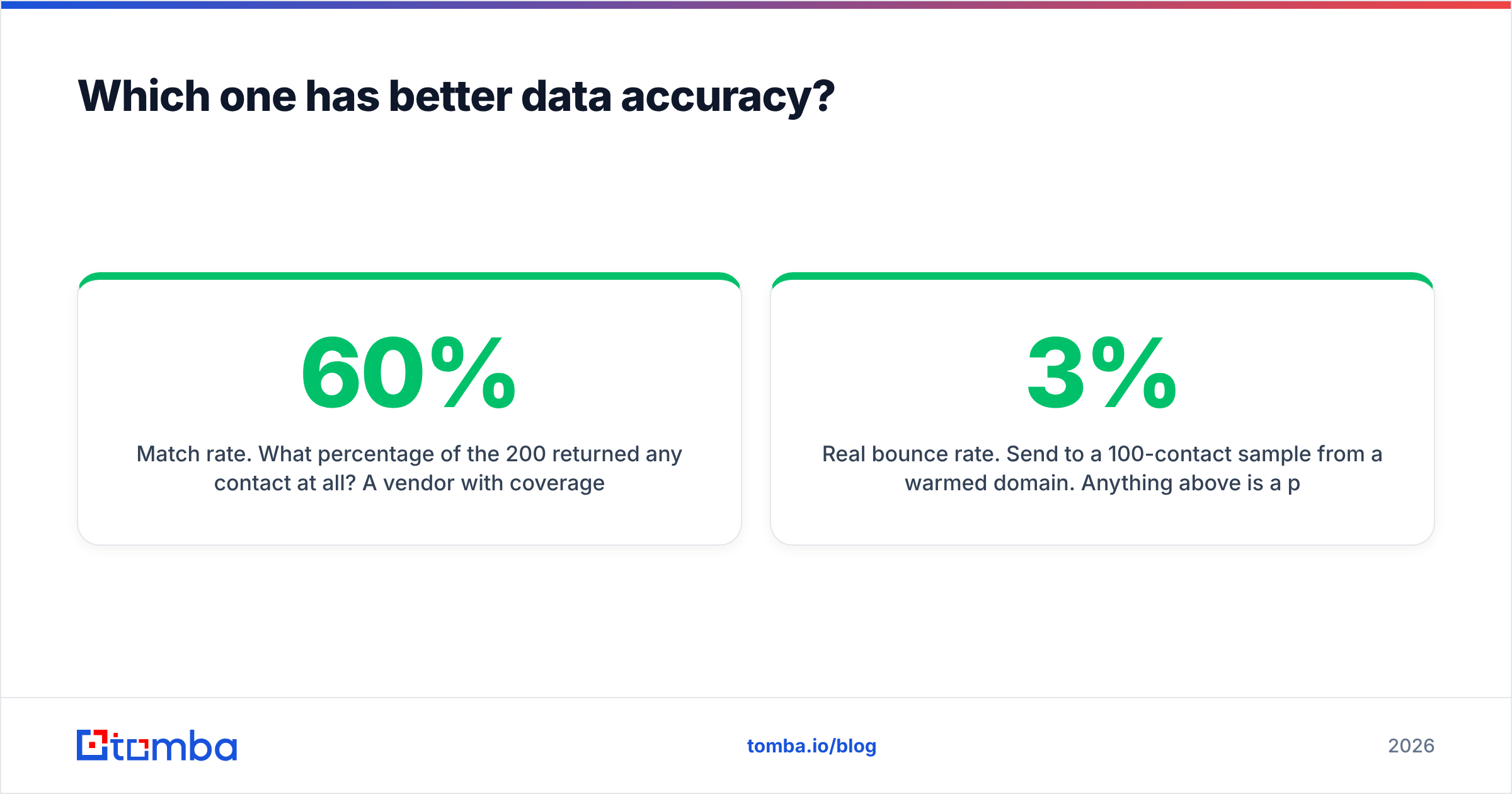
- Match rate. How many of the 200 returned any contact at all? A vendor with 60% coverage and perfect data may still lose to one with 90% coverage and a few errors.
- Verified deliverable rate. How many matches pass an outside email verifier? Never let a vendor grade its own homework.
- Real bounce rate. Send to a 100-contact sample from a warmed domain. Above 3% is a problem. Above 5% and you are hurting your sender reputation.
- Role and title drift. How many people have moved jobs or changed titles? This is the quiet campaign killer, because the address still delivers.
Big suites in the ZoomInfo lineage tend to win on match rate. They lose on freshness in fast-moving segments, because scale and recency pull against each other.
Small vendors run the other way. Coverage is narrower, but the data can be fresher inside their niche. Catch-all domains skew every result, so run a catch-all verifier first.
One more trap: a "valid" email is not always a reachable one. Roughly a third of B2B addresses sit behind catch-all servers that accept everything. If a vendor counts those as verified, its accuracy number is inflated by design.
What do these tools actually cost?#
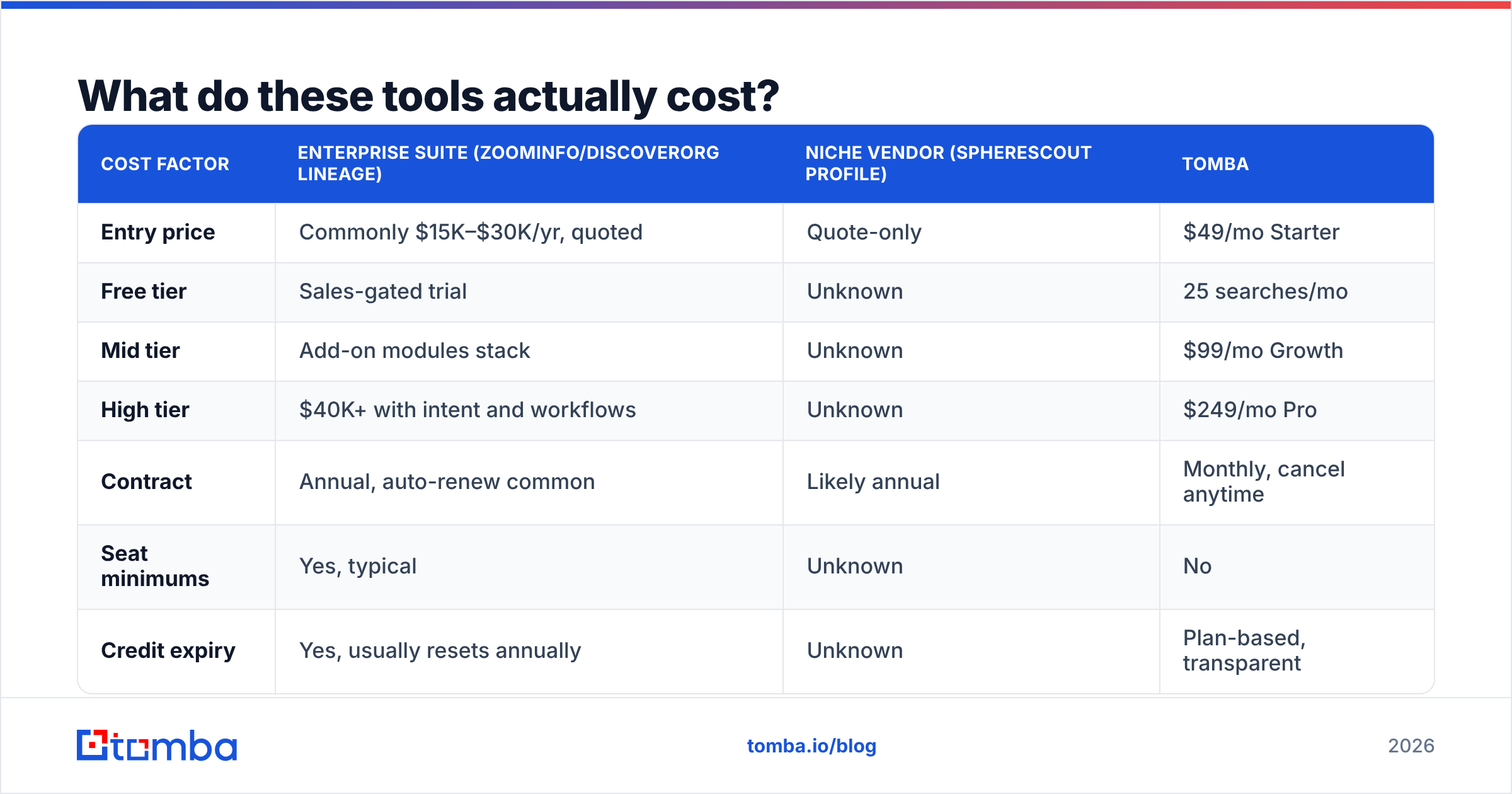
Neither vendor publishes pricing. That is itself an answer. Sales-led pricing means the number is set by what your company looks like, not by what you use.
| Cost factor | Enterprise suite (ZoomInfo/DiscoverOrg lineage) | Niche vendor (SphereScout profile) | Tomba |
|---|---|---|---|
| Entry price | Commonly $15K–$30K/yr, quoted | Quote-only | $49/mo Starter |
| Free tier | Sales-gated trial | Unknown | 25 searches/mo |
| Mid tier | Add-on modules stack | Unknown | $99/mo Growth |
| High tier | $40K+ with intent and workflows | Unknown | $249/mo Pro |
| Contract | Annual, auto-renew common | Likely annual | Monthly, cancel anytime |
| Seat minimums | Yes, typical | Unknown | No |
| Credit expiry | Yes, usually resets annually | Unknown | Plan-based, transparent |
| API included | Higher tiers / add-on | Undocumented | Yes, all paid plans |
Published figures for enterprise data contracts vary a lot, and every deal is negotiated. Treat the range above as directional, not a quote.
One part is not directional. You will be asked for an annual commitment. The renewal will cost more than year one unless you cap it up front. Analyst coverage from Gartner and peer-review sites helps you benchmark what other buyers paid.
Now compare that with transparent Tomba pricing. Starter is $49/mo, with no seat minimum and no annual lock. In a DiscoverOrg vs SphereScout budget review, the real question is not which database is bigger. It is how much you pay for coverage you never use.
Which type of tool fits your team?#
Pick based on your sales motion, not on brand recognition.
- Under 10 reps, outbound-led. You need accurate emails and phone numbers for one ICP, not intent scoring. An email finder plus a verifier covers 90% of the job at 5% of the cost.
- 10–50 reps, multi-segment. You need enrichment at volume and CRM sync. Look for a mid-market provider with an API and per-record pricing. Bulk lead generation matters more than the UI.
- 50+ reps with an ABM program. Intent data and org charts start to pay for themselves. This is where the ZoomInfo lineage earns its price, if you have RevOps capacity to use it.
- Regional or vertical focus. A niche vendor, or a curated list provider such as BookYourData, can beat the giants in a narrow segment. Check coverage in your exact geography first.
- Developer-led or product-led GTM. You want an email finder API and clean docs, not a seat-based platform. Seats are the wrong unit for automated work.
How should you run the DiscoverOrg vs SphereScout evaluation?#
Give yourself two weeks. Follow a fixed protocol so vendors cannot steer the test.
- Define the ICP list first. Name 200 accounts before any demo. Otherwise vendors show you the segments where they are strongest.
- Ask for a sample file, not a demo. Request raw output on your list. If a vendor refuses, that is your answer.
- Verify independently. Run every returned address through a neutral verifier. Record catch-all status separately.
- Test the phone data too. Mobile numbers are where accuracy claims break first. Spot-check 50 with a phone validator.
- Price per usable record. Divide total annual cost by the contacts that passed verification. That one number usually reorders the shortlist.
- Read the renewal clause. Auto-renew windows of 60–90 days are common, and they are the most expensive line in the contract.
What are the alternatives if neither fits?#
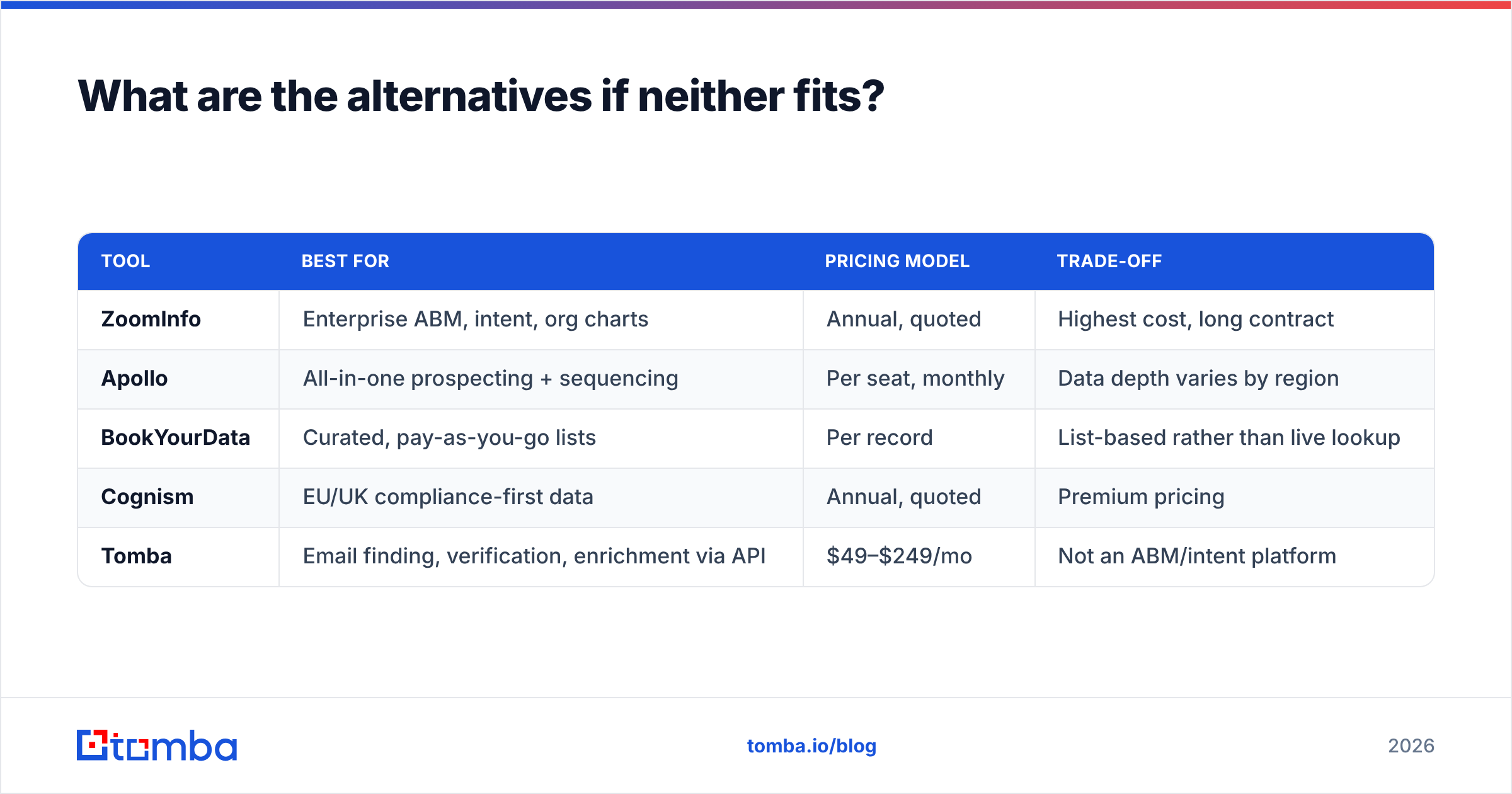
Most teams searching "DiscoverOrg vs SphereScout" end up buying neither. Here is the realistic shortlist:
| Tool | Best for | Pricing model | Trade-off |
|---|---|---|---|
| ZoomInfo | Enterprise ABM, intent, org charts | Annual, quoted | Highest cost, long contract |
| Apollo | All-in-one prospecting + sequencing | Per seat, monthly | Data depth varies by region |
| BookYourData | Curated, pay-as-you-go lists | Per record | List-based rather than live lookup |
| Cognism | EU/UK compliance-first data | Annual, quoted | Premium pricing |
| Tomba | Email finding, verification, enrichment via API | $49–$249/mo | Not an ABM/intent platform |
If your problem is "I know who to contact but not how to reach them," a focused finder beats a suite every time.
If your problem is "I do not know which accounts to work," intent and org-chart data earn their keep. That is the one place the DiscoverOrg heritage still shows up inside ZoomInfo. Teams leaving a suite often start with an Apollo alternative comparison, to see how much of the platform they really used.
The bottom line#
DiscoverOrg vs SphereScout pits a brand that no longer exists against a vendor you cannot judge without a test. Neither is a safe default purchase.
Define the job. Run a 200-contact bake-off. Price per usable record. Refuse any annual deal before you have bounce data from your own domain.
If the job is finding and verifying work emails at a predictable cost, start with the Tomba Email Finder. The free tier gives you 25 searches a month, which is enough to run your own accuracy test. Paid plans start at $49/mo with no seat minimums, and every plan includes API access. Test it against the quote you are holding. The cost per verified contact will tell you what the demo did not.
Related guides#
Ready to find emails that actually work?
Join 150,000+ professionals who stopped guessing and started sending. Free credits on signup — no credit card required.
Get the Tomba newsletter
Practical outbound tactics and product updates — once every two weeks.
About the author