DiscoverOrg vs Techsalerator: B2B Data Comparison 2026
DiscoverOrg (now folded into ZoomInfo) sells a platform. Techsalerator sells datasets. They compete on the same buyer but almost never on the same budget — here's how the two actually stack up in 2026.
DiscoverOrg vs Techsalerator is an odd match-up. One is a full sales platform. The other is a raw data supplier. This guide compares DiscoverOrg vs Techsalerator on price, data quality, and fit — and names a cheaper third option for teams that only need verified emails.
TL;DR
- DiscoverOrg no longer exists on its own. ZoomInfo bought it in 2019 and folded the brand into the ZoomInfo GTM platform. If a rep pitches you "DiscoverOrg," you are buying ZoomInfo.
- Techsalerator sells data, not software. You buy a dataset by country, industry, or company size. It arrives as a file or an API feed. No sequences, no intent scoring, no Chrome extension.
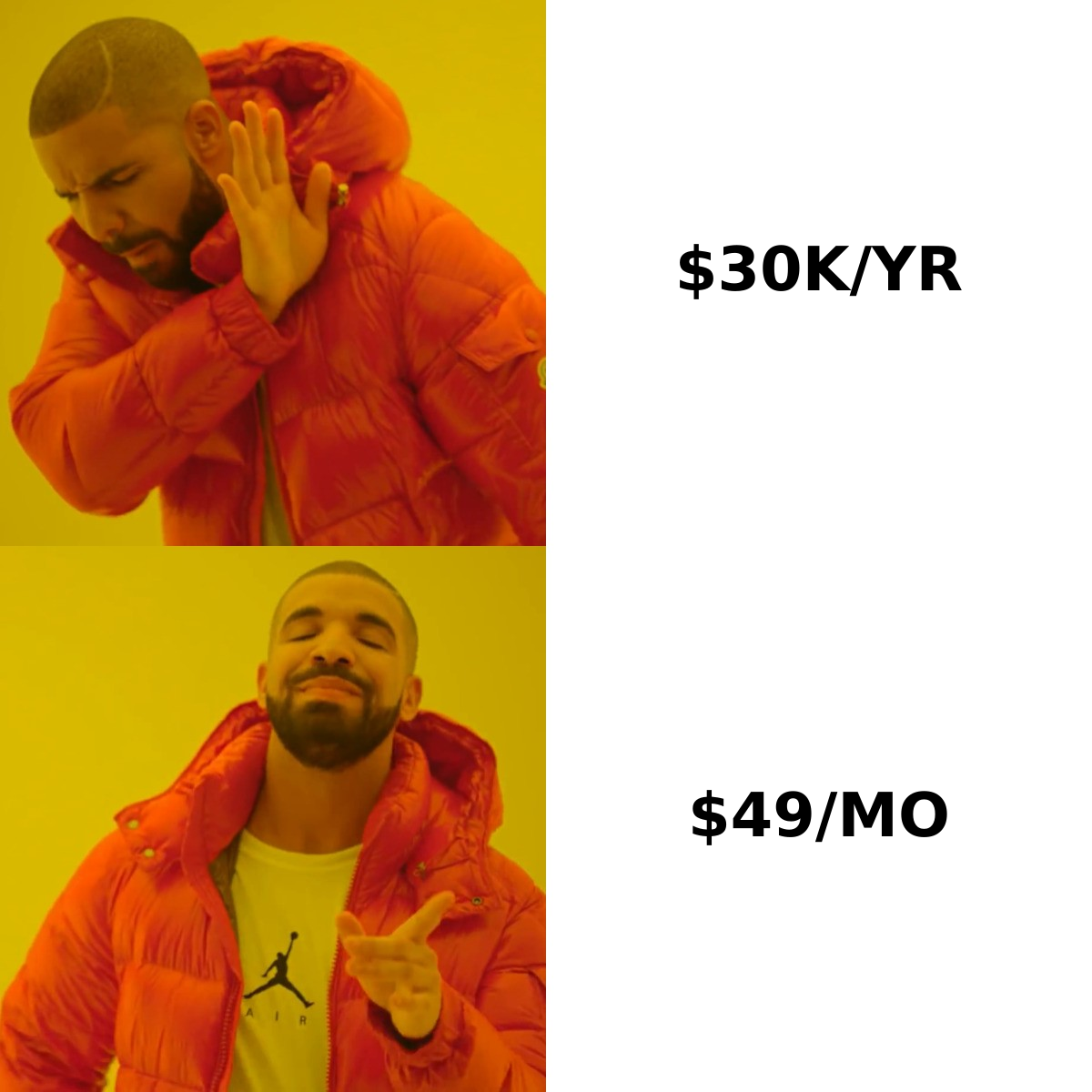
- The price gap is the headline. ZoomInfo deals commonly land between $15,000 and $40,000 a year, with seat minimums and annual lock-in. Techsalerator quotes per dataset, and a one-time pull usually costs far less.
- Neither fits if you just need verified work emails. A dedicated email finder at $49/mo covers that job. No procurement cycle required.
- Our pick: DiscoverOrg/ZoomInfo for intent data and CRM-native workflows on a team of 10 or more. Techsalerator for bulk records in one region or vertical. Tomba if you need accurate contact data and nothing else.
What is DiscoverOrg in 2026?#
DiscoverOrg was a human-verified B2B contact and org-chart database, founded in 2007. Its edge was researcher-verified data. Real people called companies to confirm titles, direct dials, and reporting lines. IT and finance departments got the deepest coverage.
In February 2019, DiscoverOrg acquired ZoomInfo. It then retired its own name and kept ZoomInfo's. The DiscoverOrg dataset still lives inside what ZoomInfo sells today as its GTM platform. The org-chart depth and the tech-stack layer came with it.
That matters for your evaluation in three concrete ways:
- You cannot buy "DiscoverOrg" alone. Any quote you get is a ZoomInfo Copilot, Sales, or Operations bundle. The legacy dataset is a component, not a product you can order.
- Pricing is platform pricing. You pay for intent signals, workflow automation, and CRM enrichment. That holds whether or not you use them.
- The org-chart depth survived the merger. Need to map a 400-person IT department? This is still the deepest commercial dataset on sale.
What is Techsalerator?#
Techsalerator sells data, full stop. It is a data-as-a-service (DaaS) provider. The catalog covers B2B firmographic files, B2C consumer records, mobile-device data, and geospatial sets. It spans a long list of countries, including markets where the big US platforms are thin: Southeast Asia, Africa, and the Gulf.
Delivery works nothing like a SaaS platform:
- You scope a dataset — say, manufacturing companies in Vietnam with 50 to 500 staff — and get a count and a quote.
- You receive a file (CSV or JSON) or an API endpoint. You do not get a login to a prospecting app.
- You own the records you buy, within the license terms. No credit meter ticks down while you work.
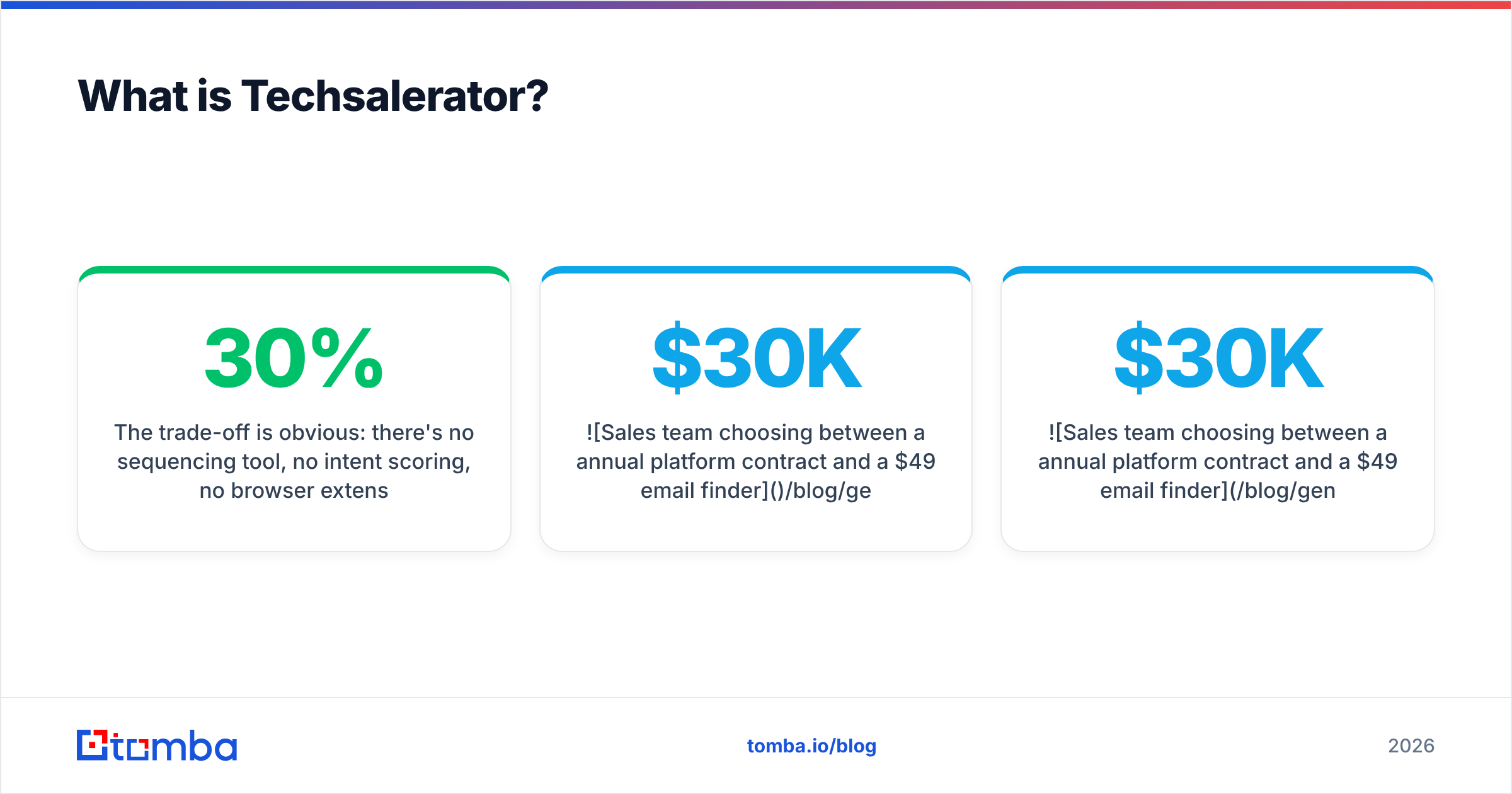
The trade-off is clear. There is no sequencing tool, no intent scoring, no browser extension, and no live verification. You get whatever the file's accuracy was on delivery day. And B2B contact data decays fast: roughly 25% to 30% a year, as people change jobs.
DiscoverOrg vs Techsalerator: how do they compare head-to-head?#
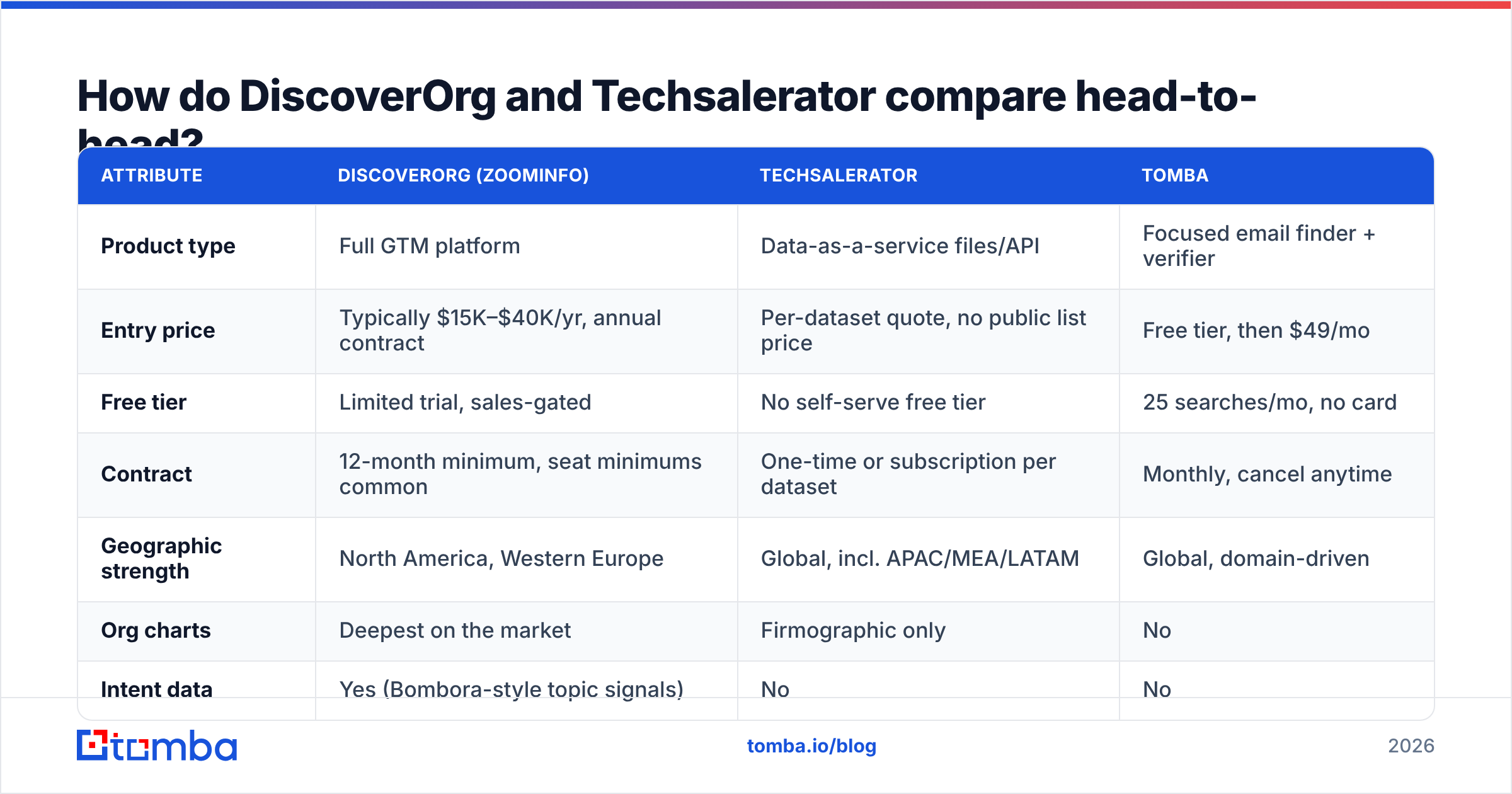
| Attribute | DiscoverOrg (ZoomInfo) | Techsalerator | Tomba |
|---|---|---|---|
| Product type | Full GTM platform | Data-as-a-service files/API | Focused email finder + verifier |
| Entry price | Typically $15K–$40K/yr, annual contract | Per-dataset quote, no public list price | Free tier, then $49/mo |
| Free tier | Limited trial, sales-gated | No self-serve free tier | 25 searches/mo, no card |
| Contract | 12-month minimum, seat minimums common | One-time or subscription per dataset | Monthly, cancel anytime |
| Geographic strength | North America, Western Europe | Global, incl. APAC/MEA/LATAM | Global, domain-driven |
| Org charts | Deepest on the market | Firmographic only | No |
| Intent data | Yes (Bombora-style topic signals) | No | No |
| Real-time verification | Yes, platform-side | No, point-in-time file | Yes, SMTP + catch-all handling |
| Direct dials | Extensive | Varies by dataset | Phone finder available |
| CRM sync | Native Salesforce, HubSpot, Dynamics | Manual import or custom pipeline | Native + Zapier/Make |
| Best for | Enterprise SDR teams, ABM programs | Bulk records for a specific market | Targeted outbound, dev workflows |
The table tells the whole story. You are comparing a workflow product to a raw material supplier. Asking which one is better is like asking whether a restaurant beats a wholesale grocer. It depends on whether you want to cook.
DiscoverOrg vs Techsalerator: which one has better data accuracy?#
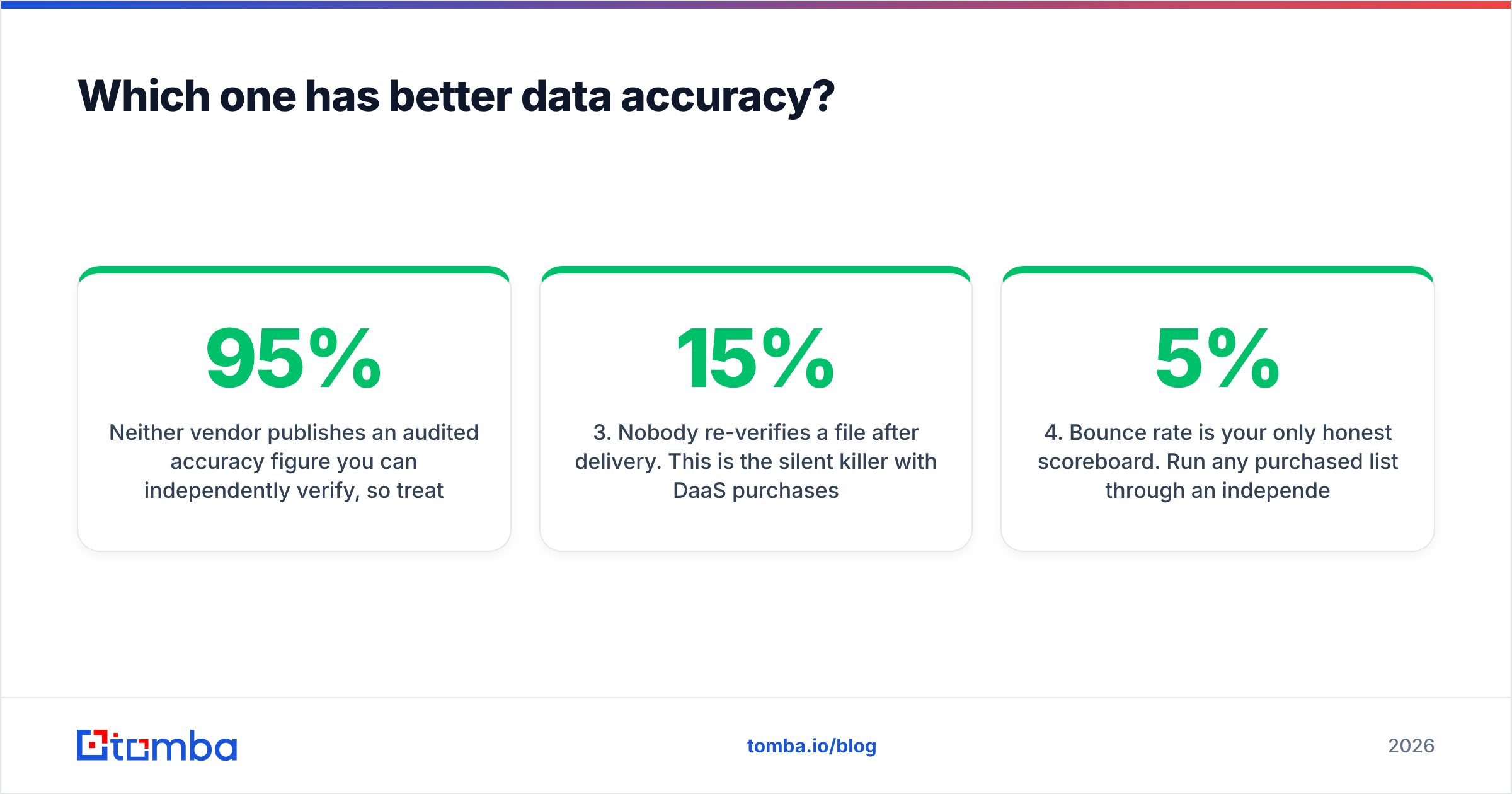
Neither vendor publishes an audited accuracy figure you can check. So treat every self-reported number with care. That includes the 95%-plus claims on nearly every vendor site in this category.
What you can judge is method. Method predicts accuracy far better than a marketing stat.
- DiscoverOrg's old edge was human verification. Researchers phoned companies to confirm records. After the merger, the mix shifted toward automated collection plus contributed data from ZoomInfo's free-tier users. Coverage went up. The share of human-checked records went down.
- Techsalerator aggregates from partner sources. Quality varies by dataset. A US firmographic file and a Nigerian mobile-data file are not built the same way. Ask for a sample before you commit.
Two more points apply to both vendors:
- Nobody re-verifies a file after delivery. This is the quiet killer with DaaS purchases. Buy 50,000 records in January, mail them in June, and 12% to 15% are already stale.
- Bounce rate is your only honest scoreboard. Run any purchased list through an independent email verifier before your first send. If a "verified" file bounces above 5%, you overpaid.
So treat purchased data as input, not truth. Verify at send time, not at purchase time.
What does DiscoverOrg actually cost?#
Cost is where the DiscoverOrg vs Techsalerator gap gets widest. ZoomInfo does not publish pricing. Reviews on G2 and public procurement records point to this shape in 2026:
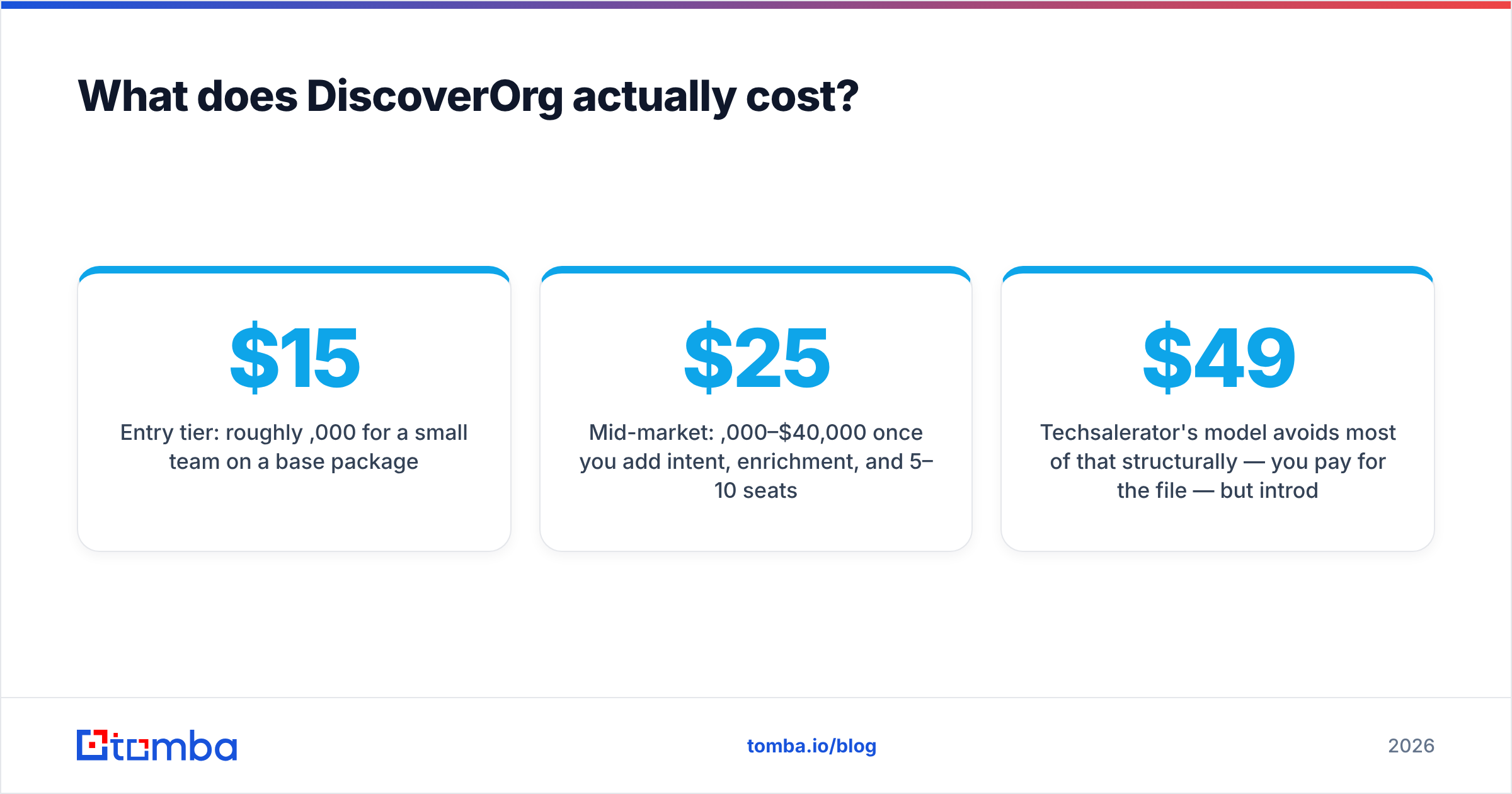
- Entry tier: about $15,000 a year for a small team on a base package
- Mid-market: $25,000 to $40,000 a year once you add intent, enrichment, and 5 to 10 seats
- Enterprise: six figures with Copilot, workflow automation, and API volume
- Structure: annual prepay, export credit caps, per-seat licensing, and auto-renewal clauses that are hard to exit
The headline number is not what surprises buyers. The extras do. Export credit limits let you see records you cannot download. Seat minimums make you buy five licenses for three reps. Then the renewal price climbs.

Techsalerator's model avoids most of that. You pay for the file. But it adds friction of its own. There is no self-serve checkout. Quotes come through a sales conversation. And you cannot sample first, then scale, the way a credit-based tool lets you.
Want transparent per-seat math instead? Published Tomba pricing sits at the other end of the spectrum: $49/mo Starter, $99/mo Growth, $249/mo Pro, all listed in public.
Who should choose DiscoverOrg (ZoomInfo)?#
Pick the platform when the workflow is the product:
- You run ABM at scale. Intent topics, org charts, and CRM enrichment in one system can save an ops team weeks per quarter.
- You need direct dials for enterprise IT buyers. This is still DiscoverOrg's strongest legacy asset.
- You have 10 or more reps. Per-seat cost only makes sense when a lot of people log in daily.
- Procurement exists and is fine. If a $30K line item needs three approvals and two months, the tool has to earn that wait.
Skip it if your team is under ten people. Skip it if your ICP sits outside North America and Western Europe. And skip it if the honest use case is "I need 2,000 emails this quarter."
Who should choose Techsalerator?#
Pick the dataset vendor when coverage in a specific market is the constraint:
- You prospect in a region the big platforms neglect. Country breadth is Techsalerator's real differentiator.
- You want to own records permanently instead of renting access under a credit cap.
- You have engineering capacity. Someone has to load, dedupe, verify, and route the file. Budget real hours: a raw dataset is an ETL project, not a login.
- You need consumer or geospatial data next to B2B firmographics. Few sales-data vendors cover both.
Skip it if you need real-time lookups. Skip it if you want a Chrome extension for one-off research. And skip it if nobody on your team wants to clean a 200,000-row CSV.
Is there a lighter alternative to both?#
Yes. For most teams under 50 people, it is the honest answer. Ask one question before you sign anything: what job is the data actually doing?
Say the answer is "we need to reach 500 specific people at 200 specific companies this quarter." Then you do not need intent signals or a 300-million-record file. You need accurate contact details on demand.
Options in that lighter tier:
- Tomba — a domain-driven email finder with a verifier, domain search, and a developer-first API. Free tier at 25 searches/mo, Starter at $49/mo. Best when your target list is already defined.
- BookYourData — pay-as-you-go B2B contact lists with a strong self-serve flow and no annual commitment. A good middle ground when you want records now.
- Apollo — a database plus sequencing. Cheaper than ZoomInfo, but data quality is more variable. See our Apollo alternative breakdown.
- Clearbit-style enrichment — already have the accounts and just need firmographic fill-in? Data enrichment on your CRM records costs far less than buying a new database.
Here is the stack that works for most sub-50-person teams. Build a defined ICP list from LinkedIn or a niche source. Use a finder to resolve contacts. Verify before every send. Then sequence.
Total cost: a few hundred dollars a month, not a five-figure contract.
What should you ask before signing either contract?#
Every DiscoverOrg vs Techsalerator shortlist should end with the same questions. Run them on any B2B data vendor:
- Can I see a 100-record sample from my exact ICP filter? Not a curated demo list. Your filter, your geography. Bounce-test it yourself.
- How often are records refreshed, in days? "Continuously" is not an answer.
- What happens to exported records if I churn? Platforms often claw back usage rights. DaaS purchases usually do not.
- Are there export credit caps separate from seat count? This is the most common source of buyer regret on platform contracts.
- What is the renewal uplift cap? Get it in writing at signature, not at renewal.
- Is GDPR/CCPA compliance documented per source? This matters most for multi-country DaaS files. The ICO's guidance on legitimate interest is the baseline for EU prospecting.
So which one wins?#
Neither wins outright. They serve different buyers. DiscoverOrg/ZoomInfo wins on org-chart depth, intent data, and CRM-native workflow, and it costs accordingly. Techsalerator wins on geographic breadth and record ownership, and it demands technical work you have to staff.
For most teams, though, the real question is not DiscoverOrg vs Techsalerator. It is this: do I need a data platform at all, or do I need accurate contact details? Most teams that start with the first question find the second one was the real problem. And it costs two orders of magnitude less to solve.
Is your bottleneck finding verified work emails for a list you already built? Start with the Tomba Email Finder. Search by domain, name, or company. Verify every result before it hits your sequencer. Then check B2B database coverage for your target market. The free tier gives you 25 searches a month with no card. That is enough to bounce-test Tomba against the quote sitting in your inbox, before you commit to twelve months of anything.
Related guides#
Ready to find emails that actually work?
Join 150,000+ professionals who stopped guessing and started sending. Free credits on signup — no credit card required.
Get the Tomba newsletter
Practical outbound tactics and product updates — once every two weeks.
About the author