DiscoverOrg vs The Org: B2B Contact Data Compared 2026
DiscoverOrg (now ZoomInfo) and The Org solve two different problems that look identical on a slide. One sells verified contact records at enterprise prices; the other maps who reports to whom, for free.
DiscoverOrg vs The Org in one line: one sells verified contact data, the other maps org charts for free.
TL;DR
- DiscoverOrg is gone as a standalone product. It merged with ZoomInfo in 2019, and the brand was absorbed. When people say "DiscoverOrg," they mean ZoomInfo's enterprise contact database. Expect annual deals of $15,000–$40,000+.
- The Org is not a data vendor. It is a free public directory of org charts. Companies report most of it themselves. You get structure and titles, not verified work emails.
- They barely compete. ZoomInfo answers "what is this VP's email and direct dial?" The Org answers "who does this VP report to?"
- The Org has no export and no outbound API. Coverage below the Fortune 5000 is thin. DiscoverOrg has deep data, but it sits behind a seat minimum and a sales call.
- Your real job is usually simpler. You need a name and a company turned into a working email. Neither tool is the cheap path there. A per-lookup email finder is.
What is DiscoverOrg, and does it still exist in 2026?#
DiscoverOrg was a B2B contact and org-chart database founded in 2007. It was known for human-checked data on IT, marketing, finance, and HR teams. Analysts called people to confirm records instead of scraping them. The database also held org charts, tech installs, and project triggers.
In February 2019, DiscoverOrg bought ZoomInfo and took its name. By 2021 the DiscoverOrg product line was retired. Visit discoverorg.com today and you land on zoominfo.com.
So any 2026 DiscoverOrg vs The Org comparison is really a ZoomInfo comparison. The old DiscoverOrg DNA still shows, though. The platform remains strongest on deep hierarchy data for mid-market and enterprise accounts.
What you get today under that umbrella:
- Contact records — name, title, verified business email, direct dial, mobile (on higher tiers), and LinkedIn URL.
- Company records — firmographics, revenue estimates, headcount, funding, and tech stack.
- Org charts — reporting lines built from verified records. Best in IT and sales teams above ~200 staff.
- Intent data — topic surges plus ZoomInfo's own WebSights visitor tracking.
- Engage / Copilot — sequencing and AI outreach layered on the data.
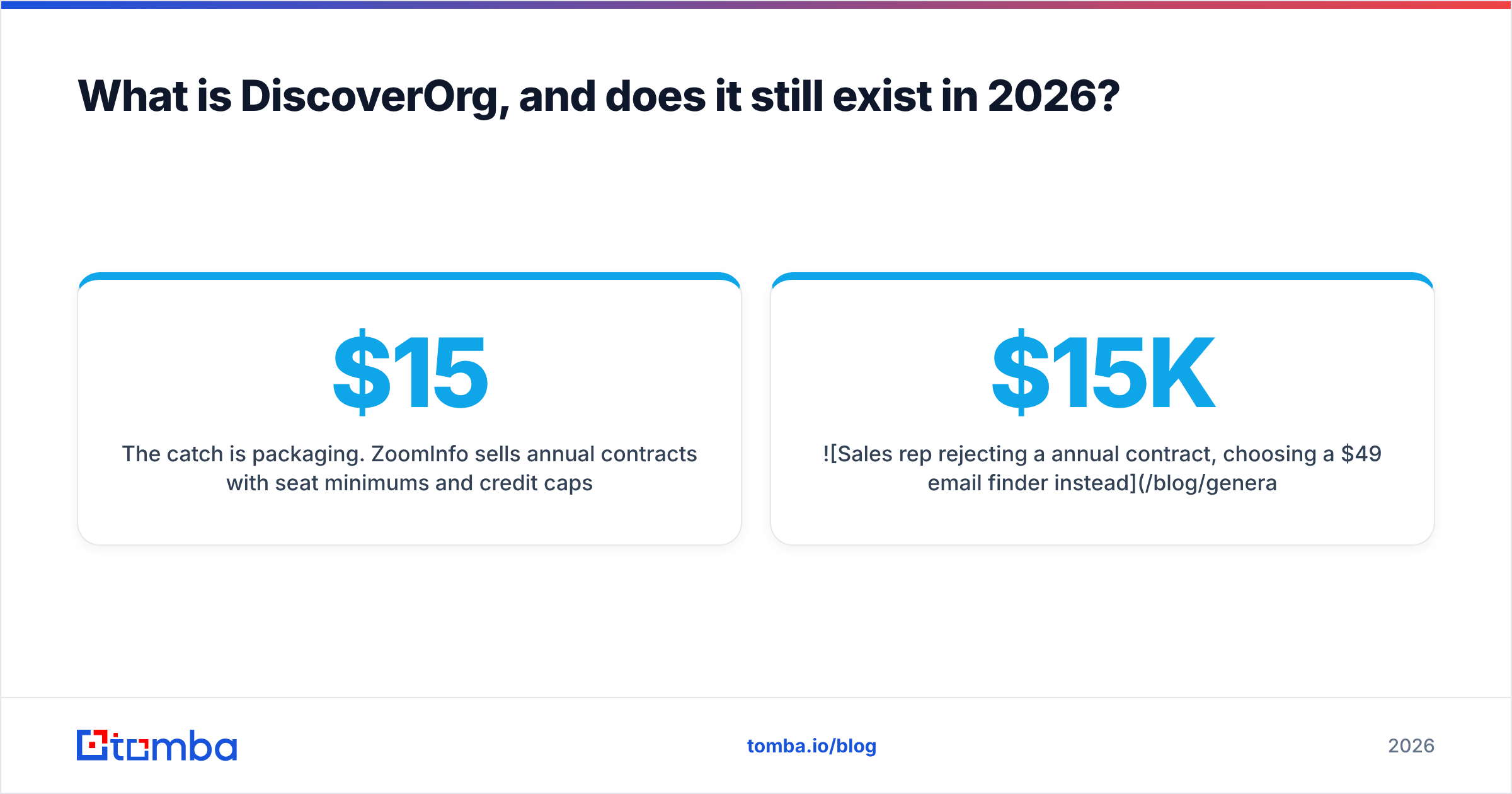
The catch is packaging. ZoomInfo sells annual contracts with seat minimums and credit caps. G2 reviews and buyer reports put entry pricing near $15,000 a year for a small team. Add intent, Engage, or export volume and it climbs fast. There is no real self-serve tier.
What is The Org, and what problem does it solve?#
The Org (theorg.com) is a free, public directory of company org charts. It launched in 2017 with backing from Sequoia and Founders Fund. Companies publish their own structure there: leaders, department heads, and reporting lines. It doubles as a recruiting page. Anyone can browse it without an account.
The value is shape, not contacts. Say you want to know if the Head of Growth reports to Marketing or Product. The Org can answer that in ten seconds, and it costs nothing. No paid tool beats that price.
The limits are just as clear:
- Self-reported and uneven. A company that wants recruiting traffic keeps a rich profile. One that does not may show three stale entries from 2022, or nothing at all.
- No verified emails. Profiles link to LinkedIn and sometimes a public bio. There is no work-email field to export and send to.
- No bulk export or outbound API. You cannot build a list of 500 VPs of Engineering and push it into your CRM.
- Coverage skews to tech and startups. It is strong for venture-backed software firms. It is thin for manufacturing, healthcare systems, regional services, and most of the mid-market.
Treat The Org like a company's own "Leadership" page. It is a free research input, not a data source.
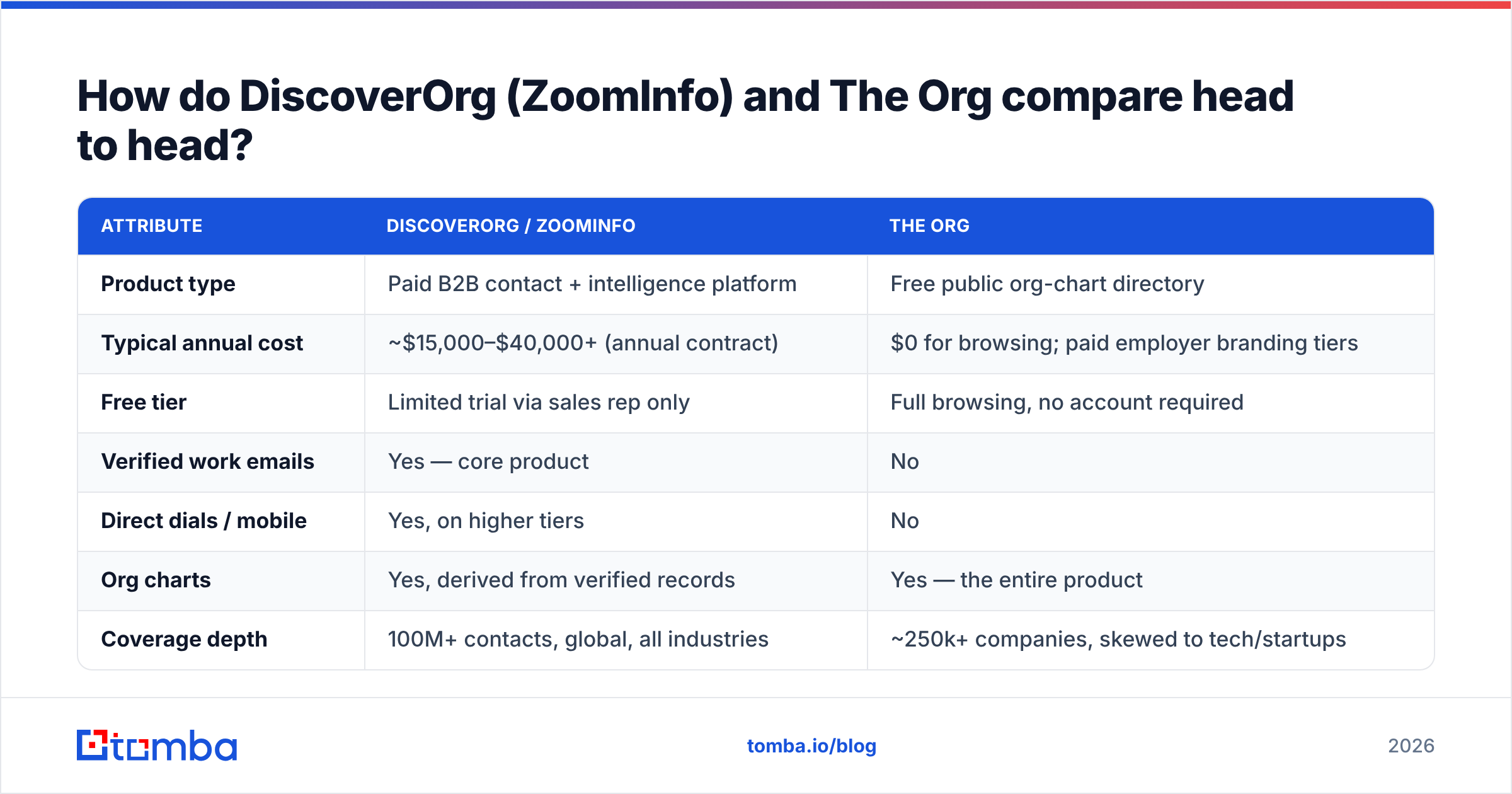
DiscoverOrg vs The Org: how do they compare head to head?#
| Attribute | DiscoverOrg / ZoomInfo | The Org |
|---|---|---|
| Product type | Paid B2B contact + intelligence platform | Free public org-chart directory |
| Typical annual cost | ~$15,000–$40,000+ (annual contract) | $0 for browsing; paid employer branding tiers |
| Free tier | Limited trial via sales rep only | Full browsing, no account required |
| Verified work emails | Yes — core product | No |
| Direct dials / mobile | Yes, on higher tiers | No |
| Org charts | Yes, derived from verified records | Yes — the entire product |
| Coverage depth | 100M+ contacts, global, all industries | ~250k+ companies, skewed to tech/startups |
| Data freshness | Continuous verification + refresh cycles | Self-reported; varies wildly by company |
| Bulk export | Yes, credit-metered | No |
| API for outbound | Yes, enterprise-priced | Not for prospecting use |
| CRM sync | Native Salesforce, HubSpot, Dynamics | None |
| Buying process | Demo → sales cycle → annual contract | Open URL |
| Best for | Enterprise ABM teams with budget | Free pre-call account research |
The table makes the real point obvious: these are complements, not alternatives. Nobody swaps ZoomInfo for The Org. Nobody swaps The Org for ZoomInfo. If you are weighing DiscoverOrg vs The Org because both appeared in one listicle, you are asking the wrong question.
DiscoverOrg vs The Org: which one fits outbound prospecting?#
Neither, on its own. Here is the honest decision tree.
Pick DiscoverOrg/ZoomInfo if: you run a defined ABM motion with 5+ reps. You also need an approved $15k data budget, direct dials, and intent signals in one contract. The value is the bundle: data, intent, dialer, and sequencing under one login, with Salesforce sync. Need only one of those four things? You are overpaying by 3–4x.
Use The Org if: you research a handful of tech accounts by hand. It helps you learn the hierarchy before an outreach email or an interview. It costs nothing. Bookmark it. Do not build a pipeline on it.
Do something else if: you have 400 names and companies and need working email addresses. That is the most common job of the three. Both tools handle it badly for the price. ZoomInfo makes you buy a platform to get it. The Org cannot do it at all.
For that job, use a dedicated email finder. It turns a name plus a domain into a verified address, one lookup at a time. Tomba's free tier covers 25 searches a month.
Tomba pricing starts at $49/mo for Starter, $99/mo for Growth, and $249/mo for Pro. There is no annual lock-in and no seat minimum. Know the company but not the people? Domain search returns every discoverable address on that domain, with its pattern and a confidence score.
What about the other players in this category?#
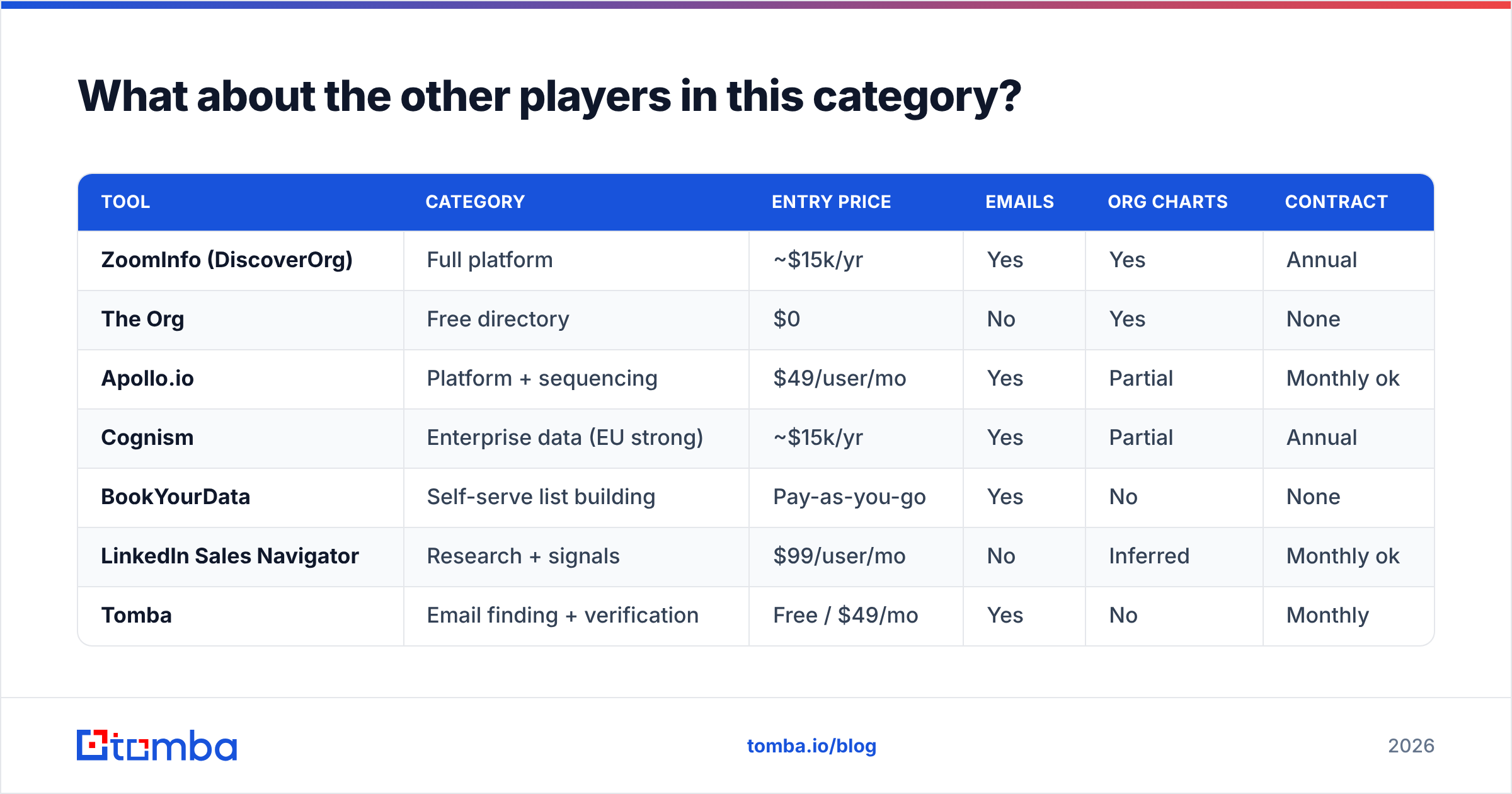
The DiscoverOrg vs The Org debate gets clearer once you add the rest of the market.
| Tool | Category | Entry price | Emails | Org charts | Contract |
|---|---|---|---|---|---|
| ZoomInfo (DiscoverOrg) | Full platform | ~$15k/yr | Yes | Yes | Annual |
| The Org | Free directory | $0 | No | Yes | None |
| Apollo.io | Platform + sequencing | $49/user/mo | Yes | Partial | Monthly ok |
| Cognism | Enterprise data (EU strong) | ~$15k/yr | Yes | Partial | Annual |
| BookYourData | Self-serve list building | Pay-as-you-go | Yes | No | None |
| LinkedIn Sales Navigator | Research + signals | $99/user/mo | No | Inferred | Monthly ok |
| Tomba | Email finding + verification | Free / $49/mo | Yes | No | Monthly |
A few notes worth making:
- Apollo is the closest self-serve substitute for ZoomInfo. Data quality on non-US mid-market records is noticeably thinner. See our take on Apollo alternatives if you are weighing that trade.
- BookYourData suits teams that want to buy a targeted list outright instead of renting seats. Pay-as-you-go avoids the annual contract problem. That is the top complaint about ZoomInfo.
- Sales Navigator beats The Org on coverage and also infers hierarchy. It still gives you no exportable email.
- Verification is a separate job from finding. Run any source through an email verifier before you send. Bought and scraped lists decay about 2–3% per month as people change jobs.
How accurate is each source, really?#
Accuracy claims in this category are marketing until you test them. Here is how to judge them yourself.
ZoomInfo/DiscoverOrg publishes high accuracy numbers for emails and lower ones for direct dials. Buyers on G2 report strong results for US enterprise contacts. Results are weaker for EMEA, APAC, and firms under 50 staff. The refresh cycle is real, but not instant. Someone who changed jobs last month may still sit in the database.
The Org offers no accuracy guarantee. That is by design, since users maintain it. A well-tended profile at a Series C startup often beats any paid database, because the company updated it itself. A neglected profile from 2019 is fiction. You cannot tell which one you are reading without checking LinkedIn.
The practical protocol either way:
- Source the structure from The Org, LinkedIn, or the company's own site. This part is free.
- Resolve the email with a finder that returns a confidence score, not a guess.
- Verify before sending. Use SMTP-level checks, plus catch-all verification for domains that accept everything.
- Re-verify every quarter on any list you plan to reuse.
- Track bounce rate as your ground truth. Under 2% is healthy. Over 5% burns sender reputation, so stop and fix the input.
That sequence works with any source. It does not matter whether the names came from a $30k contract or a free public directory.
DiscoverOrg vs The Org: what does a year actually cost?#
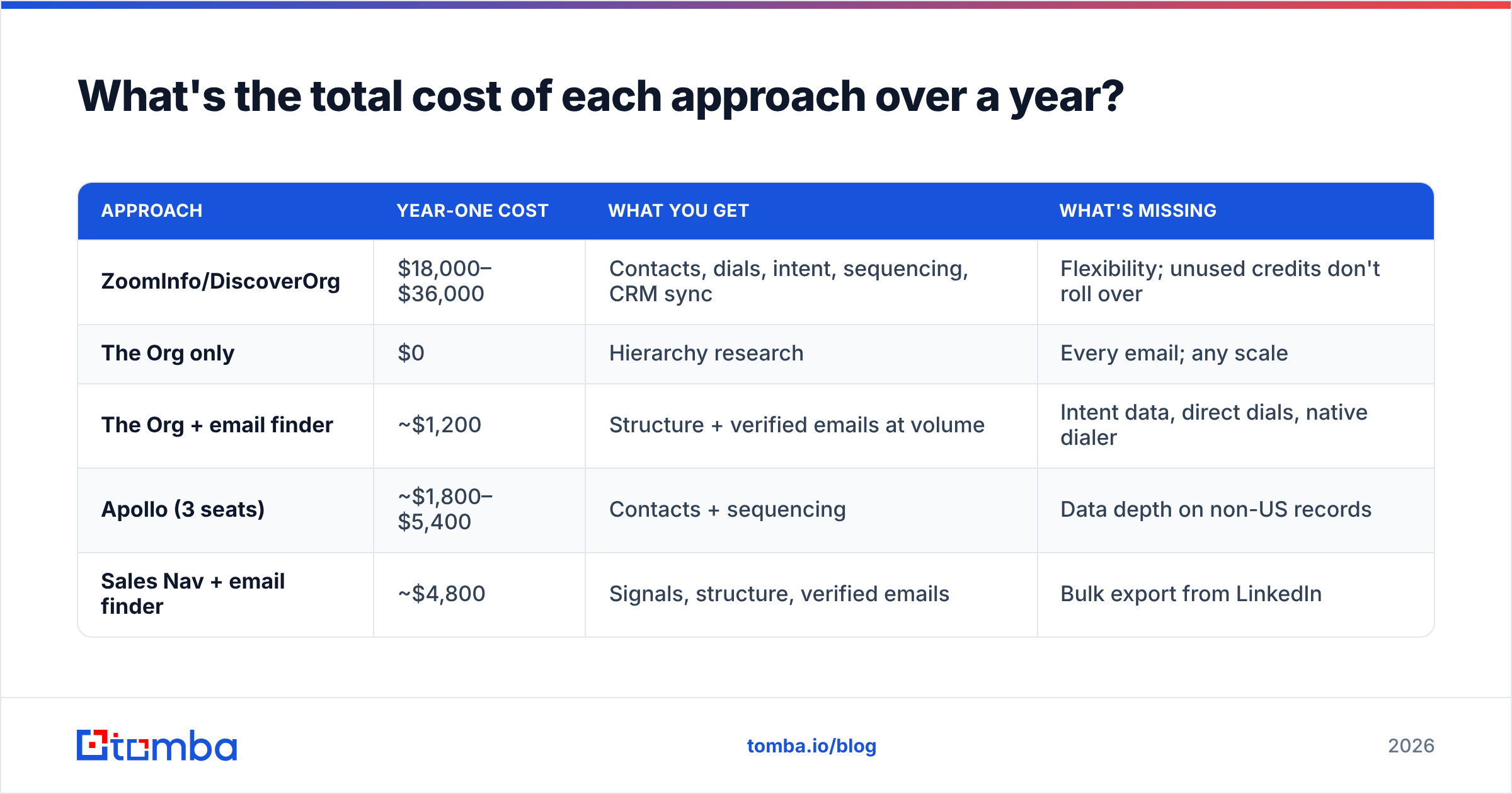
Run the math on a real case. Take a three-person SDR team that needs 1,500 verified contacts a month.
| Approach | Year-one cost | What you get | What's missing |
|---|---|---|---|
| ZoomInfo/DiscoverOrg | $18,000–$36,000 | Contacts, dials, intent, sequencing, CRM sync | Flexibility; unused credits don't roll over |
| The Org only | $0 | Hierarchy research | Every email; any scale |
| The Org + email finder | ~$1,200 | Structure + verified emails at volume | Intent data, direct dials, native dialer |
| Apollo (3 seats) | ~$1,800–$5,400 | Contacts + sequencing | Data depth on non-US records |
| Sales Nav + email finder | ~$4,800 | Signals, structure, verified emails | Bulk export from LinkedIn |
The middle row deserves the hardest look from teams under $5M ARR. You give up intent data and dialer integration. You keep about 95% of the prospecting power for roughly 5% of the enterprise price. Wait until intent data is the real limit on your pipeline. That is the moment to call ZoomInfo, and not before.
One more thing: ZoomInfo credits expire. Teams often buy annual capacity sized for their best quarter, then waste a third of it. Per-lookup pricing has no such waste. That is why bulk email finder workflows win on cost per usable contact for teams that prospect in bursts.
Frequently asked questions#
Is DiscoverOrg the same as ZoomInfo now? Yes. DiscoverOrg bought ZoomInfo in 2019, took the ZoomInfo name, and retired the DiscoverOrg product. Legacy customers moved years ago.
Can I get emails from The Org? No. The Org lists names, titles, and reporting lines. It does not publish or verify work email addresses. You need a separate finder for that.
Is The Org's data reliable? It varies by company. Firms that maintain a profile for recruiting tend to be accurate. Stale profiles carry no warning label. Cross-check LinkedIn before you act on a reporting line.
Does ZoomInfo offer a free plan? There is a limited community access path and trials through sales. There is no self-serve free tier like smaller tools offer. Expect a demo call before you see the data.
What is the cheapest way to get verified B2B emails at volume? Use per-lookup pricing from a dedicated finder, then verify before you send. Free directories cover the research layer. You pay only for resolution and validation.
The bottom line#
DiscoverOrg vs The Org is not a real fight. The two landed on the same shelf because both draw boxes and lines. ZoomInfo, the DiscoverOrg successor, is a serious enterprise data platform. It is priced for teams with a budget line for data. The Org is a free bookmark that saves you five minutes of LinkedIn digging.
Your real need is often the middle piece: turning company names and people names into deliverable emails. For that, you need neither tool. Start with Tomba Email Finder. Test 25 free searches against your own target accounts. Then pay $49/mo when you are ready to scale. Run your list, verify it, and put the $30,000 you did not spend into something that books meetings.
Related guides#
Ready to find emails that actually work?
Join 150,000+ professionals who stopped guessing and started sending. Free credits on signup — no credit card required.
Get the Tomba newsletter
Practical outbound tactics and product updates — once every two weeks.
About the author