DiscoverOrg vs Vainu (2026): Which B2B Data Tool Wins?
DiscoverOrg is now ZoomInfo. Vainu is a Nordic signal engine. They solve different problems at very different prices — here is the honest breakdown, plus a cheaper middle path.
Short answer on DiscoverOrg vs Vainu: they are not real rivals. DiscoverOrg is ZoomInfo now. Vainu is a European signal engine. Geography decides this one for most buyers.
TL;DR
- DiscoverOrg is not a standalone product any more. It merged with ZoomInfo in 2019, and the name was retired. When a vendor or a blog post says "DiscoverOrg," it means ZoomInfo today.
- Vainu is a Finnish company-data and buying-signal platform. It is deepest in the Nordics and Benelux. It sells triggers — funding, hiring, tech changes — not raw contact volume.
- So DiscoverOrg vs Vainu is not a like-for-like fight. ZoomInfo sells North American contacts and intent. Vainu sells European company depth and live events.
- Both are quote-based and pricey. ZoomInfo deals often land in the five figures a year. Vainu is usually a low-four-figure monthly contract.
- Need verified work emails and enrichment, not a $30K intent suite? A focused tool like Tomba at $49/mo covers 80% of the job for 2% of the spend.
DiscoverOrg vs Vainu: what are you actually comparing?#
Start here. Half the "DiscoverOrg vs Vainu" posts online compare a product that stopped shipping under that name seven years ago.
DiscoverOrg launched in 2007. It sold a human-verified org-chart database for IT, marketing, and finance teams. The pitch was researcher-checked accuracy. Real people called companies to confirm titles, direct dials, and reporting lines.
Then the deal happened. In February 2019, DiscoverOrg bought ZoomInfo and kept the ZoomInfo name. The company went public in 2020. The old dataset now ships inside ZoomInfo Sales, Marketing, Operations, and Copilot.
So in 2026 the real question is ZoomInfo (carrying the DiscoverOrg dataset) vs Vainu. That matters for procurement. You cannot buy "DiscoverOrg" any more. You buy a ZoomInfo contract with modules bolted on.
Plenty of DiscoverOrg did survive. The human-checking layer and the org-chart focus still shape ZoomInfo's top tier. When a rep says "we used to have DiscoverOrg, we want that back," they usually mean three things: verified direct dials, department org charts, and IT install-base data.
What is Vainu, and who is it built for?#
Vainu is a company-data platform. It was founded in Helsinki in 2014. Its core asset is a company database. Coverage runs deep in Finland, Sweden, Norway, Denmark, and the Netherlands. There is a global layer too, but it thins out fast outside Europe.
Signals are the difference. Vainu reads public sources all day — company registries, news, job ads, websites, filings. It turns each change into a trigger you can filter and route:
- Funding and money events — new rounds, revenue jumps, and registry filings. Nordic registries are unusually complete and easy for machines to read.
- Hiring signals — job ads that show a team being built. A company posting three DevOps roles is buying tooling.
- Technology signals — what runs on the website, and when it changes.
- Org changes — new executives, new owners, new offices.
- Website and content signals — new product pages, sustainability reports, pricing-page edits.
- Custom filters and workflows — combos pushed into your CRM as a scored list, not a static export.
Vainu is a company-level tool first. Contact data exists, but nobody buys it for that. Its buyers are Nordic and Dutch mid-market sales teams. They need to know which accounts changed this week. They already have a way to reach people once they pick a target.

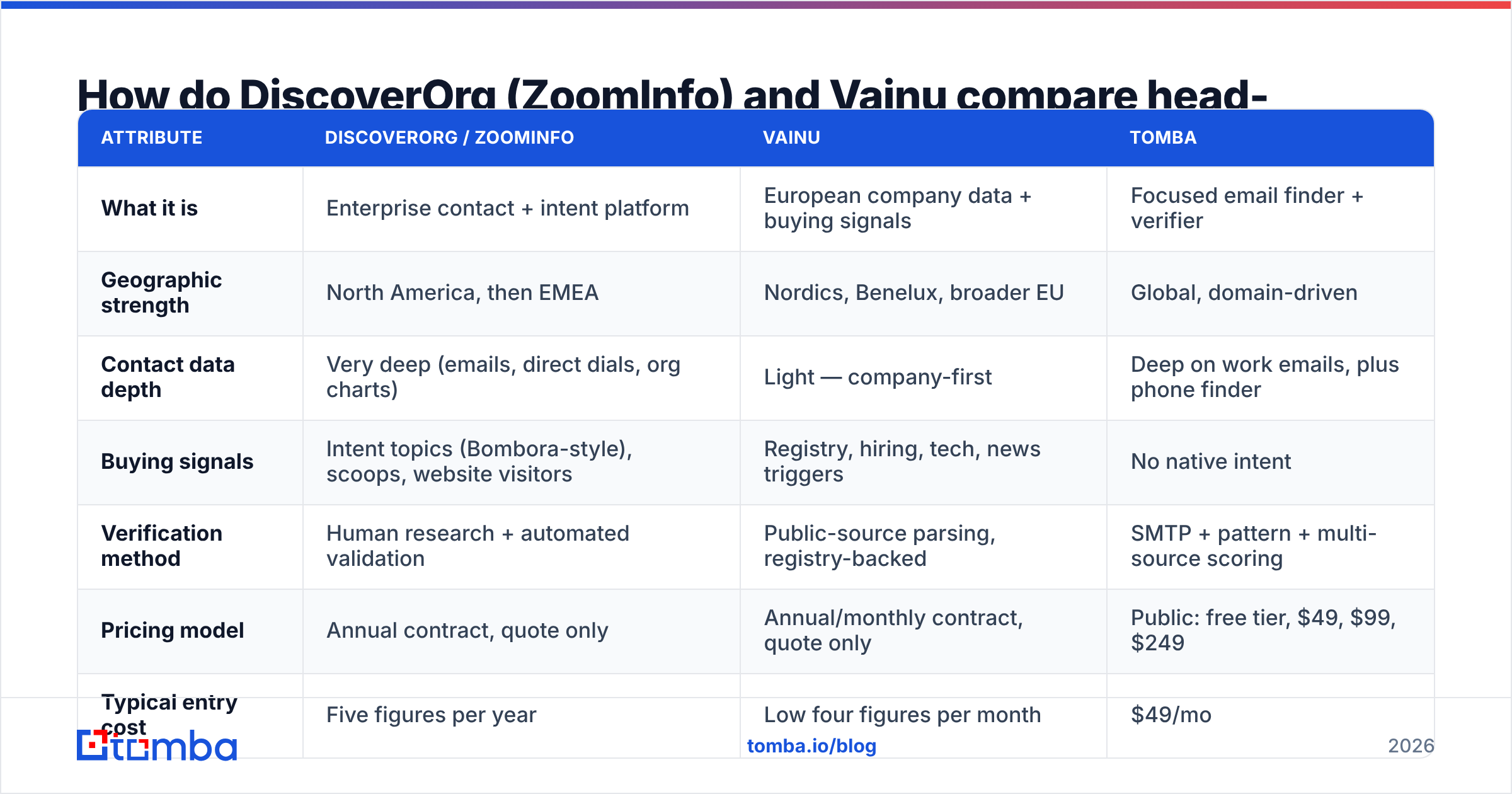
DiscoverOrg vs Vainu: the head-to-head table#
| Attribute | DiscoverOrg / ZoomInfo | Vainu | Tomba |
|---|---|---|---|
| What it is | Enterprise contact + intent platform | European company data + buying signals | Focused email finder + verifier |
| Geographic strength | North America, then EMEA | Nordics, Benelux, broader EU | Global, domain-driven |
| Contact data depth | Very deep (emails, direct dials, org charts) | Light — company-first | Deep on work emails, plus phone finder |
| Buying signals | Intent topics (Bombora-style), scoops, website visitors | Registry, hiring, tech, news triggers | No native intent |
| Verification method | Human research + automated validation | Public-source parsing, registry-backed | SMTP + pattern + multi-source scoring |
| Pricing model | Annual contract, quote only | Annual/monthly contract, quote only | Public: free tier, $49, $99, $249 |
| Typical entry cost | Five figures per year | Low four figures per month | $49/mo |
| Self-serve signup | No | Limited trial | Yes |
| API access | Yes, credit-metered, enterprise tier | Yes | Yes, on all paid plans |
| Best for | US enterprise outbound teams | Nordic/EU account intelligence | Teams that just need valid emails |
The table makes the point. These tools overlap on maybe 30% of their surface. A US SaaS team selling to a VP of Engineering in Chicago will find Vainu nearly useless for finding contacts. A Finnish supplier tracking 400,000 Nordic companies will find ZoomInfo's Nordic data thin for the price.
DiscoverOrg vs Vainu pricing: what does each one cost?#
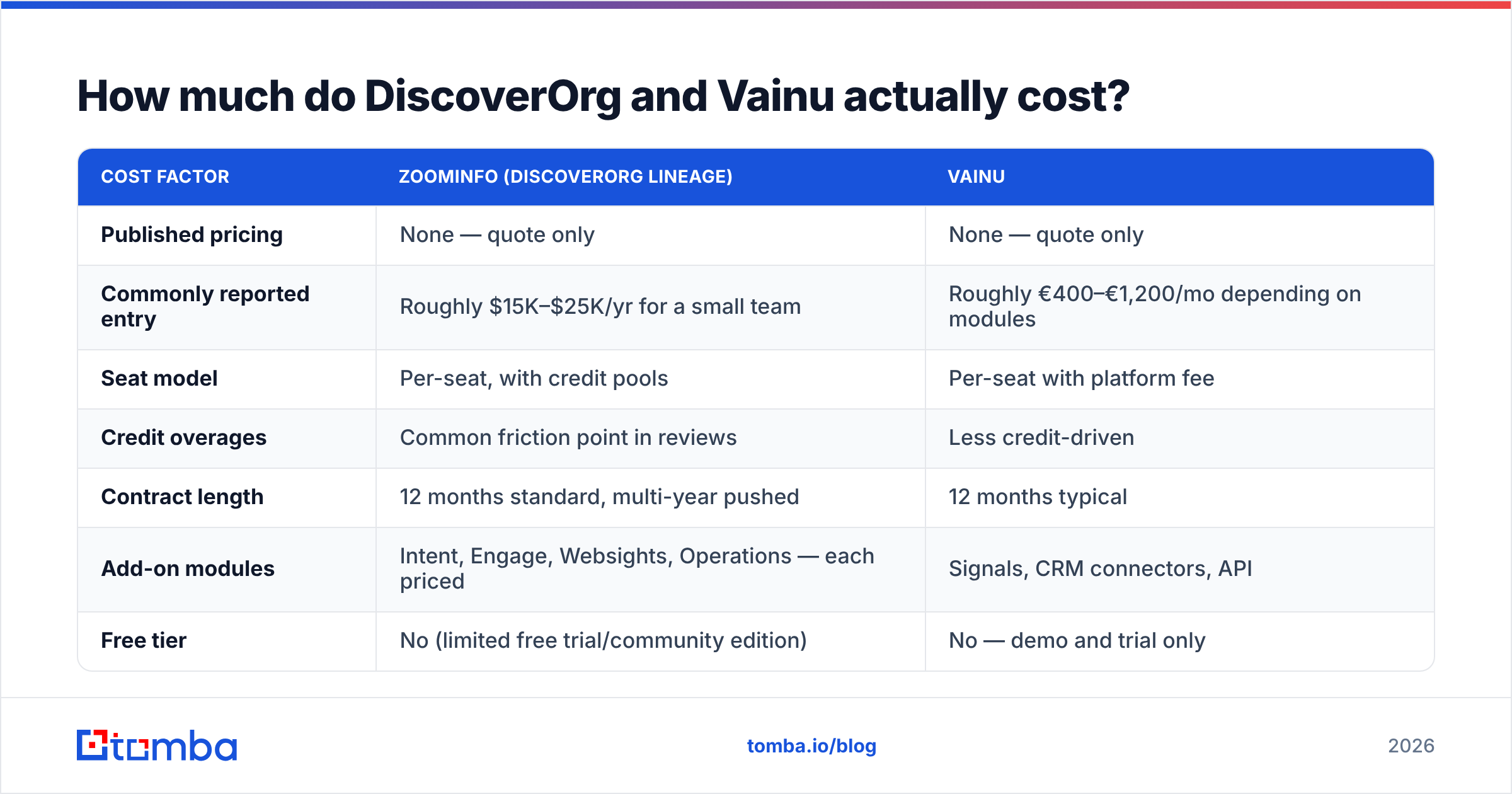
Neither vendor publishes a price list. That alone tells you about the sales motion. The numbers below come from vendor-reported ranges and public buyer reviews on G2. They are not a rate card. Treat them as a rough guide, then get your own quote.
| Cost factor | ZoomInfo (DiscoverOrg lineage) | Vainu |
|---|---|---|
| Published pricing | None — quote only | None — quote only |
| Commonly reported entry | Roughly $15K–$25K/yr for a small team | Roughly €400–€1,200/mo depending on modules |
| Seat model | Per-seat, with credit pools | Per-seat with platform fee |
| Credit overages | Common friction point in reviews | Less credit-driven |
| Contract length | 12 months standard, multi-year pushed | 12 months typical |
| Add-on modules | Intent, Engage, Websights, Operations — each priced | Signals, CRM connectors, API |
| Free tier | No (limited free trial/community edition) | No — demo and trial only |
| Negotiation leverage | High at renewal, low at first signature | Moderate |
Two warnings. First, ZoomInfo's credit system is the top complaint in buyer reviews. Export credits run out faster than teams plan for. Mid-year top-ups rarely come at the original rate. Second, both vendors price on an annual commitment. A three-person team testing a market carries the same overhead as a fifty-person team. That gap is why the mid-market keeps unbundling these suites.
Which one has better data accuracy?#
Different data. Different meanings of "accurate."
ZoomInfo leans on human checking and scale. The DiscoverOrg heritage — researchers confirming titles and dials — still gives it the best direct-dial coverage in the US. But scale cuts both ways. A database of hundreds of millions of contacts goes stale fast. B2B contact data decays at roughly 25–30% a year as people switch jobs. No vendor re-checks all of it. Expect strong data on active enterprise accounts and weaker data in the long tail of small businesses.
Vainu leans on registries, and that is a real difference. Nordic countries publish clean, official company registers. When Vainu says a Finnish company's revenue, headcount, or board changed, that came from a filing. It was not guessed. So Vainu is very reliable on company facts and very thin on personal contact details. The trade is on purpose, and it fits its market.
Neither one solves the problem that hits outbound teams hardest: the email bounced. Good company data does not make first.last@company.com deliverable. Catch-all domains, role accounts, and dead mailboxes still need their own check. That is why teams on either platform add an email verifier and a catch-all verifier before they send.
What do real buyers say about each?#
Patterns worth knowing before a demo call:
- ZoomInfo praise: US coverage no one matches, direct dials that connect, clean Salesforce and HubSpot sync, org charts that speed up multi-threading.
- ZoomInfo gripes: cost, hard renewal talks, credits running dry, auto-renewal clauses, and EU coverage that does not match the EU price.
- Vainu praise: signal quality, CRM integrations (HubSpot, Salesforce, Pipedrive, Dynamics), Nordic data nobody else has, fast support, an honest sales process.
- Vainu gripes: thin contact data, coverage that drops off outside its core markets, and a signal firehose that needs tuning before it stops making noise.
One line sums up the reviews. Buyers rarely regret the data. They regret the contract. Both platforms are sticky by design, and both are annual.
When should you pick DiscoverOrg (ZoomInfo)?#
Buy ZoomInfo when all of this is true:
- You sell to North America, mid-market or enterprise.
- You need direct dials and org charts, not just emails. You are working six-person buying committees.
- You have an ops person who can manage credits, dedupe, and CRM hygiene at scale.
- Intent data will change what reps do. If nobody works the intent list, you are paying for a dashboard.
- Your deal size supports it. At $25K a year, the tool has to earn a couple of extra closed-won deals.
Already weighing the big suites? The Apollo alternative and Clearbit alternative guides cover nearby options at lower entry prices.
When should you pick Vainu?#
Buy Vainu when:
- You sell in Finland, Sweden, Norway, Denmark, or the Netherlands. This is not a nice-to-have. It is the whole value.
- You sell on timing. ABM plays that fire on funding rounds, hiring surges, or leadership changes get real lift here.
- You already have contacts. Vainu makes a CRM smarter. It does not fill an empty one.
- Your team will build workflows. Vainu pays off with setup and punishes set-and-forget.
Vainu is a good product asked the wrong question in most "vs" posts. Next to a US contact database it looks incomplete. Next to other European company-intelligence tools, it holds up well.

Is there a cheaper middle path between the two?#
Yes. For most teams under 50 reps, it is the right answer.
Strip the question down. What do these platforms deliver that actually moves pipeline?
- A list of target companies. You can build one from your CRM, LinkedIn Sales Navigator, a trade directory, or a registry export. It is rarely the bottleneck.
- A valid work email for the right person. This is the bottleneck. A domain search returns the people at a company plus the email pattern that domain uses. Verification then confirms the mailbox before you send.
- Firmographics on the record. Size, industry, location, tech stack — enough to personalize and route. Data enrichment fills this in from the email or domain.
- A reason to reach out now. Useful, but optional. Funding news and job posts are public. A Slack alert on a Google News query costs nothing.
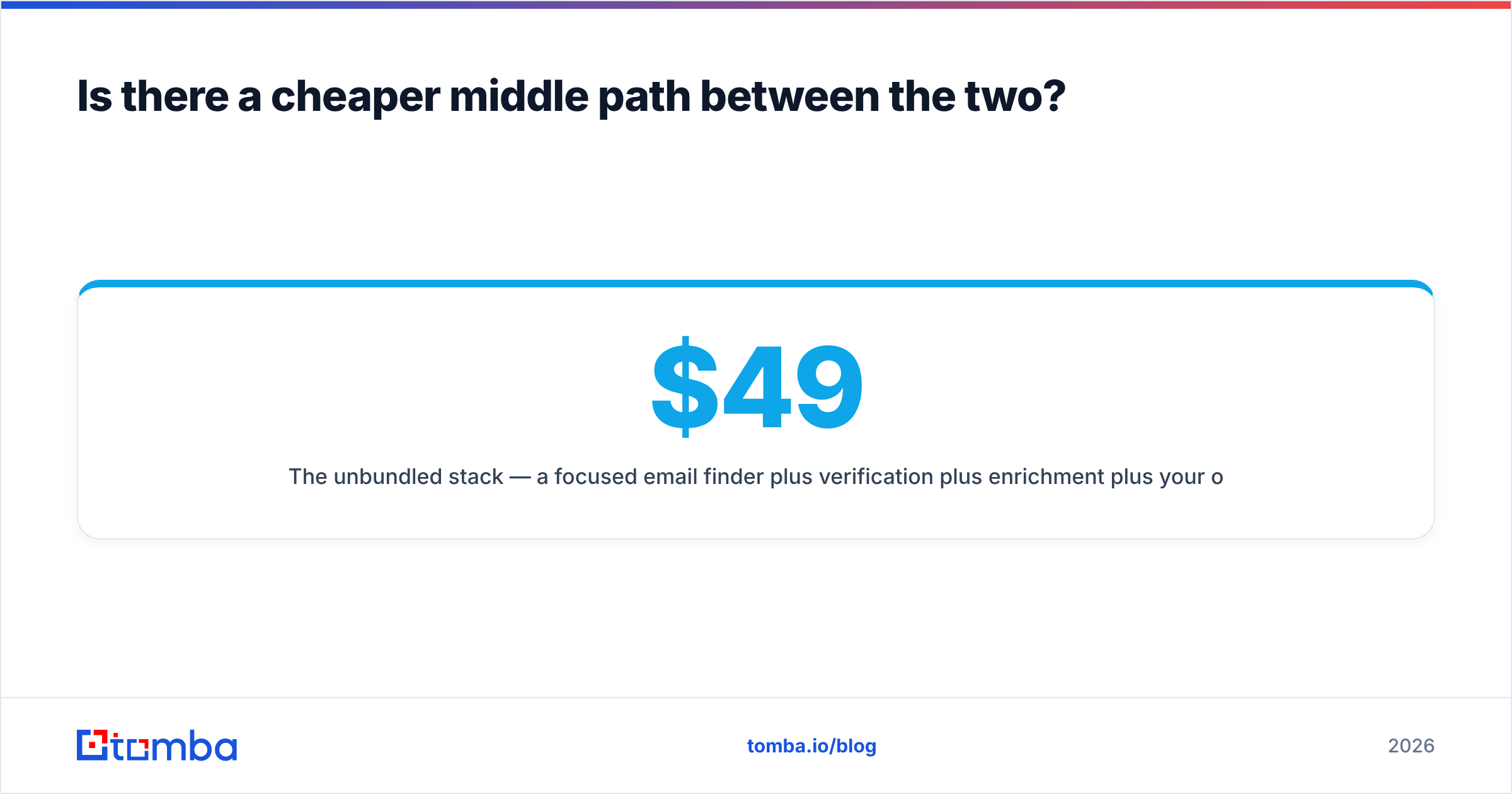
The unbundled stack costs a few hundred dollars a year instead of five figures: an email finder, verification, enrichment, and your own alerts. Tomba pricing is public and flat — a free tier at 25 searches a month, Starter at $49/mo, Growth at $99/mo, Pro at $249/mo, Enterprise on request. No credit renegotiation. No annual lock-in. No demo call to see a number.
Pay enterprise prices when you need US direct dials at scale, when intent data feeds a real SDR playbook, or when Nordic registry depth is a must-win. Do not pay them when the honest need is "find and verify work emails for a list of companies, then push them into HubSpot."
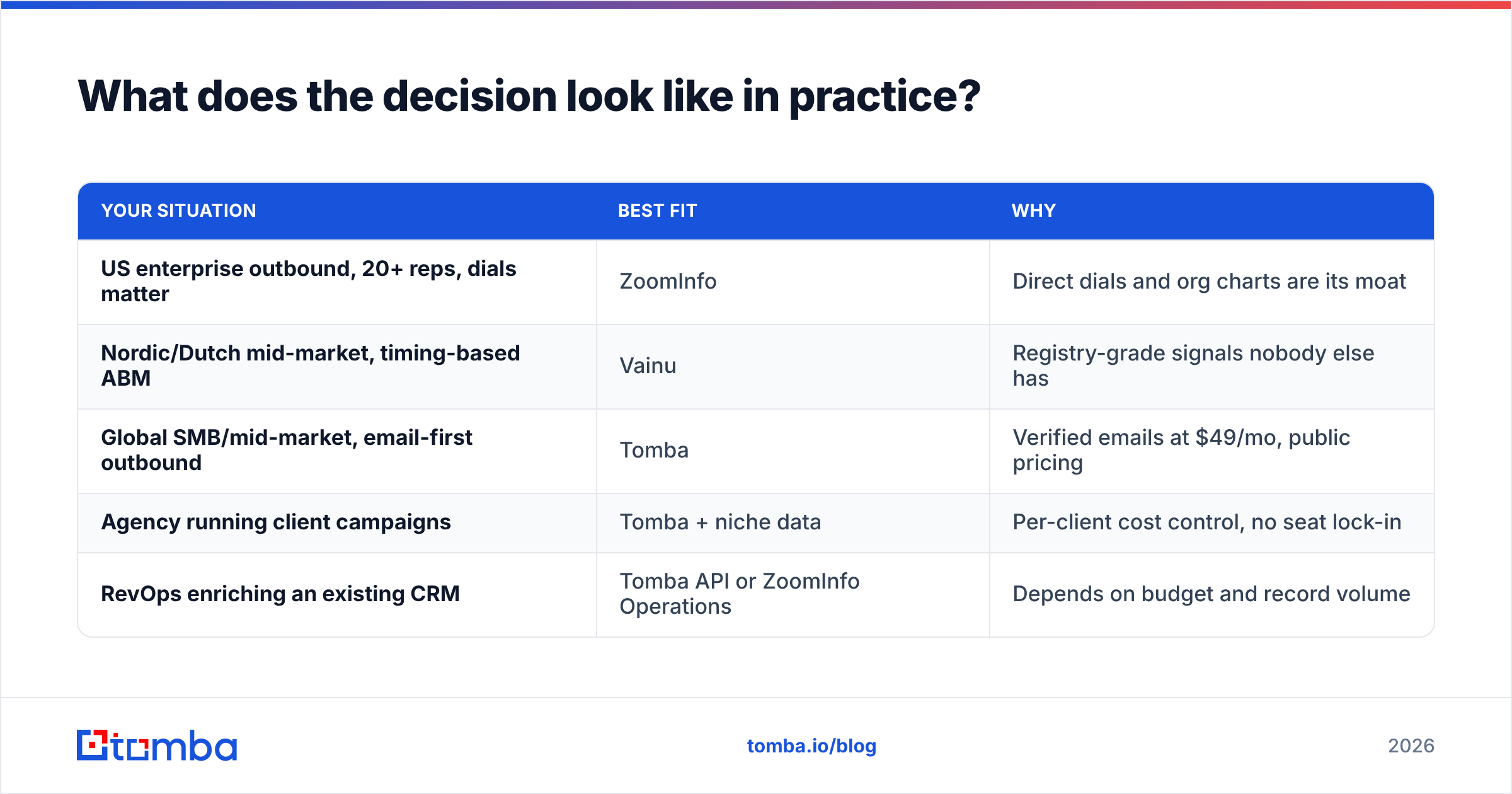
What does the decision look like in practice?#
| Your situation | Best fit | Why |
|---|---|---|
| US enterprise outbound, 20+ reps, dials matter | ZoomInfo | Direct dials and org charts are its moat |
| Nordic/Dutch mid-market, timing-based ABM | Vainu | Registry-grade signals nobody else has |
| Global SMB/mid-market, email-first outbound | Tomba | Verified emails at $49/mo, public pricing |
| Agency running client campaigns | Tomba + niche data | Per-client cost control, no seat lock-in |
| RevOps enriching an existing CRM | Tomba API or ZoomInfo Operations | Depends on budget and record volume |
A workflow that fits rows three and four: build the account list, run bulk email finder on the domains, verify, enrich, then sync. Teams that want it inside their current stack can run the same flow through the Tomba API, a spreadsheet add-on, or the browser extension.
DiscoverOrg vs Vainu: which one wins in 2026?#
Neither, across the board. That is the honest verdict.
Hand me a DiscoverOrg vs Vainu shortlist and the first thing I would fix is the shortlist. DiscoverOrg is ZoomInfo now, and ZoomInfo is a North American contact-and-intent suite priced for enterprise. Vainu is a European company-intelligence engine priced for the mid-market and built on public registries. Few teams need both. Plenty need neither.
Rank your needs in this order: geography, contact-level vs company-level data, whether anyone will work the signals, and total annual cost against extra deals won. Geography alone settles it for most buyers. If the answer is North America, Vainu is out. If the answer is the Nordics, ZoomInfo costs too much for what you get. If you sell globally over email, both are the wrong shape of tool.
Run a real test before you sign. Take 100 target accounts. Pull contacts from each trial. Send them through a verification pass. Then measure the bounce rate and connect rate yourself. Vendor accuracy claims are marketing. Your own 100-row test is data.
Start with the part that actually blocks pipeline. Before you sign a five-figure annual contract, find out how many target accounts you can already reach. The Tomba Email Finder returns verified work emails by domain, name, or company. The first 25 searches are free, and it is $49/mo when you scale. No sales call to see the price. If it covers your list, you just saved a budget cycle.
Related guides#
Ready to find emails that actually work?
Join 150,000+ professionals who stopped guessing and started sending. Free credits on signup — no credit card required.
Get the Tomba newsletter
Practical outbound tactics and product updates — once every two weeks.
About the author