Discovery Call Coaching: How to Fix Reps' Calls in 2026
Most discovery call coaching fails because managers grade the whole call instead of the three moments that decide the deal. Here's a scorecard, a cadence, and the tooling that actually moves win rates.
TL;DR
- Discovery call coaching fails when managers review whole calls and give vague feedback like "dig deeper." Score three specific moments instead: the first 90 seconds, the pain-to-impact transition, and the next-step close.
- Weekly, 20-minute, single-skill coaching beats monthly hour-long call reviews. Reps can only change one behavior at a time.
- A written scorecard removes manager subjectivity. Without one, two managers grade the same call 30 points apart.
- Conversation intelligence (Gong, Chorus, Clari Copilot) speeds up finding coachable moments — it does not replace the coaching conversation.
- Coaching only compounds when the pipeline feeding those calls is qualified. Bad data upstream means you're coaching reps on calls that were never winnable.
What is discovery call coaching?#
Discovery call coaching is the structured process of reviewing a rep's discovery calls against a defined standard, isolating one behavior to change, and verifying the change on the next call. It is not "listening to a recording and sharing thoughts."
The distinction matters because the second thing is what most sales organizations actually do. A manager blocks 60 minutes, plays a recording at 1.5x, pauses a few times, says "you could have asked about budget earlier," and moves on. The rep nods. Nothing changes. Three weeks later the same manager wonders why win rates are flat.
Real coaching has four components:
- A written standard. A scorecard that defines what "good" looks like on a discovery call, so feedback isn't just the manager's preference of the day.
- A narrow focus. One skill per cycle. Not five.
- A rep-led diagnosis. The rep listens first and self-scores before the manager speaks. Self-identified gaps stick; manager-delivered gaps get defended.
- A verification loop. You listen to the next call specifically for the one thing you coached. If it didn't change, the coaching failed — not the rep.
Most teams have zero of these four. A few have one. Teams that have all four see the compounding effect people expect from coaching in the first place.
Correction — embed as image:
Why do most discovery call coaching programs fail?#
Five failure modes account for nearly all of it.
Failure 1: Coaching the whole call. A 40-minute discovery call has maybe 6 minutes that determine the outcome. Reviewing all 40 produces a laundry list of 11 observations, none of which the rep can act on. You've spent an hour to generate noise.
Failure 2: No shared definition of good. Ask three managers on the same team to score the same call. Without a rubric, you'll typically see spreads of 20-30 points on a 100-point scale. Reps notice this immediately. Once they conclude that scores are personality-driven, coaching becomes a compliance exercise.
Failure 3: Coaching skill instead of behavior. "Be more consultative" is not coachable. "When the prospect names a problem, ask 'what does that cost you per month?' before moving on" is coachable. The first is an identity statement; the second is a behavior with a trigger.
Failure 4: Frequency collapse. Coaching gets scheduled, then bumped for pipeline reviews, forecast calls, and escalations. A monthly cadence that slips becomes quarterly. Quarterly coaching does nothing — the rep has run 60 calls since your last note.
Failure 5: Coaching reps on unwinnable calls. If half your discovery calls are with the wrong persona at the wrong company, no amount of questioning technique saves them. This is a targeting problem wearing a coaching problem's clothes. Fix the top of the funnel first — accurate contact data and correct persona targeting — then coach.
What should a discovery call scorecard actually measure?#
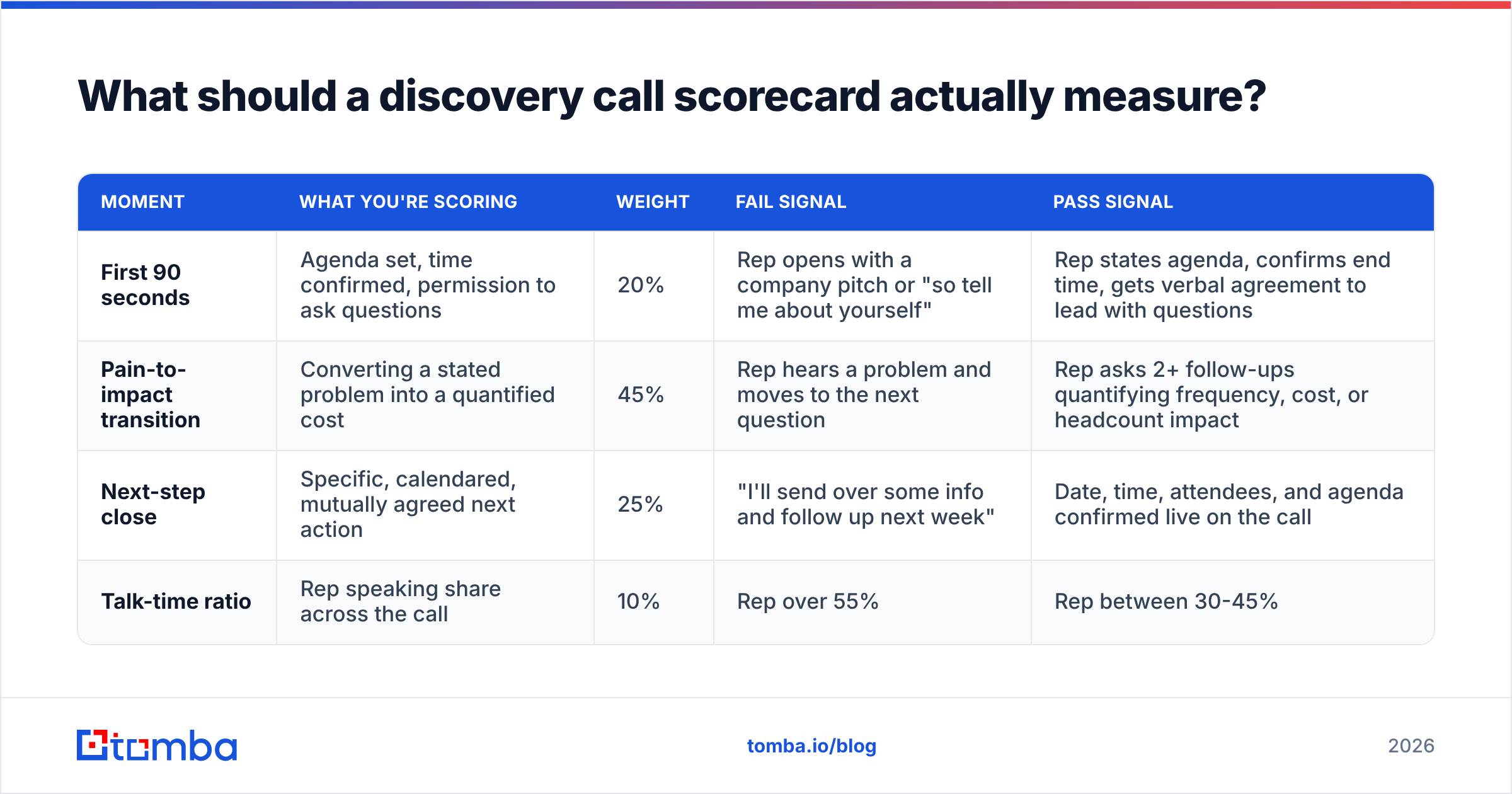
Score three moments, weighted. Everything else is commentary.
| Moment | What you're scoring | Weight | Fail signal | Pass signal |
|---|---|---|---|---|
| First 90 seconds | Agenda set, time confirmed, permission to ask questions | 20% | Rep opens with a company pitch or "so tell me about yourself" | Rep states agenda, confirms end time, gets verbal agreement to lead with questions |
| Pain-to-impact transition | Converting a stated problem into a quantified cost | 45% | Rep hears a problem and moves to the next question | Rep asks 2+ follow-ups quantifying frequency, cost, or headcount impact |
| Next-step close | Specific, calendared, mutually agreed next action | 25% | "I'll send over some info and follow up next week" | Date, time, attendees, and agenda confirmed live on the call |
| Talk-time ratio | Rep speaking share across the call | 10% | Rep over 55% | Rep between 30-45% |
The 45% weight on pain-to-impact is deliberate. It's the single behavior most correlated with deals that reach a decision — and the one reps skip most often, because asking "what does that cost you?" feels invasive until you've done it 50 times.
Run this scorecard for one quarter before you add anything to it. Every team's instinct is to expand the rubric to 12 categories. Twelve categories means no category gets coached.
The 4-step weekly coaching loop#
- Rep self-scores first (10 min, async). The rep picks one call from the week, scores it against the rubric, and writes one sentence on the lowest-scoring moment. This happens before the manager listens.
- Manager scores the same call independently (10 min). No peeking at the rep's score. Divergence between the two scores is itself diagnostic — a rep who scores themselves 90 on a call you scored 55 has a calibration problem, which is a different (and more urgent) issue than a skill problem.
- 20-minute live session. Compare scores, listen to the 3-4 minute clip around the weakest moment, agree on one behavior change with an explicit trigger ("when X happens, you do Y").
- Verify on the next call. Listen only for the coached behavior. Log whether it appeared. Do not introduce a new coaching topic until this one shows up twice.
Four steps, roughly 45 minutes of manager time per rep per week. For a team of six, that's under five hours — real, but far cheaper than the alternative of replacing a rep who ramped badly.
Which tools help with discovery call coaching in 2026?#
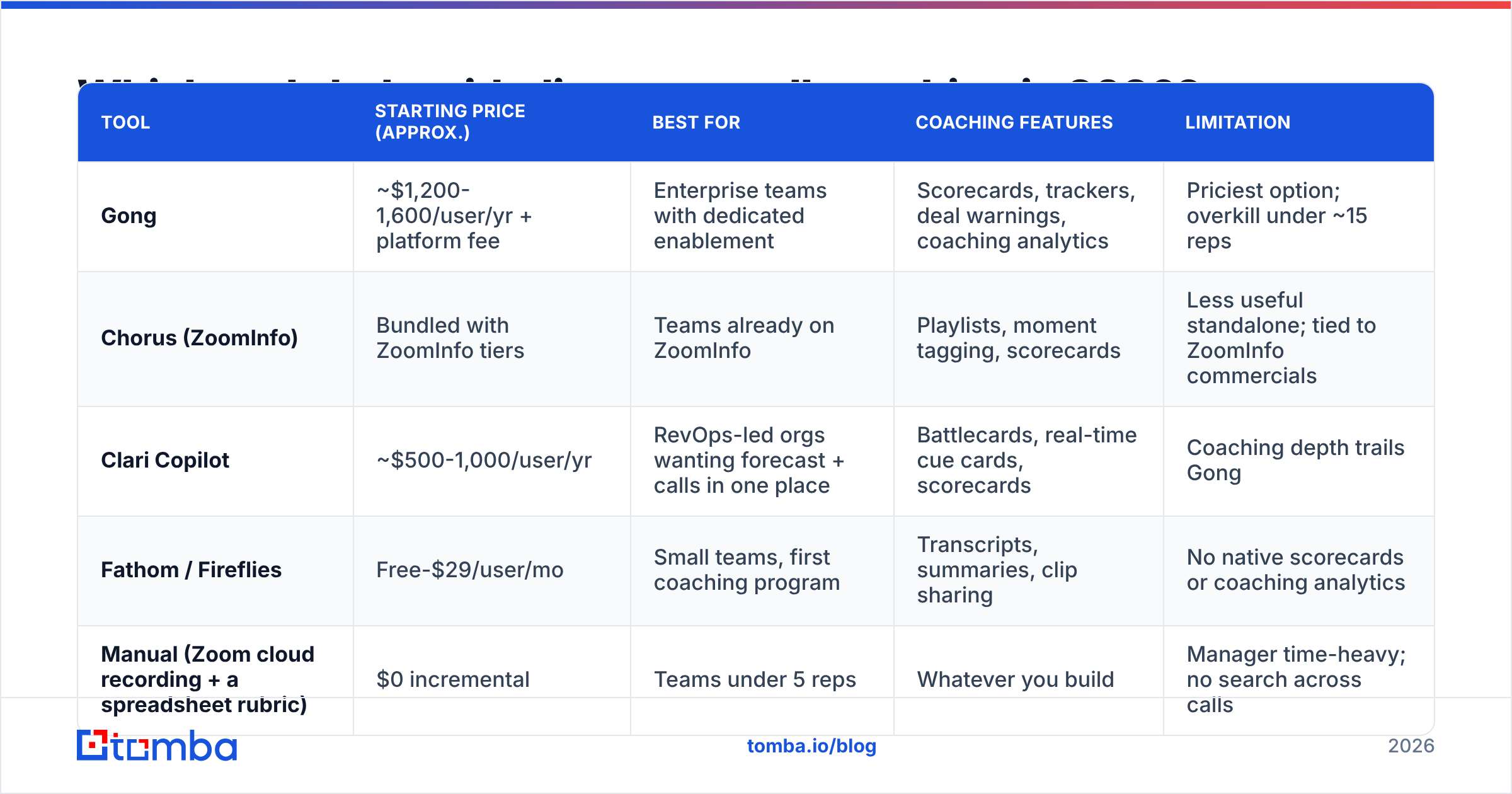
Conversation intelligence platforms record, transcribe, and surface moments. They compress the "find the coachable clip" step from 40 minutes to about 4. They do not do the coaching.
| Tool | Starting price (approx.) | Best for | Coaching features | Limitation |
|---|---|---|---|---|
| Gong | ~$1,200-1,600/user/yr + platform fee | Enterprise teams with dedicated enablement | Scorecards, trackers, deal warnings, coaching analytics | Priciest option; overkill under ~15 reps |
| Chorus (ZoomInfo) | Bundled with ZoomInfo tiers | Teams already on ZoomInfo | Playlists, moment tagging, scorecards | Less useful standalone; tied to ZoomInfo commercials |
| Clari Copilot | ~$500-1,000/user/yr | RevOps-led orgs wanting forecast + calls in one place | Battlecards, real-time cue cards, scorecards | Coaching depth trails Gong |
| Fathom / Fireflies | Free-$29/user/mo | Small teams, first coaching program | Transcripts, summaries, clip sharing | No native scorecards or coaching analytics |
| Manual (Zoom cloud recording + a spreadsheet rubric) | $0 incremental | Teams under 5 reps | Whatever you build | Manager time-heavy; no search across calls |
The honest read: if you have fewer than five reps and no coaching habit yet, start with Zoom recordings and a shared spreadsheet. Buying Gong before you have a rubric is buying a telescope before you've decided what to look at. Reviews on G2 show the same pattern repeatedly — teams that churn off conversation intelligence almost always bought it to create a coaching culture rather than to scale one that existed.
How do you coach the pain-to-impact transition specifically?#
This is the 45% line item, so it deserves its own treatment.
The failure looks like this. Prospect says: "Our onboarding takes too long." Rep says: "Got it — and how are you handling reporting today?" The rep just collected a symptom and threw it away.
The fix is a fixed three-question ladder the rep runs every time a problem is named:
- Frequency — "How often does that come up?" (Turns a vague complaint into a rate.)
- Cost — "When it happens, what does it cost you — in hours, dollars, or churned accounts?" (Attaches a number.)
- Consequence of inaction — "If this is still true in six months, what happens?" (Creates urgency the rep didn't manufacture.)
Coach the ladder as a unit. Do not coach "ask better questions." Give the rep the literal three questions, have them run the ladder on the next five calls, and score only whether the ladder appeared. Mechanical first, natural later. Reps who try to sound natural before the behavior is automatic just skip it under pressure.
A useful drill: pull three recordings where the rep dropped a stated pain, clip the 30 seconds around each drop, and play them back-to-back. Three examples of the same miss in 90 seconds is more persuasive than any amount of explanation.
How do you measure whether coaching is working?#
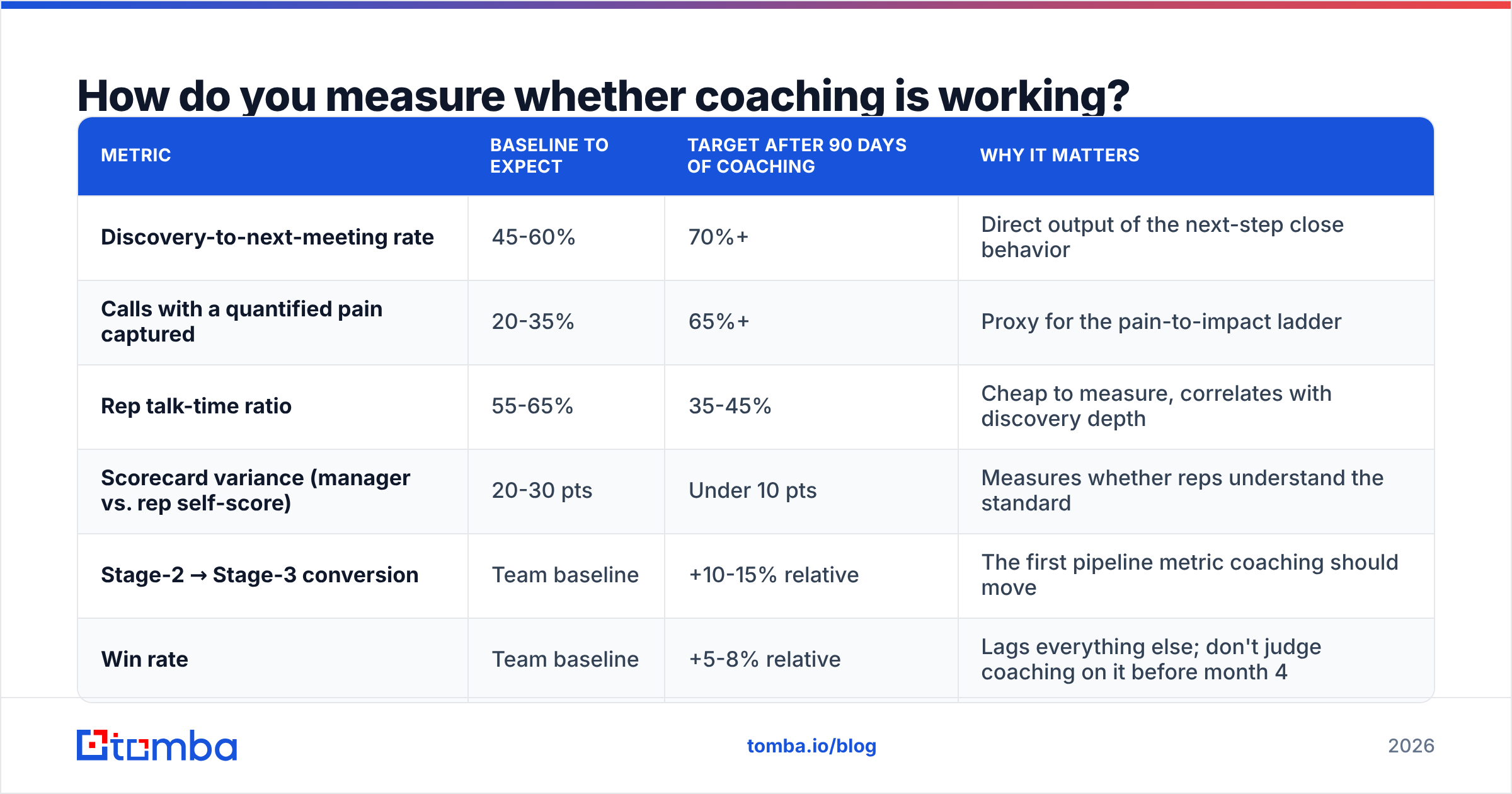
Win rate is the outcome metric, but it lags by a full sales cycle — often 60-120 days. You need leading indicators that move in weeks.
| Metric | Baseline to expect | Target after 90 days of coaching | Why it matters |
|---|---|---|---|
| Discovery-to-next-meeting rate | 45-60% | 70%+ | Direct output of the next-step close behavior |
| Calls with a quantified pain captured | 20-35% | 65%+ | Proxy for the pain-to-impact ladder |
| Rep talk-time ratio | 55-65% | 35-45% | Cheap to measure, correlates with discovery depth |
| Scorecard variance (manager vs. rep self-score) | 20-30 pts | Under 10 pts | Measures whether reps understand the standard |
| Stage-2 → Stage-3 conversion | Team baseline | +10-15% relative | The first pipeline metric coaching should move |
| Win rate | Team baseline | +5-8% relative | Lags everything else; don't judge coaching on it before month 4 |
Track scorecard variance seriously. It's the most under-used coaching metric there is. When a rep's self-score converges with the manager's, the rep has internalized the standard — and at that point they can coach themselves between sessions, which is the only way coaching scales past a 1:6 manager ratio.
Does discovery call coaching work for remote and hybrid teams?#
Yes, and in some ways better — but only if you change the format.
In-office coaching leaned on ambient learning: junior reps overheard senior reps. That channel is gone on distributed teams, and no amount of Slack replaces it. Compensate deliberately:
- Build a clip library, not a call library. Nobody watches a 40-minute recording. A tagged library of 90-second clips ("great impact question," "clean next-step close," "handled a defensive CFO") gets used.
- Run a 30-minute weekly team listen. One call, one moment, whole team scores it live, then compare. This is where calibration happens — and it fixes the manager-variance problem faster than any 1:1.
- Make peer review structured. Pair reps, have them score each other's calls with the same rubric. Reps often accept peer feedback more readily than manager feedback, and the scoring exercise teaches the scorer more than the scoree.
- Protect the slot. Recurring, same time, never bumped. When a coaching session gets moved for a forecast call, you've told the team exactly what the priority is.
Research on sales enablement from HubSpot and analyst coverage from Gartner consistently points the same direction: the delta between high- and low-performing coaching programs is almost entirely cadence consistency, not coaching content quality.
What has to be true before coaching pays off?#
Coaching multiplies whatever the pipeline hands your reps. If the input is bad, coaching multiplies a small number.
Three prerequisites:
1. Contact accuracy. If reps are on calls with people who don't own the problem, the discovery call was lost before it started. Verified contact data at the top of the funnel is a coaching prerequisite, not a separate initiative. Running a bulk verify pass on target lists before outreach removes the "wrong person entirely" category of failed discovery calls.
2. Persona clarity. The scorecard's pain-to-impact ladder assumes the person on the call can quantify cost. Junior contacts usually can't. That's not a rep skill gap, it's a targeting gap — and it shows up in coaching sessions as a rep who "can't create urgency."
3. Enough call volume to coach. A rep running two discovery calls a week doesn't generate enough reps-of-the-behavior to change anything. Below roughly six discovery calls a week per rep, prospecting volume — not coaching — is the constraint. Fill the top of the funnel first with domain search and verified outreach, then coach the calls it produces.
Sequence matters here. Teams that coach before fixing targeting conclude that "coaching doesn't work at our company," when what actually happened is they spent a quarter perfecting the questioning technique on calls that were never going to close.
Where do you start if you have nothing today?#
A realistic four-week ramp:
- Week 1: Write the three-moment scorecard. One page. Circulate it, let reps argue with it, adjust once, then freeze it for the quarter.
- Week 2: Every rep self-scores two of their own calls. No manager feedback yet. The goal is only to establish what the rep thinks good looks like.
- Week 3: Run the first calibration session — whole team scores one call together, discuss the spread. Expect chaos. This is normal and it's the point.
- Week 4: Start the weekly 1:1 loop. One behavior per rep. Verify the following week.
By week 8 you'll have enough scored calls to see which moment your team is collectively weakest on — and that's your enablement priority for the quarter, backed by data rather than by whoever complained loudest in the last pipeline review.
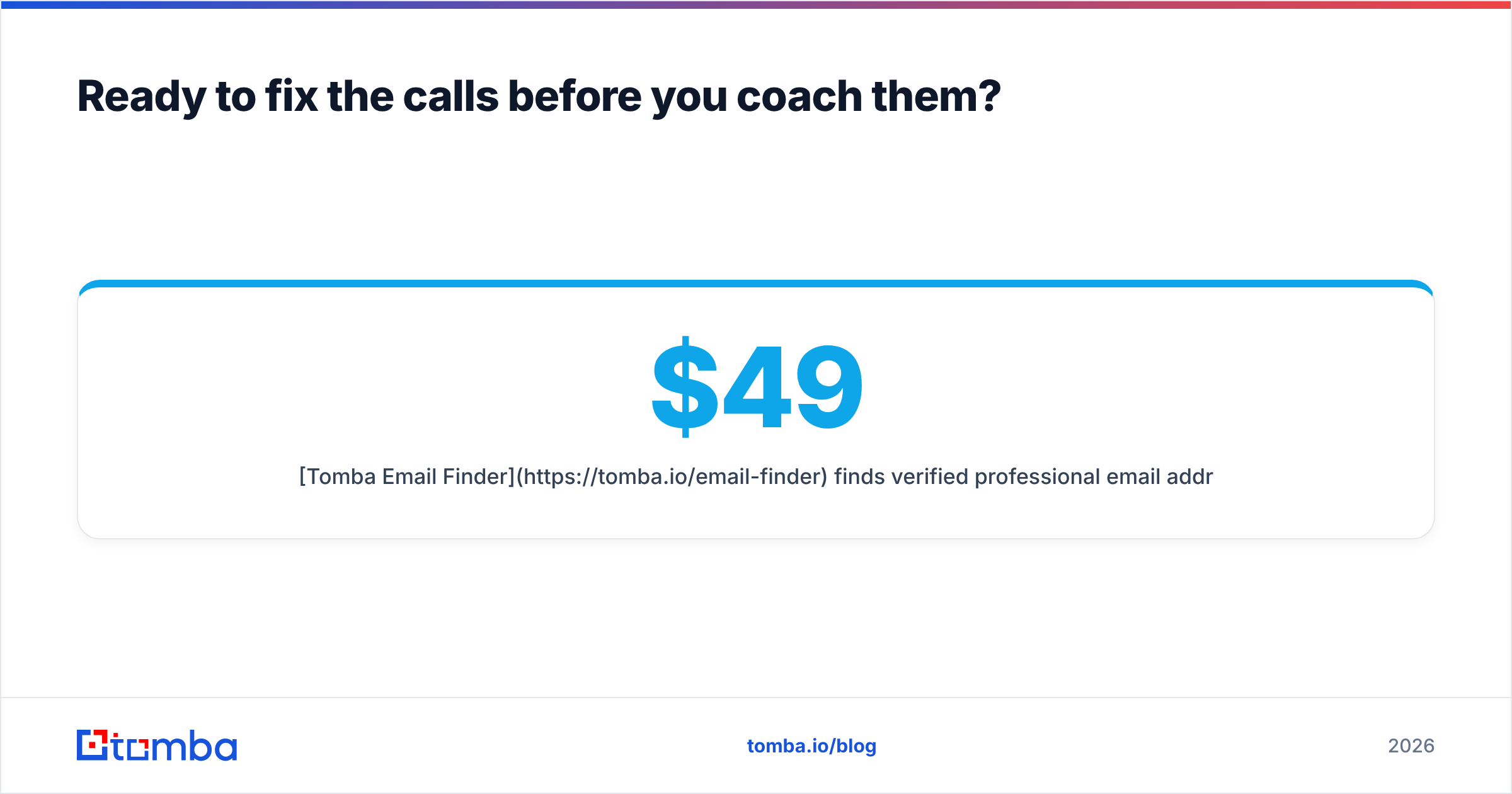
Ready to fix the calls before you coach them?#
The highest-leverage coaching investment often isn't coaching. It's making sure every discovery call is with a real, verified decision-maker at a company that fits — because a rep running eight qualified calls a week improves five times faster than one running two.
Tomba Email Finder finds verified professional email addresses by domain, name, or company, so your reps book discovery calls with the person who actually owns the budget. Start free with 25 searches a month, or move to Starter at $49/mo when you're ready to run lists at volume — see full Tomba pricing for Growth ($99/mo) and Pro ($249/mo) tiers. Pair it with the email verifier to keep bounce rates low and your reps' calendars full of calls worth coaching.
Related guides#
Ready to find emails that actually work?
Join 150,000+ professionals who stopped guessing and started sending. Free credits on signup — no credit card required.
Get the Tomba newsletter
Practical outbound tactics and product updates — once every two weeks.
About the author