Discovery Call Follow Up Email: Templates That Close Deals
Most discovery calls die in the 48 hours after the call ends. Here's the follow-up email structure, timing, and templates that keep deals moving — plus what to do when the prospect ghosts.
TL;DR
- Send your discovery call follow up email within 24 hours — reply rates drop sharply once the prospect's memory of the call fades and competing priorities take over.
- Structure beats length: one line of context, a mirrored summary of their words, an explicit next step with a date, and one attachment or resource. Four blocks, under 200 words.
- Mirror the prospect's exact language. If they said "our reps are burning two hours a day on manual list building," don't translate it into "operational inefficiency."
- Multi-thread from the first follow-up. A single champion who goes quiet kills the deal; two or three contacts on the thread keeps it alive.
- Ghosted? Run a three-touch recovery sequence over 14 days, then send a clean break-up email. Roughly a third of revived deals come back from the break-up.
What is a discovery call follow up email?#
A discovery call follow up email is the message you send after your first real conversation with a qualified prospect — the one that turns a good call into a next step. It is not a thank-you note. It is a written artifact that documents what you heard, confirms you understood the problem, and moves the deal to a specific calendar date.
Think of it like the receipt you get after a doctor's appointment. The visit already happened, but the written summary is what the patient actually shows their insurer, their spouse, and their own memory two weeks later. Your follow-up email is the version of the call that survives — the one your champion forwards to their VP, the one procurement reads, the one that gets pasted into a Slack thread you'll never see.
That last part is the reason most follow-ups fail. Reps write for the person who was on the call. You should write for the three people who weren't.
Why do most discovery call follow-ups get ignored?#
Four failure modes account for nearly all of it.
- They arrive too late. A follow-up sent on day four competes with 200 new emails and a prospect who has already mentally filed your call under "interesting, not urgent." The call's momentum has a half-life measured in hours.
- They summarize the seller, not the buyer. "As discussed, our platform offers X, Y, and Z" tells the prospect nothing about themselves. The follow-up should read like meeting minutes about their business.
- They end with a soft ask. "Let me know if you'd like to chat further" puts the entire cognitive burden on someone who has a full calendar. Propose a date, or send a link.
- They go to one person. Modern B2B deals involve six to ten stakeholders on average, according to Gartner's B2B buying research. A follow-up addressed to one contact leaves the other nine dependent on that person's forwarding habits.

There's a fifth, quieter failure: the email never arrived. If your domain reputation is poor or your list has decayed contacts, follow-ups land in spam without any bounce signal. Before you rewrite your copy, confirm your email deliverability is not the actual bottleneck — run your sending domain through an SPF checker and a spam checker once a quarter.
What should a discovery call follow up email include?#
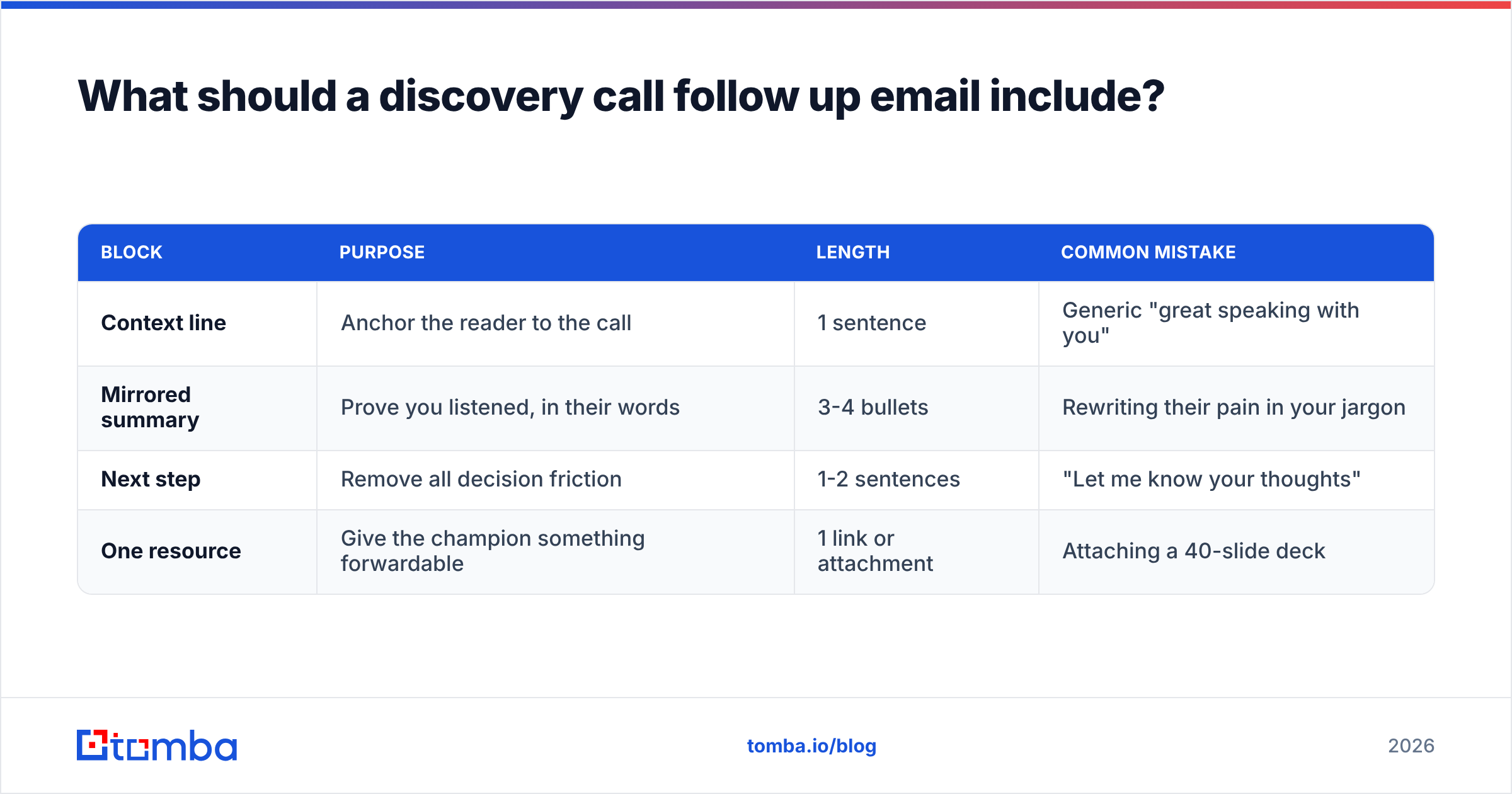
Use four blocks. Every extra block reduces the odds the whole thing gets read.
| Block | Purpose | Length | Common mistake |
|---|---|---|---|
| Context line | Anchor the reader to the call | 1 sentence | Generic "great speaking with you" |
| Mirrored summary | Prove you listened, in their words | 3-4 bullets | Rewriting their pain in your jargon |
| Next step | Remove all decision friction | 1-2 sentences | "Let me know your thoughts" |
| One resource | Give the champion something forwardable | 1 link or attachment | Attaching a 40-slide deck |
The mirrored summary does the heaviest lifting. Take notes verbatim during the call — actual phrases, not paraphrases. If the VP of Sales said "we're flying blind on which accounts are actually in-market," that sentence goes in the email inside quotation marks with attribution. It signals accuracy, and it gives your champion language they can repeat internally without translation loss.
The "one resource" rule matters more than it sounds. A champion forwarding your email to their CFO will not forward a 40-slide deck. They will forward a one-page ROI summary or a single customer story that matches the CFO's own metric. Pick the asset for the next reader, not the current one.
When should you send it, and what does the cadence look like?#
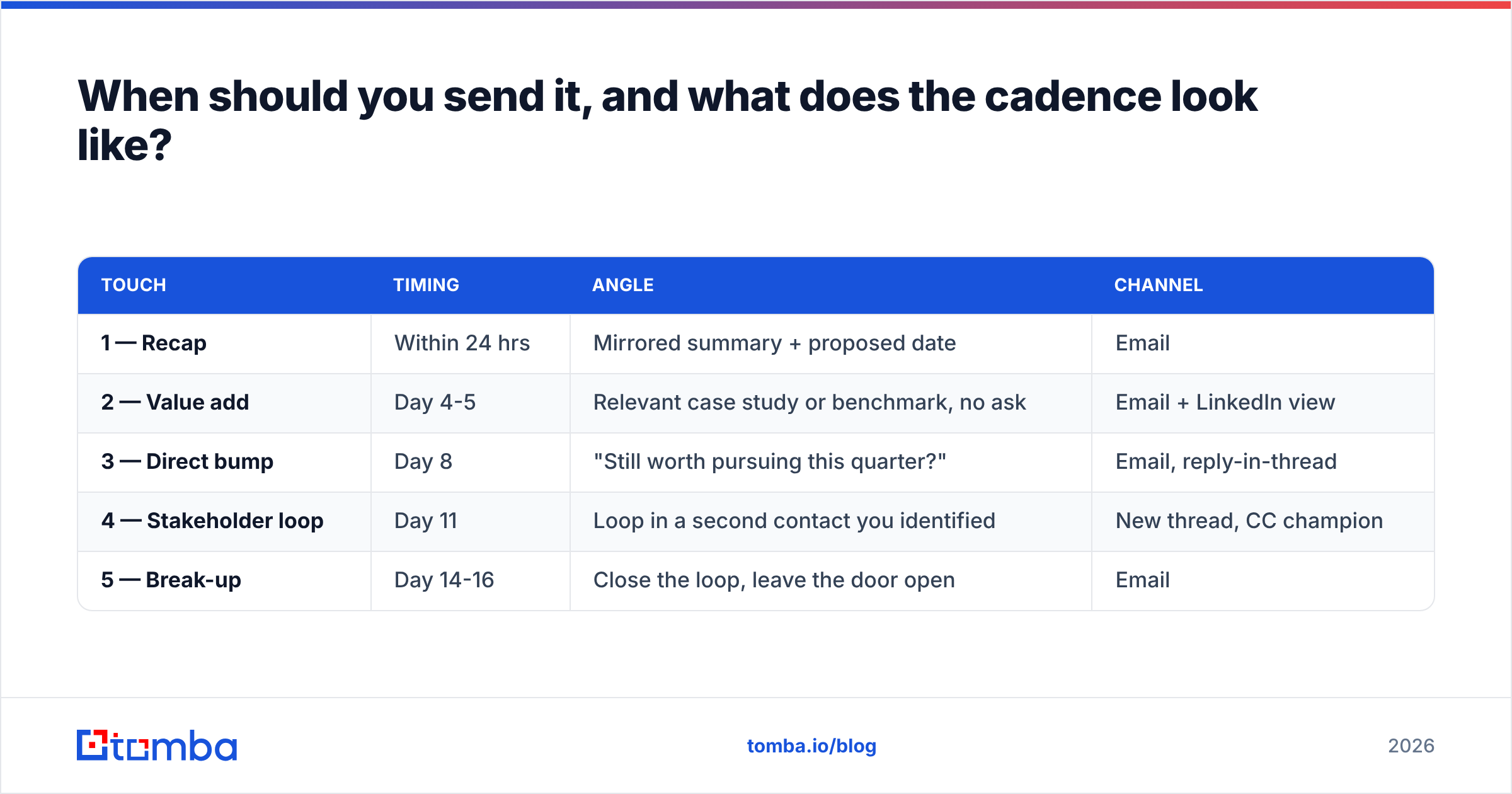
Send the first email the same business day if the call ended before 3 p.m., and by 10 a.m. the next morning otherwise. Then follow a spaced cadence rather than a daily drip — discovery follow-ups are not cold outbound, and daily pings read as desperation.
| Touch | Timing | Angle | Channel |
|---|---|---|---|
| 1 — Recap | Within 24 hrs | Mirrored summary + proposed date | |
| 2 — Value add | Day 4-5 | Relevant case study or benchmark, no ask | Email + LinkedIn view |
| 3 — Direct bump | Day 8 | "Still worth pursuing this quarter?" | Email, reply-in-thread |
| 4 — Stakeholder loop | Day 11 | Loop in a second contact you identified | New thread, CC champion |
| 5 — Break-up | Day 14-16 | Close the loop, leave the door open |
Two rules govern this table. First, touches 1 and 3 stay in the same thread — reply chains carry context and improve open rates. Touch 4 deliberately starts a new thread because you are addressing a new person. Second, never send two consecutive touches that both contain an ask. Alternate ask and give, or the sequence starts to feel like collections.
If you're building this cadence inside a sequencer, most tools handle the scheduling fine. The differentiator is whether the second and fourth stakeholder's contact details are accurate — which is a data problem, not a copywriting one.
What do good discovery call follow up email templates look like?#
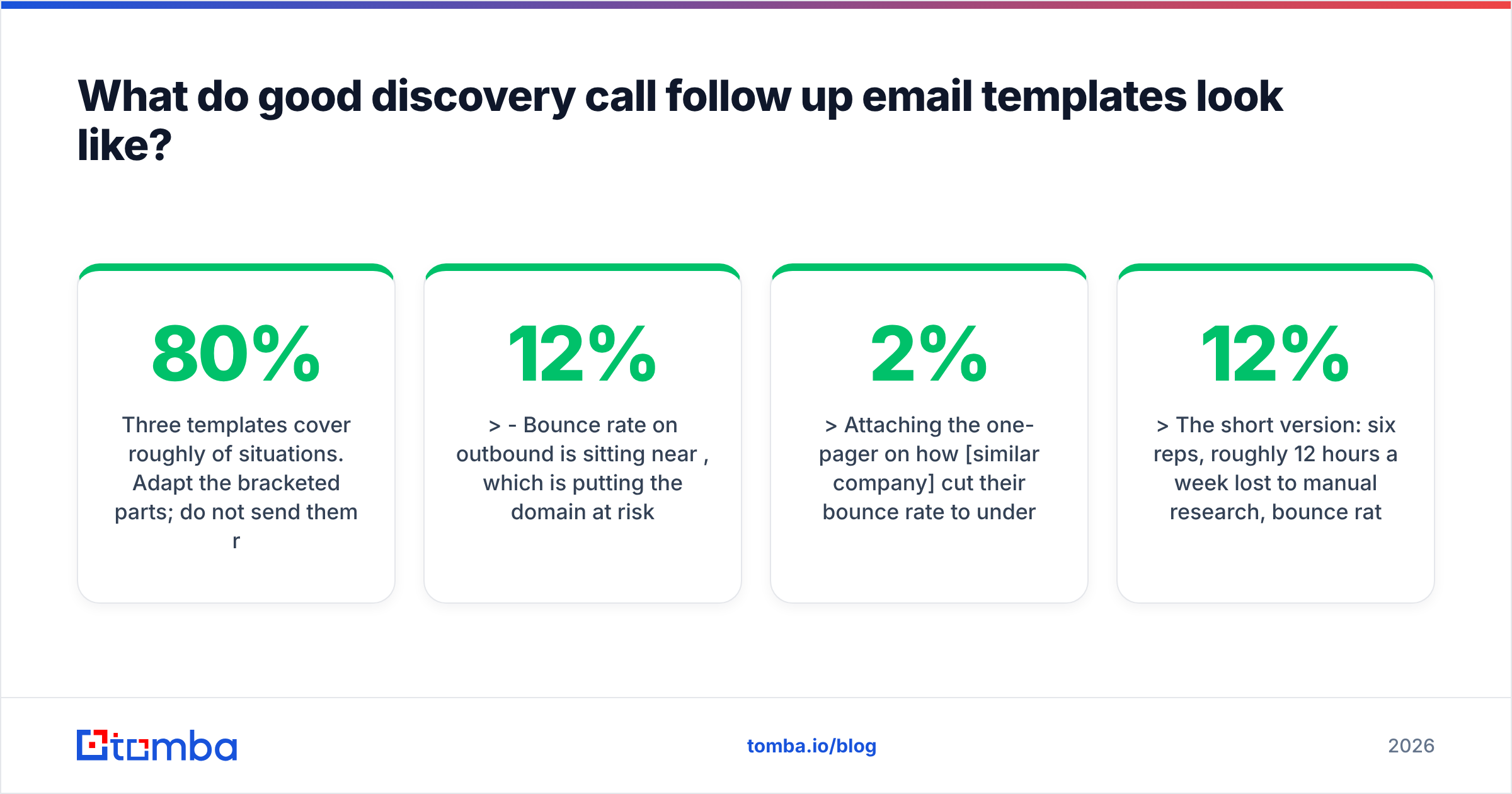
Three templates cover roughly 80% of situations. Adapt the bracketed parts; do not send them raw.
Template 1 — The standard recap (send within 24 hours)
Subject: Recap + the two numbers you mentioned
Hi [Name],
Thanks for walking me through how the SDR team is structured today.
What I heard:
- Your six SDRs spend "about two hours a day" building lists manually
- Bounce rate on outbound is sitting near 12%, which is putting the domain at risk
- You want the new territory model live before the Q4 kickoff
Based on that, the fastest path is a 30-minute working session with you and [Ops contact] where we map your current list-build step by step. I've got Tuesday 2 p.m. or Thursday 10 a.m. — either work?
Attaching the one-pager on how [similar company] cut their bounce rate to under 2%.
[Signature]
Template 2 — The multi-threading email (day 11)
Subject: Quick context for the [territory model] project
Hi [New contact], copying [Champion] —
[Champion] and I spoke last week about the manual list-building load on the SDR team before the Q4 territory change. Since data quality sits with your team, wanted to give you the two-line version rather than have it reach you third-hand.
The short version: six reps, roughly 12 hours a week lost to manual research, 12% bounce rate on the resulting lists.
Worth 20 minutes on your calendar to see whether that's a problem you'd want solved before Q4, or one you're already handling?
[Signature]
Template 3 — The break-up (day 14-16)
Subject: Closing the loop
Hi [Name],
I haven't heard back, which usually means one of three things: the territory project slipped, someone else is already solving it, or this just isn't the quarter for it. All three are fine answers.
I'll stop reaching out on this. If it comes back around in Q1, reply to this email and I'll pick up exactly where we left off — I've kept the notes.
[Signature]
The break-up email consistently outperforms the touch before it, for a simple behavioral reason: it removes the obligation to buy and replaces it with a low-cost way to be honest. People answer questions they can answer with "no."

How do you follow up when the prospect ghosts?#
Ghosting after a good discovery call almost always has an internal cause you can't see: budget got frozen, the champion's priorities shifted, or an executive killed the project in a meeting you weren't in. Your job is not to persuade harder — it's to find a second path into the account.
- Change the recipient, not the message. If your champion has gone silent for eight days, the highest-leverage move is finding another stakeholder in the same function. A domain search surfaces the other people on that team and their email patterns, so you're not guessing at
firstname.lastname@. - Change the channel. A LinkedIn comment on their post or a short voice note often gets a response an email won't. Track it as a touch either way. See LinkedIn outreach for the sequencing.
- Change the ask size. "Are you free for 30 minutes?" becomes "Is this still on the roadmap for Q4 — yes or no?" Single-word answers have a far lower activation cost.
- Verify before you escalate. Before assuming silence, confirm the address is still live. People change roles constantly, and a hard bounce that never surfaced is indistinguishable from being ignored. Run the contact through an email verifier — it takes seconds and prevents you from writing a break-up email to a mailbox that no longer exists.
That last point is underrated. In our experience reviewing decayed pipelines, a meaningful slice of "ghosted" contacts are simply people who left the company. HubSpot's sales data research has repeatedly flagged contact-data decay as a leading cause of pipeline leakage — B2B contact databases lose roughly 20-30% of their accuracy each year through job changes alone.
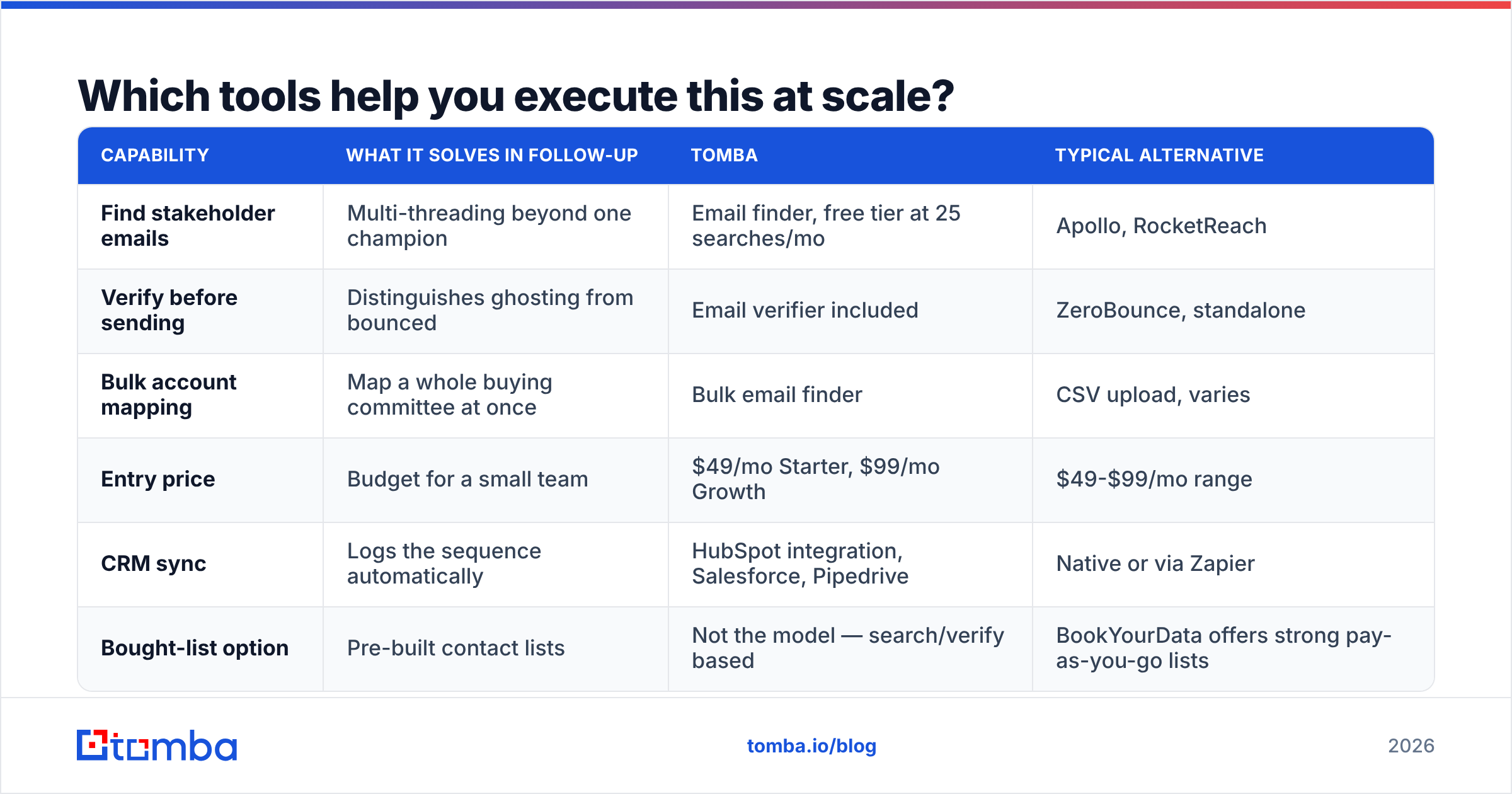
Which tools help you execute this at scale?#
The follow-up itself is manual work — templates help, full automation doesn't. Where tooling actually pays off is in the surrounding data: finding the second and third stakeholder, verifying addresses before you send, and enriching the account so your recap email references the right context.
| Capability | What it solves in follow-up | Tomba | Typical alternative |
|---|---|---|---|
| Find stakeholder emails | Multi-threading beyond one champion | Email finder, free tier at 25 searches/mo | Apollo, RocketReach |
| Verify before sending | Distinguishes ghosting from bounced | Email verifier included | ZeroBounce, standalone |
| Bulk account mapping | Map a whole buying committee at once | Bulk email finder | CSV upload, varies |
| Entry price | Budget for a small team | $49/mo Starter, $99/mo Growth | $49-$99/mo range |
| CRM sync | Logs the sequence automatically | HubSpot integration, Salesforce, Pipedrive | Native or via Zapier |
| Bought-list option | Pre-built contact lists | Not the model — search/verify based | BookYourData offers strong pay-as-you-go lists |
That last row deserves a note. If your motion is genuinely list-first — you know the exact titles and geographies and want a clean file today — a pay-as-you-go database like BookYourData is a legitimate fit and often faster than searching account by account. Tomba's model is different: you search and verify per account, which suits deal-based follow-up work where you're mapping one buying committee at a time. Neither approach is universally better; they solve different halves of the problem.
For pricing specifics across tiers, Tomba pricing lists the credit allocations per plan. Compare against alternatives on G2 before committing to an annual contract — the category shifts fast.
How do you measure whether your follow-ups are working?#
Track four numbers, not ten.
- Follow-up reply rate. Replies to touch 1 divided by discovery calls held. Under 40% means your recap isn't mirroring well enough or your timing is slipping past 24 hours.
- Time-to-next-meeting. Median days between discovery call and the booked second meeting. If this creeps past seven days, your first email isn't proposing a concrete date.
- Multi-thread rate. Percentage of post-discovery deals with two or more contacts on the thread. Aim for 60%+. This single metric correlates more strongly with close rate than any copy variable.
- Break-up revival rate. Percentage of break-up emails that get a reply. If it's under 10%, your earlier touches were probably too aggressive and the prospect had already written you off.
Run these monthly by rep, not weekly by team. Weekly samples on a low-volume motion produce noise that gets mistaken for signal, and you'll end up rewriting a template that was working fine.
One caveat on benchmarks: reply-rate targets vary enormously by segment. A 40% follow-up reply rate is realistic in mid-market SaaS after a genuinely qualified call and unrealistic in enterprise procurement cycles where the same call might generate a reply four weeks later. Set your own baseline from your last 50 calls before adopting anyone's published number, including this one. Also worth tracking your overall response rate trend so you can separate a copy problem from a targeting problem.
What's the fastest way to improve your follow-up starting tomorrow?#
Do these three things before you touch a template.
Take verbatim notes. Stop paraphrasing during calls. Capture the prospect's exact sentences, especially any sentence containing a number or a deadline. Those two categories become your email's spine.
Identify the second stakeholder on the call itself. Ask, "Who else would need to weigh in on this before it moves?" Then find that person's contact details the same day, while the call is fresh. Waiting until day 11 to start looking is what makes multi-threading feel hard.
Pre-write the next-step sentence before the call ends. If you know what the logical next step is by minute 25, you can propose it by minute 28 and simply confirm it in writing. The follow-up email becomes documentation instead of persuasion — which is exactly what it should be.
Getting the contact data right is half of follow-up execution. Multi-threading only works if the second and third stakeholder's addresses are accurate, and "ghosting" only means something if you've confirmed the mailbox is live. Tomba's Email Finder locates verified professional addresses by name and company domain, with a free tier at 25 searches per month and paid plans starting at $49/mo — enough to map a full buying committee for every deal in your pipeline without adding another seat-based subscription to the stack.
Related guides#
Ready to find emails that actually work?
Join 150,000+ professionals who stopped guessing and started sending. Free credits on signup — no credit card required.
Get the Tomba newsletter
Practical outbound tactics and product updates — once every two weeks.
About the author