DocSend vs Highspot in 2026: Which Sales Tool Wins?
DocSend tracks documents. Highspot runs an entire enablement program. They get compared constantly, but they solve different problems — here's the honest breakdown of pricing, tracking depth, and who each one actually fits.
DocSend vs Highspot is a fair fight on exactly one point: both let you send a file and see who read it. After that, they split. One is a document tracker. The other is a full sales enablement platform. Here is the honest breakdown of price, depth, and fit.
TL;DR
- DocSend tracks documents. Highspot runs an enablement program. They overlap on "send a deck, see who opened it." They diverge on almost everything else.
- DocSend wins on price and speed. Paid plans start near $15 per user per month. You can be tracking links in ten minutes, with no rollout project.
- Highspot wins on scale, control, and coaching. You get a content library, buyer rooms, training, and analytics tied to CRM deals. The price is an annual contract, usually five figures.
- Team size decides it. Under ~15 reps, a link tracker like DocSend is almost always the right call. Above ~50 reps with a full-time enablement owner, Highspot starts to pay for itself.
- Neither tool creates pipeline. Both assume you already have the right people to send documents to. That is a separate problem, and a cheaper one to fix.
What is DocSend, and what does it do?#
DocSend has been part of Dropbox since 2021. It is a secure way to share and track documents. You upload a PDF, deck, or data room. You get a link instead of an attachment. Then you watch what happens: who opened it, which pages they read, how long they stayed, and whether they passed it on.
That page-by-page view is why DocSend became a default in venture fundraising. A founder sends a deck as a link. The data shows a partner spent four minutes on the traction slide and no time on the team slide. The follow-up writes itself. The same trick works for sales proposals, pricing sheets, and security questionnaires.
What DocSend gives you:
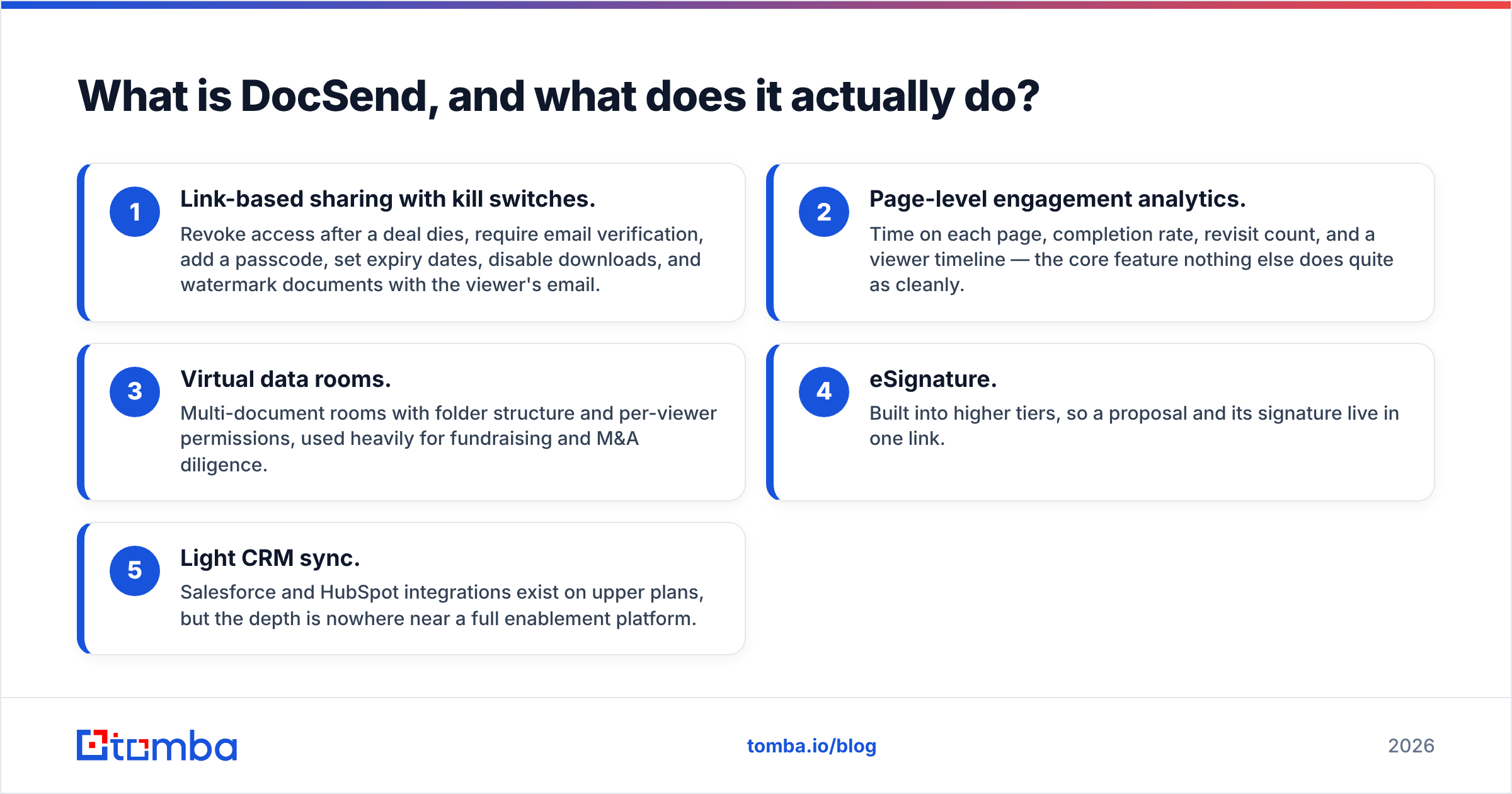
- Links with a kill switch. Cut off access after a deal dies. Require an email, add a passcode, set an expiry date, block downloads, and stamp each page with the viewer's email.
- Page-level analytics. Time on each page, completion rate, repeat visits, and a viewer timeline. Nothing else does this quite as cleanly.
- Virtual data rooms. Multi-document rooms with folders and per-viewer permissions. Fundraising and M&A teams lean on these.
- eSignature. Built into higher tiers, so a proposal and its signature live in one link.
- Light CRM sync. Salesforce and HubSpot integrations exist on upper plans. The depth is nowhere near a full enablement platform.
DocSend is narrow on purpose. It will not train your reps. It will not rank 4,000 assets by performance. It will not tell a new rep which case study suits a mid-market healthcare buyer in stage three. It tracks documents very well, then stops. Check docsend.com for current plan details before you set a budget.
What is Highspot, and how is it different?#
Highspot is a full sales enablement platform. Content management is one module among several. It also covers sales training and coaching, guided selling plays, digital sales rooms, and analytics that link content use back to deals in your CRM.
The mental model is simple. DocSend is a tracked envelope. Highspot is the mailroom, the filing system, the training school, and the reporting desk in one.
Highspot's core promise is that reps find and use the right content. Marketing publishes 300 assets a year. Reps cannot find them. So they rebuild decks from scratch, and adoption collapses. Highspot answers that with search, recommendations tied to deal context, and control — expiry dates on assets, approval steps, and one source of truth that marketing owns.
The other half is enablement proper: onboarding paths, certification, practice recordings with feedback, and "plays" that pair a sales step with the content behind it. If enablement is a real job with a real owner, that is the value. If enablement is one RevOps person and a shared Drive folder, most of it sits unused. Highspot lists no public pricing. You can browse its product pages at highspot.com and read verified buyer reviews on G2 for a reality check on setup effort.

DocSend vs Highspot: how do they compare feature by feature?#
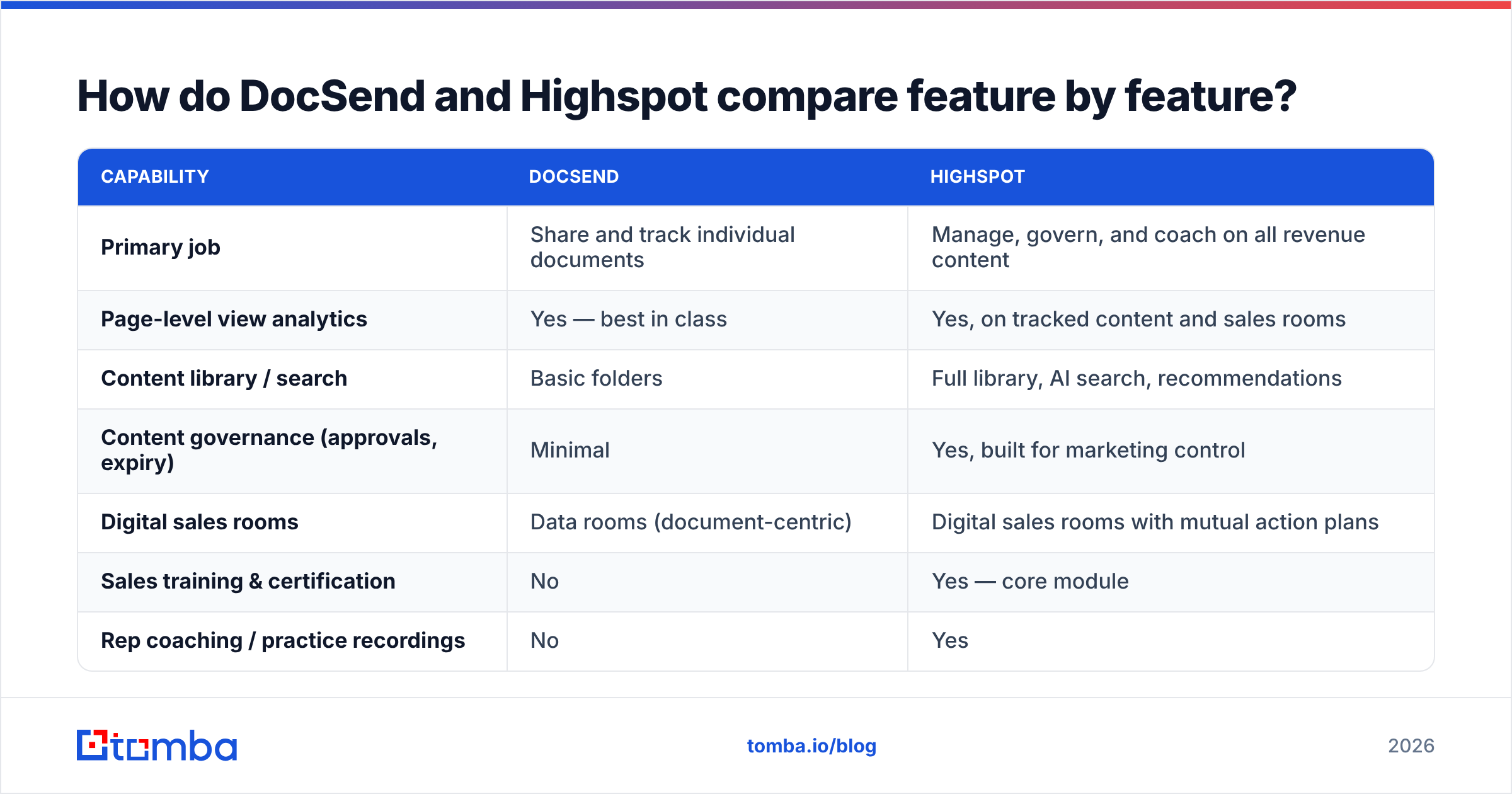
Here is where the two products really differ. Note that DocSend features vary by tier. Several rows below apply only to Advanced or Enterprise plans.
| Capability | DocSend | Highspot |
|---|---|---|
| Primary job | Share and track individual documents | Manage, govern, and coach on all revenue content |
| Page-level view analytics | Yes — best in class | Yes, on tracked content and sales rooms |
| Content library / search | Basic folders | Full library, AI search, recommendations |
| Content governance (approvals, expiry) | Minimal | Yes, built for marketing control |
| Digital sales rooms | Data rooms (document-centric) | Digital sales rooms with mutual action plans |
| Sales training & certification | No | Yes — core module |
| Rep coaching / practice recordings | No | Yes |
| Guided selling plays | No | Yes |
| eSignature | Yes (higher tiers) | Via integration |
| CRM integration depth | Salesforce, HubSpot (basic) | Deep Salesforce, Dynamics, HubSpot sync |
| Setup time | Minutes | 6–12 weeks typical implementation |
| Admin overhead | Near zero | Requires a dedicated owner |
| Contract model | Monthly or annual, self-serve | Annual contract, sales-led |
| Best team size | 1–25 | 50+ |
The pattern holds. DocSend is a tool, Highspot is a system. Tools get adopted by default. Systems get adopted only when someone owns the rollout.
One honest point in DocSend's favor. For "I need to know exactly how this buyer read this document," its analytics are still sharper and faster to act on than most enablement suites, Highspot included. For "our 80 reps keep sending the 2024 pricing PDF," DocSend has no answer at all.
DocSend vs Highspot pricing: what do they cost in 2026?#
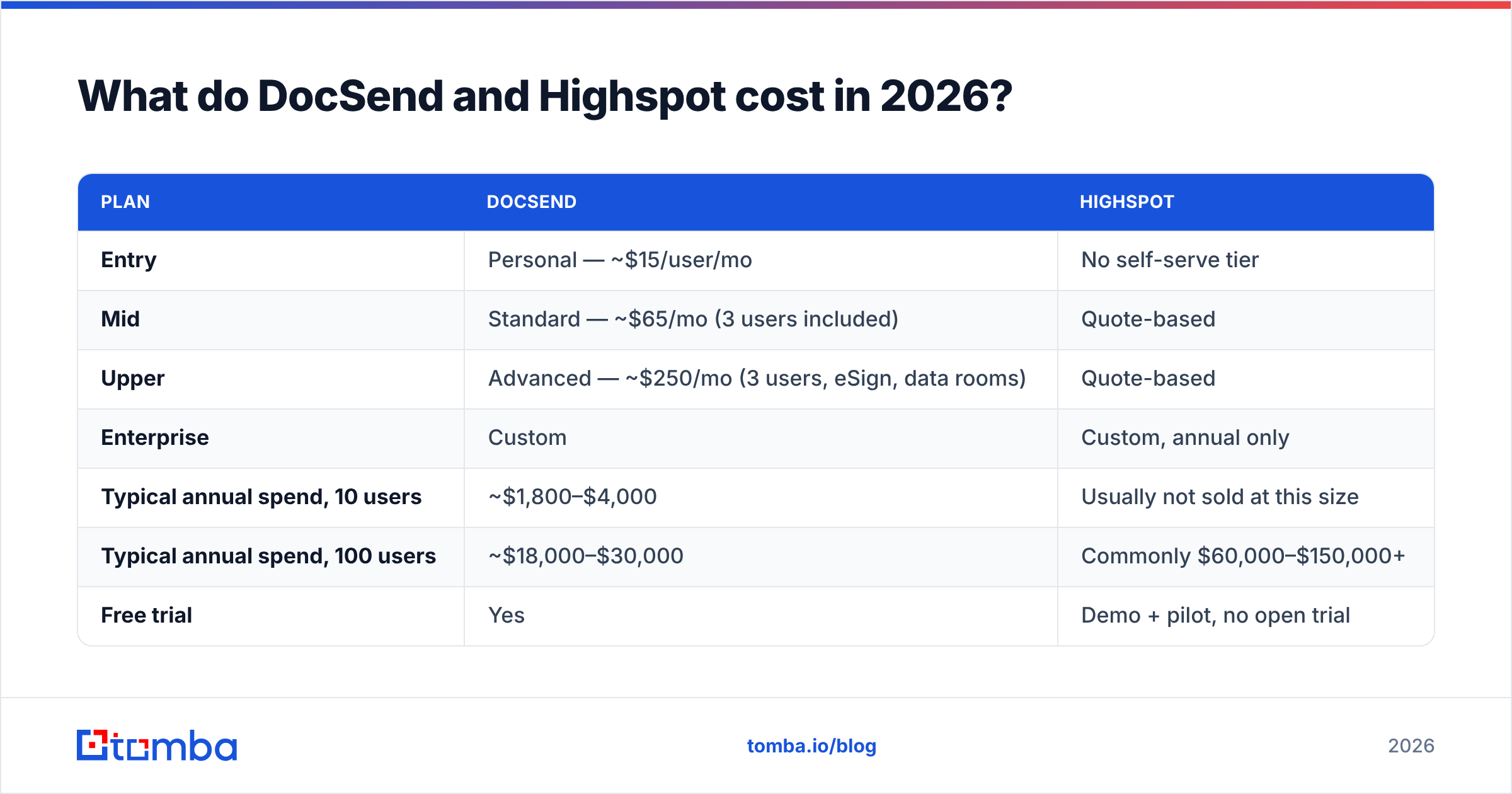
DocSend publishes pricing. Highspot does not. That gap alone tells you which buyer each product wants.
| Plan | DocSend | Highspot |
|---|---|---|
| Entry | Personal — ~$15/user/mo | No self-serve tier |
| Mid | Standard — ~$65/mo (3 users included) | Quote-based |
| Upper | Advanced — ~$250/mo (3 users, eSign, data rooms) | Quote-based |
| Enterprise | Custom | Custom, annual only |
| Typical annual spend, 10 users | ~$1,800–$4,000 | Usually not sold at this size |
| Typical annual spend, 100 users | ~$18,000–$30,000 | Commonly $60,000–$150,000+ |
| Free trial | Yes | Demo + pilot, no open trial |
| Implementation fee | None | Often a one-time services fee |
Treat the Highspot figures as rough ranges. They come from public buyer reviews and procurement chatter, not a quote. Enablement pricing swings on seat count, modules bought, and how badly the vendor wants your logo before quarter end. Always get two competing quotes.
The hidden cost on the Highspot side is not the license. It is the person. A platform like this needs a content owner who prunes the library, tags assets, builds the plays, and chases adoption. Budget for that role. Skip it, and you get the shelfware ending that kills most enablement deals.

Which one should you choose?#
Use the team-shape test, not the feature list.
Choose DocSend if:
- Fewer than ~25 people send documents, and no one owns enablement full time.
- Your main question is "did this buyer read the proposal, and where did they stall?"
- You raise capital, run diligence, or share private files, and you need links you can revoke and watermark.
- You want to be live today, not next quarter.
Choose Highspot if:
- You have 50+ reps, a marketing team shipping content at volume, and a real content-findability problem.
- New reps take months to ramp, and you want training and content in one place.
- You need marketing control — approvals, expiry, versions — because stale assets keep reaching buyers.
- You can name the person who will own the platform on day one.
Choose neither, for now, if:
- Your reps do not send enough documents for the tracking data to mean anything.
- Your real bottleneck is top of funnel. There are not enough good conversations to justify a proposal.
That last case is more common than either vendor will admit. Engagement analytics assume a steady flow of interested buyers. If your team sends nine proposals a quarter, no heatmap changes the outcome. The constraint sits upstream.
What do neither DocSend nor Highspot solve?#
Neither product finds you buyers. Both start after you have a named contact, a working email address, and a conversation warm enough to justify sending something.
That gap is easy to miss. You can spend $90,000 a year on an enablement platform and still watch reps send polished, well-governed content to fifteen contacts a month. Finding accurate contact data is still manual and slow.
The upstream stack looks different:
- Contact discovery — turn a target account list into named decision-makers with verified work emails. An email finder or domain search does this in bulk, for a fraction of enablement pricing.
- Verification — bad addresses hurt your sender reputation and skew every metric downstream. Run lists through an email verifier before the first send.
- Enrichment — job titles, company size, and tech stack, so your segments have something to work with. That is what data enrichment covers.
- Volume — a repeatable way to process hundreds of accounts at once, instead of one LinkedIn tab at a time.
If you would rather buy a list than build one, providers like BookYourData sell a ready-made B2B contact file. Verify it before import. Either path costs less than hoping a content platform will fix a pipeline problem.
Once your contacts are real and verified, the DocSend vs Highspot decision becomes what it should be: a tooling choice sized to your team, not a cure for a thin funnel.
How do you run a fair evaluation?#
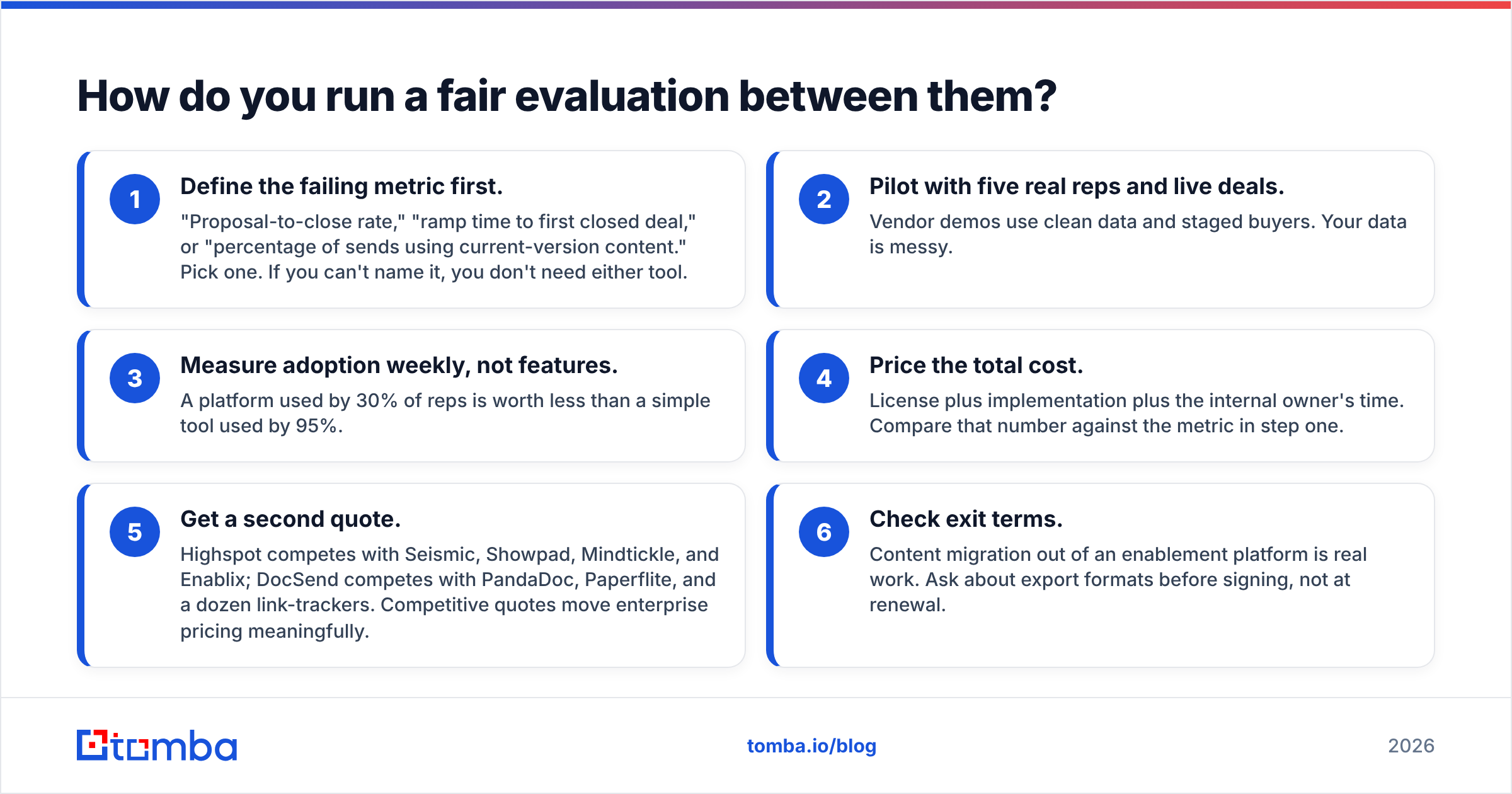
If you are truly weighing both, run a 30-day test instead of a feature-sheet duel:
- Name the failing metric first. Proposal-to-close rate, ramp time to first closed deal, or share of sends using current content. Pick one. If you cannot name it, you do not need either tool.
- Pilot with five real reps and live deals. Vendor demos use clean data and staged buyers. Your data is messy.
- Measure adoption weekly, not features. A platform used by 30% of reps is worth less than a simple tool used by 95%.
- Price the whole thing. License, setup, and the owner's time. Compare that number to the metric in step one.
- Get a second quote. Highspot competes with Seismic, Showpad, Mindtickle, and Enablix. DocSend competes with PandaDoc, Paperflite, and a dozen link trackers. Competing quotes move enterprise pricing.
- Check the exit terms. Moving content out of an enablement platform is real work. Ask about export formats before you sign, not at renewal.
Most teams land in one of two places: DocSend plus a decent CRM, or Highspot plus a real enablement hire. The middle ground — an enterprise platform bought with no owner — is where the money disappears.
Frequently asked questions#
Is DocSend a Highspot competitor? Only at the edges. They compete on "share content and track engagement." They do not compete on training, coaching, governance, or guided selling. That is most of what Highspot sells.
Does Highspot include DocSend-style page analytics? Yes, for content shared through Highspot links and digital sales rooms. The detail is good. DocSend's per-page viewer timeline is still the sharper tool for a single document.
Can you use both? Some teams do. Highspot runs the internal library and the enablement program. DocSend handles high-stakes external files like data rooms and board materials. It is redundant spend, but fair if the use cases really are separate.
What is the cheapest credible alternative? For document tracking alone, PandaDoc and Paperflite sit in a similar price band with different strengths. PandaDoc leans toward proposals and eSign. Paperflite leans toward content experience. For enablement at mid-market scale, look at Enablix or Showpad first.
How long does a Highspot rollout take? Plan for 6–12 weeks to first real adoption. Longer if your content library needs a cleanup. Anyone promising two weeks is describing the technical setup, not adoption.
Start where the pipeline starts#
The DocSend vs Highspot choice matters. But it only matters once you have enough qualified buyers for engagement data to mean something. If your reps polish decks for a contact list that is half stale, the enablement budget is treating the wrong symptom.
Fix the input first. Tomba's Email Finder turns a name and company domain into a verified work email, in bulk, with a confidence score on every result. The free tier gives you 25 searches a month, so you can test accuracy against contacts you already know. Paid plans start at $49 a month — about what one Highspot seat costs in a quarter. See full Tomba pricing and build the list before you buy the platform.
Related guides#
Ready to find emails that actually work?
Join 150,000+ professionals who stopped guessing and started sending. Free credits on signup — no credit card required.
Get the Tomba newsletter
Practical outbound tactics and product updates — once every two weeks.
About the author