11 Best Doyoumail Alternatives in 2026 (Free & Paid)
Doyoumail's unlimited-sending pitch looks great until deliverability bites. Here are 11 alternatives compared on price, data quality, inbox placement, and who each one actually fits.
TL;DR
- Doyoumail sells volume — unlimited-style sending and cheap SMTP infrastructure. That works only if your list is already clean and your domains are warmed. It is not a data provider.
- If your real bottleneck is contact data quality (bad emails, no verification, no enrichment), you need a finder/verifier stack — Tomba, Findymail, Hunter, or Prospeo — not a bigger sending pipe.
- If your bottleneck is sequencing and inbox rotation, look at Instantly, Smartlead, Saleshandy, or Emelia.
- Pricing spread is wide: verification-first tools start around $29–$49/mo, sending platforms $30–$97/mo, and full GTM suites run $99–$249/mo per seat.
- The cheapest total setup for most teams under 20k sends/month: a dedicated finder + verifier ($49/mo) plus a sending platform ($37–$97/mo). Splitting the stack usually beats one "does everything, badly" tool.
Doyoumail markets itself on one number: how many emails you can push per month for how few dollars. That pitch lands with agencies and solo founders who have already burned through Mailshake or Lemlist budgets. But volume is the easiest part of cold email to buy and the least correlated with pipeline. Before you switch, it helps to know what you're actually replacing.
What is Doyoumail and what does it actually do?#
Doyoumail is a cold-email sending platform built around cheap, high-volume dispatch. Its selling points are unlimited or very-high sending caps, bundled or low-cost inbox provisioning, and simplified campaign setup. It sits in the same bucket as budget senders that emerged after Google and Yahoo tightened bulk-sender requirements in 2024 — tools that compete on cost-per-send rather than on data or reply intelligence.
What it is not: a contact database, an email finder, or a verification engine. If you feed it a scraped list, it will happily send to the scraped list, and your domain will absorb the bounce rate. That distinction is the single most important thing to understand before you shop for replacements, because half the "Doyoumail alternatives" people search for are actually data tools, not senders.
Here's how the categories break down:
- Email finders and verifiers — Tomba, Findymail, Hunter, Prospeo. They produce and validate addresses. They do not send.
- Sending and sequencing platforms — Instantly, Smartlead, Saleshandy, Emelia, Lemlist. They rotate inboxes, warm domains, and run sequences. Their built-in data, when present, is thin.
- Full GTM suites — Apollo, Amplemarket. Database plus sequencer in one login, at a higher per-seat price and with data quality that varies by region.
- B2B list vendors — BookYourData and similar. You buy pre-verified contacts outright rather than searching for them, which suits teams that want a defined list on day one.
- Infrastructure-only — SMTP relays and inbox providers. Cheapest per send, zero campaign logic, all responsibility on you.
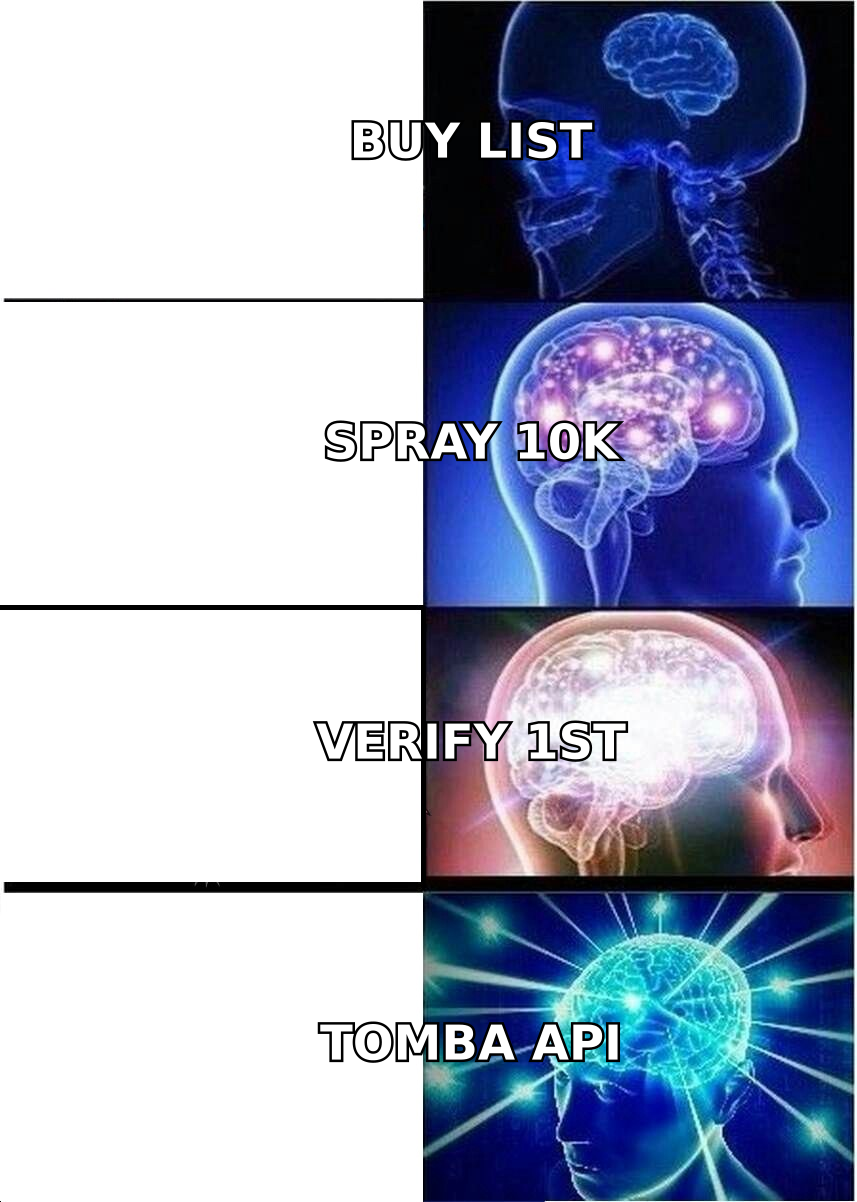
Most teams that leave Doyoumail don't need "a better Doyoumail." They need to move one layer up the stack — to the data — and keep sending cheap.
Why do teams look for Doyoumail alternatives?#
Four complaints show up repeatedly in reviews and community threads.
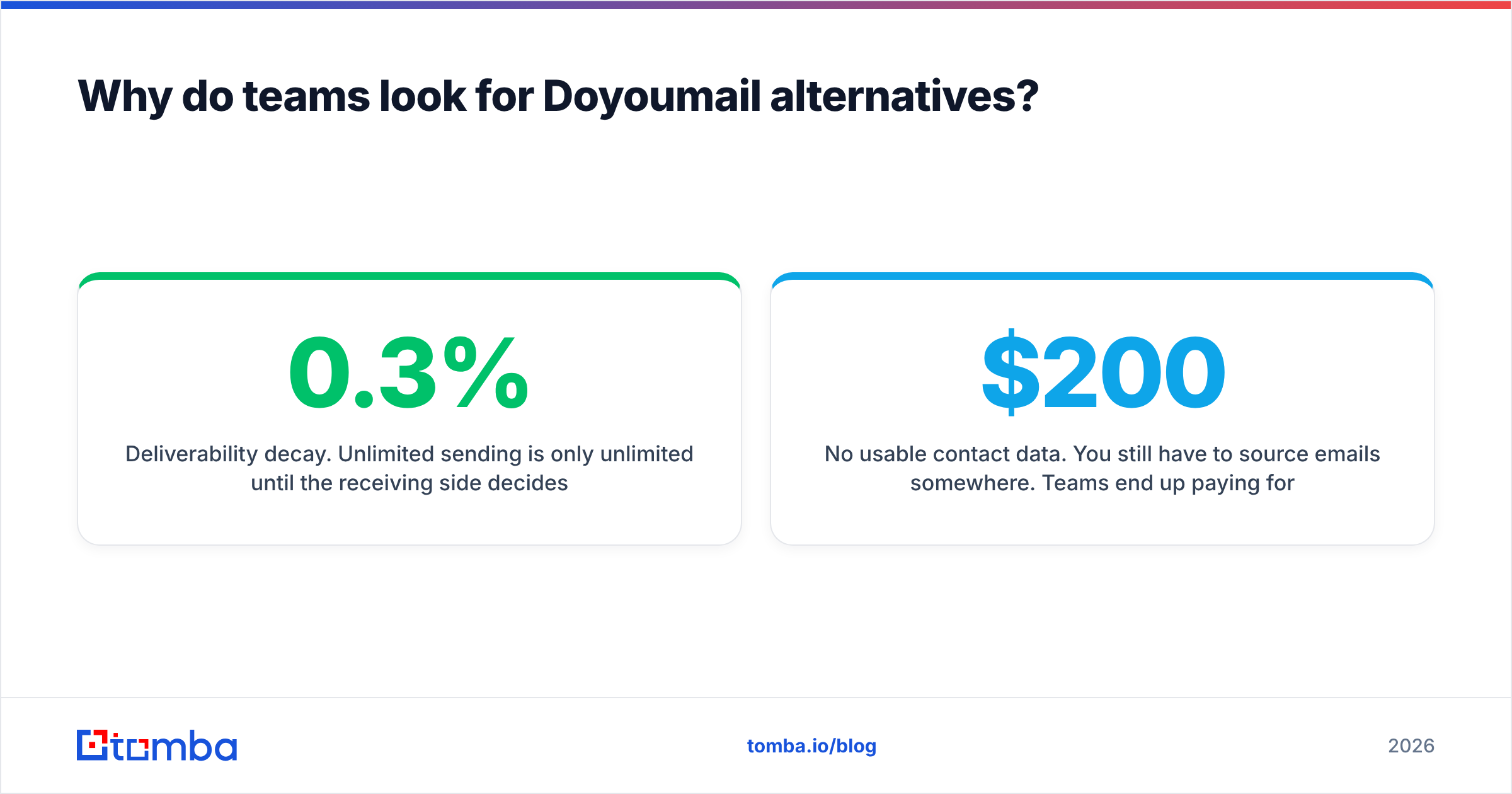
Deliverability decay. Unlimited sending is only unlimited until the receiving side decides otherwise. Google's bulk sender rules cap spam complaints at 0.3% and require authenticated mail with one-click unsubscribe. A platform that lets you send 50,000 emails a month doesn't make Gmail accept 50,000 emails a month. If your open rate slid from 40% to 12% over six weeks, the platform's ceiling was never the constraint — your sender reputation was.
No usable contact data. You still have to source emails somewhere. Teams end up paying for a scraper, a finder, and a sender, and then wonder why "cheap" cost $200/mo.
Thin reporting. Budget senders typically report sends, opens, and replies. They rarely report per-domain placement, per-inbox health, or bounce categorization — the three metrics that tell you whether to pause a campaign.
Support and account risk. Low-cost platforms operating at high volume attract abuse, and abuse attracts blocklist attention on shared infrastructure. Your campaign quality can be dragged down by someone else's.
None of that means Doyoumail is a bad product for what it is. It means the cost of a cheap sender is usually paid somewhere else in the funnel.
Which Doyoumail alternatives are worth comparing?#
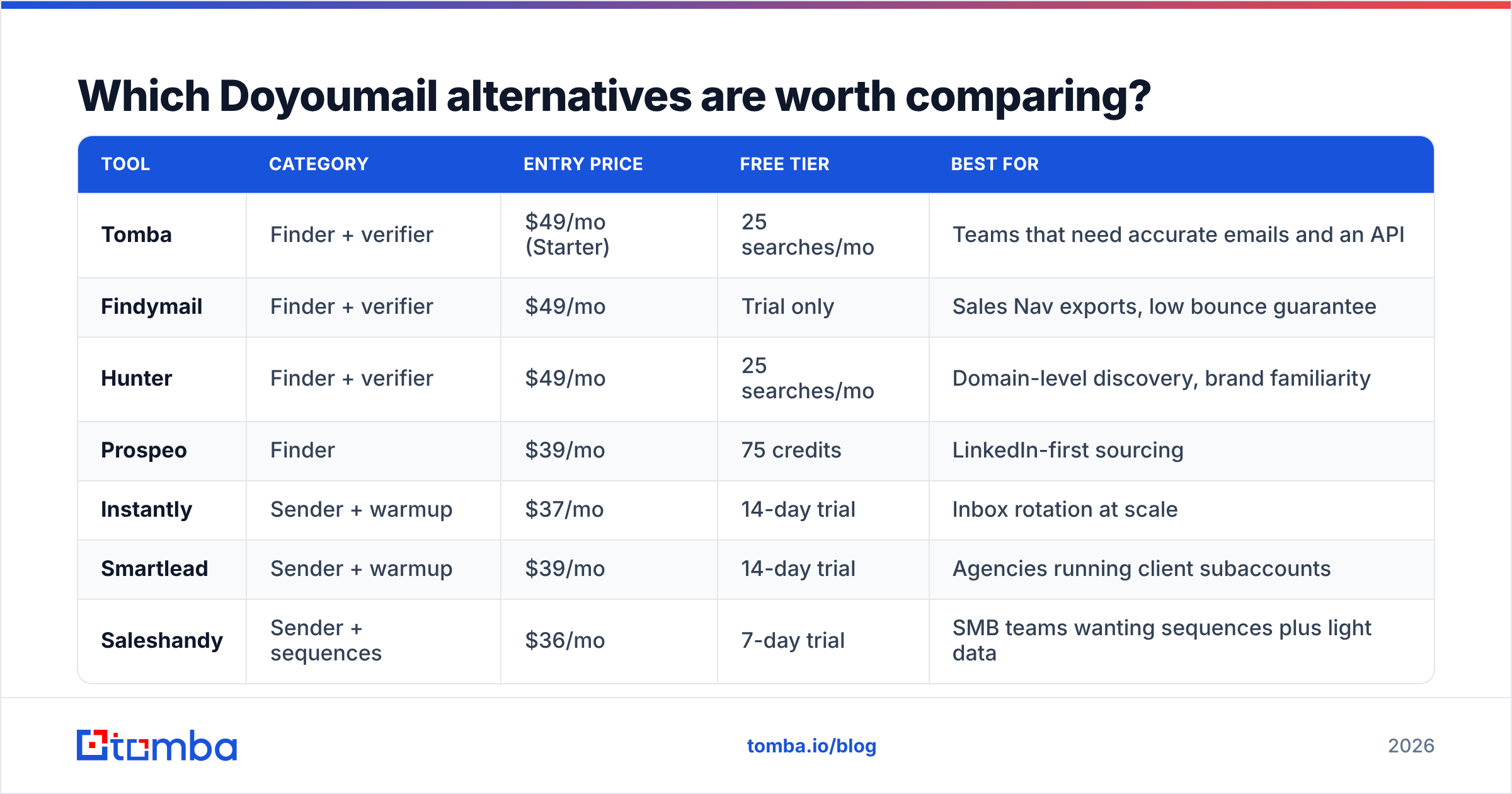
The table below covers the eleven tools that come up most often as replacements, grouped by what they actually solve.
| Tool | Category | Entry price | Free tier | Best for |
|---|---|---|---|---|
| Tomba | Finder + verifier | $49/mo (Starter) | 25 searches/mo | Teams that need accurate emails and an API |
| Findymail | Finder + verifier | $49/mo | Trial only | Sales Nav exports, low bounce guarantee |
| Hunter | Finder + verifier | $49/mo | 25 searches/mo | Domain-level discovery, brand familiarity |
| Prospeo | Finder | $39/mo | 75 credits | LinkedIn-first sourcing |
| Instantly | Sender + warmup | $37/mo | 14-day trial | Inbox rotation at scale |
| Smartlead | Sender + warmup | $39/mo | 14-day trial | Agencies running client subaccounts |
| Saleshandy | Sender + sequences | $36/mo | 7-day trial | SMB teams wanting sequences plus light data |
| Emelia | Sender + LinkedIn | $37/mo | Limited free | Multichannel on a budget |
| Lemlist | Sender + personalization | $69/mo | 14-day trial | Image/video personalization |
| Apollo | Full GTM suite | $49/user/mo | 10k credits/yr | One-login database + sequencer |
| BookYourData | B2B contact lists | Pay-as-you-go | Sample credits | Buying a defined, pre-verified list upfront |
Two things to read out of that table. First, no single tool spans data quality and sending infrastructure well at the entry price — Apollo comes closest and pays for it in per-seat cost. Second, the finder tier and the sender tier both start near $40/mo, which is why the split-stack approach lands around $80–$90/mo total and outperforms most single-vendor setups.
How do the email-finder alternatives compare on accuracy?#
If you're replacing Doyoumail because your bounce rate is the problem, this is the section that matters. Accuracy is not a marketing number — it's the ratio of addresses that accept mail to addresses returned, measured on your ICP, not on a vendor's benchmark list.

Three variables drive real-world accuracy:
- Source breadth. Tools that combine public web crawling, pattern inference, and partner data find more of the long tail than tools relying on a single scraped index. Check the vendor's data sources page before you trust a claimed hit rate.
- Verification depth. SMTP handshake alone misses catch-all domains, which are now roughly a third of mid-market corporate mail. A serious stack includes a dedicated catch-all verifier rather than marking every catch-all "risky" and moving on.
- Freshness. B2B contact data decays around 22–30% a year through job changes. A database refreshed quarterly is materially worse than one refreshed continuously, regardless of headline record count.
Run the same 100-contact test list through any two finders and compare hit rate after verification, not before. Vendors quote pre-verification coverage because it's the bigger number.
For teams that want the data layer to be programmable rather than a UI they log into, the email finder API route is usually cheaper per contact than seat-based suites — you enrich at the moment a lead enters your CRM instead of buying credits you may never spend.
Which alternative fits which team?#
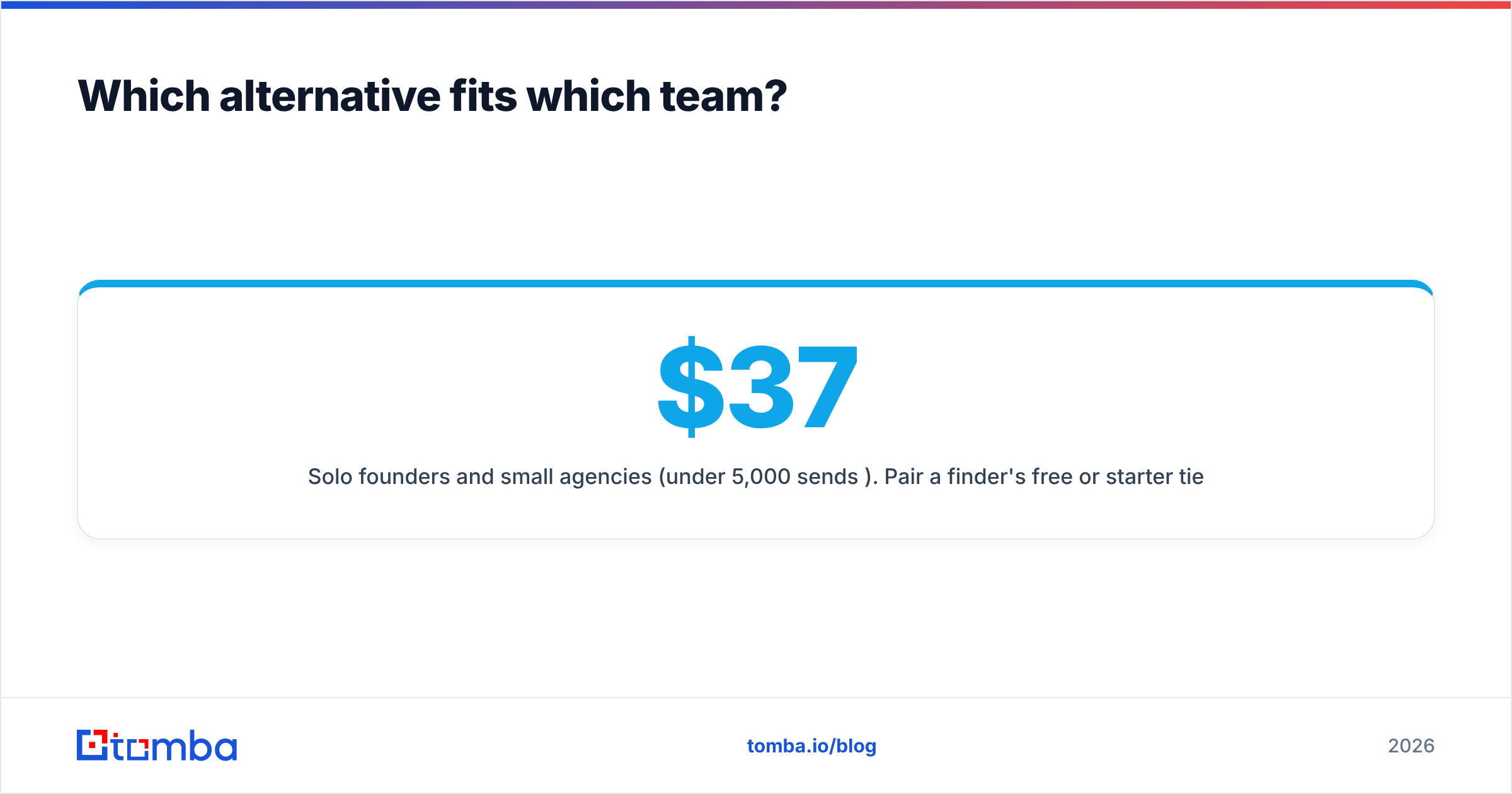
Solo founders and small agencies (under 5,000 sends/month). Pair a finder's free or starter tier with a $37/mo sender. Tomba's free tier at 25 searches/month is enough to validate the workflow; Starter at $49/mo covers a real pipeline. Add Instantly or Emelia for sending. Total: under $90/mo.
Agencies running multiple clients. Smartlead's subaccount model is the practical reason most agencies pick it over Instantly — client-level separation of domains, reporting, and blocklist exposure. Feed it from a bulk email finder so each client's list is verified before the first send.
Mid-market outbound teams (5–20 reps). The math shifts. Apollo's per-seat price becomes competitive when you count the credits and sequencer together, but regional data quality outside North America is the common complaint. A hybrid — Apollo for discovery, a dedicated verifier before every send — is what most teams end up running.
Teams that want a list, not a search workflow. BookYourData is a solid fit here: you specify the ICP, buy pre-verified contacts, and skip the enrichment loop entirely. It's a different purchasing model rather than a worse one, and for one-off campaigns or new-market tests it's often faster than building a search process.
RevOps and engineering-led teams. Skip the UI entirely. Enrichment via API into your warehouse, then sync to whatever sequencer the sales team already uses. This is where seat-based pricing stops making sense.

What should you check before switching?#
Switching senders is easy. Switching without repeating the same mistake takes a checklist.
- Authenticate everything first. SPF, DKIM, and DMARC on every sending domain. Run an SPF checker on each one — misconfigured records are the most common silent cause of placement loss, and no platform fixes them for you.
- Verify before import, not after bounce. Every list, every time, including lists a vendor swears are verified. An email verifier pass costs a fraction of a cent per record and protects a domain worth far more.
- Warm at a realistic ramp. New domains need weeks, not days. Model the ramp before you commit to a volume target.
- Measure placement, not opens. Apple Mail Privacy Protection inflates opens. Seed-list placement testing and reply rate are the honest signals.
- Check contract terms. Several budget senders bill annually with no refund window. Read the terms before the trial ends.
You can compare vendor claims against user reports on G2 before committing — filter reviews to the last twelve months, since deliverability tooling changed materially after the 2024 bulk-sender rules. For the rules themselves, Google's sender guidelines remain the authoritative source, and HubSpot's deliverability research is a reasonable neutral primer on benchmarks.
Is a split stack actually cheaper than an all-in-one?#
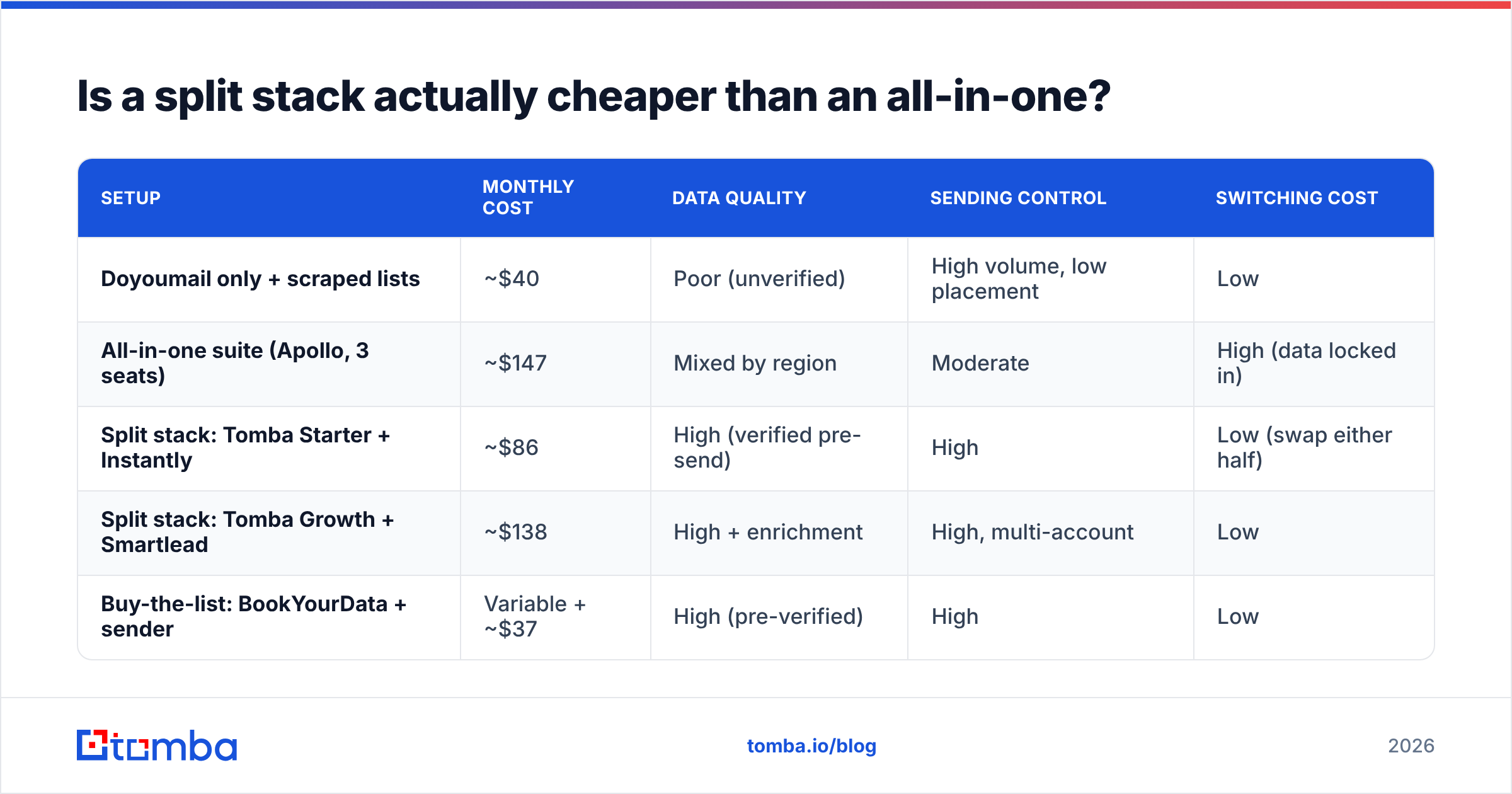
Usually, yes — and the gap widens as volume grows. Here's a concrete comparison for a three-person team sending roughly 15,000 emails a month.
| Setup | Monthly cost | Data quality | Sending control | Switching cost |
|---|---|---|---|---|
| Doyoumail only + scraped lists | ~$40 | Poor (unverified) | High volume, low placement | Low |
| All-in-one suite (Apollo, 3 seats) | ~$147 | Mixed by region | Moderate | High (data locked in) |
| Split stack: Tomba Starter + Instantly | ~$86 | High (verified pre-send) | High | Low (swap either half) |
| Split stack: Tomba Growth + Smartlead | ~$138 | High + enrichment | High, multi-account | Low |
| Buy-the-list: BookYourData + sender | Variable + ~$37 | High (pre-verified) | High | Low |
The split stack wins on two axes that don't show up in the price column: you can replace either half without migrating the other, and your contact data lives somewhere independent of your sending vendor. When a sender gets blocklisted or raises prices, that independence is worth more than the $20/mo you saved consolidating.
The all-in-one suite makes sense in exactly one scenario — when your team genuinely won't adopt two tools. That's a real constraint and worth respecting. But it's an adoption decision, not an economics one.
What about free options?#
Free tiers are for validation, not production. Tomba's free plan gives you 25 searches a month, Hunter's gives 25, Prospeo's gives 75 credits. That's enough to test hit rate on your own ICP before paying anyone. Run the same 25 target contacts through two or three tools and compare verified results — it takes twenty minutes and will tell you more than any review roundup, including this one.
On the sending side, there is no meaningful free tier. Warmup and inbox rotation cost real infrastructure money, and anyone offering unlimited free sending is either reselling compromised infrastructure or about to change their pricing. Budget $35–$40/mo minimum.
Free utilities worth keeping bookmarked regardless of which vendor you pick: a spam checker for pre-send copy scoring and a free email checker for one-off validation when a rep drops a single address in Slack.
The bottom line#
Doyoumail solves the cheapest problem in outbound. If replies dried up, the fix is almost never more volume — it's better addresses, cleaner authentication, and honest measurement.
Start with the data layer. Tomba's Email Finder finds and verifies professional addresses by name, domain, or company, with a free tier at 25 searches/month and Starter at $49/mo — and an API if you'd rather enrich inside your own pipeline than log into another dashboard. Pair it with whichever sender fits your volume, keep the two independent, and you'll have a stack you can upgrade one piece at a time instead of rebuilding every eighteen months. Full Tomba pricing is public if you want to run the math against your current setup.
Related guides#
Ready to find emails that actually work?
Join 150,000+ professionals who stopped guessing and started sending. Free credits on signup — no credit card required.
Get the Tomba newsletter
Practical outbound tactics and product updates — once every two weeks.
About the author