Drip Campaign Strategy: The 2026 Playbook That Converts
Most drip campaigns fail on data and timing, not copy. Here's how to design triggers, spacing, and exit rules for sequences that still convert in 2026 — plus the benchmarks to judge them against.
TL;DR
- A drip campaign strategy is a set of pre-written emails released on a schedule or a trigger — not a newsletter, and not a cold blast. The difference is that the recipient's behavior decides what lands next.
- Most drips die from bad list hygiene, not bad copy. Verify before you send: a 6% bounce rate on step one poisons every step after it.
- Four campaigns cover 80% of the value: onboarding, lead nurture, re-engagement, and post-demo follow-up. Build those before anything clever.
- Spacing beats volume. Day 0 / 2 / 5 / 9 / 16 outperforms daily sends in nearly every B2B dataset, and exit rules matter more than the number of steps.
- Judge a drip on reply rate, meeting rate, and unsubscribe rate — open rate has been unreliable since Apple Mail Privacy Protection started pre-fetching images.
What is a drip campaign strategy?#
A drip campaign strategy is the plan behind an automated email sequence: who enters it, what triggers each message, how far apart the messages sit, and what pulls someone out.
Think of it like a physiotherapy program rather than a single surgery. One heroic email does nothing. Ten small, correctly timed touches, each responding to what the patient actually did last week, produce the outcome. The word "drip" is literal — you release small amounts of value on a schedule the recipient can absorb.
The strategy layer is the part teams skip. They open a tool, write five emails, set the delay to "3 days," and hit start. That's a sequence, not a strategy. A strategy answers four questions before anyone writes a subject line:
- Entry condition — what specific action or attribute puts someone in this campaign? "Downloaded the pricing PDF" is an entry condition. "Is a lead" is not.
- Goal event — what single action ends the campaign successfully? Booked meeting, activated account, reply received. One goal per campaign.
- Exit rules — what removes someone even without the goal? A reply, an unsubscribe, entering a higher-priority campaign, or going cold after N steps.
- Failure branch — where do non-converters go? A quarterly newsletter is a legitimate answer. Silence is not.
Get those four right and mediocre copy still performs. Get them wrong and brilliant copy leaks into the void.
How is a drip campaign different from a newsletter or a cold sequence?#
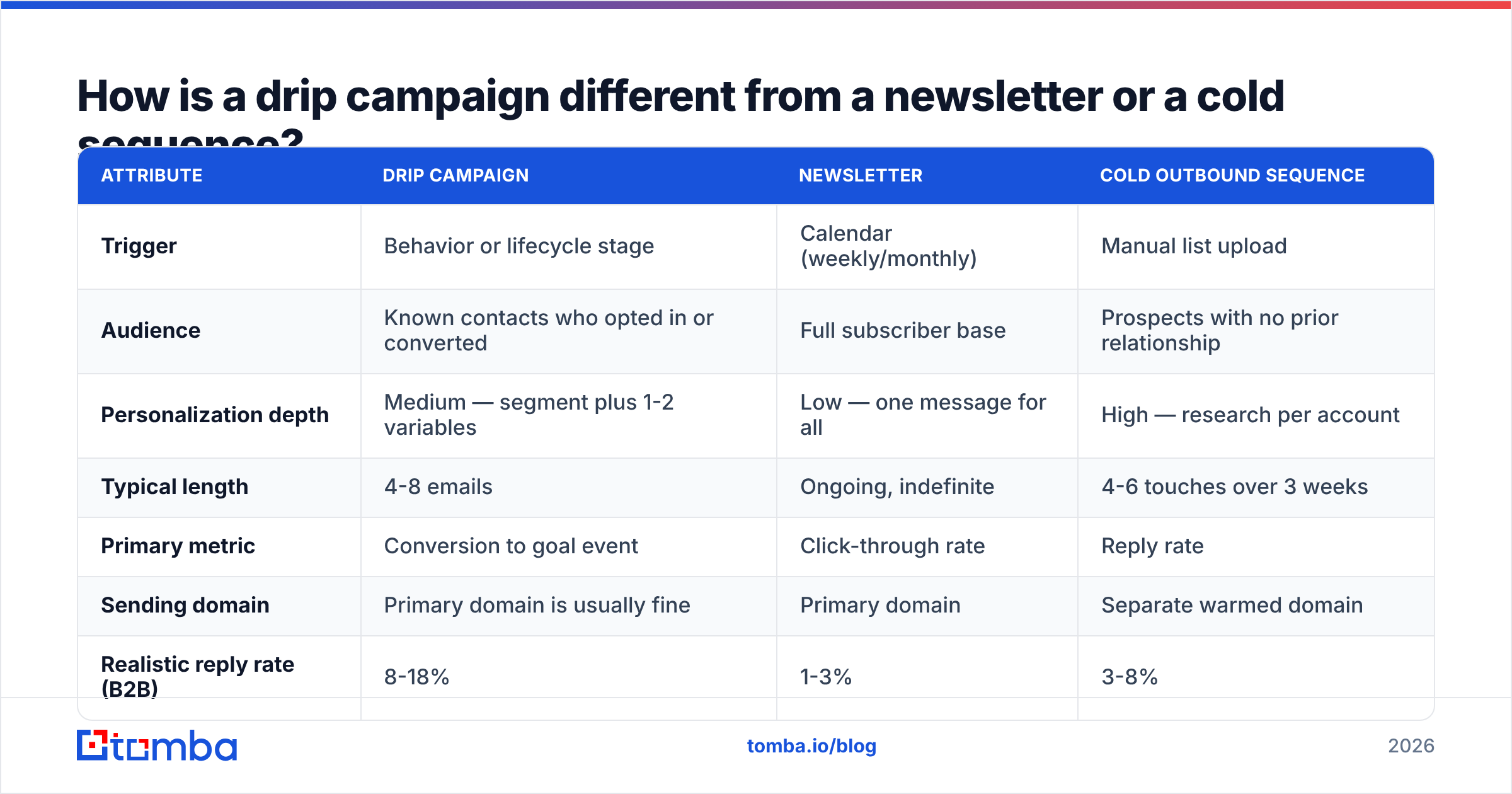
They look identical in the outbox and behave nothing alike. The distinction matters because the metrics, the list source, and the compliance obligations all diverge.
| Attribute | Drip campaign | Newsletter | Cold outbound sequence |
|---|---|---|---|
| Trigger | Behavior or lifecycle stage | Calendar (weekly/monthly) | Manual list upload |
| Audience | Known contacts who opted in or converted | Full subscriber base | Prospects with no prior relationship |
| Personalization depth | Medium — segment plus 1-2 variables | Low — one message for all | High — research per account |
| Typical length | 4-8 emails | Ongoing, indefinite | 4-6 touches over 3 weeks |
| Primary metric | Conversion to goal event | Click-through rate | Reply rate |
| Sending domain | Primary domain is usually fine | Primary domain | Separate warmed domain |
| Realistic reply rate (B2B) | 8-18% | 1-3% | 3-8% |
| Compliance risk | Low (consent exists) | Low | Higher — CAN-SPAM/GDPR care needed |
The practical takeaway: never run a drip campaign on cold-purchased data from your primary domain. Drips assume permission. If you're emailing strangers, that's outbound, and it belongs on a separate sending domain with its own warmup schedule.
What does a drip campaign strategy need before you send anything?#
Five prerequisites. Skip any one and you're optimizing copy while the foundation leaks.
- Verified addresses. This is the unglamorous one that decides everything downstream. Mailbox providers read bounce rate as a spam signal. Push past ~3% and Gmail starts filtering your good sends. Run the list through an email verifier before the first send and re-verify anything older than 90 days — B2B data decays roughly 2-2.5% per month as people change jobs.
- A segment worth separating. If you can't articulate why segment A gets a different email than segment B, you have one campaign, not two. Good splits: company size, trigger action, product tier, industry. Bad splits: arbitrary alphabet ranges, or "engaged vs. unengaged" measured only by opens.
- A single measurable goal event. Tracked in your CRM, not in the email tool. If the campaign's success lives only in a marketing dashboard, sales will never trust the number.
- Authenticated sending. SPF, DKIM, and DMARC configured on the sending domain. Since Google and Yahoo tightened bulk-sender requirements, unauthenticated mail at volume gets rejected outright rather than filtered. Check your SPF record before you build anything else.
- A written exit policy. Reply, unsubscribe, meeting booked, or hard bounce should all remove the contact instantly. The most damaging drip failure is the sequence that keeps emailing someone who already replied — it reads as incompetence and it's entirely preventable.
Which drip campaigns should you build first?#
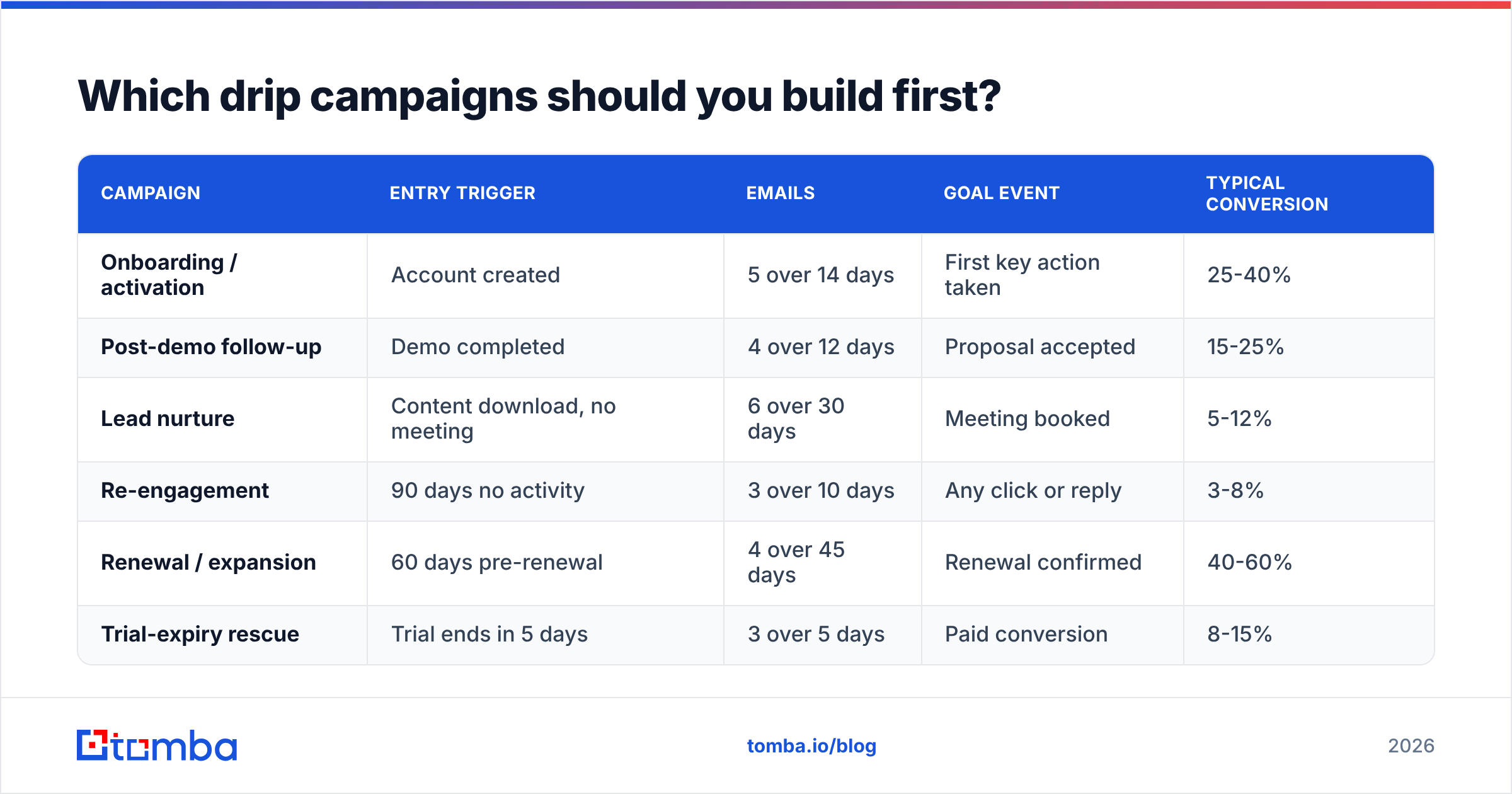
Build in this order. Each one earns the right to the next.
| Campaign | Entry trigger | Emails | Goal event | Typical conversion |
|---|---|---|---|---|
| Onboarding / activation | Account created | 5 over 14 days | First key action taken | 25-40% |
| Post-demo follow-up | Demo completed | 4 over 12 days | Proposal accepted | 15-25% |
| Lead nurture | Content download, no meeting | 6 over 30 days | Meeting booked | 5-12% |
| Re-engagement | 90 days no activity | 3 over 10 days | Any click or reply | 3-8% |
| Renewal / expansion | 60 days pre-renewal | 4 over 45 days | Renewal confirmed | 40-60% |
| Trial-expiry rescue | Trial ends in 5 days | 3 over 5 days | Paid conversion | 8-15% |
Onboarding goes first because it has the highest ceiling and the warmest audience — someone who just signed up will forgive an imperfect email. Re-engagement goes near the end because it's the campaign most likely to generate spam complaints, and you want your sender reputation established before you poke dormant contacts.
The renewal campaign is the one most B2B teams never build, and it's usually the highest-ROI line in the table. Existing customers convert at multiples of any acquisition sequence.
How long should a drip campaign be, and how should you space it?#
Longer gaps, fewer emails, is the correct default for B2B.
The spacing pattern that survives testing most consistently is a widening interval: Day 0, Day 2, Day 5, Day 9, Day 16, Day 30. Early messages sit close together while the trigger is still fresh in memory. Later messages spread out so the sequence stops feeling like pursuit.
Three rules that matter more than the exact numbers:
- Send on the recipient's business day. A perfectly timed Tuesday 9 a.m. email is a Monday 11 p.m. email if you ignored the time zone. Most tools support recipient-local scheduling; almost nobody turns it on.
- Cap total touches per contact across all campaigns. If a prospect is in nurture, in a webinar follow-up, and in a product-update drip simultaneously, they receive nine emails in a fortnight and they unsubscribe from all of it. Set a global frequency cap — three marketing emails per contact per week is a reasonable ceiling.
- Stop when the data says stop. Track reply rate per step. When step 6 produces under 1% of total replies across a meaningful sample, the sequence is one step too long. In most B2B nurture campaigns, steps 1-3 carry 70-80% of all responses.
There's a related trap worth naming: the "just one more bump" email. It's cheap to add and it measurably increases unsubscribes and complaints while adding almost no meetings. If you want more pipeline from the same list, improve step 2, don't append step 9.
How do you write drip emails people actually answer?#
The structural rules do most of the work; the wordsmithing does less than copywriters like to admit.
- One idea per email. A drip email that offers a case study, a demo, a free tool, and a newsletter signup gets zero of the four.
- Under 120 words for steps 2 onward. The first email can be longer because it's answering "why am I hearing from you." Everything after should be readable in a phone notification preview.
- Subject lines that describe, not tease. "Your Q3 onboarding checklist" beats "quick question" now that inboxes have been trained on a decade of fake curiosity gaps. If you're testing variants, a subject line generator is a reasonable starting point, but test on your own list — benchmarks travel badly across industries.
- Reference the trigger explicitly in step 1. "You downloaded the pricing comparison last Tuesday" establishes legitimacy in seven words and removes the "how did you get my email" reflex.
- One clear ask, always the same ask. Changing the CTA between steps resets the recipient's decision process each time. Keep the ask constant; change the reason.
- Plain text over HTML templates. Heavy image-based templates land in Promotions more often and look less like a person wrote them. For a nurture drip from a named human, plain text with a single link is usually the better performer.
On personalization: merge tags are table stakes and no longer impressive. What moves reply rate is relevance, which is a segmentation problem rather than a tokens problem. Five well-segmented campaigns with zero merge fields will outperform one generic campaign with {{first_name}} in the subject line.
What metrics tell you the drip is working?#
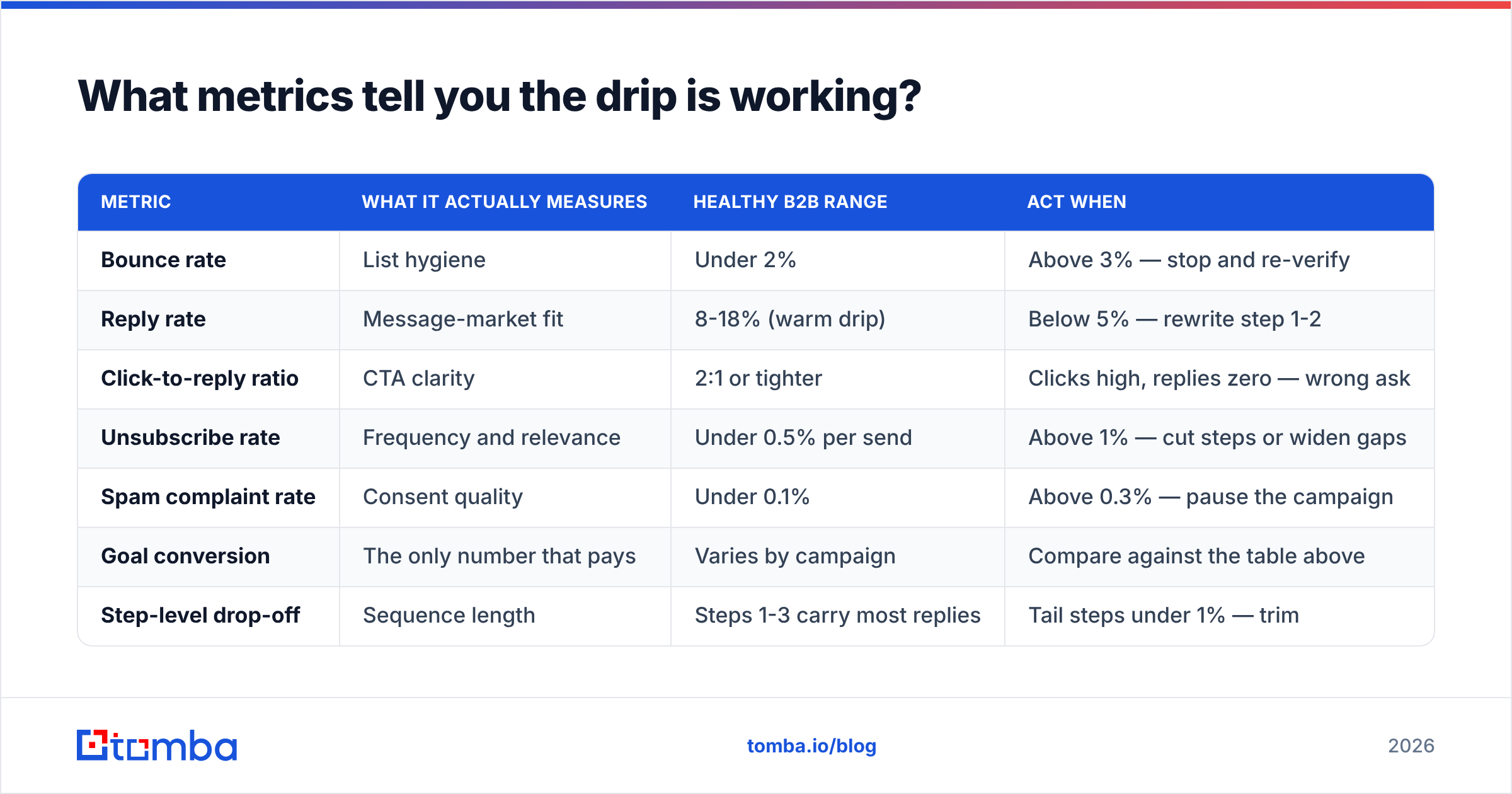
Open rate is close to useless now. Apple's Mail Privacy Protection pre-loads tracking pixels for a large share of recipients, which means a chunk of your "opens" are machines. Treat open rate as directional at best, and never optimize against it.
| Metric | What it actually measures | Healthy B2B range | Act when |
|---|---|---|---|
| Bounce rate | List hygiene | Under 2% | Above 3% — stop and re-verify |
| Reply rate | Message-market fit | 8-18% (warm drip) | Below 5% — rewrite step 1-2 |
| Click-to-reply ratio | CTA clarity | 2:1 or tighter | Clicks high, replies zero — wrong ask |
| Unsubscribe rate | Frequency and relevance | Under 0.5% per send | Above 1% — cut steps or widen gaps |
| Spam complaint rate | Consent quality | Under 0.1% | Above 0.3% — pause the campaign |
| Goal conversion | The only number that pays | Varies by campaign | Compare against the table above |
| Step-level drop-off | Sequence length | Steps 1-3 carry most replies | Tail steps under 1% — trim |
Measure per step, not per campaign. A campaign averaging 9% reply rate might be a 22% step one and four dead steps dragging the average down — and the fix for that is deleting emails, not writing more.
For a deeper definition of what counts as a response in your reporting, the response rate entry is worth a skim before you agree on a shared number with sales.
What kills drip campaigns most often?#
In rough order of frequency:
- Stale data. Emailing a list built 18 months ago and treating the resulting 11% bounce as bad luck. It isn't luck; it's arithmetic.
- No reply detection. The sequence keeps firing after someone answers. This single bug destroys more deals than bad copy ever has.
- Overlapping campaigns. Marketing nurture and sales sequences hitting the same person the same week, with contradictory asks.
- Sending from a domain with no reputation. New domain, day one, 2,000 emails. Warm it up over three to four weeks first; a warmup calculator will give you a ramp schedule instead of a guess.
- Optimizing the wrong end. Teams A/B test button color for a month while step one bounces at 7%. Fix deliverability first, then copy, then design — in that order, always.
- Catch-all domains treated as verified. Many enterprise domains accept everything at the SMTP layer, so a standard check returns "valid" for addresses that don't exist. A dedicated catch-all verifier separates genuinely deliverable addresses from the accept-all noise.
How do you choose tooling for a drip campaign strategy?#
Separate the two jobs. Sending and sequencing is one problem; contact data quality is a different one, and buying a tool that half-solves both usually means solving neither well.
For the sending layer, the mainstream options — HubSpot, Salesforce Marketing Cloud, and the many dedicated sequencing tools you'll find compared on G2 — differentiate mostly on CRM depth, branching logic, and price. If your drips are behavior-triggered and tied to deal stages, native CRM automation beats a standalone tool. If they're volume outbound, a purpose-built sequencer wins.
For the data layer, what matters is verified, current contact data entering the campaign — and being re-checked on a schedule. Providers approach this differently: list marketplaces such as BookYourData sell pre-built verified lists for teams that want volume immediately, while API-first finders build contacts on demand from a domain or a name. Both are legitimate; the choice depends on whether your entry trigger is "we chose this account" or "this person raised their hand."
If you're enriching accounts programmatically, bulk email finder workflows let you push a domain list in and get verified contacts out before anyone writes email one — which is the correct order of operations.
What does a good drip campaign strategy look like end to end?#
A worked example, condensed:
A B2B SaaS team targets operations leads at 200-1,000 employee logistics companies. Entry trigger: downloaded the ROI calculator. Goal: booked demo. Exit: reply, demo booked, or unsubscribe.
Before launch, they run the 340 downloaded contacts through verification, discard 27 invalid and 19 catch-all-unconfirmed addresses, and start with 294 deliverable contacts. Step one goes out day 0 referencing the calculator by name, 90 words, one ask. Step two on day 2 sends the two-page case study from a comparable logistics company. Step three on day 5 asks a single diagnostic question. Step four on day 9 offers a 15-minute teardown. Step five on day 16 is a two-sentence breakup email with a soft door left open.
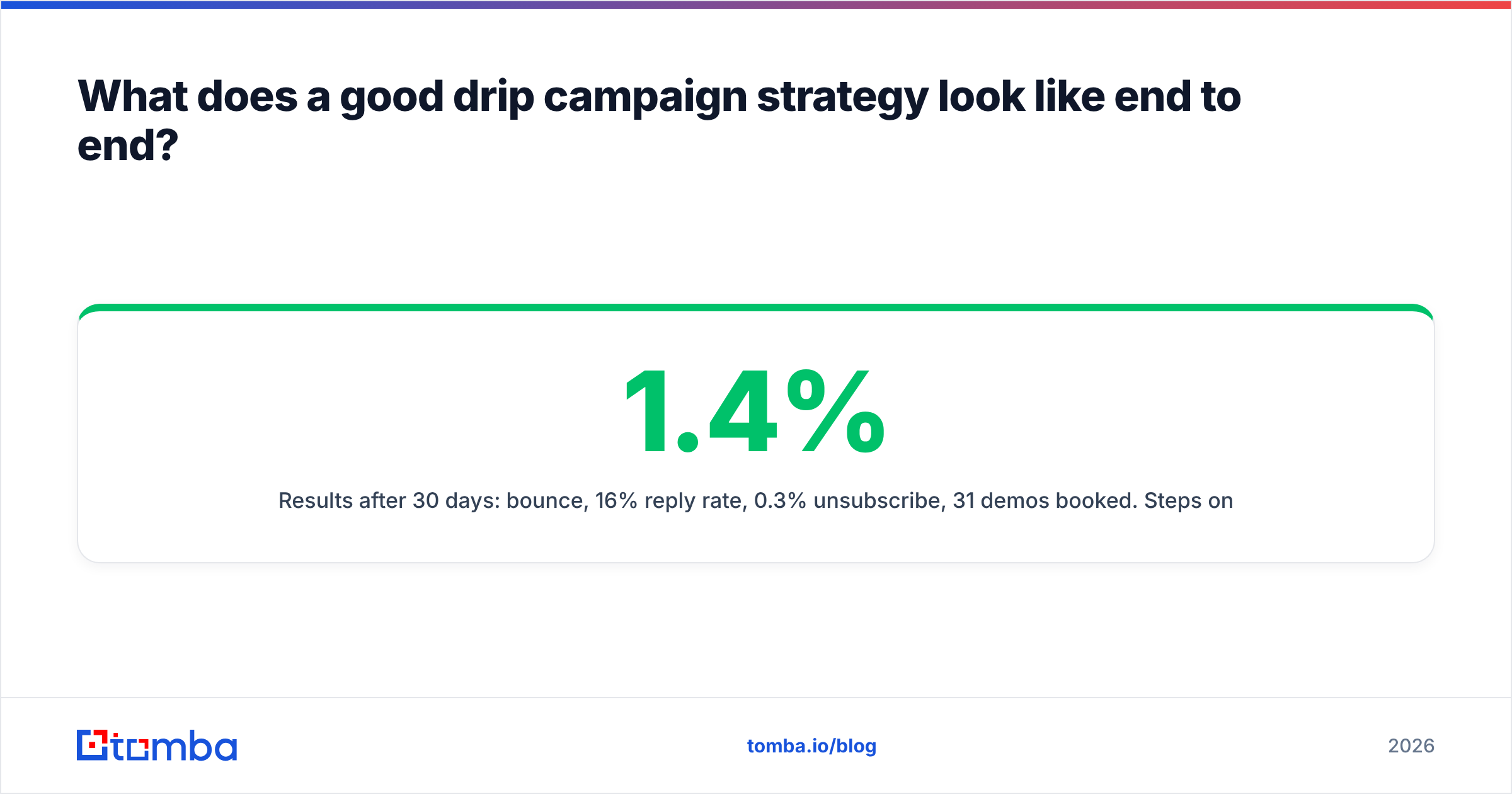
Results after 30 days: 1.4% bounce, 16% reply rate, 0.3% unsubscribe, 31 demos booked. Steps one through three produced 79% of replies — so the next iteration cuts step four and moves the teardown offer into step three.
That's the whole discipline. Clean data in, tight sequence, measure per step, delete what doesn't earn its place.
Where should you start this week?#
Pick one campaign from the table — onboarding if you have signups, post-demo follow-up if you have a sales team — and build it properly rather than building four badly. Verify the list, write five emails, set the exits, and let it run for 30 days before you touch anything.
The step that pays for itself fastest is the one before the first send. Getting accurate, current contact data into the sequence is what separates a 16% reply rate from a 4% one, and no amount of copy revision closes that gap. Tomba Email Finder finds and confirms professional email addresses by domain, name, or company, so your drip starts with contacts that actually exist. The free tier covers 25 searches a month if you want to test the difference on a small segment first; paid plans start at $49/mo, with full Tomba pricing if you need bulk or API access.
Related guides#
Ready to find emails that actually work?
Join 150,000+ professionals who stopped guessing and started sending. Free credits on signup — no credit card required.
Get the Tomba newsletter
Practical outbound tactics and product updates — once every two weeks.
About the author