Dun & Bradstreet vs Apollo.io: Full 2026 Data Comparison
One is a 200-year-old credit and firmographic bureau. The other is a self-serve prospecting engine. Here's how Dun & Bradstreet and Apollo.io actually compare on data, pricing, and workflow in 2026.
Dun & Bradstreet vs Apollo.io is an easy pair to compare and a hard pair to score. One tool rates risk. The other finds inboxes. This guide puts both side by side on data, pricing, and daily use.
TL;DR
- Dun & Bradstreet is a firmographic and risk-data bureau. Its value is the DUNS number, corporate family trees, credit scores, and legal-entity resolution — not finding you a VP of Engineering's inbox.
- Apollo.io is a self-serve prospecting engine. Its value is contact-level coverage, filters, and a built-in sequencer. Its firmographics are shallower and its entity resolution is looser.
- They are not really competitors for most teams. D&B wins on account intelligence and compliance; Apollo wins on speed-to-first-email and cost per seat.
- Both have the same weak spot: the email addresses in a static database decay 20–30% per year, so neither replaces a real-time verification layer.
- Best-value stack for most mid-market teams: Apollo (or a cheaper alternative) for discovery, a dedicated finder/verifier for the email layer, D&B only if you have a genuine risk, compliance, or enterprise-hierarchy requirement.
What is Dun & Bradstreet actually for?#
Dun & Bradstreet has been in the business-information trade since 1841. That history matters, because it explains the product. D&B was built to answer one question: "should we extend credit to this company?" It was not built to answer "who runs demand gen there?"
The core asset is the DUNS number. It is a nine-digit ID for one legal business at one physical address. Around it sits the Data Cloud, a store of hundreds of millions of business records. Each record can carry corporate linkage (parent, subsidiary, branch), financials, credit and failure scores, and industry codes. It can also carry compliance flags, such as sanctions screening and beneficial-ownership data.
D&B Hoovers is the sales-facing wrapper on top of that. It layers buyer-intent signals, trigger alerts, and contact records onto the entity graph. But the contacts are the newest and thinnest part of the offer. It shows.
Where D&B genuinely has no peer:
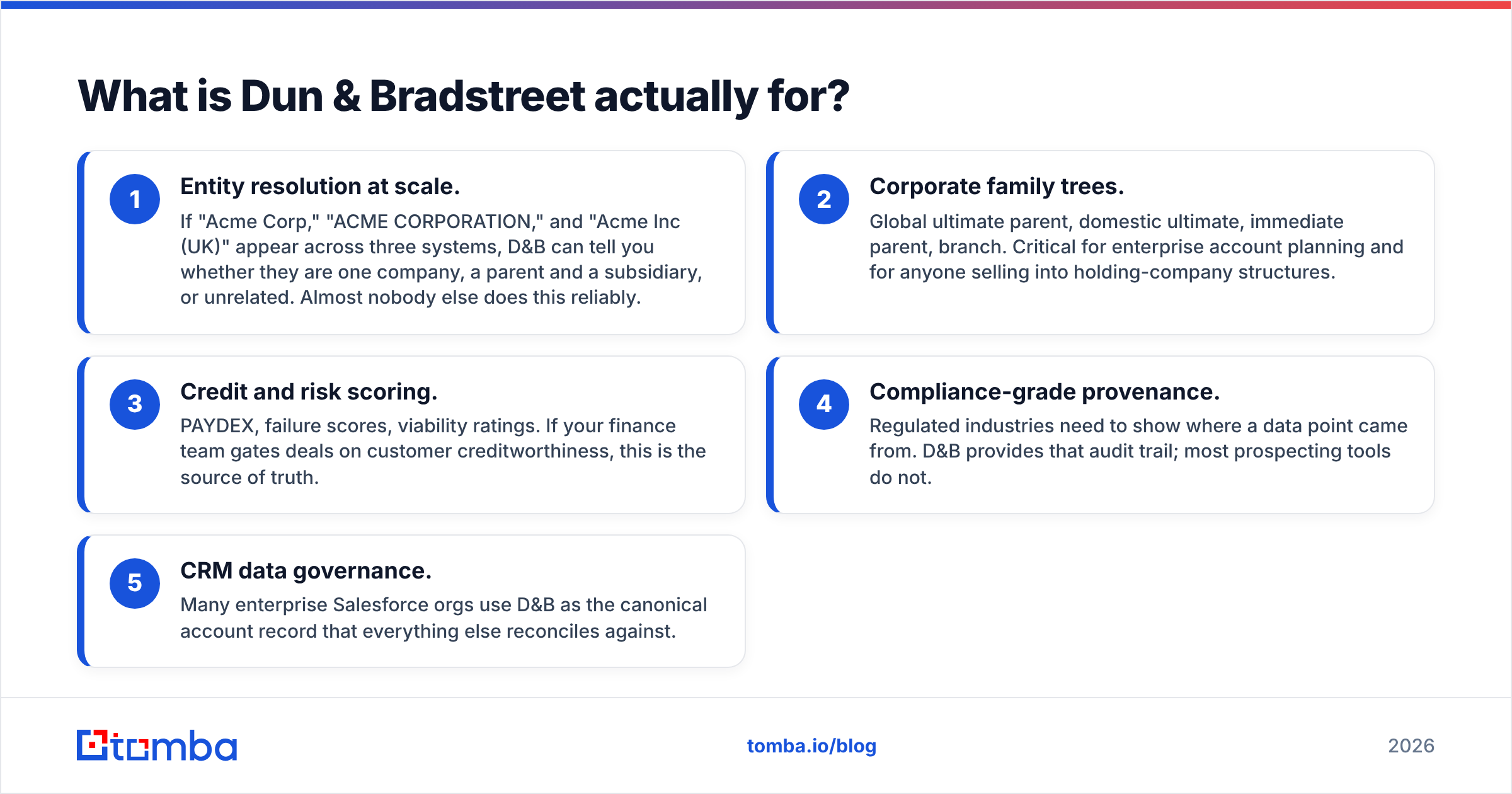
- Entity resolution at scale. Say "Acme Corp," "ACME CORPORATION," and "Acme Inc (UK)" show up across three systems. D&B can tell you if they are one company, a parent and a subsidiary, or unrelated. Almost nobody else does this well.
- Corporate family trees. Global ultimate parent, domestic ultimate, immediate parent, branch. Critical for enterprise account planning and for anyone selling into holding-company structures.
- Credit and risk scoring. PAYDEX, failure scores, viability ratings. If your finance team gates deals on customer creditworthiness, this is the source of truth.
- Compliance-grade provenance. Regulated industries need to show where a data point came from. D&B provides that audit trail. Most prospecting tools do not.
- CRM data governance. Many enterprise Salesforce orgs use D&B as the canonical account record that everything else reconciles against.
What is Apollo.io actually for?#
Apollo.io is the opposite shape. It was built for a rep who needs 200 named prospects and a sequence running before lunch.
Apollo packs a lot into one seat. You get a large contact database; the company advertises coverage in the hundreds of millions of contacts across tens of millions of companies. You also get a filter-heavy search UI, a Chrome extension for LinkedIn, email and call sequencing, and basic CRM sync. Newer AI features handle research and first-draft copy.
The pitch is consolidation. Instead of buying a database, a sequencer, and a dialer, you buy one seat. For a five-person SDR team, that is hard to argue with on price.
The trade-offs are real, and they follow from how the data is sourced. A large share is contributory: users install the extension and sync their mailboxes and contact lists. So coverage is excellent in the segments where Apollo's users work — US tech, SaaS, mid-market. It thins out fast in EMEA manufacturing, Japanese enterprises, and government. If no SDR in that market ever installed the extension, the records are not there.
Dun & Bradstreet vs Apollo.io: how do they compare head to head?#
| Dimension | Dun & Bradstreet | Apollo.io |
|---|---|---|
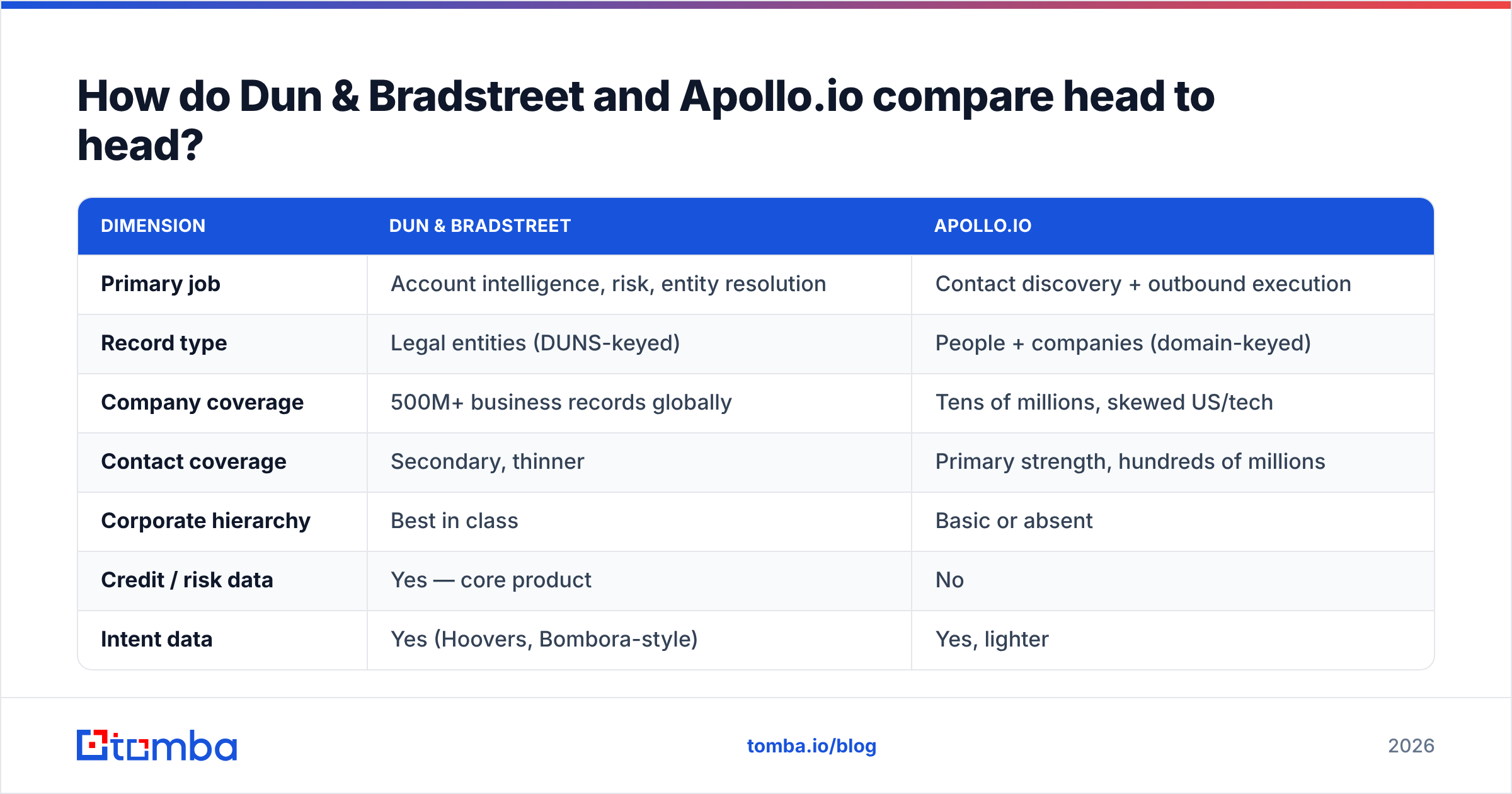
| Primary job | Account intelligence, risk, entity resolution | Contact discovery + outbound execution |
| Record type | Legal entities (DUNS-keyed) | People + companies (domain-keyed) |
| Company coverage | 500M+ business records globally | Tens of millions, skewed US/tech |
| Contact coverage | Secondary, thinner | Primary strength, hundreds of millions |
| Corporate hierarchy | Best in class | Basic or absent |
| Credit / risk data | Yes — core product | No |
| Intent data | Yes (Hoovers, Bombora-style) | Yes, lighter |
| Built-in sequencer | No | Yes |
| Dialer | No | Yes (higher tiers) |
| Pricing model | Annual contract, quote-only | Per user/month, self-serve |
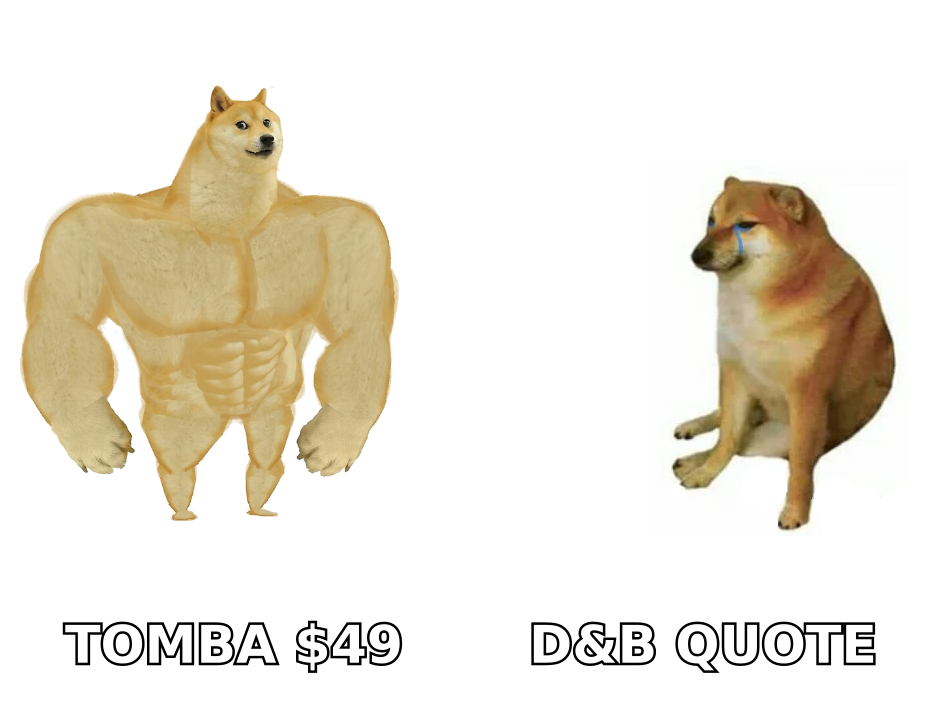
| Typical entry cost | Five figures per year | Free tier; paid seats from roughly $49/user/mo |
| Time to first email sent | Weeks (procurement + onboarding) | Same day |
| Buyer | RevOps, finance, data governance | SDR managers, founders, growth |
| Contract exit | Annual, negotiated | Monthly, self-serve |
Read that table again and the point is clear. These tools sit at different layers of the stack. D&B answers "which accounts exist, how are they related, and are they safe to sell to." Apollo answers "who do I email at that account this afternoon."
They get compared because of budget. A VP of Sales with $40k to spend on data has to pick one. So both vendors land in the same review, even though they solve different problems.
Which one has better data quality?#
Here the honest answer gets uncomfortable. Each one is good at a different half of the record, and both are weak on email.
D&B firmographics are excellent. Revenue bands, employee counts, SIC/NAICS codes, and head-office addresses are curated, cross-checked, and traceable. Does your ICP depend on an exact employee band? Then D&B beats almost anything self-serve.
D&B contact data is a different story. Coverage of individual people is patchy. Job-change lag can be long. Direct-dial coverage thins out fast outside the Fortune 5000. You are buying an account graph with contacts attached, not a contact graph.
Apollo inverts this. Contact coverage in its strong segments is impressive. You can build a list of 400 Series B SaaS heads of marketing in about four minutes. But the firmographics on those contacts are often stale or scraped. Employee counts drift. There is no real entity resolution, so subsidiaries and rebrands create duplicates.
Then there is the shared problem. Buyer reviews on G2 and elsewhere flag bounce rates as the top complaint against every large static B2B database, Apollo and D&B included. That is not vendor incompetence. It is physics. Roughly 2% of B2B contacts change something material every month. People move roles, firms get acquired, mail servers switch to catch-all, and old aliases get shut off.
So treat every exported email as a hypothesis, not a fact. Run your list through a real-time email verifier before it hits your sequencer. It is the highest-ROI step in the whole workflow. It costs cents per thousand, and it protects the domain reputation you spent months building.
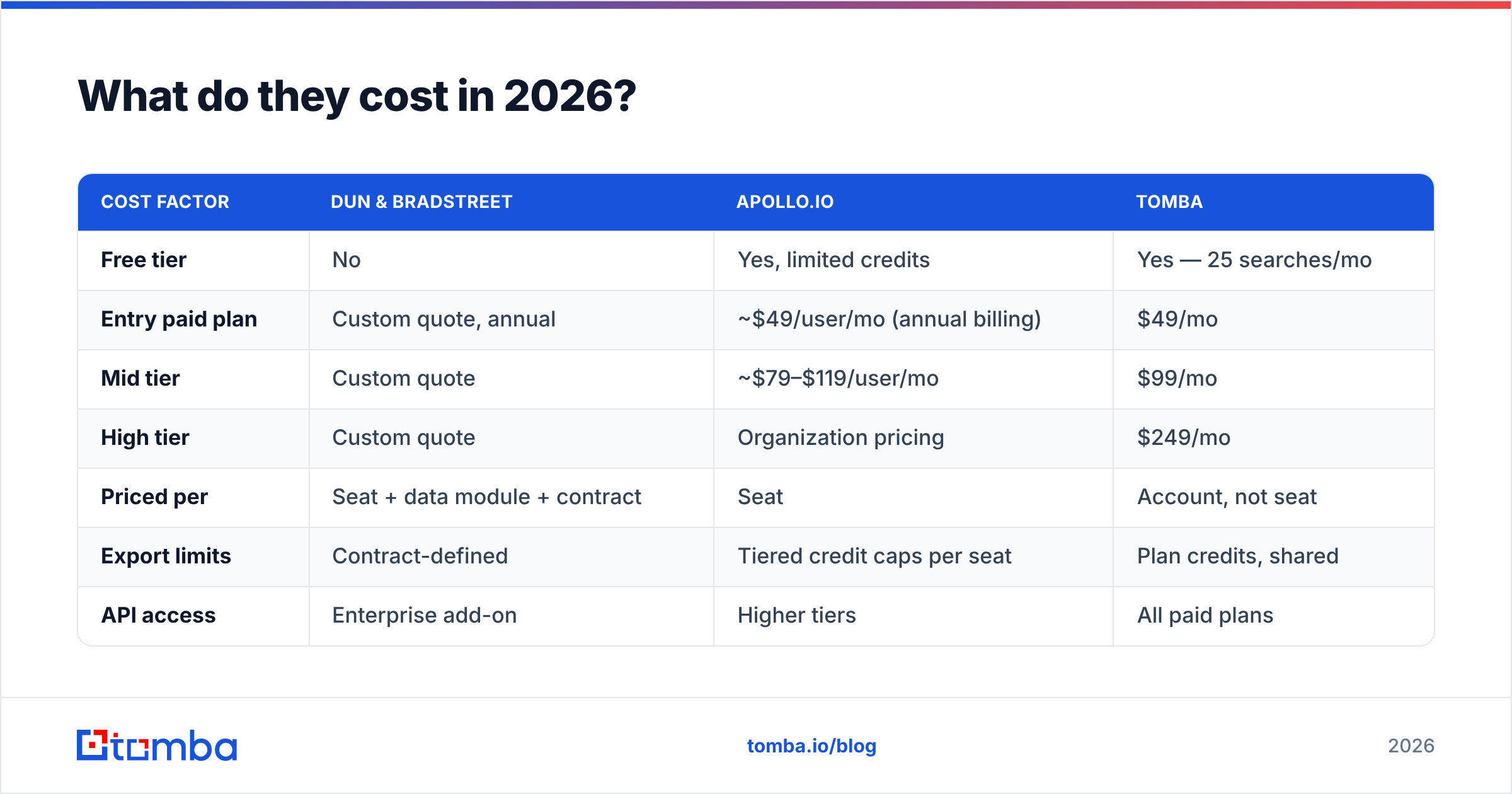
What do they cost in 2026?#
| Cost factor | Dun & Bradstreet | Apollo.io | Tomba |
|---|---|---|---|
| Free tier | No | Yes, limited credits | Yes — 25 searches/mo |
| Entry paid plan | Custom quote, annual | ~$49/user/mo (annual billing) | $49/mo |
| Mid tier | Custom quote | ~$79–$119/user/mo | $99/mo |
| High tier | Custom quote | Organization pricing | $249/mo |
| Priced per | Seat + data module + contract | Seat | Account, not seat |
| Export limits | Contract-defined | Tiered credit caps per seat | Plan credits, shared |
| API access | Enterprise add-on | Higher tiers | All paid plans |
| Sales call required | Yes | No | No |
Two things worth calling out.
First, Apollo's per-seat model scales badly for data-only use. Say you have eight reps, but only two of them build lists. You still tend to pay for seats to unlock credits. Account-level pricing, the model used by tools like Tomba, is cheaper when list-building sits with one team. You can check current Tomba pricing against your seat math in about a minute.
Second, D&B's quote-only model is not a red flag. It is a segmentation choice. They price on data modules, record volume, and refresh rate. Need to resolve 400,000 CRM accounts to legal entities and watch them for risk events? Then a five-figure contract is defensible. Need 5,000 emails? Then it is not.

When should you choose Dun & Bradstreet?#
Pick D&B when at least two of these are true:
- You sell into enterprise account hierarchies. A target may be a branch of a global parent you already sell to. That single fact changes your whole approach.
- Finance or legal gates your deals. Credit checks, sanctions screening, and supplier risk are D&B's home turf.
- Your CRM is a swamp. D&B's cleanse-and-match services against DUNS are the standard remedy for a Salesforce org with 60,000 duplicate accounts.
- You operate in regulated industries. Data provenance and audit trails are contractual requirements, not nice-to-haves.
- Your TAM is defined by firmographics, not personas. "All manufacturers in DACH with 200–1,000 employees and revenue over €50M" is a D&B query, not an Apollo one.
When should you choose Apollo.io?#
Pick Apollo when:
- You need volume outbound running this week. Nothing beats a bundled database-plus-sequencer for time to first touch.
- Your ICP is US-centric tech, SaaS, or mid-market services. That's where the contributory data is densest.
- You're a small team that can't justify three separate tools. One seat replacing a database, a sequencer, and a dialer is real savings.
- You want to evaluate before you buy. Self-serve signup and a free tier beat a six-week procurement cycle.
Like the shape of Apollo but not the seat price or the contract? The Apollo alternative market in 2026 is crowded. Several tools now beat it on cost per verified email. You give up the bundled sequencer in exchange.
Is there a third option that beats both?#
For one specific and very common job: yes.
Maybe what you need is simple. Take a list of companies, and get deliverable email addresses for the right people there. For that job, a risk bureau is overkill and a bundled sales suite is a detour. A dedicated finder-and-verifier layer costs less, is more accurate on the one thing it does, and plugs into whatever you already own.
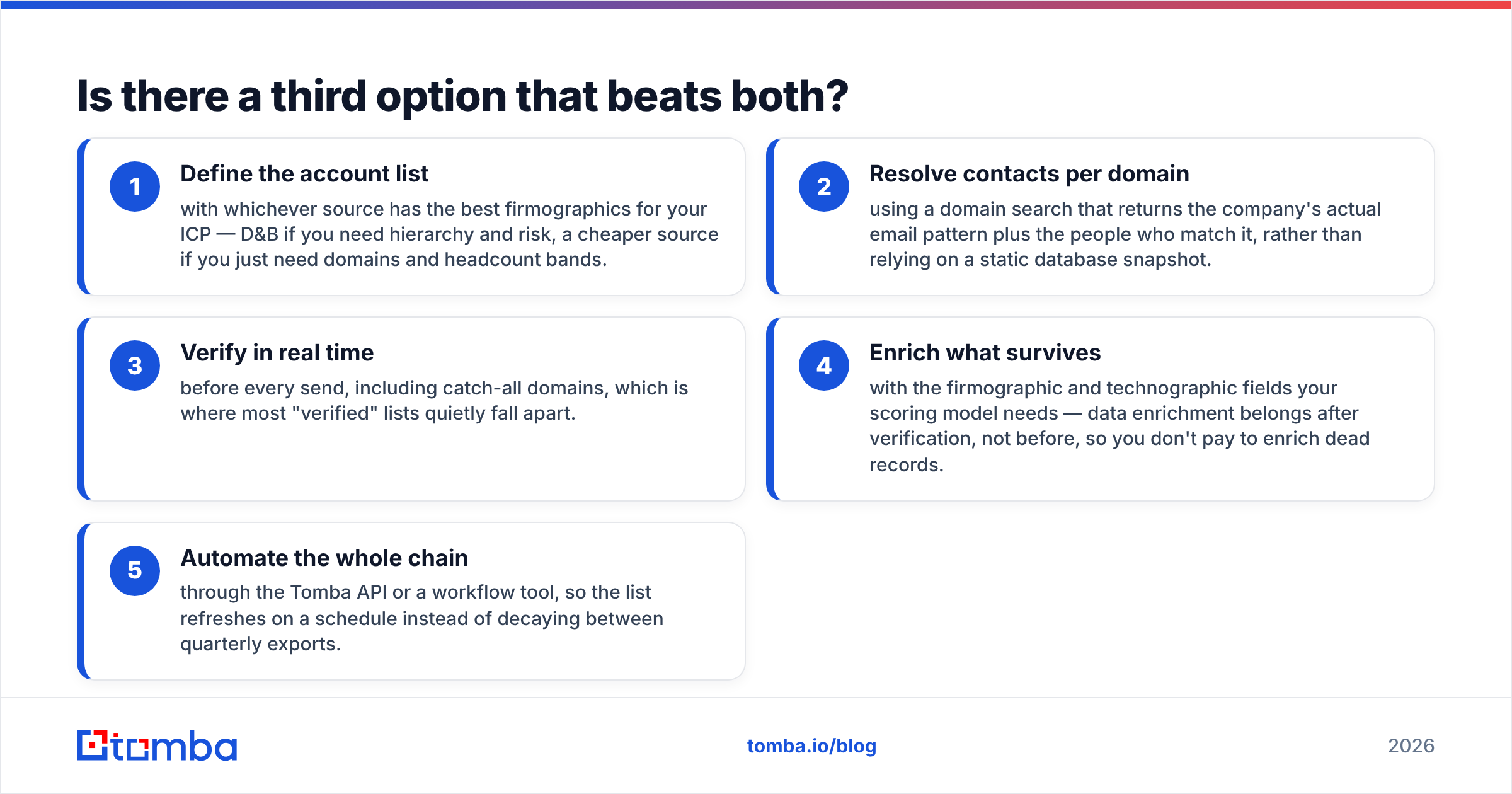
The pattern that works well in 2026:
- Define the account list with whichever source has the best firmographics for your ICP. Use D&B if you need hierarchy and risk. Use a cheaper source if you just need domains and headcount bands.
- Resolve contacts per domain with a domain search. It returns the company's real email pattern plus the people who match it, instead of a stale database snapshot.
- Verify in real time before every send. Include catch-all domains, which is where most "verified" lists quietly fall apart.
- Enrich what survives with the firmographic and technographic fields your scoring model needs. Data enrichment belongs after verification, so you never pay to enrich dead records.
- Automate the whole chain through the Tomba API or a workflow tool. Then the list refreshes on a schedule instead of decaying between quarterly exports.
That split is why so many teams run two or three tools rather than one. Bundled platforms optimize for convenience. Specialist layers optimize for the number your deliverability depends on.
What's the verdict?#
In a Dun & Bradstreet vs Apollo.io comparison there is no single winner, because each tool answers a different question. There is still a wrong answer for most teams.
Buying Dun & Bradstreet to run cold outbound is the wrong answer. You pay enterprise prices for an account graph you barely use. The contact data you came for is not the product's strength.
Buying Apollo.io and treating its firmographics as authoritative is also wrong. You build ICP segments on employee counts that are eighteen months stale. Then you wonder why your conversion model does not hold.
Here is the right answer for most mid-market GTM teams in 2026. Use a self-serve prospecting platform for discovery. Add a specialist email layer for accuracy. Bring in D&B only when a real hierarchy, risk, or compliance need shows up. That need is real for maybe one team in five, and for that team D&B is worth every dollar.
Start with the layer that decides whether your emails land. Tomba's Email Finder returns verified, source-attributed professional emails by domain, name, or company. The free tier covers 25 searches a month. Paid plans start at $49/mo, billed to the account rather than per seat, and API access is included on every one. Run it next to whatever database you already own, then compare bounce rates on your next 1,000 sends. That test settles the argument faster than any comparison table.
Related guides#
Ready to find emails that actually work?
Join 150,000+ professionals who stopped guessing and started sending. Free credits on signup — no credit card required.
Get the Tomba newsletter
Practical outbound tactics and product updates — once every two weeks.
About the author