Dun Bradstreet vs ListKit: Which B2B Data Tool Wins in 2026?
Dun & Bradstreet sells firmographic depth at enterprise prices. ListKit sells verified cold-email lists at startup prices. Here's the honest breakdown of which one your team actually needs — and when neither is the right call.
Dun Bradstreet vs ListKit is a fair fight only if you know what each tool is built for. One sells entity-grade company data. The other sells verified emails you can send this week. Here is the short answer, then the detail.
TL;DR
- Dun & Bradstreet is a credit-and-risk data firm that also sells sales intelligence. You buy it for DUNS numbers, corporate trees, financial health scores, and compliance checks — not for cold-email contacts.
- ListKit is a done-for-you B2B list builder for cold-email agencies and SDR teams. You buy it for triple-verified lists you can push straight into a sequencer.
- They barely compete. D&B costs five figures a year. ListKit costs low three figures a month.
- Neither fits well if you already have a target list and just need accurate emails on demand. That is an email finder's job, and it costs far less.
- Our pick: ListKit for outbound teams under 20 reps, D&B for enterprises with risk or ABM mandates, and a finder like Tomba under both to keep bounce rates down.
Dun Bradstreet vs ListKit: what are they, actually?#
They solve different problems. Most "vs" articles blur that on purpose, because it drives clicks. Let's be precise.
Dun & Bradstreet has been in the business data trade since 1841. Its foundation is the D-U-N-S Number — a nine-digit ID for a business entity, used by governments, banks, and procurement teams worldwide.
The Data Cloud behind it holds hundreds of millions of business records. You get linkage data (who owns whom), payment behavior via the PAYDEX score, firmographics, technographics, and intent signals. The sales-facing product, D&B Hoovers, wraps all of that in a prospecting UI with list building, alerts, and CRM sync.
ListKit launched in 2023 out of the cold-email agency world. The pitch is narrow and clear. You filter by job title, industry, headcount, technology, and intent. It returns contacts with triple-verified emails and, on higher plans, mobile numbers.
It plugs into Smartlead, Instantly, Clay, and HubSpot. There is no credit bureau behind it, no DUNS number, no risk scoring. That is not a criticism — it is a different product category.
Here's the practical framing. D&B tells you a company exists, who owns it, whether it pays its bills, and where it sits in a corporate tree. ListKit tells you which human to email there, and hands you the address. If you need both, buy both — or buy one and fill the gap cheaply.
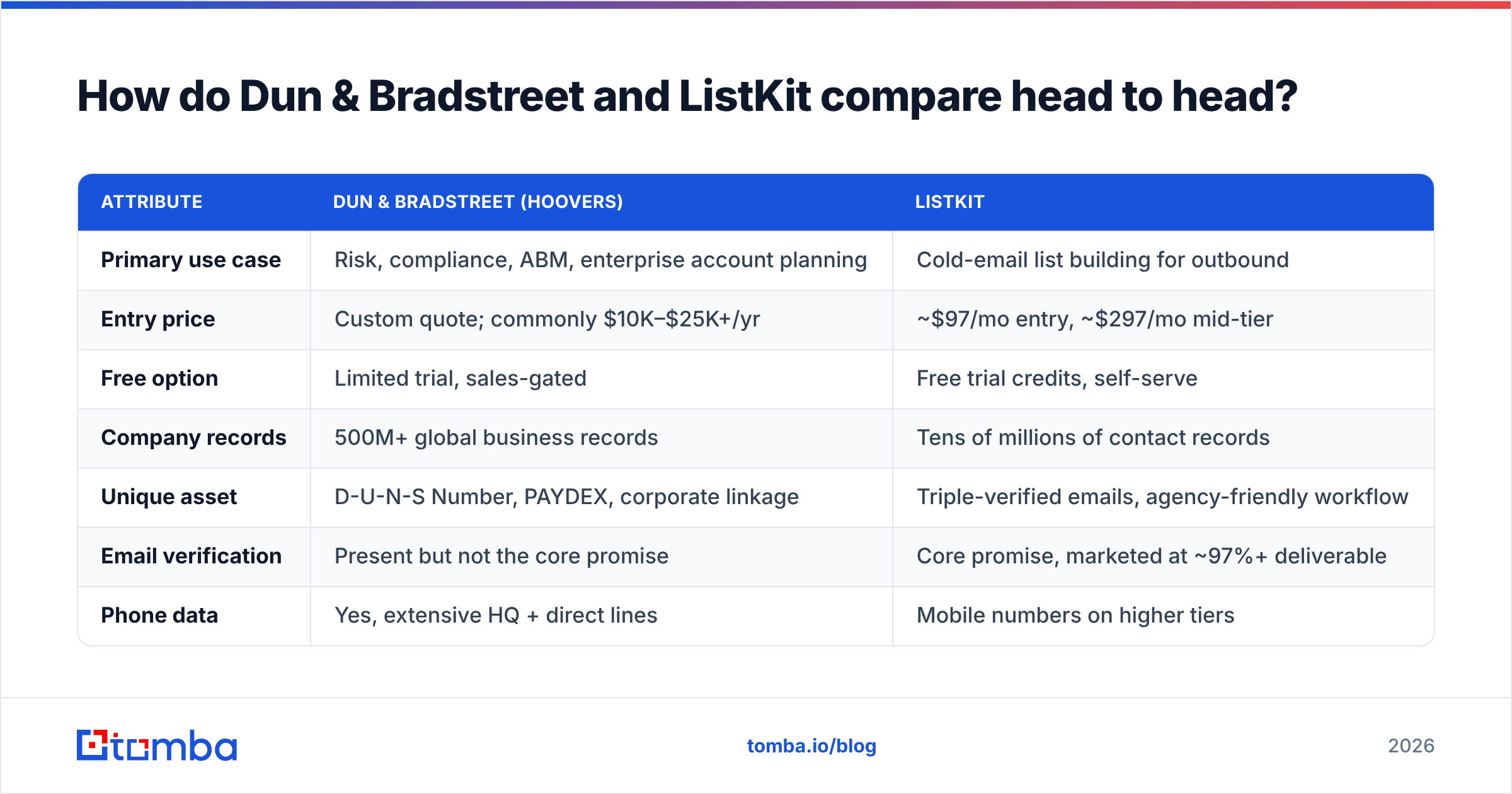
How do Dun & Bradstreet and ListKit compare head to head?#
| Attribute | Dun & Bradstreet (Hoovers) | ListKit |
|---|---|---|
| Primary use case | Risk, compliance, ABM, enterprise account planning | Cold-email list building for outbound |
| Entry price | Custom quote; commonly $10K–$25K+/yr | ~$97/mo entry, ~$297/mo mid-tier |
| Free option | Limited trial, sales-gated | Free trial credits, self-serve |
| Company records | 500M+ global business records | Tens of millions of contact records |
| Unique asset | D-U-N-S Number, PAYDEX, corporate linkage | Triple-verified emails, agency-friendly workflow |
| Email verification | Present but not the core promise | Core promise, marketed at ~97%+ deliverable |
| Phone data | Yes, extensive HQ + direct lines | Mobile numbers on higher tiers |
| Intent data | Bombora-powered, mature | Basic intent filters |
| Contract | Annual, negotiated, procurement-heavy | Monthly, cancel anytime |
| Time to first list | Days to weeks (onboarding, seats) | Under an hour |
| Best fit team size | 50+ employees, formal RevOps | 1–20 reps, agencies, solo founders |
| CRM depth | Salesforce/MS Dynamics native, deep | HubSpot + sequencer integrations |
Read that table as a fork in the road, not a scoreboard.
If three or more rows in the D&B column match things you truly need — corporate hierarchy, credit risk, vendor screening — the price stops looking absurd. If none of them do, you are paying a bureau premium for contact data you can get elsewhere for 5% of the cost.
Which one has better data accuracy?#
Accuracy means two different things here. Mixing them up is how buyers get burned.
D&B's accuracy is entity accuracy. Is this the right legal entity? Is this subsidiary owned by that parent? Would the revenue figure hold up in an audit? On those questions, D&B is close to the reference standard. The U.S. federal government used DUNS for contractor registration for decades.
Its weak spot is contact freshness. Job titles and emails inside Hoovers can lag reality. Refreshing 500 million records at the person level is a different engineering problem than keeping entity links correct. Reviewers on G2 name stale contacts as the most common complaint.
ListKit's accuracy is deliverability accuracy. Will this email land in an inbox without bouncing? ListKit runs multi-pass verification and markets a ~97% deliverable rate. Users report bounce rates of 1–3% on fresh pulls, which is genuinely good for a self-serve list.
The weak spot is depth. Filter to something narrow — VPs of Quality at contract manufacturers in Northern Italy — and results thin out fast next to a database with global entity coverage.
There is a third case neither one handles well. You already know the 400 companies you want, and you need the right person's email at each, verified, today. That is a lookup problem, not a list-buying problem.
A dedicated email finder turns a name plus a domain into a verified address in real time. Domain search pulls every discoverable contact at a company, with no list to buy. Running the results through an email verifier before they hit a sequencer is the cheapest insurance in outbound.
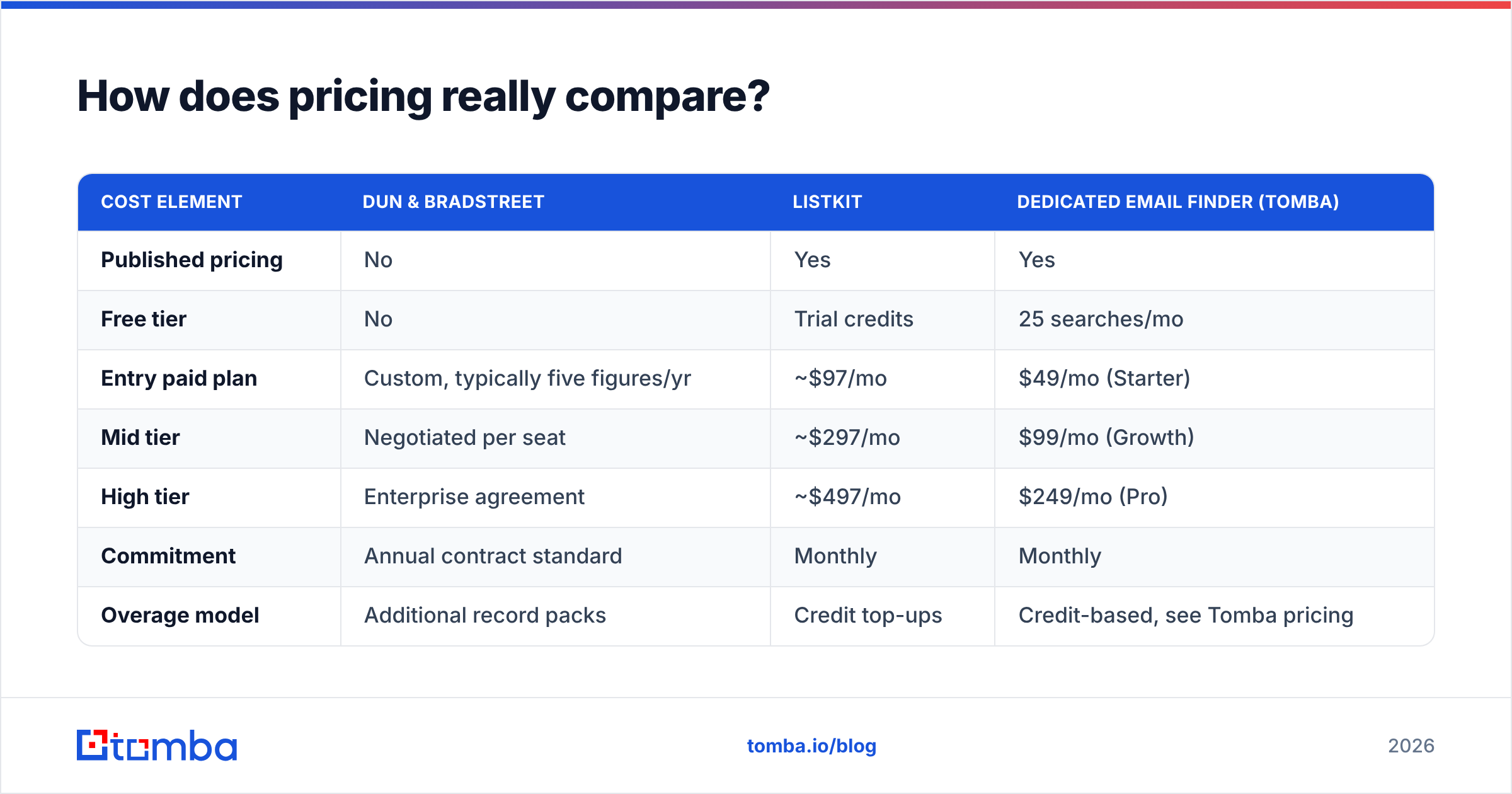
How does pricing really compare?#
| Cost element | Dun & Bradstreet | ListKit | Dedicated email finder (Tomba) |
|---|---|---|---|
| Published pricing | No | Yes | Yes |
| Free tier | No | Trial credits | 25 searches/mo |
| Entry paid plan | Custom, typically five figures/yr | ~$97/mo | $49/mo (Starter) |
| Mid tier | Negotiated per seat | ~$297/mo | $99/mo (Growth) |
| High tier | Enterprise agreement | ~$497/mo | $249/mo (Pro) |
| Commitment | Annual contract standard | Monthly | Monthly |
| Overage model | Additional record packs | Credit top-ups | Credit-based, see Tomba pricing |
| Hidden costs | Onboarding, seats, API add-ons, data appends | Minimal | Minimal |
Three things are worth flagging honestly.
- D&B's price is not arbitrary. You are buying liability-grade data. If compliance needs proof that a vendor isn't a sanctioned shell company, ListKit cannot help, and neither can a $49/mo tool.
- ListKit's price is per-list, in effect. Credits burn as you pull contacts. Agencies running several client campaigns chew through mid-tier plans faster than the sticker suggests. Model your real monthly volume first.
- Both get cheaper when you stop over-buying. The common waste pattern: teams buy a full data platform, then use 8% of its fields.
If your only recurring need is a verified email for a known person at a known company, that is a $49–$99/mo line item, not a $20K one.
For a sense of how the category prices itself, Gartner's peer reviews and Capterra listings are the least-biased public sources. Vendor sites won't publish comparative numbers.
Is ListKit better than Dun & Bradstreet for cold outbound?#
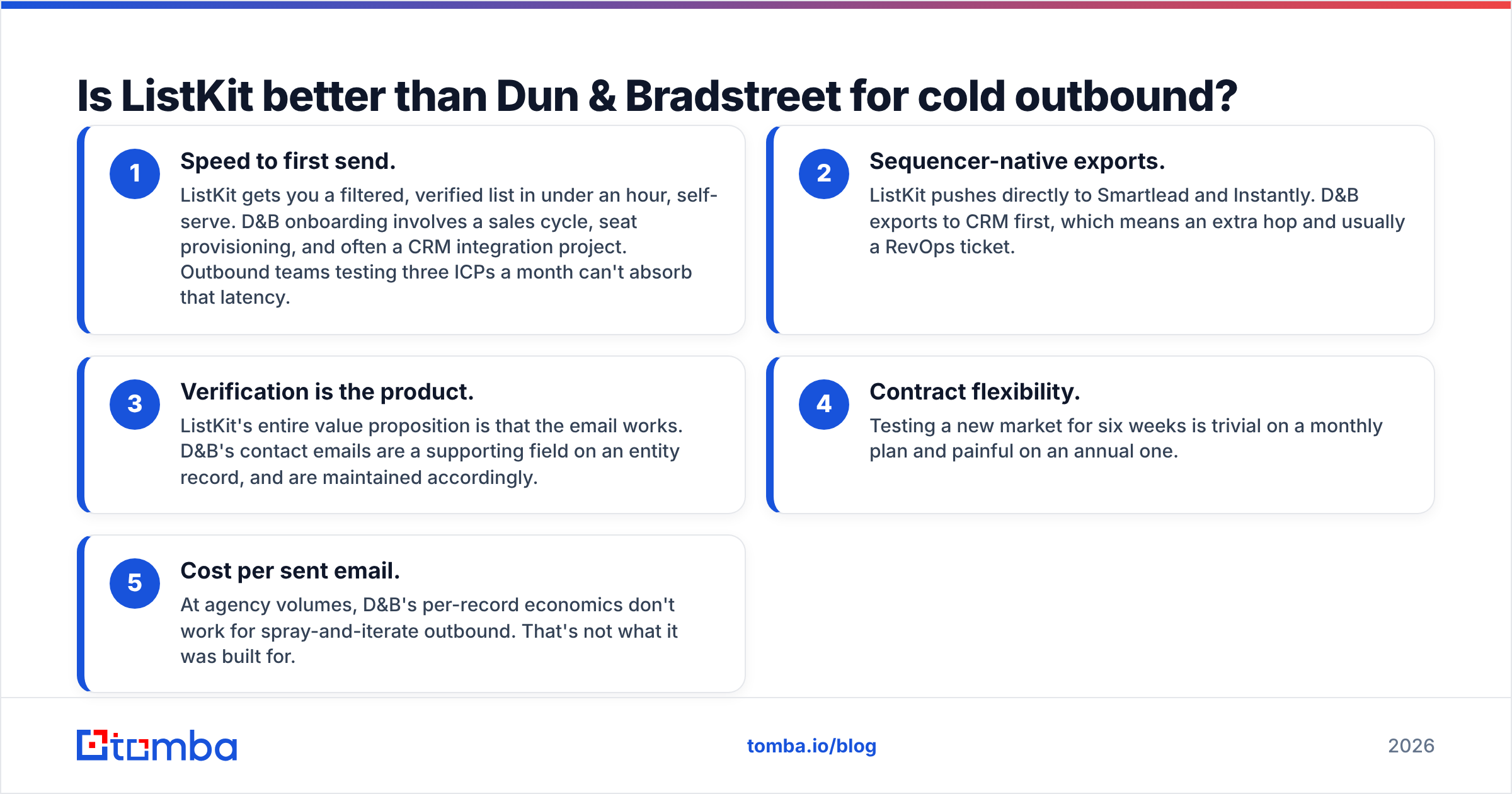
For pure cold email, yes — and it isn't close. The reasons are structural, not about data quality.
- Speed to first send. ListKit hands you a filtered, verified list in under an hour, self-serve. D&B onboarding means a sales cycle, seat setup, and often a CRM project.
- Sequencer-native exports. ListKit pushes straight to Smartlead and Instantly. D&B exports to the CRM first, which adds a hop and usually a RevOps ticket.
- Verification is the product. For ListKit, the email working is the value. For D&B, contact emails are a supporting field on an entity record.
- Contract flexibility. Testing a market for six weeks is easy on a monthly plan and painful on an annual one.
- Cost per sent email. At agency volumes, D&B's per-record math doesn't work for spray-and-iterate outbound.
D&B still wins some outbound-adjacent work. Think multi-threading into a 40,000-person enterprise where you need the org tree, or spotting which of eleven similar subsidiaries holds the budget. It also wins ABM lists where firmographic precision beats raw volume. If your ACV is $250K, one correct decision-maker pays for the platform.

What are the real alternatives to both?#
Most teams shopping these two are in a wider market than they realize. The honest map:
- Apollo.io — big contact database plus a built-in sequencer. Cheapest path to "database plus sending" on one bill. Data quality swings by segment, so verify before you send. See the Apollo alternative breakdown.
- ZoomInfo — the closest true rival to D&B on sales intelligence. Fresher contacts, similar enterprise pricing and contract friction.
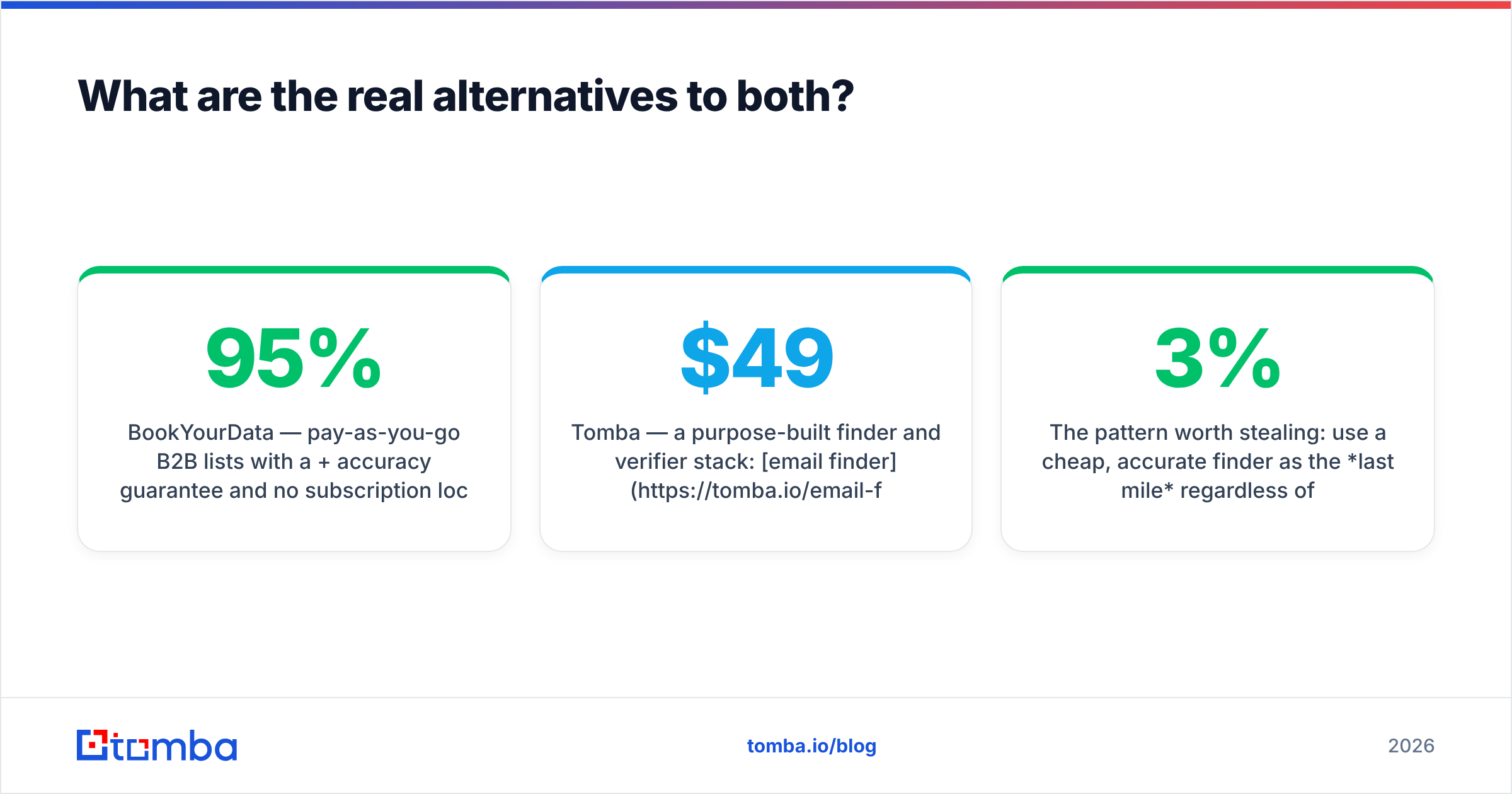
- BookYourData — pay-as-you-go B2B lists with a 95%+ accuracy guarantee and no subscription lock-in. Its credits don't expire the way subscription allotments do.
- Clay — not a data source but an orchestrator. It chains several providers with waterfall enrichment. Best for teams with an ops person who enjoys building.
- Tomba — a purpose-built finder and verifier stack: email finder, bulk email finder, data enrichment, and a documented Tomba API. Free tier at 25 searches/mo, Starter $49/mo, Growth $99/mo, Pro $249/mo.
Here is the pattern worth stealing. Use a cheap, accurate finder as the last mile, whichever database you buy.
Whatever list you source — D&B, ListKit, a conference sheet, a scraped LinkedIn segment — verify and complete it before send. That is what protects your sender reputation. Bounces above 3% start to hurt domain health, and no vendor guarantees you past that line.
How should you decide?#
Answer these in order and the Dun Bradstreet vs ListKit choice makes itself.
- Do you need a D-U-N-S Number, credit risk data, or corporate hierarchy? If yes, Dun & Bradstreet. Nothing else here provides it, and no discount tool substitutes.
- Is your main motion high-volume cold email to SMB or mid-market? If yes, ListKit. Fast, verified, monthly, sequencer-native.
- Do you already have your target company list and only need contacts? Skip both. Use a finder plus a verifier for under $100/mo.
Three more, if you are still torn:
- Are you running client campaigns across several ICPs? ListKit or BookYourData for sourcing, plus a finder API to fill the gaps.
- Do you have a RevOps team and a Salesforce instance you actually maintain? That is where D&B's integration depth earns its cost. Without it, the platform goes unused within two quarters.
- Is budget the binding constraint? Start at the bottom. A free tier plus a $49/mo plan tells you whether your ICP hypothesis is even right.
The failure mode we see most often is buying enterprise data to fix a targeting problem. If reply rates are low, a better database rarely helps. A sharper ICP and a better first line usually do.
Frequently asked questions#
Does ListKit include phone numbers? Mobile numbers come with the higher tiers. If phone is central to your motion, compare a dedicated phone finder before you pay to upgrade.
Can I use D&B data for cold email legally? Your compliance posture matters more than the source. GDPR, CAN-SPAM, and CASL duties attach to your sending, not to your vendor. Both vendors publish compliance docs; read them for your jurisdiction.
Is ListKit's 97% deliverability claim real? On fresh pulls, broadly yes. Most users report low single-digit bounce rates. It degrades on narrow filters and on lists left sitting for weeks. Re-verify anything older than 30 days.
What about catch-all domains? Both vendors struggle here, as does everyone. Catch-all servers accept all mail, so standard checks return "unknown." A catch-all verifier uses pattern-and-signal analysis to make those records usable instead of discarded.
The bottom line#
Dun Bradstreet vs ListKit isn't really a rivalry. The two answer different questions.
D&B is infrastructure for companies that need defensible entity data and can absorb an annual contract. ListKit is a tool for teams that need verified inboxes to email this week and want to pay monthly. Most SMB and mid-market outbound teams should pick ListKit. Most enterprises with risk or procurement mandates should pick D&B.
Either way, the last mile is the same: the email has to be right. If your list came back with missing contacts, generic info@ addresses, or records you don't trust, run them through Tomba Email Finder before they touch your sequencer. Start free with 25 searches a month, then move to Starter at $49/mo when the volume justifies it.
Related guides#
Ready to find emails that actually work?
Join 150,000+ professionals who stopped guessing and started sending. Free credits on signup — no credit card required.
Get the Tomba newsletter
Practical outbound tactics and product updates — once every two weeks.
About the author