11 Best Dynamic Leads Alternatives for B2B Data in 2026
Dynamic Leads is solid at UK visitor identification, but it is not a full prospecting stack. Here are 11 alternatives compared on data coverage, verification, pricing, and the jobs each one actually does well.
TL;DR
- Dynamic Leads (Lead Forensics' UK-focused peer in the website-visitor-identification space) tells you which companies visited your site. It does not reliably hand you verified individual email addresses at scale.
- If your gap is "I know the account, I need the person," an email finder like Tomba Email Finder solves a different job for a fraction of the cost — from free to $49/mo Starter.
- If your gap is "I need more accounts," the real alternatives are Leadfeeder/Dealfront, Albacross, Clearbit Reveal, and 6sense.
- Most teams end up buying two things, not one: an identification layer and a contact-data layer. Budget accordingly.
- The single biggest cost driver nobody quotes you upfront is bounce rate. Unverified contact data at 12% bounce will damage your domain faster than any tool will fix it.
What is Dynamic Leads and what does it actually do?#
Dynamic Leads is a website visitor identification platform. You install a tracking script, it resolves the visiting IP address against a business IP database, and it reports which companies browsed your site, which pages they viewed, and how long they stayed. It sits in the same product category as Lead Forensics, Leadfeeder (now Dealfront), and Albacross.
That's a genuinely useful signal. Roughly 95–98% of B2B site traffic never fills in a form, and knowing that a mid-market manufacturer spent nine minutes on your pricing page is a better prospecting trigger than a cold list.
But there are three structural limits worth understanding before you renew:
- It identifies companies, not people. IP-to-company resolution cannot tell you who at that company was browsing. You still need a contact-data source to name a buyer and get their email.
- Coverage is IP-dependent. Remote workers on residential IPs, VPN traffic, and mobile sessions frequently resolve to nothing or to the wrong entity. Match rates in the 25–40% band are typical across this whole category, not just Dynamic Leads.
- Pricing is quote-based and annual. Like most of this category, you're generally looking at a 12-month commitment negotiated by a sales rep, which makes it hard to compare against self-serve tools on a per-record basis.
None of that makes it a bad product. It makes it a specific product. The mistake teams make is expecting it to replace a prospecting database.
Why do teams look for Dynamic Leads alternatives?#
From reading G2 and Capterra reviews across the visitor-ID category, plus the questions that show up in RevOps communities, the churn reasons cluster into five buckets:
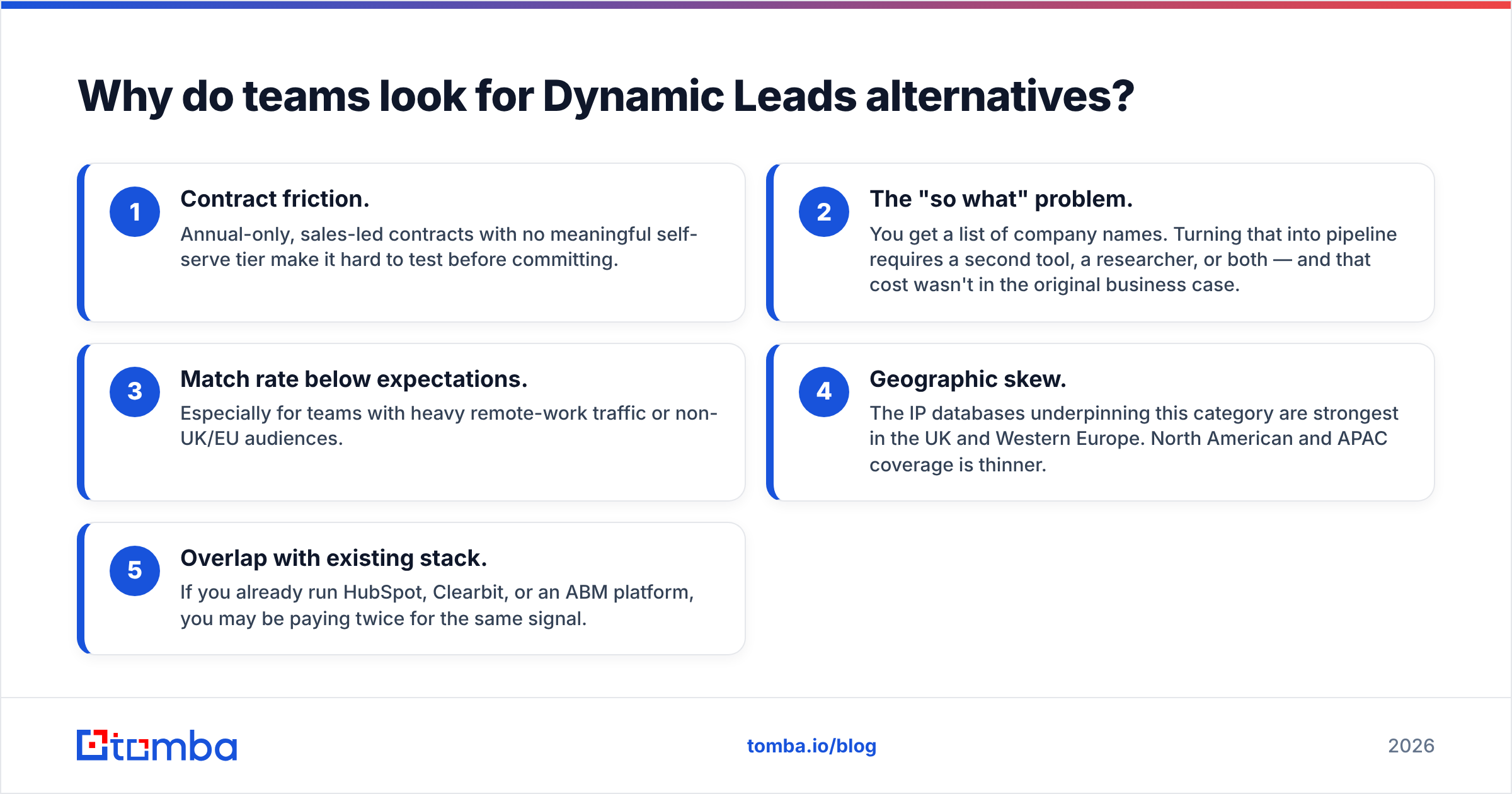
- Contract friction. Annual-only, sales-led contracts with no meaningful self-serve tier make it hard to test before committing.
- The "so what" problem. You get a list of company names. Turning that into pipeline requires a second tool, a researcher, or both — and that cost wasn't in the original business case.
- Match rate below expectations. Especially for teams with heavy remote-work traffic or non-UK/EU audiences.
- Geographic skew. The IP databases underpinning this category are strongest in the UK and Western Europe. North American and APAC coverage is thinner.
- Overlap with existing stack. If you already run HubSpot, Clearbit, or an ABM platform, you may be paying twice for the same signal.
If reason #2 is yours, you don't need a Dynamic Leads replacement. You need a contact-data layer bolted on. That distinction saves a lot of money.
What are the best Dynamic Leads alternatives in 2026?#
Here's the honest map. I've split it by the job each tool does, because comparing an email finder to a visitor-ID platform on price alone is meaningless.
Visitor identification (direct replacements)#
1. Dealfront (Leadfeeder + Echobot) — The most direct swap. Strong European coverage, GDPR-conscious architecture, and a genuinely usable free tier that shows you the last 7 days of identified companies. The Echobot merger added firmographic and trigger data, so it's closer to a full GTM platform than pure visitor ID. Best for: European mid-market with a real ABM motion.
2. Albacross — Nordic-built, strong on European IP resolution, and it plays well with ad platforms for retargeting identified accounts. Simpler UI than Dealfront. Best for: teams who want visitor data flowing into paid social and display rather than into SDR queues. See our Albacross alternative breakdown for the detail.
3. Lead Forensics — The category incumbent, UK-headquartered, largest sales team, and the most aggressive pricing. Coverage is competitive. Contracts are notoriously rigid. Best for: teams who want maximum UK match rate and can negotiate hard.
4. Clearbit Reveal (now part of HubSpot Breeze Intelligence) — Since the HubSpot acquisition, Reveal is deeply wired into HubSpot's workflows. If you're a HubSpot shop, this is the path of least resistance. Best for: HubSpot-native teams. Our Clearbit alternative page covers where it falls short standalone.
5. 6sense / Demandbase — Enterprise intent platforms. These do visitor ID as one feature inside a much larger predictive-account-scoring product. Six-figure territory. Best for: enterprise ABM programs with a dedicated ops team.
Contact data (the layer most teams actually need next)#
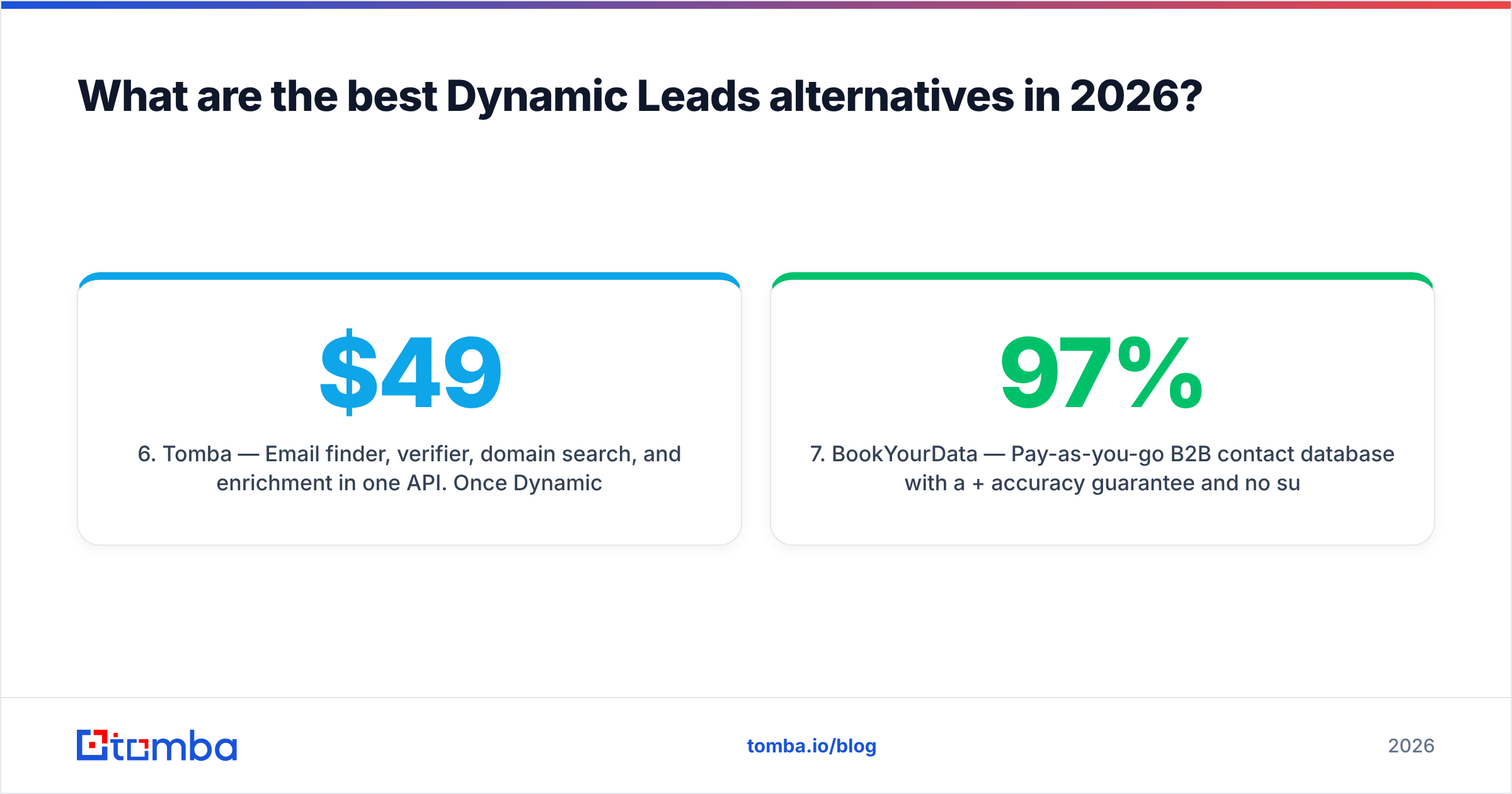
6. Tomba — Email finder, verifier, domain search, and enrichment in one API. Once Dynamic Leads tells you Acme Manufacturing visited, you run a domain search on acme.com, filter to the buying committee, verify, and send. Free tier is 25 searches/mo; Starter is $49/mo; Growth $99/mo; Pro $249/mo. Best for: turning account signals into contactable people without an enterprise contract.
7. BookYourData — Pay-as-you-go B2B contact database with a 97%+ accuracy guarantee and no subscription lock-in. Genuinely useful when you need a one-off list build for a specific ICP rather than an ongoing search tool. Credits don't expire, which is rare in this space. Best for: teams who buy data in bursts, not continuously.
8. Apollo.io — Database plus sequencer plus dialer. Huge contact volume, but data freshness is inconsistent on smaller companies and the all-in-one bundle means you pay for modules you may not use. See the Apollo alternative comparison.
9. Clay — Waterfall enrichment. You feed it a domain, it queries a dozen providers in sequence and returns the first hit. Powerful, expensive, and it requires someone who enjoys building tables. Best for: RevOps teams with real technical appetite.
10. Cognism — GDPR-focused, phone-verified (Diamond Data) contact database with strong EMEA coverage. Annual contracts, enterprise pricing. Best for: European teams who need verified mobile numbers.
11. RocketReach — Broad contact coverage with a simple self-serve model. Weaker verification than dedicated verifiers. Best for: individual reps rather than teams. Detail on our RocketReach alternative page.
How do these Dynamic Leads alternatives compare on price and fit?#
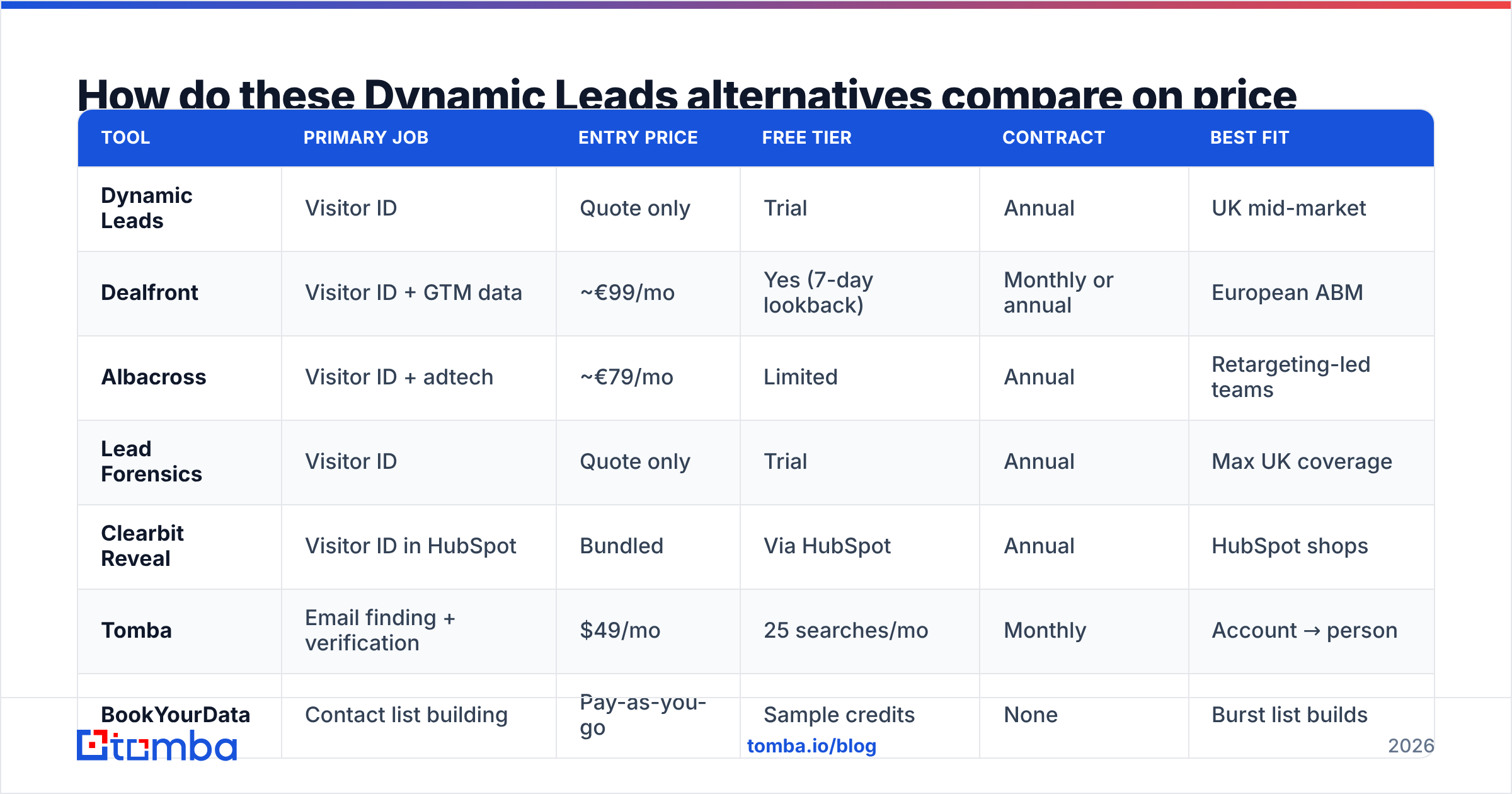
| Tool | Primary job | Entry price | Free tier | Contract | Best fit |
|---|---|---|---|---|---|
| Dynamic Leads | Visitor ID | Quote only | Trial | Annual | UK mid-market |
| Dealfront | Visitor ID + GTM data | ~€99/mo | Yes (7-day lookback) | Monthly or annual | European ABM |
| Albacross | Visitor ID + adtech | ~€79/mo | Limited | Annual | Retargeting-led teams |
| Lead Forensics | Visitor ID | Quote only | Trial | Annual | Max UK coverage |
| Clearbit Reveal | Visitor ID in HubSpot | Bundled | Via HubSpot | Annual | HubSpot shops |
| Tomba | Email finding + verification | $49/mo | 25 searches/mo | Monthly | Account → person |
| BookYourData | Contact list building | Pay-as-you-go | Sample credits | None | Burst list builds |
| Apollo.io | All-in-one outbound | $49/user/mo | Yes | Monthly/annual | Solo SDRs |
| Cognism | EMEA contact + mobile | Quote only | No | Annual | Enterprise EMEA |
Two things jump out of that table.
First, the visitor-ID category is uniformly opaque on pricing. Four of five vendors want a call before they'll quote. Budget 6–18 months of committed spend as your real unit of purchase, not a monthly rate.
Second, the contact-data layer is dramatically cheaper than the identification layer. A $49/mo email finder plus a €99/mo visitor-ID tool is a complete pipeline for under $200/month. Many teams pay 5–10× that for a single enterprise platform that does both adequately.
Do you actually need a visitor-ID tool at all?#
Test this before you renew anything. Pull your last 12 months of closed-won deals and ask: how many originated from an anonymous-visitor alert that your team acted on within 48 hours?
If the answer is fewer than five, the visitor-ID layer isn't your constraint — follow-up speed or contact data is. Three cheaper paths to the same outcome:
- Start from a target list, not from traffic. Build your ICP account list, run domain search against each company to map the buying committee, and work it systematically. No tracking script required.
- Mine the traffic you already identify. Form fills, newsletter signups, and content downloads give you named individuals. Run data enrichment on those records to fill in title, company size, and technology stack before routing.
- Use author and content signals. If you sell to marketers, an author finder pulls contact details from the bylines of companies publishing in your space — a stronger buying signal than an IP hit in many niches.
What should you check before switching tools?#
Whichever direction you go, the data quality question matters more than the feature list. Bad contact data is not neutral — it actively costs you.
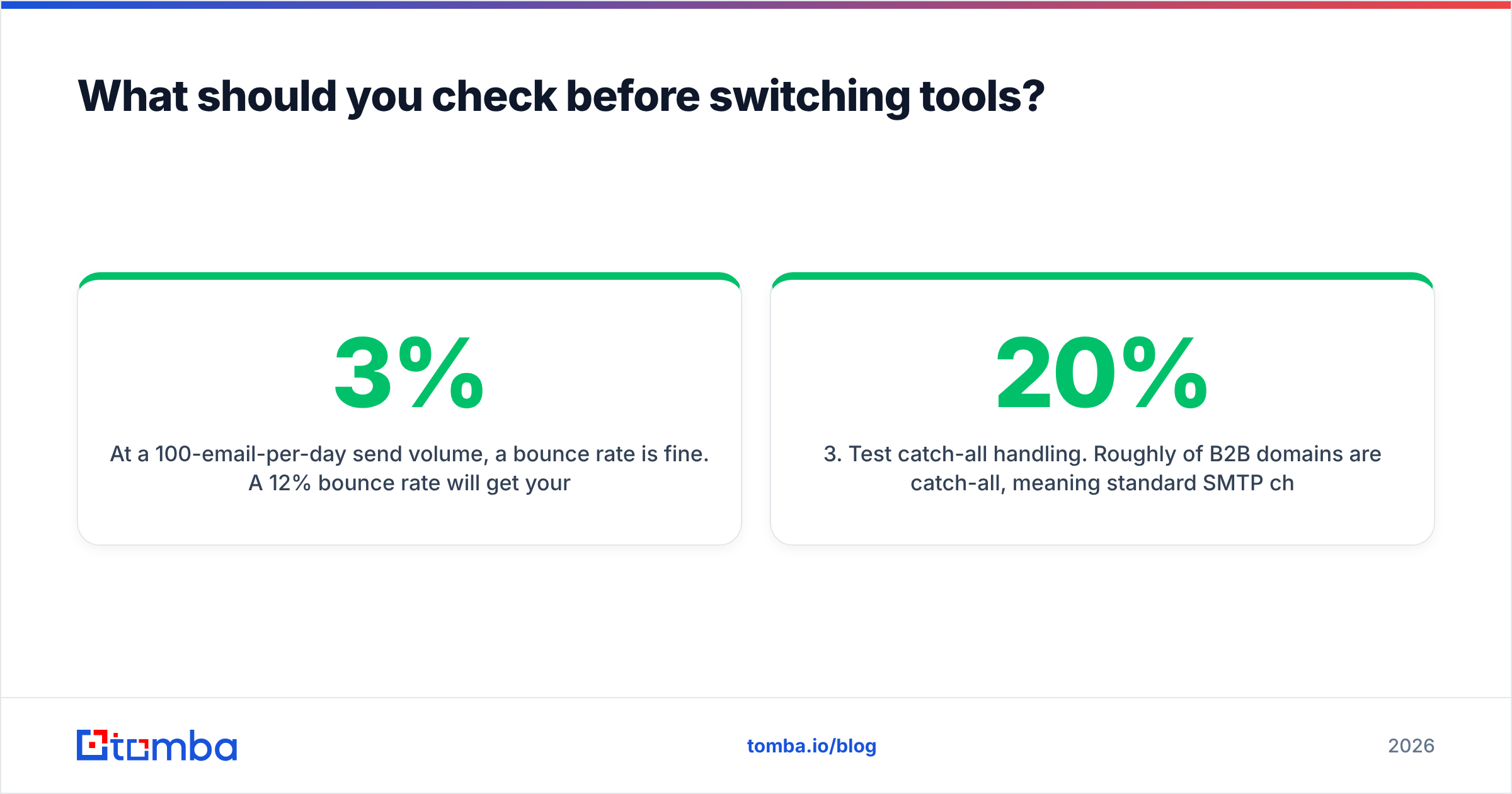
At a 100-email-per-day send volume, a 3% bounce rate is fine. A 12% bounce rate will get your domain flagged by Google and Microsoft within two weeks, and recovery takes months. That's the real hidden cost of cheap data.
Run this checklist on any vendor before you sign:
- Ask for a blind sample test. Give them 100 domains from your actual ICP. Measure match rate and, separately, bounce rate after verification. Vendors quote match rate; nobody volunteers bounce rate.
- Check verification is included, not extra. Some databases charge separately to verify what they sold you. Run every list through an email verifier regardless of vendor claims.
- Test catch-all handling. Roughly 20% of B2B domains are catch-all, meaning standard SMTP checks return "valid" for every address. A catch-all verifier is the difference between a real deliverability read and a false positive.
- Confirm data provenance and GDPR posture. Ask where the data comes from and what the legal basis for processing is. If the answer is vague, that's your answer. Tomba publishes its data sources openly.
- Check the exit. Can you export your data? Is the contract monthly? What's the notice period? Annual auto-renew with 90-day notice is a common trap in this category.
- Test the API before the UI. If you'll eventually automate, a clean email finder API matters more than a pretty dashboard. Check rate limits and response schema, not screenshots.

How do you build a stack that replaces Dynamic Leads?#
A practical assembly that most mid-market teams can run for under $250/month:
Layer 1 — Signal. Dealfront free tier or Albacross for anonymous traffic. Or skip it entirely and start from a static ICP list if your traffic volume is low (under ~5,000 monthly B2B sessions makes visitor ID hard to justify).
Layer 2 — People. Run identified domains through domain search to map roles. Filter to the 2–4 titles that actually sign. Skip the "everyone at the company" export — it's the fastest route to a spam complaint.
Layer 3 — Verification. Every address, every time, before it enters the sequencer. Non-negotiable. Watch your sender reputation as the health metric, not open rate.
Layer 4 — Enrichment. Add firmographics, tech stack, and phone where you need them. A phone finder turns an email-only sequence into a multichannel one, which typically lifts reply rates meaningfully on mid-market accounts.
Layer 5 — Routing. Push into your CRM. Both HubSpot and Salesforce handle this natively; check the integrations list for your specific stack.
The reason this beats a single platform: each layer is independently replaceable. When your visitor-ID vendor raises prices 40% at renewal — and they will — you swap that layer without rebuilding your entire motion.
Which alternative should you pick?#
- You want the closest like-for-like swap: Dealfront. Best coverage-to-transparency ratio in the visitor-ID category, and the free tier lets you validate match rate before paying.
- You're already on HubSpot: Breeze Intelligence (Clearbit Reveal). The integration tax you'd pay elsewhere isn't worth it.
- Your real problem is contacts, not accounts: Tomba. Different job, order of magnitude cheaper, no annual contract.
- You buy data in project bursts: BookYourData. Pay-as-you-go with non-expiring credits is the right shape for irregular list builds.
- You have enterprise budget and an ops team: 6sense or Demandbase, with Cognism for EMEA contact data underneath.
Ready to turn identified accounts into real conversations?#
Visitor identification tells you a company is interested. It can't tell you who to email. That last mile is where most Dynamic Leads deployments quietly stall — a dashboard full of company names and nobody assigned to work them.
Tomba Email Finder closes that gap. Point it at any domain from your visitor report, get the buying committee with verified addresses, and push straight into your sequencer or CRM. Start on the free tier with 25 searches a month to test match quality against your own ICP, then scale to Starter at $49/mo when it earns its place. Full Tomba pricing is public — no sales call, no annual lock-in.
Related guides#
Ready to find emails that actually work?
Join 150,000+ professionals who stopped guessing and started sending. Free credits on signup — no credit card required.
Get the Tomba newsletter
Practical outbound tactics and product updates — once every two weeks.
About the author