Easy Email Verification vs Apollo.io: Which Wins in 2026?
One verifies, one prospects, and most teams buy the wrong one first. Here is how Easy Email Verification and Apollo.io actually compare on accuracy, pricing, and what each does to your bounce rate.
TL;DR
- These two tools do not compete. Easy Email Verification cleans lists you already have; Apollo.io generates the lists in the first place and bundles sequencing, dialing, and a light CRM on top.
- If your bounce rate is the problem, a dedicated verifier wins. If your pipeline is empty, a database wins. Buying the wrong one is the most common mistake we see in outbound audits.
- Apollo's built-in "verified" flag is a data-freshness signal, not a live SMTP check. Teams that trust it blindly still see 4-8% bounces on aged records.
- Pay-as-you-go credits (Easy Email Verification) beat per-seat pricing (Apollo) for anyone verifying in bursts. Per-seat wins when the whole SDR team lives in one tool.
- The realistic stack for most B2B teams in 2026 is a finder + verifier layer (Tomba, Easy Email Verification) feeding a sequencer — not one vendor doing everything at 80% quality.
What are you actually comparing here?#
You are comparing a scalpel to a Swiss Army knife.
Easy Email Verification is a single-purpose utility: you upload a list, it tells you which addresses will bounce, you download the clean file. That is the whole product surface, and that focus is the point.
Apollo.io is a go-to-market platform: a contact database of roughly 275 million people, filters to slice it, sequences to email them, a dialer to call them, and enrichment to push it all into your CRM. Verification is one small feature inside a much larger machine.
So "Easy Email Verification vs Apollo.io" is really a question about where your outbound is broken. Diagnose that first, and the buying decision answers itself:
- Bounce rate above 3% — your problem is data hygiene. A dedicated verifier is the cheaper, faster fix. Apollo will not solve this for you.
- Not enough contacts to email — your problem is sourcing. A verifier has nothing to verify. You need a database or an email finder.
- Contacts exist but sit in spreadsheets — your problem is workflow. Apollo's sequencer or a standalone sending tool closes that gap.
- Emails land in spam despite low bounces — neither tool is your answer. That is a sender reputation and authentication issue.
- You need both sourcing and hygiene — most teams. Split the budget rather than forcing one vendor to cover both.

What is Easy Email Verification and who is it for?#
Easy Email Verification (easyemailverification.com) is a bulk verification service built around one job: reduce hard bounces before you hit send.
The workflow is deliberately boring. Upload a CSV or connect via API, the service runs syntax checks, MX record lookups, disposable-domain detection, role-account flagging, and an SMTP handshake against the receiving server. You get back a status per address — valid, invalid, catch-all/accept-all, unknown — plus a downloadable clean list.
What you get:
- Credit-based pricing with no seat minimums, so a one-off 50,000-record cleanup does not require a subscription conversation.
- An API for pipeline use, which matters if you are verifying at signup or before each sequence launch.
- Deduplication and role-account filtering, which quietly removes the
info@,support@, andsales@addresses that inflate your complaint rate.
What you do not get: any way to find an address that is not already in your file. No company filters, no job-title search, no sequences, no dialer. If your CRM is empty, this tool has nothing to do.
Who it fits: list buyers who need to sanitize purchased data, agencies running cleanups for clients, email marketers with aging subscriber bases, and anyone whose ESP has started sending warning emails about bounce thresholds.
What is Apollo.io and what does it actually do?#
Apollo.io (apollo.io) is one of the largest self-serve prospecting databases on the market, and its scale is genuinely useful. You filter by industry, headcount, technology stack, funding stage, or job title, and export contacts with emails and phone numbers attached.
Where Apollo earns its price is breadth:
- Contact database — hundreds of millions of records with intent signals layered on top.
- Sequences — multi-step email cadences with A/B testing and reply detection.
- Dialer — click-to-call with recording and basic conversation logging.
- Enrichment — keep CRM records current on a schedule.
- Chrome extension — pull contact data while browsing LinkedIn or a company site.
Where Apollo gets criticized, consistently, in G2 reviews and practitioner threads: data accuracy varies wildly by region and seniority. North American mid-market records are strong. European SMB, APAC, and recently-changed-jobs records are noticeably weaker. Apollo marks records as "verified," but that flag reflects when the record was last confirmed in their system — it is not a live mailbox check performed at export time.
That distinction is the entire reason people search for "Easy Email Verification vs Apollo.io" in the first place. They exported an Apollo list, sent it, and watched the bounce report come back ugly.
How accurate is each one in practice?#
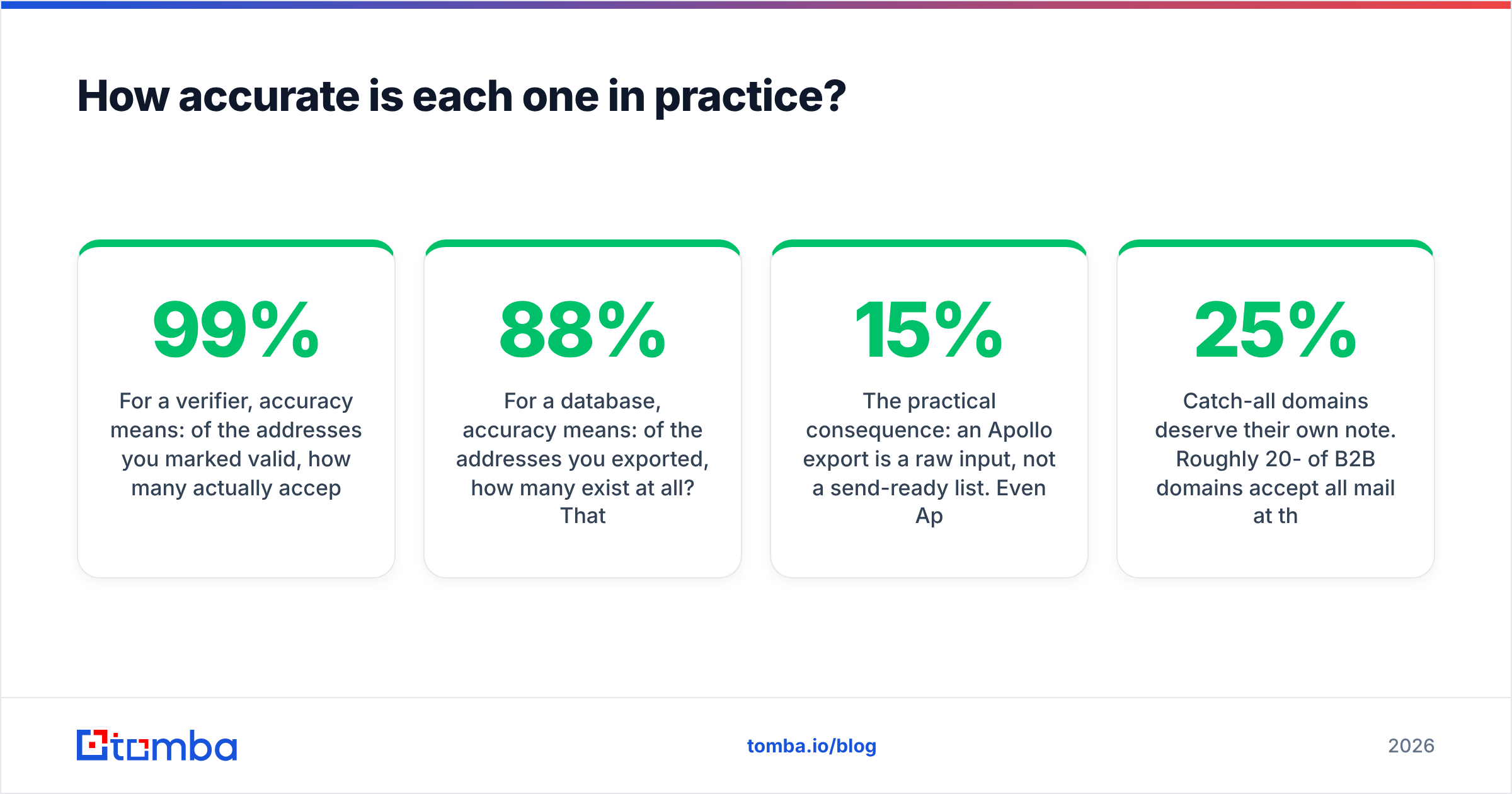
Accuracy means two different things here, and conflating them is how teams end up disappointed.
For a verifier, accuracy means: of the addresses you marked valid, how many actually accepted mail? Good verifiers land in the 97-99% range on standard domains. The variance shows up on catch-all domains, where the receiving server accepts everything and tells you nothing useful.
For a database, accuracy means: of the addresses you exported, how many exist at all? That number is structurally lower — typically 65-88% depending on the segment — because a database is guessing at patterns and reconciling stale records across sources.

The practical consequence: an Apollo export is a raw input, not a send-ready list. Even Apollo's own documentation and support guidance recommends verifying before large sends. Running that export through a dedicated verifier — Easy Email Verification, or Tomba's email verifier — typically strips 8-15% of records and drops observed bounce rates from the 5-7% range to under 2%.
Catch-all domains deserve their own note. Roughly 20-25% of B2B domains accept all mail at the gateway, so a standard SMTP check returns "unknown." Most verifiers stop there and hand you a bucket of maybes. Tools with a dedicated catch-all verifier apply pattern confidence, historical engagement, and secondary signals to split that bucket into probable-valid and probable-invalid, which is the difference between mailing 4,000 usable contacts and discarding them.
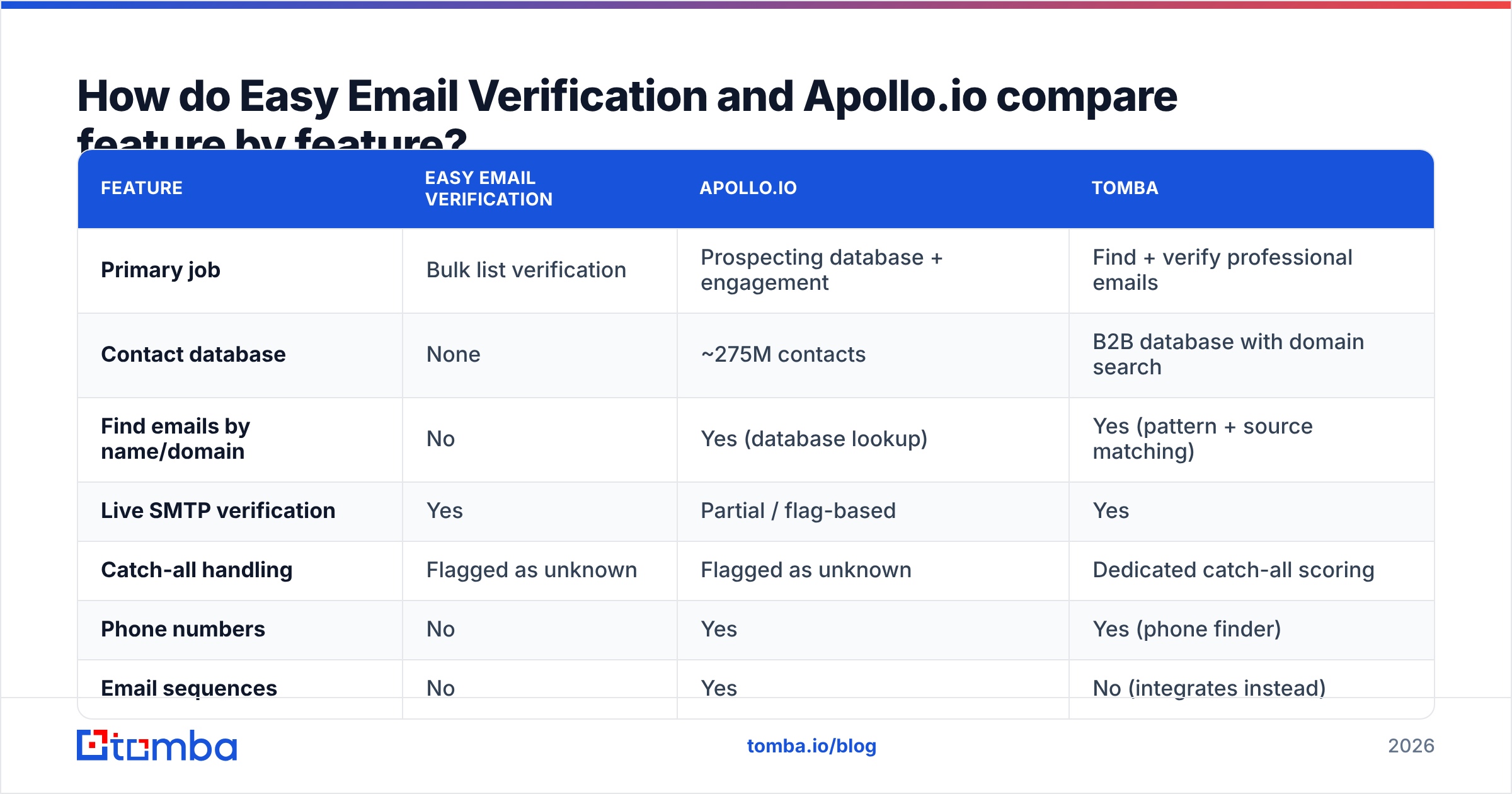
How do Easy Email Verification and Apollo.io compare feature by feature?#
| Feature | Easy Email Verification | Apollo.io | Tomba |
|---|---|---|---|
| Primary job | Bulk list verification | Prospecting database + engagement | Find + verify professional emails |
| Contact database | None | ~275M contacts | B2B database with domain search |
| Find emails by name/domain | No | Yes (database lookup) | Yes (pattern + source matching) |
| Live SMTP verification | Yes | Partial / flag-based | Yes |
| Catch-all handling | Flagged as unknown | Flagged as unknown | Dedicated catch-all scoring |
| Phone numbers | No | Yes | Yes (phone finder) |
| Email sequences | No | Yes | No (integrates instead) |
| Dialer | No | Yes | No |
| API access | Yes | Yes (higher tiers) | Yes, all paid plans |
| Chrome extension | No | Yes | Yes |
| CRM enrichment | No | Yes | Yes |
| Pricing model | Pay-as-you-go credits | Per seat, per month | Per account, per month |
| Free tier | Trial credits | Limited free plan | 25 searches/month |
| Best for | Cleaning existing lists | Full outbound motion in one tool | Sourcing + hygiene without seat costs |

Read that table as a shopping list, not a scoreboard. Easy Email Verification "losing" on sequences is not a flaw — it never claimed the category. Apollo "losing" on catch-all depth is more consequential, because Apollo is the tool people actually send from.
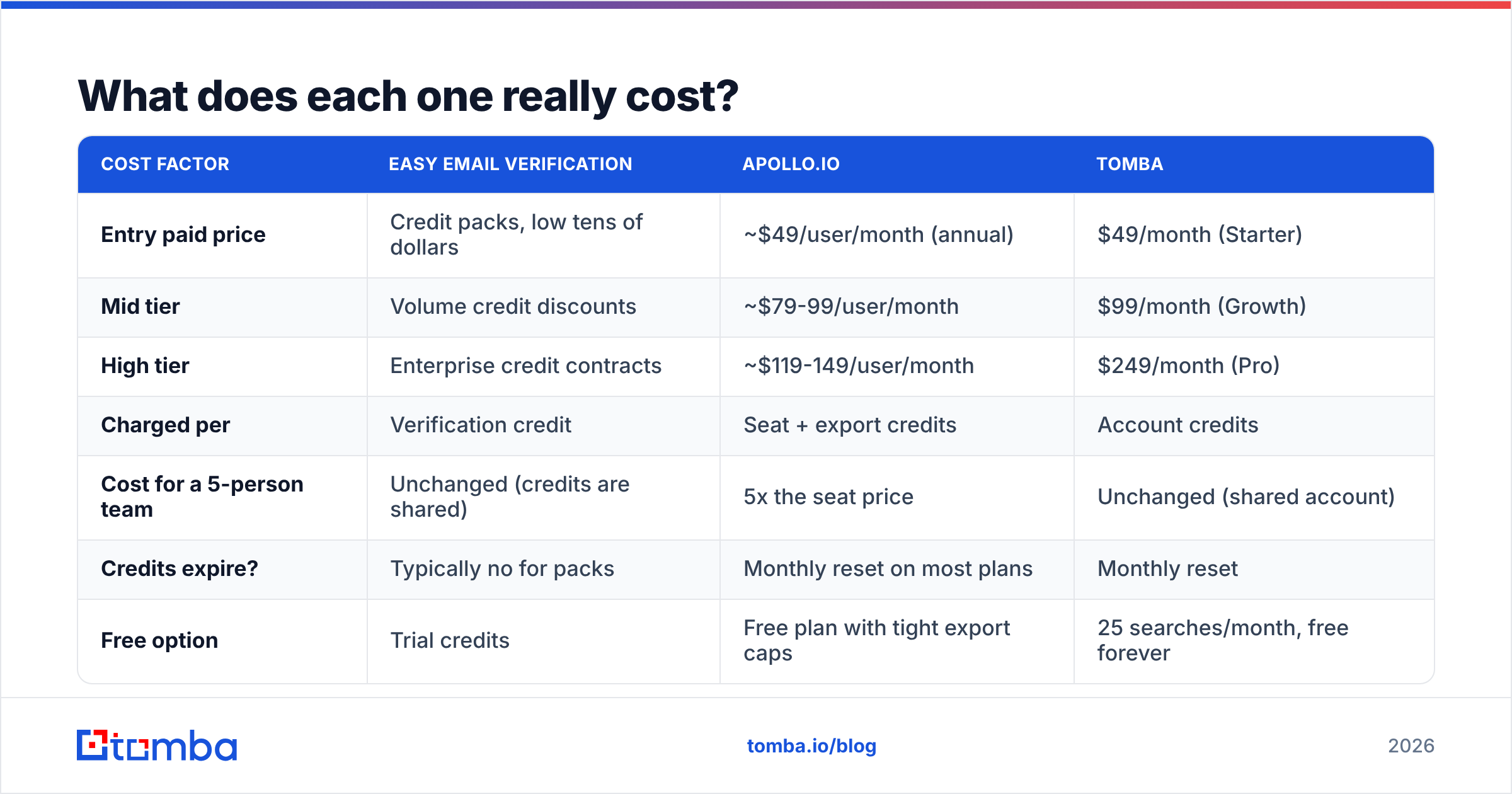
What does each one really cost?#
Pricing on both sides moves; treat these as directional and confirm on the vendor page before you sign anything.
| Cost factor | Easy Email Verification | Apollo.io | Tomba |
|---|---|---|---|
| Entry paid price | Credit packs, low tens of dollars | ~$49/user/month (annual) | $49/month (Starter) |
| Mid tier | Volume credit discounts | ~$79-99/user/month | $99/month (Growth) |
| High tier | Enterprise credit contracts | ~$119-149/user/month | $249/month (Pro) |
| Charged per | Verification credit | Seat + export credits | Account credits |
| Cost for a 5-person team | Unchanged (credits are shared) | 5x the seat price | Unchanged (shared account) |
| Credits expire? | Typically no for packs | Monthly reset on most plans | Monthly reset |
| Free option | Trial credits | Free plan with tight export caps | 25 searches/month, free forever |
The structural difference matters more than the sticker price. Per-seat pricing scales with headcount, so a 6-rep team on Apollo Professional is looking at roughly $475-600 per month before add-ons. Credit-based pricing scales with usage, so a 6-person team verifying the same volume as a solo founder pays the same. Check Tomba pricing if you want to model the account-based version of that math.
Two hidden costs people forget:
- Apollo export credits are separate from seats. Heavy exporting on a lower tier stalls mid-month, and the upgrade is not cheap.
- Verification waste. If you verify an unfiltered database export, you pay to verify records you were never going to email. Filter first, verify second.

Which one should you pick for your use case?#
- You bought or scraped a list and need it clean. Easy Email Verification. Nothing in Apollo does this job better, and you would be paying for a database you already bypassed.
- You are starting outbound from zero with no contacts. Apollo, or a finder plus a sequencer. A verifier has no input to work on.
- You have a small team and hate per-seat pricing. Neither Apollo tier is friendly here. Look at account-priced finder/verifier combinations, or a dedicated Apollo alternative that does not tax you per head.
- You need phone numbers alongside emails. Apollo covers this natively; a pure verifier does not. Standalone options like a phone finder fill the gap if you would rather not buy the whole platform.
- You are enriching an existing CRM, not prospecting. Verification plus data enrichment beats a full GTM platform, because you already have the accounts — you just need current, deliverable contact data on them.
- You send at real volume (50k+/month). Run both layers. Source from a database, verify with a dedicated verifier immediately before each send, and never send off a month-old export.
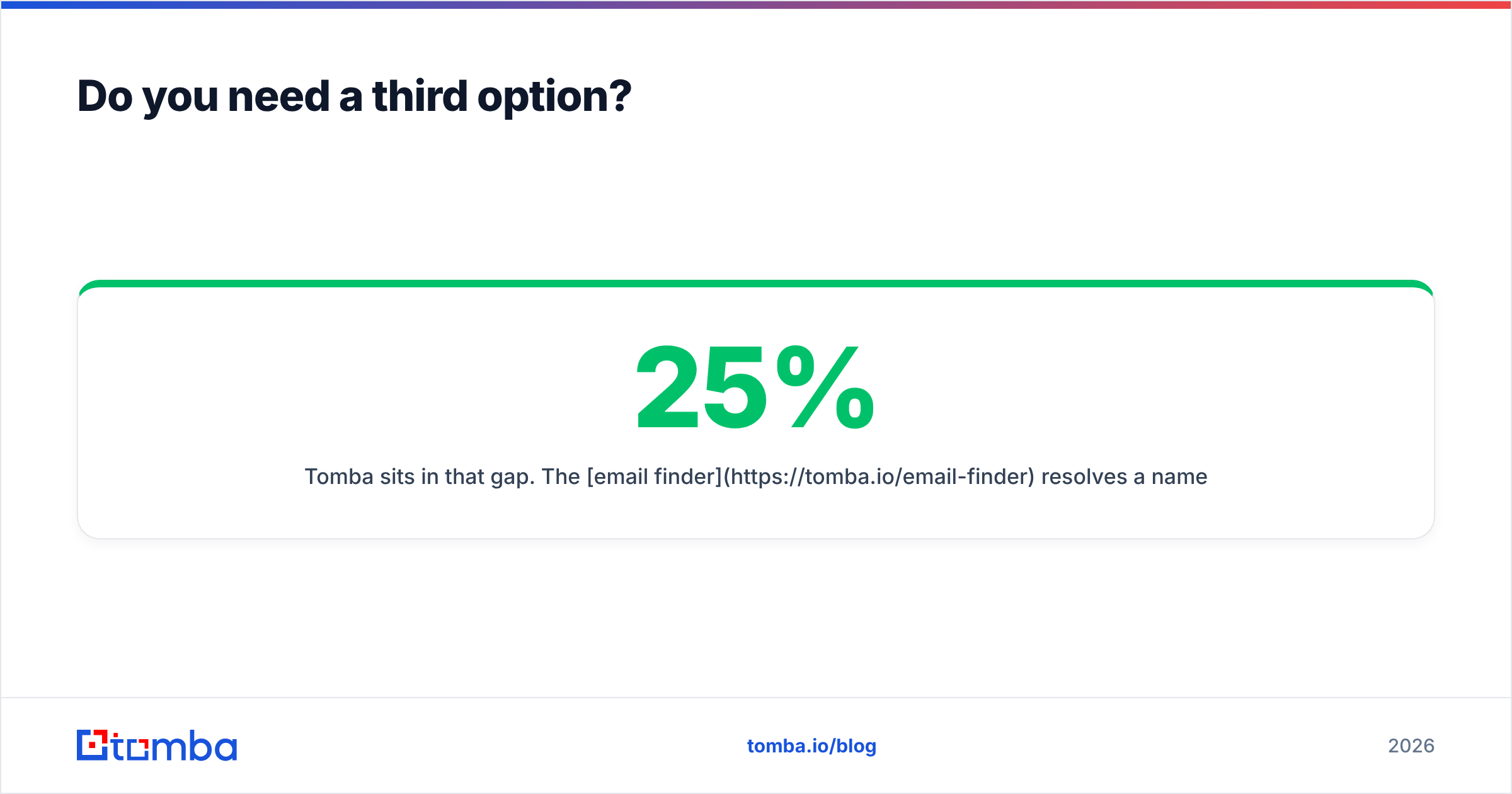
Do you need a third option?#
Often, yes — and this is where the honest version of the comparison lands.
The gap between these two products is the job most B2B teams actually have: find a specific person's work email, confirm it is deliverable, and move on. Easy Email Verification handles half of that. Apollo handles the other half, plus a lot of software you may not need.
Tomba sits in that gap. The email finder resolves a name and domain to a verified address, domain search pulls every discoverable contact at a company, the verifier runs live SMTP checks, and the catch-all layer handles the 20-25% of domains that defeat simpler tools. Pricing is per account — Free (25 searches/month), Starter $49/month, Growth $99/month, Pro $249/month — so adding teammates does not multiply the bill.
What Tomba deliberately does not do: sequences, dialing, or CRM replacement. It integrates with the tools you already send from (HubSpot, Pipedrive, Zapier) rather than trying to replace them. If you want one vendor to run your entire GTM motion, Apollo is the more complete answer, and that is a fair reason to choose it.
What is the verdict?#
Pick by the bottleneck, not the feature list.
Choose Easy Email Verification when you have lists and a bounce problem. It is focused, credit-priced, and does not ask you to adopt a platform.
Choose Apollo.io when you need volume sourcing plus sequencing in one login and your team is large enough that per-seat pricing is already normal. Just budget for a verification step on top — the built-in flag is not a substitute.
Choose a finder-plus-verifier stack when your real need is accurate contact data for a defined target list, and you would rather not pay platform prices for features your reps will not open.
The failure mode is treating any single vendor's output as send-ready. Databases go stale, people change jobs at roughly 20% per year, and catch-all domains hide the truth. A verification step before every send is the cheapest insurance in outbound.
Ready to fix the sourcing half? Start with the Tomba Email Finder — find professional emails by name, domain, or company, with SMTP verification and catch-all scoring built into the same lookup. The free tier gives you 25 searches a month, no card required, so you can benchmark it against your current Apollo export before you renew anything.
Related guides#
Ready to find emails that actually work?
Join 150,000+ professionals who stopped guessing and started sending. Free credits on signup — no credit card required.
Get the Tomba newsletter
Practical outbound tactics and product updates — once every two weeks.
About the author