Easy Email Verification vs Lead411: Which One Should You Use?
One tool cleans the emails you already have. The other sells you emails you don't. Here's how Easy Email Verification and Lead411 actually compare on price, accuracy, and workflow — and when neither is the right buy.
TL;DR
- Easy Email Verification and Lead411 are not real competitors. One validates a list you already own; the other sells you a list you don't. Comparing them head-to-head only makes sense if you're deciding where your budget should go first.
- If your bounce rate is above 3% and you already have thousands of contacts, buy verification. If you have deliverability under control but no pipeline, buy data.
- Lead411 is priced per seat (roughly $99/user/month on annual billing at the time of writing) and bundles intent data, technographics, and direct dials. Easy Email Verification is pay-as-you-go credits, typically fractions of a cent per email.
- Neither tool does both jobs well. A finder-plus-verifier stack — Tomba, for example, starts free with 25 searches and $49/mo paid — usually beats buying two point tools at two price points.
- The decision is really about your bottleneck, not the vendor. Diagnose the bottleneck first; the tool choice follows in ten minutes.
What is Easy Email Verification?#
Easy Email Verification is a single-purpose list-hygiene tool. You upload a CSV of email addresses, it runs syntax checks, MX record lookups, SMTP handshakes, disposable-domain detection, and role-account flagging, then hands you back a file marked valid / invalid / risky / unknown. That's the whole product.
Think of it like a bouncer at the door of your sending domain. It doesn't invite anyone to the party — it just stops the people who'll cause a scene from walking in. The service (easyemailverification.com) sells credits rather than seats, which is the right model for what it does: verification is bursty work, not daily work.
What it does not do: find anyone. If you hand it an empty file, you get an empty file back. There's no database, no prospecting UI, no company search, no intent signals. That is a feature, not a flaw — narrow tools tend to be cheaper and better at their one job — but it defines who should buy it.
Where verification tools differ from each other is mostly in three places: how they treat catch-all domains, how honest they are about "unknown" results, and how fast bulk jobs run. A verifier that marks every catch-all as "valid" is lying to you, and you'll find out three weeks later when your sender reputation tanks. This is why a dedicated catch-all verifier matters more than raw pass-rate marketing numbers.
What is Lead411?#
Lead411 is a B2B sales intelligence platform. It sells access to a contact and company database — emails, direct dial phone numbers, org charts, technographics, and buying-intent signals sourced from Bombora and its own triggers. You search by title, industry, headcount, location, or technology installed, then export or push contacts into your CRM.
The Lead411 pitch is "unlimited" — most plans advertise unlimited email views within fair-use caps, which is genuinely unusual in a market where everyone else meters credits aggressively. Direct dials are typically capped separately, because phone data is expensive to acquire and maintain.
Lead411 sits in the same competitive set as ZoomInfo, Apollo, Cognism, and Seamless.AI. On G2 it consistently scores well on price-to-value against ZoomInfo — which is mostly what it's selling: enterprise-shaped data at mid-market pricing, without the multi-year contract theatrics.
What Lead411 does not do well is deep list hygiene. It verifies its own records on some cadence, but it will not take your 40,000-row legacy CRM export and tell you which addresses are dead. That's not the product.

Are Easy Email Verification and Lead411 even competing?#
No — and this is the most useful thing to understand before you spend money.
They sit at different stages of the same pipeline:
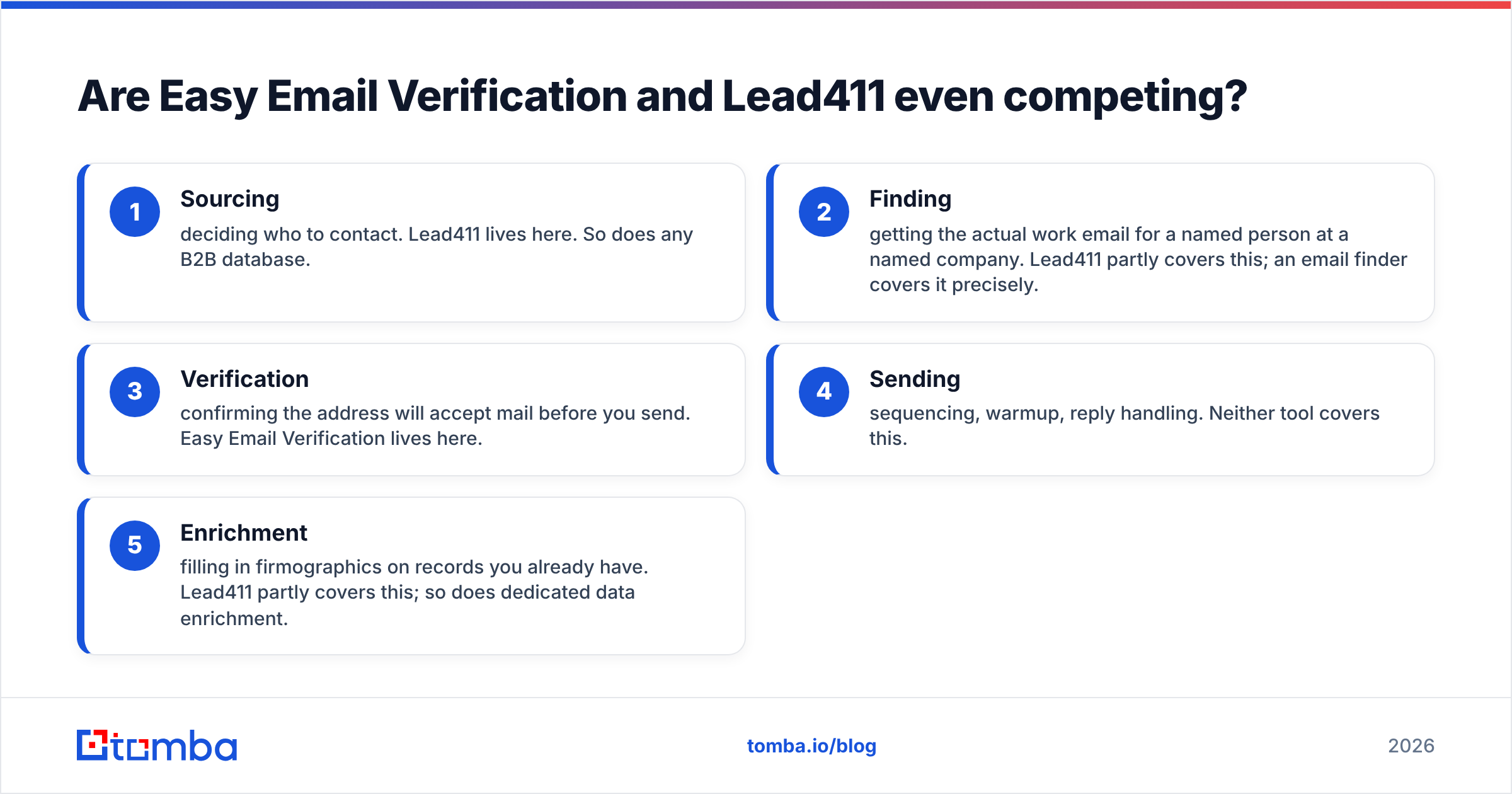
- Sourcing — deciding who to contact. Lead411 lives here. So does any B2B database.
- Finding — getting the actual work email for a named person at a named company. Lead411 partly covers this; an email finder covers it precisely.
- Verification — confirming the address will accept mail before you send. Easy Email Verification lives here.
- Sending — sequencing, warmup, reply handling. Neither tool covers this.
- Enrichment — filling in firmographics on records you already have. Lead411 partly covers this; so does dedicated data enrichment.
If someone tells you to compare "easy email verification vs lead411" as if they're substitutes, they're really asking a budget-allocation question: given one line item, which stage of my pipeline is bleeding the most?
The honest test takes five minutes. Pull your last 1,000 sends. If your hard bounce rate is above 3%, your problem is stage 3 and no amount of new data will fix it — you'll just bounce faster and lose the domain sooner. If bounces are under 2% but you sent 1,000 emails to a list you scraped in 2023, your problem is stage 1.
How do Easy Email Verification and Lead411 compare feature by feature?#
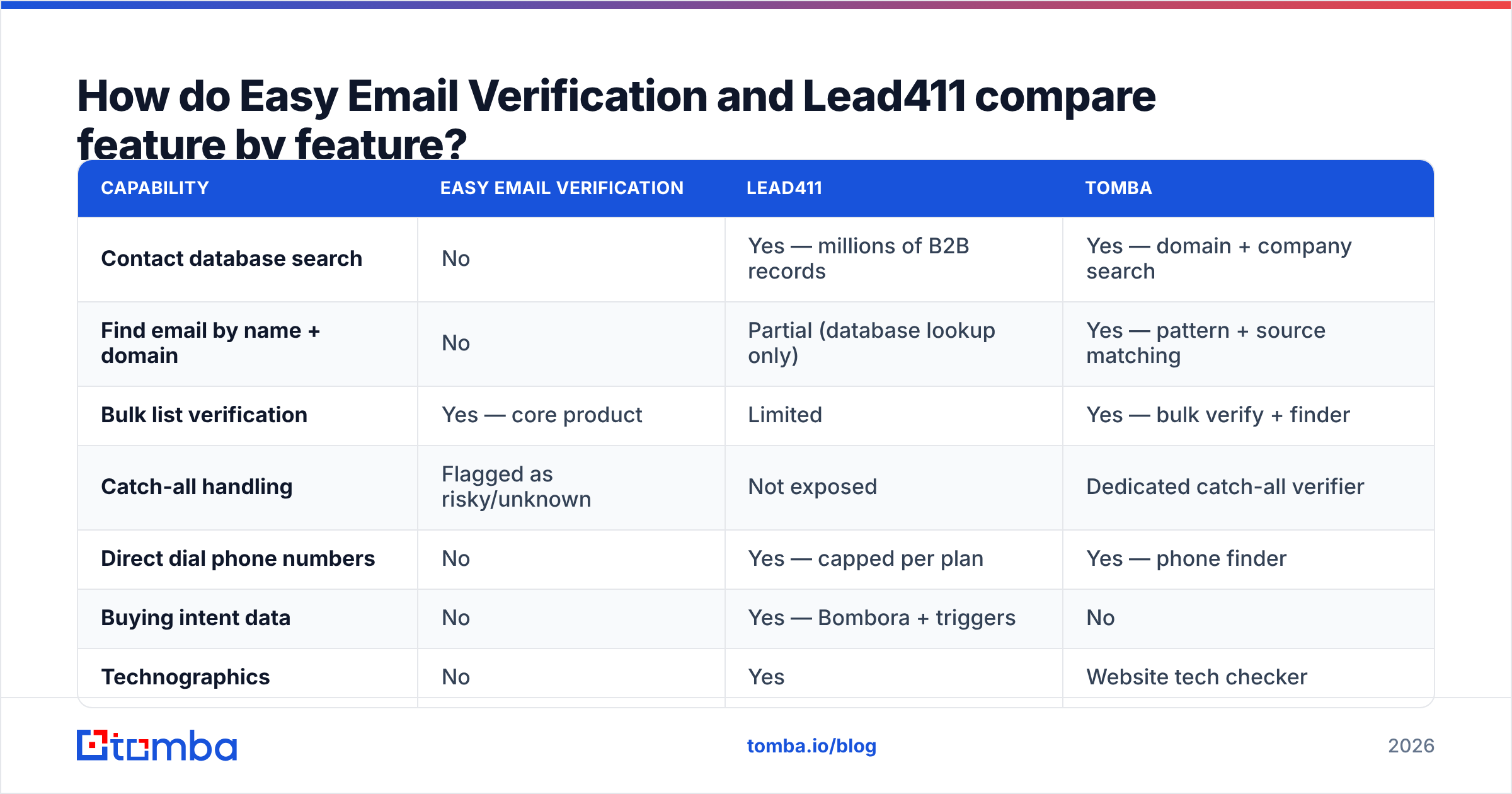
Here's the practical breakdown, with a finder-plus-verifier stack in the third column for reference.
| Capability | Easy Email Verification | Lead411 | Tomba |
|---|---|---|---|
| Contact database search | No | Yes — millions of B2B records | Yes — domain + company search |
| Find email by name + domain | No | Partial (database lookup only) | Yes — pattern + source matching |
| Bulk list verification | Yes — core product | Limited | Yes — bulk verify + finder |
| Catch-all handling | Flagged as risky/unknown | Not exposed | Dedicated catch-all verifier |
| Direct dial phone numbers | No | Yes — capped per plan | Yes — phone finder |
| Buying intent data | No | Yes — Bombora + triggers | No |
| Technographics | No | Yes | Website tech checker |
| API access | Yes | Yes (higher tiers) | Yes — all paid plans |
| Chrome extension | No | Yes | Yes |
| Free tier | Trial credits | Trial only | 25 searches/mo, no card |
| Pricing model | Pay-as-you-go credits | Per seat, annual-leaning | Per month, credit-based |
The pattern is obvious once it's laid out: Lead411's column is wide and shallow on hygiene; Easy Email Verification's column is narrow and deep on hygiene. Neither column is complete on its own.
How much do they actually cost?#
Pricing changes, so treat these as directional and confirm on the vendor pages before you buy.
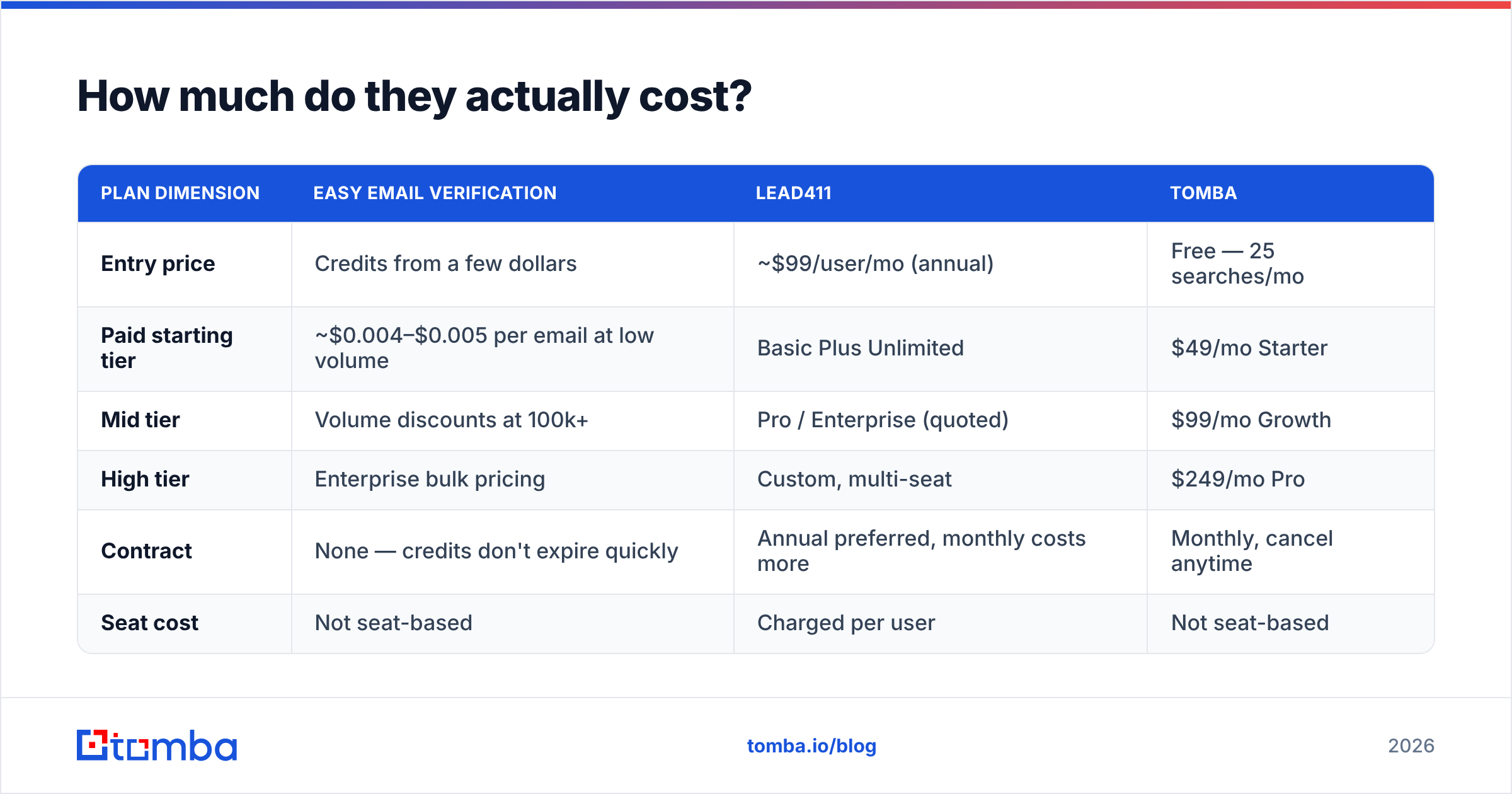
| Plan dimension | Easy Email Verification | Lead411 | Tomba |
|---|---|---|---|
| Entry price | Credits from a few dollars | ~$99/user/mo (annual) | Free — 25 searches/mo |
| Paid starting tier | ~$0.004–$0.005 per email at low volume | Basic Plus Unlimited | $49/mo Starter |
| Mid tier | Volume discounts at 100k+ | Pro / Enterprise (quoted) | $99/mo Growth |
| High tier | Enterprise bulk pricing | Custom, multi-seat | $249/mo Pro |
| Contract | None — credits don't expire quickly | Annual preferred, monthly costs more | Monthly, cancel anytime |
| Seat cost | Not seat-based | Charged per user | Not seat-based |
Two cost traps worth naming:
The seat trap. Lead411 charges per user. A four-person SDR team is four seats before anyone exports a single contact. Verification tools and credit-based finders don't care how many humans log in, which changes the math substantially for small teams.
The re-verification trap. Verification is not a one-time purchase. B2B email data decays somewhere around 22–30% per year as people change jobs. If you verify a 50,000-row list in January, roughly a third of it is questionable by December. Budget for verification as a recurring line item, not a cleanup project. Full Tomba pricing is published for comparison if you want a third data point.

Which one is more accurate — and what does accuracy even mean here?#
They're measuring different things, which is why vendor accuracy claims are close to useless when compared across categories.
Verification accuracy means: of the addresses marked "valid," what percentage actually accepted mail? Good verifiers land in the 95–98% range on non-catch-all domains. The honest ones also report a meaningful "unknown" bucket — usually 5–15% of any real-world list — because catch-all servers and greylisting genuinely cannot be resolved with an SMTP handshake alone.
Database accuracy means: of the contacts in the database, what percentage are current, correctly attributed, and reachable? This is a decay problem, not a protocol problem. A database can have a perfectly formatted address for someone who left the company eight months ago.
That difference matters operationally. A verifier will happily confirm that jane.doe@acme.com accepts mail — even though Jane resigned in March and the address now forwards to a shared inbox no one reads. Technically valid. Commercially dead. Conversely, a database can hand you a fresh, correct-looking address that bounces because the company migrated mail providers last week.
The only reliable setup is both checks, in sequence: source or find the address, then verify it immediately before sending — not at export time, not last quarter. If you're pulling contacts from LinkedIn profiles, run them through a LinkedIn finder and then an email verifier in the same pass rather than trusting either step alone.
Who should choose which?#
Six clear cases, in the order you're most likely to hit them:
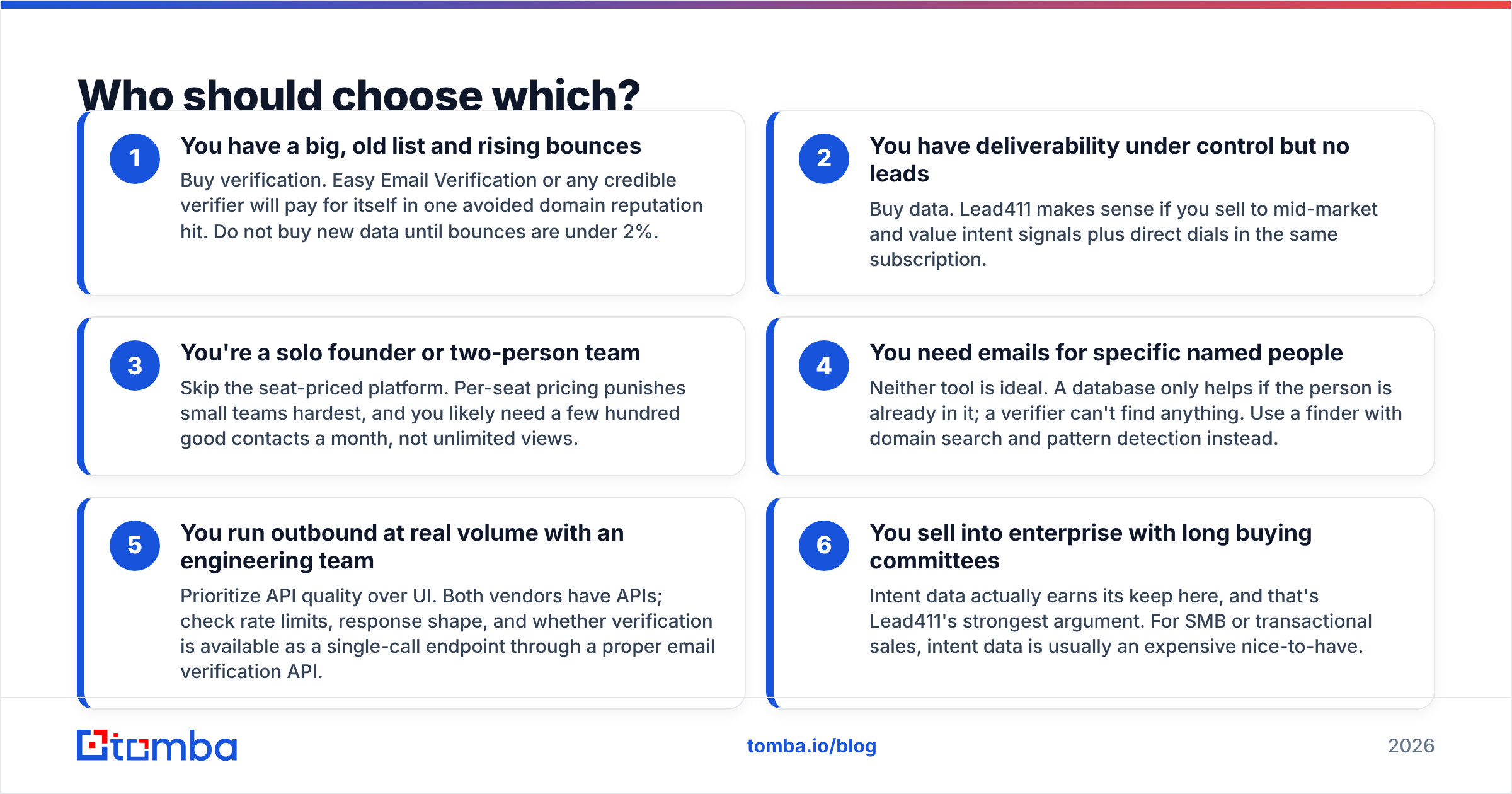
- You have a big, old list and rising bounces — Buy verification. Easy Email Verification or any credible verifier will pay for itself in one avoided domain reputation hit. Do not buy new data until bounces are under 2%.
- You have deliverability under control but no leads — Buy data. Lead411 makes sense if you sell to mid-market and value intent signals plus direct dials in the same subscription.
- You're a solo founder or two-person team — Skip the seat-priced platform. Per-seat pricing punishes small teams hardest, and you likely need a few hundred good contacts a month, not unlimited views.
- You need emails for specific named people — Neither tool is ideal. A database only helps if the person is already in it; a verifier can't find anything. Use a finder with domain search and pattern detection instead.
- You run outbound at real volume with an engineering team — Prioritize API quality over UI. Both vendors have APIs; check rate limits, response shape, and whether verification is available as a single-call endpoint through a proper email verification API.
- You sell into enterprise with long buying committees — Intent data actually earns its keep here, and that's Lead411's strongest argument. For SMB or transactional sales, intent data is usually an expensive nice-to-have.
What alternatives should be on your shortlist?#
If you're evaluating "easy email verification vs lead411," you should also price these before committing:
- ZoomInfo — bigger database, bigger contract, enterprise procurement cycle. Overkill below 20 seats.
- Apollo.io — data plus sequencing in one product; convenient, though data quality varies by vertical. See the Apollo alternative breakdown for the trade-offs.
- Cognism — strong EU coverage and GDPR posture, priced accordingly.
- ZeroBounce / Bouncer / Debounce — direct substitutes for Easy Email Verification; compare on catch-all honesty, not headline accuracy.
- BookYourData — pay-as-you-go B2B contact lists with a verification guarantee. Genuinely useful if you want data without a subscription commitment, and a reasonable middle ground between the two categories discussed here.
- Tomba — finder plus verifier plus enrichment in one credit pool, with a free tier to test accuracy on your own domains before paying.

How should you actually run the evaluation?#
Don't trust anyone's published accuracy number, including the ones above. Run this instead:
Build a truth set. Take 100 contacts you already know are valid — customers, partners, people who replied to you last quarter. Add 50 you know are dead: bounced addresses, people who've left companies you track. Mix them.
Run the set through each trial. Score on the dead ones. Any verifier can mark valid addresses valid. The differentiator is whether it correctly catches the 50 dead ones, and how many valid addresses it wrongly kills (false positives cost you real pipeline).
For database tools, test coverage on your ICP specifically. Pull a list of 50 companies you'd actually sell to and check how many have a current, correctly-titled decision maker. Global database size is a vanity metric; coverage in your niche is the only number that matters.
Check the export path. How does data reach your CRM or sequencer? A tool that requires manual CSV shuffling every week will cost more in SDR hours than it saves in license fees. Look for native integrations rather than promised roadmap items.
The bottom line#
Easy Email Verification and Lead411 solve different problems, and the right answer for most teams is "one of them, plus something that covers the gap." Verification without sourcing means a very clean list of people you're not reaching. Sourcing without verification means a large list that burns your domain.
If you'd rather not run two subscriptions to cover one workflow, start with the Tomba Email Finder — find addresses by domain, name, or company, verify them in the same credit pool, and test the whole thing on 25 free searches a month before you commit to anything. Run your own truth set against it, compare the numbers to whatever Lead411 or a standalone verifier quotes you, and buy based on your data instead of a pricing page.
Related guides#
Ready to find emails that actually work?
Join 150,000+ professionals who stopped guessing and started sending. Free credits on signup — no credit card required.
Get the Tomba newsletter
Practical outbound tactics and product updates — once every two weeks.
About the author