7 Best EasyLeadz Alternatives in 2026 (Tested & Priced)
EasyLeadz built its name on Indian mobile numbers, but coverage gaps and credit math push a lot of teams elsewhere. Here are 7 alternatives tested on price, accuracy, and API depth.
TL;DR
- EasyLeadz (Mr. E) is strongest on Indian and APAC mobile numbers pulled from LinkedIn profiles — that's the niche it owns, and no honest list pretends otherwise.
- The three reasons teams leave: thin coverage outside India/SEA, credits that burn on failed lookups, and an API that's a bolt-on rather than the product.
- If email is your primary channel, a dedicated email finder with verification built in costs less per usable contact than a phone-first tool.
- Best fits by use case: Tomba for email-first outbound and API workloads, Lusha for a direct phone-first swap, BookYourData for pay-as-you-go list purchases, Apollo for all-in-one sequencing.
- Ignore the sticker price. Calculate cost per verified, deliverable contact — that number moves 3-5x between these tools.
What is EasyLeadz and who actually uses it?#
EasyLeadz is an Indian B2B contact-data company best known for Mr. E, its Chrome extension that reveals direct mobile numbers from LinkedIn profiles. You open a prospect's profile, click the extension, and it returns a phone number (and sometimes an email) drawn from its contributed and licensed database.
Think of it like a phone book that was assembled by everyone who ever installed the extension. That model has a real strength and a real weakness. The strength: for markets where its contributor base is dense — India first, then parts of Southeast Asia and the Middle East — it surfaces mobile numbers that global databases simply don't have. The weakness: coverage falls off a cliff outside that footprint, and you only discover the gap after you've spent credits.
Its typical user is an SDR or recruiter doing high-volume phone outreach into Indian companies, or a Western team selling into India. If that's you, EasyLeadz is a genuinely reasonable tool and this article may end with you renewing.
Everyone else tends to hit one of three walls.
Why do teams look for EasyLeadz alternatives?#
Here are the complaints that show up repeatedly in reviews on G2 and in sales-ops communities:
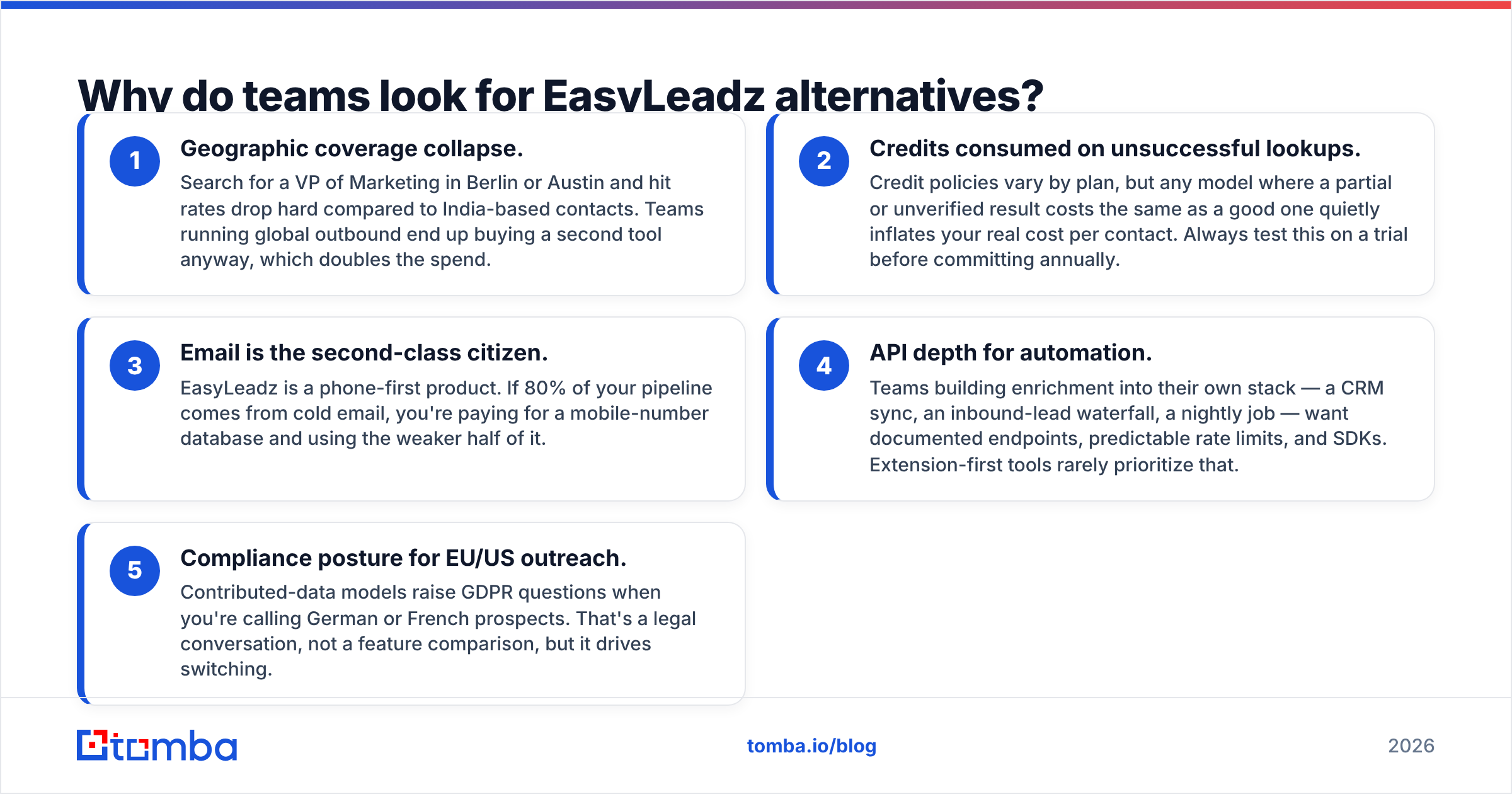
- Geographic coverage collapse. Search for a VP of Marketing in Berlin or Austin and hit rates drop hard compared to India-based contacts. Teams running global outbound end up buying a second tool anyway, which doubles the spend.
- Credits consumed on unsuccessful lookups. Credit policies vary by plan, but any model where a partial or unverified result costs the same as a good one quietly inflates your real cost per contact. Always test this on a trial before committing annually.
- Email is the second-class citizen. EasyLeadz is a phone-first product. If 80% of your pipeline comes from cold email, you're paying for a mobile-number database and using the weaker half of it.
- API depth for automation. Teams building enrichment into their own stack — a CRM sync, an inbound-lead waterfall, a nightly job — want documented endpoints, predictable rate limits, and SDKs. Extension-first tools rarely prioritize that.
- Compliance posture for EU/US outreach. Contributed-data models raise GDPR questions when you're calling German or French prospects. That's a legal conversation, not a feature comparison, but it drives switching.

None of this makes EasyLeadz a bad product. It makes it a specific product. The rest of this post is about matching your actual motion to the right tool.
How should you evaluate a replacement?#
Score every candidate on these six dimensions before you look at price:
- Coverage where you sell. Not global coverage claims — your ICP's geography, company size band, and seniority. Run the same 50 test contacts through every trial.
- Verification depth. Does the tool tell you an email is valid, risky, or catch-all? An unverified email is a bounce waiting to hurt your sender reputation.
- Credit mechanics. Do failed lookups cost credits? Do credits roll over? Is verification billed separately from finding?
- API and integrations. Documented REST endpoints, SDKs, rate limits, and native connectors to your CRM. Check whether the API costs extra.
- Data provenance. Where does the data come from, and can the vendor tell you? Ask directly — the ones with clean answers publish them.
- Real cost per usable contact. Total monthly spend ÷ contacts that were correct and deliverable. This is the only number that matters.
Which are the best EasyLeadz alternatives in 2026?#
1. Tomba — best for email-first outbound and API workloads#
Tomba is a dedicated email-finding and verification platform. Where EasyLeadz optimizes for phone numbers, Tomba optimizes for getting a deliverable email address into your sequence and keeping your bounce rate under control.
The practical difference is that finding and verifying live in the same system. You run a domain search to pull every public email pattern at a company, find the specific person, and the email verifier grades the result — including catch-all domains, which most tools just shrug at.
For engineering-adjacent teams, the Tomba API is the actual selling point: documented endpoints, SDKs in most major languages, plus a CLI and MCP server if you're wiring data into agents or internal tooling. Pricing runs Free (25 searches/mo), Starter $49/mo, Growth $99/mo, Pro $249/mo, and custom Enterprise.
Trade-off to know: Tomba does offer a phone finder, but if your entire motion is cold-calling Indian mobiles, EasyLeadz still owns that specific lane.
2. Lusha — closest phone-first swap#
Lusha is the most direct like-for-like replacement if you want mobile numbers plus a browser extension and better Western coverage. Strong US and European direct-dial data, clean UI, solid CRM integrations. It's meaningfully more expensive per contact than EasyLeadz, and its credit packaging pushes teams toward annual commitments faster than they'd like.
3. BookYourData — best for pay-as-you-go list purchases#
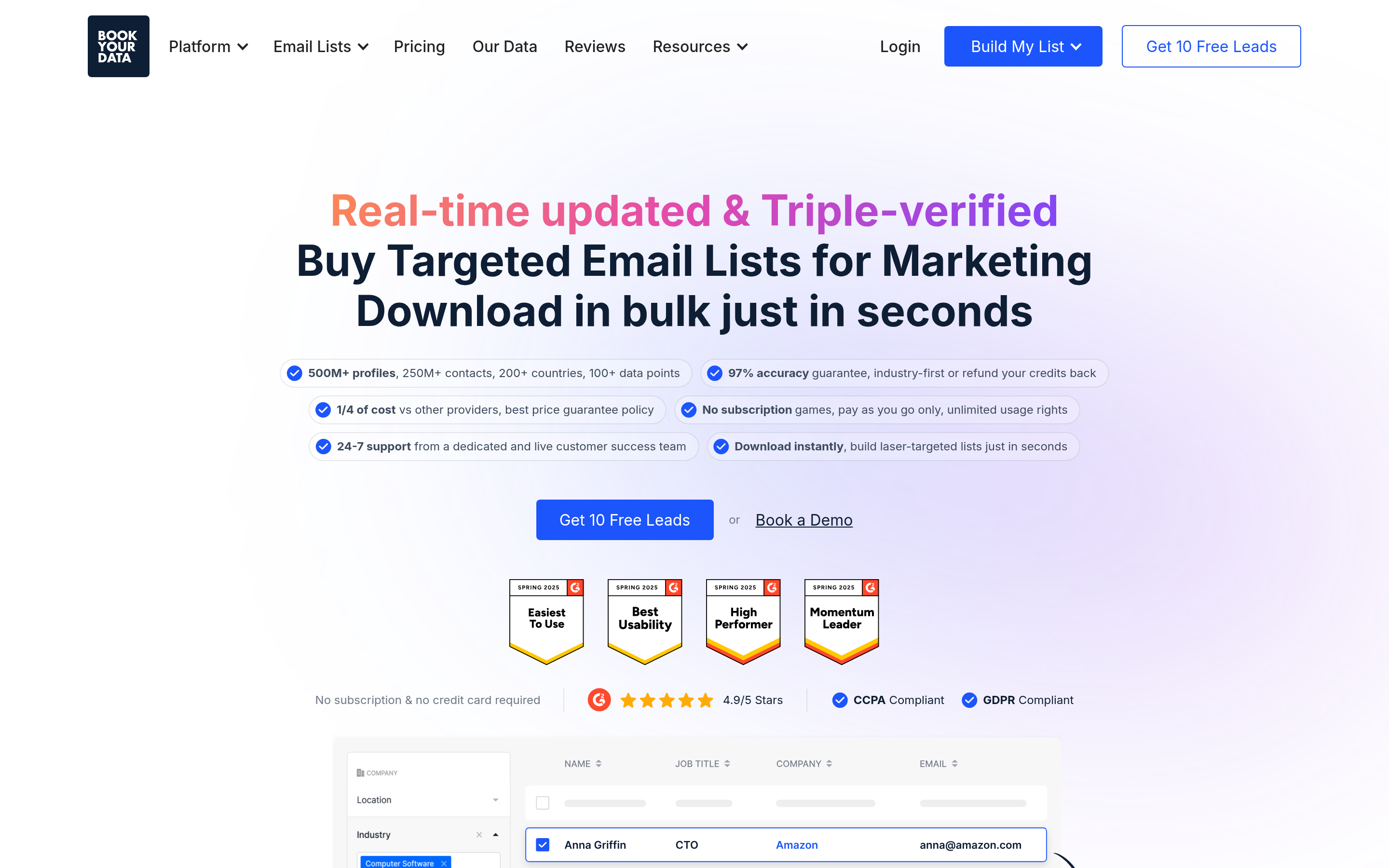
BookYourData takes a different shape entirely: you build a filtered list (industry, title, geography, company size), see the count, and buy the records outright. No subscription treadmill. It publishes an accuracy guarantee and offers replacement credits for bad records, which makes budgeting genuinely predictable — you know the cost of a 5,000-contact list before you commit. It's a strong fit for one-off campaign lists, ABM target loads, and teams whose outbound is project-based rather than continuous. If you prefer subscription-based enrichment that runs daily, a credit-based platform will suit you better.
4. Apollo.io — best all-in-one if you want sequencing included#
Apollo bundles a large contact database with sequencing, dialer, and basic CRM. If you're replacing both EasyLeadz and your outreach tool, the consolidation math can work. The tradeoffs are well documented: data accuracy varies by segment, the free tier's limits tighten regularly, and you're locked into their sequencer. See a full breakdown of Apollo alternatives if consolidation isn't a priority.
5. RocketReach — best for breadth over depth#
Large aggregate database, decent hit rates across geographies, straightforward search. Verification is lighter than dedicated tools, so plan on a separate verification step before you load lists into a sender. Compare the RocketReach alternative options if per-contact cost is your constraint.
6. ContactOut — best for recruiters living in LinkedIn#
Built for talent teams. Strong personal-email coverage (which recruiters need and sales teams usually don't), tight LinkedIn workflow, and an extension that fits recruiting research patterns. Weaker for company-level firmographic filtering.
7. Clearbit / HubSpot Breeze Intelligence — best for inbound enrichment#
If your problem is enriching inbound form fills rather than finding net-new outbound contacts, an enrichment-first tool is the right shape. Since the HubSpot acquisition, the offering is increasingly bundled into HubSpot's platform — great if you already live there, awkward if you don't. HubSpot's own documentation is the honest source on current packaging.
How do the EasyLeadz alternatives compare on price and features?#
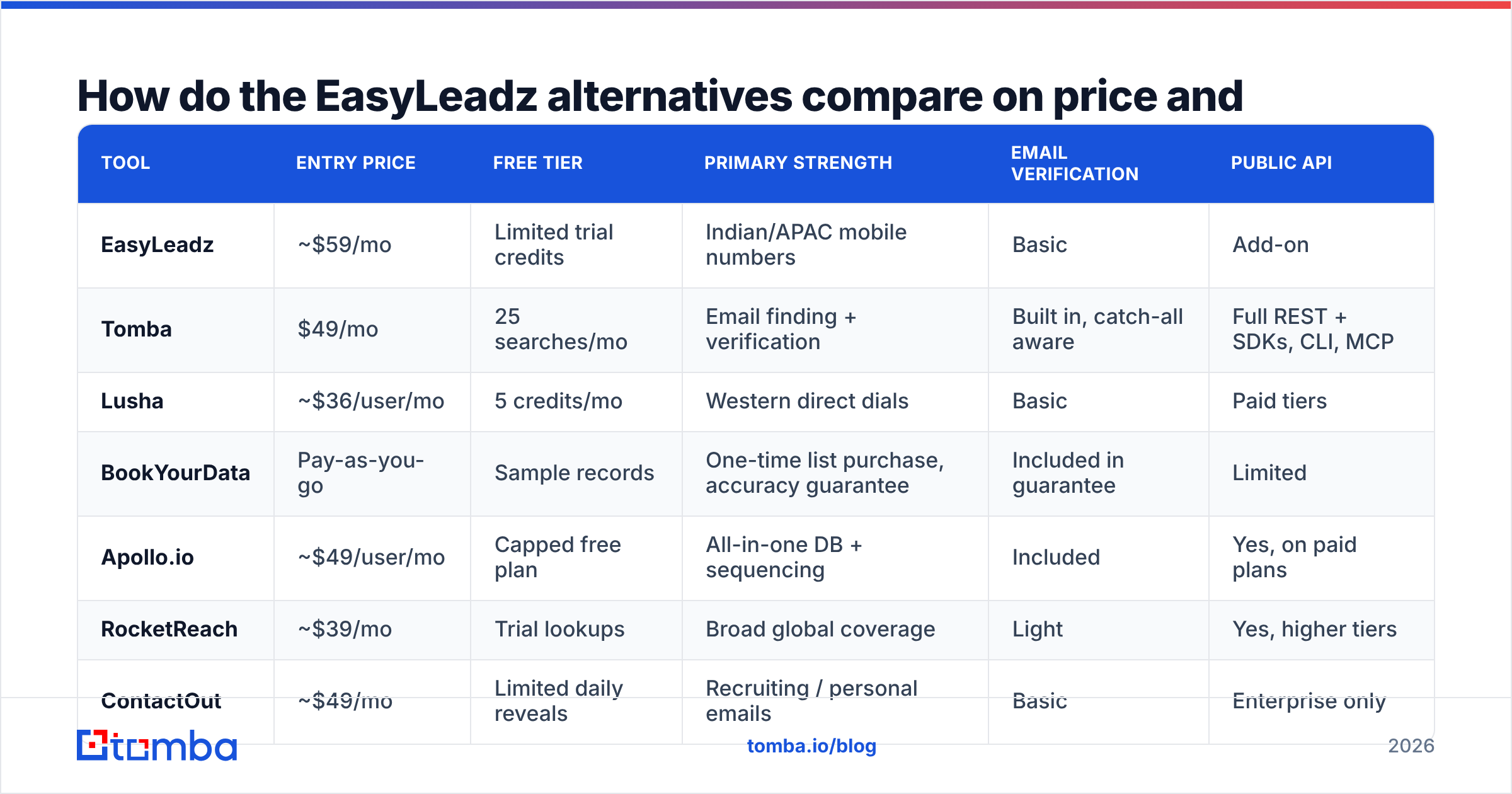
| Tool | Entry price | Free tier | Primary strength | Email verification | Public API |
|---|---|---|---|---|---|
| EasyLeadz | ~$59/mo | Limited trial credits | Indian/APAC mobile numbers | Basic | Add-on |
| Tomba | $49/mo | 25 searches/mo | Email finding + verification | Built in, catch-all aware | Full REST + SDKs, CLI, MCP |
| Lusha | ~$36/user/mo | 5 credits/mo | Western direct dials | Basic | Paid tiers |
| BookYourData | Pay-as-you-go | Sample records | One-time list purchase, accuracy guarantee | Included in guarantee | Limited |
| Apollo.io | ~$49/user/mo | Capped free plan | All-in-one DB + sequencing | Included | Yes, on paid plans |
| RocketReach | ~$39/mo | Trial lookups | Broad global coverage | Light | Yes, higher tiers |
| ContactOut | ~$49/mo | Limited daily reveals | Recruiting / personal emails | Basic | Enterprise only |
Prices move. Treat this as a shape-of-the-market table and confirm on each vendor's own page — Tomba's pricing is public and flat-rate, which is not universal in this category.
What does the real cost per contact look like?#
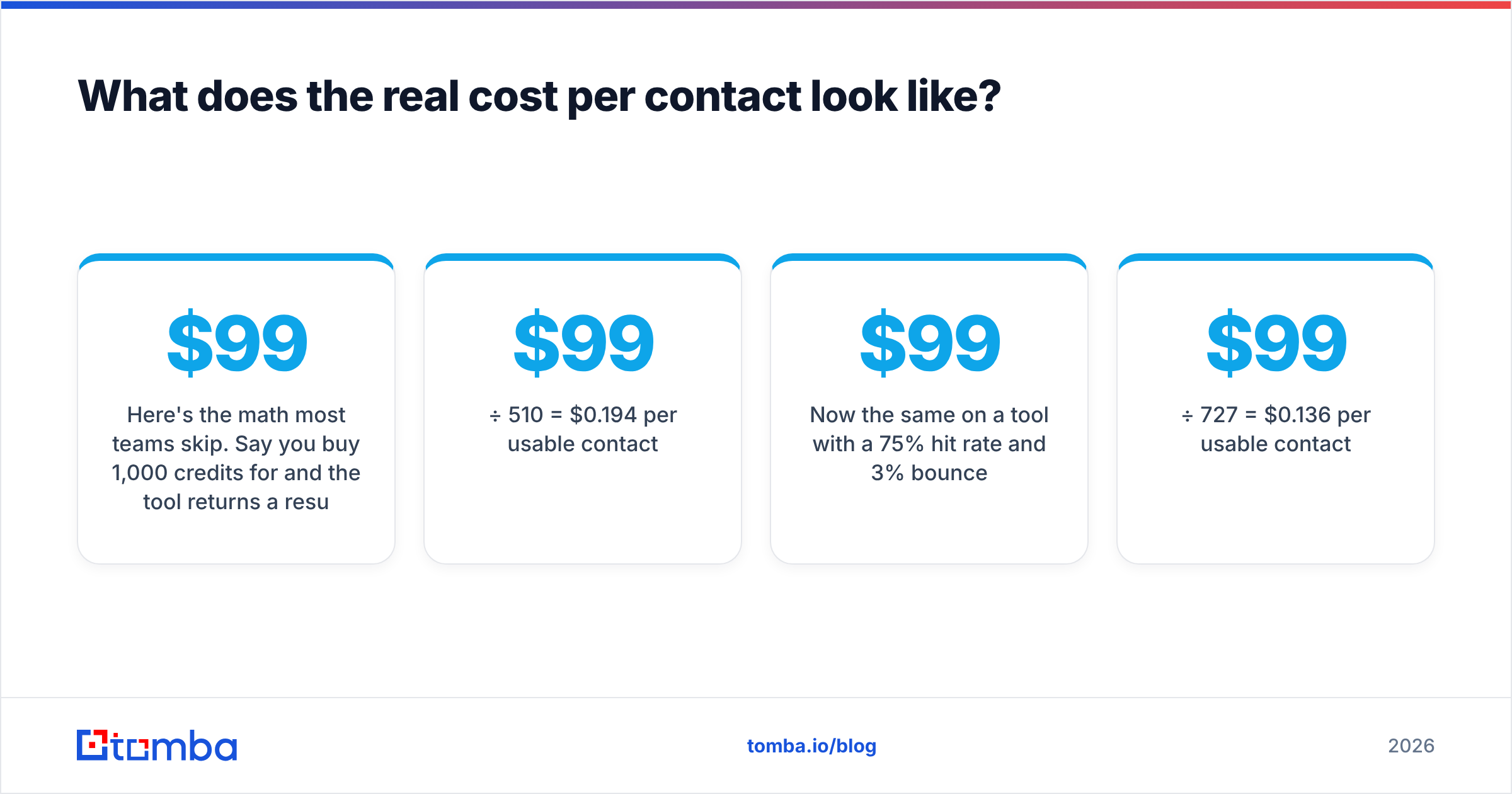
Here's the math most teams skip. Say you buy 1,000 credits for $99 and the tool returns a result 60% of the time, with 15% of those emails bouncing:
- 1,000 credits → 600 results → 510 deliverable contacts
- $99 ÷ 510 = $0.194 per usable contact
Now the same $99 on a tool with a 75% hit rate and 3% bounce:
- 1,000 credits → 750 results → 727 deliverable contacts
- $99 ÷ 727 = $0.136 per usable contact
Same invoice, 30% lower true cost. And that ignores the second-order damage: those extra bounces degrade your domain's email deliverability, which quietly suppresses every campaign that follows for weeks.

Run this calculation on a trial with your own ICP list, not the vendor's demo data. Fifty contacts is enough to see the pattern.
Which alternative fits your team?#
- You cold-call Indian prospects all day. Stay on EasyLeadz. Nothing on this list beats it in that lane.
- Email is 70%+ of your pipeline. Move to a dedicated finder-plus-verifier. The bounce reduction alone usually pays for the switch.
- You need net-new lists in bursts, not continuously. A pay-as-you-go provider like BookYourData avoids paying for idle months.
- You're building enrichment into your own product or internal tooling. API quality and rate limits decide this, not the UI. Test the docs before the dashboard.
- You want to consolidate finding + sending into one bill. Apollo, with eyes open about the data variance.
- You're a recruiter. ContactOut, no contest.
How do you migrate without losing pipeline?#
Run the switch in parallel for two weeks — don't cut over cold.
- Export your existing contact set from EasyLeadz before your subscription lapses. Contacts you've already paid for shouldn't be stranded.
- Deduplicate against your CRM so you're not re-buying records you own. A quick pass with a deduplicate email list tool prevents double-billing on the new platform.
- Run the same 50-contact test list through both tools. Compare hit rate, accuracy (spot-check 10 manually), and bounce rate after a real send.
- Verify everything before the first campaign on the new tool, even results the vendor marks as valid. Trust it after you've seen a month of bounce data, not before.
- Re-check your sending setup — SPF, DKIM, DMARC — because a tooling switch often coincides with a volume increase, and volume increases expose authentication gaps.
Two weeks of overlap costs one extra month of subscription. A botched migration costs a quarter of pipeline.
Where do these tools get their data?#
Ask this question in every sales call, and score the answer.
Contributed-data models (extension users share their contact lists) produce great coverage in dense contributor markets and poor coverage everywhere else. Licensed and public-web models produce flatter, more predictable coverage. Most serious vendors blend both.
The tell is whether the vendor will explain their sources without hedging. Tomba publishes its data sources openly; BookYourData backs its records with a published accuracy guarantee. Vendors that won't answer are usually reselling someone else's database with a markup, which means their coverage can change without warning when a supplier contract ends.
For EU or UK outreach, this isn't academic. Your legal basis for processing depends partly on how the data was collected. Get the answer in writing before your first send into a GDPR jurisdiction.
The bottom line#
EasyLeadz is a sharp tool for a specific job: Indian and APAC mobile numbers, sourced from LinkedIn, delivered through a browser extension. If that's your job, keep it.
If your outbound runs on email, sells into Western markets, or needs to be automated through an API rather than clicked one profile at a time, you're paying for capability you don't use and missing capability you need. The switch usually pays for itself in reduced bounces within the first month.
Start with the free tier. Tomba's Email Finder gives you 25 searches a month at no cost — enough to run a real head-to-head against your current EasyLeadz results using your own ICP. Find the emails, verify them in the same platform, and compare the cost per deliverable contact yourself. If the numbers don't beat what you're paying now, you've lost nothing but an afternoon. If they do, Starter is $49/mo and the API is included, not upsold.
Related guides#
Ready to find emails that actually work?
Join 150,000+ professionals who stopped guessing and started sending. Free credits on signup — no credit card required.
Get the Tomba newsletter
Practical outbound tactics and product updates — once every two weeks.
About the author