eGrabber vs Apolloio (2026): Which Prospecting Tool Wins?
eGrabber scrapes and appends contacts from a Windows desktop app. Apollo.io sells a 275M-contact database plus a sequencer. We compare accuracy, pricing, and fit — plus where a cheaper API beats both.
Short answer: Apollo.io wins for most teams, and eGrabber wins for recruiters who scrape niche web pages. That is the eGrabber vs Apolloio call in one line. The rest of this guide shows the numbers behind it. We cover data accuracy, real pricing, and the costs neither vendor prints on its pricing page.
TL;DR
- eGrabber (ListGrabber, eMail-Prospector, LeadGrabber Pro) is Windows desktop software that scrapes names from LinkedIn, directories, and web pages, then appends emails and phones. You buy a per-seat license, not a database.
- Apollo.io is a cloud platform: a ~275M-contact B2B database, filters, a Chrome extension, sequences, dialer, and light CRM. You buy seats plus credits.
- Accuracy is the real fight. Both append via pattern-guessing plus verification. Independent tests put general-purpose databases in the 60–80% deliverable range outside US tech. Dedicated finders score higher on verified-only output.
- Pricing shape differs sharply. eGrabber is a heavy annual license (roughly $3,500+/year per seat for LeadGrabber Pro with credits). Apollo starts free and scales to ~$99/user/mo on Organization.
- Neither is the cheapest way to just get verified emails. If you already know your accounts, an API-first finder like Tomba Email Finder at $49/mo does that job without paying for a sequencer or a desktop license.
What is eGrabber and who actually uses it?#
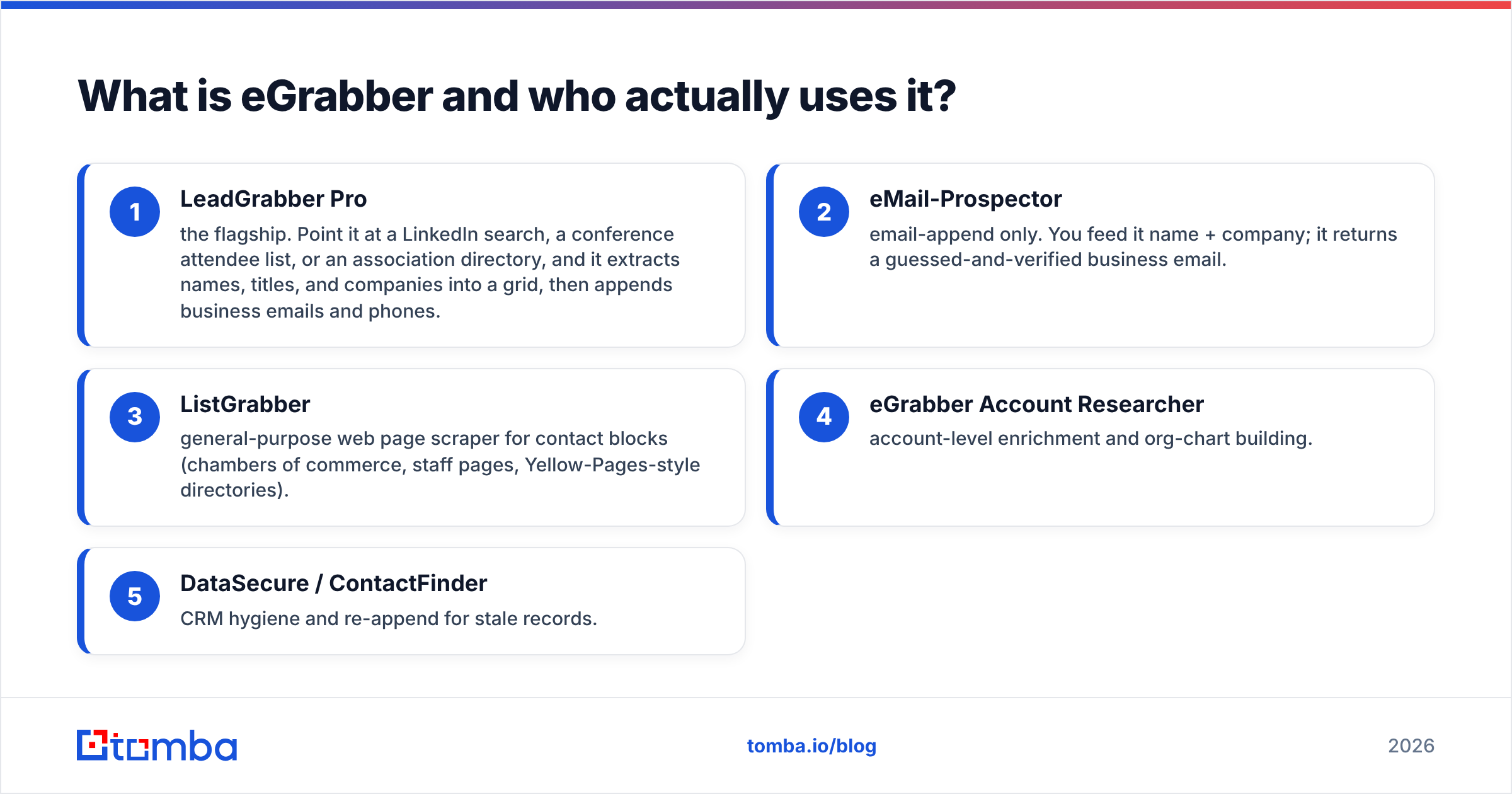
eGrabber is a US software company that has sold Windows desktop prospecting tools since the 1990s. The product line matters more than the brand name:
- LeadGrabber Pro — the flagship. Point it at a LinkedIn search, a conference attendee list, or an association directory. It pulls names, titles, and companies into a grid, then appends business emails and phones.
- eMail-Prospector — email-append only. You feed it name + company; it returns a guessed-and-verified business email.
- ListGrabber — general-purpose web page scraper for contact blocks (chambers of commerce, staff pages, Yellow-Pages-style directories).
- eGrabber Account Researcher — account-level enrichment and org-chart building.
- DataSecure / ContactFinder — CRM hygiene and re-append for stale records.
The buyer profile is specific. Think staffing and recruiting agencies, small manufacturers, and B2B teams that live in Windows and Outlook. They want a tool they own rather than rent. If your prospecting inputs are messy public web pages rather than clean firmographic filters, eGrabber's scraping-first model genuinely fits.
The catch is equally specific. It is Windows-only desktop software. There is no meaningful cloud UI, no native macOS build, and no modern REST API to wire into a data pipeline. Everything runs on one machine, under one license, and the output is a CSV you move by hand.
What is Apollo.io and what do you get for the money?#
Apollo.io is the opposite architecture: everything is cloud, everything is one platform. You get a searchable database of roughly 275 million contacts across ~73 million companies. Filters cover title, headcount, revenue, tech stack, funding, and intent signals. On top of the data sits an outbound engine — email sequences, a power dialer, meeting booking, conversation intelligence, and bi-directional sync with Salesforce and HubSpot.
Apollo's growth came from a freemium motion. The free plan gives you unlimited email credits within daily limits, which makes it the default first tool for founders and one-person sales teams. That same motion explains where the data comes from. Apollo has long enriched its graph from user email inboxes and contact syncs. That is great for coverage. It is less great if you care about sourcing. Read the Apollo alternative breakdown if compliance sourcing is a procurement blocker for you.
Where Apollo strains is precision. Broad filters return huge lists. A large slice of any 10,000-record export will be role changes, catch-all domains, and stale titles. That is not a scandal — it is what happens at 275M records. It just means you need a verification step you did not budget for.
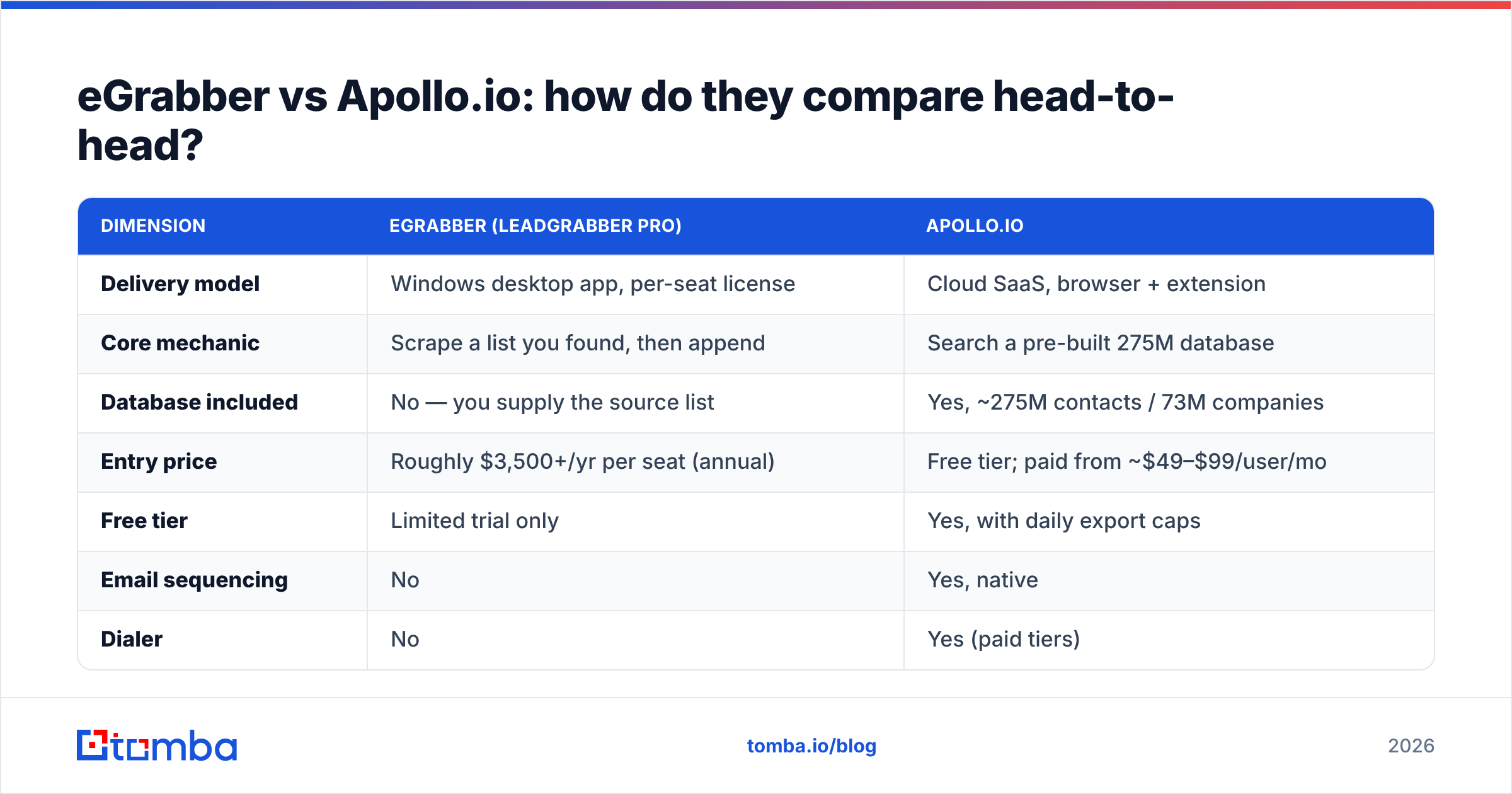
eGrabber vs Apolloio: how do they compare head-to-head?#
| Dimension | eGrabber (LeadGrabber Pro) | Apollo.io |
|---|---|---|
| Delivery model | Windows desktop app, per-seat license | Cloud SaaS, browser + extension |
| Core mechanic | Scrape a list you found, then append | Search a pre-built 275M database |
| Database included | No — you supply the source list | Yes, ~275M contacts / 73M companies |
| Entry price | Roughly $3,500+/yr per seat (annual) | Free tier; paid from ~$49–$99/user/mo |
| Free tier | Limited trial only | Yes, with daily export caps |
| Email sequencing | No | Yes, native |
| Dialer | No | Yes (paid tiers) |
| CRM sync | CSV / Salesforce export | Native two-way (Salesforce, HubSpot) |
| API access | Effectively none | Yes, on higher tiers |
| macOS / Linux | No | Yes (browser-based) |
| Best for | Recruiters scraping niche directories | SDR teams needing volume + sequencing |
| Worst for | Teams needing API or non-Windows | Anyone needing pinpoint accuracy per contact |
The table hides the most important asymmetry: these tools do not actually compete on the same axis. eGrabber assumes you already know where your prospects are listed and need help converting that page into contactable records. Apollo assumes you do not know who your prospects are and need a filterable universe to discover them.
If you have a list of 400 target companies from a trade show, eGrabber is the more natural fit. If you need "all VP Engineering at Series B SaaS companies in DACH with 50–200 employees," Apollo answers that in thirty seconds and eGrabber cannot answer it at all.
Which one has better data accuracy?#
Neither vendor publishes a third-party audited accuracy figure, so treat every marketing number with suspicion — including the ones on this blog's competitors' sites.
What you can reason about is mechanism, which predicts accuracy better than any claimed percentage:
- Apollo serves a stored record. It was correct when it entered the graph. B2B contact data decays at roughly 22–30% per year as people change jobs, so a record's age is your dominant risk. Apollo's "verified" flag is a signal, not a guarantee, and catch-all domains frequently pass as valid.
- eGrabber guesses at query time. It builds candidate patterns (first.last@, f.last@, firstl@) and tests them. Fresh-at-runtime is a real advantage. But catch-all domains now cover a large share of mid-market and enterprise mail servers. There, SMTP testing returns "accept" for every pattern. The tool has to pick one and hope.
Dedicated finders like Tomba split the difference. They apply pattern intelligence per domain, then add a verification layer that flags catch-alls explicitly instead of silently guessing. That is exactly what the catch-all verifier exists to handle.
The practical takeaway: whichever tool you buy, budget for an independent verification pass before you send. Sending to an unverified export from any of these platforms is how you burn a sending domain in three weeks. If you are not already running exports through an email verifier, that is a bigger lever on your reply rate than the eGrabber vs Apolloio choice itself.
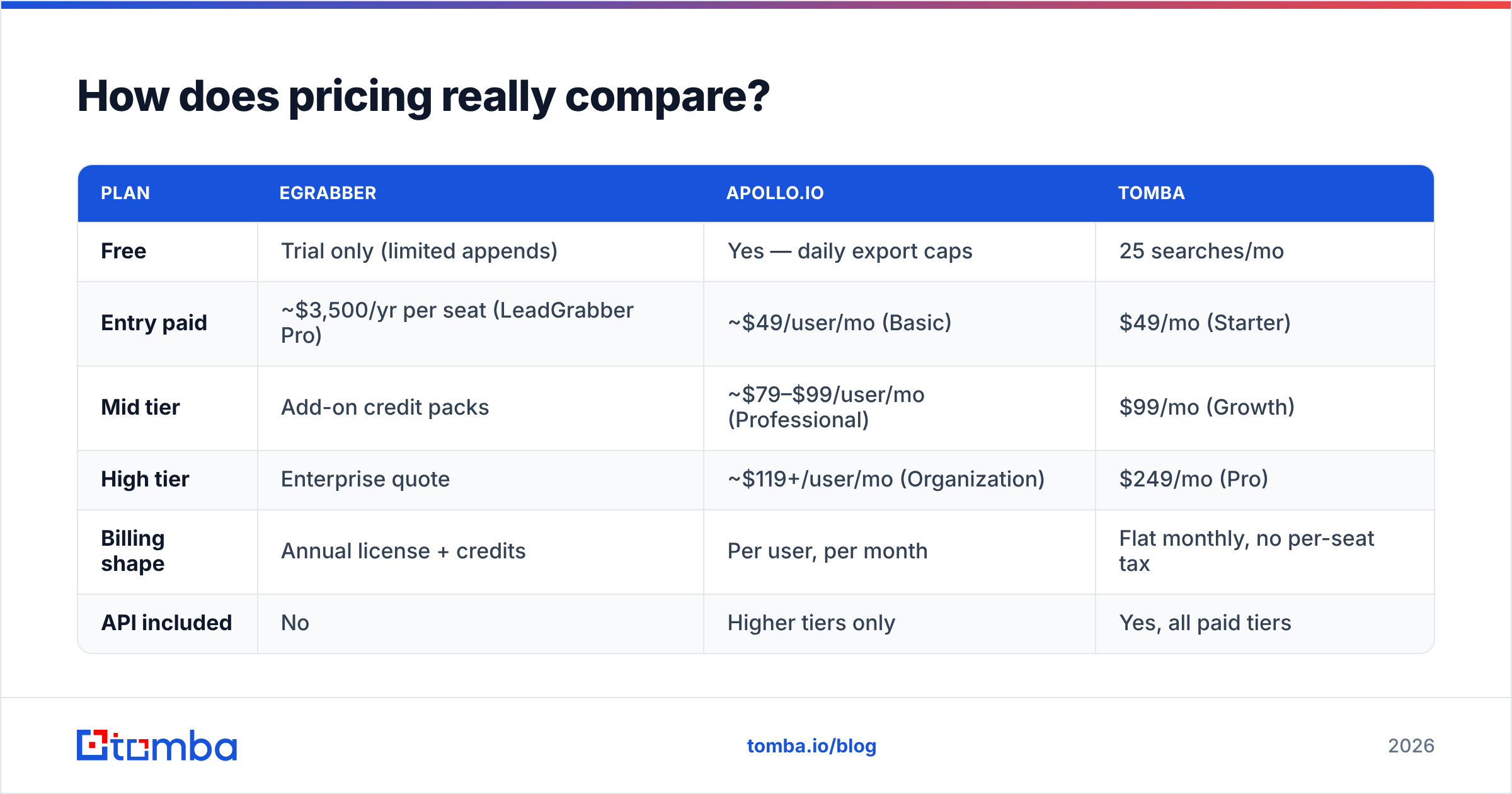
How does pricing really compare?#
| Plan | eGrabber | Apollo.io | Tomba |
|---|---|---|---|
| Free | Trial only (limited appends) | Yes — daily export caps | 25 searches/mo |
| Entry paid | ~$3,500/yr per seat (LeadGrabber Pro) | ~$49/user/mo (Basic) | $49/mo (Starter) |
| Mid tier | Add-on credit packs | ~$79–$99/user/mo (Professional) | $99/mo (Growth) |
| High tier | Enterprise quote | ~$119+/user/mo (Organization) | $249/mo (Pro) |
| Billing shape | Annual license + credits | Per user, per month | Flat monthly, no per-seat tax |
| API included | No | Higher tiers only | Yes, all paid tiers |
Three things this table makes obvious.
First, eGrabber's per-seat cost only makes sense for one or two power users. At $3,500+ per seat annually, a five-person team is looking at $17,500/year before credits. That's Apollo Organization money for five reps with a sequencer and dialer included.
Second, Apollo's per-user model punishes wide, shallow deployment. If you have twelve people who each need data twice a month, you are paying twelve seats for two seats' worth of usage. This is the single most common reason teams start hunting for an Apollo alternative — not data quality, but seat math.
Third, neither model is efficient if all you need is emails. A flat $49/mo with API access covers a lot of ground when the sequencer already lives in Instantly, Smartlead, or your CRM. Check current Tomba pricing against your actual monthly lookup volume before assuming you need a platform.
When should you pick eGrabber over Apollo?#
Pick eGrabber if three or more of these are true:
- Your source lists are unstructured web pages — association directories, event attendee lists, board rosters, alumni pages — rather than filterable firmographics.
- You are a recruiter or staffing agency. eGrabber's roots are in recruiting workflows, and the resume/candidate handling is more mature than anything Apollo offers.
- Your whole team is on Windows and nobody needs API access or mobile.
- You prefer capex to opex. A perpetual-ish license with annual maintenance is easier to justify in some procurement environments than a monthly SaaS line item.
- You do low volume with high specificity — 200 hand-picked contacts a month, not 20,000.
Pick Apollo if:
- You need discovery, not just appending. You don't have the list yet.
- You want data and sending in one bill. Consolidating a database, a sequencer, and a dialer genuinely saves money versus three tools.
- You have an SDR team that lives in a shared workspace with shared sequences and shared reporting.
- You're starting from zero budget. The free tier is legitimately usable for a founder doing 50 emails a week.
What are the real alternatives to both?#
The eGrabber vs Apolloio framing assumes you must choose between a scraper and a mega-platform. In 2026, most teams do better with a composed stack:
- Database layer — Apollo, BookYourData (strong for pay-as-you-go verified B2B lists with no subscription lock-in), or a vertical provider for your niche.
- Find + verify layer — a dedicated API. This is where domain search and bulk verification belong, because it's the layer you want to run last, right before send, on records from any source.
- Sending layer — Instantly, Smartlead, Lemlist, or your CRM's native sequencer. Deliverability tooling has specialized fast enough that bundled sequencers rarely win on features.
- Enrichment layer — data enrichment to fill firmographics and social profiles on records you already own.
This stack costs less than Apollo Organization for a five-person team in most configurations, and every layer is swappable. The counter-argument is real, though: four vendors means four contracts, four support queues, and integration work. If your team is under five people and nobody owns ops, the all-in-one is genuinely the right call.
For teams sitting in the middle, the pragmatic move is: keep Apollo's free or Basic tier for discovery, then push every export through a separate finder and verifier before it touches a sending domain. You get Apollo's coverage without trusting Apollo's freshness.
What questions should you ask before buying either?#
Before you sit through a demo, get written answers to these:
- What is the refund or credit policy on bounced emails? Some vendors credit bounces back; some don't. This is worth more than a 5% list-price discount.
- Are catch-all domains counted as valid? If the answer is yes or vague, inflate your bounce estimate by 10–15 points.
- What happens to your data if you cancel? Desktop licenses usually let you keep local exports. Cloud platforms vary.
- Is the API included or an upsell? Apollo gates API access by tier; eGrabber effectively doesn't offer one. If automation matters at all, this is disqualifying for one of them.
- What's the actual coverage in your specific geography and vertical? Ask for a 50-record blind test against accounts you already know. Any vendor confident in its data will run it.
Run that 50-record test with all three candidates on the same day, against the same accounts, and score deliverability yourself. Compare the results against your own control set. For a neutral reference point, cross-check public review data on G2. The test takes an afternoon. It will tell you more than every comparison article on the internet, including this one.
The verdict#
Apollo.io wins for most teams because discovery plus sequencing in one bill beats a Windows-only appender for the majority of B2B sales motions, and the free tier removes the risk of finding out.
eGrabber wins in a narrow but real lane: recruiters and researchers converting messy public web pages into contact records, on Windows, at low volume, with a preference for owned software.
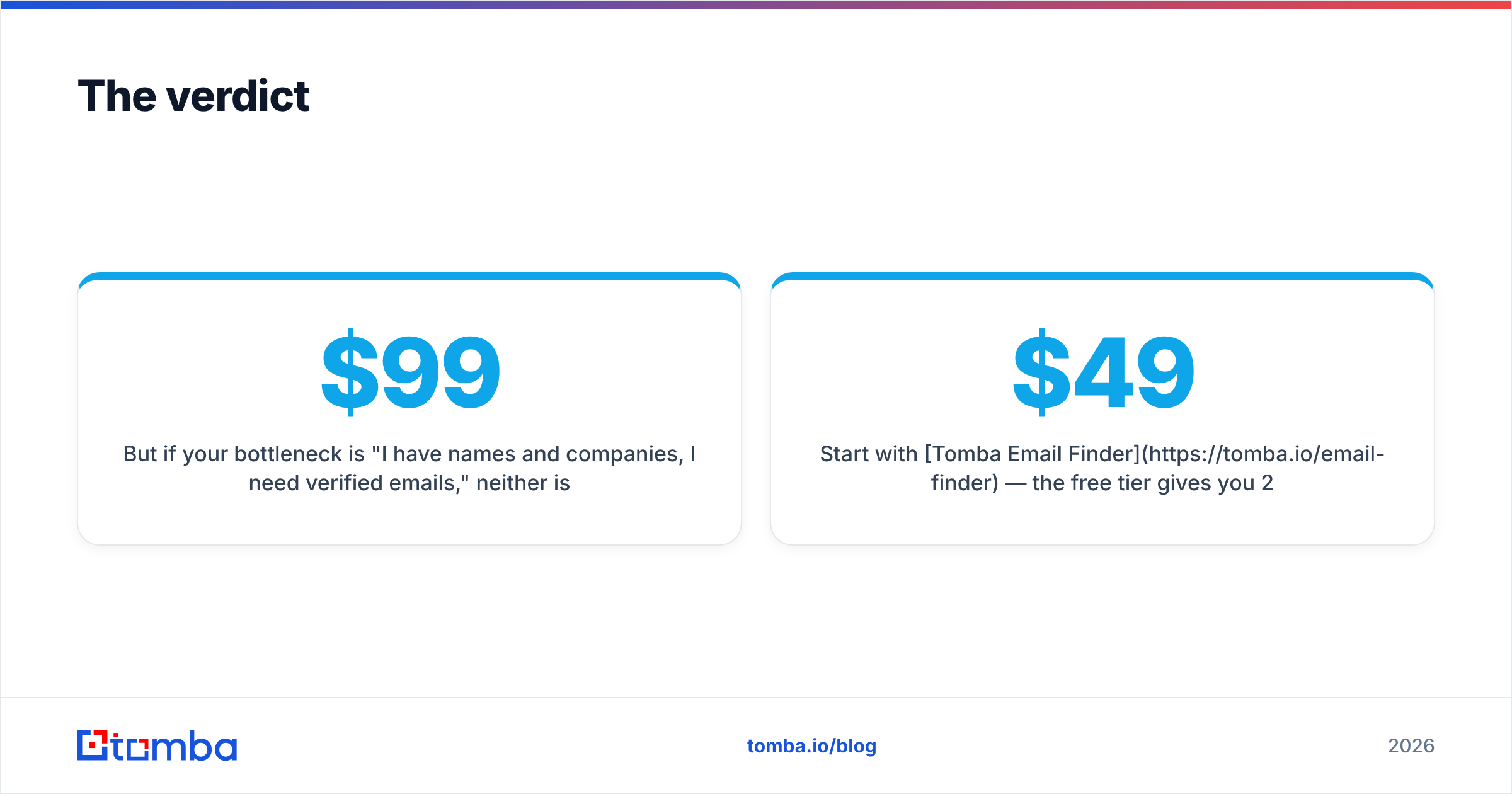
But if your bottleneck is "I have names and companies, I need verified emails," the eGrabber vs Apolloio debate is beside the point. That job is a single API call, and paying $99/user/month or $3,500/year for it is a rounding error you'll notice at renewal.
Start with Tomba Email Finder — the free tier gives you 25 searches a month to benchmark against whatever you're using now, Starter is $49/mo with full API access, and there's no per-seat charge to add your whole team. Run the same 50 accounts through it that you run through eGrabber and Apollo, compare the bounce rates yourself, and let the numbers pick the winner.
Related guides#
Ready to find emails that actually work?
Join 150,000+ professionals who stopped guessing and started sending. Free credits on signup — no credit card required.
Get the Tomba newsletter
Practical outbound tactics and product updates — once every two weeks.
About the author