Elevator Pitch Training: A 2026 Playbook for B2B Reps
Most elevator pitch training ends with a laminated script nobody uses. Here's how to build a 30-day drill program, score pitches objectively, and prove the training moved reply and meeting rates.
TL;DR
- Elevator pitch training fails when it ends at the script. The script is the easy 10%; the reps, the scoring, and the channel adaptation are the other 90%.
- A pitch that works has five moving parts: a named buyer, an observable problem, a mechanism, one proof point, and a low-friction ask. Anything else is padding.
- Drilling beats workshopping. Twenty 90-second reps across four weeks outperforms a single four-hour offsite, and it costs nothing but calendar time.
- Score pitches on a rubric, not vibes. Time-to-value, specificity, and ask clarity are all measurable by a manager with a stopwatch.
- The best pitch in the world dies against a wrong contact. Fix your data hygiene and targeting before you blame delivery.
What is elevator pitch training, actually?#
Elevator pitch training is structured practice at compressing what you sell into 20 to 60 seconds so a specific buyer can decide, immediately, whether to keep listening.
That definition matters because most programs quietly optimize for something else: producing a document. A manager runs a session, the team leaves with a shared doc titled "Q1 Pitch v3," and nobody says the words out loud again until a prospect asks "so what do you do?" and they improvise badly.
Think of it like a fire drill. Nobody schedules a fire drill so employees can read the evacuation map. The map exists so the drill has a shape. The drill is the point. Technically, elevator pitch training is deliberate practice applied to a compressed value-articulation task — repetition under mild pressure, with immediate feedback against a fixed rubric. Practically, it means saying it out loud until it stops sounding rehearsed.
The elevator pitch format itself is old — Hollywood, then venture capital, then B2B sales. What's changed in 2026 is where it gets used. Fewer literal elevators, far more 30-second windows: the opening of a cold call, the first four lines of a LinkedIn message, the "quick intro" round at a virtual event, the answer you give when a champion asks you to explain the tool to their CFO.
What does a pitch that works actually contain?#
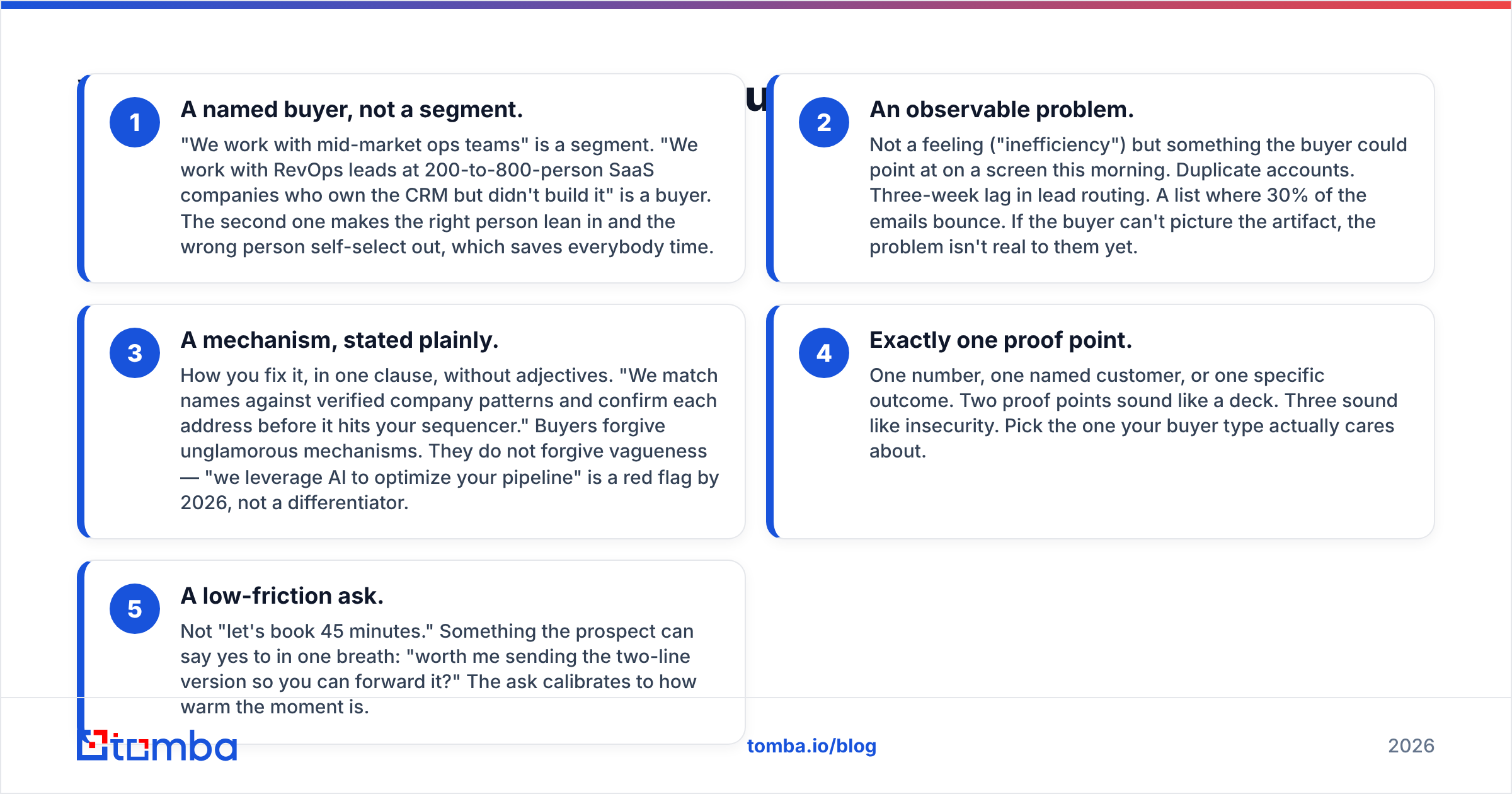
Strip a high-performing B2B pitch down and you find five components. If one is missing, the pitch either confuses or bores. Both are fatal.
- A named buyer, not a segment. "We work with mid-market ops teams" is a segment. "We work with RevOps leads at 200-to-800-person SaaS companies who own the CRM but didn't build it" is a buyer. The second one makes the right person lean in and the wrong person self-select out, which saves everybody time.
- An observable problem. Not a feeling ("inefficiency") but something the buyer could point at on a screen this morning. Duplicate accounts. Three-week lag in lead routing. A list where 30% of the emails bounce. If the buyer can't picture the artifact, the problem isn't real to them yet.
- A mechanism, stated plainly. How you fix it, in one clause, without adjectives. "We match names against verified company patterns and confirm each address before it hits your sequencer." Buyers forgive unglamorous mechanisms. They do not forgive vagueness — "we leverage AI to optimize your pipeline" is a red flag by 2026, not a differentiator.
- Exactly one proof point. One number, one named customer, or one specific outcome. Two proof points sound like a deck. Three sound like insecurity. Pick the one your buyer type actually cares about.
- A low-friction ask. Not "let's book 45 minutes." Something the prospect can say yes to in one breath: "worth me sending the two-line version so you can forward it?" The ask calibrates to how warm the moment is.
Total: 45 to 60 seconds spoken at a normal pace. Time yourself. Most untrained reps run 95 seconds and think they ran 30.
Why does most elevator pitch training fail?#
Three reasons, in descending order of how often I see them.
It confuses memorization with fluency. A memorized script has a single failure mode — an interruption. The prospect asks "wait, how is that different from what we already have?" and the rep loses their place, restarts, and sounds like a robot rebooting. Fluent reps hold the five components, not the sentences. They can reorder on the fly because they know what each piece is for.
It happens once. A four-hour workshop feels substantial and produces almost no behavior change, because skill acquisition needs spacing. The same eight hours split into sixteen 30-minute drill sessions over a month produces reps who actually sound different on calls. Boring, but true.
It has no scoring. "That was great, maybe tighten the middle" is not feedback. It gives the rep nothing to fix and no way to know if the next attempt was better. Without a rubric, coaching quality tracks the manager's mood.
There's a fourth reason that's less about training and more about honesty: sometimes the pitch is bad because the positioning is bad. If four reps independently struggle to explain the problem you solve, the issue is upstream. No amount of drilling fixes a value proposition the company hasn't decided on.
Which elevator pitch training format should you pick?#
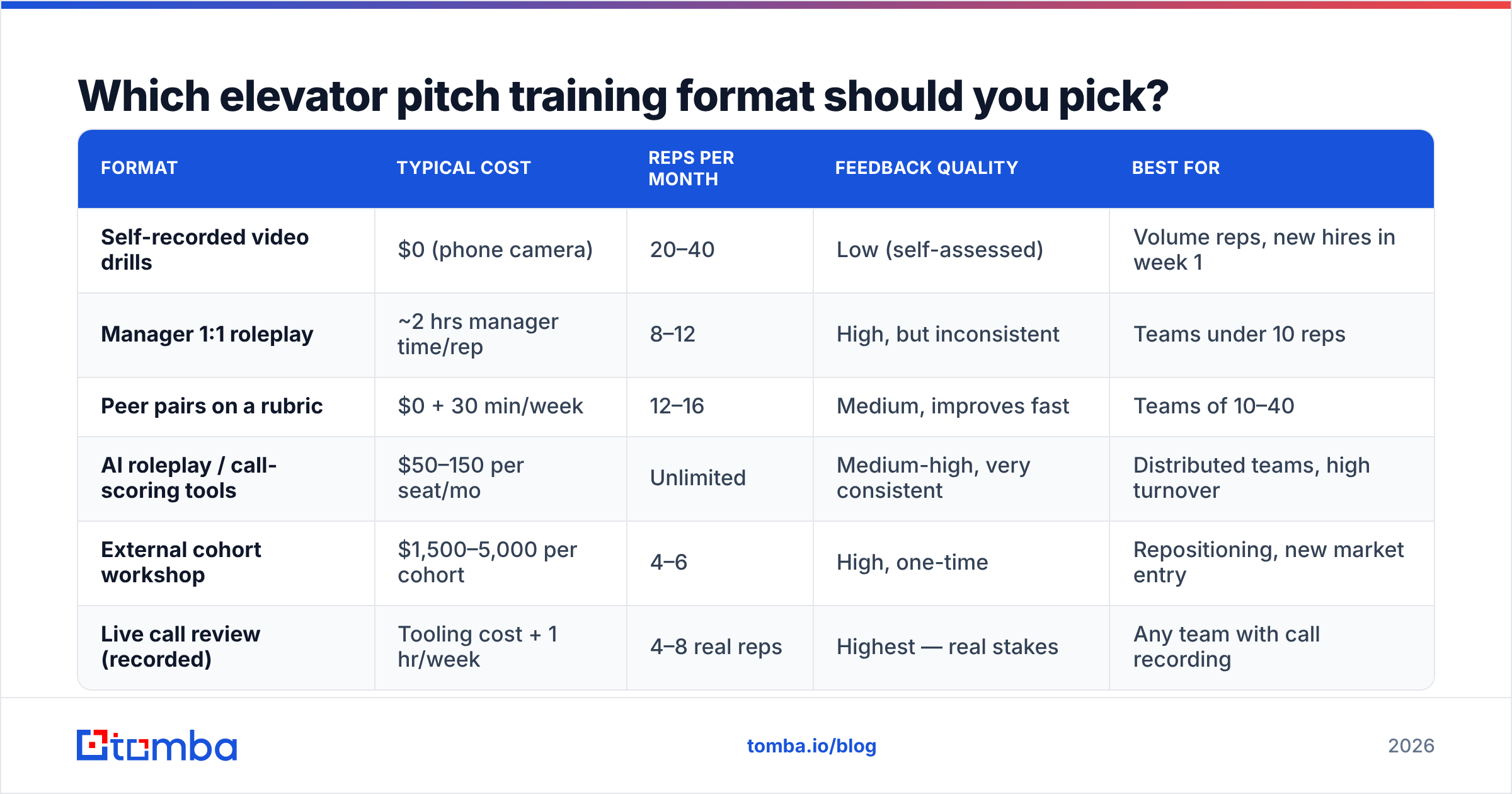
There are five realistic options, and they trade off cost against feedback quality. Most teams should combine two: something cheap and frequent for volume, plus something expensive and occasional for calibration.
| Format | Typical cost | Reps per month | Feedback quality | Best for |
|---|---|---|---|---|
| Self-recorded video drills | $0 (phone camera) | 20–40 | Low (self-assessed) | Volume reps, new hires in week 1 |
| Manager 1:1 roleplay | ~2 hrs manager time/rep | 8–12 | High, but inconsistent | Teams under 10 reps |
| Peer pairs on a rubric | $0 + 30 min/week | 12–16 | Medium, improves fast | Teams of 10–40 |
| AI roleplay / call-scoring tools | $50–150 per seat/mo | Unlimited | Medium-high, very consistent | Distributed teams, high turnover |
| External cohort workshop | $1,500–5,000 per cohort | 4–6 | High, one-time | Repositioning, new market entry |
| Live call review (recorded) | Tooling cost + 1 hr/week | 4–8 real reps | Highest — real stakes | Any team with call recording |
The pattern that works best in practice: peer pairs weekly for volume, live call review monthly for reality, and one external workshop per year only if positioning changed. Conversation-intelligence platforms like Gong make the live-call-review leg dramatically cheaper than it was five years ago, because you stop relying on reps to self-report what happened.
Skip the external workshop if your pitch problem is a rep-count problem. Paying $4,000 to have a consultant tell your team to be more specific is expensive when a rubric and a stopwatch do the same job.
How do you run a 30-day drill program?#
Here's a program you can start Monday with no budget. It assumes one manager and up to twelve reps.
Week 1 — Build the components. Each rep writes their own five components (buyer, problem, mechanism, proof, ask) for one ICP segment. Not the company's pitch — theirs, in their own words. Manager reviews the written components only, not delivery. Reject anything with an unobservable problem or more than one proof point. Budget: 45 minutes of writing, 15 minutes of review per rep.
Week 2 — Drill for time. Pairs, three sessions of 20 minutes. Rep A pitches, Rep B holds a stopwatch and scores on the rubric below. Then swap. Target: 60 seconds by Wednesday, 40 by Friday, with all five components intact. Most of the cutting happens in the mechanism — reps overexplain how the product works because that's the part they were trained on in onboarding.
Week 3 — Drill for interruptions. Same pairs, but the listener now interrupts twice per pitch with one of five stock objections: "we already have something for that," "how is this different from [competitor]," "who else uses you," "sounds expensive," and the brutal one — silence, followed by "okay… and?" The goal is not to answer perfectly. The goal is to reenter the pitch without restarting it.
Week 4 — Drill in channel. The spoken pitch is the source, but it has to translate. Each rep produces four variants: the cold-call opener, the four-line LinkedIn version, the cold email version, and the 15-second event version. Score each against the same rubric. The email variant is the hardest because you lose tone — the components have to carry it alone. If you need a starting structure, the shapes in these cold email templates map cleanly onto the same five components.
Then repeat weeks 2 and 3 quarterly. Skills decay. Reps who stop drilling drift back to feature lists within about six weeks.
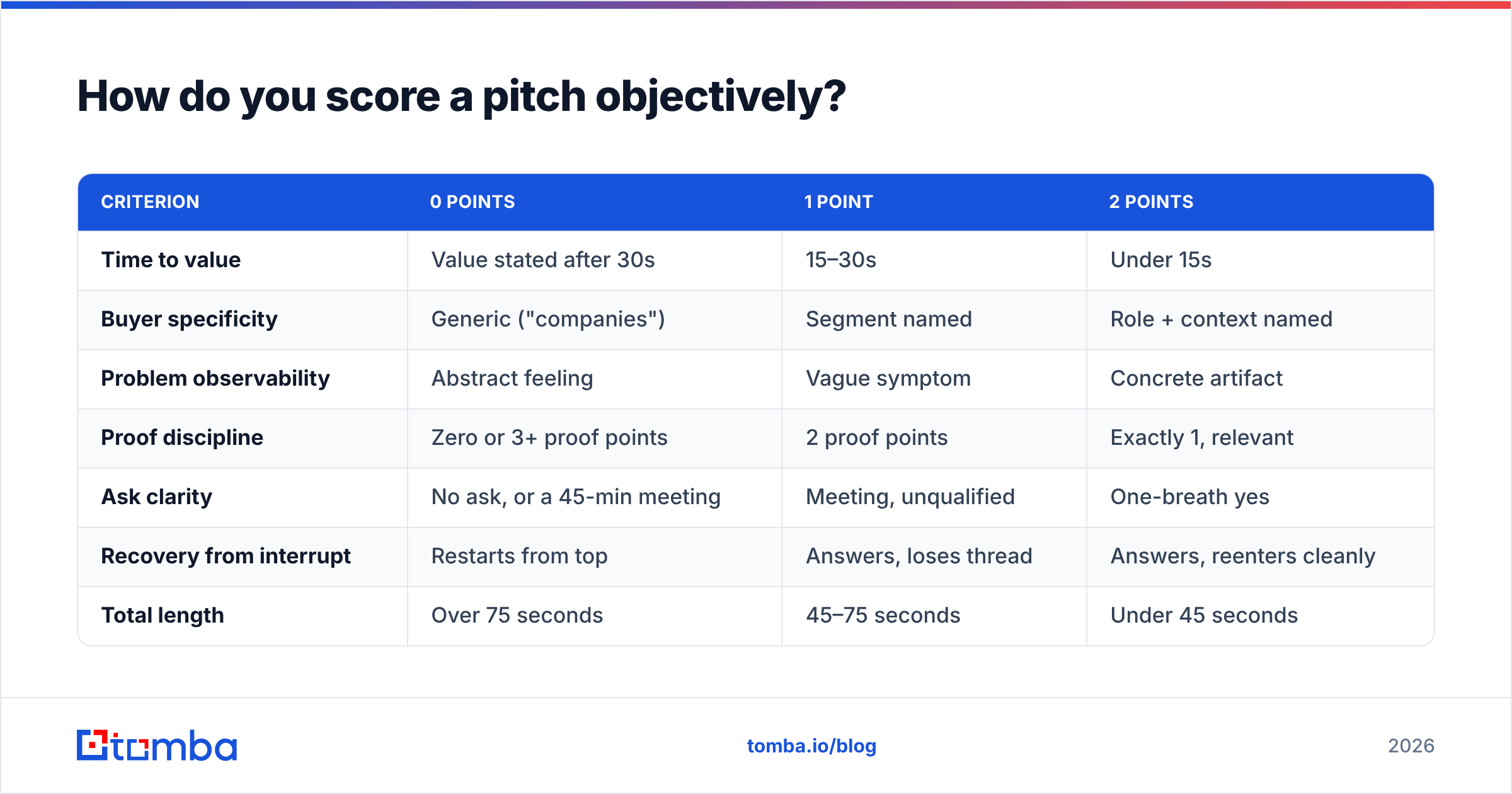
How do you score a pitch objectively?#
Use a fixed rubric so two different managers give the same rep roughly the same score. Six criteria, 0–2 each, 12 points total. Anything at 9+ is field-ready.
| Criterion | 0 points | 1 point | 2 points |
|---|---|---|---|
| Time to value | Value stated after 30s | 15–30s | Under 15s |
| Buyer specificity | Generic ("companies") | Segment named | Role + context named |
| Problem observability | Abstract feeling | Vague symptom | Concrete artifact |
| Proof discipline | Zero or 3+ proof points | 2 proof points | Exactly 1, relevant |
| Ask clarity | No ask, or a 45-min meeting | Meeting, unqualified | One-breath yes |
| Recovery from interrupt | Restarts from top | Answers, loses thread | Answers, reenters cleanly |
| Total length | Over 75 seconds | 45–75 seconds | Under 45 seconds |
Two notes on using this. First, score from a recording, not live — live scoring makes managers charitable. Second, publish the scores inside the team. Not to shame anyone, but because reps calibrate off each other far faster than off a manager. The rep sitting at 11/12 becomes the reference implementation.
Does the pitch change by channel?#
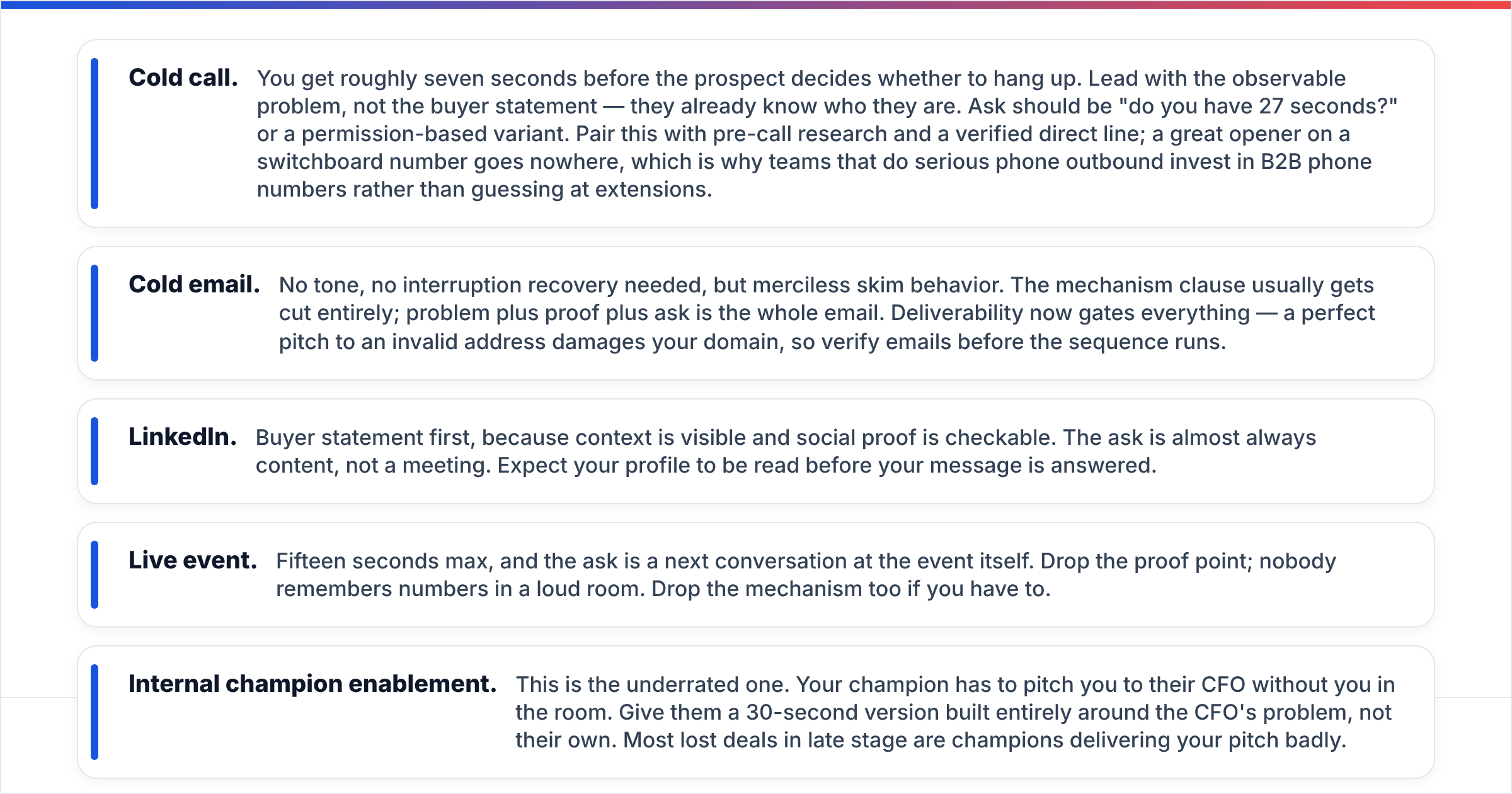
Yes, and this is where most training stops too early. The components stay constant; the compression ratio and the ask change.
- Cold call. You get roughly seven seconds before the prospect decides whether to hang up. Lead with the observable problem, not the buyer statement — they already know who they are. Ask should be "do you have 27 seconds?" or a permission-based variant. Pair this with pre-call research and a verified direct line; a great opener on a switchboard number goes nowhere, which is why teams that do serious phone outbound invest in B2B phone numbers rather than guessing at extensions.
- Cold email. No tone, no interruption recovery needed, but merciless skim behavior. The mechanism clause usually gets cut entirely; problem plus proof plus ask is the whole email. Deliverability now gates everything — a perfect pitch to an invalid address damages your domain, so verify emails before the sequence runs.
- LinkedIn. Buyer statement first, because context is visible and social proof is checkable. The ask is almost always content, not a meeting. Expect your profile to be read before your message is answered.
- Live event. Fifteen seconds max, and the ask is a next conversation at the event itself. Drop the proof point; nobody remembers numbers in a loud room. Drop the mechanism too if you have to.
- Internal champion enablement. This is the underrated one. Your champion has to pitch you to their CFO without you in the room. Give them a 30-second version built entirely around the CFO's problem, not their own. Most lost deals in late stage are champions delivering your pitch badly.
What actually breaks a well-delivered pitch?#
Data, most of the time. A rep can hit 12/12 on the rubric and still get nothing back, and the honest diagnosis is usually one of three things.

Wrong person. You pitched the problem beautifully to someone who doesn't own it. The most common version: pitching an individual contributor's problem to a VP who thinks in budget terms, or pitching cost savings to an operator judged on speed.
Wrong moment. Right person, no trigger. Nobody buys because your pitch was tight; they buy because something changed — a new hire in the role, a funding round, a tool they just ripped out.
Wrong contact data. The pitch never arrived. Bounced email, dead direct dial, a general info@ inbox. This is the quietest failure because it looks like rejection in your metrics when it's actually non-delivery.
That last one is worth auditing before you spend another dollar on training. If 25% of your list is undeliverable, a 4-point rubric improvement gets swamped by the noise. Pull a sample of 200 records, check deliverability, and see what you're actually working with — and understand where your provider's data sources come from, because sourcing method predicts decay rate more than headline accuracy claims do.
How do you measure whether the training worked?#
Pick leading and lagging indicators, and measure the leading ones weekly.
Leading: average rubric score, percentage of pitches under 45 seconds, interruption-recovery rate. These move within two weeks and tell you whether the drills are landing.
Lagging: connect-to-conversation rate on calls, response rate on first-touch email, meeting-hold rate, and stage-1-to-stage-2 conversion. These move in 30 to 90 days depending on cycle length.
Two measurement traps. First, don't attribute pipeline to pitch training in a quarter where you also changed targeting or channel mix — you'll learn nothing. Second, watch meeting hold rate, not just booked rate. A vague pitch books meetings that no-show, because the prospect agreed without understanding what they agreed to. Rising bookings with falling hold rate means your pitch is charming and unclear.
For benchmarks on what "good" looks like by segment, HubSpot's sales research and buyer reviews on G2 are more useful than vendor case studies, mostly because they aggregate across companies that had no incentive to publish.
Where should you start this week?#
Start with a stopwatch and a recording, not a document. Have every rep record a 60-second pitch on their phone today, score it against the seven-row rubric above, and note the two lowest criteria per rep. That's your curriculum — you'll usually find the whole team fails the same two rows, which means it's a positioning problem you can fix once for everyone.
Then fix the pipe the pitch travels through. Training raises your conversion on delivered messages; it can't raise conversion on messages that never arrive. Before your next drill cycle, run your target account list through Tomba's email finder to get verified addresses for the exact roles you built the pitch around, so week 4's channel drills land on real inboxes instead of guesses. The free tier covers 25 searches a month if you want to sanity-check accuracy on your own accounts first, and Tomba pricing starts at $49/mo when you're ready to run a full list. A tight pitch plus a clean list is the whole game — one without the other is just practice.
Related guides#
Ready to find emails that actually work?
Join 150,000+ professionals who stopped guessing and started sending. Free credits on signup — no credit card required.
Get the Tomba newsletter
Practical outbound tactics and product updates — once every two weeks.
About the author