Email A-B Testing Tools in 2026: Which One Actually Wins?
Most email A-B tests never reach significance because the sample is too small and the tool splits at the wrong layer. Here's how the major email A-B testing tools compare, and how to run tests that actually change your numbers.
Email A-B testing tools are easy to switch on and easy to misread. Most cold outreach tests run on too few sends, so the winner is luck, not copy. This guide covers the sample size you need, which tools split a list correctly, and what to test first.
TL;DR
- Most cold email A-B tests prove nothing. At 200 sends per variant and a 5% reply rate, you need about a 4-point lift to trust the result. Few subject lines move that much.
- The split layer matters more than the tool. If your variants also differ in send time, inbox, and list quality, you are measuring noise.
- Instantly, Smartlead, Lemlist, Saleshandy, and HubSpot all run tests. They differ on variant count, auto-winner logic, and split level.
- Deliverability skews everything. If variant B lands in Promotions and variant A lands in Primary, you measured placement, not copy.
- Clean the list first. A 12% bounce rate ruins a test faster than any subject line choice.
What are email A-B testing tools, and what do they actually do?#
Email A-B testing tools split a send list into two or more groups, deliver a different version of the message to each, and report which version performed better on a chosen metric — open rate, reply rate, click rate, or booked meetings.
Think of it like a taste test at a grocery store. Two cups, one recipe difference, hundreds of shoppers. The test only tells you something if the cups match in every way except the one thing you changed, and if enough people taste them. Most email A-B tests fail both conditions.
In practice, the tools fall into three buckets:
- Cold outreach platforms — Instantly, Smartlead, Lemlist, Saleshandy, Reply.io. They split at the sequence-step level, usually with 2-5 variants, and rotate across multiple sending inboxes.
- Marketing automation platforms — HubSpot, Mailchimp, Klaviyo, ActiveCampaign. Built for broadcast sends to opted-in lists, with proper holdout groups and longer statistical windows.
- Standalone experiment layers — less common, usually custom-built on top of an ESP API when a team needs multivariate testing the native tool can't handle.
The distinction matters because cold outreach sends 50-500 emails per variant, while a marketing broadcast might send 50,000. Statistics behave differently at those two scales. A tool built for one will quietly mislead you in the other.
Why do most email A-B tests produce nothing useful?#
Because the samples are too small to detect the small gains you can realistically get.
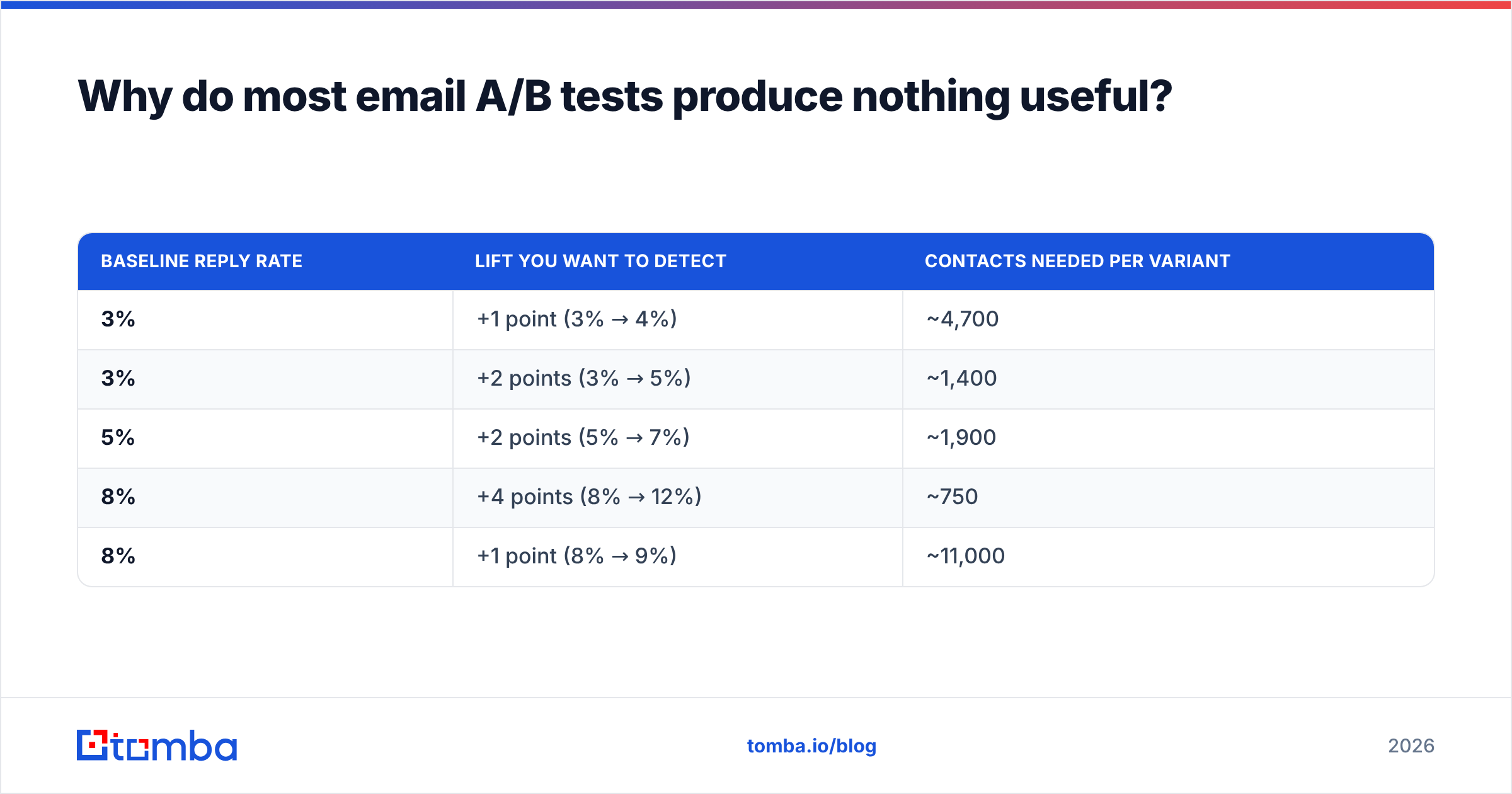
Here's the math nobody in the tool's onboarding flow shows you. To detect a lift with 95% confidence and 80% power, you need roughly:
| Baseline reply rate | Lift you want to detect | Contacts needed per variant |
|---|---|---|
| 3% | +1 point (3% → 4%) | ~4,700 |
| 3% | +2 points (3% → 5%) | ~1,400 |
| 5% | +2 points (5% → 7%) | ~1,900 |
| 8% | +4 points (8% → 12%) | ~750 |
| 8% | +1 point (8% → 9%) | ~11,000 |
Read that table again next time a tool tells you variant B "won" on 180 sends. It didn't. It got lucky.
This is the core problem with sequence-level A-B testing in cold outreach. The volumes are almost never enough for subtle copy changes. Which leads to a practical rule — test big swings, not small ones.
- Worth testing: entire angle changes (problem-led vs. proof-led), CTA type (ask for a call vs. ask for a reply), sequence length (3 steps vs. 7), personalization depth (none vs. researched first line).
- Not worth testing at cold-outreach volume: subject line punctuation, sender first name vs. full name, one-word tweaks, emoji vs. no emoji, "Hi" vs. "Hey".
The second list isn't wrong in principle. It's just undetectable at 300 sends, so those tests cost you time and produce confident-sounding garbage.
Which email A-B testing tools compare best in 2026?#
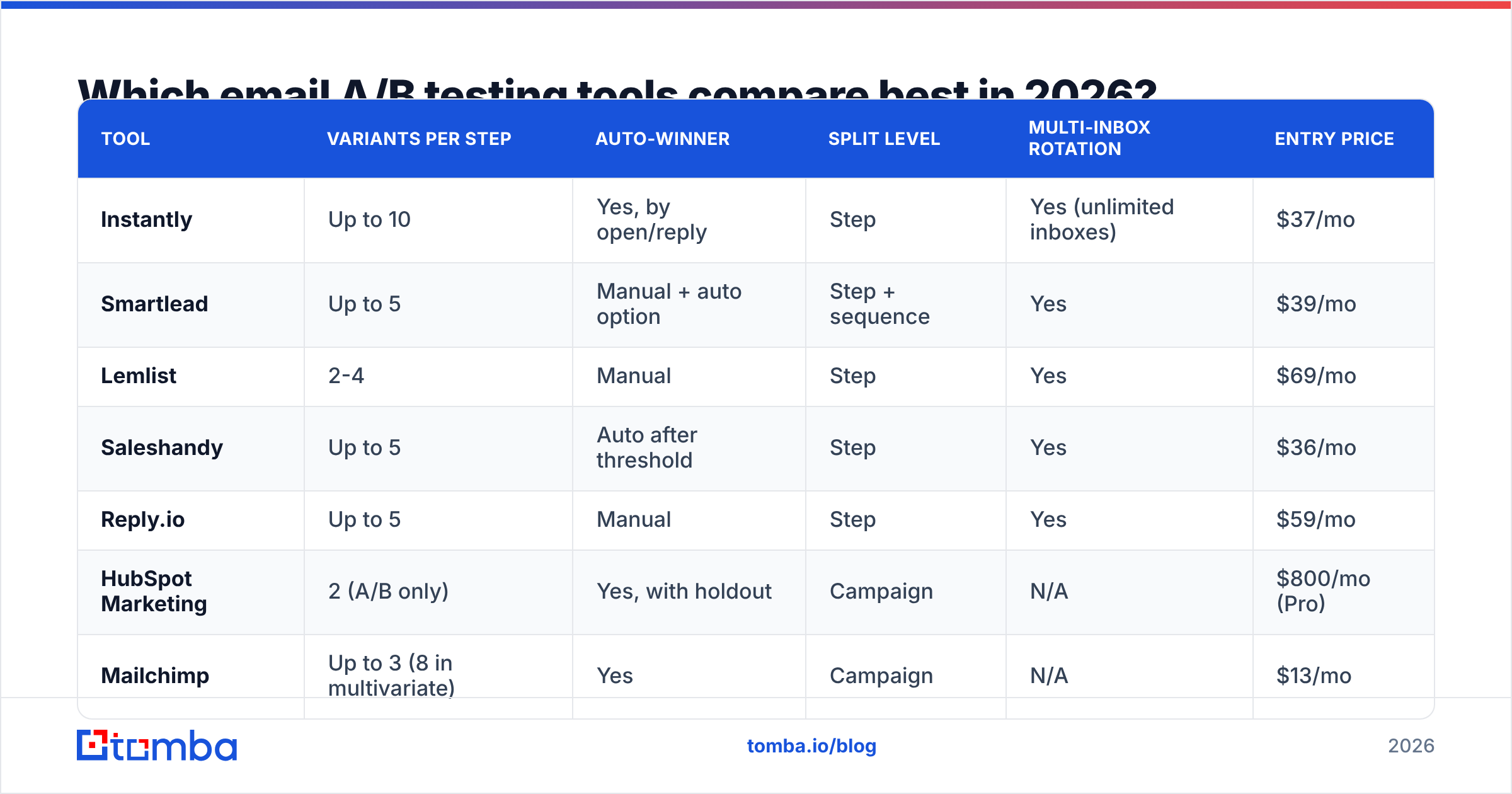
The honest comparison depends on whether you're doing cold outbound or opted-in marketing. Here's how the main platforms line up on the features that actually change test quality:
| Tool | Variants per step | Auto-winner | Split level | Multi-inbox rotation | Entry price |
|---|---|---|---|---|---|
| Instantly | Up to 10 | Yes, by open/reply | Step | Yes (unlimited inboxes) | $37/mo |
| Smartlead | Up to 5 | Manual + auto option | Step + sequence | Yes | $39/mo |
| Lemlist | 2-4 | Manual | Step | Yes | $69/mo |
| Saleshandy | Up to 5 | Auto after threshold | Step | Yes | $36/mo |
| Reply.io | Up to 5 | Manual | Step | Yes | $59/mo |
| HubSpot Marketing | 2 (A-B only) | Yes, with holdout | Campaign | N/A | $800/mo (Pro) |
| Mailchimp | Up to 3 (8 in multivariate) | Yes | Campaign | N/A | $13/mo |
A few things to flag honestly:
Auto-winner is the most dangerous feature on this list. Most versions pick a winner as soon as one variant leads, with no significance test and no minimum sample. If you use it, set the threshold by hand and set it high — 500+ per variant if the platform lets you.
Open-rate-based winners are broken in 2026. Apple Mail Privacy Protection, Gmail image proxying, and corporate link scanners have made open tracking unreliable for years. If your tool declares a winner on opens, it may be picking whichever variant triggered more security scanners. Judge on replies or booked meetings only.
Step-level vs. campaign-level matters. Cold outreach tools split per step, so variant A of step 1 can be followed by variant B of step 2. You end up measuring combinations, not clean variants. Marketing tools split at campaign level, which is cleaner but less flexible.
How do you set up a test that isn't confounded?#
Control everything except the one variable. In cold email, that's harder than it sounds, because so many things vary silently.
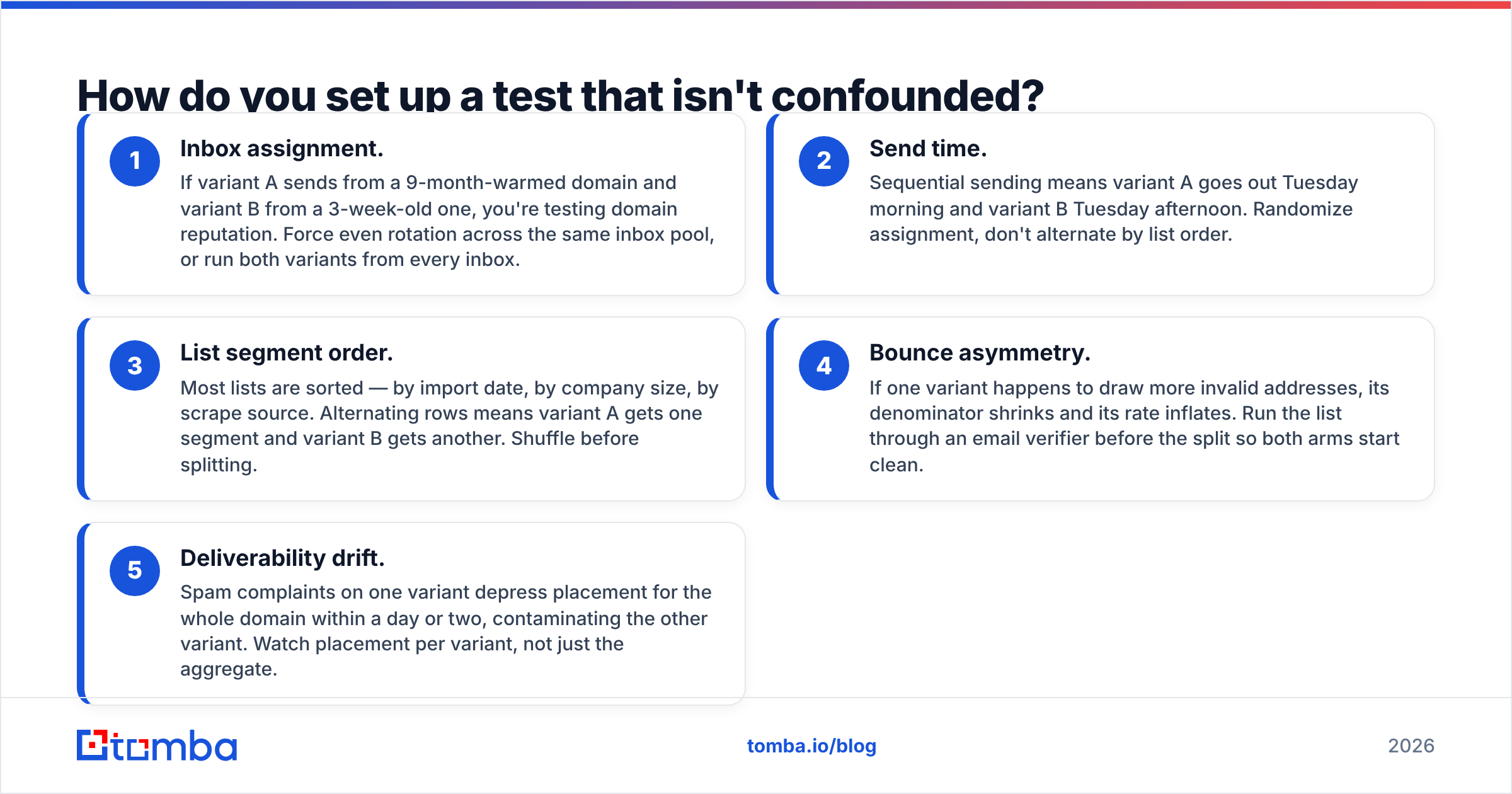
The confounders that ruin most tests:
- Inbox assignment. If variant A sends from a 9-month-warmed domain and variant B from a 3-week-old one, you're testing domain reputation. Force even rotation across the same inbox pool, or run both variants from every inbox.
- Send time. Sequential sending means variant A goes out Tuesday morning and variant B Tuesday afternoon. Randomize assignment, don't alternate by list order.
- List segment order. Most lists are sorted — by import date, by company size, by scrape source. Alternating rows means variant A gets one segment and variant B gets another. Shuffle before splitting.
Those three are about how the split is made. The next two are about the data underneath it.
- Bounce asymmetry. If one variant draws more invalid addresses, its denominator shrinks and its rate inflates. Run the list through an email verifier before the split so both arms start clean.
- Deliverability drift. Spam complaints on one variant depress placement for the whole domain within a day or two, which contaminates the other variant. Watch placement per variant, not just the aggregate.
Point 4 is the one teams skip most often and pay for hardest. A list with 15% invalid addresses doesn't just waste sends. It distorts every rate you calculate downstream and drags your sender reputation with it. Data quality is upstream of experiment design, not parallel to it.
What should you actually test first?#
In rough order of expected impact, based on what consistently moves reply rates in B2B outbound:
- List quality and targeting. Not a copy test, but it dominates everything else. The same email to a well-matched ICP beats brilliant copy to a bad list by multiples. Fix this before you run a single copy experiment.
- The offer / angle. "We help teams do X" vs. "Noticed you're hiring 4 SDRs — here's what that usually breaks." Angle changes are big enough to detect at realistic volume.
- CTA weight. A 15-minute call request vs. "worth a reply?" vs. a resource offer. This one routinely swings reply rates by 2-4 points, which you can detect at ~800 per variant.
Those three are the ones your volume can actually resolve. The next three matter, but they take longer to read out:
- Sequence length and cadence. 3 touches over 8 days vs. 6 touches over 21. Often the biggest lever after targeting, and almost never tested, because the results take weeks.
- Personalization depth. Fully templated vs. one researched line vs. deeply custom. Test this to find your ROI ceiling. Deep personalization often wins on rate but loses on rate-per-hour.
- Subject line. Last, and only at volume. Yes, really last. If you want a starting bank of options, run them through a subject line generator and pick two genuinely different concepts rather than two phrasings of the same one.
How long should you run an email A-B test?#
Long enough to hit your sample target, and never shorter than one full reply cycle.
Reply patterns in B2B are long-tailed. Roughly 40-50% of replies to a cold email arrive within 24 hours. The rest trickle in over the following 5-10 business days. Call a winner at 48 hours and you favor whichever variant pulled fast, low-intent replies. That is often the pushier one, and it can lose on meetings booked.
Practical rules:
- Minimum window: 7 business days after the last send in the variant.
- Minimum sample: use the table above. If you can't hit it, don't run the test. Run a sequential trial instead — variant A for a month, variant B for the next — and accept that it's directional, not conclusive.
- Metric hierarchy: meetings booked > positive replies > total replies > clicks > opens. Optimize the highest one you have enough volume to measure.
- Stop rule set in advance. Write down the sample size and the metric before you launch. Deciding after you see the data is how teams talk themselves into noise.
If you're on a marketing platform with real volume, HubSpot's own testing documentation is a reasonable baseline for window and threshold defaults. For cold outbound volumes, ignore the defaults and compute your own.
Do you need a dedicated testing tool, or is your sending platform enough?#
Your sending platform is almost certainly enough. The gap in most outbound programs isn't testing infrastructure. It's input data.
Here's the uncomfortable ordering. A team running perfect tests on a list with 20% invalid addresses and loose ICP matching will lose to a team running zero tests on a verified, tightly-targeted list. Test infrastructure amplifies a good foundation. It doesn't create one.
So the spend priority looks like this:
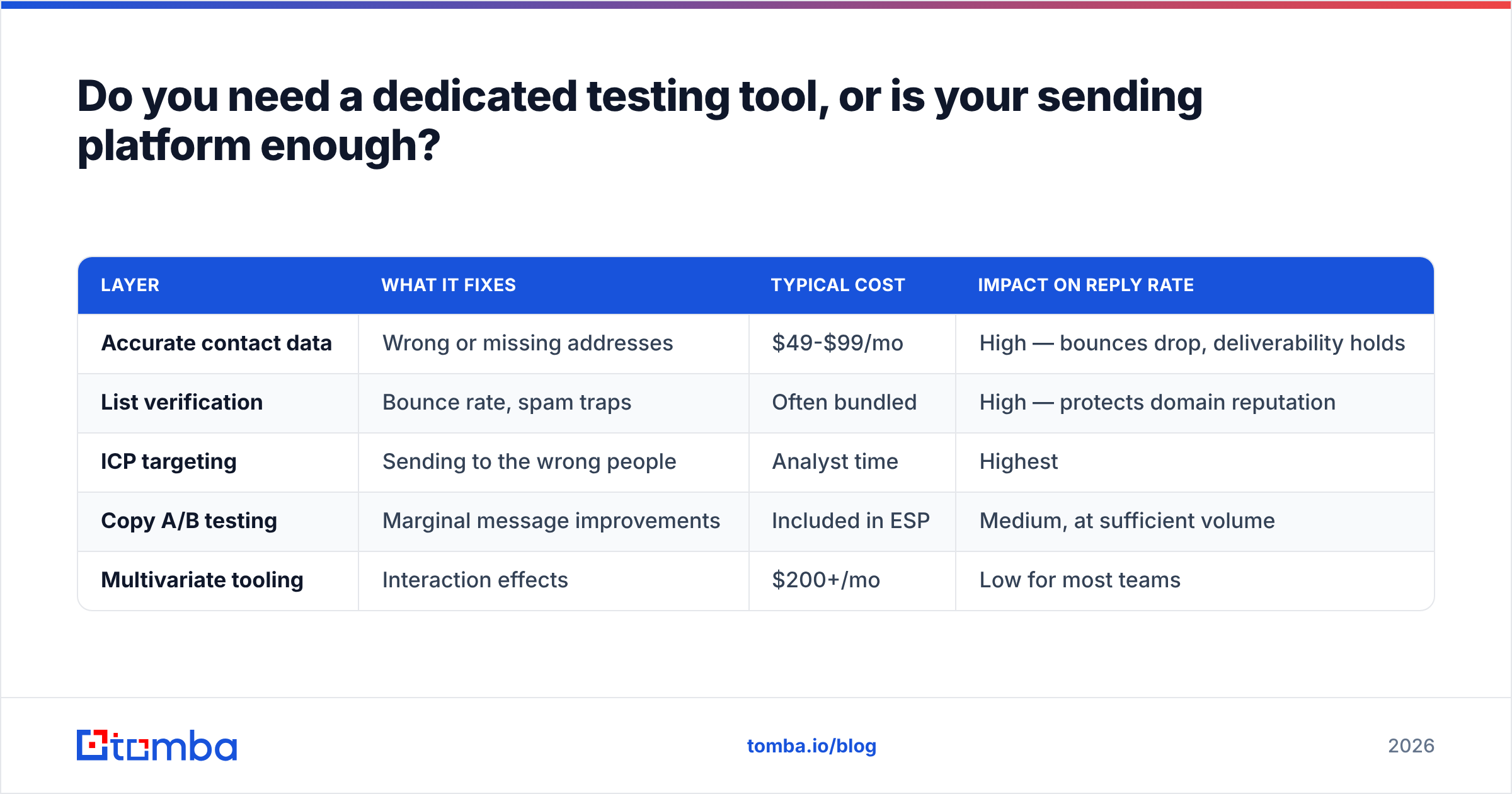
| Layer | What it fixes | Typical cost | Impact on reply rate |
|---|---|---|---|
| Accurate contact data | Wrong or missing addresses | $49-$99/mo | High — bounces drop, deliverability holds |
| List verification | Bounce rate, spam traps | Often bundled | High — protects domain reputation |
| ICP targeting | Sending to the wrong people | Analyst time | Highest |
| Copy A-B testing | Marginal message improvements | Included in ESP | Medium, at sufficient volume |
| Multivariate tooling | Interaction effects | $200+/mo | Low for most teams |
Note where copy testing sits. It's worth doing. It's just not the first thing worth doing.
For the data layer, most teams end up combining a finder and a verifier. Tools like Tomba, Hunter, Findymail, and BookYourData all cover this ground with different tradeoffs. Tomba and Hunter lean toward pattern-based discovery and API access, BookYourData toward pre-built list purchase with a verification guarantee, Findymail toward waterfall enrichment. Compare them on your own ICP, not on published accuracy claims, which are measured on vendor-chosen samples. G2's category listings are a reasonable starting point for shortlisting.
Tomba's pricing runs from a free tier at 25 searches/month through Starter at $49/mo, Growth at $99/mo, and Pro at $249/mo, with an API for teams wiring verification directly into their sending workflow.
What does a good testing cadence look like?#
One test at a time, per campaign, with a documented hypothesis.
The teams that get real compounding gains from A-B testing share three habits:
- They write the hypothesis first. "Changing the CTA from a call request to a soft reply ask will raise reply rate, because our ICP is time-poor and resists calendar commitments early." A hypothesis makes a null result informative.
- They keep a test log. Date, variable, sample, result, decision. Six months of this is worth more than any single tool. Most teams re-run the same tests every year because nobody wrote down the last answer.
- They retire winners. A subject line that won in March is often used up by September as the market saturates. Winners have a half-life. Re-test the biggest ones quarterly.
And one habit that separates the good from the frustrated: they fix the plumbing before they tune the engine. Clean data, warmed domains, correct SPF/DKIM/DMARC, verified addresses. Run a SPF checker and a spam checker on your setup before you decide that variant B lost on copy. Half the "copy losses" in cold email are really deliverability problems in a copy costume.
Get the input data right first#
Every one of these email A-B testing tools sits downstream of one thing: whether the addresses you send to are real, current, and attached to the right people. No split test rescues a list that bounces.
Start with the Tomba Email Finder to build a verified prospect list from domains, names, or company records. Then run your variants on top of a foundation you can trust. The free tier gives you 25 searches a month to check accuracy on your own ICP before you commit to a plan — which is exactly the kind of test worth running first.
Related guides#
Ready to find emails that actually work?
Join 150,000+ professionals who stopped guessing and started sending. Free credits on signup — no credit card required.
Get the Tomba newsletter
Practical outbound tactics and product updates — once every two weeks.
About the author