Email Checkernet Pricing 2026: Reviews, Pros and Cons
An independent breakdown of Email Checkernet pricing, real reviewer complaints, and where credit-based verification quietly costs more than the sticker price suggests.
TL;DR
- Email Checkernet (checker.net / email-checker.net family of verification tools) sells credits, not seats — headline prices look cheap until you divide by usable results.
- Expect roughly $0.004–$0.010 per verification depending on volume, with the cheapest rate locked behind six-figure credit packs most teams never buy.
- The most common reviewer complaints across G2 and Capterra-style listings are the same three: credits burned on "unknown"/catch-all results, credits that expire, and support that slows down on lower tiers.
- Verification-only pricing is a bad deal if you also pay a separate vendor to find the emails. Bundled platforms like Tomba pricing at $49/mo fold finding, verifying, and enrichment into one credit pool.
- Buy Email Checkernet if you already have a clean list and just need a second-opinion validator. Skip it if your real problem is sourcing contacts in the first place.
What is Email Checkernet and who actually uses it?#
Email Checkernet belongs to the "single-purpose validator" category: you upload a list of addresses you already own, it pings the mail servers, and it hands back a status for each one — valid, invalid, catch-all, disposable, role-based, or unknown.
Think of it like a bouncer at the door of your sending domain. It does not go find guests for you. It only checks IDs on the people already standing in line. That distinction drives every pricing decision below.
The typical buyer is one of three profiles:
- A marketer with an aging database — 80,000 contacts collected over four years, bounce rate creeping past 4%, needs a one-time scrub before a re-engagement campaign.
- An agency running client lists — verification is a billable line item, so per-credit cost directly hits margin.
- An ops person double-checking another tool — the list came from a scraper or a data broker, and nobody trusts it yet.
Notice what is missing: nobody in that list is prospecting. If you are building lists from scratch, a validator is the second tool you buy, not the first. That's why comparing Email Checkernet pricing to a full-stack platform is only fair when you count both line items.
How does Email Checkernet pricing actually work?#
Credit-based, pay-as-you-go, with volume discounts. One credit equals one email checked — including the ones that come back "unknown," which is where the frustration starts.
Published pricing for tools in this class (Email Checkernet, ZeroBounce, DeBounce, Clearout and the rest of the validator pack) clusters tightly. Here is the shape of the market as of 2026:
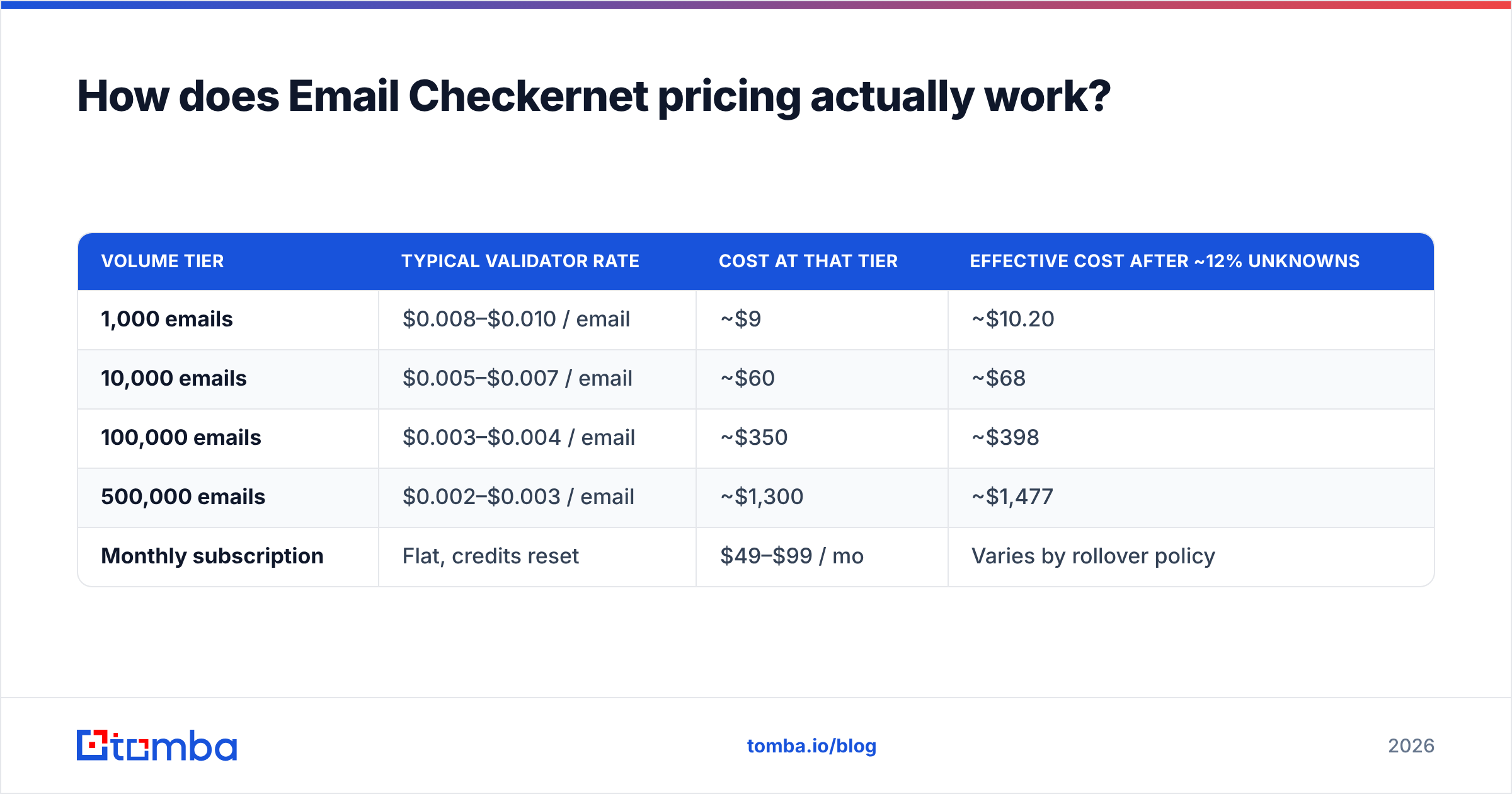
| Volume tier | Typical validator rate | Cost at that tier | Effective cost after ~12% unknowns |
|---|---|---|---|
| 1,000 emails | $0.008–$0.010 / email | ~$9 | ~$10.20 |
| 10,000 emails | $0.005–$0.007 / email | ~$60 | ~$68 |
| 100,000 emails | $0.003–$0.004 / email | ~$350 | ~$398 |
| 500,000 emails | $0.002–$0.003 / email | ~$1,300 | ~$1,477 |
| Monthly subscription | Flat, credits reset | $49–$99 / mo | Varies by rollover policy |
Three mechanics matter more than the sticker rate:
- Unknown results still consume credits. Every validator hits servers that refuse to confirm or deny. Depending on your list composition, 8–15% of a B2B list returns unknown or catch-all. You pay for those.
- Credit expiry. Pay-as-you-go credits at most validators expire in 12 months; subscription credits usually expire monthly. Buying the 500k pack to get the good rate only saves money if you actually burn it.
- API vs. dashboard parity. Some validators charge the same for both; others gate the real-time API behind a higher plan. Check before you build against it.
Is Email Checkernet accurate enough to trust?#
Accuracy claims in this category are close to meaningless as marketing copy — every vendor claims 98%+ — but they differ sharply in how they handle the hard cases.
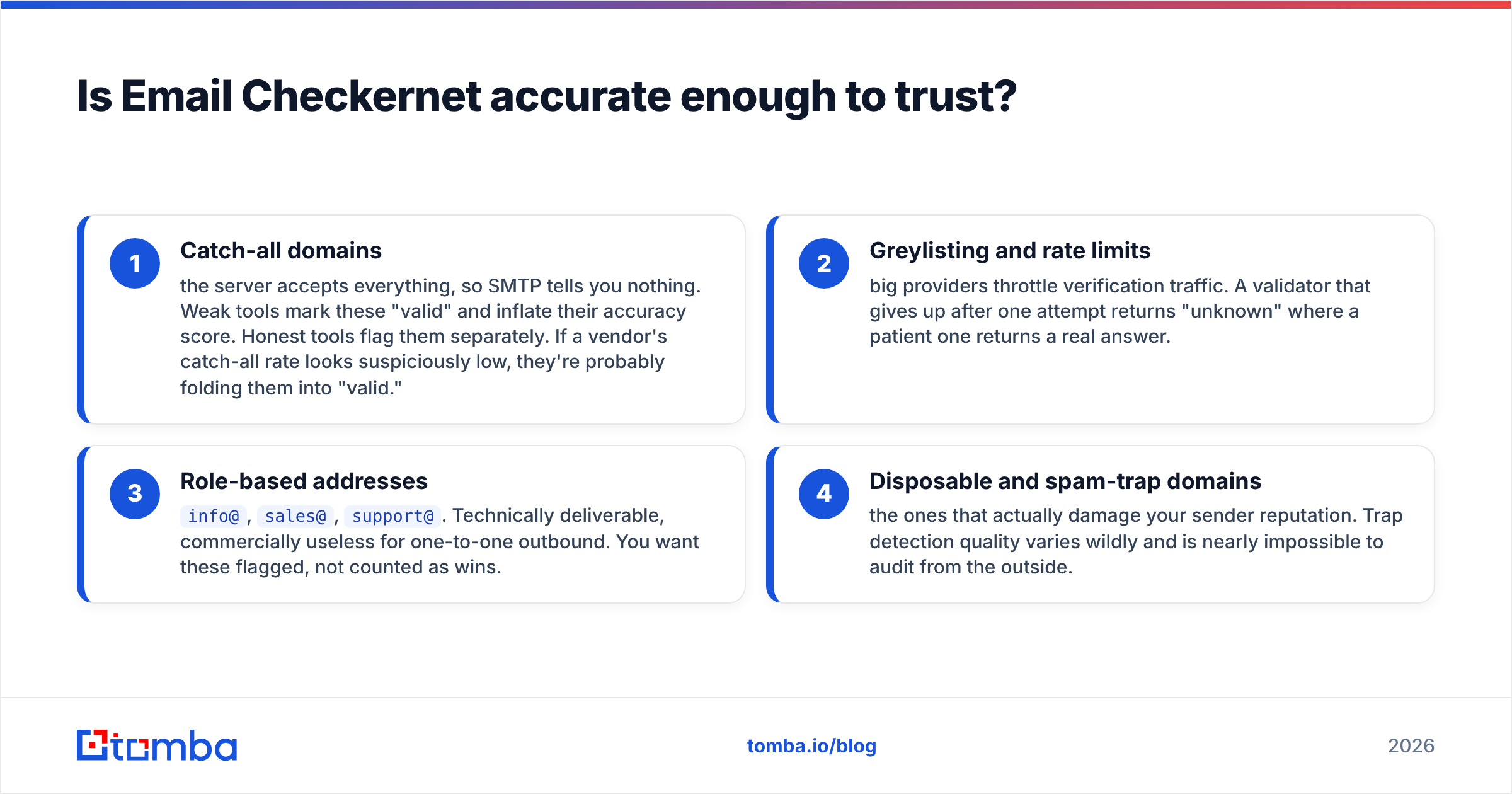
There are only four hard cases, and a validator's real quality is entirely in how it treats them:
- Catch-all domains — the server accepts everything, so SMTP tells you nothing. Weak tools mark these "valid" and inflate their accuracy score. Honest tools flag them separately. If a vendor's catch-all rate looks suspiciously low, they're probably folding them into "valid."
- Greylisting and rate limits — big providers throttle verification traffic. A validator that gives up after one attempt returns "unknown" where a patient one returns a real answer.
- Role-based addresses —
info@,sales@,support@. Technically deliverable, commercially useless for one-to-one outbound. You want these flagged, not counted as wins. - Disposable and spam-trap domains — the ones that actually damage your sender reputation. Trap detection quality varies wildly and is nearly impossible to audit from the outside.
The practical test: take 500 addresses you already know the truth about — your own CRM's engaged contacts plus a set of known-dead ones — and run them through any validator's free tier before you buy. Every serious vendor gives you enough free credits to do this. If you want a zero-commitment sanity check first, a free email checker will tell you whether the list is bad enough to justify paying anyone.
What do real Email Checkernet reviews say?#
Filter out the affiliate content and the review patterns across validation tools are remarkably consistent. On G2 and Capterra, the same praise and the same gripes surface for nearly every player in this category.
What reviewers consistently praise:
- Speed on bulk uploads. A 50,000-row CSV finishing in under an hour is table stakes now, and most users report it works.
- Simple, boring UI. Upload, wait, download. Nobody wants a "platform" for this job.
- Clean CSV output. Status columns that map cleanly into a mail-merge filter save real time.
- Fair free tier. 100 free credits is enough to test the accuracy claim yourself.
What reviewers consistently complain about:
- Paying for "unknown." The single most common one-star theme across the category. Users feel charged for a non-answer, and it's a legitimate gripe.
- Credit expiry surprises. Someone buys 100k credits for a quarterly scrub, forgets, and loses the balance at the 12-month mark.
- Support tiering. Sub-$100 customers routinely report multi-day email-only response times while enterprise accounts get Slack channels.
- Refund friction. Credits consumed are almost never refunded, even when the results are demonstrably wrong.
- No sourcing. Reviewers repeatedly note they still need a second tool to actually find addresses — which is the whole cost argument below.
Email Checkernet vs. the alternatives: what's the real cost?#
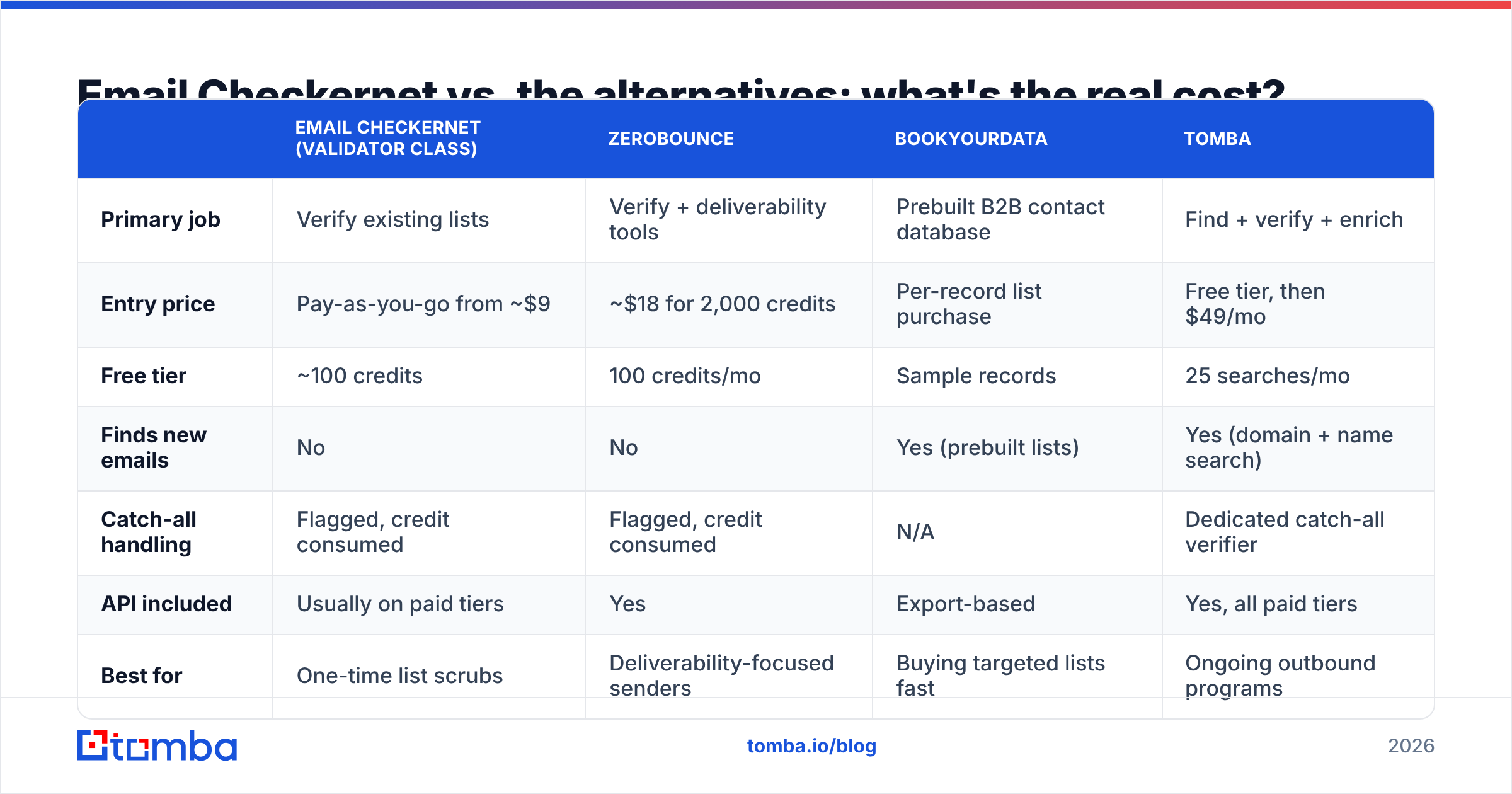
Here's where the comparison gets interesting. A validator's price is only half your bill if you also pay to source contacts.
| Email Checkernet (validator class) | ZeroBounce | BookYourData | Tomba | |
|---|---|---|---|---|
| Primary job | Verify existing lists | Verify + deliverability tools | Prebuilt B2B contact database | Find + verify + enrich |
| Entry price | Pay-as-you-go from ~$9 | ~$18 for 2,000 credits | Per-record list purchase | Free tier, then $49/mo |
| Free tier | ~100 credits | 100 credits/mo | Sample records | 25 searches/mo |
| Finds new emails | No | No | Yes (prebuilt lists) | Yes (domain + name search) |
| Catch-all handling | Flagged, credit consumed | Flagged, credit consumed | N/A | Dedicated catch-all verifier |
| API included | Usually on paid tiers | Yes | Export-based | Yes, all paid tiers |
| Best for | One-time list scrubs | Deliverability-focused senders | Buying targeted lists fast | Ongoing outbound programs |
A few honest notes on that table. BookYourData solves a genuinely different problem — if you want a targeted list handed to you rather than built, it's a strong option and pricing is per-record rather than per-check. ZeroBounce bundles deliverability extras (inbox placement tests, blacklist monitoring) that pure validators don't. And Tomba's $49/mo Starter isn't cheaper than pay-as-you-go for a single 5,000-record scrub — it's cheaper when verification is a recurring line item alongside finding.
Run the arithmetic for a team prospecting 2,000 new contacts a month:
- Validator + separate finder: ~$14/mo in verification credits + $49–$99/mo for a finder = $63–$113/mo, two dashboards, two invoices, two support queues.
- Bundled platform: $49/mo on Tomba Starter, one credit pool covering find emails, email verification, and enrichment.
The standalone validator wins on one-time jobs. It loses on anything recurring.
What are the pros and cons of Email Checkernet?#
Pros
- No subscription required. Pay-as-you-go suits the "scrub twice a year" use case perfectly, and nothing else does.
- Genuinely fast bulk processing. Large CSVs come back in useful timeframes.
- Low switching cost. Your list is a CSV. If accuracy disappoints, you leave in ten minutes.
- Good second opinion. Running a sample through a second validator is a legitimate QA practice, and cheap validators are ideal for it.
- Straightforward tooling. No onboarding call, no implementation project.
Cons
- Credits burn on non-answers. Unknown and catch-all results cost the same as clean verdicts.
- Expiry risk on bulk packs. The good per-email rate requires a commitment you might not consume.
- Zero sourcing capability. You will pay another vendor to find the addresses.
- Support quality scales with spend. Small accounts wait.
- Catch-all remains a coin flip. No standalone SMTP validator fully solves this; a catch-all verifier built for the problem gets closer than generic bulk validation.
Who should buy it, and who should buy something else?#
Buy a standalone validator like Email Checkernet if:
- You have one list, you scrub it once or twice a year, and a subscription would sit idle.
- You need an independent second opinion on results from your primary tool.
- Your list came from an event, a webinar, or a partner handoff and you don't know its provenance.
- Your total annual verification volume is under ~20,000 emails.
Buy a bundled platform instead if:
- You are building lists continuously, not cleaning one.
- Verification is a step inside an automated workflow, not a manual batch job.
- You want domain search, verification, and enrichment drawing from one credit pool and one API key.
- You are tired of reconciling two vendors' definitions of "valid."
Buy a data provider instead if:
- You need contacts in a specific niche fast and would rather buy a targeted list than build one. This is where a database vendor earns its price.
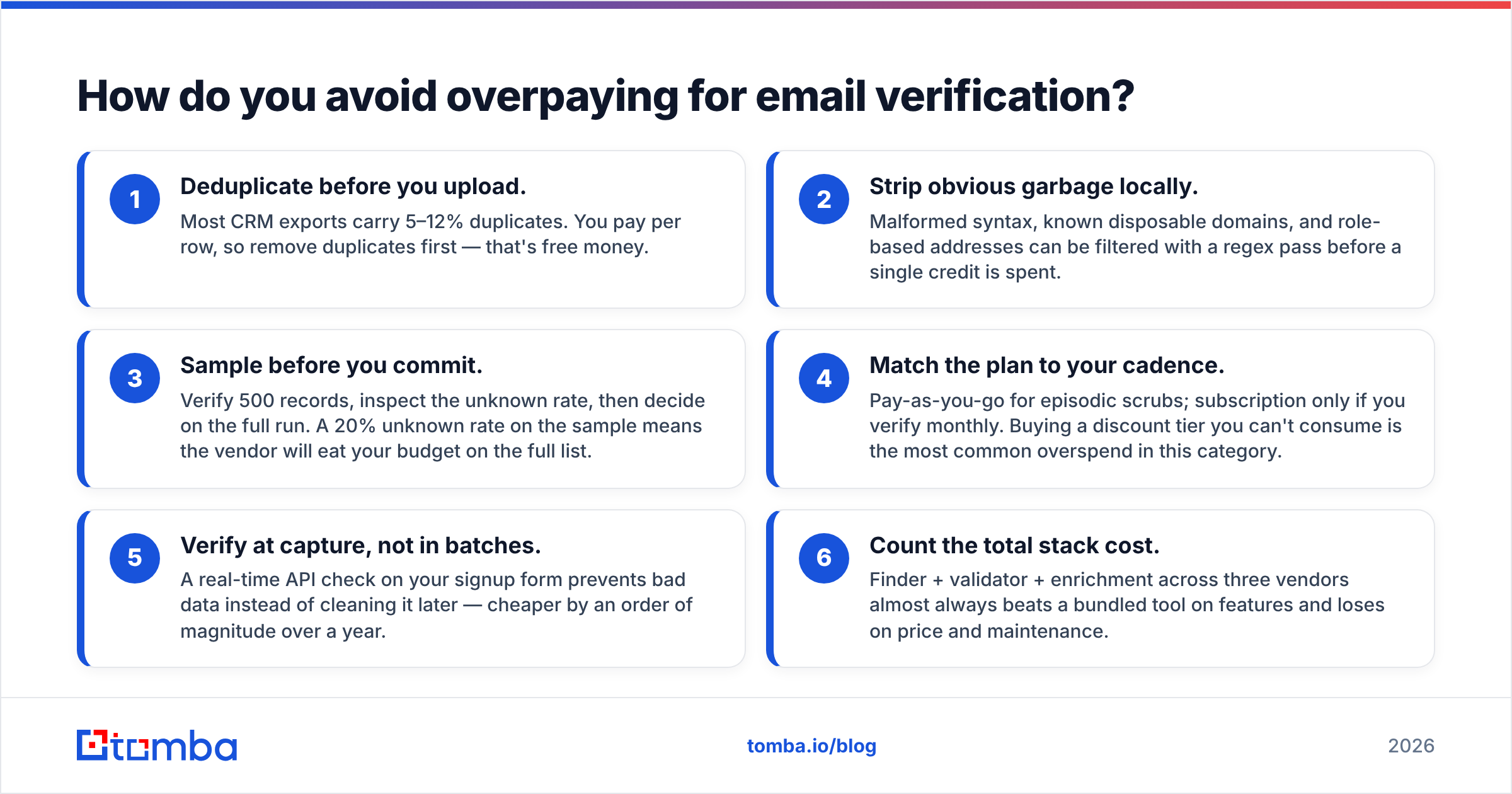
How do you avoid overpaying for email verification?#
Five things that reliably cut the bill, regardless of which vendor you land on:
- Deduplicate before you upload. Most CRM exports carry 5–12% duplicates. You pay per row, so remove duplicates first — that's free money.
- Strip obvious garbage locally. Malformed syntax, known disposable domains, and role-based addresses can be filtered with a regex pass before a single credit is spent.
- Sample before you commit. Verify 500 records, inspect the unknown rate, then decide on the full run. A 20% unknown rate on the sample means the vendor will eat your budget on the full list.
- Match the plan to your cadence. Pay-as-you-go for episodic scrubs; subscription only if you verify monthly. Buying a discount tier you can't consume is the most common overspend in this category.
- Verify at capture, not in batches. A real-time API check on your signup form prevents bad data instead of cleaning it later — cheaper by an order of magnitude over a year.
- Count the total stack cost. Finder + validator + enrichment across three vendors almost always beats a bundled tool on features and loses on price and maintenance.
One more thing worth saying plainly: verification is not a substitute for email deliverability hygiene. A perfectly verified list still lands in spam if your SPF, DKIM, and DMARC records are wrong or your domain has no sending history. Verification removes bounces. It does not build reputation. HubSpot's research on email engagement makes the same point from the other direction — engagement, not list size, is what mailbox providers actually score you on.
What's the verdict on Email Checkernet pricing in 2026?#
Fair, unremarkable, and priced like everyone else — which is exactly the problem.
Standalone validators have commoditized. The per-email rates are within a rounding error of each other, the accuracy claims are unverifiable from the outside, and the differentiators that remain are catch-all handling and support responsiveness. Email Checkernet is a reasonable pick in that pack if your job is genuinely "clean this one list." Test it with free credits against a list you know the truth about, and buy the smallest pack that covers your actual volume.
But if you found this post because your bounce rate is high and you're struggling to build lists at all, you're solving the wrong problem with the wrong tool. Verification is downstream. Sourcing is where the money and the time actually go.
That's the case for consolidating. Tomba's Email Finder finds professional addresses by domain, name, or company and verifies them in the same pass — one credit pool, one API, one invoice. Start on the free tier at 25 searches a month, move to Starter at $49/mo when outbound becomes a habit rather than a project, and stop paying two vendors to do one job.
Related guides#
Ready to find emails that actually work?
Join 150,000+ professionals who stopped guessing and started sending. Free credits on signup — no credit card required.
Get the Tomba newsletter
Practical outbound tactics and product updates — once every two weeks.
About the author