Email Checkernet vs Generect: Which B2B Data Tool Wins in 2026?
Email Checkernet verifies addresses. Generect builds lead lists. They solve different halves of the same problem — here's which one your pipeline actually needs, and where a single-vendor stack beats both.
TL;DR
- Email Checkernet and Generect are not real competitors — Checkernet is a bulk email verification service, Generect is a lead database and list-building platform. Comparing them head-to-head only makes sense if you're deciding where your next budget dollar goes.
- If your list is already built and bouncing, verification wins. If you have no list at all, verification is worthless — you need sourcing first.
- Running both means two vendors, two credit systems, two APIs, and a hand-off gap where unverified records leak into your sequencer.
- Consolidated platforms (Tomba, Apollo, BookYourData) cover finding and verification in one credit pool, which is usually cheaper than two point tools at the same volume.
- Our pick for most SMB and mid-market outbound teams in 2026: one platform that does find + verify + enrich, with a real free tier to test accuracy before you commit.
What is Email Checkernet and what does it actually do?#
Email Checkernet sits in the email verification category. You upload a list — CSV, API push, or an integration from your ESP — and it returns a status per address: valid, invalid, catch-all/accept-all, role-based, disposable, or unknown.
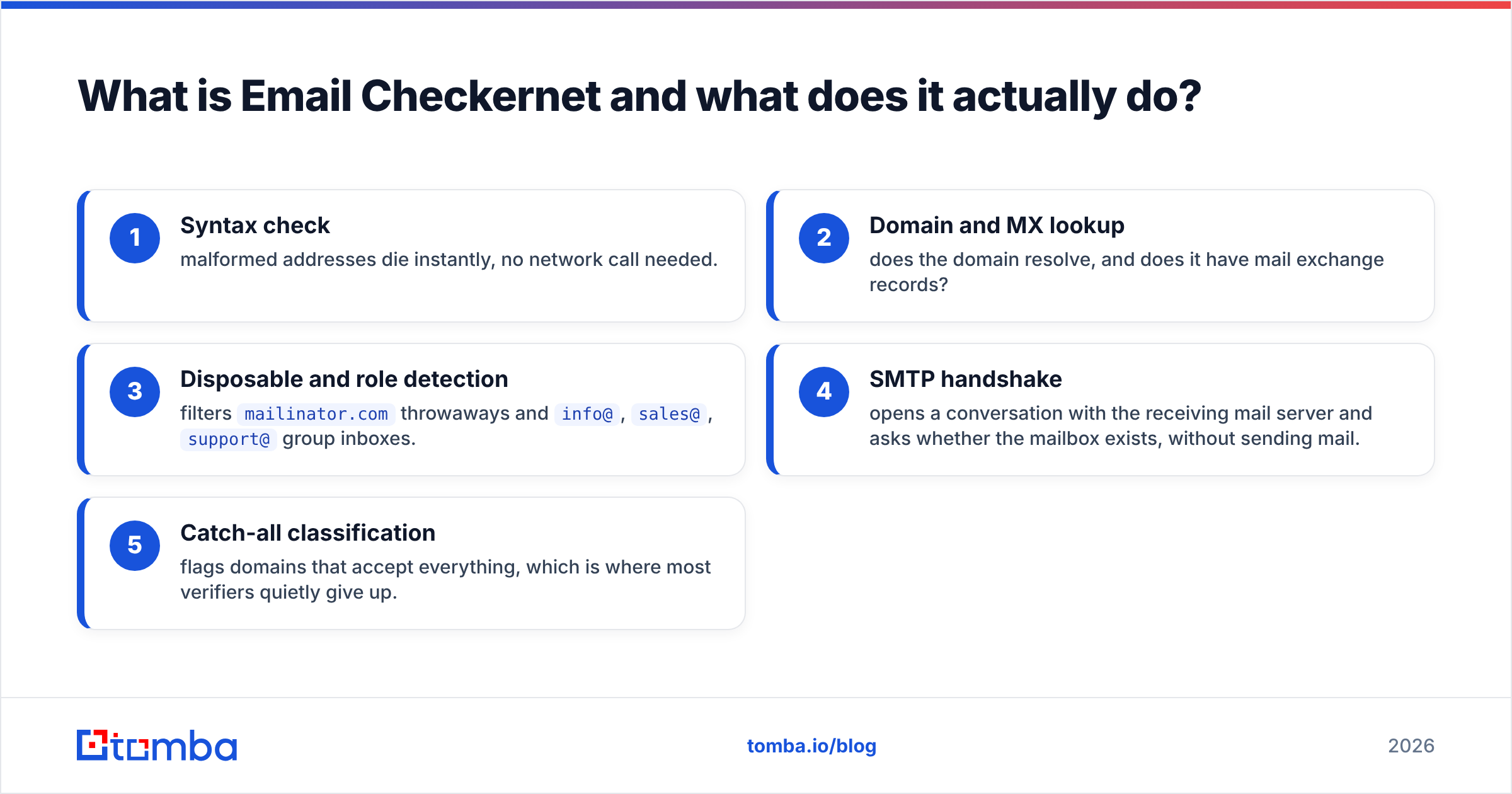
The mechanics are the same across every verifier worth using:
- Syntax check — malformed addresses die instantly, no network call needed.
- Domain and MX lookup — does the domain resolve, and does it have mail exchange records?
- Disposable and role detection — filters
mailinator.comthrowaways andinfo@,sales@,support@group inboxes. - SMTP handshake — opens a conversation with the receiving mail server and asks whether the mailbox exists, without sending mail.
- Catch-all classification — flags domains that accept everything, which is where most verifiers quietly give up.
That last step is the honest dividing line between verification tools. Roughly 15–25% of B2B domains are configured as catch-all, and a basic verifier returns "unknown" on all of them. You can either delete those leads (throwing away real buyers) or mail them blind (raising bounce risk). A catch-all verifier that actually resolves them is the difference between a usable list and a coin flip.
What Email Checkernet does not do: it does not find you a single new contact. Feed it an empty file, you get an empty file back.
What is Generect and who is it for?#
Generect is on the other side of the workflow — a lead generation and B2B data platform. Its value proposition is sourcing: pull companies and people matching your ICP filters (industry, headcount, tech stack, geography, job title), then export contact records with emails and sometimes phone numbers.
Generect's positioning leans heavily on LinkedIn-derived data and real-time lookups rather than serving stale rows from a static dump. That's the right architecture — a B2B contact record decays at roughly 25–30% per year as people change jobs, so anything pulled from a warehouse refreshed quarterly is already partly wrong when you download it.
Where Generect fits:
- You have an ICP but no list. Filters → companies → decision-makers → export.
- You run account-based outbound. You need every relevant title at a target account, not one contact.
- You want the LinkedIn-to-email hop. A profile URL in, a work email out. Same job as a LinkedIn finder.
Where it doesn't fit: ongoing hygiene on a list you already own. Sourcing platforms typically verify at export time, then stop caring. Six months later that CRM segment is stale again and you're back to needing a verifier.

Email Checkernet vs Generect: how do they compare feature by feature?#
Here's the head-to-head on the attributes that actually change your cost per booked meeting. Note that both vendors publish limited public pricing detail, so treat dollar figures as directional and confirm on their own sites before you buy.
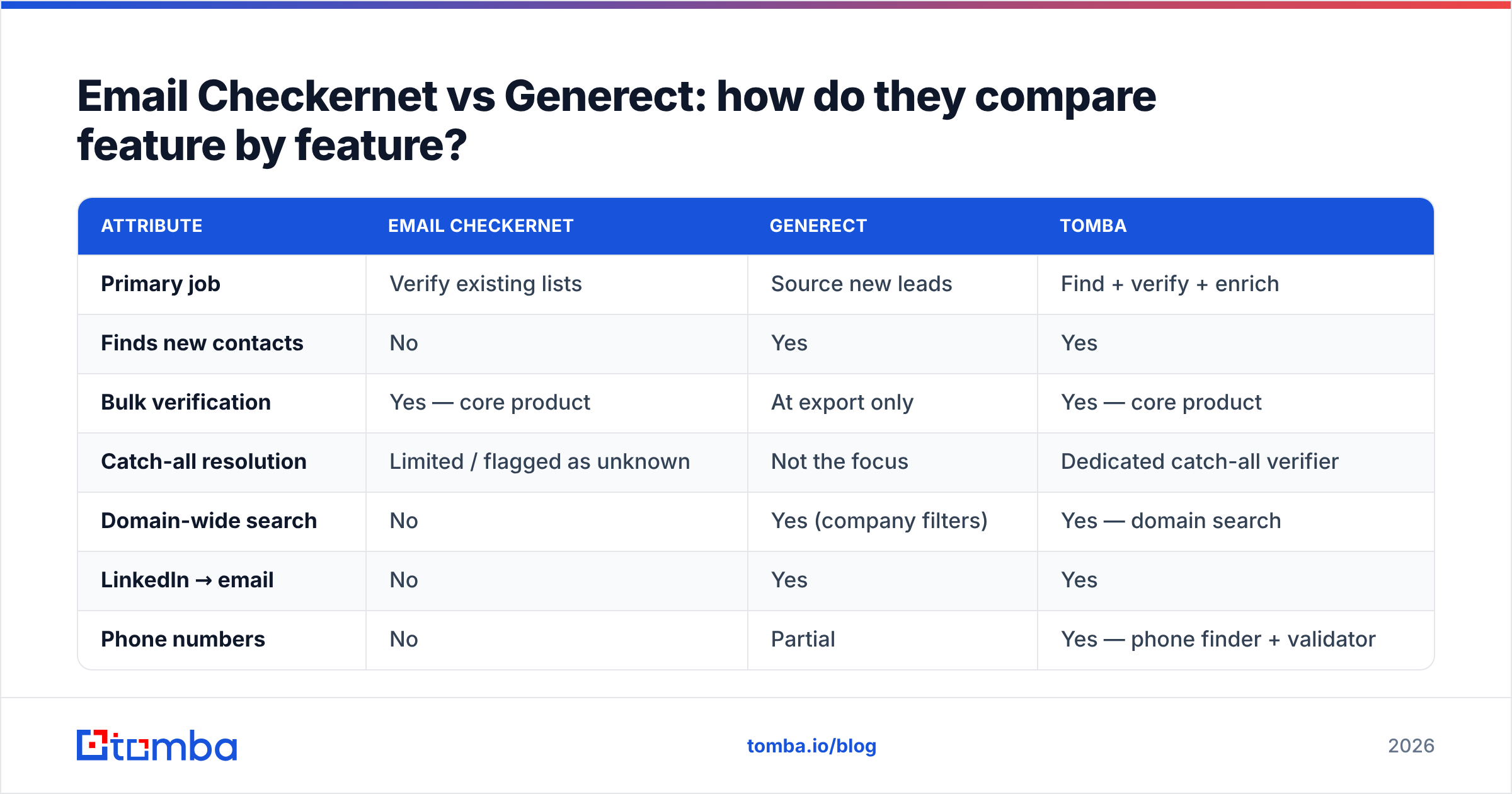
| Attribute | Email Checkernet | Generect | Tomba |
|---|---|---|---|
| Primary job | Verify existing lists | Source new leads | Find + verify + enrich |
| Finds new contacts | No | Yes | Yes |
| Bulk verification | Yes — core product | At export only | Yes — core product |
| Catch-all resolution | Limited / flagged as unknown | Not the focus | Dedicated catch-all verifier |
| Domain-wide search | No | Yes (company filters) | Yes — domain search |
| LinkedIn → email | No | Yes | Yes |
| Phone numbers | No | Partial | Yes — phone finder + validator |
| API access | Yes | Yes | Yes, documented REST API |
| Free tier | Trial credits | Demo / trial | 25 searches/mo, no card |
| Entry paid price | Credit packs, low entry | Quote-based / higher entry | $49/mo Starter |
| Best for | Hygiene on owned lists | ICP list building | Teams wanting one vendor |
The table makes the real conclusion visible: the columns barely overlap. Choosing between them isn't a comparison, it's a diagnosis of which problem you have right now.
Which problem do you actually have?#
Run through these four questions honestly:
- Is your bounce rate above 3%? That's the deliverability red line most inbox providers treat as a spam signal. You have a verification problem — Checkernet-class tooling solves it.
- Do you have fewer than 500 prospects in your ICP list? You have a sourcing problem. No amount of verification creates records that don't exist.
- Are your reps spending more than an hour a day hunting for addresses manually? You have a workflow problem — you need an API or a Chrome extension, not another database subscription.
- Are you paying for two tools that each bill in separate credit systems? You have a procurement problem, and consolidation usually cuts 30–40% off the combined bill at the same volume.
Most teams answer yes to two or more. That's exactly why the "vs" framing collapses — you don't need to pick a winner, you need to stop paying two vendors for one workflow.
Is verification or sourcing more important for deliverability?#
Verification, but only after sourcing exists. The order matters more than the priority.
Google and Yahoo's bulk sender requirements, in force since 2024 and tightened since, put a hard spam-complaint ceiling at 0.3% and expect authenticated domains with SPF, DKIM, and DMARC in place. Bounces don't appear in that threshold directly, but they feed the same reputation model — a mailbox provider reading a 12% hard-bounce rate concludes you bought a list, and throttling follows. You can read the current requirements straight from Google's Postmaster documentation.
The practical sequence:
- Source the list against a real ICP. Garbage targeting can't be verified into quality.
- Verify before the first send, and re-verify anything older than 90 days.
- Authenticate the sending domain — check your SPF record and DMARC alignment before volume ramps.
- Warm up the domain gradually rather than firing 2,000 emails on day one.
- Monitor sender reputation weekly and pull back when complaint rates drift.
Skip step 2 and steps 3–5 can't save you. Skip step 1 and step 2 is verifying a list of people who were never going to buy.
What are the real alternatives to running both tools?#
The consolidated-platform market is crowded, and each vendor optimizes for a different buyer. A fair read of the field:
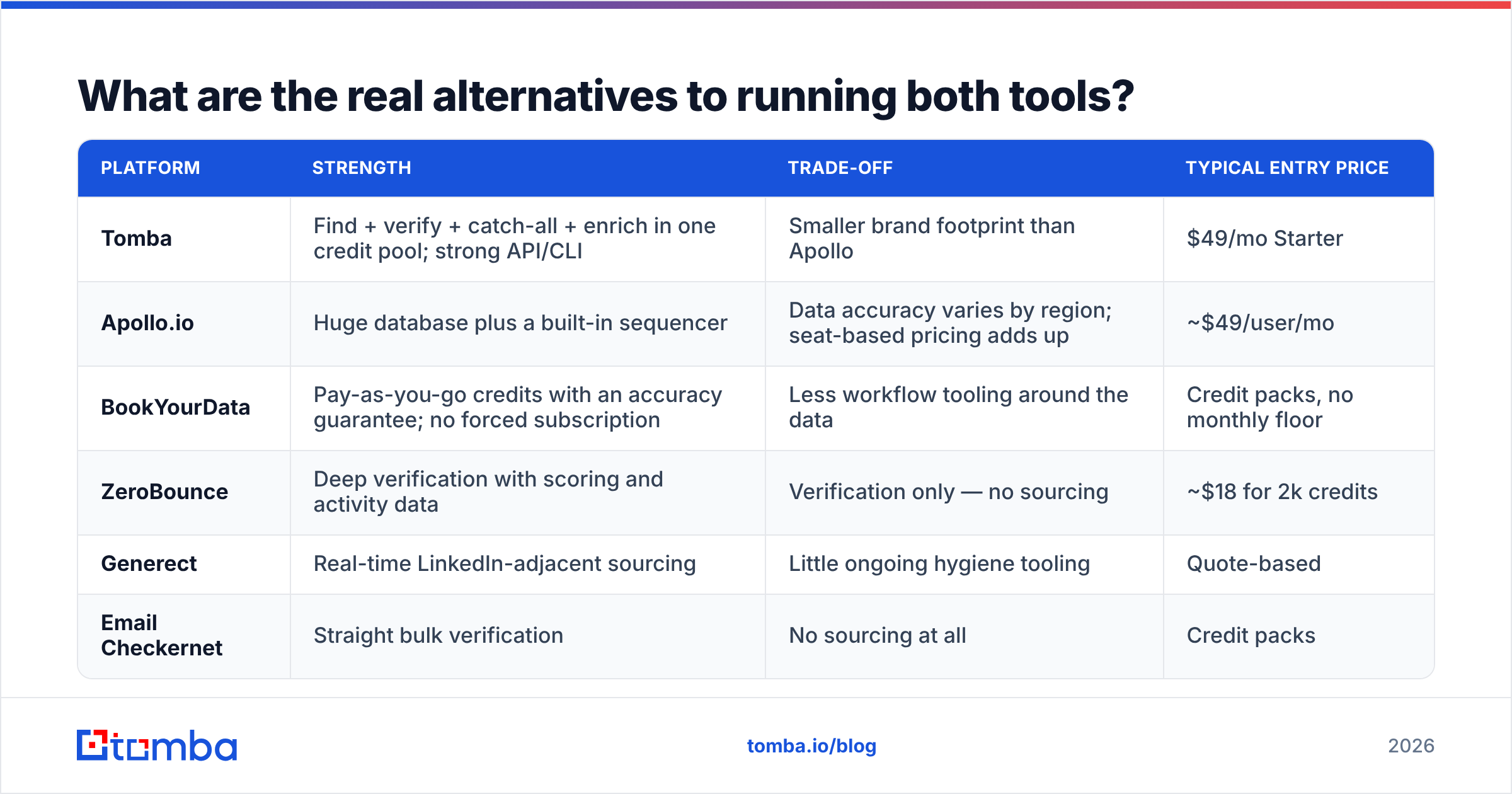
| Platform | Strength | Trade-off | Typical entry price |
|---|---|---|---|
| Tomba | Find + verify + catch-all + enrich in one credit pool; strong API/CLI | Smaller brand footprint than Apollo | $49/mo Starter |
| Apollo.io | Huge database plus a built-in sequencer | Data accuracy varies by region; seat-based pricing adds up | ~$49/user/mo |
| BookYourData | Pay-as-you-go credits with an accuracy guarantee; no forced subscription | Less workflow tooling around the data | Credit packs, no monthly floor |
| ZeroBounce | Deep verification with scoring and activity data | Verification only — no sourcing | ~$18 for 2k credits |
| Generect | Real-time LinkedIn-adjacent sourcing | Little ongoing hygiene tooling | Quote-based |
| Email Checkernet | Straight bulk verification | No sourcing at all | Credit packs |
BookYourData deserves a specific mention for teams that hate subscriptions: its pay-as-you-go model with a stated accuracy guarantee is genuinely the cleanest fit when your outbound is seasonal or project-based, and you shouldn't pay a monthly floor for eight months of the year. It's a solid peer product with a different billing philosophy, not a worse one.
Apollo is the default answer for teams that want database and sequencing in one seat, though its per-seat model gets expensive past five reps — which is why Apollo alternatives is one of the highest-volume searches in this category. And if verification is genuinely all you need, ZeroBounce alternatives covers the pure-play verifier field in depth.

How do you evaluate accuracy without trusting marketing pages?#
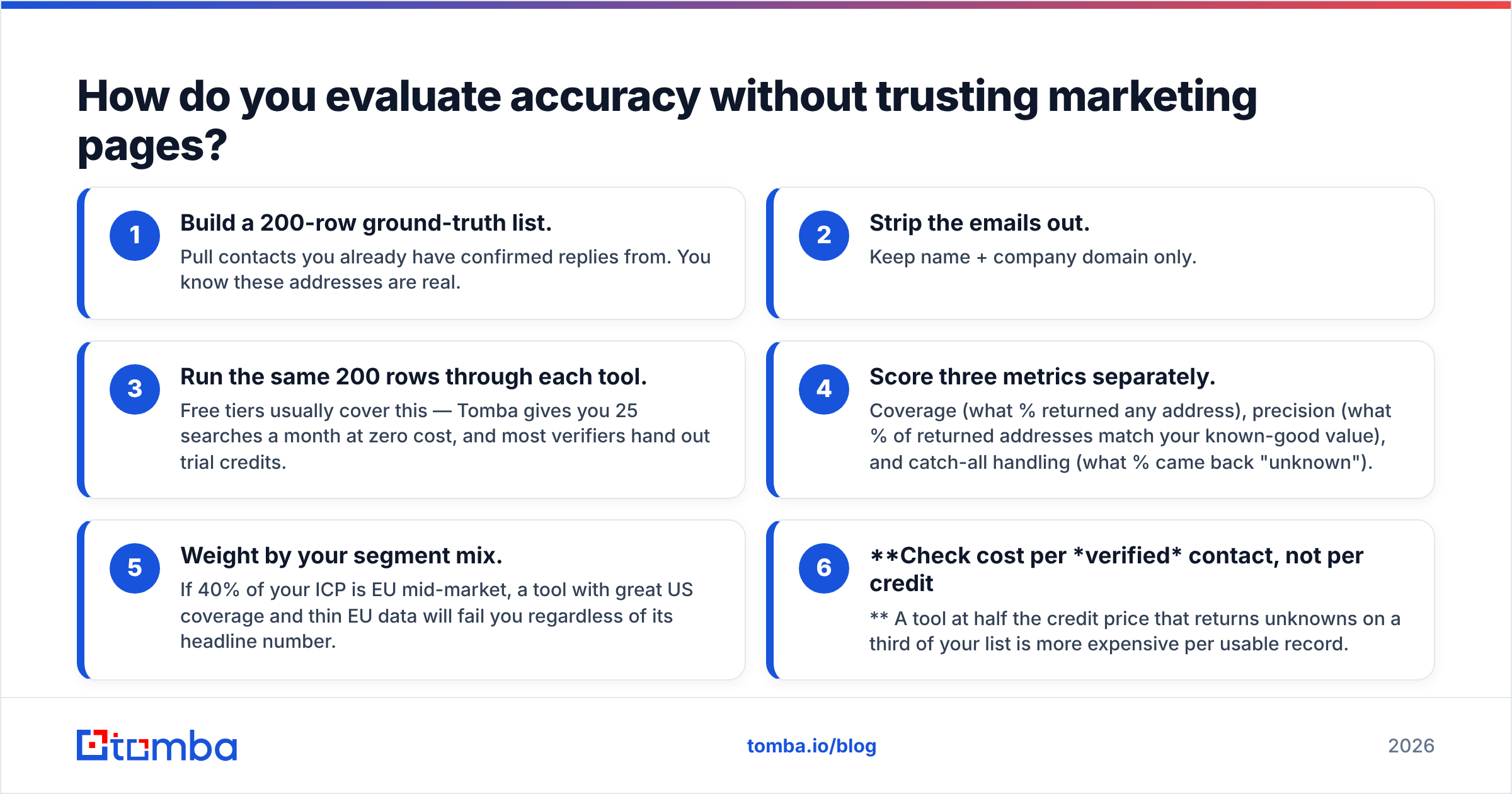
Every vendor on this list claims 95%+ accuracy. Those numbers are measured on the vendor's own test set, which is not your ICP. Run your own benchmark instead — it takes about 40 minutes.
- Build a 200-row ground-truth list. Pull contacts you already have confirmed replies from. You know these addresses are real.
- Strip the emails out. Keep name + company domain only.
- Run the same 200 rows through each tool. Free tiers usually cover this — Tomba gives you 25 searches a month at zero cost, and most verifiers hand out trial credits.
- Score three metrics separately. Coverage (what % returned any address), precision (what % of returned addresses match your known-good value), and catch-all handling (what % came back "unknown").
- Weight by your segment mix. If 40% of your ICP is EU mid-market, a tool with great US coverage and thin EU data will fail you regardless of its headline number.
- Check cost per verified contact, not per credit. A tool at half the credit price that returns unknowns on a third of your list is more expensive per usable record.
That last point is where most procurement decisions go wrong. Credit price is the number on the pricing page; cost per usable, deliverable contact is the number that hits your CAC. Cross-check vendor claims against real reviews on G2 rather than case studies the vendor selected.
Which should you choose in 2026?#
Choose Email Checkernet-style verification if you have a large owned list — CRM exports, webinar registrations, an old newsletter database — and your only job is cleaning it before you mail. Pure verifiers are cheap per record and do one thing well.
Choose Generect if you're building outbound from zero, your ICP is well-defined, and you need fresh contacts at named accounts more than you need list hygiene. Real-time sourcing beats static databases on data decay.
Choose a consolidated platform if you'd otherwise be buying both — which describes most teams running outbound seriously. One credit pool, one API key, one invoice, and no hand-off gap where an unverified record slips into a sequence because someone forgot to run the export through the verifier.
The practical stack for a five-rep outbound team in 2026 looks like this:
- Sourcing + verification: one platform with a documented API so enrichment runs on CRM write, not as a manual monthly chore.
- Sequencing: a dedicated sender with per-inbox throttling and reply detection.
- Deliverability monitoring: Postmaster Tools plus a weekly blacklist check.
- Enrichment on inbound: data enrichment fired on form submit so your routing rules have firmographics to work with.
Notice that only one line item overlaps with what Checkernet and Generect each sell. Two subscriptions for one line item is the pattern worth fixing.
Getting started without another procurement cycle#
Test before you sign anything. Pull 25 contacts from your best-performing closed-won accounts, run them through the Tomba Email Finder free tier, and check the results against what you already know is true. If coverage and precision hold up on your actual ICP — not a vendor demo dataset — you have your answer, and you'll have replaced two line items with one.
Paid plans start at $49/mo on Starter and $99/mo on Growth, with find, verify, catch-all resolution, and enrichment sharing the same credit pool. Full Tomba pricing is public, no sales call required, and the Tomba API means the whole workflow can run inside your CRM instead of inside a spreadsheet.
Related guides#
Ready to find emails that actually work?
Join 150,000+ professionals who stopped guessing and started sending. Free credits on signup — no credit card required.
Get the Tomba newsletter
Practical outbound tactics and product updates — once every two weeks.
About the author