Email Click Rate: What's Good in 2026 and How to Fix Yours
Most teams chase open rates while their click rate quietly stalls. Here are the real 2026 benchmarks by industry and channel, plus the five levers that actually move clicks.
TL;DR
- Median B2B email click rate in 2026 sits between 1.5% and 3.5% for broadcast campaigns, and 2%–6% for tightly targeted cold outreach. Anything above 5% on a list over 5,000 contacts is genuinely strong.
- Click rate (CTR) and click-to-open rate (CTOR) measure different things. Mixing them up is the single most common reporting error, and it hides the problem you actually have.
- Apple Mail Privacy Protection wrecked open-rate reliability years ago. Clicks are now the first metric in the funnel you can partly trust — but bot clicks from security scanners still inflate it by 5%–20%.
- The biggest CTR lever is not copy. It's list quality: sending to people who can't or won't act caps your ceiling before the first word is written.
- Fix order that works: clean the list → tighten the segment → sharpen one offer → simplify to one call to action → then test copy.
What is email click rate, exactly?#
Email click rate is the percentage of delivered emails that produced at least one click on a link inside the message.
The formula:
Click Rate (CTR) = (Unique Clicks / Emails Delivered) × 100Note "delivered," not "sent." If you send 10,000 and 400 bounce, your denominator is 9,600. Some platforms quietly use sends instead, which deflates your number by whatever your bounce rate is. Check your provider's docs before comparing against anyone else's benchmark.
Now the metric people confuse it with:
Click-to-Open Rate (CTOR) = (Unique Clicks / Unique Opens) × 100CTR asks: did the list respond? CTOR asks: once someone actually looked, was the content compelling?
Think of it like a shop window. CTR is how many people walking past ended up buying something. CTOR is how many people who stepped inside ended up buying. If foot traffic is bad, a better shop layout won't save you — and if the layout is bad, more foot traffic just means more people leaving empty-handed. You need to know which one is broken.
There's a third number worth tracking that almost nobody does: click-to-reply rate on cold outbound. In cold email, a click often means the prospect is doing due diligence, not buying. A 6% CTR with a 0.4% reply rate is a curiosity problem, not a pipeline win.
What is a good email click rate in 2026?#
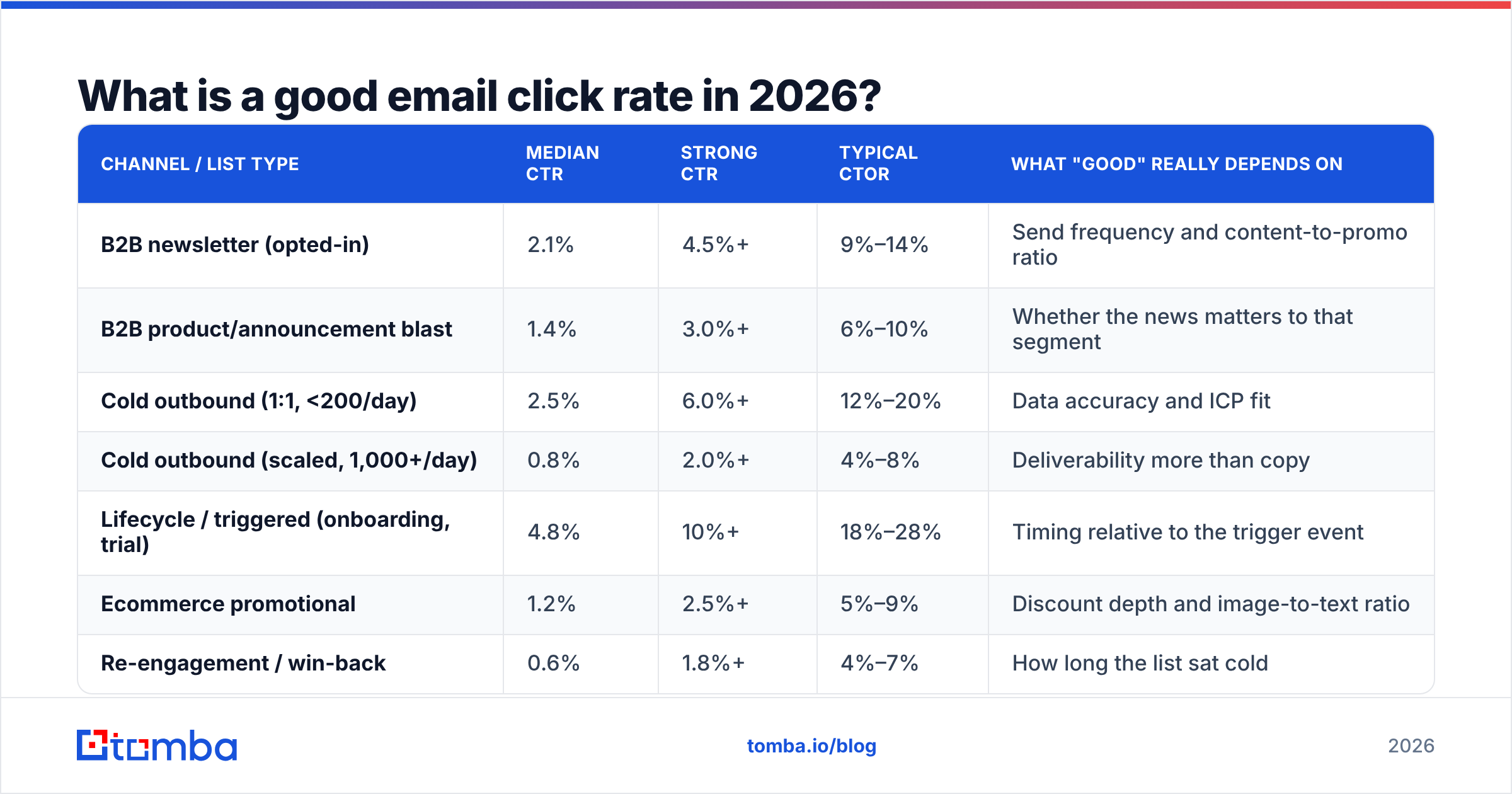
Depends on the channel and the industry. Here are the ranges we see reported consistently across ESP benchmark studies and platform data:
| Channel / list type | Median CTR | Strong CTR | Typical CTOR | What "good" really depends on |
|---|---|---|---|---|
| B2B newsletter (opted-in) | 2.1% | 4.5%+ | 9%–14% | Send frequency and content-to-promo ratio |
| B2B product/announcement blast | 1.4% | 3.0%+ | 6%–10% | Whether the news matters to that segment |
| Cold outbound (1:1, <200/day) | 2.5% | 6.0%+ | 12%–20% | Data accuracy and ICP fit |
| Cold outbound (scaled, 1,000+/day) | 0.8% | 2.0%+ | 4%–8% | Deliverability more than copy |
| Lifecycle / triggered (onboarding, trial) | 4.8% | 10%+ | 18%–28% | Timing relative to the trigger event |
| Ecommerce promotional | 1.2% | 2.5%+ | 5%–9% | Discount depth and image-to-text ratio |
| Re-engagement / win-back | 0.6% | 1.8%+ | 4%–7% | How long the list sat cold |
Two caveats before you benchmark yourself against this.
First, industry variance is enormous. Government, education, and nonprofit lists routinely clear 3%–5% CTR because subscribers self-selected hard. Insurance, legal, and real estate sit at the bottom, often under 1%. If you're in a low-CTR vertical, comparing to a cross-industry median tells you nothing useful. Mailchimp's published benchmark data breaks this down by vertical and is worth reading before you panic about a 1.1% number.
Second, list size is inversely correlated with CTR. A 500-person list of hand-picked prospects will beat a 50,000-person list on rate every single time. It will also produce fewer total clicks. Rate is a quality signal, not a volume signal — don't optimize rate at the expense of pipeline.
Why is your click rate lower than the benchmark?#
Run through these in order. Each one is cheaper to fix than the one after it, and most teams start at step 5.
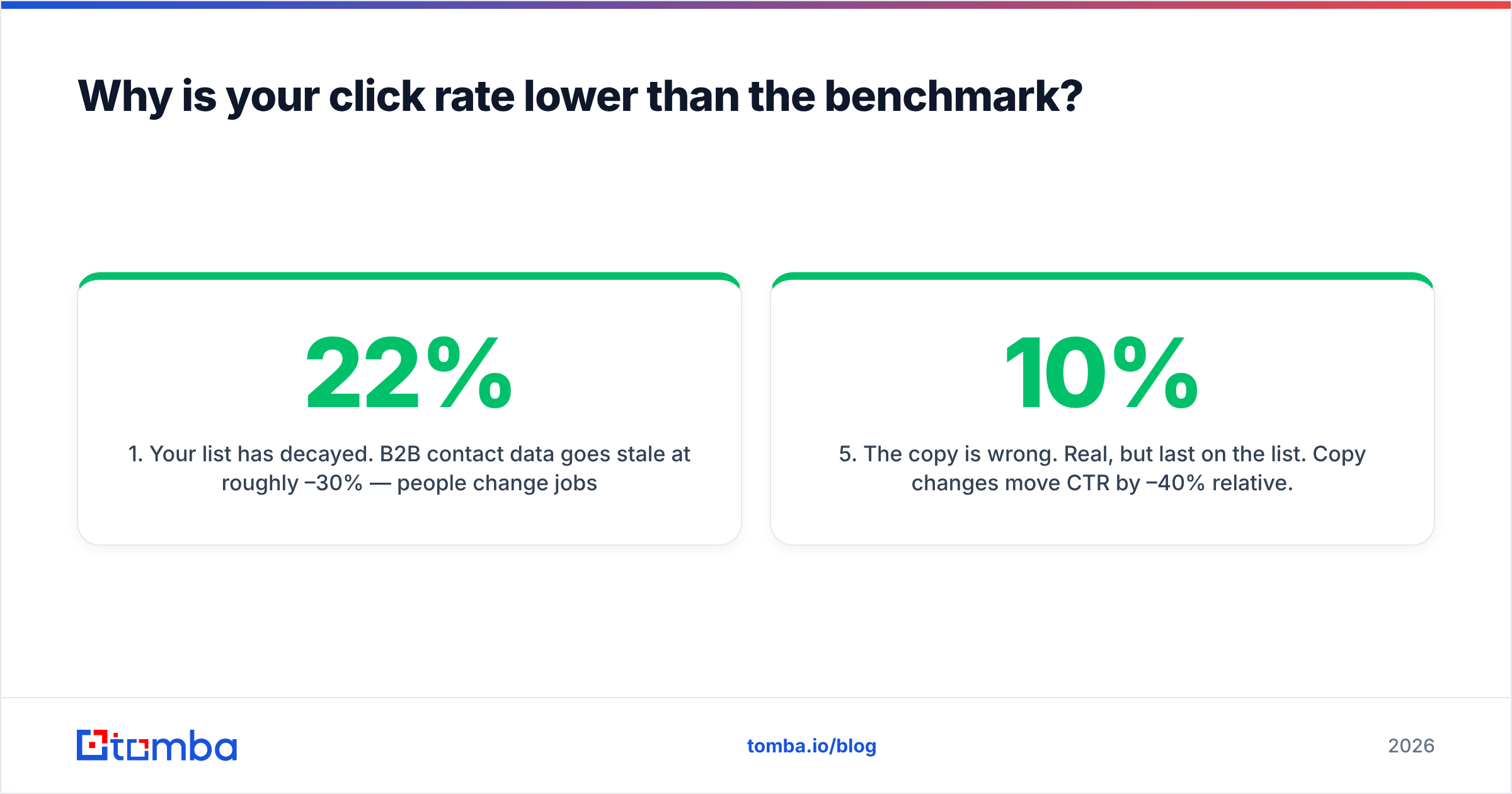
Your list has decayed. B2B contact data goes stale at roughly 22%–30% per year — people change jobs, companies rebrand, mailboxes get deactivated. Every dead address is a guaranteed zero in your denominator. Run the list through an email verifier before every major campaign, not once a quarter.
You're sending to the wrong segment. A CTO does not click a pricing page link. A VP of RevOps does not click a technical whitepaper on Kubernetes. Segment mismatch shows up as normal opens with terrible clicks — high CTR-to-CTOR gap.
Deliverability is quietly degrading. If a growing share of your mail lands in Promotions or Spam, opens hold up (people still scan those folders) while clicks collapse. Check your SPF record and DMARC alignment first. Google and Yahoo's bulk-sender requirements made this non-negotiable, and their enforcement thresholds tightened again for high-volume senders.
You have too many calls to action. Three links, three outcomes, split attention, fewer clicks on the one that matters. Single-CTA emails consistently outperform multi-CTA on primary-link clicks.
The copy is wrong. Real, but last on the list. Copy changes move CTR by 10%–40% relative. List and segment changes move it by 200%–400%.
How do you calculate and interpret click rate correctly?#
The mechanics matter more than most teams admit. Four decisions that change your number without changing your performance:
- Unique vs. total clicks. Unique counts one click per recipient. Total counts every click, including the person who opened your email four times. Total clicks can exceed 100% of delivered — always report unique for benchmarking.
- Bot click filtering. Corporate security gateways (Mimecast, Proofpoint, Microsoft Defender) pre-click every link in an email to scan it. On enterprise-heavy lists this inflates CTR by 5%–20%. If your CTR is high but reply and conversion rates are flat, you're measuring robots. Most modern ESPs offer a "filter machine clicks" toggle — turn it on.
- Link tracking domains. If you're using a shared tracking domain from your ESP, you inherit every other sender's reputation on it. Set up a custom tracking domain on your own subdomain.
- Attribution window. A 7-day window and a 30-day window produce meaningfully different numbers on B2B lists, where buyers revisit emails weeks later. Pick one and never change it mid-analysis.
One more: strip UTM-heavy, obviously-tracked URLs where you can. A link that reads go.yourdomain.com/x7f2q9 looks like marketing. A clean, readable destination looks like a colleague sharing something.
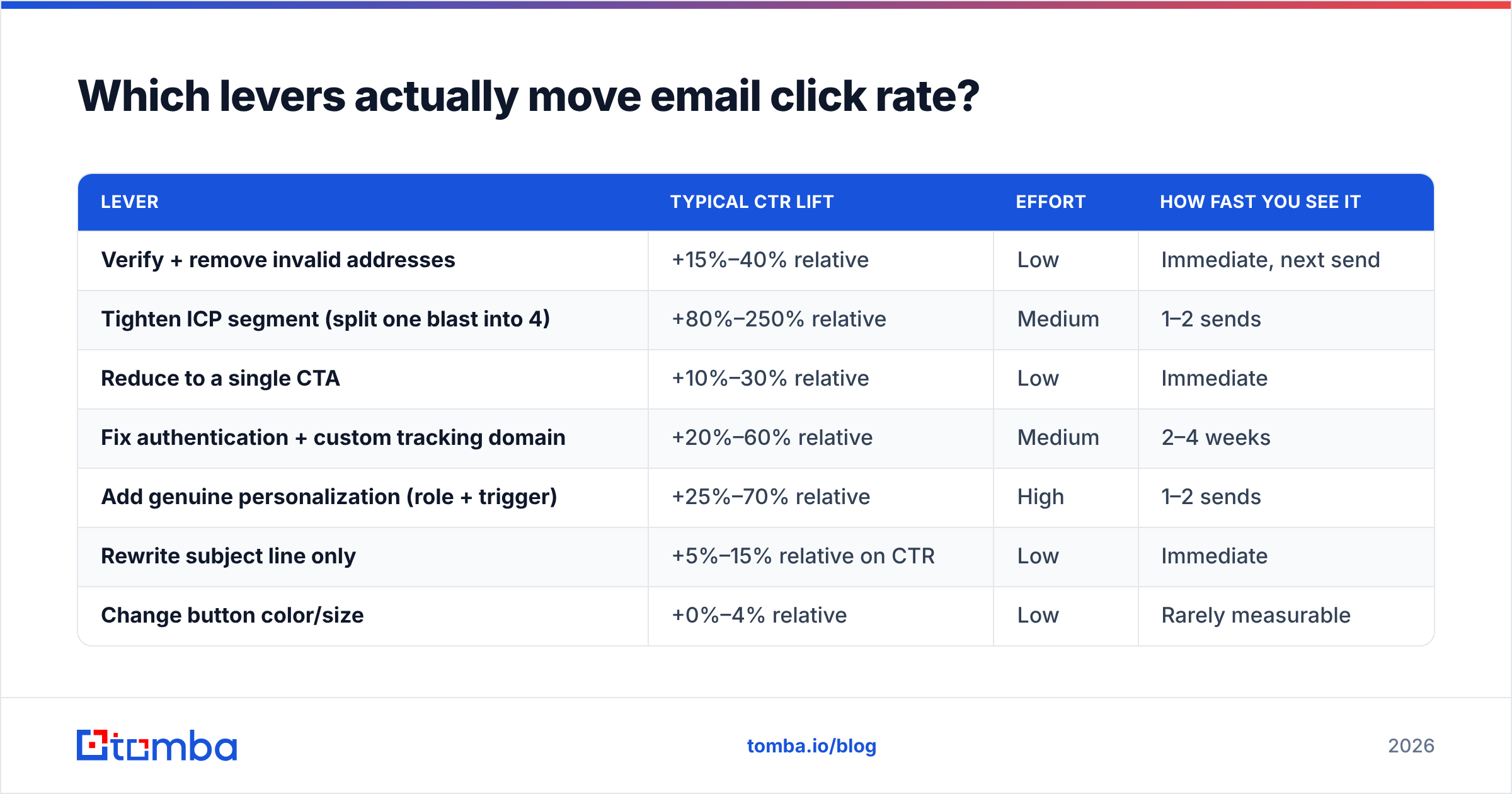
Which levers actually move email click rate?#
Here's the honest hierarchy, ranked by effect size rather than by how fun they are to work on.
| Lever | Typical CTR lift | Effort | How fast you see it |
|---|---|---|---|
| Verify + remove invalid addresses | +15%–40% relative | Low | Immediate, next send |
| Tighten ICP segment (split one blast into 4) | +80%–250% relative | Medium | 1–2 sends |
| Reduce to a single CTA | +10%–30% relative | Low | Immediate |
| Fix authentication + custom tracking domain | +20%–60% relative | Medium | 2–4 weeks |
| Add genuine personalization (role + trigger) | +25%–70% relative | High | 1–2 sends |
| Rewrite subject line only | +5%–15% relative on CTR | Low | Immediate |
| Change button color/size | +0%–4% relative | Low | Rarely measurable |
The pattern: the further upstream you fix things, the bigger the effect. Button color is the most-tested and least-impactful variable in email marketing.

Personalization that actually works is worth expanding on, because "Hi {{first_name}}" hasn't moved a needle since 2015. What moves clicks in 2026:
- Role-specific framing — the same product benefit stated in the language of that job function. A security lead cares about audit trails; the CFO who signs for it cares about seat cost.
- Trigger-based timing — sent within 72 hours of a funding round, a job posting, a leadership change, or a tech-stack change on their site.
- Named-account specificity — referencing something verifiable about their company, not a generic industry observation.
- Relevant proof — a customer in their vertical at their approximate company size, not your biggest logo.
- A link that matches the ask — if the email pitches a 12-minute walkthrough, the link should go to the walkthrough, not your homepage.
Points 1 through 4 all depend on data you have to actually possess. That's why contact enrichment sits underneath click-rate work rather than beside it — you can't personalize on a field you don't have.
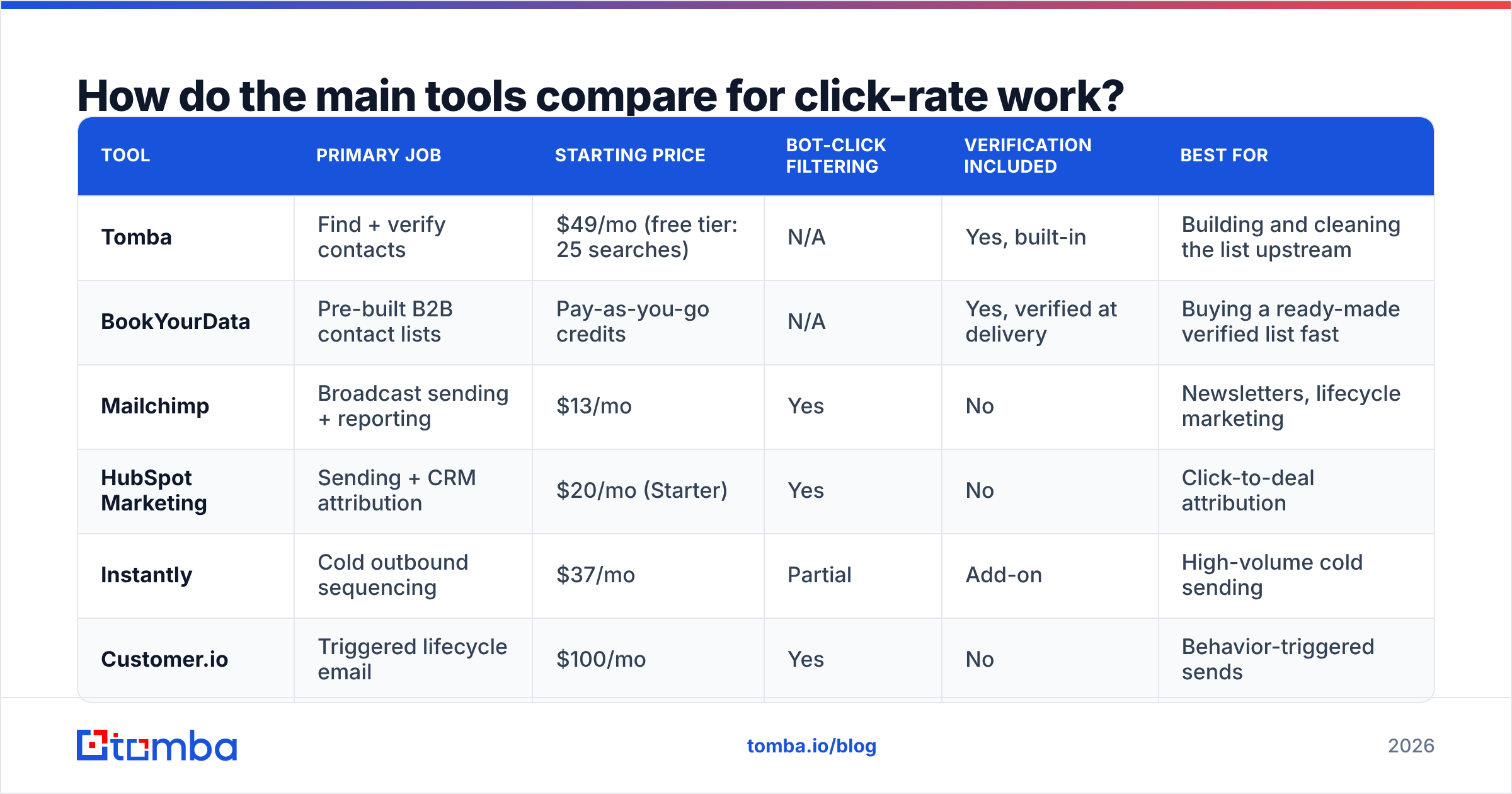
How do the main tools compare for click-rate work?#
No single platform covers list hygiene, sending, and analytics well. Here's how the common stack pieces stack up for the specific job of improving CTR:
| Tool | Primary job | Starting price | Bot-click filtering | Verification included | Best for |
|---|---|---|---|---|---|
| Tomba | Find + verify contacts | $49/mo (free tier: 25 searches) | N/A | Yes, built-in | Building and cleaning the list upstream |
| BookYourData | Pre-built B2B contact lists | Pay-as-you-go credits | N/A | Yes, verified at delivery | Buying a ready-made verified list fast |
| Mailchimp | Broadcast sending + reporting | $13/mo | Yes | No | Newsletters, lifecycle marketing |
| HubSpot Marketing | Sending + CRM attribution | $20/mo (Starter) | Yes | No | Click-to-deal attribution |
| Instantly | Cold outbound sequencing | $37/mo | Partial | Add-on | High-volume cold sending |
| Customer.io | Triggered lifecycle email | $100/mo | Yes | No | Behavior-triggered sends |
The practical build for a B2B team: source and verify contacts upstream, send through whichever sequencer fits your motion, and hold your CTR analysis in one place so you're not comparing numbers calculated four different ways.
If you're sourcing contacts yourself, domain search plus verification is the cheapest CTR improvement available — you're removing guaranteed zeros from the denominator before they cost you anything. If you'd rather buy a list that arrives pre-verified, BookYourData is a solid option for teams who need volume immediately and don't want to run their own sourcing pipeline. Both approaches work; the deciding factor is usually whether you need repeatable sourcing or a one-time list.
How should you run a click-rate test that isn't noise?#
Most email A/B tests are underpowered. If your list is 2,000 people and your CTR is 2%, you have roughly 40 clicks to work with — a "20% improvement" is well inside random variance.
Rough sample-size guidance for detecting a 20% relative lift at a 2% baseline: you need about 8,000 recipients per variant. At a 5% baseline, about 3,000 per variant. Below those numbers, run the change on everyone and evaluate over 4–6 sends instead of splitting.
Practical rules:
- Test one variable per send. Subject and CTA changed together tells you nothing about either.
- Hold the send window constant. Tuesday 10am vs. Thursday 4pm is its own variable.
- Wait 72 hours before reading results. B2B click curves have a long tail; 24-hour reads systematically favor whichever variant hit inboxes during working hours.
- Segment your results. A variant can lose overall and win decisively with your best-fit accounts. That's the segment you care about.
- Track downstream. A subject line that lifts CTR while dropping reply rate has made your funnel worse, not better. Response rate is the check on click-rate vanity.
What should you do in the next 30 days?#
A concrete sequence, in the order that produces results fastest:
Week 1 — Measure honestly. Confirm whether your platform reports unique or total clicks, and whether the denominator is sends or delivers. Turn on machine-click filtering. Recalculate the last six months on the corrected basis. Your real baseline is probably lower than the one on your dashboard.
Week 2 — Clean. Run the full active list through verification. Suppress everything invalid, plus any address that hasn't opened or clicked in 180 days. Yes, your list will shrink. Your CTR, deliverability, and sender reputation will all improve, and the contacts you removed weren't going to buy.
Week 3 — Segment. Take your worst-performing broadcast and split it into three or four ICP-based versions with different framing and different destination links. Don't change the offer yet — isolate the segmentation effect.
Week 4 — Simplify and test. Cut every email to one call to action. Then, and only then, start testing copy. You'll be testing on a clean, segmented list, so the results will actually mean something.
Repeat quarterly. Contact data decays continuously, so list hygiene isn't a project — it's maintenance, like changing the oil rather than rebuilding the engine.
Common questions about email click rate#
Is a 1% click rate bad? Not necessarily. In insurance, legal, or real estate on a large list, 1% is around median. On a 300-person hand-built prospect list, 1% means something is broken.
Should I optimize for CTR or CTOR? Track both, act on the gap. Low CTR with healthy CTOR means a list or deliverability problem. Healthy CTR with low CTOR is unusual and typically means bot clicks are inflating your CTR.
Do images hurt click rate? Image-heavy emails render worse in dark mode, load slower on mobile, and trip more spam filters. Text-forward emails with one or two supporting images generally outperform in B2B. In cold outbound, plain text wins almost every time.
Does removing tracking help? It can. Some senders see reply rates rise when they drop click tracking entirely on 1:1 outbound, because tracking pixels and rewritten links are spam-filter signals. You lose the metric to gain the outcome — a reasonable trade on low-volume, high-value sequences.
Start where the leverage is#
Your click rate ceiling is set before you write a word. If a third of your list can't receive mail and another third doesn't fit your ICP, no subject line rescues that send.
Build the list right first. Tomba's Email Finder sources verified professional email addresses by domain, name, or company, with verification built into the same workflow — so the contacts entering your sequences are real, current, and matched to the accounts you actually want. The free tier gives you 25 searches to test the data quality against a list you already have; paid plans start at $49/mo, with full Tomba pricing laid out per tier.
Clean the denominator, then optimize the numerator. That order is the whole game.
Related guides#
Ready to find emails that actually work?
Join 150,000+ professionals who stopped guessing and started sending. Free credits on signup — no credit card required.
Get the Tomba newsletter
Practical outbound tactics and product updates — once every two weeks.
About the author