Email Closers That Actually Get Replies: 2026 Guide
Your last line does more work than your subject line and gets a fraction of the attention. Here's what separates email closers that book meetings from the ones that get ignored.
TL;DR
- An email closer is the last 1–2 lines of your email — the ask plus the sign-off. It carries more weight than the subject line for reply rate, because it's the only part that tells the reader what to physically do next.
- Soft, open-ended closers ("Let me know your thoughts", "Would love to connect") underperform because they require the reader to invent the next step. Specific, low-cost asks outperform them consistently.
- The three closer families that work: the single-question close, the interest close, and the permission close. Everything else is decoration.
- Calendar links in a first-touch email suppress replies. Save them for after someone says yes.
- Your closer can't save a bad list. Bounces and unverified contacts kill more campaigns than weak copy ever will.
What Is an Email Closer?#
An email closer is the final sentence or two before your sign-off — the part that converts attention into action. It's usually a question, sometimes a statement, occasionally a permission request. It is not "Best regards, Sam."
Think of it like the end of a phone call. Everything before it was context. The closer is the moment where you either say "I'll call you Thursday at 2" or you say "well, let me know" and hang up hoping. One of those produces a Thursday call.
In cold outreach, the closer does three jobs at once:
- Defines the next action. The reader should never have to decide what "responding" means.
- Sets the cost of replying. A yes/no question costs three seconds. "Would you be open to a 30-minute discovery call?" costs a calendar audit.
- Signals confidence without pressure. Desperate closers ("Please let me know either way!") read as low-status and get skipped.
Most reps spend an hour on the subject line and eleven seconds on the closer. That's backwards. The subject line earns the open; the closer earns the response rate.
Why Do Most Email Closers Fail?#
Because they hand the work back to the recipient.
"Let me know your thoughts" asks a stranger to compose an original response about a product they just learned exists. That's a writing assignment, not a reply. Meanwhile "Worth a look, or is this not a priority this quarter?" is a yes/no — and even the "no" is useful, because it clears your pipeline.
Here are the specific failure patterns, ranked by how often they show up in audits:
- The vague invitation. "Happy to chat if you're interested." Interested in what? Chatting when? The reader has to build the meeting in their head before they can accept it.
- The double ask. "Are you the right person, and if so do you have time next week?" Two decisions in one sentence. The reader defers both.
- The premature calendar link. Dropping a Calendly URL in email one assumes a relationship that doesn't exist yet. It also converts a reply into a booking action, which is a much higher bar.
- The apology close. "Sorry to bother you — I know you're busy." You've just told them this email wasn't worth their time. They'll believe you.
- The fake deadline. "Let me know by Friday." Nobody is on your Friday.
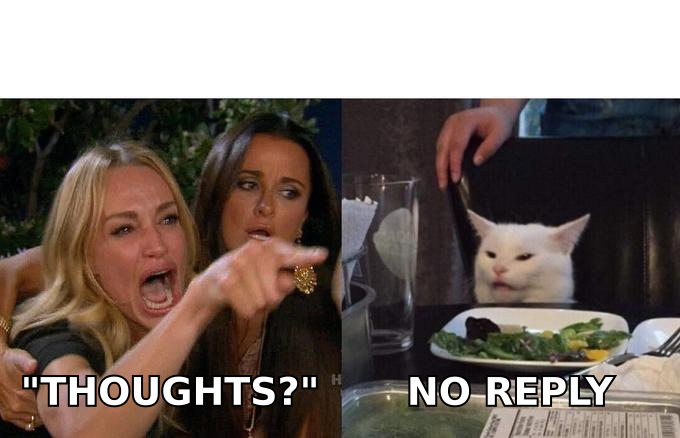
The through-line: every failing closer moves cognitive load from the sender to the reader. Every winning closer does the opposite.
Which Email Closers Actually Work in 2026?#
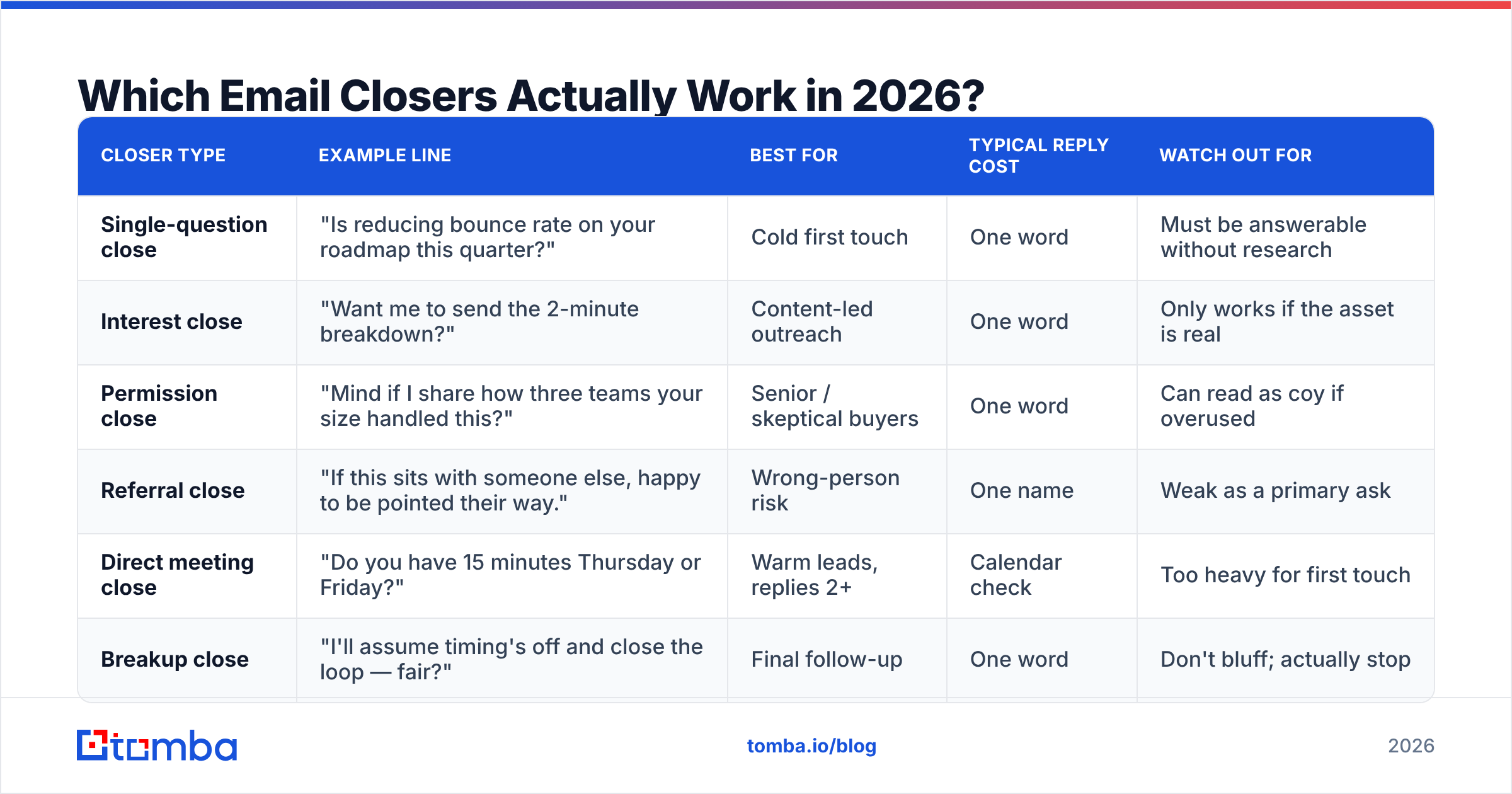
There are three closer families worth memorizing. Everything else is a variation.
| Closer type | Example line | Best for | Typical reply cost | Watch out for |
|---|---|---|---|---|
| Single-question close | "Is reducing bounce rate on your roadmap this quarter?" | Cold first touch | One word | Must be answerable without research |
| Interest close | "Want me to send the 2-minute breakdown?" | Content-led outreach | One word | Only works if the asset is real |
| Permission close | "Mind if I share how three teams your size handled this?" | Senior / skeptical buyers | One word | Can read as coy if overused |
| Referral close | "If this sits with someone else, happy to be pointed their way." | Wrong-person risk | One name | Weak as a primary ask |
| Direct meeting close | "Do you have 15 minutes Thursday or Friday?" | Warm leads, replies 2+ | Calendar check | Too heavy for first touch |
| Breakup close | "I'll assume timing's off and close the loop — fair?" | Final follow-up | One word | Don't bluff; actually stop |
Notice the pattern: the strongest closers are all answerable in a single word. That's the design constraint. If your closer can't be answered with "yes," "no," "send it," or a name, rewrite it.
The single-question close#
This is the workhorse. One question, tied to a problem the prospect already has, answerable without opening another tab.
"Is inbound lead quality something your team is actively working on this quarter, or is that a next-year problem?"
The "or" construction matters. It gives the reader a socially acceptable exit, which paradoxically increases response — people reply more readily when saying no is easy.
The interest close#
Instead of asking for time, ask for permission to send value.
"I put together a teardown of how your competitors structure their outbound. Want it?"
Two-character replies ("yes") are extremely common here. Once you've got a reply, the thread is alive and the meeting ask lands far better on message two.
The permission close#
For VPs and above, who get 200 emails a day and have well-trained delete reflexes.
"Mind if I show you the one number that changed for a team in your position?"
This works because it inverts the power dynamic. You're asking for permission rather than time, and permission is cheap.
How Do Email Closers Differ by Sequence Stage?#
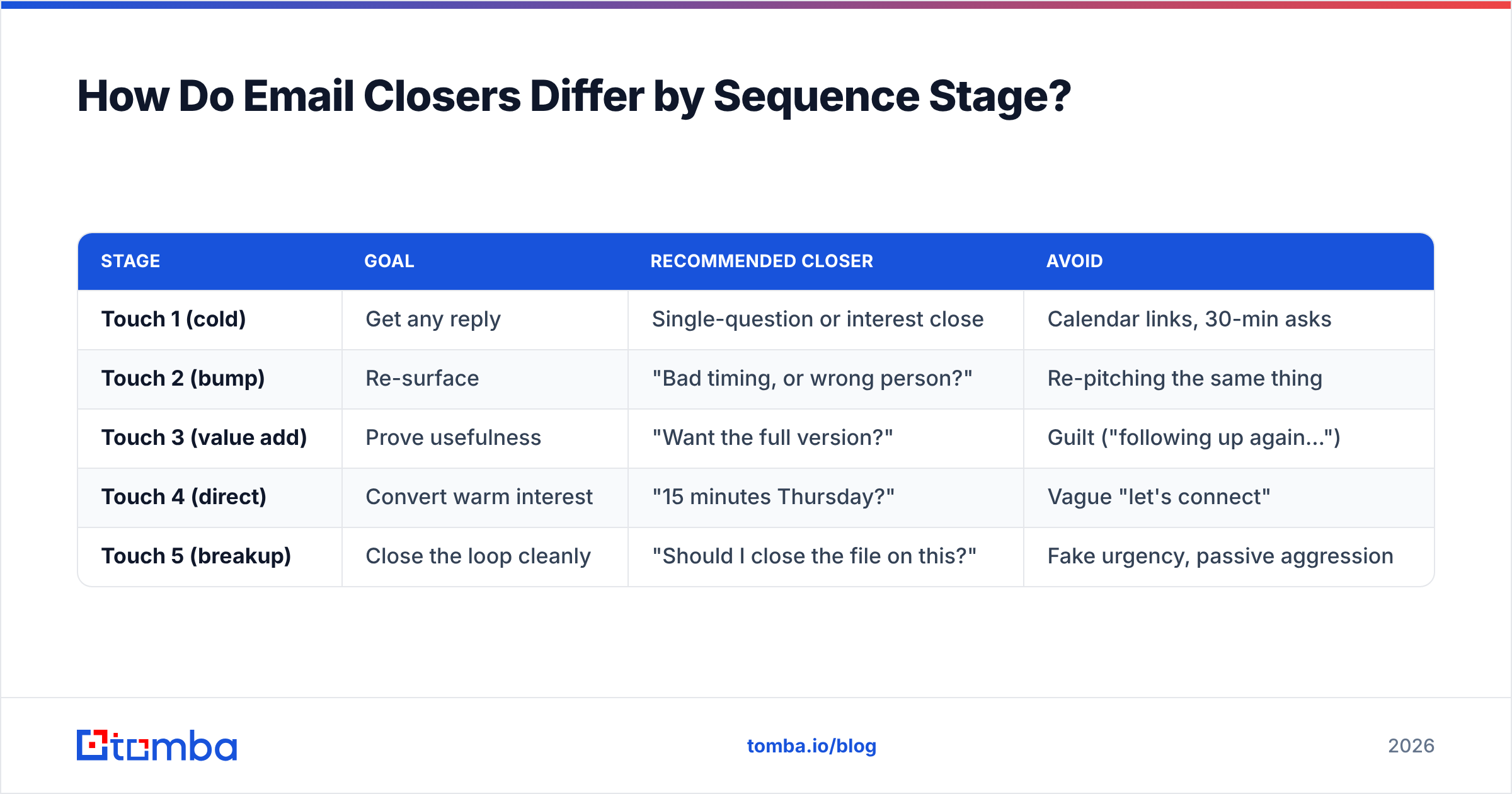
A closer that works on touch one is wrong on touch four. The ask should escalate as the relationship warms, and de-escalate if it doesn't.
| Stage | Goal | Recommended closer | Avoid |
|---|---|---|---|
| Touch 1 (cold) | Get any reply | Single-question or interest close | Calendar links, 30-min asks |
| Touch 2 (bump) | Re-surface | "Bad timing, or wrong person?" | Re-pitching the same thing |
| Touch 3 (value add) | Prove usefulness | "Want the full version?" | Guilt ("following up again…") |
| Touch 4 (direct) | Convert warm interest | "15 minutes Thursday?" | Vague "let's connect" |
| Touch 5 (breakup) | Close the loop cleanly | "Should I close the file on this?" | Fake urgency, passive aggression |
The breakup email is the most underrated slot in the sequence. It routinely outperforms touches two and three, because it triggers loss aversion and asks for the cheapest possible reply. Just don't lie — if you say you're closing the file, close the file. Re-engaging three weeks later after a "final email" is how you get marked as spam.
Does the Sign-Off Itself Matter?#
Less than people think, but not zero.
Research aggregated across large email datasets consistently puts gratitude-based sign-offs at the top: "Thanks in advance," "Thanks," and "Appreciate it" outperform "Best," "Regards," and "Sincerely." The effect is real but modest — a handful of percentage points, not a transformation.
What matters more:
- Use a real first name. No "Sales Team," no full formal name block.
- Keep the signature to three lines. Name, role, company. Every extra link is a deliverability liability and a distraction from your one ask. A email signature generator helps you strip it down without losing the essentials.
- Skip the banner image. Image-heavy signatures raise spam scores and break in dark mode.
- Don't stack a P.S. with a second ask. One P.S. reinforcing the same ask is fine. Two asks is zero asks.
The order of operations is: ask, sign-off, signature. If your reader has to scroll past a 12-line signature to find the question, your closer failed regardless of how it was worded.
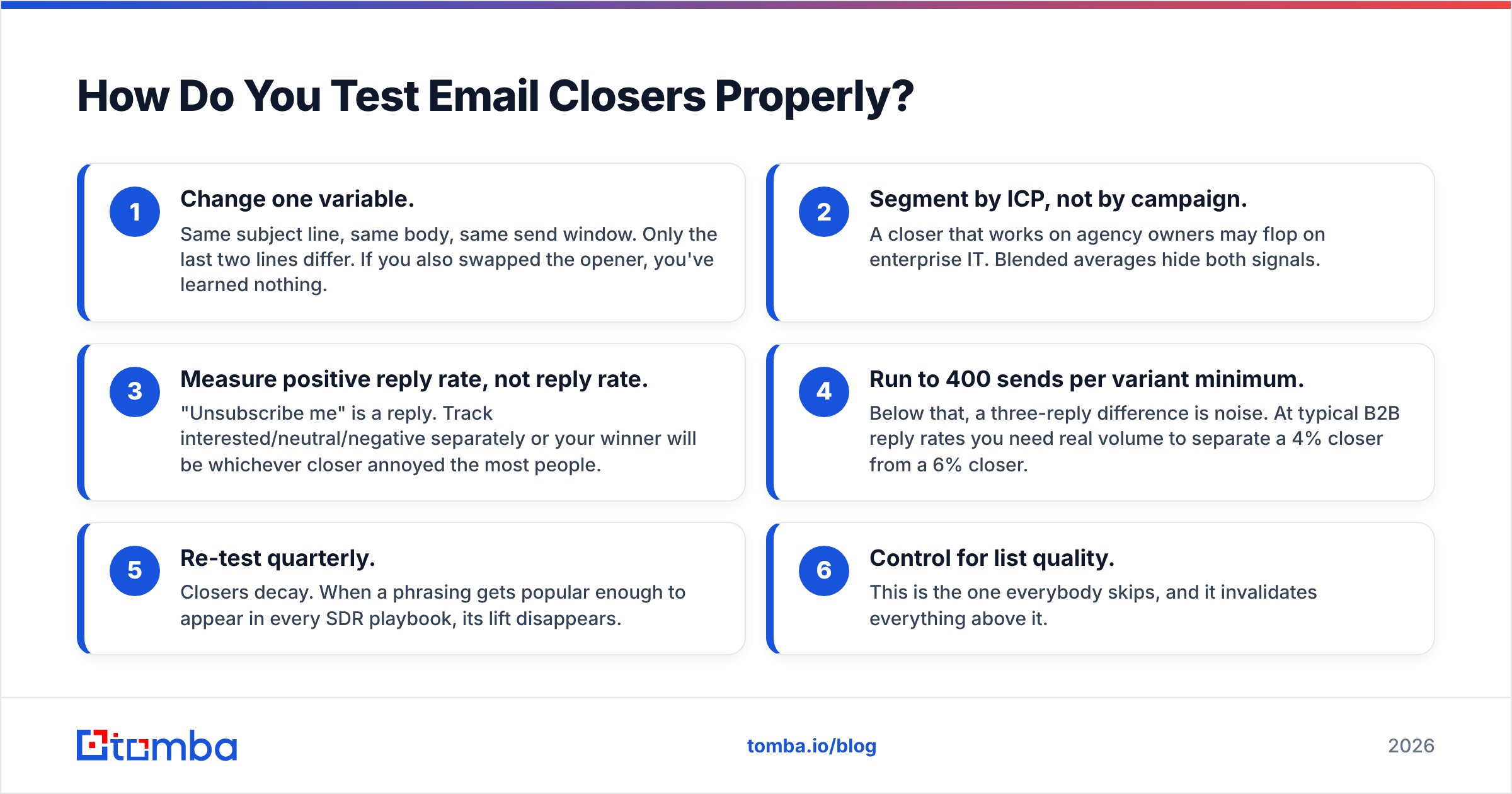
How Do You Test Email Closers Properly?#
Most closer "testing" is anecdote collection. Here's the version that produces usable answers.
- Change one variable. Same subject line, same body, same send window. Only the last two lines differ. If you also swapped the opener, you've learned nothing.
- Segment by ICP, not by campaign. A closer that works on agency owners may flop on enterprise IT. Blended averages hide both signals.
- Measure positive reply rate, not reply rate. "Unsubscribe me" is a reply. Track interested/neutral/negative separately or your winner will be whichever closer annoyed the most people.
- Run to 400 sends per variant minimum. Below that, a three-reply difference is noise. At typical B2B reply rates you need real volume to separate a 4% closer from a 6% closer.
- Re-test quarterly. Closers decay. When a phrasing gets popular enough to appear in every SDR playbook, its lift disappears.
- Control for list quality. This is the one everybody skips, and it invalidates everything above it.
That last point deserves its own section.
Why Does List Quality Beat Closer Copy?#
Because a perfect closer sent to a dead mailbox is a bounce.
If 12% of your list bounces, your measured reply rate is depressed across every variant — and worse, your sender reputation degrades until the emails that do land start hitting the promotions tab or spam. At that point you're A/B testing closers on a channel that's already broken. You'll conclude "nothing works," when the actual problem is upstream.
The sequence that makes closer testing meaningful:
- Build the list from verified sources. Scraped contact pages and purchased CSVs carry bounce rates north of 20%. A proper email finder that returns confidence scores gives you a baseline you can actually trust.
- Verify before the first send. Run the list through an email verifier and drop anything unknown or risky. Catch-all domains need their own handling — a catch-all verifier tells you which ones are safe to send to instead of guessing.
- Check your sending setup. SPF, DKIM, DMARC. Google and Yahoo's bulk-sender requirements have been enforced since 2024 and non-compliant senders get filtered regardless of how good the copy is. Google's own sender guidelines are the authoritative reference.
- Then, and only then, test closers. With bounces under 2% and authentication clean, a reply-rate difference between variants is signal.
Reviewers on G2 consistently flag data accuracy — not feature count — as the differentiator between lead tools that work and ones that get churned after a quarter. That matches what shows up in campaign audits: teams rarely lose to copy. They lose to email deliverability and stale data.
What Are the Best Email Closer Templates to Steal?#
Copy these, then rewrite them in your own voice. Templates used verbatim by 4,000 SDRs stop working fast.
Cold, problem-led:
"Is [specific problem] something you're actively fixing this quarter, or is it further down the list?"
Cold, curiosity-led:
"Want the 90-second version of how [similar company] handled this?"
Cold, senior buyer:
"Worth two minutes of your time, or should I go away?"
Bump (touch 2):
"Floating this back up — bad timing, or wrong person to ask?"
Value add (touch 3):
"No ask here. If it's useful, the full breakdown is yours — just say the word."
Warm, post-reply:
"Thursday 10am or Friday 2pm — either work?"
Breakup:
"I'll take the silence as a no and close this out. If that's wrong, one word and I'll pick it back up."
Referral catch:
"If this belongs with someone else on your team, happy to be pointed in the right direction."
For a broader library organized by scenario, the cold email templates collection covers full-email structures rather than just closing lines. And if you want a fast second opinion on phrasing, HubSpot's sales email research is a reasonable neutral benchmark for what's currently landing.
Common Questions About Email Closers#
Should you ever use "Looking forward to hearing from you"? No. It's a statement about your feelings, not an ask. It ends the email without giving the reader anything to act on. Replace it with a question.
Is "Thoughts?" a good closer? It's better than nothing and worse than a real question. It's cheap to answer but vague about what you're asking for. Use it only when the body already framed a specific yes/no decision.
How long should a closer be? One sentence. Two if the second is a sign-off. If your closing paragraph runs four lines, you've buried the ask inside it.
Do emojis in closers help? In B2B, no. They read as consumer marketing, and some filters weight them. Skip them.
Should the closer be bold or highlighted? No. Formatting tricks in plain-text outreach signal automation. Keep it visually identical to the rest of the email.
Does the closer change for LinkedIn versus email? Yes — LinkedIn messages tolerate shorter, blunter asks because the medium is more conversational. Email closers need slightly more context because there's no profile sitting next to the message.
What Should You Do Next?#
Pick one closer family, apply it to your entire active sequence, and hold everything else constant for 30 days. Track positive replies, not total replies. Then swap in a second family and compare. Two quarters of that discipline will teach you more about your ICP than any listicle of 47 closing lines.
But do the boring part first. Before you rewrite a single line, confirm your contacts are real and your domain is authenticated — otherwise you're optimizing copy for emails nobody receives. Start by building the list correctly with the Tomba Email Finder: search by domain, name, or company, get confidence-scored results, and verify in the same workflow before your first send. The free tier covers 25 searches a month if you want to test the data quality against your current provider, and Tomba pricing starts at $49/mo for Starter when you're ready to run real volume.
Good closers get replies. Verified lists make those replies possible.
Related guides#
Ready to find emails that actually work?
Join 150,000+ professionals who stopped guessing and started sending. Free credits on signup — no credit card required.
Get the Tomba newsletter
Practical outbound tactics and product updates — once every two weeks.
About the author