Email Copywriting Best Practices: The 2026 Field Guide
Most cold emails fail on the copy, not the list. Here are the email copywriting best practices that still earn replies in 2026 — length, structure, subject lines, CTAs, and the habits quietly killing your reply rate.
TL;DR
- Reply rate is the only metric email copy controls. Opens are noise, and since Apple Mail Privacy Protection they are partly fabricated noise.
- The winning shape is boringly consistent: 50–125 words, one idea, one ask, fifth-grade reading level, no attachments, no images, no links in the first send.
- Personalization only works when it's observable and specific. "I saw you're scaling" is worse than no personalization at all, because it signals a template.
- Frameworks (PAS, BAB, QVC) are scaffolding, not scripts. Pick one per campaign and hold it constant so your A/B tests mean something.
- Great copy on a bad list still fails. Verify deliverability and contact accuracy before you blame the words.
Why do most cold emails fail on the copy?#
Because they're written for the sender, not the reader.
Open any underperforming sequence and you'll find the same three tells: a first line about the sender's company, a middle paragraph explaining a product nobody asked about, and a closing question that requires a 30-minute calendar commitment from a stranger. The copy isn't badly written in a grammatical sense. It's badly aimed.
The reader is scanning on a phone, in a preview pane, between meetings. They give you roughly two seconds to answer one question: is this about me or about you? Every email copywriting best practice below is downstream of that question.
There's a second failure mode worth naming early. A lot of "copy problems" are actually data problems. If 18% of your list bounces, your sender reputation tanks, your emails land in Promotions or Spam, and your reply rate collapses regardless of how good the writing is. Run your list through an email verifier before you spend a week rewriting subject lines. Diagnose in the right order.
What are the core email copywriting best practices?#
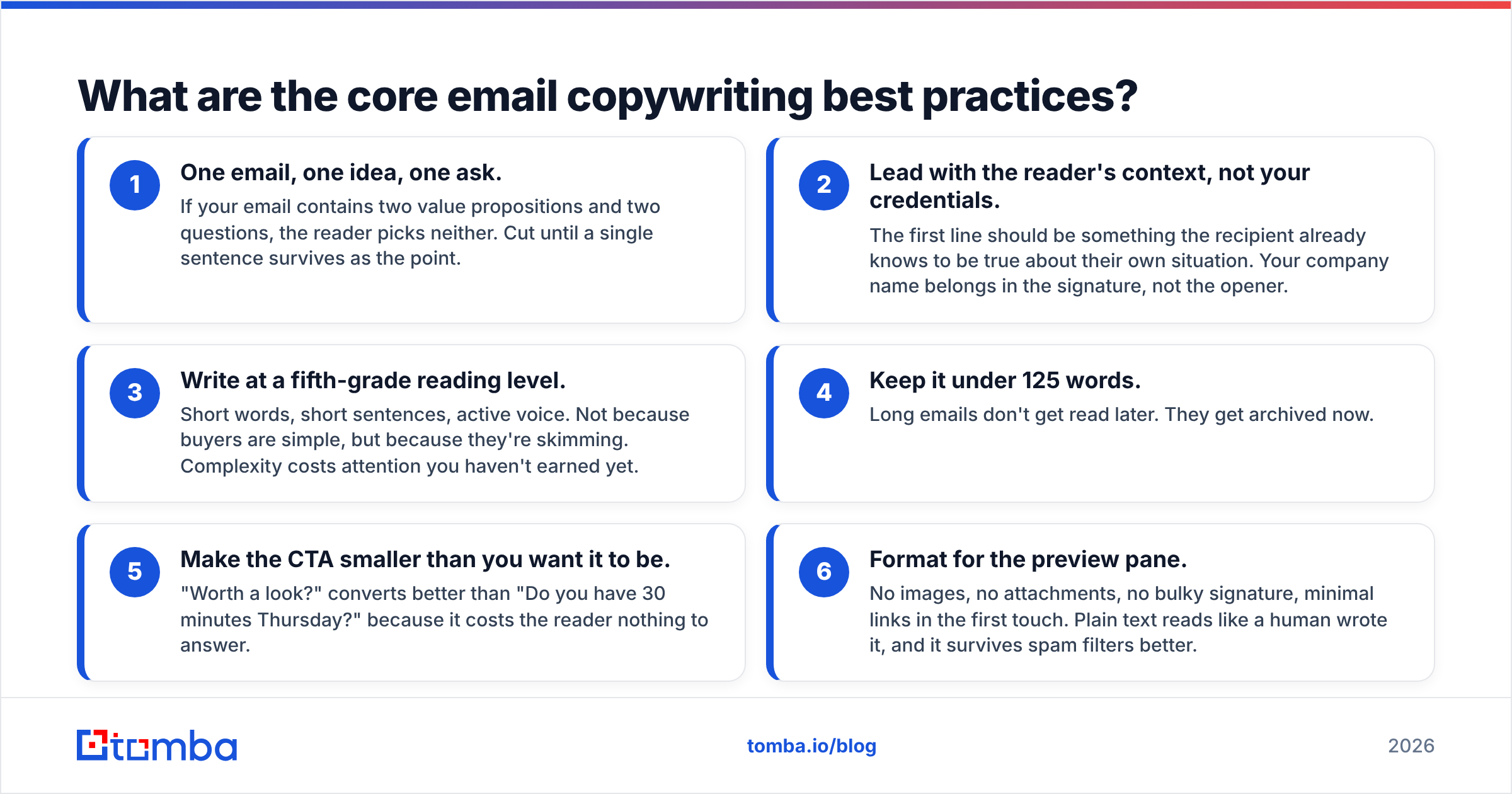
These six do most of the work. Everything else is refinement.
- One email, one idea, one ask. If your email contains two value propositions and two questions, the reader picks neither. Cut until a single sentence survives as the point.
- Lead with the reader's context, not your credentials. The first line should be something the recipient already knows to be true about their own situation. Your company name belongs in the signature, not the opener.
- Write at a fifth-grade reading level. Short words, short sentences, active voice. Not because buyers are simple, but because they're skimming. Complexity costs attention you haven't earned yet.
- Keep it under 125 words. Long emails don't get read later. They get archived now.
- Make the CTA smaller than you want it to be. "Worth a look?" converts better than "Do you have 30 minutes Thursday?" because it costs the reader nothing to answer.
- Format for the preview pane. No images, no attachments, no bulky signature, minimal links in the first touch. Plain text reads like a human wrote it, and it survives spam filters better.

That escalation is the whole game. The jump from "Hi {FNAME}" to a real trigger line is where reply rates move, and the jump from a trigger line to verified, correctly-attributed contact data is where the campaign stops leaking.
How long should a cold email actually be?#
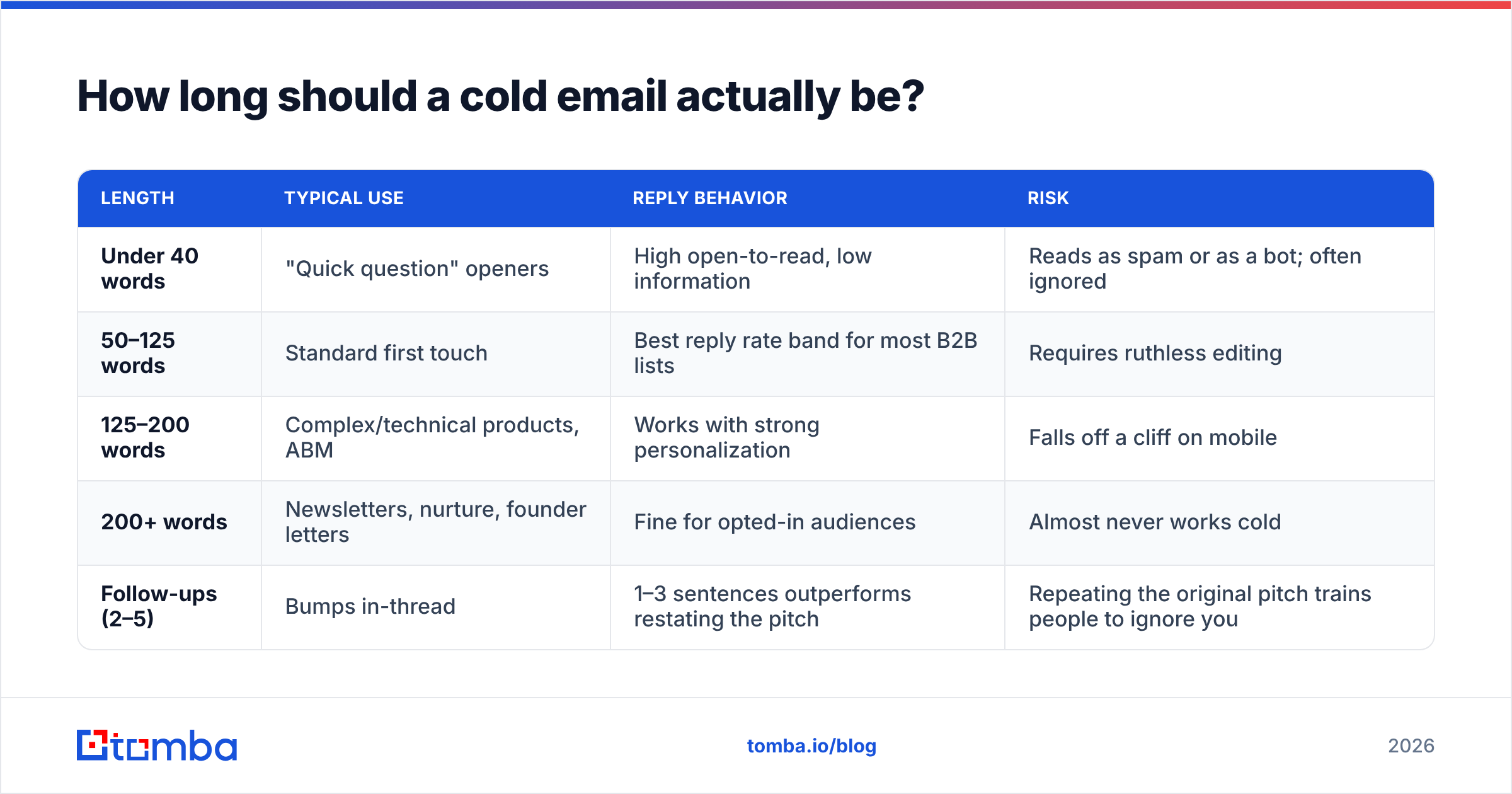
Short, but not so short it reads as lazy. Here's how the common length bands perform in practice for B2B outbound:
| Length | Typical use | Reply behavior | Risk |
|---|---|---|---|
| Under 40 words | "Quick question" openers | High open-to-read, low information | Reads as spam or as a bot; often ignored |
| 50–125 words | Standard first touch | Best reply rate band for most B2B lists | Requires ruthless editing |
| 125–200 words | Complex/technical products, ABM | Works with strong personalization | Falls off a cliff on mobile |
| 200+ words | Newsletters, nurture, founder letters | Fine for opted-in audiences | Almost never works cold |
| Follow-ups (2–5) | Bumps in-thread | 1–3 sentences outperforms restating the pitch | Repeating the original pitch trains people to ignore you |
The practical rule: draft freely, then delete every sentence that doesn't either establish relevance or make the ask. Most first drafts lose 40% of their words and gain reply rate doing it.
Which copywriting framework should you use?#
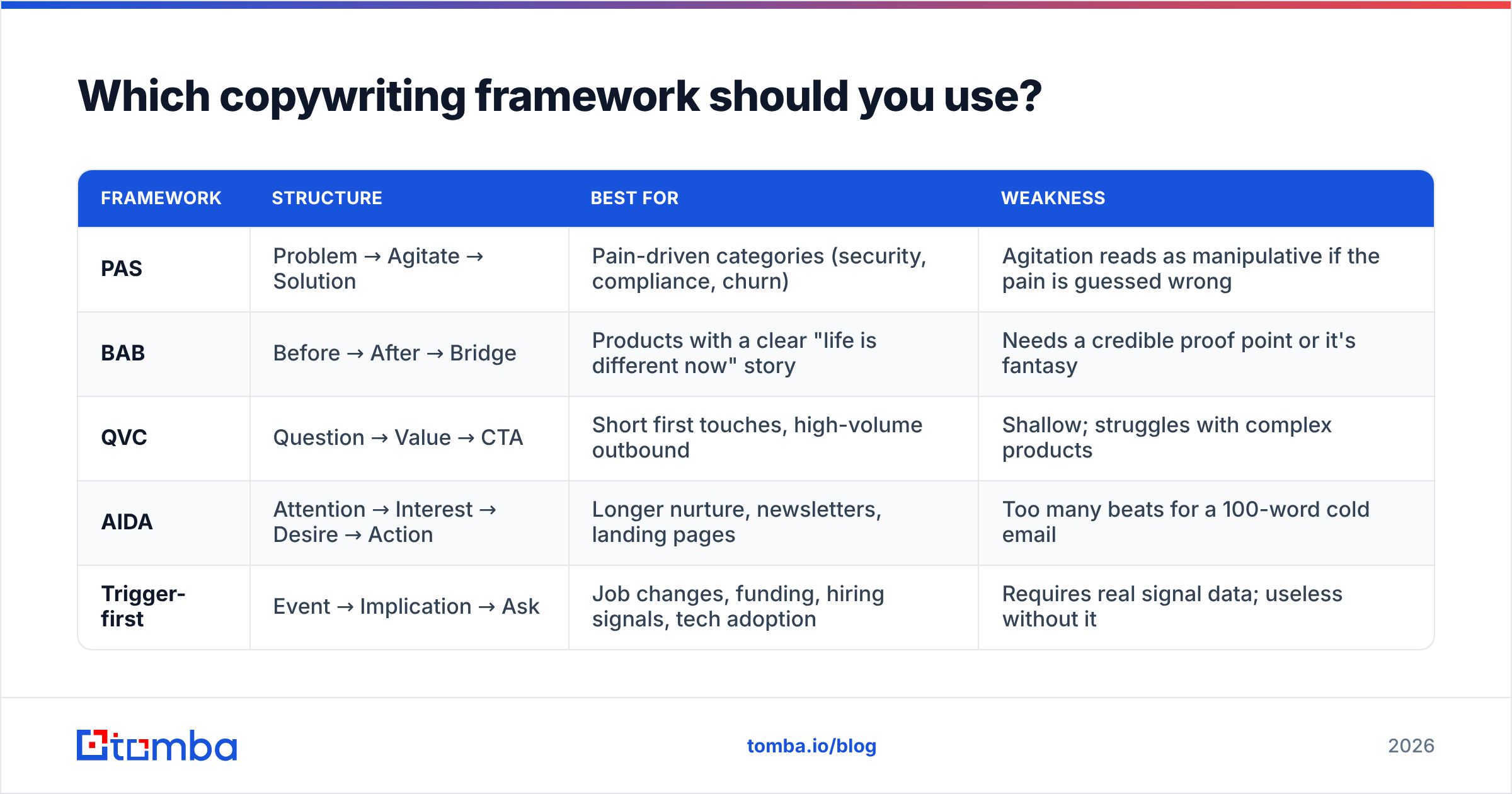
Frameworks stop you from freestyling a different structure every time, which is what makes testing impossible. Pick one per campaign, write ten emails inside it, then compare.
| Framework | Structure | Best for | Weakness |
|---|---|---|---|
| PAS | Problem → Agitate → Solution | Pain-driven categories (security, compliance, churn) | Agitation reads as manipulative if the pain is guessed wrong |
| BAB | Before → After → Bridge | Products with a clear "life is different now" story | Needs a credible proof point or it's fantasy |
| QVC | Question → Value → CTA | Short first touches, high-volume outbound | Shallow; struggles with complex products |
| AIDA | Attention → Interest → Desire → Action | Longer nurture, newsletters, landing pages | Too many beats for a 100-word cold email |
| Trigger-first | Event → Implication → Ask | Job changes, funding, hiring signals, tech adoption | Requires real signal data; useless without it |
Trigger-first is the highest-performing structure available to most outbound teams in 2026, and it's the one most teams can't run because they lack the data layer. A trigger email is only as good as the event behind it — a funding round, a new VP of Sales, a tech stack change, a hiring spree in the department you sell to.
How do you write a subject line that gets opened?#
Stop optimizing for opens and start optimizing for the right opens.
Since Apple's Mail Privacy Protection began pre-fetching images, open rates on Apple Mail traffic are inflated and unreliable. A subject line that wins on open rate and loses on reply rate is a losing subject line. Judge subject lines by replies per thousand sent.
What consistently works:
- 2–5 words. Long subject lines truncate on mobile and read like marketing.
- Lowercase or sentence case. Title Case Signals A Campaign.
- Specific nouns over adjectives. "onboarding docs" beats "an amazing opportunity."
- No brackets, no emojis, no "Re:" fakery. Faking a reply thread is the fastest way to lose trust and pick up spam complaints.
- Match the body. A curiosity-gap subject with an unrelated body produces opens and deletions.
If you're stuck, run candidates through a subject line generator to get variants fast, then cut anything that sounds like a headline rather than something a colleague would type. HubSpot's sales blog keeps a well-maintained library of real-world examples worth pattern-matching against (blog.hubspot.com/sales).
Is personalization still worth it in 2026?#
Yes, but only the kind that would be impossible to send to anyone else.
There's a spectrum. On one end: {first_name} and {company}. Every buyer has seen ten thousand of those, and merge tags now actively signal "mass send." On the other end: a sentence referencing something the recipient did, said, shipped, or hired for in the last 90 days.
The middle of that spectrum is the dangerous part. "I saw {company} is growing fast" is generic and pretends to be personal, which is worse than being plainly generic. It burns credibility in the first line.
Practical personalization sources that scale:
- Role and department changes — someone new in seat has budget and a mandate to change things
- Public hiring signals — a job posting tells you what the team is missing
- Product and content output — a changelog entry, a conference talk, a published article
- Tech stack changes — a newly adopted or dropped tool implies a workflow in flux
- Company milestones — funding, expansion, a new market
The bottleneck is usually contact-level accuracy: you find the trigger, then can't reach the right person. A domain search that returns role-mapped contacts for a company, or an author finder that resolves the person who actually wrote the piece you're referencing, closes that gap. Personalization dies at the point where you can't reach the human you researched.
What does a good cold email look like end to end?#
Here's the anatomy, annotated:
Subject: sdr onboarding
Body:
Noticed you posted two SDR roles last month, both ramping in Q3.
Most teams that hire in pairs lose the first month to list building instead of calling. We cut that to about a day for {similar company}.
Worth a look?
— Sam
Twenty-nine words in the body. Line one is an observable fact. Line two names a consequence the reader recognizes and attaches a proof point. Line three is a low-cost ask. No links, no attachment, no calendar demand, no company boilerplate.
Compare that to what most teams send: three paragraphs, a mission statement, a bulleted feature list, and a Calendly link. The second email isn't worse because it's badly written. It's worse because it asks for more than it has earned.

What kills reply rates fastest?#
In rough order of damage:
- Bad data. Hard bounces above 3% put your domain at risk. Verify before sending, every time. Check your setup with an SPF checker and a spam checker before scaling volume.
- Feature dumps. Nobody buys a feature list from a stranger. Sell the outcome, once.
- Fake familiarity. "Hope you're doing well!" and "Just circling back" are invisible at best, irritating at worst.
- The 30-minute ask. Time is the most expensive currency you can request in a first email.
- Sending to the wrong role. Beautiful copy aimed at someone with no budget is still a zero.
- Ignoring compliance. Unsubscribe handling and identification requirements aren't optional; the CAN-SPAM Act and GDPR both apply depending on your audience. Non-compliance is a legal problem and a deliverability one.
- Rewriting the whole sequence every two weeks. You never learn anything because you never hold anything constant.
How should you test and iterate?#
Change one variable at a time, and give it enough volume to mean something.
A workable cadence:
- Sample size: at least 300–500 sends per variant before you draw a conclusion. Below that you're reading noise.
- One variable: subject line or opening line or CTA. Not all three.
- Metric: replies per thousand sent, plus positive-reply rate. Track response rate as your headline number and opens as diagnostic only.
- Hold the list constant: if variant A goes to enterprise and variant B goes to SMB, you've tested segments, not copy.
- Log everything: a shared doc of what you tested and what happened compounds faster than any single clever email.
Gartner's research on B2B buying behavior is a useful sanity check here: buyers spend a small fraction of their journey with any single vendor, which is why one well-aimed email beats five insistent ones (gartner.com). Volume is not a substitute for relevance.
If you want a faster first draft to test against, a cold email AI writer or a starting email template will get you to a testable v1 in minutes. Just don't ship the AI draft unedited — it will default to the exact generic middle-of-the-spectrum personalization that kills reply rates.
What's the fastest way to improve your next campaign?#
Do these three things before you write another word:
- Verify the list. Every invalid address costs you deliverability that good copy can't buy back.
- Confirm you're emailing the right role. Copy aimed one level too low never recovers.
- Cut your best email in half. Then read it out loud. If it sounds like a person talking, send it.
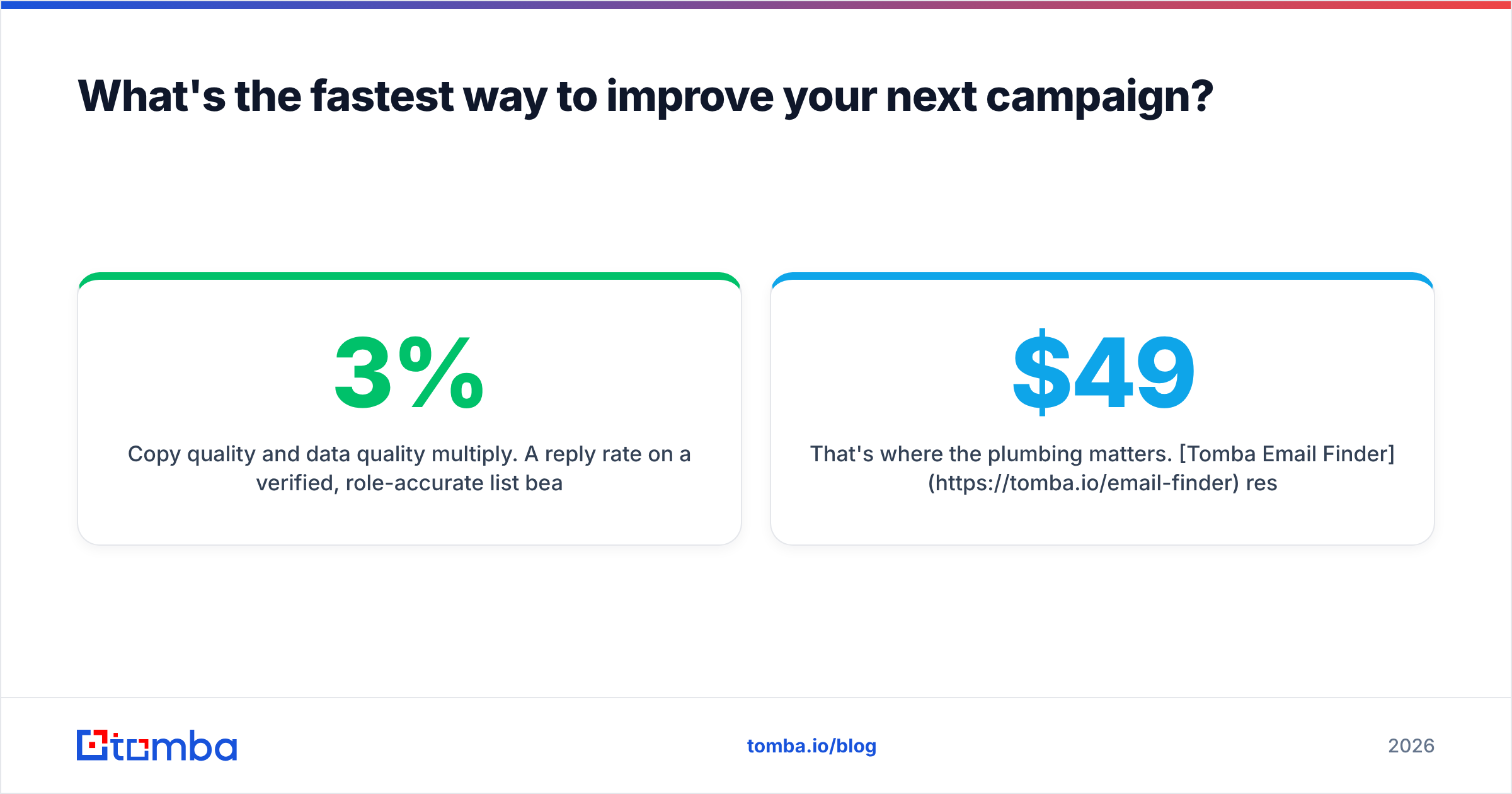
Copy quality and data quality multiply. A 3% reply rate on a verified, role-accurate list beats a 6% reply rate on a list where half the addresses bounce, because the second campaign also costs you your domain.
That's where the plumbing matters. Tomba Email Finder resolves professional email addresses by name, domain, or company, so the person you researched is the person who actually receives your carefully-cut 80-word email. It starts free with 25 searches a month, and paid plans run $49/mo (Starter), $99/mo (Growth), and $249/mo (Pro) — full Tomba pricing is public if you want to size it against your send volume. Write the email you'd want to receive, then make sure it lands in the right inbox.
Related guides#
Ready to find emails that actually work?
Join 150,000+ professionals who stopped guessing and started sending. Free credits on signup — no credit card required.
Get the Tomba newsletter
Practical outbound tactics and product updates — once every two weeks.
About the author