Email Data Providers in 2026: How to Choose the Right One
Email data providers all claim 95%+ accuracy. Here's how their data is actually sourced, what the real match rates look like, and how to run a 200-contact test before you sign a contract.
TL;DR
- Every email data provider claims 90-99% accuracy. That number describes their internal validation on a sample they chose — not the match rate you'll get on your ICP list.
- There are only three ways a provider gets an email: it crawls the public web, it buys/licenses a database, or it collects from a contributory network (browser extensions, email plugins). Everything else is derivation on top of those three.
- Waterfall enrichment — querying 3-5 providers in sequence — typically lifts coverage 25-40 points over any single vendor, but it multiplies cost per record if you don't cap it.
- Run a 200-contact blind test before you sign anything. Score match rate, bounce rate, and cost-per-valid-email — not credits.
- Budget for verification separately. A provider that returns 900 emails at 12% bounce is worse than one returning 700 at 1.5%.
What Are Email Data Providers, Really?#
An email data provider sells you a lookup: you give it a person and a company, it returns a work email address. Some also return phone numbers, job titles, firmographics, and technographics. The category covers everything from single-purpose tools like Tomba Email Finder to full sales-intelligence platforms like ZoomInfo and Apollo.
Think of it like a phone book that nobody prints anymore. The old white pages were compiled from one authoritative source — the telco. Work emails have no telco. There is no central registry of who works where with what address. So every provider has to reconstruct the phone book from fragments: a conference speaker page here, a press release there, a GitHub commit, a signature block someone's plugin scraped.
That reconstruction is why accuracy varies so wildly between vendors on the same list, and why a vendor that's excellent for US SaaS mid-market can be nearly useless for German manufacturing.
Where Does the Data Actually Come From?#
Three primary sources, and every provider is some blend of them.
- Public web crawling. The provider crawls company sites, press releases, job boards, GitHub, academic pages, PDFs, and conference agendas, extracting anything that looks like an address. This is the most transparent source and the most defensible under GDPR's legitimate-interest basis. It's also biased toward roles that publish — engineers, founders, marketers, PR contacts.
- Licensed and purchased databases. Data brokers, trade-show registration lists, webinar co-marketing exchanges, and B2B directories get bought and merged. Coverage is broad; freshness is the weak point. A record licensed in 2023 may describe a job that ended in 2024.
- Contributory networks. Browser extensions and email plugins that, per their terms, sync contacts from users' inboxes and CRMs back to a shared pool. Coverage in sales-heavy verticals is excellent because that's who installs these tools. This is also the source most likely to raise procurement or legal questions in the EU.
- Pattern derivation. Once you know that Acme uses
first.last@acme.comacross 40 known records, you can generatejane.doe@acme.comfor anyone at Acme. This isn't a source — it's inference on top of one. Good providers label these as "guessed" or assign a lower confidence score; weak ones sell them as verified. - SMTP and MX validation. The final gate. The provider pings the receiving mail server to check whether the mailbox exists. This is why the email verifier step matters independently of the finder step — and why catch-all domains, which accept everything, are the industry's permanent blind spot.
Ask any vendor which of these five they use and in what proportion. If they won't answer, that's your answer. Tomba publishes its data sources publicly, which is the bar you should hold every vendor to.
Why Do Accuracy Claims Never Match Reality?#
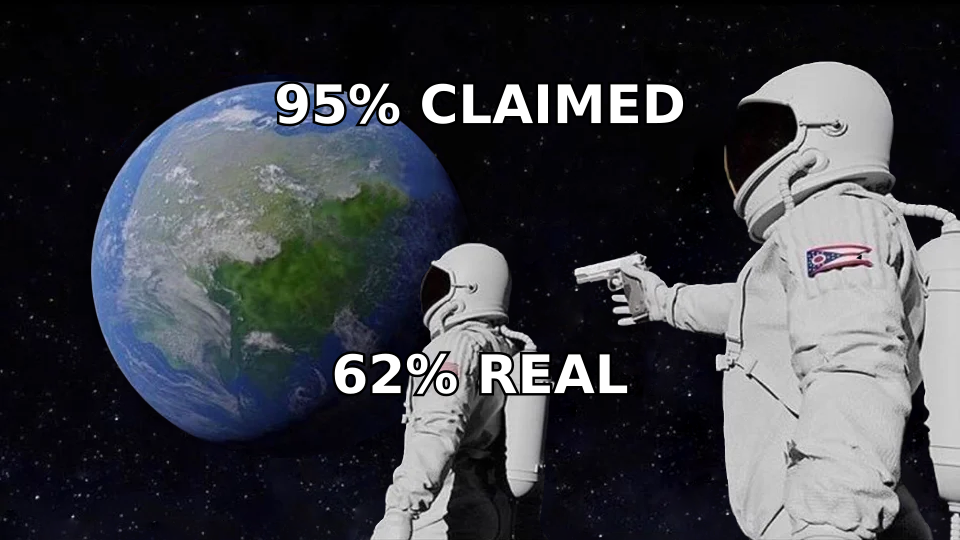
Because "95% accuracy" and "95% match rate" are different numbers, and vendors quote the flattering one.
Accuracy = of the emails we returned, what share are deliverable. Match rate (or coverage) = of the contacts you asked about, what share we found at all. A provider can hit 98% accuracy by simply refusing to return anything it isn't sure about — and leave you with a 40% match rate. Another returns something for 92% of your list and bounces on a fifth of them.
The metric that actually matters is neither. It's cost per valid email:
cost per valid email = (credits spent × price per credit) / (emails returned × (1 - bounce rate))A $99/mo plan returning 1,000 emails at 15% bounce costs $0.116 per usable address. A $249/mo plan returning 2,500 at 2% bounce costs $0.101 — cheaper per outcome despite the higher sticker.
Three other things degrade real-world accuracy in ways vendor benchmarks never capture:
- Geography. Most databases are 60-75% North American. European coverage drops hard outside the UK and Netherlands; APAC drops harder.
- Company size. Sub-50-employee companies have thin web footprints. Enterprise coverage is near-universal; SMB coverage is where vendors diverge most.
- Role seniority. VPs and C-suite appear in press releases and speaker bios. Individual contributors in non-publishing functions (finance, ops, procurement) are the hardest segment in the industry.

How Do the Main Email Data Providers Compare?#
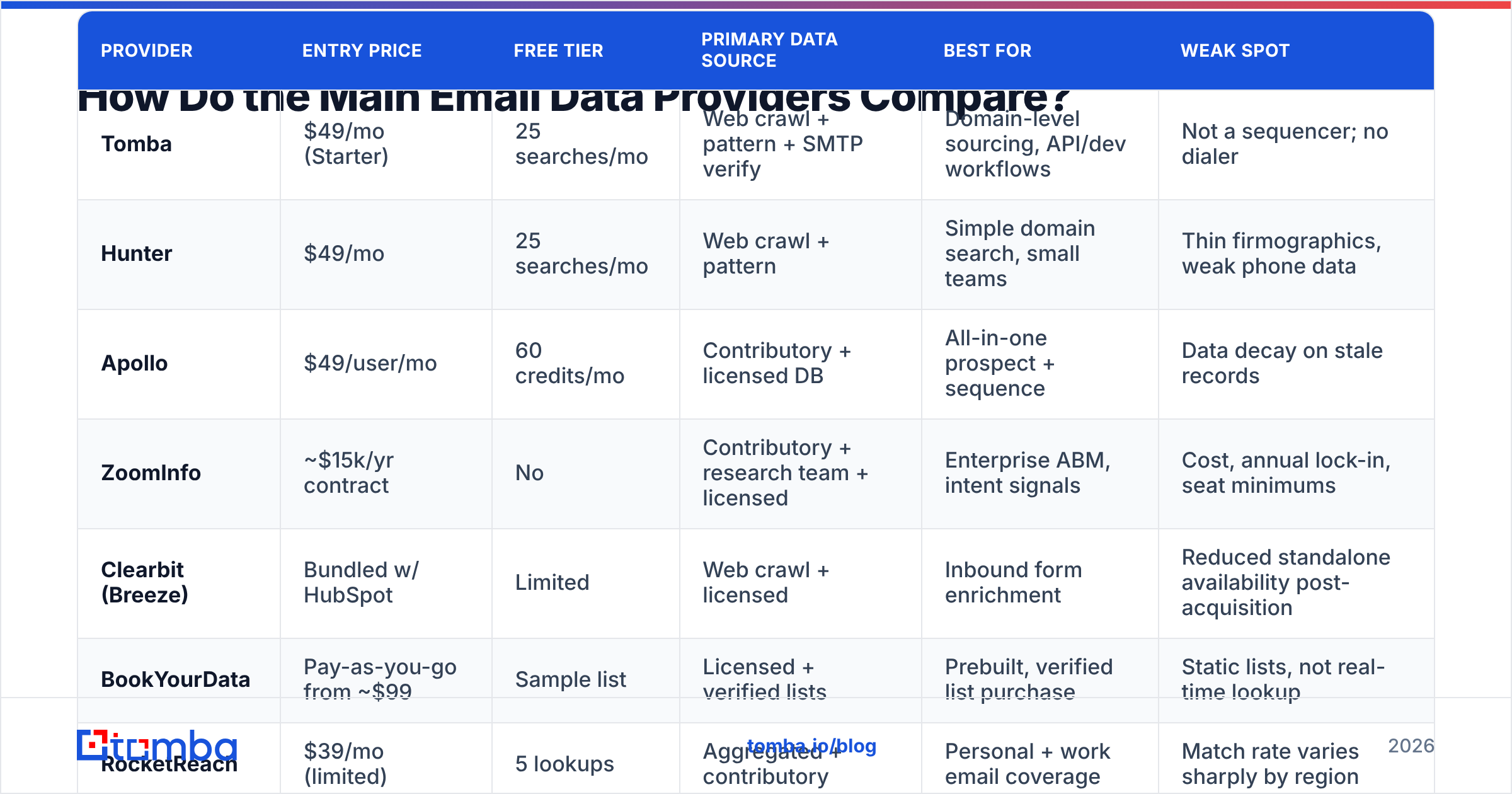
The table below covers the vendor archetypes you'll shortlist. Prices are list prices for the entry paid tier as of mid-2026; enterprise pricing is negotiated and rarely resembles the site.
| Provider | Entry price | Free tier | Primary data source | Best for | Weak spot |
|---|---|---|---|---|---|
| Tomba | $49/mo (Starter) | 25 searches/mo | Web crawl + pattern + SMTP verify | Domain-level sourcing, API/dev workflows | Not a sequencer; no dialer |
| Hunter | $49/mo | 25 searches/mo | Web crawl + pattern | Simple domain search, small teams | Thin firmographics, weak phone data |
| Apollo | $49/user/mo | 60 credits/mo | Contributory + licensed DB | All-in-one prospect + sequence | Data decay on stale records |
| ZoomInfo | ~$15k/yr contract | No | Contributory + research team + licensed | Enterprise ABM, intent signals | Cost, annual lock-in, seat minimums |
| Clearbit (Breeze) | Bundled w/ HubSpot | Limited | Web crawl + licensed | Inbound form enrichment | Reduced standalone availability post-acquisition |
| BookYourData | Pay-as-you-go from ~$99 | Sample list | Licensed + verified lists | Prebuilt, verified list purchase | Static lists, not real-time lookup |
| RocketReach | $39/mo (limited) | 5 lookups | Aggregated + contributory | Personal + work email coverage | Match rate varies sharply by region |
Two structural notes. First, list-purchase vendors like BookYourData and real-time lookup APIs like Tomba solve genuinely different problems — a pre-built verified list is faster for a defined segment you already know, while an API is what you want when the target set is generated dynamically from your CRM or a scraper. Plenty of teams run both. Second, ZoomInfo and Apollo bundle sequencing and dialing, which makes the per-record comparison unfair in both directions: you're buying workflow, not just data.

For a like-for-like look at the sequencer-bundled options, the Apollo alternative breakdown separates data quality from workflow features, which is the split most buyers get wrong.
What Is Waterfall Enrichment and Do You Need It?#
Waterfall enrichment queries providers in sequence and stops at the first hit. Contact goes to Provider A; if no result, it falls to Provider B; then C. The logic is simple — different providers have non-overlapping coverage, so unioning them beats any single one.
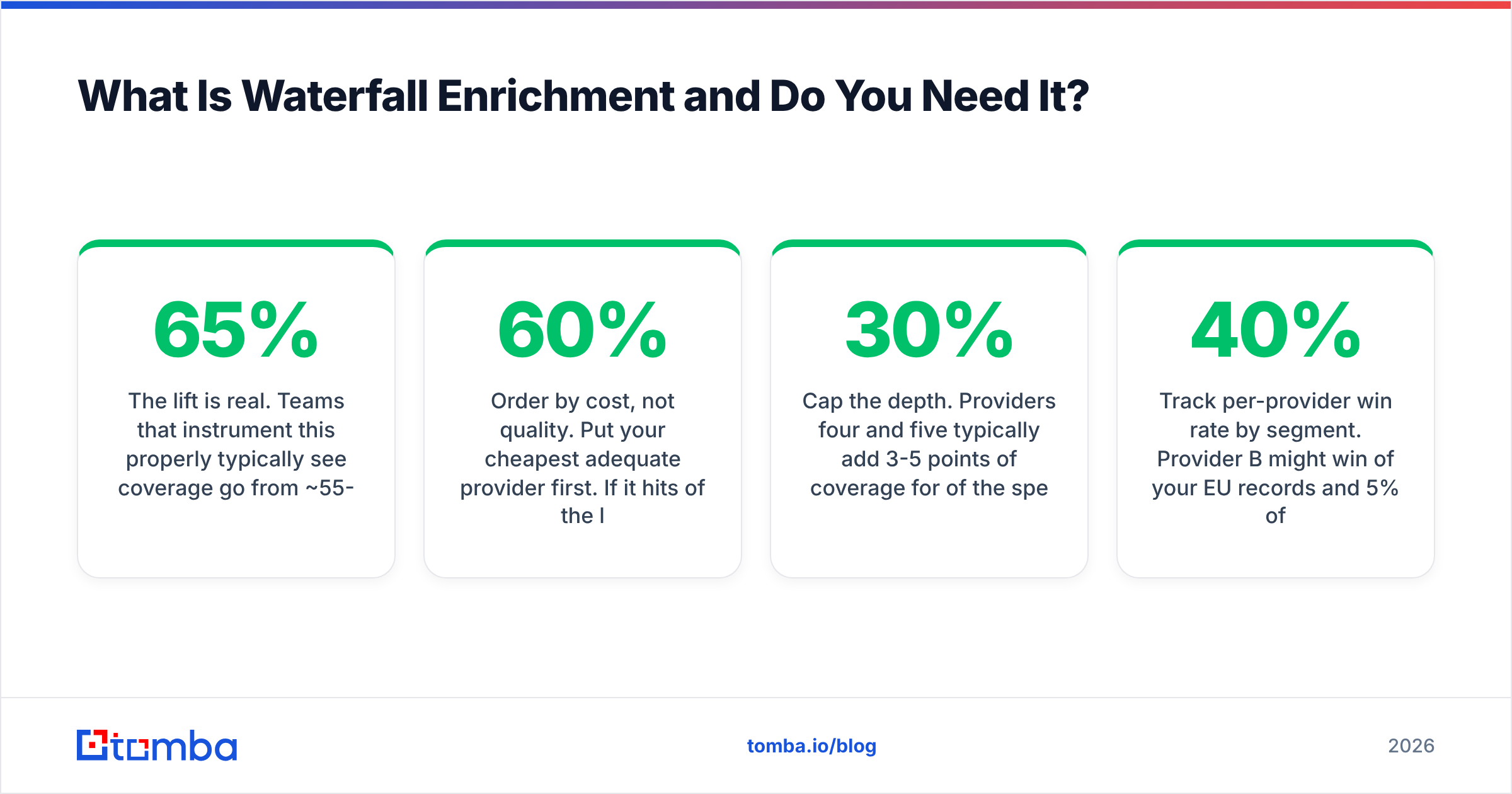
The lift is real. Teams that instrument this properly typically see coverage go from ~55-65% single-vendor to ~85-90% across a four-provider waterfall on a mixed ICP list. The catch is cost and complexity:
- Order by cost, not quality. Put your cheapest adequate provider first. If it hits 60% of the list, you only pay the expensive vendor on the remaining 40%.
- Cap the depth. Providers four and five typically add 3-5 points of coverage for 30% of the spend. Set a stop rule.
- Verify at the end, not per-hop. Run one verification pass on the union. Verifying at each hop burns credits on records you'll discard.
- Track per-provider win rate by segment. Provider B might win 40% of your EU records and 5% of your US ones. Reorder the waterfall per segment, not globally.
If you're building this yourself, the Tomba API sits cleanly in a waterfall — single endpoint, confidence score on every result, and per-source attribution so you can see whether a hit came from a crawled page or a derived pattern. Off-the-shelf waterfall tools exist (Clay, BetterContact), but they add a margin on top of the underlying providers' pricing.
How Do You Test a Provider Before You Buy?#
Never buy on a demo. The demo list is curated. Run this instead — it takes about two hours.
- Build a 200-contact truth set. Pull contacts you already have verified emails for — closed-won accounts, webinar attendees who replied, existing customers. Strip the emails. Keep name + company domain.
- Stratify it. 25% enterprise, 25% mid-market, 25% SMB, 25% non-US. If your ICP skews, match the skew. A test list of 200 US SaaS VPs will make every vendor look great.
- Run the same list through each trial. Every serious vendor offers a free tier or trial. Tomba's free tier gives 25 searches/mo, Hunter's the same, Apollo gives 60 credits — enough for a stratified 50-contact mini-test per vendor if you're careful, or pay for one month of the cheapest tier to run the full 200.
- Score four numbers per vendor: match rate (returned / requested), accuracy vs. your truth set, bounce rate on the records you couldn't verify against truth, and cost per valid email.
- Segment the scores. Break every number down by company size and region. This is where the winner usually changes — the global leader is often third-best on the segment you actually sell into.
- Send 50 real emails. Nothing else surfaces catch-all problems and spam-trap risk. Watch your bounce rate and check your sender reputation before and after.
Cross-check whatever you find against public review data on G2 and Capterra — not for the star ratings, which are gameable, but for the pattern of complaints in one-star reviews. Recurring complaints about billing, credit rollover, or contract exit are the signal.
What About Compliance and GDPR?#
Short version: buying B2B contact data is legal in most jurisdictions, but the obligation to justify it sits with you, not the vendor.
Under GDPR, work email addresses of identifiable people are personal data. Cold outreach to them is typically justified under legitimate interest (Art. 6(1)(f)) rather than consent — but that requires a documented balancing test, a clear opt-out in every message, and the ability to honor deletion requests within 30 days. The ICO's guidance on legitimate interests is the clearest free reference on how the test is meant to work.
Practical vendor questions:
- Can they produce a data processing agreement and name their sub-processors?
- Do they support suppression list ingestion so opt-outs stay opted out across refreshes?
- What's their deletion SLA when a subject requests removal?
- For US buyers: are they CCPA/CPRA-compliant with a working "do not sell" mechanism?
- Where is the data stored and processed — relevant if you have EU data-residency commitments to your own customers.
A vendor that can't answer these in writing is a procurement risk regardless of how good the match rate looks.
What Should You Actually Do Next?#
Pick based on how you'll use the data, not on the feature matrix:
- You need emails inside an existing workflow (CRM, script, scraper): buy an API-first provider and wire it up. Skip the platform.
- You need a prebuilt list for a defined segment right now: a verified list vendor is faster than building a lookup pipeline.
- You need data plus sequencing plus dialing in one seat: an all-in-one platform, accepting that the data will be second-best.
- You need maximum coverage and have engineering time: waterfall, cheapest-first, capped at four providers.
Then instrument it. Log match rate and bounce rate monthly, segmented. Data decays at roughly 25-30% annually as people change jobs, so a vendor that wins today is not automatically the vendor that wins in eighteen months. Re-run the 200-contact test once a year.
If you want to start with the lookup layer rather than a platform commitment, Tomba Email Finder is a reasonable first leg of any waterfall: 25 free searches to run your own test, confidence scoring and source attribution on every result, SMTP verification built in, and pricing that starts at $49/mo for Starter and $99/mo for Growth — no annual contract to find out whether the data works on your list. Run the test against your own truth set before you spend a dollar with anyone, including us.
Related guides#
Ready to find emails that actually work?
Join 150,000+ professionals who stopped guessing and started sending. Free credits on signup — no credit card required.
Get the Tomba newsletter
Practical outbound tactics and product updates — once every two weeks.
About the author