Email Deliverability News Today: What Changed in 2026
Gmail, Microsoft, and Yahoo all tightened inbox rules again this year. Here's what actually changed, what it breaks in your cold email stack, and the fixes that still work in 2026.
TL;DR
- Microsoft joined Gmail and Yahoo. As of May 2025, Outlook.com, Hotmail, and Live enforce SPF, DKIM, and DMARC on high-volume senders. Through 2026 the enforcement has moved from "route to junk" to outright rejection for repeat offenders.
- The 0.3% spam-complaint ceiling is now the whole game. Gmail's Postmaster Tools threshold hasn't moved, but the number of senders being throttled against it has climbed sharply as AI-generated outbound floods B2B inboxes.
- Bounce rate is a reputation signal, not a vanity metric. Sustained hard-bounce rates above 2-3% now trigger throttling at every major mailbox provider, which makes list hygiene a deliverability control rather than a data-quality nicety.
- Shared IP pools got riskier. Sending-platform IP ranges that host AI-scaled sequences are being blocklisted faster; several 2026 incidents took down entire pools for days.
- The fix hasn't changed, only the tolerance. Authenticate properly, verify before you send, warm slowly, and keep complaint rate under 0.1% if you want headroom.
What is actually new in email deliverability news today?#
Short answer: enforcement caught up with the rules. The 2024 Gmail and Yahoo bulk-sender requirements were announced with a grace period. That grace period is over, Microsoft has adopted a near-identical framework, and the 2026 story is that mailbox providers are now punishing senders who technically comply but behave badly.
Three concrete developments matter for anyone running outbound.
1. Microsoft's high-volume sender enforcement is live and hardening. Microsoft announced in April 2025 that senders pushing more than 5,000 messages per day to Outlook.com domains must pass SPF, DKIM, and DMARC. What started as junk-folder routing has escalated: unauthenticated bulk mail to consumer Microsoft domains now gets 550-class rejections in a growing number of cases. If you have been telling yourself Outlook is the forgiving one, that stopped being true.
2. One-click unsubscribe is being audited, not just required. RFC 8058 List-Unsubscribe-Post headers were mandated for bulk senders in 2024. In 2026, providers are checking whether the header actually works — whether the unsubscribe request is honored within two days, and whether the sender keeps mailing after the opt-out. A header that 404s is worse than no header, because it converts a quiet unsubscribe into a spam complaint.
3. AI-generated volume is compressing everyone's margin for error. The practical consequence of cheap AI copy is that B2B recipients get more mail than ever, and their complaint reflex is faster. The 0.3% Gmail threshold was designed when a mediocre sender might drift toward it. Now mediocre senders blow past it in a week.
What are the current bulk-sender rules at each provider?#
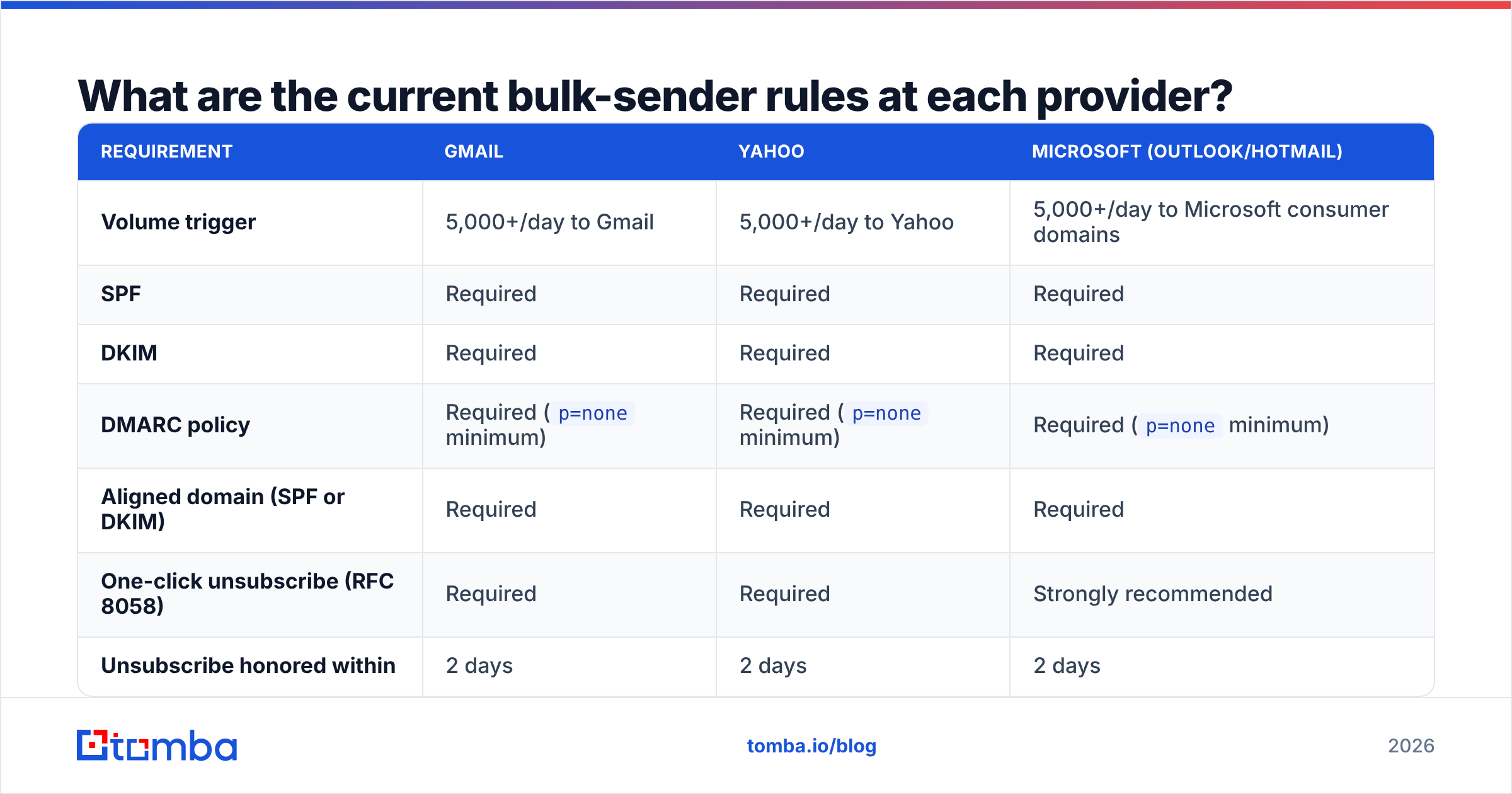
Here is the state of play across the three providers that hold the overwhelming majority of B2B inboxes. Rules below reflect published provider guidance as of mid-2026.
| Requirement | Gmail | Yahoo | Microsoft (Outlook/Hotmail) |
|---|---|---|---|
| Volume trigger | 5,000+/day to Gmail | 5,000+/day to Yahoo | 5,000+/day to Microsoft consumer domains |
| SPF | Required | Required | Required |
| DKIM | Required | Required | Required |
| DMARC policy | Required (p=none minimum) |
Required (p=none minimum) |
Required (p=none minimum) |
| Aligned domain (SPF or DKIM) | Required | Required | Required |
| One-click unsubscribe (RFC 8058) | Required | Required | Strongly recommended |
| Unsubscribe honored within | 2 days | 2 days | 2 days |
| Spam-complaint ceiling | 0.3% (target under 0.1%) | 0.3% | Not published; enforced via filtering |
| Consequence of failure | Junk routing, then rejection | Junk routing, then rejection | Junk routing, escalating to rejection |
| Reputation dashboard | Postmaster Tools | Sender Hub | SNDS / JMRP |
The pattern is obvious: the three providers converged. There is no longer a "weak link" mailbox provider you can lean on while you fix the others. Whatever you build has to satisfy all three simultaneously.
Which changes actually break cold email campaigns?#
Most teams reading deliverability news assume the authentication items are the hard part. They are the easy part — DNS records are a one-afternoon fix. The changes that quietly destroy campaigns are the behavioral ones.
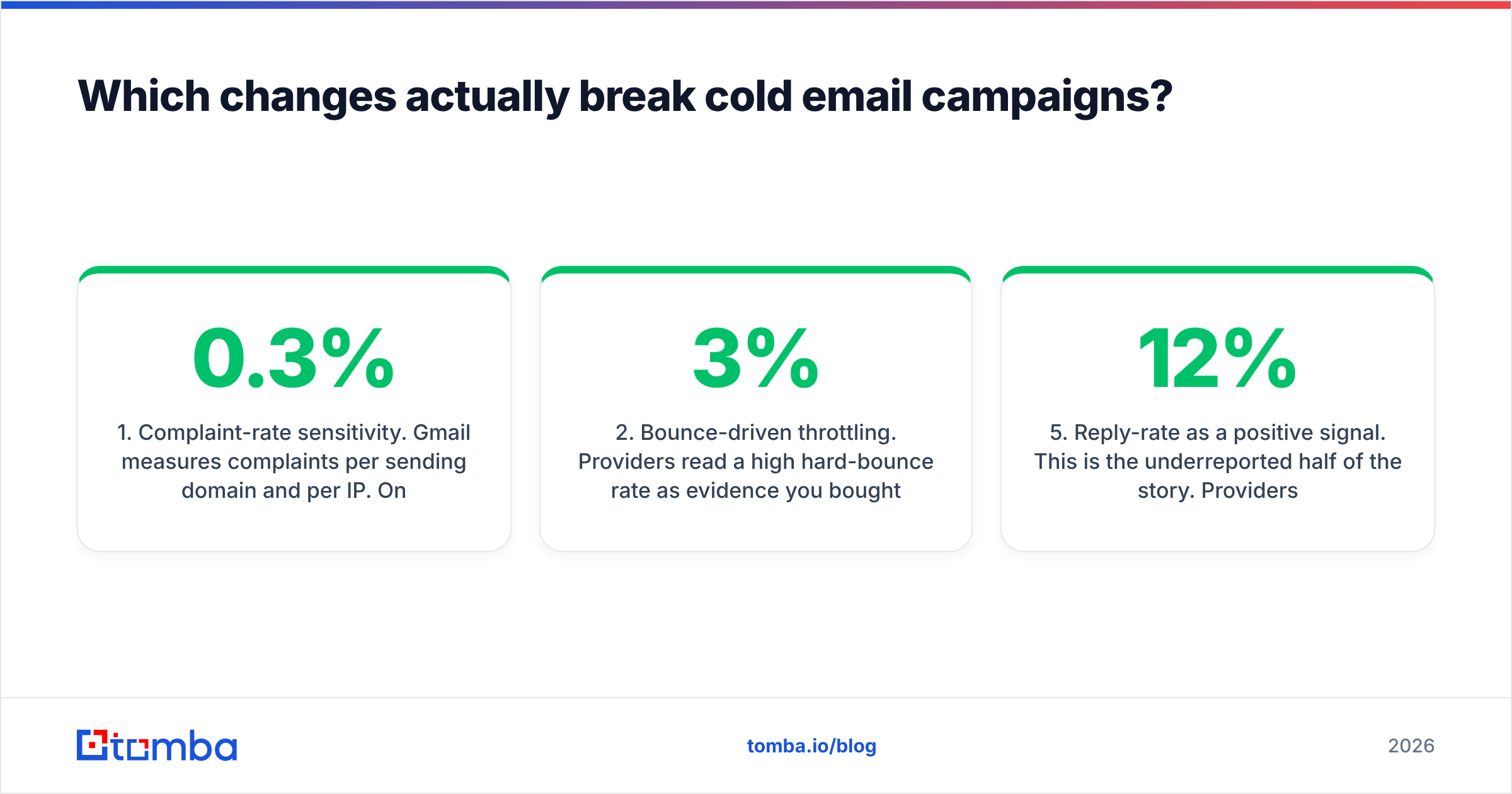
Complaint-rate sensitivity. Gmail measures complaints per sending domain and per IP. One bad segment in a 10,000-contact campaign can drag a domain over 0.3% and take the rest of your sequences with it. Segment by intent, not by convenience.
Bounce-driven throttling. Providers read a high hard-bounce rate as evidence you bought a list. Above roughly 3%, you start seeing deferrals; above 5%, you start seeing blocks. This is the single most controllable variable in the entire system, because bounces are preventable with verification before send.
Domain age and pattern detection. Buying twelve lookalike domains and blasting from all of them on day three is now a detectable pattern. Providers correlate registration date, DNS configuration similarity, and content fingerprints. Warmup that ramps from 5 to 500 in a week reads as automation, not as a human.
Shared-pool contamination. If your sending platform puts you on shared IPs, your reputation is partly hostage to strangers. Several sequencing platforms had pool-wide incidents in 2026 where a single abusive tenant caused multi-day delivery failures for everyone on the range. Ask your vendor whether dedicated IPs are available at your volume — and whether they actually recommend them, since a dedicated IP at low volume warms slowly and can hurt.
Reply-rate as a positive signal. This is the underreported half of the story. Providers increasingly weight engagement, and replies are the strongest engagement signal a B2B sender can generate. A 400-contact campaign with a 12% reply rate builds reputation. A 40,000-contact campaign with a 0.4% reply rate burns it.
Catch-all ambiguity. Catch-all domains accept everything at the SMTP layer, so a naive "verified" flag means nothing there. If a meaningful slice of your list is catch-all, you need a catch-all verifier that scores deliverability probabilistically rather than a binary valid/invalid check.
How do you audit your own setup against the 2026 rules?#
Work through this in order. Each step gates the next — there is no point optimizing copy while your DMARC record is broken.
Step 1 — Verify authentication end to end. Check that your SPF record resolves in under 10 DNS lookups, that DKIM signs with a 2048-bit key, and that DMARC alignment passes on the domain you actually send from (not just the organizational domain). A quick SPF checker will surface lookup-limit failures that a visual inspection misses. If you are unclear on the mechanics, the SPF record primer covers it.
Step 2 — Pull your Postmaster Tools history. Google Postmaster Tools shows domain reputation, IP reputation, spam rate, and authentication pass rates over time. If your domain reputation reads "Low" or "Bad," nothing else you do this quarter matters until it recovers. Set up Postmaster Tools properly if you have not — most teams register the wrong domain.
Step 3 — Audit list hygiene before the next send. Run your list through verification and remove hard bounces, role accounts, and stale contacts older than roughly 18 months. This is the step teams skip because it costs credits, and it is the step that determines whether the campaign lands.
Step 4 — Check whether you are on a blocklist. Spamhaus, SORBS, and Barracuda listings explain a shocking share of "my emails just stopped landing" tickets. A blacklist checker takes 30 seconds and rules out the most embarrassing possible cause.
Step 5 — Test the message itself. Spam-word density matters less than it did in 2015, but link-to-text ratio, image-only bodies, and URL shorteners still hurt. Run the draft through a spam checker before the sequence goes live.
Step 6 — Re-warm if you paused. Domains that go quiet for 60+ days and then resume at prior volume get treated as suspicious. Ramp back with a warmup calculator rather than guessing.
Does list quality really move deliverability that much?#
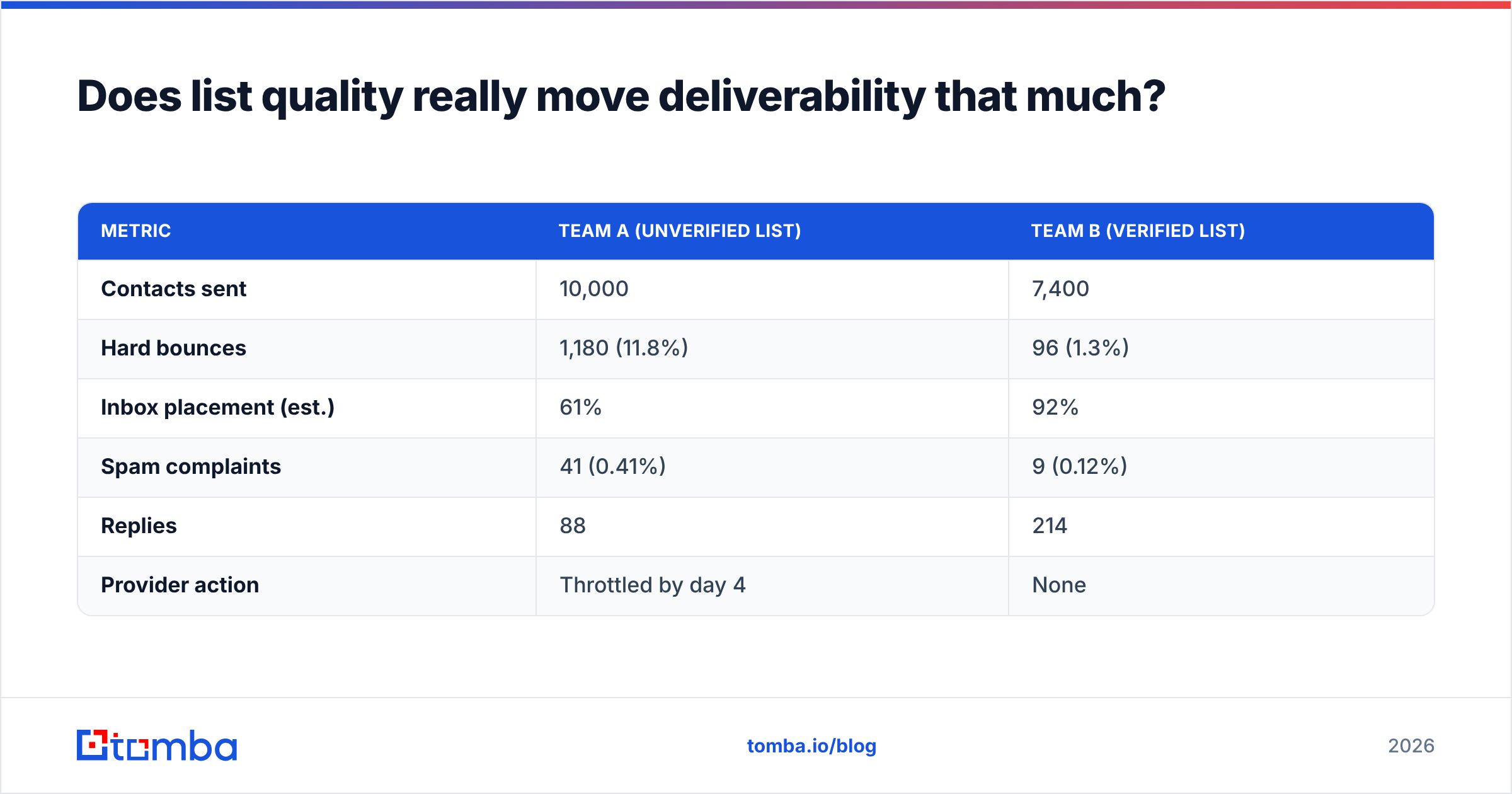
Yes, and the arithmetic is unforgiving. Consider two teams sending the same copy from equally-authenticated domains.
| Metric | Team A (unverified list) | Team B (verified list) |
|---|---|---|
| Contacts sent | 10,000 | 7,400 |
| Hard bounces | 1,180 (11.8%) | 96 (1.3%) |
| Inbox placement (est.) | 61% | 92% |
| Spam complaints | 41 (0.41%) | 9 (0.12%) |
| Replies | 88 | 214 |
| Provider action | Throttled by day 4 | None |
Team A sent 35% more email and got fewer than half the replies, then lost the domain. The unverified list did not just waste credits — it converted a working sending domain into a liability. That is why email verification belongs in the deliverability budget line, not the data budget line.
The other half of the equation is where the addresses came from in the first place. Guessed permutations bounce. Scraped lists carry spam traps. Sourcing from a maintained B2B database with documented provenance produces a materially different bounce profile than a pattern generator, and that difference shows up in sender reputation within two campaigns.
What should you do differently for the rest of 2026?#
Five changes, ranked by impact per hour invested.
Move DMARC from p=none to p=quarantine. Monitoring-only DMARC satisfies the letter of the requirement and none of the spirit. Quarantine actually stops spoofers from burning your domain, and providers read the stricter policy as a trust signal. Review your aggregate reports for two weeks first, then move.
Cap daily volume per mailbox at 30-50, not 200. The old advice was to max out what the provider tolerates. The current advice is to stay well under it. More mailboxes at lower volume beats fewer mailboxes at higher volume in every 2026 dataset worth reading.
Verify at the moment of send, not at import. B2B contact data decays at roughly 22-30% per year according to widely-cited industry estimates. A list verified in January and sent in July is a list with two months of accumulated rot. Verification via API at send time solves this without a manual re-run.
Instrument replies, not opens. Apple Mail Privacy Protection made open rates fiction years ago, and providers do not weight your open metric anyway. Track response rate as your primary health metric — it correlates with the engagement signals providers actually see.
Separate your domains by function. Transactional mail, marketing mail, and cold outbound should not share a sending domain. When outbound reputation dips, you do not want password resets going to spam with it.
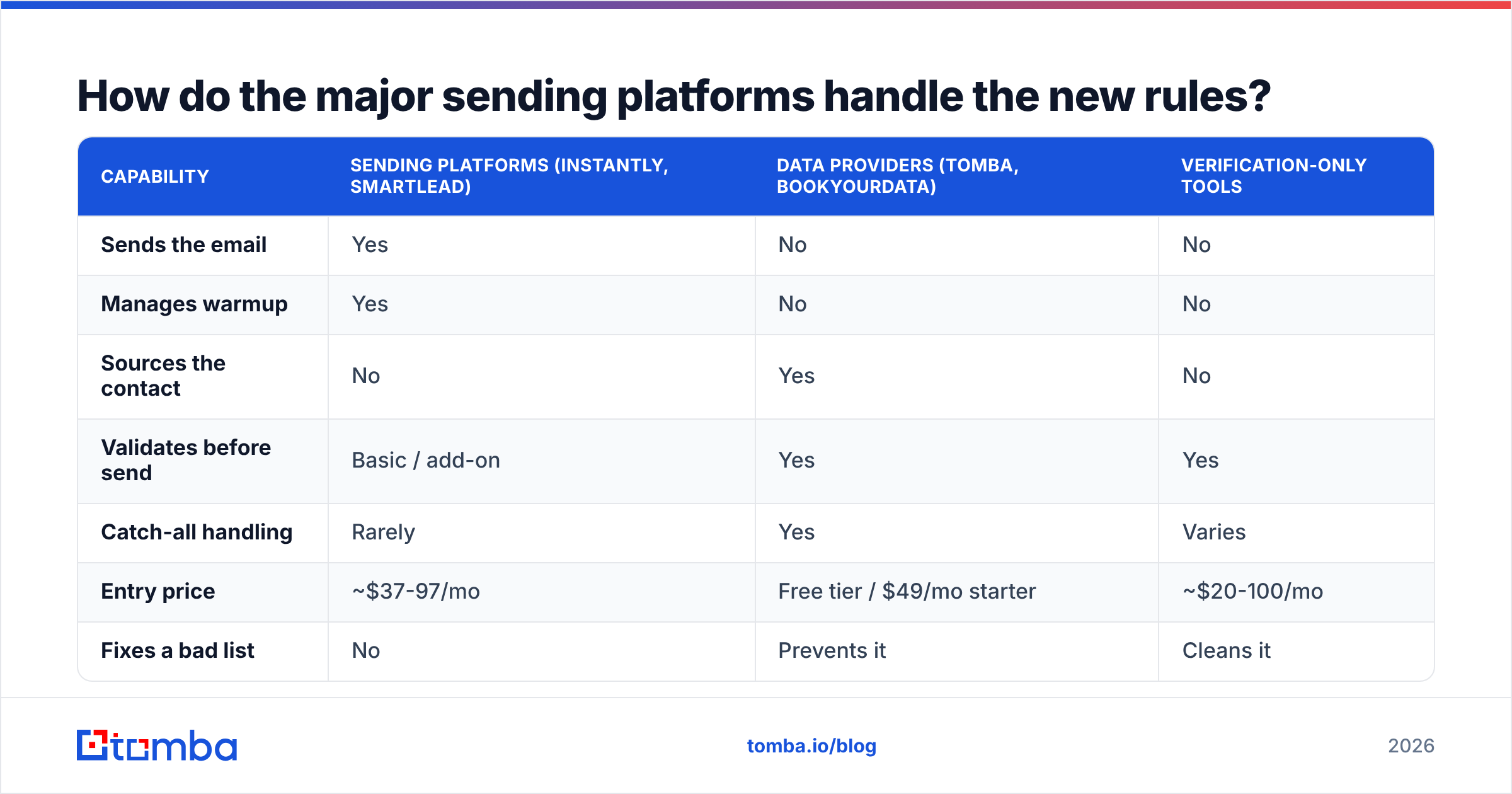
How do the major sending platforms handle the new rules?#
A brief, honest comparison of where the responsibility sits. Note that none of these tools fix bad data — they distribute it faster.
| Capability | Sending platforms (Instantly, Smartlead) | Data providers (Tomba, BookYourData) | Verification-only tools |
|---|---|---|---|
| Sends the email | Yes | No | No |
| Manages warmup | Yes | No | No |
| Sources the contact | No | Yes | No |
| Validates before send | Basic / add-on | Yes | Yes |
| Catch-all handling | Rarely | Yes | Varies |
| Entry price | ~$37-97/mo | Free tier / $49/mo starter | ~$20-100/mo |
| Fixes a bad list | No | Prevents it | Cleans it |
The stack most teams end up with is a data layer plus a sending layer, because the two problems are genuinely different. Tomba pricing starts free at 25 searches per month and moves to $49/mo on Starter, which is where most teams running one or two sequences land. BookYourData takes a different approach with pre-built purchasable lists and a bounce guarantee, which suits teams that want volume without building a sourcing workflow. Both beat guessing.
What deliverability advice is now outdated?#
Some widely-repeated tactics stopped working, and a few now actively hurt.
- "Use a .co or .net for your cold domain." Providers do not meaningfully penalize TLD choice for legitimate business domains, and cheap TLDs correlate with abuse. Use a normal lookalike domain of your primary.
- "Warm up with a warmup network for 90 days." Reciprocal warmup pools are increasingly fingerprinted. They still help, but 90 days of artificial engagement followed by real sending at 10x the volume fools nobody.
- "Avoid the word 'free' in subject lines." Keyword-based spam filtering is a decade obsolete. Sender reputation and engagement dominate; a single word does not.
- "Plain text always beats HTML." Neither wins on format. What matters is link count, image weight, and whether the recipient wanted the message.
- "Bounces don't matter if you clean up after." They matter at the moment they happen. Post-hoc cleanup does not reverse the reputation damage.
Where does this go next?#
Expect three things over the next twelve months. First, DMARC p=reject will drift from best practice toward de facto requirement for high-volume senders, following the same path p=none took. Second, providers will publish more granular engagement thresholds — Gmail already hints at this in Postmaster Tools, and Yahoo's Sender Hub has been expanding. Third, AI-generated outbound will force some form of sender verification beyond DNS, whether that is BIMI adoption, paid sender certification, or something new.
None of that changes the fundamentals. Authenticate, verify, warm, segment, and earn replies. The teams that were doing this in 2023 barely noticed the 2024 rules, barely noticed the 2025 Microsoft change, and will barely notice whatever lands in 2027.
Start with the data layer#
Deliverability problems almost always trace back to who you emailed, not how you emailed them. If your bounce rate is above 3%, no amount of DNS tuning or warmup will save the domain — the list is the problem.
Start by fixing what goes into the sequence. The Tomba Email Finder sources verified professional addresses by domain, name, or company, with confidence scoring on every result so you know what you are sending to before you send it. The free tier gives you 25 searches a month to test the bounce profile against your current list; Starter runs $49/mo when you are ready to scale. Clean input, then worry about the headers.
Related guides#
// get started
Find, verify and enrich your first contacts today
Start on the free plan with 25 searches a month, then scale when your team is ready.
Free plan · No credit card required · GDPR & CCPA
// about the author