Email Deliverability Services in 2026: What You Actually Pay For
Deliverability vendors promise the inbox, but the price range runs from $0 to $6,000 a month for overlapping work. Here is what each tier actually does, what it costs, and what you can fix yourself first.

TL;DR
- "Email deliverability services" covers four very different products: monitoring/seed testing, managed consulting, infrastructure-and-warmup tooling, and list hygiene. Buying the wrong one is the most common mistake.
- Typical 2026 pricing runs from free (Google Postmaster Tools) to $200–$600/mo for monitoring platforms, and $2,000–$6,000/mo for retained managed deliverability consultants.
- Roughly 60–70% of the deliverability tickets we see trace back to list quality and authentication — both fixable in an afternoon without a vendor.
- Fix in this order: authentication (SPF/DKIM/DMARC) → list hygiene → sending volume ramp → content. Paying a consultant before step two is paying someone to tell you to do step two.
- Buy monitoring if you send 500k+/mo. Buy consulting if you're already blocked at a major mailbox provider or have compliance exposure. Otherwise, tooling plus discipline gets you 90% of the way.
What are email deliverability services?#
Email deliverability services are products and consultancies that work to get more of your sent mail into the inbox instead of spam, bulk, or a hard block. That's the whole category — and it's why the label is nearly useless when you're shopping.
Think of it like "car services." That word covers oil changes, engine diagnostics, insurance, and full-fleet management. All of them touch the car. Only one of them fixes the noise you're hearing.
The confusion has commercial consequences. Founders regularly sign $3,000/mo consulting retainers to solve a problem that a $49 list-cleaning pass would have handled. Others buy a seed-list monitoring tool, watch the dashboard turn red, and still have no idea what to change. Email deliverability is not one problem, so it doesn't have one vendor.
Here is the honest breakdown of the four sub-categories:
- Monitoring and seed testing — Sends test messages to a panel of seed accounts across Gmail, Outlook, Yahoo, and corporate filters, then reports where they landed. Tells you that you have a problem and roughly where. Examples: Validity Everest, GlockApps, MailReach's inbox tests.
- Managed deliverability consulting — Humans who audit your infrastructure, talk to mailbox providers and blocklist operators on your behalf, and rebuild your sending program. Tells you why and what to change. Sold as monthly retainers, usually 3-month minimums.
- Infrastructure and warmup tooling — Domain/IP setup, SPF-DKIM-DMARC configuration, dedicated IP provisioning, and automated warmup networks that build sending reputation over 2–6 weeks. Handles the plumbing.
- List hygiene and verification — Removes invalid, role-based, spam-trap, and dead addresses before you send. This is the cheapest and highest-leverage tier, and it's the one people skip.
- Compliance and consent tooling — Preference centers, suppression management, GDPR/CAN-SPAM/CASL enforcement. Boring, and the thing that saves you when a regulator or an ESP compliance team comes asking.
Most "deliverability service" vendors do one of these well and gesture at the other four in their marketing copy.

Why does most email land in spam in the first place?#
Because the mailbox provider concluded, from your own behavior, that recipients don't want your mail. That's it. Filters are not moral judges of your subject line — they're engagement forecasters.
Four inputs dominate:
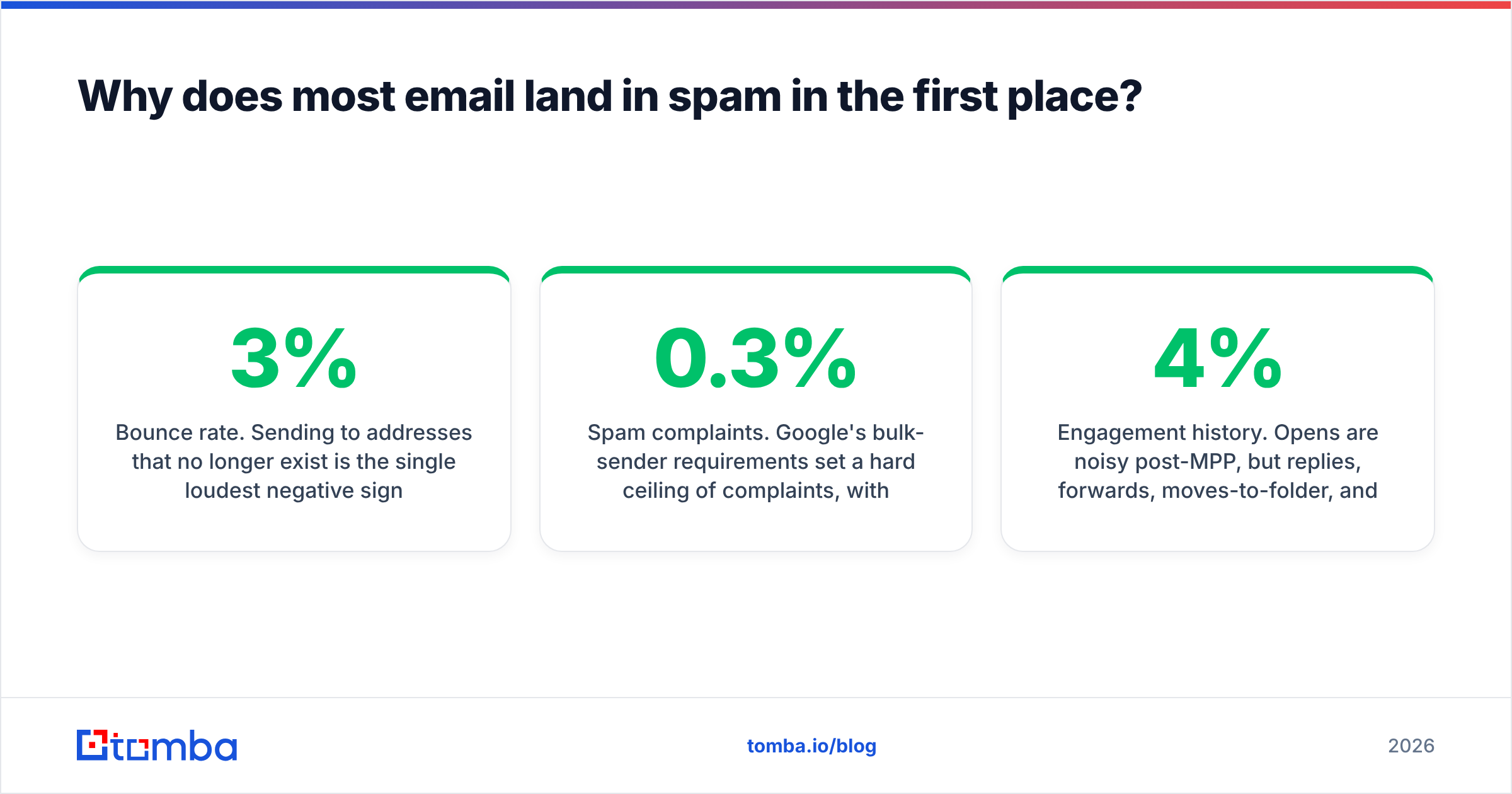
Bounce rate. Sending to addresses that no longer exist is the single loudest negative signal. Gmail and Microsoft both treat a spike in unknown-user bounces as evidence you're mailing a purchased or stale list. Anything over 3% is a warning; over 5% and you should stop sending immediately.
Spam complaints. Google's bulk-sender requirements set a hard ceiling of 0.3% complaints, with 0.1% as the target. That is roughly one complaint per thousand messages. Three per thousand and throttling begins. You can read the current thresholds directly in Google's sender guidelines.
Authentication. SPF, DKIM, and a published DMARC policy are now baseline, not best practice. Since the 2024 Gmail/Yahoo enforcement wave, unauthenticated bulk mail is rejected outright rather than filtered. Check yours with a free SPF checker before you assume the problem is elsewhere.
Engagement history. Opens are noisy post-MPP, but replies, forwards, moves-to-folder, and "not spam" actions still carry heavy weight. A domain that has never received a reply looks different from one that gets a 4% reply rate at the same volume.
Notice what isn't on that list: the word "free," an image-to-text ratio, or an exclamation mark. Content-based spam filtering matters far less in 2026 than reputation-based filtering. If your content were the problem, your good sends wouldn't work either.
How much do email deliverability services cost in 2026?#
Prices below are typical market ranges as of mid-2026, not quotes. Consulting in particular varies by sending volume and how bad the fire is.
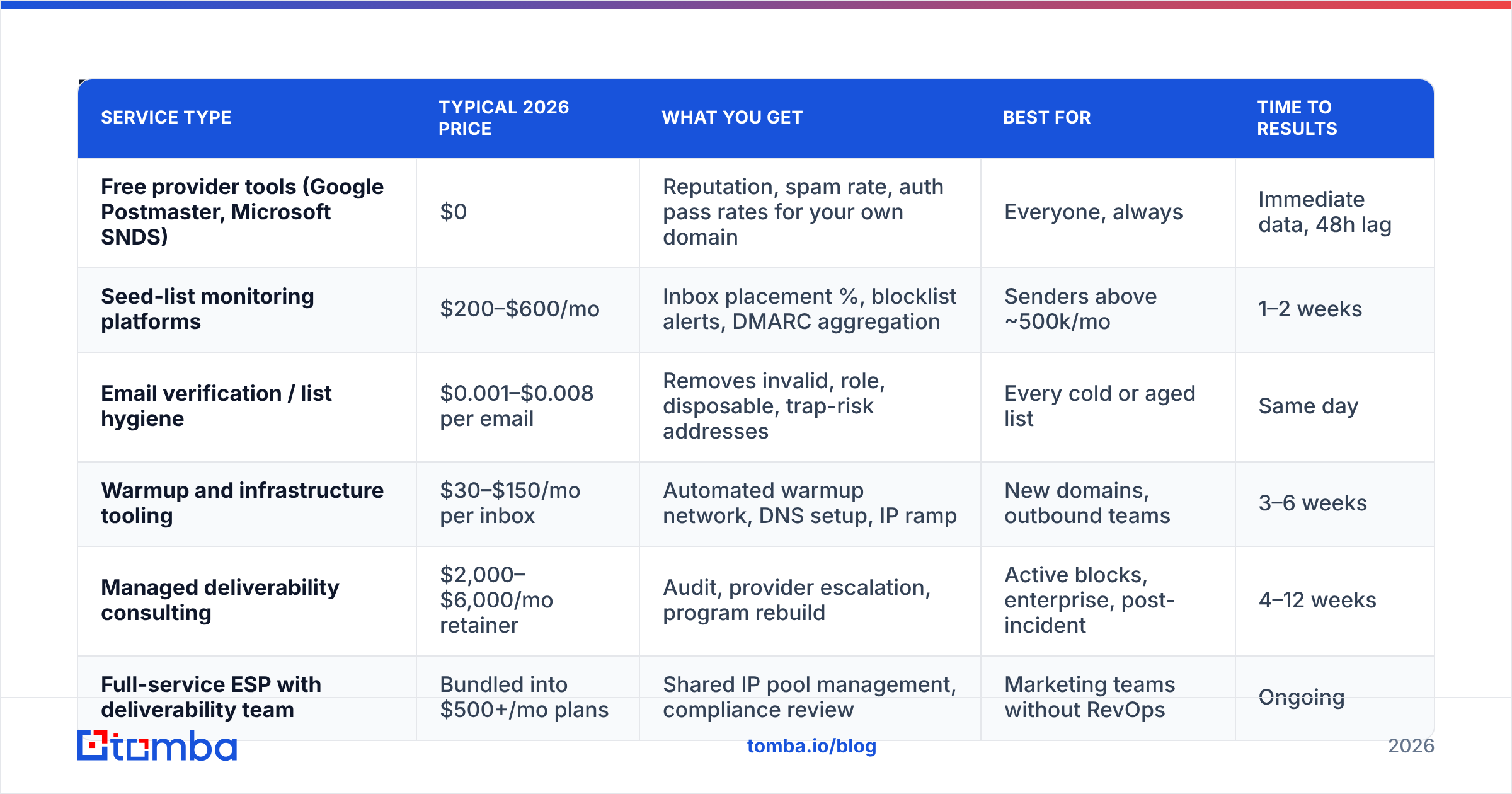
| Service type | Typical 2026 price | What you get | Best for | Time to results |
|---|---|---|---|---|
| Free provider tools (Google Postmaster, Microsoft SNDS) | $0 | Reputation, spam rate, auth pass rates for your own domain | Everyone, always | Immediate data, 48h lag |
| Seed-list monitoring platforms | $200–$600/mo | Inbox placement %, blocklist alerts, DMARC aggregation | Senders above ~500k/mo | 1–2 weeks |
| Email verification / list hygiene | $0.001–$0.008 per email | Removes invalid, role, disposable, trap-risk addresses | Every cold or aged list | Same day |
| Warmup and infrastructure tooling | $30–$150/mo per inbox | Automated warmup network, DNS setup, IP ramp | New domains, outbound teams | 3–6 weeks |
| Managed deliverability consulting | $2,000–$6,000/mo retainer | Audit, provider escalation, program rebuild | Active blocks, enterprise, post-incident | 4–12 weeks |
| Full-service ESP with deliverability team | Bundled into $500+/mo plans | Shared IP pool management, compliance review | Marketing teams without RevOps | Ongoing |
Two things jump out of that table.
First, the cheapest row has the fastest payback. Verification at fractions of a cent per record removes the exact signal — unknown-user bounces — that triggers the throttling everything else is trying to undo. Running an email verifier across a 50,000-record list costs less than one hour of consulting and reliably drops bounce rate from double digits to under 2%.
Second, the most expensive row is priced on urgency, not effort. A managed consultant is worth $4,000/mo when Microsoft has blocked your IP range and you have a Q3 number to hit. That same retainer is a waste when your only issue is that you bought a list in 2023 and never cleaned it.
Which deliverability problem do you actually have?#
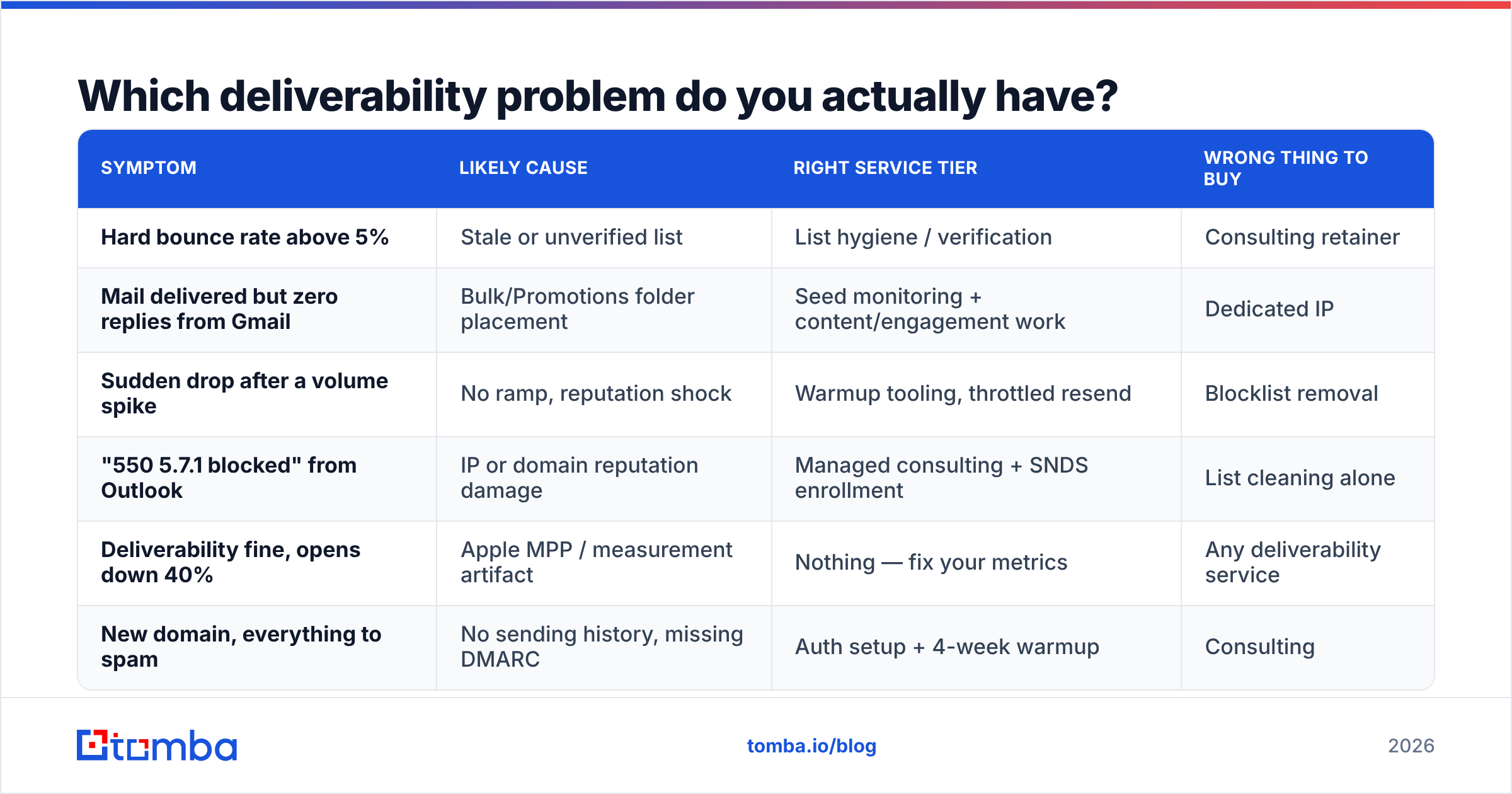
Diagnose before you buy. Match your symptom to the row:
| Symptom | Likely cause | Right service tier | Wrong thing to buy |
|---|---|---|---|
| Hard bounce rate above 5% | Stale or unverified list | List hygiene / verification | Consulting retainer |
| Mail delivered but zero replies from Gmail | Bulk/Promotions folder placement | Seed monitoring + content/engagement work | Dedicated IP |
| Sudden drop after a volume spike | No ramp, reputation shock | Warmup tooling, throttled resend | Blocklist removal |
| "550 5.7.1 blocked" from Outlook | IP or domain reputation damage | Managed consulting + SNDS enrollment | List cleaning alone |
| Deliverability fine, opens down 40% | Apple MPP / measurement artifact | Nothing — fix your metrics | Any deliverability service |
| New domain, everything to spam | No sending history, missing DMARC | Auth setup + 4-week warmup | Consulting |
The fifth row catches people constantly. A reported open-rate collapse after an iOS update is a measurement change, not a deliverability incident. Before you spend anything, confirm the problem is real by checking bounce codes and reply rates, which no privacy feature obscures.
What can you fix yourself before hiring anyone?#
Most of it, honestly. Work this checklist in order — each step feeds the next, and skipping ahead wastes the work you did before.
- Publish and verify SPF, DKIM, and DMARC. Start DMARC at
p=nonewith an aggregate reporting address, read two weeks of reports, then move top=quarantine. Anything less than full alignment on all three is a hard fail at Gmail volume. - Enroll in the free provider dashboards. Google Postmaster Tools gives you your own domain reputation, spam rate, and auth pass rate. Microsoft SNDS does the same for IPs. This is free, first-party, and better than most paid seed data.
- Clean the list before the next send, not after. Remove invalids, role accounts (
info@,sales@), duplicates, and anything that hasn't engaged in 12 months. Catch-all domains need their own treatment — a catch-all verifier distinguishes "accepts everything blindly" from "actually deliverable," which a standard SMTP check cannot. - Segment and suppress aggressively. Split your active-90-day segment from your dormant one and mail them on different domains or at minimum different cadences. Dormant re-engagement campaigns are the highest-complaint-rate mail you will ever send.
- Ramp volume like a human would. Doubling daily volume every 3–4 days, capped at your steady-state target, is the standard curve. Use a warmup calculator to plan the schedule rather than guessing.
- Set up a real unsubscribe path. One-click list-unsubscribe headers are mandatory for bulk senders. A visible unsubscribe converts would-be complainers into opt-outs, and opt-outs don't damage reputation.
Do all six and re-measure. If your bounce rate is under 2%, complaint rate under 0.1%, and you're still landing in spam at a specific provider, now you have a problem worth paying a specialist for. That's a genuine reputation or filtering issue, and it's exactly what consultants are good at.

Are managed deliverability services worth it?#
Sometimes — and the conditions are specific enough to list.
Buy managed consulting when:
- You're actively blocked or throttled at Gmail, Microsoft, or a major regional provider and self-remediation hasn't moved the needle in two weeks.
- You send more than 2 million messages a month, where a 3-point placement improvement is worth six figures in pipeline.
- You've been listed on Spamhaus or a similar blocklist more than once. Repeat listings mean a structural problem, and consultants have direct escalation paths you don't.
- You're migrating ESPs or moving to dedicated IPs and can't afford a bad ramp.
- There's regulatory exposure — healthcare, finance, or an EU-heavy list where consent documentation matters.
Skip it when:
- Your list is under 100k and unverified. Clean first; the problem usually disappears.
- You're a cold outbound team sending under 2,000/day. Your issues are targeting and volume, not reputation science.
- You haven't yet published DMARC. No consultant will start anywhere else, and you'll pay retainer rates for a DNS edit.
One more caveat on vendor selection: check independent reviews before signing. The G2 email deliverability category is a reasonable starting point for filtering by company size, though treat the aggregate scores as directional rather than definitive. Ask any prospective consultant for two references at your sending volume, and ask those references what changed in month three — not month one.
How do you measure whether the service worked?#
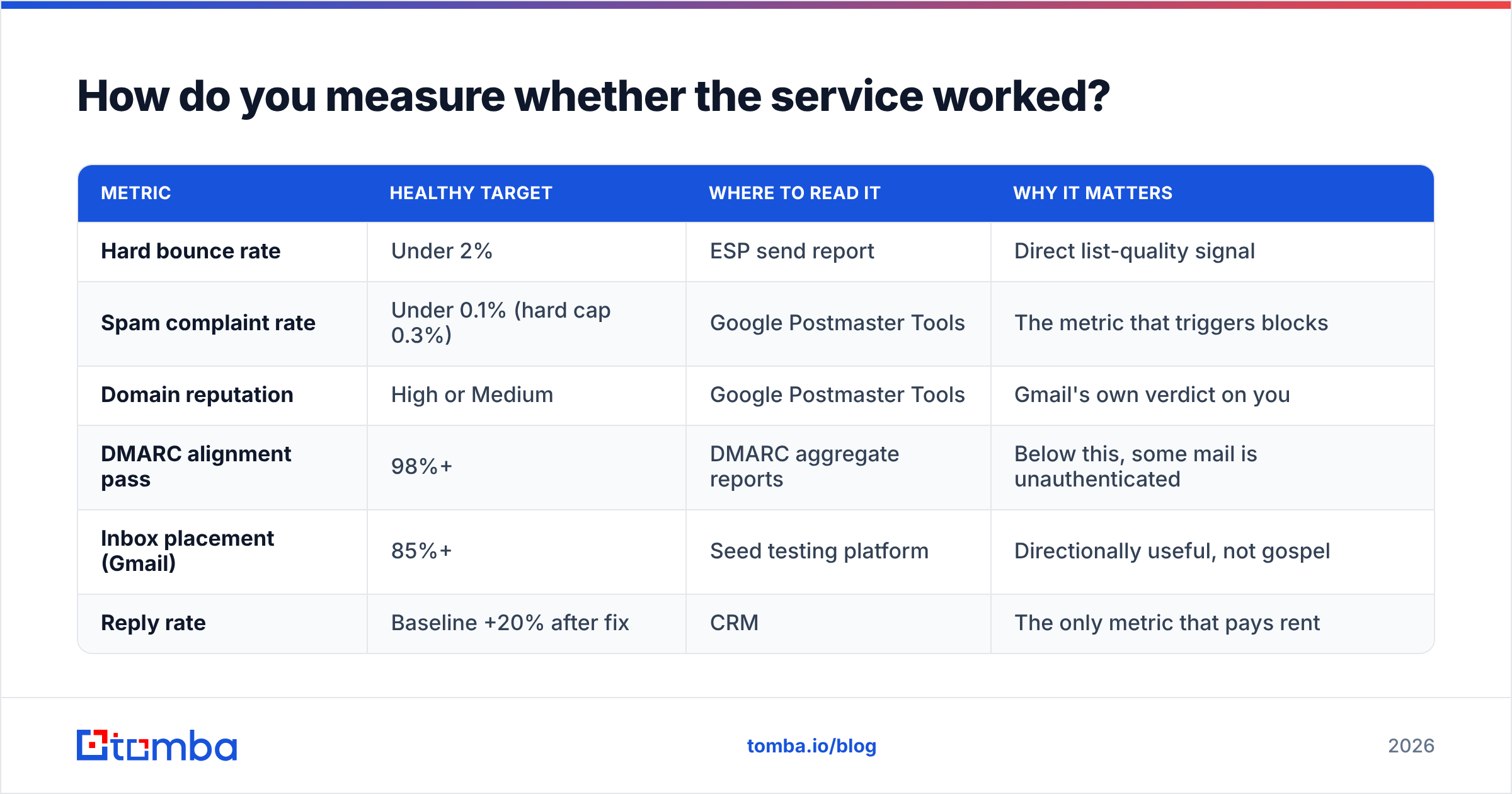
Set the baseline before you sign anything, or you'll be arguing about attribution in 90 days.
| Metric | Healthy target | Where to read it | Why it matters |
|---|---|---|---|
| Hard bounce rate | Under 2% | ESP send report | Direct list-quality signal |
| Spam complaint rate | Under 0.1% (hard cap 0.3%) | Google Postmaster Tools | The metric that triggers blocks |
| Domain reputation | High or Medium | Google Postmaster Tools | Gmail's own verdict on you |
| DMARC alignment pass | 98%+ | DMARC aggregate reports | Below this, some mail is unauthenticated |
| Inbox placement (Gmail) | 85%+ | Seed testing platform | Directionally useful, not gospel |
| Reply rate | Baseline +20% after fix | CRM | The only metric that pays rent |
Two notes on reading that table honestly. Seed-list placement numbers are a proxy — seed accounts have no engagement history, so they systematically under-report placement for engaged lists and over-report for cold ones. And reply rate is the metric to hold a vendor to, because it's the one that can't be gamed by sending less mail to safer segments.
If you're building lists from scratch rather than repairing an old one, sourcing matters as much as cleaning. Buying pre-verified data from a reputable provider — BookYourData is a solid option in that space — starts you from a healthier baseline than scraping. Either way, verify at the point of import and again before any send older than 60 days.
What's the fastest path from spam folder to inbox?#
Compress everything above into a two-week plan:
Days 1–2: Publish SPF, DKIM, DMARC at p=none. Enroll in Postmaster Tools and SNDS. Pull a baseline on all six metrics in the table.
Days 3–4: Run the entire list through verification. Delete invalids and role accounts. Quarantine catch-all domains into a separate low-volume segment. Suppress anyone dormant beyond 12 months.
Days 5–12: Resume sending at 25% of prior volume to your most engaged segment only. Increase 50% every third day. Watch complaint rate daily, not weekly.
Day 14: Re-measure. Domain reputation should have moved at least one band. If it hasn't, and auth is clean and bounces are under 2%, that's your signal to bring in a specialist — and you'll now be paying them to solve a real problem instead of doing your homework.
The uncomfortable truth of this category is that most deliverability spend is a tax on skipped list hygiene. Providers don't punish you for sending marketing mail; they punish you for sending it to people who don't exist and people who don't want it. Both are data problems.
Start with the data layer. Clean, accurate contact records are the cheapest deliverability improvement available, and the only one that compounds. The Tomba Email Finder sources and validates professional addresses at the point of capture, so bad records never reach your ESP in the first place — free tier includes 25 searches a month, Starter is $49/mo, and Growth runs $99/mo with bulk processing. Full Tomba pricing is public, no sales call required. Fix the list, then decide whether you still need a consultant.
Related guides#
Ready to find emails that actually work?
Join 150,000+ professionals who stopped guessing and started sending. Free credits on signup — no credit card required.
Get the Tomba newsletter
Practical outbound tactics and product updates — once every two weeks.
About the author