Email Hippo Pricing Reviews Pros and Cons (2026 Guide)
A neutral breakdown of Email Hippo pricing, real user reviews, and the pros and cons that matter — plus how its per-credit cost stacks up against cheaper verification stacks in 2026.
TL;DR
- Email Hippo sells verification in credit packs and monthly subscriptions, not seats — expect roughly $0.002–$0.01 per verification depending on volume, with the cheapest rate reserved for very large commitments.
- Its strongest asset is MORE (the deep-audit product), which returns far more signal per address than a simple valid/invalid flag. That depth is what you're actually paying for.
- The weakest spots reviewers flag: credits that expire, catch-all domains returned as "unknown", and no email finding at all — it verifies addresses you already have.
- If you need to find addresses and verify them, Email Hippo is only half a stack. A combined finder + verifier (Tomba's Free tier is 25 searches/mo, Starter $49/mo) usually costs less than two separate vendors.
- Verdict: strong for compliance-heavy list hygiene and one-off database cleans. Weak as the backbone of an outbound prospecting motion.
What is Email Hippo, and what does it actually do?#
Email Hippo is a UK-based email verification company. You hand it a list — or hit its API — and it tells you whether each address is deliverable, undeliverable, or somewhere in between. It has been around since 2013, which in this category counts as ancient, and it leans hard on that longevity in its marketing.
Think of it like a building inspector rather than a real-estate agent. It won't find you a house. It will tell you, in detail, whether the one you already found has a cracked foundation.
The product line splits three ways:
- CORE — the standard bulk and API verification service. Syntax, DNS, MX, mailbox-level SMTP checks, disposable-domain detection, role-account flags.
- MORE — the deep-audit tier. Adds domain age, social presence signals, breach exposure, and a broader risk profile per address. This is the part reviewers consistently rate highest.
- ASSESS — a free-to-cheap list-scoring tool that samples a list and estimates how dirty it is before you commit budget to a full clean.
That structure matters for pricing, because the tier you need decides the per-credit rate you pay. People who quote "Email Hippo is expensive" are usually pricing MORE. People who quote "it's cheap" are usually pricing CORE at volume.
Correction — the meme belongs here:

How does Email Hippo pricing actually work in 2026?#
Credits, not seats. One credit equals one verification, and credits are consumed whether the result is valid, invalid, or unknown. That last detail catches people out: a list full of catch-all domains will burn credits and return results you can't act on.
There are two purchase paths:
- Pay-as-you-go credit packs — buy a block, use it, buy another. Higher per-unit cost, no monthly commitment.
- Monthly subscriptions — lower per-unit cost, credits reset (and generally do not roll over indefinitely).
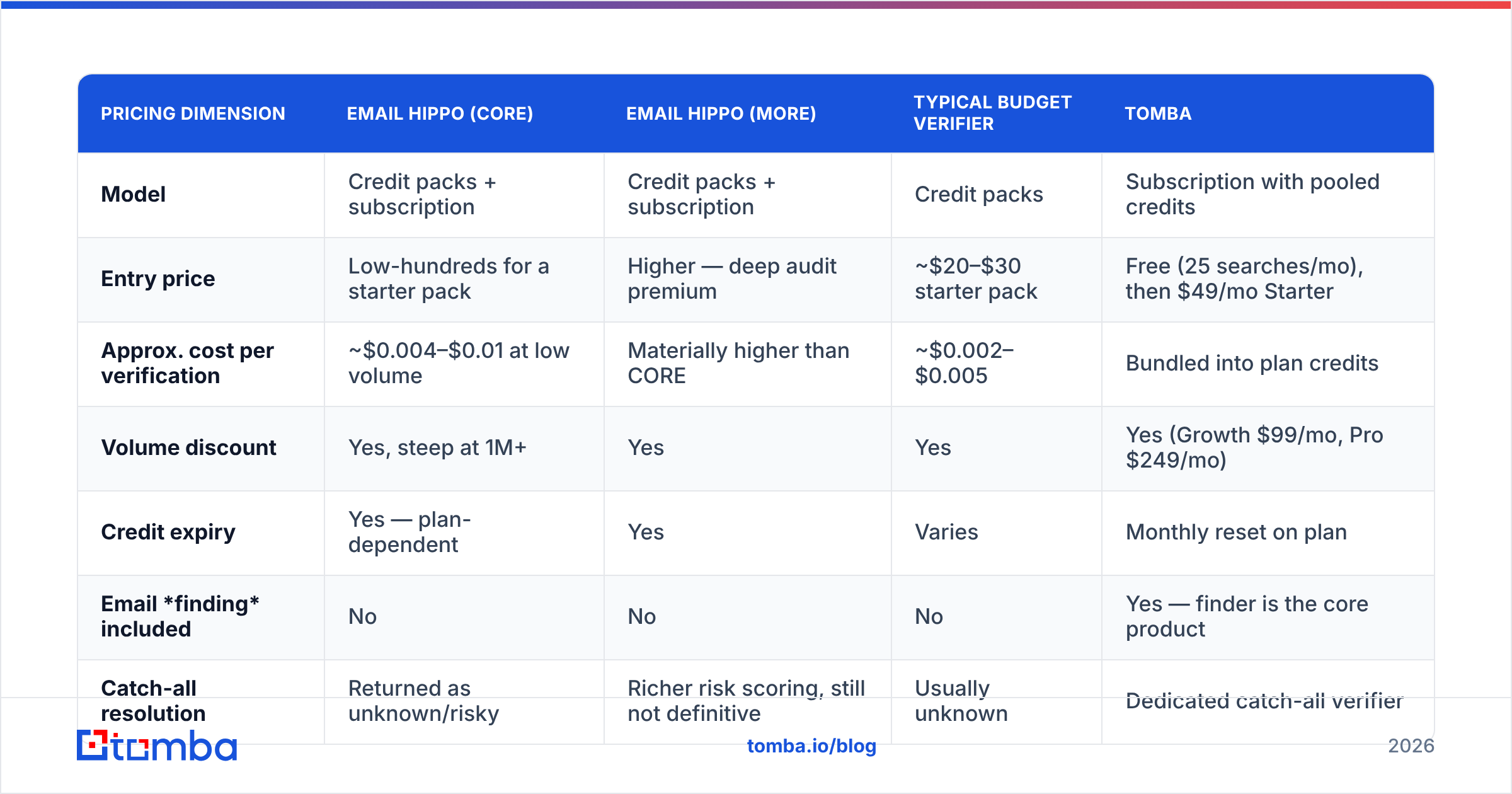
Published rates move around and vary by region and product tier, so treat the table below as the shape of the pricing rather than a quote. Always confirm against the official Email Hippo pricing page before you commit budget.
| Pricing dimension | Email Hippo (CORE) | Email Hippo (MORE) | Typical budget verifier | Tomba |
|---|---|---|---|---|
| Model | Credit packs + subscription | Credit packs + subscription | Credit packs | Subscription with pooled credits |
| Entry price | Low-hundreds for a starter pack | Higher — deep audit premium | ~$20–$30 starter pack | Free (25 searches/mo), then $49/mo Starter |
| Approx. cost per verification | ~$0.004–$0.01 at low volume | Materially higher than CORE | ~$0.002–$0.005 | Bundled into plan credits |
| Volume discount | Yes, steep at 1M+ | Yes | Yes | Yes (Growth $99/mo, Pro $249/mo) |
| Credit expiry | Yes — plan-dependent | Yes | Varies | Monthly reset on plan |
| Email finding included | No | No | No | Yes — finder is the core product |
| Catch-all resolution | Returned as unknown/risky | Richer risk scoring, still not definitive | Usually unknown | Dedicated catch-all verifier |
| Free trial | Yes, limited credits | Limited | Usually | Yes — free tier, no card |
The honest read: Email Hippo's CORE per-credit price is competitive but not category-leading. You are not buying the cheapest verification on the market. You are buying verification with an audit trail, an SLA posture, and GDPR/ISO-aligned processing — which is exactly why it shows up in regulated industries and enterprise procurement lists more than in scrappy outbound teams.
Where the real cost hides#
Four line items that don't appear on the pricing page:
- Unknown results still cost a credit. If 18% of your list sits on catch-all domains, you paid full price for 18% ambiguity.
- Credit expiry. Buy for a one-time database clean, forget to use the remainder, lose it. Multiple G2 reviewers mention this specifically.
- The second vendor. Email Hippo doesn't source addresses. Whatever you spend on it, add the cost of your finder or data provider on top.
- Re-verification cadence. B2B data decays roughly 22–30% a year. A list verified in January is meaningfully stale by August, so budget for two to four cleans annually, not one.
Is Email Hippo accurate enough to trust?#
Mostly yes, with one structural caveat that applies to every vendor in this space.
On standard mailboxes — Google Workspace, Microsoft 365, self-hosted Postfix with an honest SMTP responder — Email Hippo performs well. Reviewers on G2 and Capterra consistently report low bounce rates on cleaned lists, generally in the 1–3% range, which is inside the tolerance most ESPs want.
The caveat is catch-all domains. When a mail server accepts every address at the domain and sorts it out later, no external verifier can prove a specific mailbox exists without sending mail. Email Hippo is candid about this and returns "unknown" rather than guessing — which is intellectually honest and operationally annoying. If a third of your ICP sits behind catch-all servers (common in enterprise and in agencies), you'll get a large unresolved bucket.
MORE partially addresses this by scoring risk instead of asserting validity. Domain age, breach history, and social footprint let you make a judgment call on an unknown address. That's genuinely useful. It's also the expensive tier.
One more accuracy factor people under-weight: verification only measures whether a mailbox exists. It does not measure whether mail from you will land in the inbox. That's email deliverability, and it depends on your sender reputation, authentication records, and content. A perfectly verified list sent from a cold domain with no SPF alignment still lands in spam. Run an SPF checker before you blame the data.
What do real Email Hippo reviews say — pros and cons?#
Aggregating public review sentiment across G2, Capterra, and Trustpilot, the pattern is remarkably consistent.
Pros reviewers repeat:
- Depth of data in MORE — "we get more than valid/invalid" is the single most common piece of praise. For risk and compliance teams, the extra fields justify the premium.
- Support responsiveness — human replies, UK business hours, actual engineers on technical tickets. Rare in a category dominated by chatbots.
- Compliance posture — GDPR-aligned, ISO 27001 certified, EU/UK data residency options. This closes enterprise deals that cheaper vendors can't touch.
- Stable API — clean docs, predictable response schema, minimal breaking changes. Engineers like it.
- ASSESS as a pre-purchase check — being able to score a list before paying to clean it is a genuinely good-faith feature.
Cons reviewers repeat:
- Price at low volume — small teams doing 5–20k verifications a month feel the per-credit rate more than enterprises buying millions.
- Credit expiry — the most-cited frustration by a wide margin.
- Catch-all "unknown" volume — expected, but still cited as the top functional limitation.
- No email finder — the platform verifies; it does not prospect. Teams looking for one tool are always disappointed here.
- UI feels dated — functional, not delightful. Several reviewers describe the dashboard as "enterprise 2018."
- Slower bulk processing on very large files — thorough SMTP checking takes time; multi-million-row jobs are measured in hours, not minutes.
Notice the shape of that list. Nearly every con is a consequence of a deliberate positioning choice — deep, compliant, cautious verification for organizations that value being right over being fast or cheap. Whether that's a flaw depends entirely on which problem you brought.
Who should buy Email Hippo, and who should not?#
Buy it if:
- You're cleaning a large existing CRM or marketing database, not building a new list.
- Compliance, data residency, or audit trails come up in your procurement process.
- You need per-address risk signals beyond deliverable/undeliverable — fraud screening, signup validation, KYC-adjacent workflows.
- You have engineering capacity to integrate the API into a signup or import flow.
Don't buy it (alone) if:
- Your primary job is finding new contacts. It has no discovery layer at all.
- You run high-velocity outbound and re-verify weekly — the per-credit math gets ugly fast.
- You're a solo founder or small team where a $49/mo all-in tool covers finding and verification.
- Most of your ICP sits behind catch-all servers and you need a decision, not an "unknown."
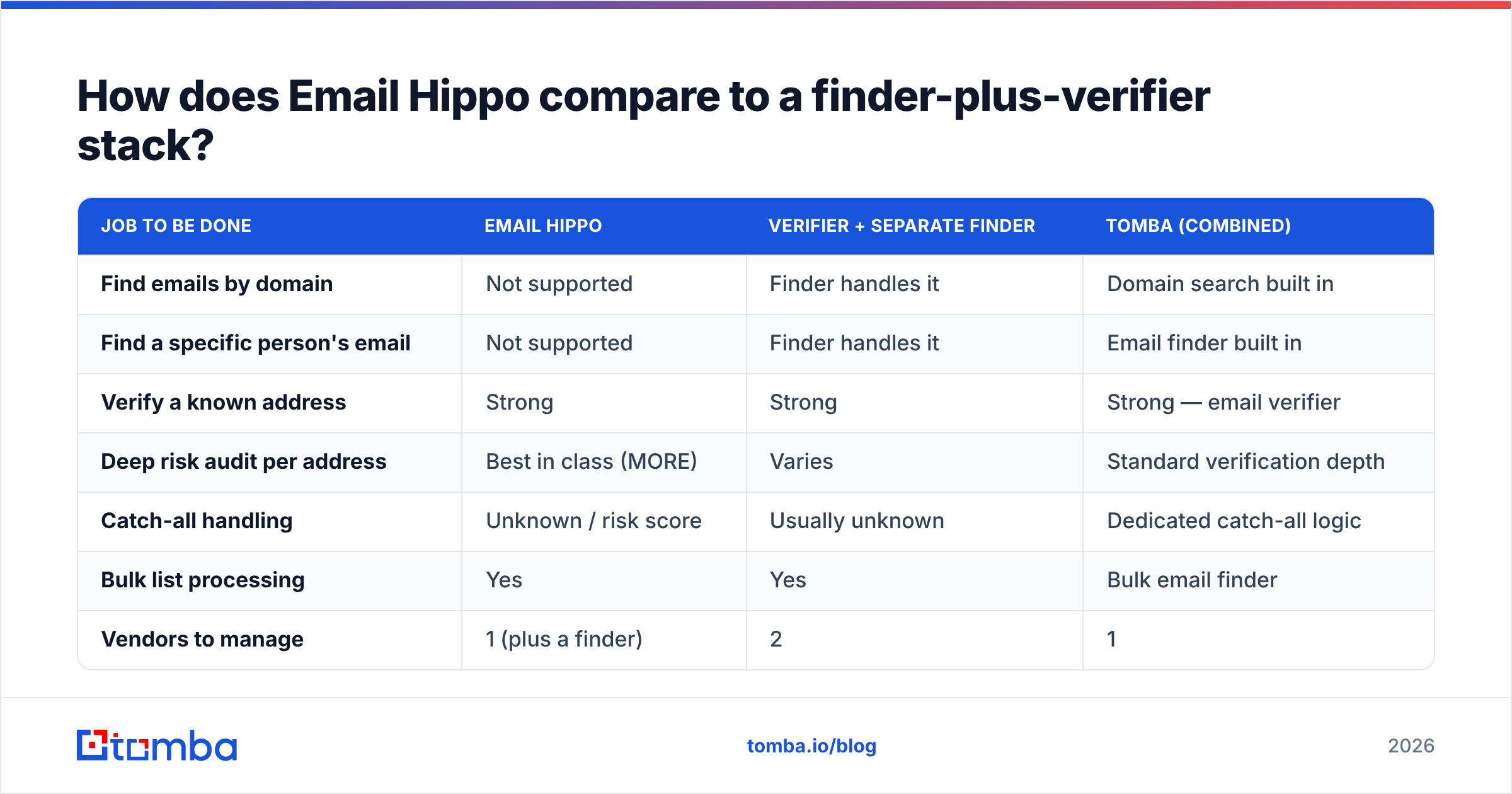
How does Email Hippo compare to a finder-plus-verifier stack?#
This is the comparison most buyers actually need, because "which verifier is best" is the wrong question when you don't have addresses yet.
| Job to be done | Email Hippo | Verifier + separate finder | Tomba (combined) |
|---|---|---|---|
| Find emails by domain | Not supported | Finder handles it | Domain search built in |
| Find a specific person's email | Not supported | Finder handles it | Email finder built in |
| Verify a known address | Strong | Strong | Strong — email verifier |
| Deep risk audit per address | Best in class (MORE) | Varies | Standard verification depth |
| Catch-all handling | Unknown / risk score | Usually unknown | Dedicated catch-all logic |
| Bulk list processing | Yes | Yes | Bulk email finder |
| Vendors to manage | 1 (plus a finder) | 2 | 1 |
| Entry cost | Credit pack | Two subscriptions | Free tier, then $49/mo |
| API for both jobs | Verification only | Two APIs, two keys | Single Tomba API |
The arithmetic is straightforward. If you pay one vendor for discovery and another for verification, you're maintaining two contracts, two credit pools, two rate limits, and two sets of API keys — and you're paying twice for what is fundamentally one workflow: turn a company name into a contactable person.
That's not an argument that Email Hippo is bad. It's an argument that Email Hippo is a component. If your architecture already has a strong data source — a licensed B2B database, a scraping pipeline, an inbound signup funnel — then bolting Email Hippo on as the quality gate is a defensible design, and MORE gives you signal that lighter verifiers simply don't produce.
If you're starting from "I have a list of 400 target companies and no contacts," a verifier alone solves nothing.
What should you check before you sign anything?#
Run this five-point due diligence regardless of which vendor you pick:
- Test on your own data, not their sample. Pull 500 addresses from your real ICP — including the catch-all-heavy segments — and run them through the trial. Vendor demo lists are curated.
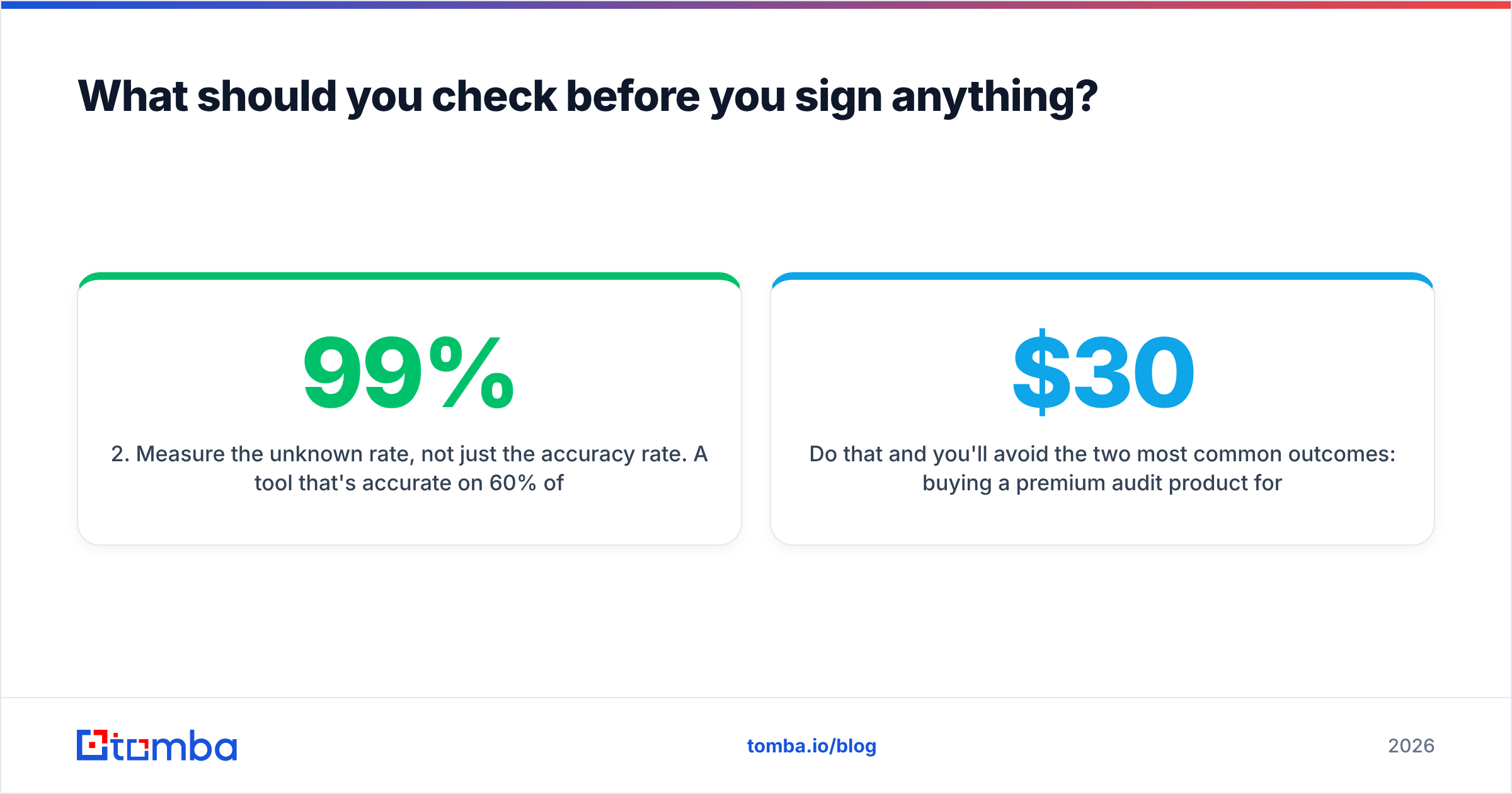
- Measure the unknown rate, not just the accuracy rate. A tool that's 99% accurate on 60% of your list is less useful than one that's 96% accurate on 90% of it.
- Ask about credit expiry in writing. Get the rollover policy in the contract, not the chat transcript.
- Check the re-verification cadence you actually need. Multiply per-credit cost by list size by cleans-per-year. That's your real annual number, and it's usually 2–4x the sticker.
- Confirm the integration path. If your data lives in HubSpot or Salesforce, verify there's a native path — see HubSpot's own data hygiene guidance for how they expect enrichment tools to behave — rather than a CSV round-trip you'll stop doing by week three.
Do that and you'll avoid the two most common outcomes: buying a premium audit product for a job that needed a $30 bulk clean, or buying a cheap bulk clean for a job that needed an audit trail.
What's the final verdict on Email Hippo pricing?#
Email Hippo is fairly priced for what it is and overpriced for what many buyers assume it is.
For a compliance-conscious organization cleaning a large database, running signup fraud checks, or needing defensible data-processing documentation, the CORE-plus-MORE combination earns its rate. The support is real, the API is stable, and the depth of the MORE payload is genuinely differentiated. Reviewers who love it love it for those reasons and rarely churn.
For an outbound team that needs to find people and email them this quarter, it's an incomplete purchase. You'll add a second vendor, manage two credit pools, and pay more in total than a combined platform costs — while still hitting the same catch-all wall everyone hits.
The practical move: if your bottleneck is list quality on data you already own, trial Email Hippo with ASSESS first and price CORE at your real annual re-verification volume. If your bottleneck is not having the contacts at all, fix that first and treat verification as a feature of the same tool rather than a separate line item.
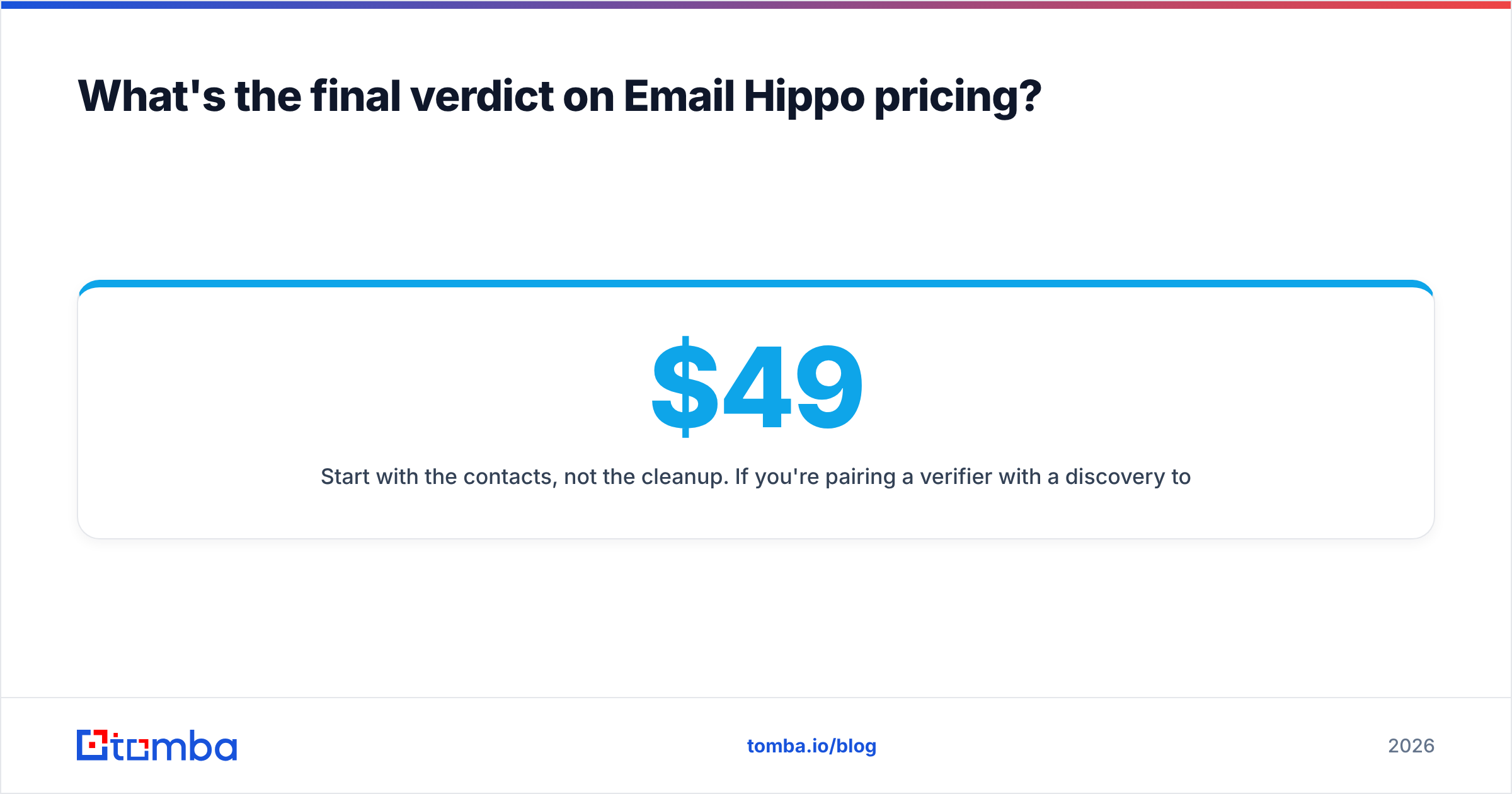
Start with the contacts, not the cleanup. If you're pairing a verifier with a discovery tool anyway, run the Tomba Email Finder against your target account list first — search by domain, name, or company, get verified addresses back in one step, and see the catch-all handling on your own data before you spend a credit. The free tier is 25 searches a month with no card required; Tomba pricing starts at $49/mo for Starter when you're ready to scale, with Growth at $99/mo and Pro at $249/mo. Test it against your hardest 100 accounts and compare the fill rate to whatever you're paying for today.
Related guides#
Ready to find emails that actually work?
Join 150,000+ professionals who stopped guessing and started sending. Free credits on signup — no credit card required.
Get the Tomba newsletter
Practical outbound tactics and product updates — once every two weeks.
About the author