Email Introduction Between Two Parties: Templates That Work
A bad intro email costs you two relationships at once. Here is the double opt-in process, the forwardable blurb format, and copy-paste templates for every side of the introduction.
TL;DR
- An email introduction between two parties only works when both sides have said yes before the introduction email is sent. That is the double opt-in rule, and it is non-negotiable for anything above a casual referral.
- The unit of work is not the intro email. It is the forwardable blurb — a 4-6 line paragraph the connector can copy, paste, and send without editing.
- Move yourself to BCC in the first line of the intro. It signals the handoff is complete and stops a five-message thread from clogging your inbox.
- The person being introduced to has more to lose than the person asking. Write every intro so that side can decline without friction.
- Verify the recipient address before the introducer sends. A bounced introduction embarrasses three people at once, not one.
What is an email introduction between two parties?#
An email introduction between two parties is a message where a mutual contact — the connector — puts two people who don't know each other into a single thread, explains why they should talk, and then steps back.
Think of it like a dinner party host walking a guest across the room. The host doesn't stay for the whole conversation. They say who each person is, why the two of them are worth ten minutes, and then go refill drinks. An intro email that stays in the thread is a host hovering over the table.
The mechanics are simple. What makes it hard is that three people have different stakes:
- The requester wants access. They benefit most and risk least, so they should do the most work — writing the blurb, following up, and closing the loop.
- The recipient is being asked for time by a stranger. They carry the real cost, and they are the reason double opt-in exists.
- The connector is spending social capital that took years to build. One bad intro and they stop taking requests from you permanently.
Most advice on this topic treats it as a copywriting problem. It isn't. It is a consent and sequencing problem with a copywriting layer on top.
Why do most intro emails fail?#
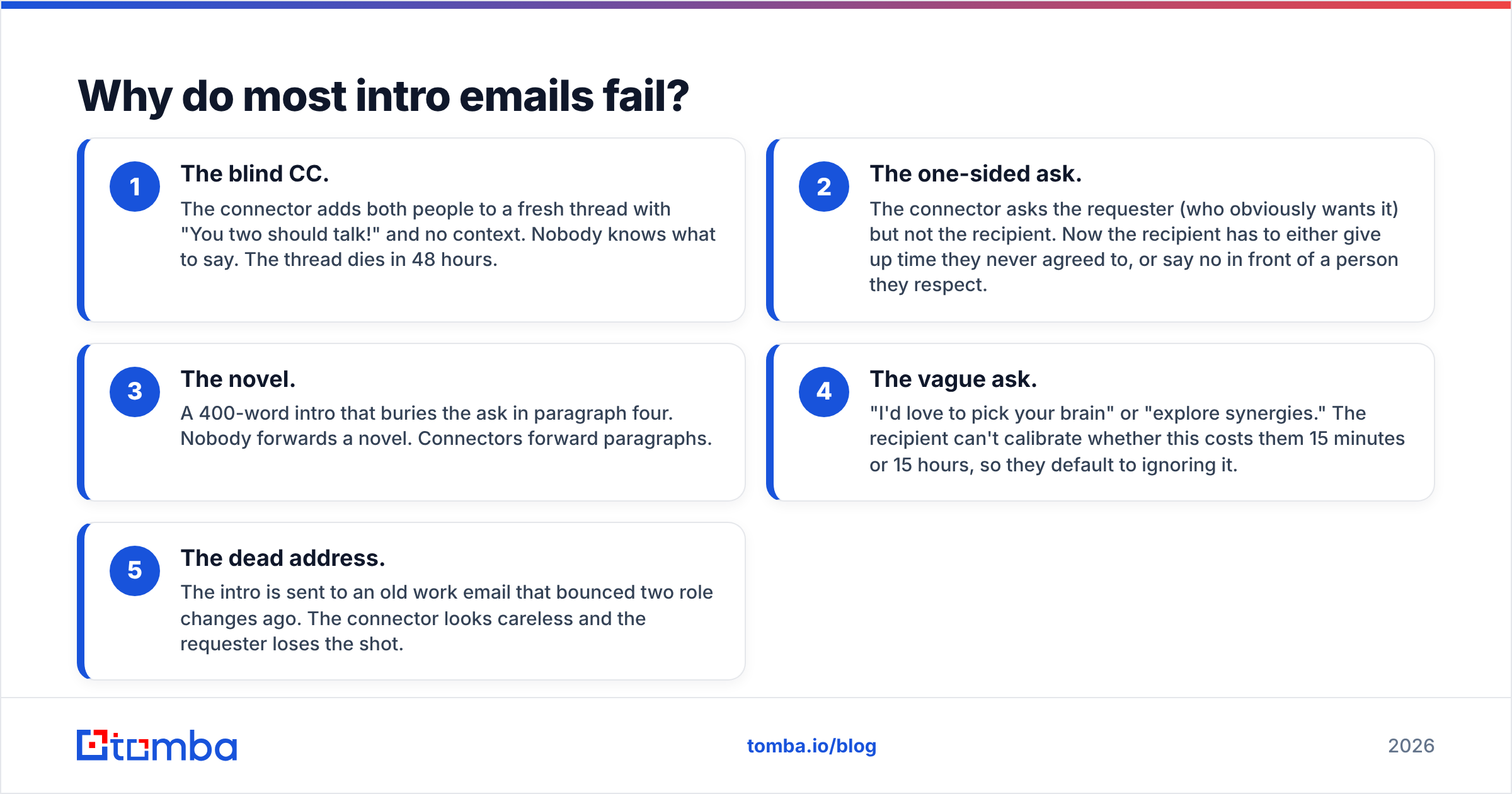
Because the connector sends before asking, or asks only one side. Here are the five failure modes that show up over and over in B2B threads:
- The blind CC. The connector adds both people to a fresh thread with "You two should talk!" and no context. Nobody knows what to say. The thread dies in 48 hours.
- The one-sided ask. The connector asks the requester (who obviously wants it) but not the recipient. Now the recipient has to either give up time they never agreed to, or say no in front of a person they respect.
- The novel. A 400-word intro that buries the ask in paragraph four. Nobody forwards a novel. Connectors forward paragraphs.
- The vague ask. "I'd love to pick your brain" or "explore synergies." The recipient can't calibrate whether this costs them 15 minutes or 15 hours, so they default to ignoring it.
- The dead address. The intro is sent to an old work email that bounced two role changes ago. The connector looks careless and the requester loses the shot.
Failure modes 1 and 2 are process problems. Fix the process and the copywriting problems mostly disappear, because a recipient who already agreed to the intro will forgive an average paragraph.
What is the double opt-in introduction?#
Double opt-in means both parties confirm interest before the intro email goes out. The term is borrowed from opt-in email permission mechanics, and the logic transfers directly: consent before contact.
The sequence looks like this:
- Requester sends the connector a forwardable blurb. Not "can you intro me to Sarah?" — an actual paste-ready paragraph with who they are, what they want, and why it's relevant to Sarah specifically.
- Connector forwards the blurb to the recipient with a one-line endorsement. Something like "This is a good one — worth 20 minutes if it's relevant. No pressure either way."
- Recipient replies yes or no, privately. This is the whole point. A no costs the recipient nothing and never becomes visible to the requester.
- Connector makes the intro only on a yes. Both parties are now warm, and the first reply usually comes within a day.
- Connector moves to BCC in the opening line. The handoff is explicit and the thread belongs to the two parties.
- Requester closes the loop. A short note back to the connector a week later: what happened, and thank you. This is what earns the next intro.
Skipping step 3 is what separates a professional intro from a favor that quietly damages the connector's reputation.
Is double opt-in always better than a direct intro?#
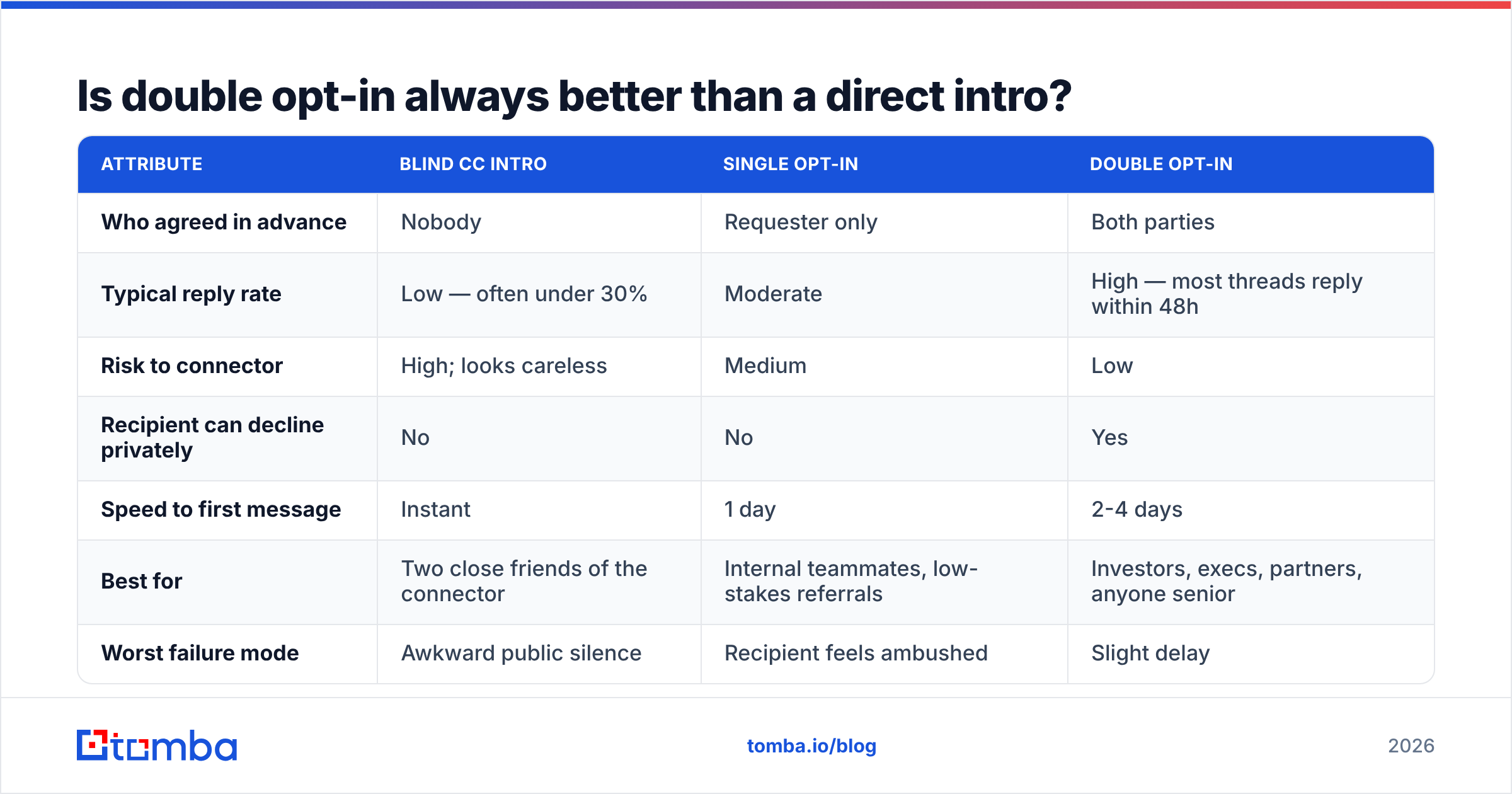
Not always. Here is the honest comparison across the three common formats:
| Attribute | Blind CC intro | Single opt-in | Double opt-in |
|---|---|---|---|
| Who agreed in advance | Nobody | Requester only | Both parties |
| Typical reply rate | Low — often under 30% | Moderate | High — most threads reply within 48h |
| Risk to connector | High; looks careless | Medium | Low |
| Recipient can decline privately | No | No | Yes |
| Speed to first message | Instant | 1 day | 2-4 days |
| Best for | Two close friends of the connector | Internal teammates, low-stakes referrals | Investors, execs, partners, anyone senior |
| Worst failure mode | Awkward public silence | Recipient feels ambushed | Slight delay |
The trade is speed for safety. If both people already know the connector well and the ask is trivial ("meet my new designer"), a direct intro is fine. The moment the recipient is senior, busy, or being asked for something with commercial value, double opt-in is the only defensible option.
Sales research from HubSpot's sales blog has consistently found referrals convert at multiples of cold outreach — but that advantage evaporates when the referral is unsolicited on the receiving end. A referral the recipient never agreed to is just a cold email with a friend's name attached.
How do you write the forwardable blurb?#
The blurb is the highest-leverage 100 words in this whole process. Format it so the connector can select-all, paste, and hit send.
Rules for the blurb:
- Lead with the relevance, not your title. "Sarah's team just moved to a hybrid billing model — that's the exact migration I ran at X" beats "I'm the VP of Ops at X."
- Name the ask and its size. "20 minutes, one question about vendor selection" is answerable. "Explore ways we could work together" is not.
- Give one credibility anchor, not five. A single specific result outperforms a resume.
- Write in third person if the connector will forward it verbatim. Many connectors paste blurbs directly into a forward.
- Keep it under 120 words. If it doesn't fit on a phone screen, it doesn't get forwarded.
Template — the blurb you send to the connector:
Subject: Blurb for the Sarah intro (feel free to forward)
Hi Marcus — happy to make this easy. Paste-ready below, and genuinely no problem if she passes.
Dana runs revenue ops at Northbeam, where she rebuilt the quote-to-cash flow after their move to usage-based pricing — the same shift Sarah's team started last quarter. She's not selling anything; she's mapping how other teams handled the billing migration and would value 20 minutes of Sarah's take. Happy to send questions in advance.#
Thanks either way, Marcus.
Note what is doing the work: the specific overlap, the explicit non-sales disclaimer, the bounded time, and the pre-emptive out.
What does the actual introduction email look like?#
Once the recipient says yes, the connector writes something short. Three or four sentences total.
Template — the connector's intro email:
Subject: Dana Ruiz <> Sarah Whitfield (intro)
Sarah, meet Dana Ruiz — she rebuilt Northbeam's quote-to-cash process through a usage-based pricing migration, which is the thing you mentioned last month.
Dana, Sarah leads finance systems at Corvel and has done this at a larger scale than most people I know.
Moving myself to BCC — I'll let you two take it from here.
Marcus
Template — the requester's first reply (send within 24 hours):
Thanks Marcus (moving you to BCC).
Sarah — great to meet you. Short version: we finished our usage-based migration in March and the billing reconciliation piece was harder than everything else combined. I'd love 20 minutes on how your team handled proration and mid-cycle plan changes.
Three questions, sent in advance so you can decide if it's worth the call:
- Did you rebuild in-house or buy?
- How did you handle historical contracts mid-migration?
- What would you do differently?
Here are two times that work — or send anything that suits you: Tuesday 10-12 ET, Thursday afternoon ET.
Dana
Reply within one business day, always. The recipient's willingness decays fast, and a three-day gap tells them this wasn't urgent for you either.
How do you ask for an introduction without being awkward?#
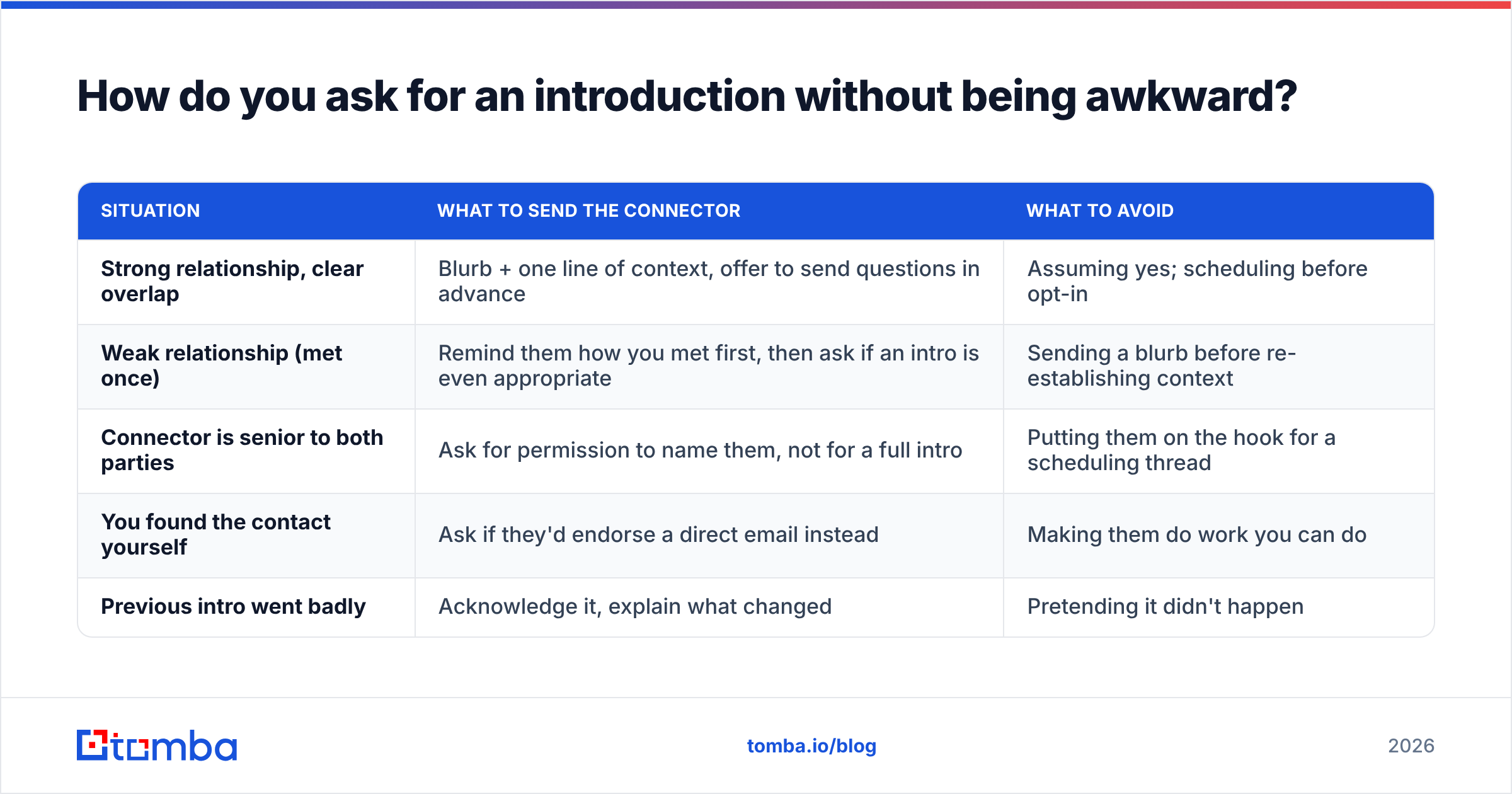
The request email to your connector should make saying no completely painless. Give them a written out, and mean it.
| Situation | What to send the connector | What to avoid |
|---|---|---|
| Strong relationship, clear overlap | Blurb + one line of context, offer to send questions in advance | Assuming yes; scheduling before opt-in |
| Weak relationship (met once) | Remind them how you met first, then ask if an intro is even appropriate | Sending a blurb before re-establishing context |
| Connector is senior to both parties | Ask for permission to name them, not for a full intro | Putting them on the hook for a scheduling thread |
| You found the contact yourself | Ask if they'd endorse a direct email instead | Making them do work you can do |
| Previous intro went badly | Acknowledge it, explain what changed | Pretending it didn't happen |
That fourth row matters more than it looks. Sometimes the fastest path is a direct, well-researched email where you mention the shared connection with permission — no forwarding, no waiting. If you can locate the right person and address yourself with an email finder or a domain search, you can ask your connector for a one-line endorsement instead of a full introduction. That is a much smaller favor, and connectors say yes to it far more often.
How do you make sure the intro email actually lands?#
An introduction is a single-shot message with three reputations attached to it. Technical failure is the most avoidable way to lose it.
Before the connector sends, confirm the address is live. Role changes, acquisitions, and domain migrations mean a contact you saved 18 months ago has a meaningful chance of bouncing today. Run it through an email verifier first — it takes seconds and removes the worst outcome in the whole process, which is your connector's message hard-bouncing in front of them.
Three more practical checks:
- Use a plain subject line.
Dana Ruiz <> Sarah Whitfield (intro)renders cleanly everywhere and is searchable later. Avoid emoji, avoid "Quick question." - Keep it plain text. Tracking pixels, link shorteners, and heavy HTML in a one-off personal email is the fastest way into a spam folder. Intros are personal correspondence; format them that way.
- Check your signature. A bloated signature with six social icons makes a three-sentence intro look like marketing. A clean email signature with name, role, company, and one link is enough.
For a full breakdown of what pushes one-to-one mail into the promotions tab, the fundamentals of email deliverability apply here exactly as they do to sequences — with the added stake that you only get one attempt.
What should you track after the introduction?#
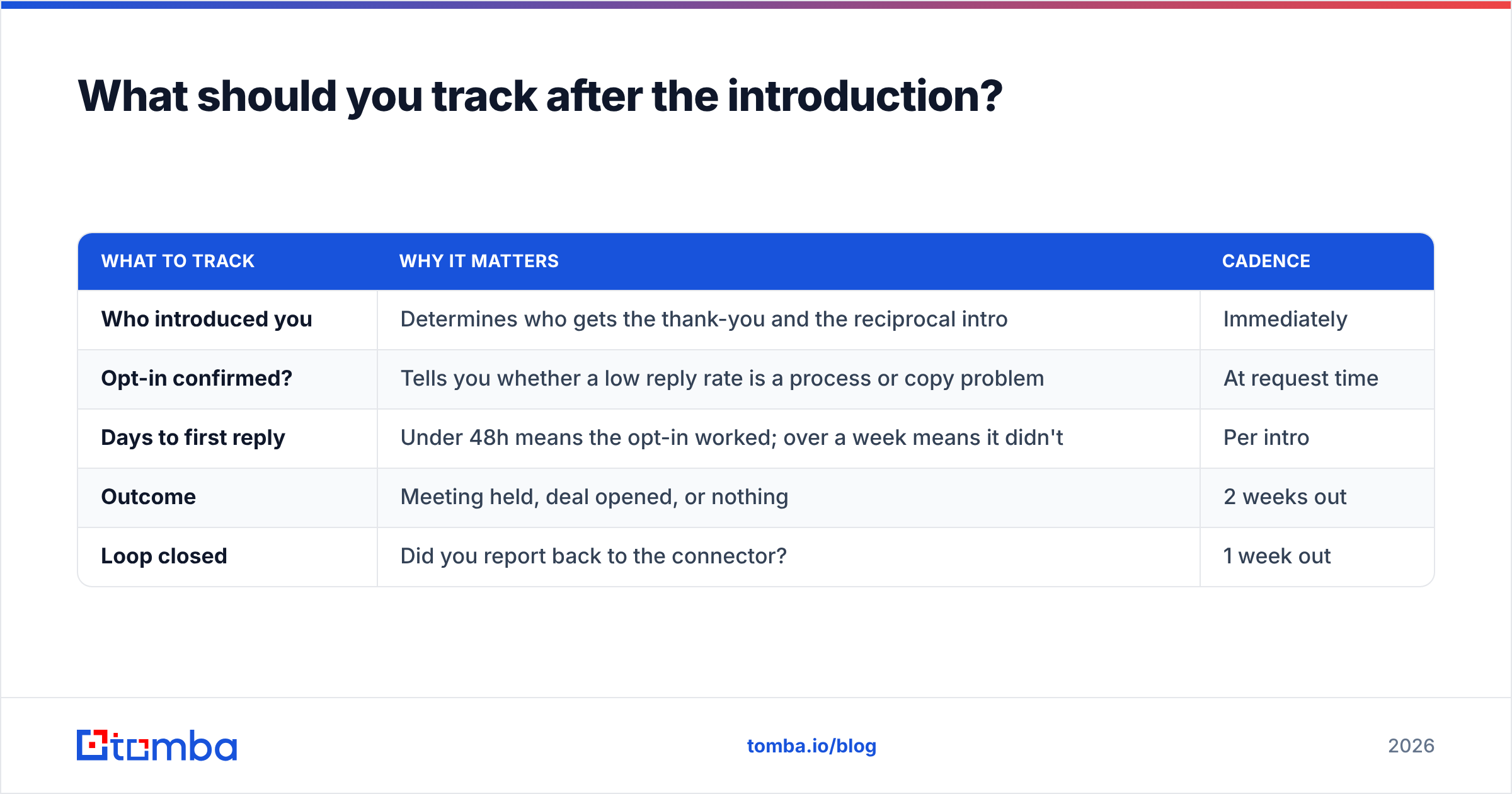
Introductions are a compounding asset, and the only way they compound is if you close the loop. Keep a simple record:
| What to track | Why it matters | Cadence |
|---|---|---|
| Who introduced you | Determines who gets the thank-you and the reciprocal intro | Immediately |
| Opt-in confirmed? | Tells you whether a low reply rate is a process or copy problem | At request time |
| Days to first reply | Under 48h means the opt-in worked; over a week means it didn't | Per intro |
| Outcome | Meeting held, deal opened, or nothing | 2 weeks out |
| Loop closed | Did you report back to the connector? | 1 week out |
Connectors keep score whether they admit it or not. The single strongest predictor of whether someone will make a second introduction for you is whether you told them how the first one went. Track your response rate on introduced threads separately from cold outreach — the numbers should be dramatically different, and if they aren't, your opt-in step is broken.
Analyst coverage of B2B buying behavior from firms like Gartner keeps landing on the same point: buyers trust peer and network signals over vendor messaging. An introduction is the cheapest way to borrow that trust. It is also the easiest to squander.
The short version#
Ask both sides first. Write a blurb someone can forward without editing. Name the ask and bound the time. Move to BCC. Reply within a day. Report back within a week. That is the whole discipline, and it beats any clever subject line.
If the bottleneck is that you don't know who to ask for or how to reach them once the connector says yes, start there. Tomba Email Finder locates verified professional addresses by name, company, or domain, so the person your connector introduces you to actually receives the message — and so you can identify the right contact before you spend anyone's social capital asking for the intro. The free tier covers 25 searches a month, and paid plans start at $49/mo on Tomba pricing when you need volume.
Related guides#
Ready to find emails that actually work?
Join 150,000+ professionals who stopped guessing and started sending. Free credits on signup — no credit card required.
Get the Tomba newsletter
Practical outbound tactics and product updates — once every two weeks.
About the author