Email Lead Nurturing: Sequences, Timing, and Tools (2026)
Most nurture sequences are just delayed newsletters. Here's how email lead nurturing actually works in 2026 — stage-by-stage sequences, segmentation you can run without a 40-field form, and the metrics that prove it moves pipeline.
TL;DR
- Email lead nurturing is a stage-aware sequence that moves a known contact from "aware" to "ready to talk" — it is not a newsletter on a timer.
- The single biggest failure mode is sending the same content to everyone. Two or three behavioural segments beat a 40-field form every time.
- Cadence that works in 2026: dense early (day 0, 2, 5), then decaying (day 12, 25, 45). Stop when engagement flatlines — don't grind a dead list.
- Nurture data decays at roughly 25-30% per year. If you aren't re-verifying addresses quarterly, your "low open rate" is a data problem, not a copy problem.
- Measure stage progression and reply quality, not open rate. Apple Mail Privacy Protection made opens a vanity metric years ago.
What is email lead nurturing, exactly?#
Email lead nurturing is the practice of sending a planned, staged series of emails to a lead who has already identified themselves — a demo no-show, a whitepaper download, a webinar registrant, a trial that stalled — with the goal of moving them one buying stage forward per touch.
The analogy that works: nurturing is physiotherapy, not surgery. Cold outbound is the surgical strike — you interrupt a stranger and hope the timing is right. Nurturing is the slow, repetitive rehab work on someone who already limped into your clinic. Different patient, different protocol.
Technically, that means three things have to be true before a sequence counts as nurturing:
- The contact is known. You have a name, a company, and at least one behavioural signal (what they downloaded, viewed, or attended).
- The content maps to a stage. Awareness-stage leads get framing and education. Consideration-stage leads get comparisons and proof. Decision-stage leads get pricing, security docs, and a calendar link.
- The sequence branches. If clicking the pricing link doesn't change what the next email says, you have a broadcast, not a nurture.
Miss any of those and you're running a scheduled newsletter with extra steps. HubSpot's research on lead nurturing has been consistent on this for years: staged, segmented sends outperform undifferentiated sends by a wide margin, and the gap widens as list size grows.
Why do most nurture sequences fail?#
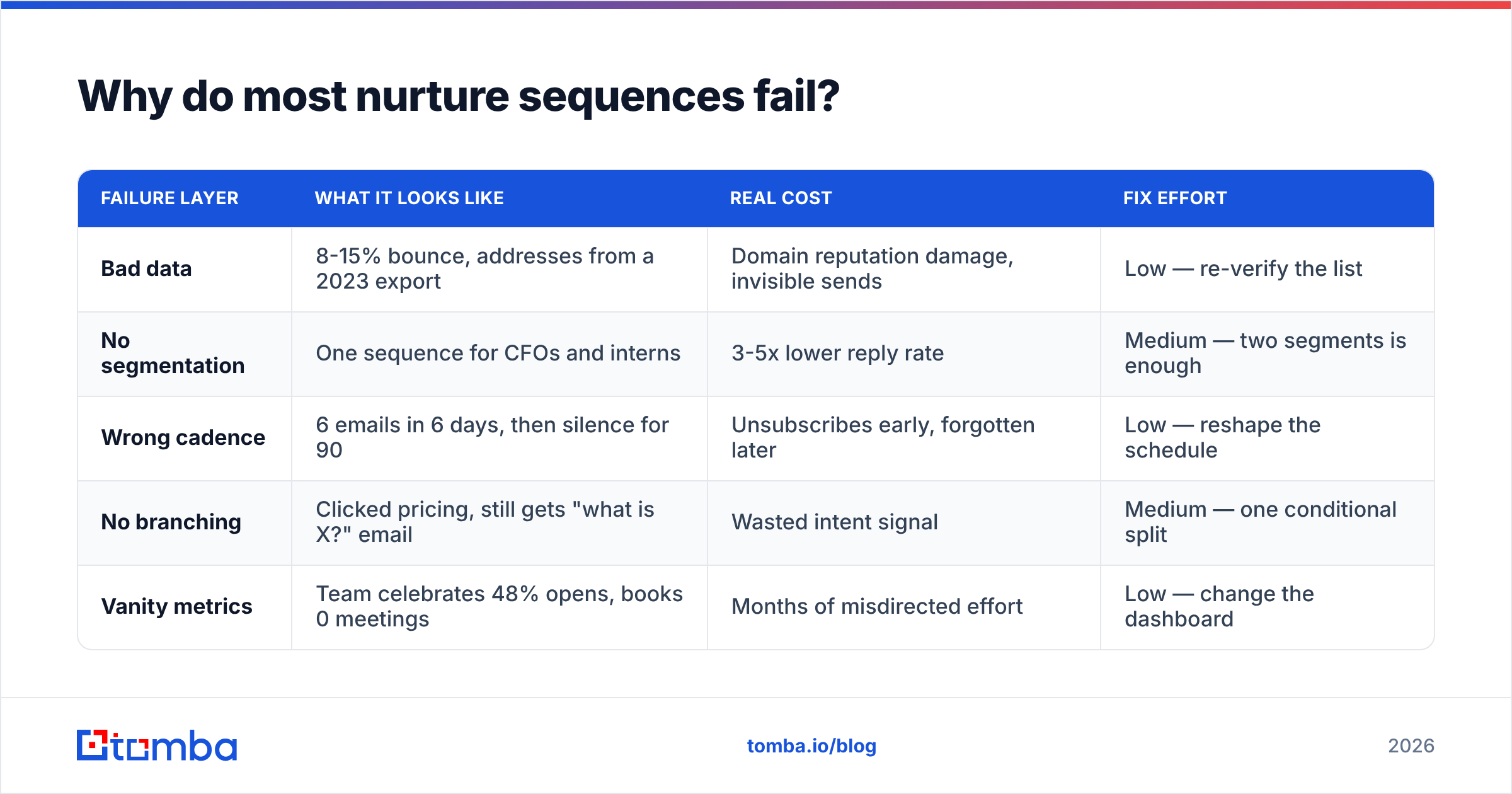
Because they optimise the wrong layer. Teams rewrite subject lines for three weeks while the actual leak is upstream. Here's the failure stack, in the order it usually bites:
| Failure layer | What it looks like | Real cost | Fix effort |
|---|---|---|---|
| Bad data | 8-15% bounce, addresses from a 2023 export | Domain reputation damage, invisible sends | Low — re-verify the list |
| No segmentation | One sequence for CFOs and interns | 3-5x lower reply rate | Medium — two segments is enough |
| Wrong cadence | 6 emails in 6 days, then silence for 90 | Unsubscribes early, forgotten later | Low — reshape the schedule |
| No branching | Clicked pricing, still gets "what is X?" email | Wasted intent signal | Medium — one conditional split |
| Vanity metrics | Team celebrates 48% opens, books 0 meetings | Months of misdirected effort | Low — change the dashboard |
Notice that the two cheapest fixes sit at the top and bottom. Most teams start in the middle, building elaborate branching logic on top of a list where a tenth of the addresses no longer exist.
Start with the data layer. Run your nurture list through an email verifier before you touch the copy. A list that bounces at 9% will get throttled by Google and Microsoft regardless of how good the writing is, and you'll spend a quarter blaming the words.
What does a real nurture sequence look like, stage by stage?#
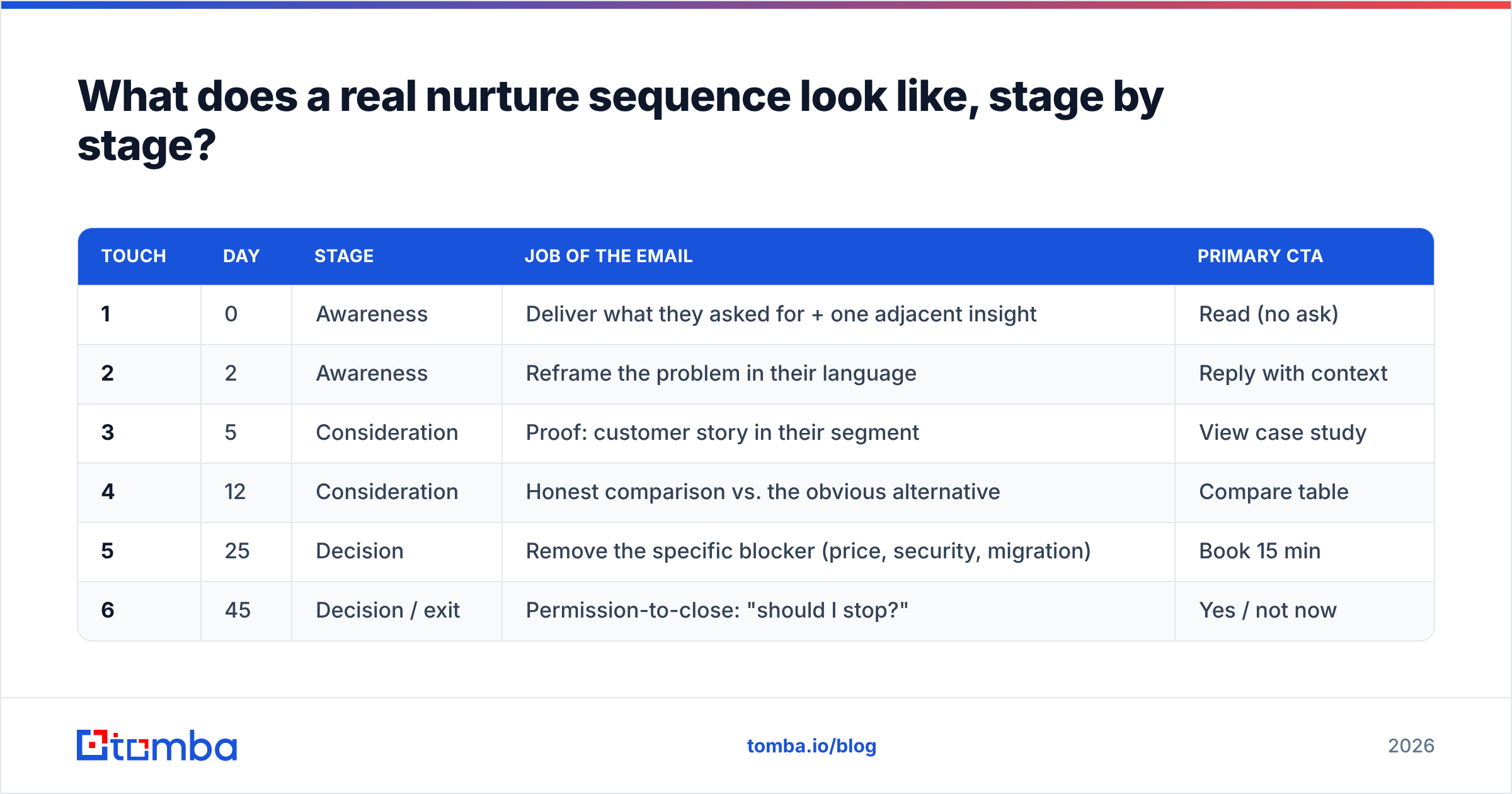
Here is a six-touch structure that works for mid-market B2B with a 30-90 day cycle. Adjust the intervals to your sales cycle — the shape matters more than the exact days.
| Touch | Day | Stage | Job of the email | Primary CTA |
|---|---|---|---|---|
| 1 | 0 | Awareness | Deliver what they asked for + one adjacent insight | Read (no ask) |
| 2 | 2 | Awareness | Reframe the problem in their language | Reply with context |
| 3 | 5 | Consideration | Proof: customer story in their segment | View case study |
| 4 | 12 | Consideration | Honest comparison vs. the obvious alternative | Compare table |
| 5 | 25 | Decision | Remove the specific blocker (price, security, migration) | Book 15 min |
| 6 | 45 | Decision / exit | Permission-to-close: "should I stop?" | Yes / not now |
Three things to notice about this shape.
The front is dense, the back is sparse. Attention decays fast. Touch 1 through 3 land inside a week while the download is still a memory. After that, intervals roughly double.
Only two emails ask for a meeting. Touches 1-4 ask for attention, not calendar time. Teams that ask for a meeting in every email train the recipient to ignore the ask.
Touch 6 is an exit ramp, not a guilt trip. The "should I stop emailing you?" pattern gets a disproportionate reply rate because it's the only email in the sequence where replying costs the recipient nothing. It also cleans your list for free.
How do you segment without a 40-field form?#
You don't need a monstrous form. You need two or three axes you can actually populate. The trick is deriving segmentation from data you already have or can enrich programmatically, rather than asking the lead to type it.
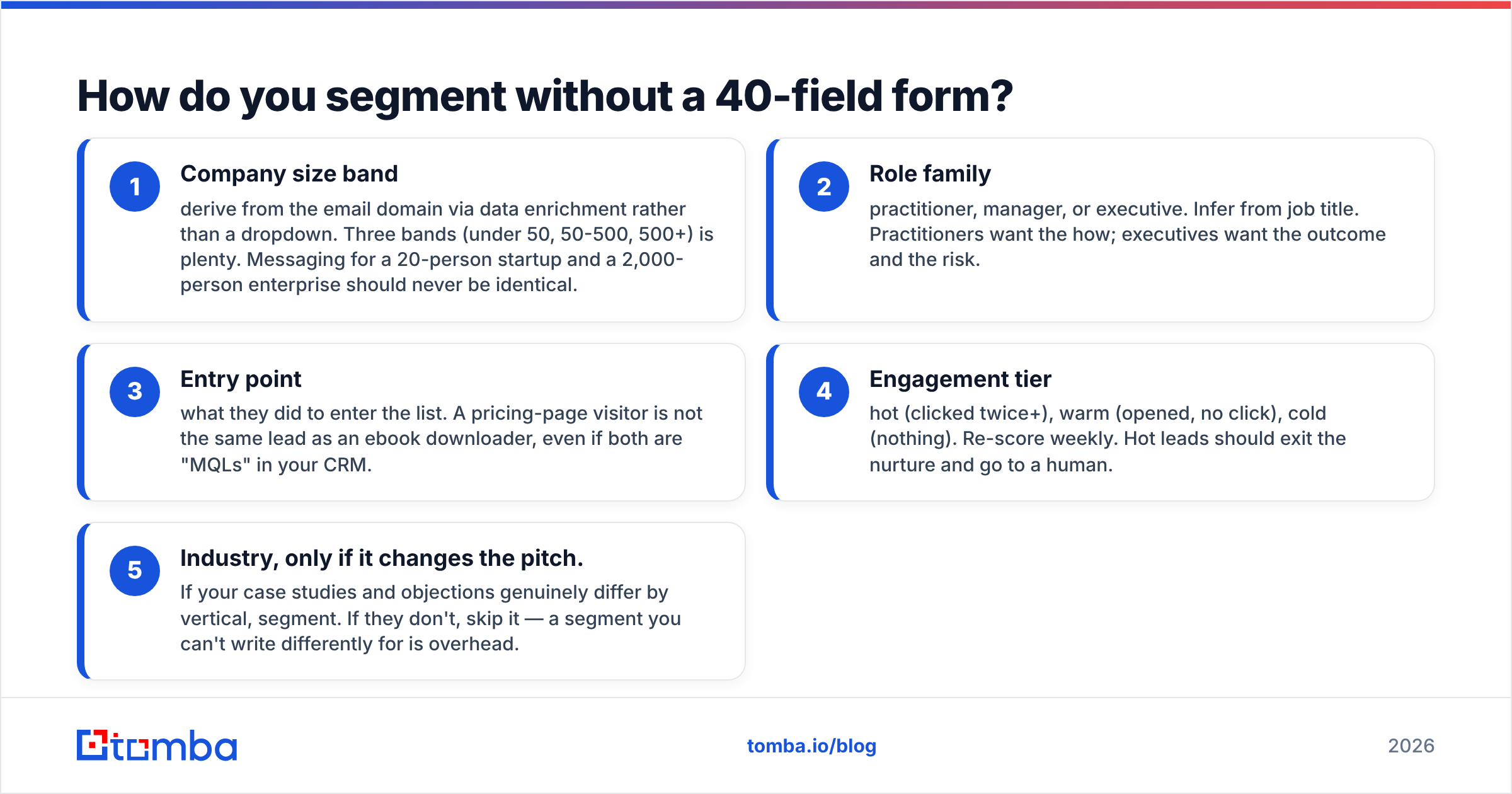
- Company size band — derive from the email domain via data enrichment rather than a dropdown. Three bands (under 50, 50-500, 500+) is plenty. Messaging for a 20-person startup and a 2,000-person enterprise should never be identical.
- Role family — practitioner, manager, or executive. Infer from job title. Practitioners want the how; executives want the outcome and the risk.
- Entry point — what they did to enter the list. A pricing-page visitor is not the same lead as an ebook downloader, even if both are "MQLs" in your CRM.
- Engagement tier — hot (clicked twice+), warm (opened, no click), cold (nothing). Re-score weekly. Hot leads should exit the nurture and go to a human.
- Industry, only if it changes the pitch. If your case studies and objections genuinely differ by vertical, segment. If they don't, skip it — a segment you can't write differently for is overhead.
Four of those five require zero extra form fields. The domain gives you company, size, and often industry; the title gives you role family; your marketing automation platform already has engagement. That's the whole point — segmentation is an enrichment problem far more than it is a form-design problem.
If your CRM records are thin, a domain search across your inbound accounts will usually surface the additional stakeholders you're missing. Most B2B deals involve six to ten people, and Gartner's B2B buying research has documented this buying-group expansion for years. Nurturing one contact at a ten-person account is nurturing 10% of the decision.
Which tools should run your nurture program?#
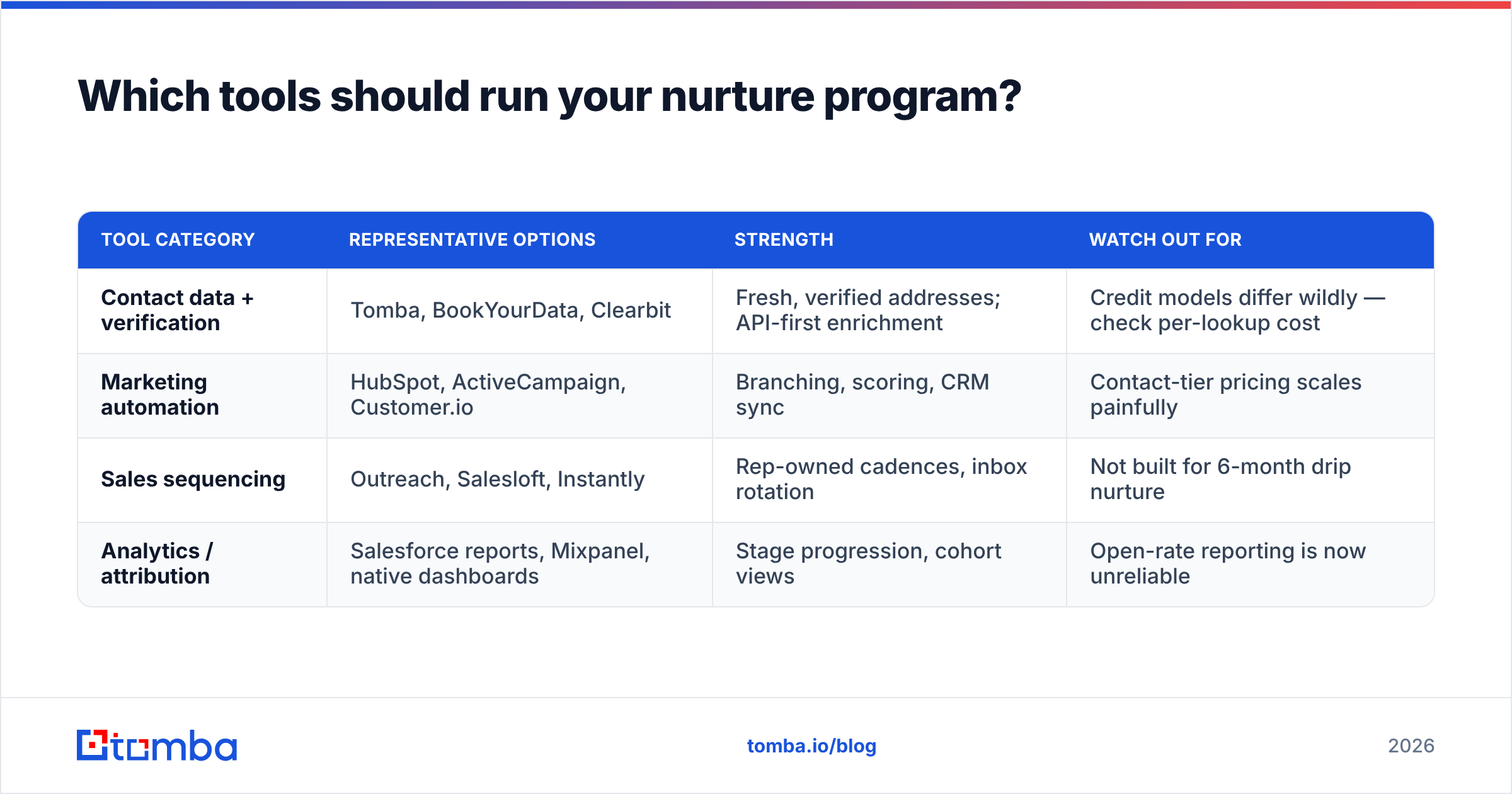
The stack splits into three jobs: source and verify contacts, orchestrate the sequence, and measure progression. Very few tools do all three well, and the ones that claim to usually do one properly.
| Tool category | Representative options | Strength | Watch out for |
|---|---|---|---|
| Contact data + verification | Tomba, BookYourData, Clearbit | Fresh, verified addresses; API-first enrichment | Credit models differ wildly — check per-lookup cost |
| Marketing automation | HubSpot, ActiveCampaign, Customer.io | Branching, scoring, CRM sync | Contact-tier pricing scales painfully |
| Sales sequencing | Outreach, Salesloft, Instantly | Rep-owned cadences, inbox rotation | Not built for 6-month drip nurture |
| Analytics / attribution | Salesforce reports, Mixpanel, native dashboards | Stage progression, cohort views | Open-rate reporting is now unreliable |
On pricing, the data layer is usually the cheapest line item and the one that determines whether everything above it works. For reference, Tomba pricing runs a free tier at 25 searches/month, Starter at $49/mo, Growth at $99/mo, and Pro at $249/mo, with API access on paid plans. Marketing automation platforms typically cost several multiples of that once your contact count passes a few thousand — which is exactly why you should not be paying to store dead contacts.
BookYourData is a solid option if you want pre-built, verified list purchases rather than on-demand lookup; it fits teams that buy in bulk against a defined ICP. Tomba fits better when you want to find and verify contacts programmatically as accounts enter your funnel, via the Tomba API or a spreadsheet workflow. Both are legitimate approaches — the question is whether your motion is "buy a list quarterly" or "enrich continuously."
Check current user reviews on G2 before committing to any of these; the category churns fast and vendor feature pages lag reality by a couple of quarters.
How do you keep nurture email out of the spam folder?#
Nurture email has an advantage over cold outbound — the recipient opted in — and a disadvantage: it runs for months, so small reputation problems compound.
Authenticate properly. SPF, DKIM, and DMARC are table stakes since the 2024 Google and Yahoo bulk-sender rules. If you're sending from a subdomain, make sure it's aligned. A quick SPF check takes thirty seconds and catches a surprising number of misconfigurations after a domain migration.
Keep bounce rate under 2%. This is the hard number. Above it, mailbox providers start throttling. Since nurture lists sit idle between touches, re-verify before every major campaign — B2B email data decays as people change jobs, and a list that was clean in January will not be clean in July.
Suppress the non-engaged. After touch 6, if a contact has zero opens, zero clicks, and zero replies, stop. Continuing to mail unengaged contacts is the fastest way to train Gmail that your domain is low-value. Move them to a quarterly "still relevant?" list instead.
Watch the reply rate, not just delivery. Replies are the strongest positive engagement signal a mailbox provider can see. Sequences engineered to earn replies — short emails, one question, no attachments — get better inbox placement than sequences engineered to earn clicks. If you want a benchmark to sanity-check against, our glossary entry on response rate covers what's realistic by segment.
What metrics actually prove nurturing is working?#
Open rate is dead as a primary metric. Apple's Mail Privacy Protection pre-fetches images for a large share of consumer and mixed-use inboxes, which inflates opens without any human involvement. Track it as a directional signal only.
Use these instead:
- Stage progression rate — percentage of nurtured leads that advance one funnel stage within the sequence window. This is the metric the program exists to move.
- Reply rate, split by sentiment — positive, "not now," and negative. A rising "not now" share is good news; it means you're reaching real humans at the wrong time, which is a timing fix, not a targeting fix.
- Sequence-attributed meetings — meetings booked within 14 days of a nurture touch. Imperfect attribution, but consistent.
- Time-to-first-reply — if it's shrinking, your early touches are landing better.
- List health — bounce rate, unsubscribe rate, and spam complaints per thousand sends. Complaints above 0.3% is an emergency, not a trend.
Salesforce's State of Sales research consistently finds that reps spend a minority of their week actually selling. A good nurture program's real return isn't the leads it converts — it's the leads it disqualifies before a human ever spends time on them.
How long should a nurture sequence run?#
Match it to your sales cycle, then add 50%. A 60-day average cycle deserves a 90-day nurture window. Beyond that, you're not nurturing — you're running a newsletter, and you should move the contact to a genuine newsletter with a genuine unsubscribe.
Two practical rules:
Exit on intent. Any contact that hits the pricing page twice, replies, or books a call should immediately exit the automated sequence. Nothing looks worse than an automated "just checking if you saw this" landing an hour after a rep's real conversation.
Re-enter on decay. Closed-lost and gone-quiet leads can re-enter a lighter, quarterly sequence six months later. Job changes are the highest-value re-entry trigger in B2B — the same person at a new company is a warm lead with a fresh budget.
Where should you start this week?#
Pick the cheapest fix with the biggest lever: clean the list, then cut one sequence into two segments. That's it. Don't build the branching logic, don't rewrite the copy, don't buy new software until those two are done. Most teams find their "nurture problem" was 40% dead addresses and one undifferentiated sequence trying to speak to four different buyers at once.
Once the list is clean and segmented, the copy work you do actually compounds — because it's landing in real inboxes belonging to people you understand.
If your bottleneck is contact data rather than copy, start there. The Tomba Email Finder locates verified professional addresses by domain, name, or company, so the accounts entering your nurture program arrive with complete, deliverable contact records instead of gaps you paper over with guesses. The free tier covers 25 searches a month if you want to test the accuracy on your own account list before committing to a plan.
Related guides#
Ready to find emails that actually work?
Join 150,000+ professionals who stopped guessing and started sending. Free credits on signup — no credit card required.
Get the Tomba newsletter
Practical outbound tactics and product updates — once every two weeks.
About the author